La Hoihoi Ea, 1912.

DAY NOT TO BE FORGOTTEN BY TRUE HAWAIIANS.

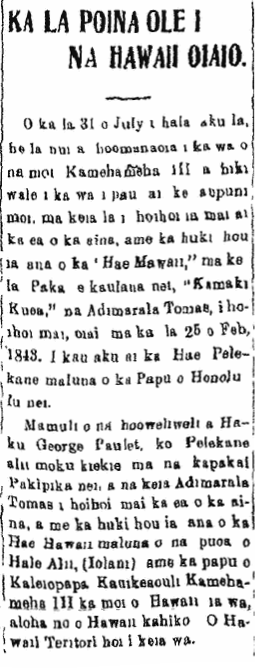
The past 31st of July was a great day celebrated in days of the monarchs, from Kamehameha III all the way until the end of the monarchy; on this day sovereignty was restored and the Hawaiian Flag was raised at that famous park, “Thomas Square,” by Admiral Thomas [Adimarala Tomas], who did the restoration, being that on the 25th of February, 1843, the British Flag was raised over the Fort of Honolulu.

As a result of the threats by Lord George Paulet; Britain’s high officer on the Pacific Ocean, it was Admiral Thomas who restored the sovereignty of the land, and re-raised the Hawaiian Flag on the flag staffs at the Palace (Iolani) and the fort of Kaleiopapa Kauikeaouli Kamehameha III, the king of Hawaii at the time; Aloha to Hawaii of old, which is the Territory of Hawaii now.

(Kuokoa Home Rula, 8/1/1912, p. 1)
KA LA POINA OLE I NA HAWAII OIAIO.

Kuokoa Home Rula, Buke X, Helu 31, Aoao 1. Augate 1, 1912.
Even more from Ka Nonanona, August 8, 1843.

TRAITORS.

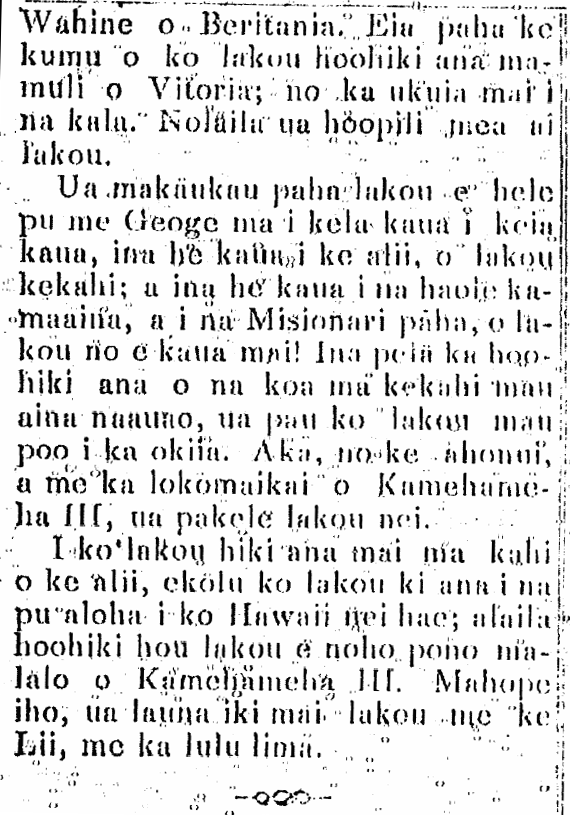
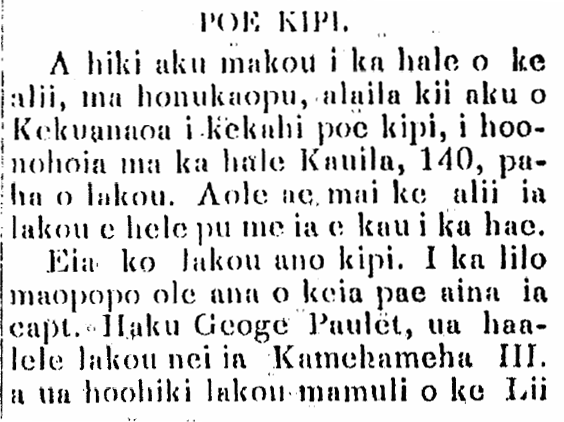
When we reached the residence of the king, at Honukaopu [Honokaupu ?], Kekuanaoa fetched some traitors who were kept at Hale Kauila; perhaps there were 140 of them. The king did not allow them to accompany him to raise the flag.

This is the nature of their treason. When this archipelago was not clearly under Capt. Lord George Paulet, they left Kamehameha III, and they swore allegiance to the Queen of Britain. This is probably the reason they swore allegiance to Victoria; because they were paid money. They therefore curried his favor [hoopilimeaai].

They were probably prepared to go with George to this war and that; if he warred against the king, so too would they; and if he went to war against the local haole or the Missionaries, they would fight as well! If soldiers of enlightened lands took an oath in this fashion, their heads would fall. But because of the patience and goodness of Kamehameha III, they were saved.

When they came in the presence of the king, they gave a three gun salute to Hawaii’s flag; and they swore once again to live obediently beneath Kamehameha III. After that, they spent time with the King, and shook hands.

(Nonanona, 8/8/1843, pp. 25 & 26.)

POE KIPI.

Ka Nonanona, Buke 3, Pepa 6, Aoao 25. Augate 8, 1843.

Wahine o Beritania...

Ka Nonanona, Buke 3, Pepa 6, Aoao 26. Augate 8, 1843.

More from Ka Nonanona, August 8, 1843.

THE RESTORATION OF THE KINGDOM.

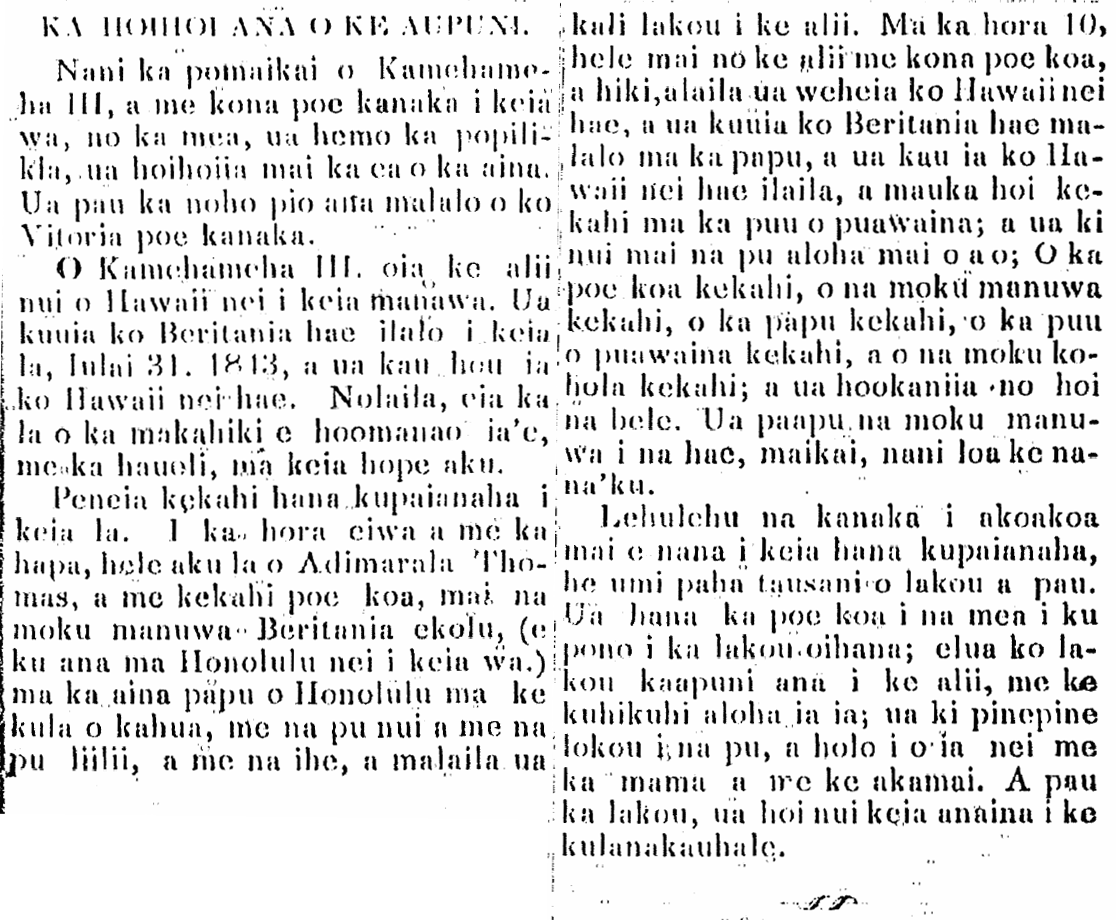
How great are the blessings of Kamehameha III and his subjects now, for the difficulties have subsided and the sovereignty of the land has been restored. No more is the living as subjects under the men of Victoria.

Kamehameha III is now the monarch of Hawaii nei. The British flag has been taken down on this day, July 31, 1843, and Hawaii’s flag has been raised once more. Therefore, this will be the day of the year that will be commemorated with joy from here forth.

Here is an awesome event that happened today. At half past eight, Admiral Thomas went along with some sailors, from the three British ships (anchored at Honolulu now) to the fort of Honolulu at Kulaokahua, with large and small firearms, and spears, and there he awaited the king. At 10 o’clock, the king went with his soldiers, and arrived; the Hawaiian flag was unfurled, the British flag was taken down from the fort, and there the Hawaiian flag was raised, and so too in uplands, on the hill of Puawaina [Punchbowl]; many guns were shot off in salute all over: The soldiers did it, the warships as well, the forts as well, and the hill of Puawaina as well, and the whaling ships as well; and the bells were rung. The warships were festooned with flags; it was a fine and beautiful sight to see.

There were many people gathered to witness this amazing event, perhaps there were ten thousand in total. The soldiers carried out their duties well; they circled the king twice, while saluting him; they shot off their guns many times and marched here and there quickly and smartly. And when they were done, the crowd all returned to town.

(Nonanona, 8/8/1843, p. 25)

KA HOIHOI ANA O KE AUPUNI.

Ka Nonanona, Buke 3, Pepa 6, Aoao 25. Augate 8, 1843.

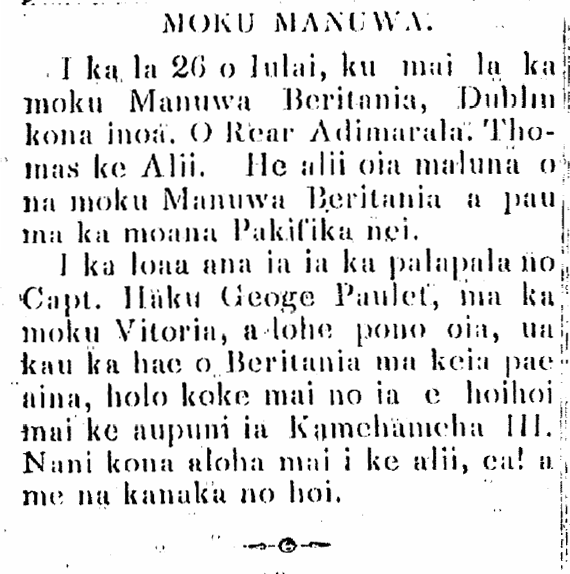
The first newspaper article printed following July 31, 1843.

BATTLESHIP.

On the 26th of July, the British Warship named Dublin arrived. Rear Admiral Thomas is the Captain. He is the officer in charge of all of the British warships in the Pacific Ocean.

When he received documents pertaining to Capt. Lord George Paulet aboard Victoria’s ship, and he heard clearly that the British flag was raised over these islands, he came quickly to restore the government to Kamehameha III. How fine is his aloha for the king, isn’t it! and for the citizens as well.

(Nonanona, 8/8/1843, p. 25)

MOKU MANUWA.

Ka Nonanona, Buke 3, Pepa 6, Aoao 25. Augate 8, 1843.

“All subjects were handled for what he believed to be the best interests of the Hawaiians…” 1902.

Ka ʻOihana Lawaiʻa: Hawaiian Fishing Traditions

Ka ʻOihana Lawaiʻa: Hawaiian Fishing Traditions

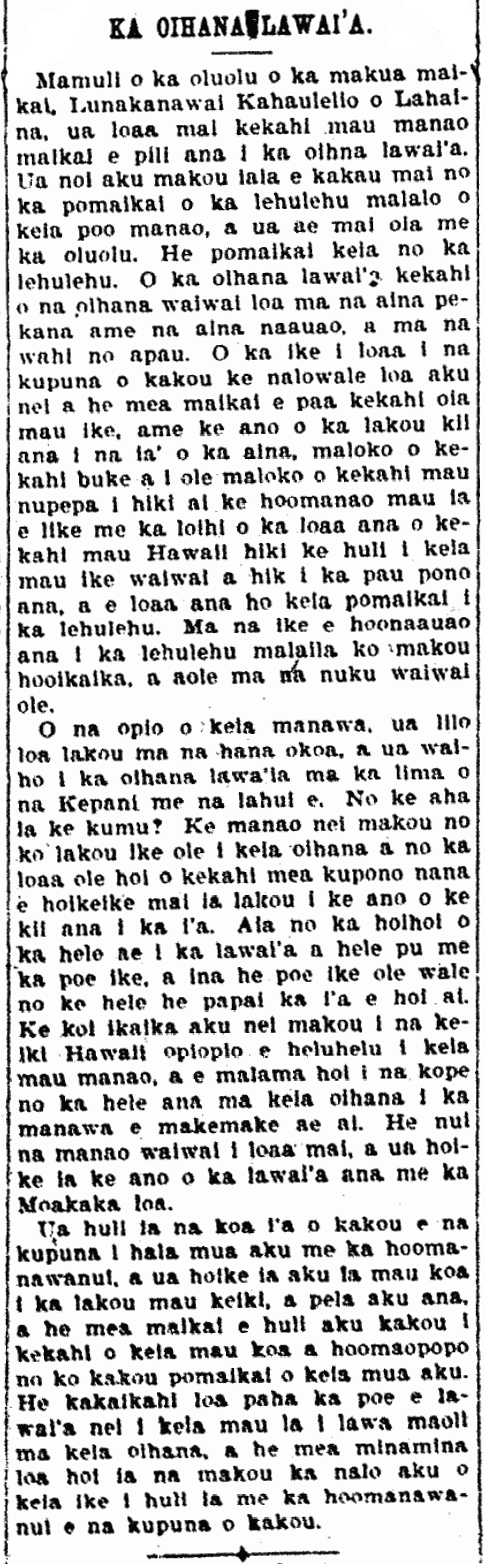
If you haven’t seen this book on fishing and so much more by Daniela Kahaulelio yet, it is one of the stories David Kanewanui, editor of the Kuokoa, knew was important for him to print for the youths of his time, and perhaps more importantly, for those of today and tomorrow. Kanewanui writes:

“…O ka ike i loaa i na kupuna o kakou ke nalowale loa aku nei a he mea maikai e paa kekahi oia mau ike, ame ke ano o ka lakou kii ana i na ia o ka aina, maloko o kekahi buke a i ole maloko o kekahi mau nupepa i hiki ai ke hoomanao mau ia e like me ka loihi o ka loaa ana o kekahi mau Hawaii hiki ke huli i keia mau ike waiwai a hik i ka pau pono ana, e loaa ana no keia pomaikai i ka lehulehu. Ma na ike e hoonaauao ana i ka lehulehu malaila ko makou hooikaika, a aole ma na nuku waiwai ole.”

“The knowledge possessed by our kupuna is disappearing, and it is good to record some of that knowledge, along with how they caught the fish of the land, within a book or within some newspapers, so that they can always be recalled as long as there are Hawaiians who can seek this treasured knowledge until it is exhausted, and its benefits will be for all. Through knowledge will the public be educated, and this is our focus, and not worthless complaining.”

(Kuokoa, 2/28/1902, p. 2)

KA OIHANA LAWAIA

Ka Nupepa Kuokoa, Buke XL, Helu 9, Aoao 2. Feberuari 28, 1902.

In praise of Mataio Kekuanaoa, 1871.

The different Father of Chiefs.

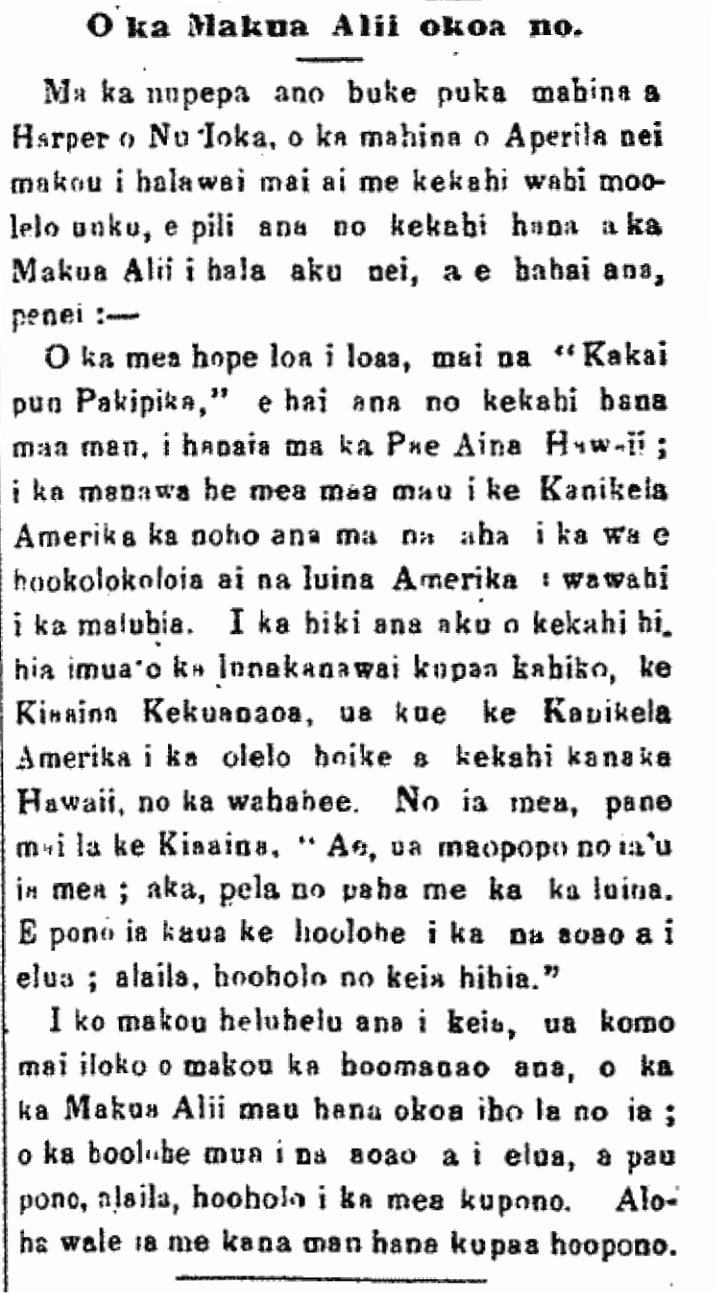
In the monthly magazine, Harper’s of New York, we came across in the April edition, a short story about something done by the Alii Father [Makua Alii] who has passed, and it reports:—

The latest received from the “Pacific String of Hills” speaks of a regular practice carried out in the Hawaiian Islands; during the times when it was a regular thing for the American Consul to sit at court when an American sailor was on trial for disturbing the peace. When a case came before the traditional judge, the Governor Kekuanaoa, the American Consul objected to the testimony of a Hawaiian on the grounds of perjury. At which the Governor replied, “Yes, I am aware of this; but the same may be true of the sailor. The two of us must hear both sides and then rule on this matter.”

When we read this, we recalled that is the different way the Father of Chiefs did things; he listened to both sides first, and when that was finished, he would decide what was proper. Aloha to him and his deeds of steadfast righteousness.

(Au Okoa, 4/13/1871, p. 1)

O ka Makua Alii okoa no.

Ke Au Okoa, Buke VI, Helu 52, Aoao 1. Aperila 13, 1871.

Hawaii’s Story by Hawaii’s Queen, in the Hawaiian Language, 1898.

WE WILL SATISFY.

Because we are constantly asked by our readers to print the story which our Queen wrote in Washington and that was just published in Boston, therefore, we are spreading the news to our readership that we will translate and print the story in the columns of the newspapers the daily and weekly Ke Aloha Aina, on the first week of this coming month for the benefit of our readers. Therefore, do take up Ke Aloha Aina so that you can see the one story written by Queen Liliuokalani and published in foreign lands, with statements full of sentiment and aloha dealing with Her overthrow. Aloha for Her.

(Aloha Aina, 3/19/1898, p. 5)

E HOOKO AKU ANA MAKOU.

Ke Aloha Aina, Buke IV, Helu 12, Aoao 5. Maraki 19, 1898.

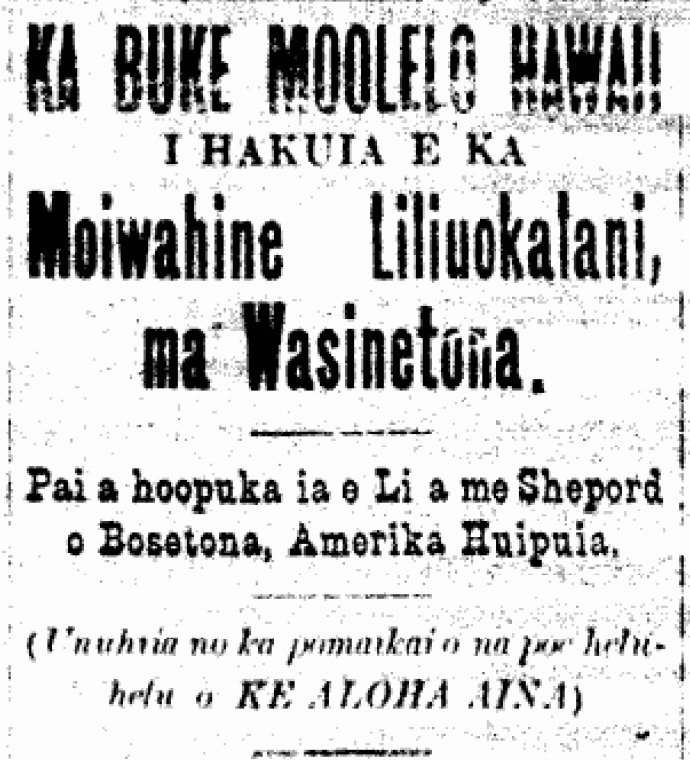
Here, by the way, is what the heading of that running column looked like:

HAWAIIAN HISTORY

WRITTEN BY

Queen Liliuokalani,

in Washington.

Published by Lee and Shepard

of Boston, United States of America.

(Translated for the benefit of the

readers of KE ALOHA AINA)

(Aloha Aina, 4/2/1898, p. 6)

KA BUKE MOOLELO HAWAII

Ke Aloha Aina, Buke IV, Helu 14, Aoao 6. Aperila 2, 1898.

On Liliuokalani’s composition of “Mele Lahui Hawaii,” 1898.

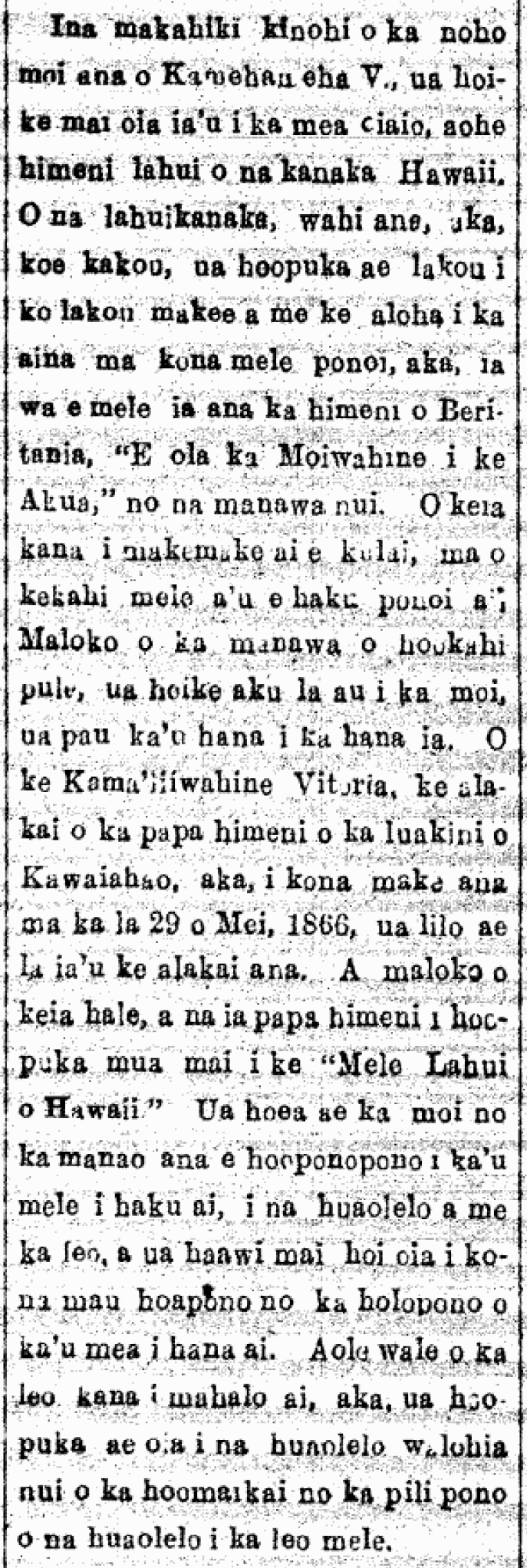
“In the early years of the reign of Kamehameha V, he brought to my notice the fact that the Hawaiian people had no national air. Each nation, he said, but ours had its expression of patriotism and love of country in its own music; but we were using for the purpose on state occasions the time-honored British anthem, “God save the Queen.” This he desired me to supplant by one of my own composition. In one week’s time I notified the king that I had completed my task. The Princess Victoria had been the leader of the choir of the Kawaiahao church; but upon her death, May 29, 1866, I assumed the leadership. It was in this building and by that choir that I first introduced the “Hawaiian National Anthem.” The king was present for the purpose of criticising my new composition of both words and music, and was liberal in his commendations to me on my success. He admired not only the beauty of the music, but spoke enthusiastically of the appropriate words, so well adapted to the air and to the purpose of which they were written.”

(from Hawaii’s Story by Hawaii’s Queen, pp. 31–32.)

“Ina makahiki kinohi o ka noho moi ana o Kamehameha V., ua hoike mai oia ia’u i ka mea oiaio, aohe himeni lahui o na kanaka Hawaii. O na lahuikanaka, wahi ana, aka, koe kakou, ua hoopuka ae lakou i ko lakou makee a me ke aloha i ka aina ma kona mele ponoi, aka, ia wa e mele ia ana ka himeni o Beritania, “E ola ka Moiwahine i ke Akua,” no na manawa nui. O keia kana i makemake ai e kulai, ma o kekahi mele a’u e haku ponoi ai. Maloko o ka manawa o hookahi pule, ua hoike aku la au i ka moi, ua pau ka’u hana i ka hana ia. O ke Kama’liiwahine Vitoria, ke alakai o ka papa himeni o ka luakini o Kawaiahao, aka, i kona make ana ma ka la 29 o Mei, 1866, ua lilo ae la ia’u ke alakai ana. A maloko o keia hale, a na ia papa himeni i hoopuka mua mai i ke “Mele Lahui o Hawaii.” Ua hoea ae ka moi no ka manao ana e hooponopono i ka’u mele i haku ai, i na huaolelo a me ka leo, a ua haawi mai hoi oia i kona mau hoapono no ka holopono o ka’u mea i hana ai. Aole wale o ka leo kana i mahalo ai, aka, ua hoopuka ae oia i na huaolelo walohia nui o ka hoomaikai no ka pili pono o na huaolelo i ka leo mele.”

(Aloha Aina, 5/14/1898, p. 7)

KA BUKE MOOLELO HAWAII I HAKUIA E KA Moiwahine Liliuokalani...

Ke Aloha Aina, Buke IV, Helu 20, Aoao 7. Mei 14, 1898.

Hawaiian National Anthem, 1866.

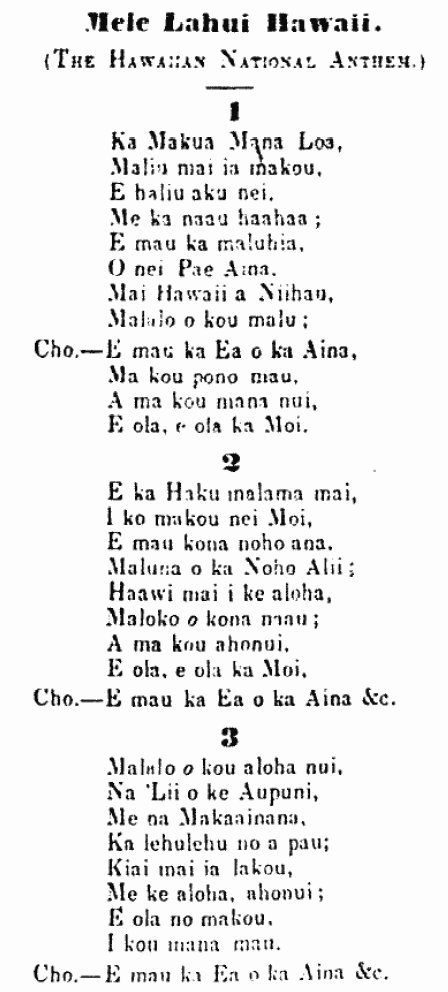
Mele Lahui Hawaii.
(The Hawaiian National Anthem.)

1

Ka Makua Mana Loa,
Maliu mai ia makou,
E haliu aku nei,
Me ka naau haahaa;
E mau ka maluhia,
O nei Pae Aina,
Mai Hawaii a Niihau,
Malalo o kou malu.

Cho.—E mau ka Ea o ka Aina,
Ma kou pono mau,
A ma kou mana nui,
E ola, e ola ka Moi.

2

E ka Haku malama mai,
I ko makou nei Moi,
E mau kona noho ana,
Maluna o ka Noho Alii;
Haawi mai i ke aloha,
Maloko o kona naau;
A ma kou ahonui,
E ola, e ola ka Moi.

Cho.—E mau ka Ea o ka Aina, &c.

3

Malalo o kou aloha nui,
Na ‘Lii o ke Aupuni,
Me na Makaainana,
Ka lehulehu no a pau;
Kiai mai ia lakou,
Me ke aloha, ahonui;
E ola no makou,
I kou mana mau.

Cho.—E mau ka Ea o ka Aina, &c.

The Hawaiian National Anthem.

1

Almighty Father,
Heed us,
Who turn to you,
With humble hearts;
Let there forever be peace,
In these Islands,
From Hawaii to Niihau,
Under your protection;

Cho.—Let the Sovereignty of this Land be for always,
By your never ending righteousness,
And by your great power,
Long live, long live the King.

2

O Lord, protect,
Our King,
Let his rule continue,
Upon the Throne;
Bestow him aloha,
Within his heart;
And by your grace
Long live, long live the King.

Cho.—Let the Sovereignty of this Land be for always, &c.

3

Under your great love,
Are the Alii of the Nation,
And the Makaainana,
All the people;
Do watch over them,
With aloha and magnanimity,
Let us live,
By your eternal power.

Cho.—Let the Sovereignty of this Land be for always, &c.

(Kuokoa, 11/24/1866, p. 2)

Mele Lahui Hawaii.

Ka Nupepa Kuokoa, Buke V, Helu 47, Aoao 2. Novemaba 24, 1866.

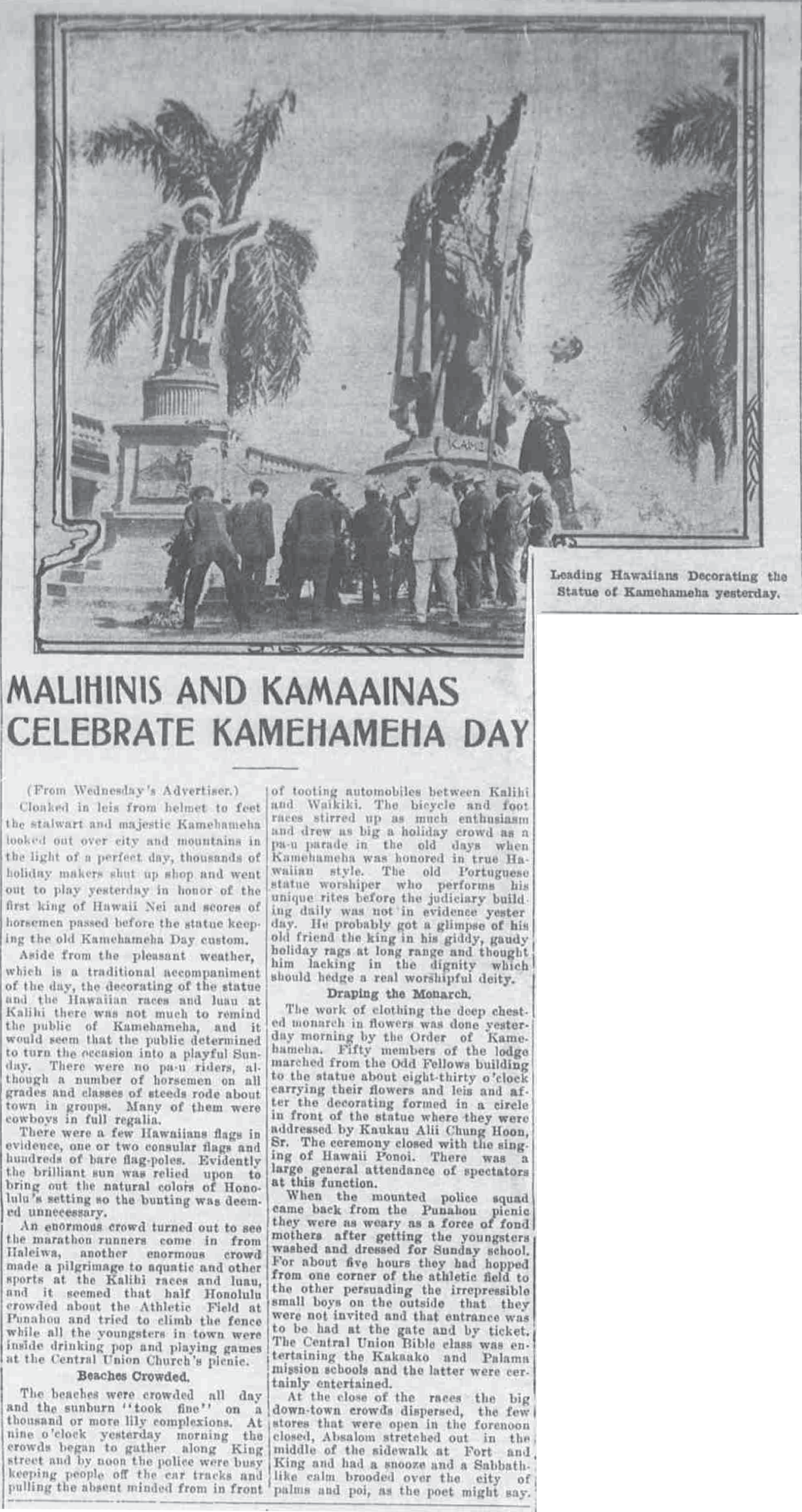
More Decorating the Kamehameha Statue, 1912.

MALIHINIS AND KAMAAINAS CELEBRATE KAMEHAMEHA DAY

Leading Hawaiians Decorating the Statue of Kamehameha yesterday.

(From Wednesday’s Advertiser.)

Cloaked in leis from helmet to feet the stalwart and majestic Kamehameha looked out over city and mountains in the light of a perfect day, thousands of holiday makers shut up shop and went out to play yesterday in honor of the first king of Hawaii Nei and scores of horsemen passed before the statue keeping the old Kamehameha Day custom.

Aside from the pleasant weather, which is a traditional accompaniment of the day, the decorating of the statue and the Hawaiian races and luau at Kalihi there was not much to remind the public of Kamehameha, and it would seem that the public determined to turn the occasion into a playful Sunday. There were no pa-u riders, although a number of horsemen on all grades and classes of steeds rode about town in groups. Many of them were cowboys in full regalia.

There were a few Hawaiian flags in evidence, one or two consular flags and hundreds of bare flag-poles. Evidently the brilliant sun was relied upon to bring out the natural colors of Honolulu’s setting so the bunting was deemed unnecessary.

An enormous crowd turned out to see the marathon runners come in from Haleiwa, another enormous crowd made a pilgrimage to aquatic and other sports at the Kalihi races and luau, and it seemed that half of Honolulu crowded about the Athletic Field at Punahou and tried to climb the fence while all the youngsters in town were inside drinking pop and playing games at the Central Union Church’s picnic.

Beaches Crowded.

The beaches were crowded all day and the sunburn “took fine” on a thousand or more lily complexions. At nine o’clock yesterday morning the crowds began to gather along King street and by noon the police were busy keeping people off the car tracks and pulling the absent minded from in front of tooting automobiles between Kalihi and Waikiki. The bicycle and foot races stirred up as much enthusiasm and drew as big a holiday crowd as a pa-u parade in the old days when Kamehameha was honored in true Hawaiian style. The old Portuguese statue worshiper who performs his unique rites before the judiciary building daily was not in evidence yesterday. He probably got a glimpse of his old friend the king in his giddy, gaudy holiday rags at long range and thought him lacking in the dignity which should hedge a real worshipful deity.

Draping the Monarch.

The work of clothing the deep chested monarch in flowers was done yesterday morning by the Order of Kamehameha. Fifty members of the lodge marched from the Odd Fellows building to the statue about eight-thirty o’clock carrying their flowers and leis and after the decorating formed in a circle in front of the statue where they were addressed by Kaukau Alii Chung Hoon, Sr. The ceremony closed with the singing of Hawaii Ponoi. There was a large general attendance of spectators at this function.

When the mounted police squad came back from the Punahou picnic they were as weary as a force of fond mothers after getting the youngsters washed and dressed for Sunday school. For about five hours they had hopped from one corner of the athletic field to the other persuading the irrepressible small boys on the outside that they were not invited and that entrance was to be had at the gate and by ticket. The Central Union Bible class was entertaining the Kakaako and Palama mission schools and the latter were certainly entertained.

At the close of the races the big down-town crowds dispersed, the few stores that were open in the forenoon closed, Absalom stretched out in the middle of the sidewalk at Fort and King and had a snooze and a Sabbath-like calm brooded over the city of palms and poi, as the poet might say.

[Found on Chronicling America!]

(Hawaiian Gazette, 6/14/1912, p. 2)

MALIHINIS AND KAMAAINAS CELEBRATE KAMEHAMEHA DAY

The Hawaiian Gazette, Volume LV, Number 39, Page 2. June 14, 1912.