Sigh, 2018.

Did you see last week Monday’s post on Welo Hou? It is funny how mele written by someone from a long time ago can stir up personal memories, both good and bad. Thomas Lindsey’s “Honesakala” is timeless. Does anyone know which Thomas Lindsey this was.

Click the sheet music below to check it out:
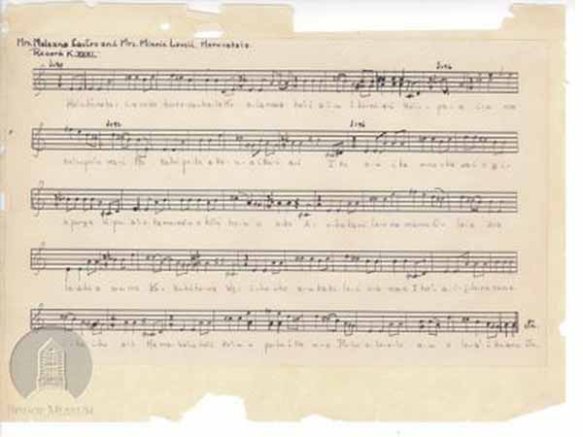
MS_SC_Roberts_2_2_Honesakala_BMWM-1-400x300.jpg

MS SC Roberts 2.2, p. 3. “Honesakala”

Pule should be studied as well, 1891.

[Prayer of Kana found in: “He Moolelo Kaao no Kana: Ke Ahi Kanana, Ka Hiapaiole, Ka Moopuna a Uli, Ka Mea Nana i Hoohiolo o Haupukele ka Puu Kaua i Molokai.”]

Ua meha ka leo o  ka ale o ka moana
Ua mea ka leo o ke kai
Ua meha ka leo o ke kanaka
Ua meha ka leo o ka manu noio o ke kai
Ua meha ka leo o ka Aama kua lenalena o ka pali
Ua meha ka leo o ka Opihi makaiauli
Ua meha ka leo o ka Hee pali
Ua meha ka leo o ka Amakihi holo kahakai Continue reading

Death announcements from Kalawao, 1876.

Deaths at Kalawao, Molokai.

[Hardly anything is legible in this article! If there was not also an announcement in the Kuokoa, we would not have this information. Oftentimes information is found in only a single issue of one newspaper. We need to rescan all the illegible pages of newspapers now while we can.]

(Lahui Hawaii, 11/16/1876, p. 2)

LahuiHawaii_11_16_1876_2.png

Ka Lahui Hawaii, Buke II, Helu 47, Aoao 2. Novemaba 16, 1876.

More on Ipo Lei Manu, 1892.

[Found under: “LOCAL AND GENERAL NEWS.]

The Bulletin acknowledges the receipt of the music and words of two hula kuis—”Ipo Lei Manu” and “Pua Melekule”—the first ever printed. They have been copyrighted by Mr. W. F. Reynolds of the Golden Rule Bazaar, in both the Hawaiian Islands and the United States. A few copies arrived by the last steamer, which can be had at the Bazaar at fifty cents a copy.

[One year after the death of King Kalakaua, the mele gets copyrighted by someone who obviously did not compose it, as so often happens to Hawaiian music. What is interesting is that I have not found any public performances in Hawaii of this song until after 1924.]

Welo Hou and the Helen H. Roberts Collection at the Bishop Museum, 2018.

It seems the Welo Hou blog has been up since November of 2017, with posts every Monday. If you are a mele person, or a history person, or are from Hawaii nei, you should check it out and start a dialogue! This is its opening post from last year [click anywhere below to link to the blog]:

Welo Hou: Building Connections to the Helen Roberts Mele Collection

 How has mele informed your understanding of a Hawaiian worldview?

As I ponder this question framed within the context of the above quote, my mind begins to churn with examples stemming from my own life and learning experiences. I recall my early childhood years in keiki hula class where I proudly chanted “Kūnihi ka mauna” while oblivious to the meaning of the words that were resonating from my mouth. Yet even in my naivety, I understood the function and purpose of that oli kahea. Though my mind was too young to comprehend the arbitrary words formed by my lips, I was fully aware that I had to be focused and present-minded in order to be granted permission into the hālau. This is a small example of how, even at 5 years old, mele/oli had already begun to shape my perspective to be one that reflects a Hawaiian way of thinking and behaving. “Kūnihi ka mauna” followed me into the academic arena where I eventually learned how to dissect the mele word for word, structure by structure, phrase by phrase, and sound by sound. I learned about the different places referenced in the mele and discovered the kaona behind words. I came to know the story by which the mele was inspired and I internalized the knowledge gained through the deconstruction and reconstruction of this mele. I share these thoughts with the hope that we can collectively become even more conscious of the way in which mele is able to shed light on aspects that are often considered obscure in research and Hawaiian knowledge acquisition.

                As we meet here weekly for Mele Monday, I invite you to ponder deeply on the pieces we will discuss from the Roberts’ Mele Collection over the next two years. The purpose of this blog is to cultivate a community of mele enthusiasts who would like to dialogue about the gems uncovered from within the mele we will explore over the coming weeks. Please feel free to ask questions, share manaʻo, and post comments that will contribute to the facilitation of thoughtful and respectful discourse.

                If you feel so inclined, I invite you to leave a comment expressing your thoughts on the quote and question posed above. 

E hea i ke kanaka e komo ma loko…..

Queen Emma portrait offered for 1881 subscription of Kuokoa, 1880.

THE

KUOKOA NEWSPAPER

FOR 1881!

“While the rain is still in the sky, clear the fields below.”

“Time and tide wait for no man; we need to be prepared.”

Therefore, O Friends of

“The Greatest Prize of the Hawaiian Nation.”

Make ready for the benefits of the

KUOKOA

carried and place before you for the new coming year. Continue reading

Not just February, 1938, Today, Tomorrow.

Need to Care For

A petition was put before the Board of Supervisors [Papa Lunakiai] of Maui on this past Monday, May 15, and it was about the obvious truth of the sad acknowledgement by the kamaaina of Hawaii, about the quiet decline of the Hawaiian language.

This document was sent from Molokai, one of the bastions of the old Hawaiians, and the document was written in the Hawaiian language, and it is something important taken and considered by the members of the board, the press, and others who went to observe the meeting. Continue reading

George K. Dwight, 1918.

Taps Sounded For Honolulu Boy Who Joined Gas Corps

GEORGE K. DWIGHT

George K. Dwight, a Honolulu boy, who left here in December to join the gas and flame corps of the American army, died last Sunday, Jan. 27, in a hospital at Annapolis, Maryland. Continue reading