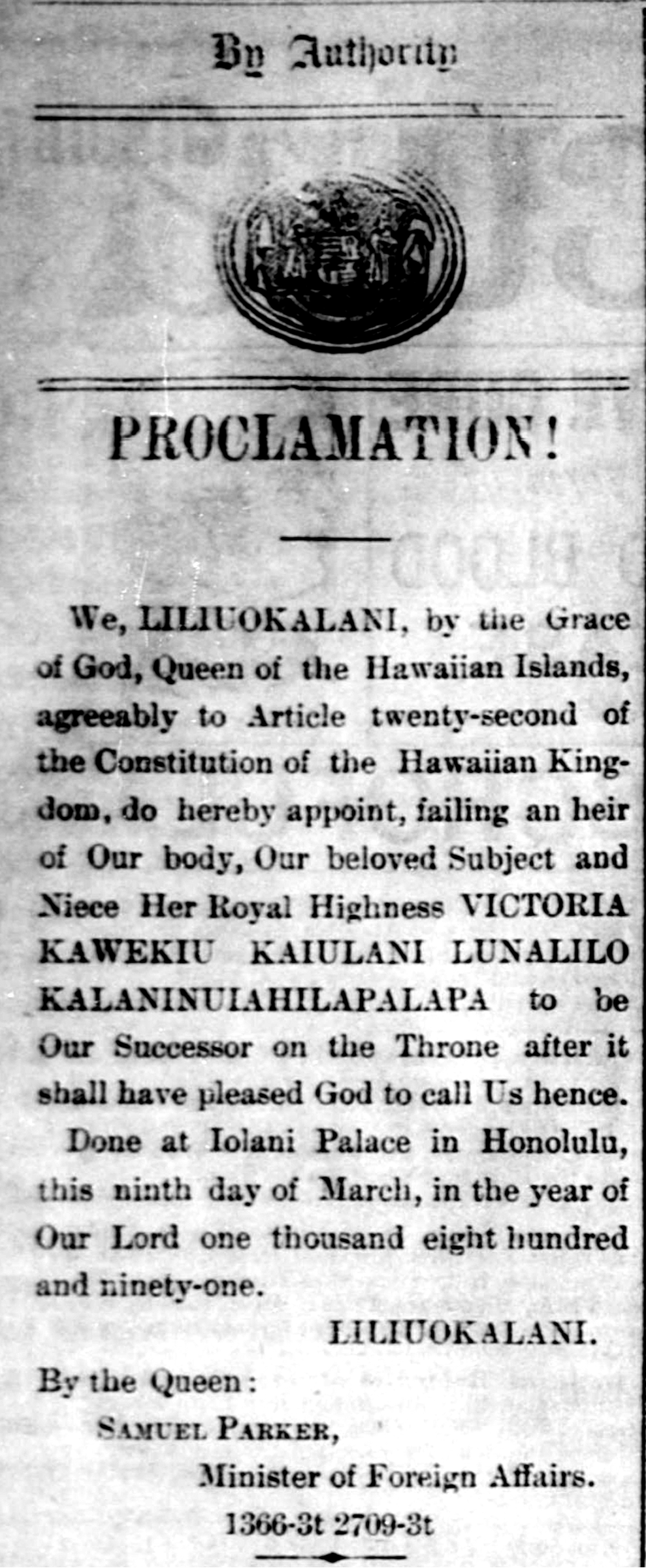
Princess Kaiulani proclaimed heir to the crown, 1891.

By Authority

PROCLAMATION!

We, LILIUOKALANI, by the Grace of God, Queen of the Hawaiian Islands, agreeably to Article twenty-second of the Constitution of the Hawaiian Kingdom, do hereby appoint, failing an heir of Our body, Our beloved Subject and Niece Her Royal Highness VICTORIA KAWEKIU KAIULANI LUNALILO KALANINUIAHILAPALAPA to be Our Successor on the Throne after it shall have pleased God to call Us hence.

Done at Iolani Palace in Honolulu, this ninth day of March, in the year of Our Lord one thousand eight hundred and ninety-one.

LILIUOKALANI.

By the Queen:

Samuel Parker,

Minister of Foreign Affairs.

[Sometimes there are typesetting errors in newspapers, which is why important numbers are often given in numeric form as well as in words. The Hawaiian proclamation found in the Leo o ka Lahui only used the numeric form of the date, and the typesetter seems to have flipped the “9” over.]

(Hawaiian Gazette, 3/17/1891, p. 4)

By Authority

Hawaiian Gazette, Volume XXVI, Number 11, Page 4. March 17, 1891.

Translation of H. Rider Haggard’s, “Morning Star,” 1910.

THE HEART-STIRRING TALE

—:OF:—

THE MORNING STAR

—AND—

RAMSES HER BELOVED SWEETHEART

“The Heir of Pharoah
The Favorite of Amen-Rah
The Proud Beauty of Egypt
The Darling of Her People.”

An Old Story from Egypt.
(Translated for the Hoku o Hawaii.)

Introduction.

We are printing this famous story of the Kingdom of Egypt. And it was near the time when Moses was living in Egypt. It is a story of speaking of the religion of that ancient people, and a story of their Chiefly kapu intertwined with their Godly kapu.

We published before our readers some years ago stories of our own Alii of ancient times of our land, and Tales of Hawaii which are nearly not remembered by the  current people of these times, and through this story which we are sharing with our readers, they will see some things about that ancient people of the land in the east. It is toilsome to translate these stories for the benefit of the people who enjoy reading stories in the Hoku. And from the Hoku, we lovingly urge its readers to please remember the life of this Hoku of ours. Printing a newspaper is very costly, and its existence and progress is reliant upon its readers.

We hope that some of the subscribers of the Hoku who are delinquent in their payments to the life of the Hoku will be moved with aloha, and they will make their payment towards the life of this patient servant.

Forgive us for these words that are not related to our story, however, “Ears do not get filled up with words.” And it is our responsibility to call out with aloha to our readers who have not paid their subscription, for the good of the newspaper to print educational stories and wise discussions of this new age.

[That was the introduction by the Hoku o Hawaii newspaper to their translation of the story, “The Morning Star” by H. Rider Haggard, which was printed just earlier that year in 1910. It ran in the weekly Hoku from March 17, 1910 to February 1, 1912.

It would be a cool thing if immersion students were introduced to old translations like these. They could see what kind of vocabulary and turns of phrase that were common during the period. I realize that trying to get through a novel in this format is tiresome and tedious, and I am considering reformatting a story (in the original orthography so that students can get more practice at reading material as they were presented in the newspapers) so that it reads continuously as a book. However, I am not sure if immersion teachers or students out there think that it would be beneficial. Perhaps it is already being done.]

(Hoku o Hawaii, 3/17/1910, p. 1)

HE MOOLELO HOONIUA PUUWAI NO KA HOKU KAKAHIAKA

Ka Hoku o Hawaii, Buke IV, Helu 46, Aoao 1. Maraki 17, 1910.

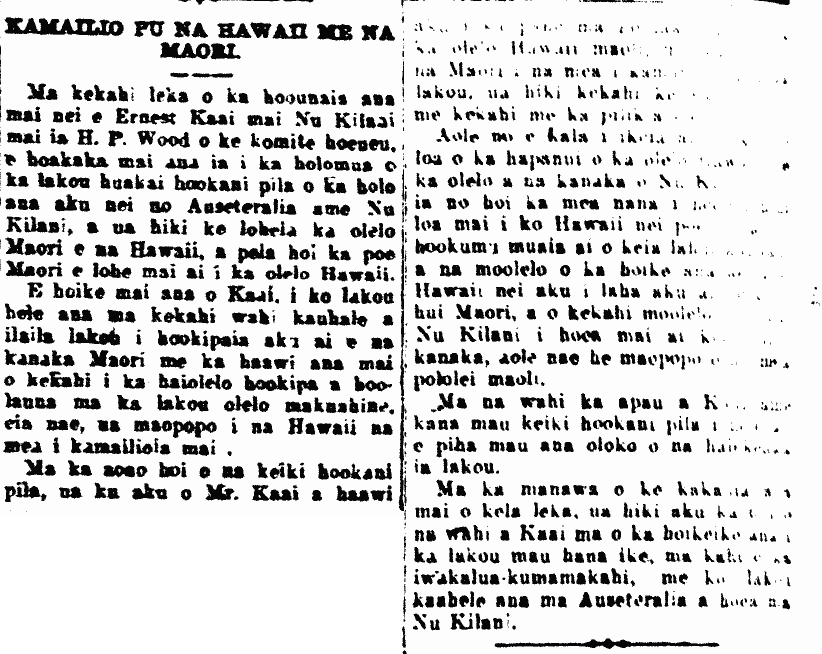
The Maori and Hawaiians, 1911.

Hawaiians and Maori Talk to Each Other.

In a letter sent by Ernest Kaai from New Zealand to H. P. Wood of the Hawaiian Promotion Committee [which seems to be a precursor to the visitor’s bureau], he shows the progress of their musical touring of Australia and New Zealand. The Hawaiians could hear the Maori language and the Maori could hear the language of Hawaii.

Kaai said that when they went to some villages, they were hosted by Maori people, where one of them said words of welcome and friendship in their mother tongue. But the Hawaiians understood what was being said.

From the side of the musicians, Mr. Kaai stood and gave [rest of the paragraph unclear].

It was not long ago that [also unclear here, but they seem to be talking about the relationship between Aotearoa and Hawaii].

Everywhere that Kaai and his musical group went, the theaters would be filled with them.

When this letter was written, the number of places that Kaai them performed at was about 21, with them going around Australia and reaching New Zealand[?]

[A great deal of the Hawaiian Language Newspapers are bound into book form, and because they were purposely printed without much empty margins, often the printed portions that fall in the margin area of the books are not legible, especially when scanned. To get a clear image of the entire page, the books will have to be unbound first. That, it seems, takes a great amount of funding.]

(Kuokoa, 6/30/1911, p. 8)

KAMAILIO PU NA HAWAII ME NA MAORI.

Ka Nupepa Kuokoa, Buke XLVII, Helu 26, Aoao 8. Iune 30, 1911.

More on language, 2015.

LANGUAGE MATTERS

Language Matters asks what we lose when languages die and how we can save them. It was filmed around the world: on a remote island off the coast of Australia, where 400 Aboriginal people speak 10 different languages, all at risk; in Wales, where Welsh, once in danger, is today making a comeback; and in Hawaii, where a group of Hawaiian activists is fighting to save the native tongue.

Language Matters is a co-production of David Grubin Productions and Pacific Islanders in Communications. Major funding provided by the National Endowment for the Humanities with additional funding provided by the Corporation for Public Broadcasting, the Arthur Vining Davis Foundations, the National Endowment for the Arts.

[This showed on PBS on 1/19/2015. It might be a long show, but don’t skip to the back, it is well worth watching from the beginning! Click the picture below.]

Language Matters

Language Matters

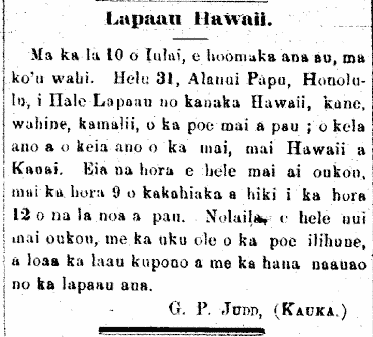
Kauka Judd opens a clinic for Hawaiians, 1871.

Treatment for Hawaiians.

On the 10th of July, I will commence at my place. Number 31, Fort Street, Honolulu, a Clinic for Hawaiian, men, women, children, everyone; with any illness, from Hawaii to Kauai. These are the hours for you all to come by, from 9 o’clock in the morning until 12 on weekdays [la noa]. Therefore, come all; there is no pay for the indigent, and you will get proper medicine with enlightened treatment.

G. P. Judd, (Kauka.)

[Although the title of this advertisement, “Lapaau Hawaii,” can be seen as “Treatment for Hawaiians,” I think the first idea that comes to mind would be “Hawaiian Medicine.” I wonder if that was done on purpose…]

(Au Okoa, 7/20/1871, p. 2)

Lapaau Hawaii.

Ke Au Okoa, Buke VII, Helu 14, Aoao 2. Iulai 20, 1871.

Pedestrians and Drivers need to be vigilant! 1917.

[Found under: “Nuhou Kuloko”]

One must be very careful when crossing from one side of the street to the other, because the automobiles speed by without paying attention to the people on the street.

[It seems like there are more and more accidents out lately. Please be careful out there!!]

(Aloha Aina, 12/14/1917, p. 4)

He mea pono e akahele...

Ke Aloha Aina, Buke, XXII, Helu 50, Aoao 4. Dekemaba 14, 1917.

Hawaiians on ships attacked by the CSS Alabama, 1882.

Alabama Claims.

VICTIMS OF THE ALABAMA.

Here below are the Hawaiian sailors who have rights to the claims from the money plundered by the ship Alabama from ships in the Arctic Ocean [Kai o Arika].

      Ship—John Howland—Keoni Haulani.

Name.                                          Place of Residence

Hoopii,                                Estate of Pika Kaeo [Peter Kaeo]
Napuu,                                Manamana,
Maele,                                 Makiki,
Hopu,                                  Kikihale,
Paahao,                               Kapalama,
Hanaike,                              Auwaiolimu,
Kauai,                                  Kikihale.

Ship—Covington—Kawikona.

Name.                                          Place of Residence

Leimakani,                          Kaopuaua,
Kalua,                                 Moanalua,
Puhau,                                Halealii [Palace],
Kekahea,                            Halealii [Palace],
Keoni Ohaio,                      Haliimaile,
Kolohai,                              Kepahoni.

Ship—Euphrates—Iupekisi.

Name.                                          Place of Residence

Mahiai,                             Kaumakapili,
Kauhikoa,                         Makiki,
Mana,                               Pelekane,
Mahoe,                             Kikihale,
Waihalulu,                        Kikihale,
Kahanu,                            Kapuukolo,
Kaoni,                               Kaopuaua,
Kamai,                              Waikiki,
Kumoanahulu,                  Waikahalulu.

Ship—Nassau—Nakau.

Name.                                          Place of Residence

Opunui,                               Kaopuaua,
Kaiawe,                               Auwaiolimu,
Kanikaula,                           Honokaupu,
Kanoho,                              Niolopa.

Ship—Milo—Mailo.

Name.                                          Place of Residence

Keaupuni,                          Moanalua,
Namauu,                            Haimoeipo,
Kamaole,                            Pukalale,
Luhilea,                              Kapamoo,
Kimo Kaiwi,                        Kapalama.

Ship—Congress—Konolisa.

Name.                                          Place of Residence

Kekuaihehia,                     Puunui,
Nakaneihele,                     Kaopuaua,
Kekoa,                               Kaopuaua,
Hale liilii,                           Keoneula,
Kamaa,                              Lepekaholo,
Kalanihookahu,                 Kakaako,
Hakuole,                            Pauoa,
Keliilelepa,                        Kaopuaua,
Namakaeha,                      Estate of Pika Kaeo [Peter Kaeo],
Kalulu,                               Halealii [Palace],
Kolona,                              Kaakopua,
Kaunu,                               Aala,
Kahumoku liilii,                  Kikihale,
Kemaha,                             Kaakopua,
Kapuniai,                            Kauluwela,
Kaihe,                                 Kauanonoula.

Ship—Favorite—Fewalaiki.

Name.                                          Place of Residence

David,                                 Kapuukolo,
Maihui,                               Kapuukolo,
Kanoa,                                Kapuukolo,
Kahula,                               Kaopuaua,
Kaai,                                   Kikihale,
Kaapa,                                Kapuukolo,
Kaneihalau,                        Kapauhi,
Mauaa,                               Kaakopua.

Ship—Martha—Maleka.

Name.                                          Place of Residence

Kainaina,                             Kaopuaua,
Pika,                                    Kaumakapili,
Manuhoa,                           Lepekaholo,
Ikaaka,                                Niupaipai,
Kalama,                              Apua,
Ii,                                         Kapuukolo,
Keliaa,                                 Kaopuaua,
Kalawaia,                             Apua,
Honu,                                  Kikihale,
Kekipi,                                 Apua,
Kilauea,                               Kapuukolo,
Pao,                                     Moanalua,
Alapai,                                 Kaopuaua,
Kaawaloa,                           Kapalama,
Aiamanu,                            Apua,
Hoomana,                           Peleula,
Kapela,                                Apua,
Kapou,                                 Honokaupu,
Kealonui,                             Apua,
Kalue,                                  Lepekaholo,
William Thompson, Uilama Kamikana,
Kahunapau Keala,
Kahananui,                         Kaumakapili,
Kaailaau,                            Kapuukolo,
Kumakauila,                       Kapuukolo,
Mahoe,                               Kapuukolo,
Kauhailama,                       Pukalale,
Kaumaka.

Ship—Nile—Naila.

Name.                                          Place of Residence

Naihelua,                          Kepahoni,
Kuakolu,                           Kepahoni,
Kanalu,                             Pauoa,
Kamaka,                           Peleula,
Hoaiki,                              Kapamoo,
Moeino,                            Kepahoni,
Kauhane,                          Kikihale,
Palakiko,                          Palolo,
Kaia,                                Paeaki,
Kaumealani,                    Kaumakapili,
Kalimahelehonua,           Honokaupu,
Kanuha,                           Kikihale,
Pau,                                 Kaopuaua,
Kekahea,                         Halealii [Palace],
Kalua,                              Kapalama.

Ship—Catherine—Kakalina.

Name.                                          Place of Residence

Samuel,                             Kaopuaua,
Piko,                                  Kaopuaua,
Kealoha,                            Niolopa,
Epela Waahia,                   Kawaiahao,
Simona Nuole,                  Kaakopua,
Poaeae,                             Niupaipai,
Keawe,                              Kapuukolo,
Hahololio,                         Kapuukolo,
Kanuha,                            Kikihale,
Peniamina,                        Kapalama.

The names above, are the Hawaiian sailors aboard the ships mentioned above, that were pirated by the Shenandoah in 1865.

Those who received the aforementioned money, should not come again—as for those who did not receive the money, they must come at once to my office in Honolulu.

Should one of these people have died, then relatives or heirs should come.

A. S. Hartwell.

Honolulu, Dec. 1, 1882.

[Does anyone know how to easily do tabs in WordPress?]

Nene being cared for by Herbert Shipman, etc. 1941.

[Found under: “Hunahuna Meahou o Hamakua Ame Kohala” by Mrs. Reinhardt.]

Last week, two men living and working at the Kilauea National Park came to Honokaa School, their names being Gunther Olsen and friend. The school was filled with its 496 students from 1st grade to 6th, to see pictures of the mountains of this island. Olsen described the different birds while his companion showed pictures of the birds on a white cloth. Truly beautiful were the pictures of the mamo, O-o, Elepaio, Iiwi, Apapane, and so forth. The names of the birds of ours were clearly pronounced in Hawaii by that man.

According what was said by this man, in Keaau is being cared for at the home of Herbert Shipman, NENE birds, which are believed to be going extinct, but they are increasing. Our birds were much more beautiful in the olden days before other birds were imported from all over, the birds that are a problem for the crops growing in our gardens. They eat flowers of the peppers [nioi], and that is why the nioi doesn’t fruit as they did in years past.

After the pictures of the birds were shown, pictures were shown of the burning fires of Pele atop Mokuaweoweo last year. These men climbed up Mokuaweoweo on horseback and when they reached a certain point, the horses were left and they went on foot until the crater. Where they were was scorching. While the fires were boiling, snow was seen on both sides covering the ground. Continue reading

More on the pidgin in Kalaupapa article, 1882 / 2015.

Before getting to the pidgin phrase in question, I had a question in the last paragraph which in the original read: “ke hele la a mauakea i ka la.” And thankfully there was a response.

Puakea says:

Aloha – the last line might be missing an “o” – Ke hele la a moauakea i ka la – making a haughty display- like white-feathered chickens – in the sun. (moa uakea – often a reference for Maunaloa/Maunakea when snow-covered)

That would fit in nicely, considering there were typos in the newspapers even back then. The last paragraph would then read something like:

The white-haired old men of Kalaupapa are out surfing these days, resembling white-feathered chickens under the sun.

As for the pidgin phrase: “Kokami iu palali kanaka! Iu anu faita, ai am solon, mi kivi iu kut polo, mi inilis man,”

There was one suggestion.

Robert Ikuwa says:

“Go come you bloody kanaka. You wanna fight. I am strong. Me give you good blow, me is invisible [? invincible] man.”

Another suggestion I have is maybe:

“Goddam you bloody kanaka. You wanna fight? I am strong. Me give you good blow. Me Englishman.”

Also there was another comment just a few minutes ago!

Michael Newtson says:

In our Cummings Ohana I have written of many of our ancestors exploits. But these long overdue articles brings to mind an early story of our Patriarch Thomas Booth Cummings who was so inspired by a hapa Hawaiian who served alongside of him in the jury pools of Edwin Miner’s court in Lahaina (1848-50) that he named his first born son after him. The young man who had such a promising will to help the needy was William Humphreys, who often went by the name Ulawalea as a pen name when writing the countless articles in Hawaiian Nupepa about the injustices of the peninsula. Kalaupapa has received much of the attention, in part from Father Damien. However, there was a second smaller colony at the eastern end of the peninsula at Kalawao. Most patients here were Chinese, and this is where Humphreys concentrated his efforts in the early until his untimely death from a prescribed medicine in the mid 1860’s. He might have been one of the first to use the media of his day to educate those in the islands that were unaware of the seriousness of the conditions. At Kalawao he organized voting blocks, book clubs and taught many years for no expense. He served two terms as Sheriff and was imprisoned twice, once for refusing to arrest patients for victimless crimes and another for butchering beef on a nearby ranch to provide fresh meat for the starving. He like many others, worked under the radar and was but a small foot print in Hawaii’s history, but when passed the patients of Kalawao lost their dearest friend.

Mahalo to everyone that gave responses, they put much more meaning into this post!

Speaking of language—and halahu and halahi, 2015.

I thought I would ask once again for people to maybe take some time to add corrections to misinterpretations that I make in these posts. I know for a fact that there are a lot of times that I may think that something is being said, but it actually is not. It would help me for one, and it might perhaps help others as well.

Also, if you have any comments or added information to contents of posts, please feel free and don’t hesitate to comment.

Mahalo.