Henry Wilfred Waiau weds Isabela Kaheapuulani Akiona, 1911.

THOSE HAWAIIAN YOUTHS MARRIED.

Mr. Solomon Hanohano, Editor, Aloha oe: Please allow me some space of the pride of the people, so that everyone from Hawaii, island of Keawe, all the way to the sun-snatching island of Manokalanipo (Kauai), knows of the marriage of Henry Wilfred Waiau of the calm seas of Kona, where you had affection in the days of your youth, distinguished by the passing of the cloud banks and the hinano flowers in the calm, with the type-setting girl of the garden island of Manokalanipo.

After Henry Wilfred Waiau spent a year or more on Kauai, Miss Isabela Kaheapuulani Akiona of the island of Manokalanipo, the island that snatches the shining rays of the sun from the tip of Kumukahi and setting at the base of Lehua, proudly took him (H. W. Waiau) and placed him in the sacred stage of the covenant of matrimony at 8 oʻclock in the evening of last Wednesday, and the two of them were joined by Rev. W. Kamau of the church of Lihue, Kauai.
Continue reading
Hawaiian medical kahuna and haole doctors, 1871.

Answer to W. P. Waha.

Mr. Editor; Aloha oe:

Perhaps it is well that I explain in your newspaper a thought responding to W. P. Waha of Honomaele Uka, Hana, Maui.

In the newspaper, Kuokoa, Buke 10, Helu 27, of the 8th of this past July, Waha published an opinion pertaining to the Practice of Hawaiian Medicine. From what I saw searching from beginning to end; this is what I mainly got out of it, that “he is jealous, malicious, and a slanderer, ” and so forth. You just chomp your mouth like a wild shark of the sea saying, “All of the Hawaiians are dying because of whom? Yes! They are dying because of you Heads of the Government!” If that is the intent of the questioner, then I ask of you, “Is that indeed true?” Let us all look at the thoughts of this malicious inciter, being that the Heads of our Nation are not looking to kill off the Hawaiian Lahui, and ways to kill them, but it is you, and it is you yourselves who offer yourselves off to die; and you enjoy grumbling to our Heads of Government. Take a short look at this, you fault finder; During the past session of the Legislature, in the year 1870, $4,000 was put to teach Hawaiian youths Medicine, and in the month of November of last year, the government chose the proper person in which they trust, as a teacher for the school, and it is being taught now. There is no other reason for this action except because of the aloha for you, O Hawaiian people.

Take another look; some Hawaiian medical kahuna are licensed, so that they can practice medicine in the country and areas where there are no doctors. The ignorant and uneducated practitioners are being sued. If you look at these actions by our Government Heads, it appears as if they are concerned that our Lahui will perish. Continue reading

Theresa Owana Wilcox Belliveau and the Estate of Pauahi and Liliuokalani, 1918.

FIGHTING OVER THE ESTATE OF PAUAHI

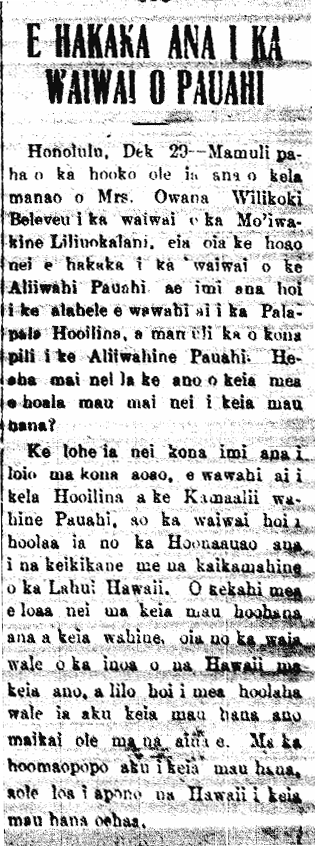
Honolulu, Dec. 29—Perhaps it is because the desires of Mrs. Owana Wilcox Beleveu [Belliveau] were not appeased over the estate of Queen Liliuokalani that here she is fighting over the estate of the Aliiwahine Pauahi and she is trying to find a way to break the Will, as if she is related to Chiefess Pauahi. What does she expect by starting all of this?

It is heard that she is looking for an attorney on her side to break the Will of Princess Pauahi, and the money to be dedicated to Educate the boys and girls of the Hawaiian Lahui. Something that will result through this action by this woman is the dishonor to the name of Hawaiians, and this improper action will be something reported in other lands. When they find out about  this, Hawaiians will definitely not approve of this deceitful act.

(Aloha Aina, 1/3/1918, p. 2)

E HAKAKA ANA I KA WAIWAI O PAUAHI

Ka Hoku o Hawaii, Buke 12, Helu 32, Aoao 2. Ianuari 3, 1918.

Emma Nakuina educates teachers on Hawaiian history, 1920.

HAWAIIAN STORIES PRESENTED BEFORE THE TEACHERS’ SCHOOL.

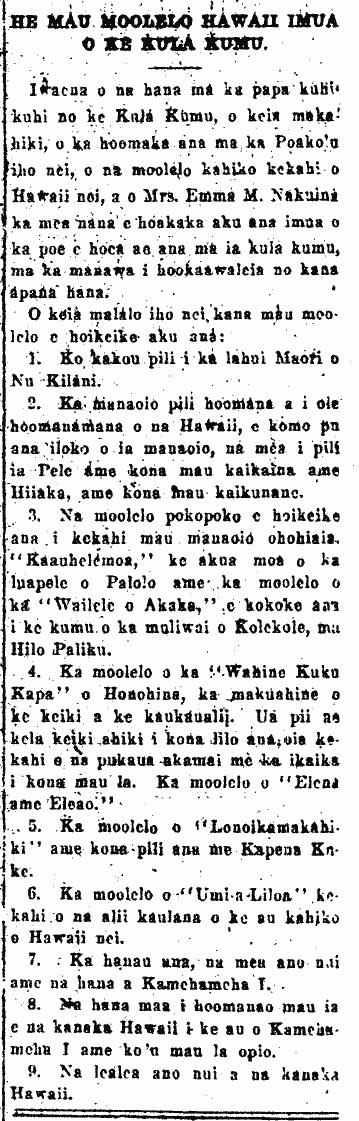
In the syllabus of the School of Education this year, beginning on this past Wednesday, were old moolelo of Hawaii nei. And it is Mrs. Emma M. Nakuina who is teaching them before those who come to the teachers’ school during the time set aside for her course.

These below are the moolelo that she will be teaching:

1. Our ties with the Maori of New Zealand.

2. The religion or superstition of the Hawaiians, and along with those beliefs are things relating to Pele and her younger sisters and Hiiaka, along with her brothers.

3. Short stories which show amazing beliefs, like the story of “Kaauhelemoa,” the chicken god of the crater of Palolo and the story of “Akaka Waterfall,” which is close to the head of the Kolekole River in Hilo Paliku.

4. The story of “The Kapa-Beating Woman” of Honohina, the mother of the chiefly child. That child grew up to become one of the strong and skilled warriors of his time. The story of “Elena [Eleau?] and Eleao.”

5. The moolelo of “Lonoikamakahiki” and his association with Capt. Cook.

6. The moolelo of “Umi-a-Liloa,” one of the famous alii of old Hawaii nei.

7. The birth, the important things, and accomplishments of Kamehameha I.

8. The usual activities recalled by Hawaiians in the time of Kamehameha I as well as during my childhood.

9. The major entertainments of Hawaiians.

(Kuokoa, 7/9/1920, p. 4)

HE MAU MOOLELO HAWAII IMUA O KE KULA KUMU.

Ka Nupepa Kuokoa, Buke LVIII, Helu 28, Aoao 4. Iulai 9, 1920.

Commemorative Kamani planted at Kamehameha Schools, 1904.

Kamehameha Schools.

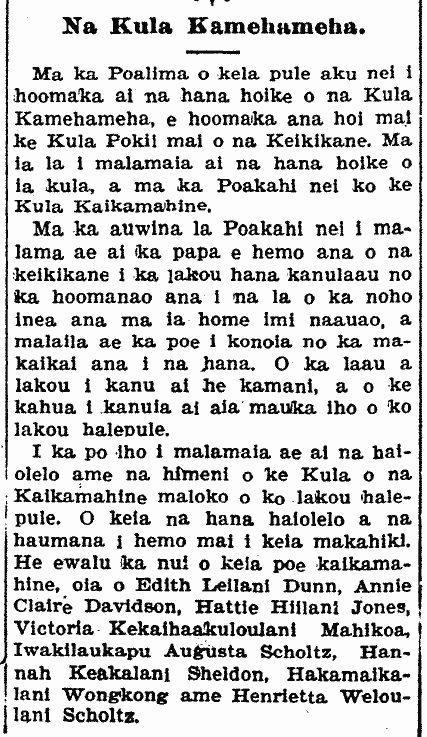
The Kamehameha Schools held their exhibition on this past Friday, starting with the Boys’ Primary School. On that day the exhibition of that school was held, and on this past Monday for the Girls’ School.

On Monday afternoon, the boys’ senior class held a tree planting to memorialize the days of living in hardship at this home of learning, and present were those invited to watch the activities. The tree that they planted was a kamani, and the area where it was planted was upland of their chapel.

Later that night, speeches and songs were performed by the Girls’ School in their chapel. These were speeches by the students graduating this year. There were eight girls: Edith Leilani Dunn, Annie Claire Davidson, Hattie Hiilani Jones, Victoria Kekaihaakuloulani Mahikoa, Iwakilaukapu Augusta Scholtz, Hannah Keakalani Sheldon, Hakamaikalani Wongkong [Hakamaikalani Wong Kong] and Henrietta Weloulani Scholtz.

(Kuokoa, 6/10/1904, p. 2)

Na Kula Kamehameha.

Ka Nupepa Kuokoa, Buke XLII, Helu 24, Aoao 2. Iune 10, 1904.

The Blue and White revived, 1904.

THE BLUE AND WHITE

The New Kamehameha School Paper of Students.

“Blue and White” is the title of a very neat four page paper published by the students of the Kamehameha Schools. The initial number was issued yesterday. The staff is composed of the following:

Abel Ah You, editor-in-chief; George Wells, assistant editor; Charles Lyman, athletics; David Desha, exchange editor; Charles Williams, superintendent of printing; associate editors, Enoch Hussey, Henry Sniffen, David Mahukona.

The leading editorial is devoted to a synopsis of an address made before the Kamehameha Alumni meeting held on June 8, 1904, as follows:

And now a serious word about Kamehameha. Kamehameha with all it means is the Hawaiian heritage. If ever an institution belonged to a people, this belongs to you. It is yours to guard, to use, to cherish. And to my mind, Kamehameha is the last hope of the Hawaiian people. But it is enough. Continue reading

From Chicago to Honolulu to go to school? 1929.

CHILDREN COME TO ATTEND SCHOOL IN HAWAII NEI

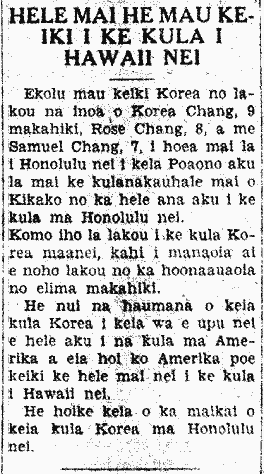
Three Korean children named Korea Chang, 9 years old, Rose Chang, 8, and Samuel Chang, 7, arrived in Honolulu this past Saturday from the city of Chicago, to go to school here in Honolulu.

They entered the Korean school here, where it is believed they will remain to be educated for five years.

There are many children at this Korean school who are now hoping to go to school in America, and here are children from America coming to school in Hawaii nei.

This attests to the quality of the Korean school in Honolulu.

(Alakai o Hawaii, 3/7/1929, p. 2)

HELE MAI HE MAU KEIKI I KE KULA I HAWAII NEI

Ke Alakai o Hawaii, Buke 1, Helu 45, Aoao 2. Maraki 7, 1929.

Kukuiolono Park opens, Nov. 3, 1911.

BIG DAY IS ON FOR NOVEMBER 3. IN PARK

Hanalei School Items Show a Continued Interest is Still Kept Up in Our National Sport

C. MASER WINS THE FIRST PRIZE

Many Entries Enlivens The Contest S. E. Lucas, Opticians, Will Arrive on The Kinau Tomorrow

November third will be a big day at the Kukuiolono Park, the new McBryde Park. The occasion will be the celebration of the Mikado’s birthday anniversary and the amusements arranged for the day include horse racing, sulky racing, bicycle and foot racing, as well as various other athletic sports. Continue reading

William Charles Achi, Jr. composer of many college anthems, 1940.

Judge Achi is a Composer of Music

There are many of our readers who do not know that our good friend, Judge William Charles Achi, Attorney, is the composer of three famous mele that are being sung by students of three great schools of Americca, as was written about in the November 25th issue of Newsweek. Continue reading

Kamehameha School for Girls, 50th Anniversary, 1944.

50th ANNIVERSARY STORY¹

By Betty Yim

Featuring the education of the Hawaiian people from early times up to the present day, an historical pageant of authenticly staged scenes with more than 100 characters climaxed the celebration of the founding of the Kamehameha Schools for Girls.

Three performances were given, on Wednesday, December 6, for students; the others on Friday, December 8, for parents and guests and Saturday, December 9, for alumnae and alumni. Continue reading