More on Hattie L. S. Reinhardt and politics, 1944.

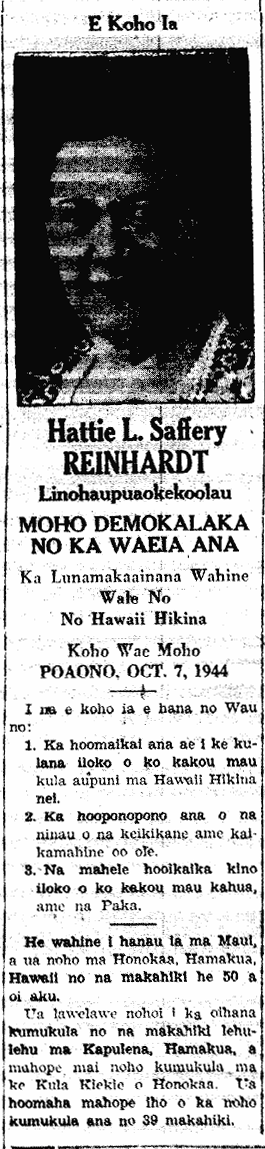
Vote For

Hattie L. Saffery
REINHARDT
Linohaupuaokekoolau

DEMOCRATIC CANDIDATE
FOR ELECTION

The Only
Woman Representative
For East Hawaii

Election
SATURDAY, OCT. 7, 1944

Should I be elected I will work for:

1. Benefit the state of our public schools here in East Hawaii.

2. Deal with the obstacles of girls and boys who have not yet reached adulthood.

3. Physical education in our Parks and grounds.

This is a woman born on Maui, and lived in Honokaa, Hamakua, Hawaii for over 50 years.

She had the occupation of school teacher for many years at Kapulena, Hamakua, and after that, she served as a teacher at Honokaa High School. She retired after teaching for 39 years.

(Hoku o Hawaii, 9/27/1944, p. 2)

E Koho Ia Hattie L. Saffery

Ka Hoku o Hawaii, Volume XXXIX, Number 23, Aoao 2. Sepatemaba 27, 1944.

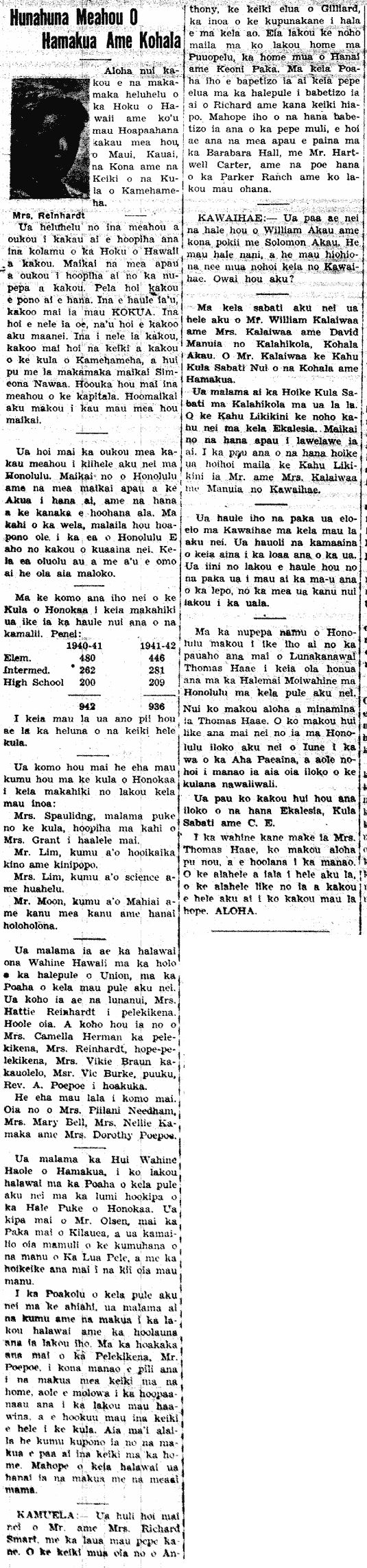
Hattie Linohaupuaokekoolau Saffery Reinhardt, correspondent for Hamakua and Kohala, 1941.

Bits of News from Hamakua and Kohala

Aloha nui kakou, readers of the Hoku o Hawaii and my fellow news writers from Maui, Kauai, the two Kona [North and South], and the Children of Kamehameha Schools.

I’ve read the news you all have written filling the columns of our Hoku o Hawaii. All that you all have written to fill our newspaper have been fine. That is the way we should do it. Should I be put aside, I will support those who KOKUA. Should you not have material, I will give aid here. If we all are without, our children from the Kamehameha School will give support, along with that good friend, Simeona Nawaa. Do send more news from the capitol. We give appreciation for your choice news.

Your news writer has returned from her wandering in Honolulu. Honolulu is great, along with all the great many things God has created, as well as all that man is carrying out. Where it is hot, that is what I don’t like, the air of Honolulu. We in the countryside are better off. With this cool air which you and I breathe; there is life there within.

With the recent start of Honokaa School this year, there has been seen a severe drop in the number of children. Like this:

1940–41 1941–42
Elem.    480    446
Intermed.    262    281
High School    200    209
 ———  ———
   942    936

These past days, the number of children attending school has rebounded.

Four new teachers came to Honokaa School this year, their names being:

Mrs. Spaulding, librarian for the school; taking the place of Mrs. Grant who left.

Mr. Lim, fitness teacher and baseball.

Mrs. Lim, science and math teacher.

Mr. Moon, Farming and Agriculture and Animal husbandry teacher.

The Hawaiian Women’s meeting was held in the hall of the Union Church several Thursdays ago. The officers were selected; Mrs. Hattie Reinhardt as president. She refused. Reselected was Mrs. Camella Herman as president; Mrs. Reinhardt as vice president; Mrs. Vikie Braun as secretary; Mrs. Vic Burke as treasurer; and Rev. A. Poepoe as adviser.

Four members joined. They being Mrs. Piilani Needham, Mrs. Mary Bell, Mrs. Nellie Kamaka and Mrs. Dorothy Poepoe.

The Haole Women’s Board of Hamakua held their meeting last Thursday in the lobby of the Honokaa Library. Mr. Olsen paid a visit, from the Kilauea Park, and he talked on the subject of the birds of the Volcanic Crater, while showing pictures of the birds.

On the Wednesday of last week, in the evening, the teachers and parents held their meeting and introduced themselves. In the introduction by the President, Mr. Poepoe, pertaining to his thoughts on parents at home, was the idea that they should not be lax in the children’s studies, and that they should let them always go to school. If the child is sick, that is a proper reason for the parents to keep the child at home. After the meeting, the parents were fed a snack.

KAMUELA:—Mr. and Mrs. Richard Smart returned along with their baby boy. The first child is Anthony, the second is Gilliard, named for the grandfather who has gone to the other world. They are living at their home in Puuopelu, at the previous residence of Hanai and Keoni Paka [Hannah and John Parker]. This coming Thursday, the second baby will be baptized at the church where Richard and his first child were baptized. After the baptism of the youngest child, everyone will return to eat at Barabara hall, with Mr. Hartwell Carter and the workers of Parker Ranch and their families.

KAWAIHAE:—The new homes of William Akau and his younger brother, Solomon Akau, have been completed. They are beautiful houses, and it is a sign of progress for Kawaihae. Now who else?

This past sabbath, Mr. William Kalaiwaa and Mrs. Kalaiwaa and David Manuia  went to Kalahikiola in North Kohala. Mr. Kalaiwaa is the head Kahu of the Sunday Schools of two Kohala [North Kohala and South Kohala] and Hamakua.

On that day, they were holding the Sunday School Hoike at Kalahikiola. Pastor Likikini presides as kahu of the Church. Everything that took place was fine. After the hoike was through, Pastor Likikini took Mr. and Mrs. Kalaiwaa and Manuia back to Kawaihae.

Drenching raindrops fell at Kawaihae these past days. The kamaaina of this area were glad to receive rain. They hope the rain will fall again so that the soil remains damp, for they have planted much sweet potato.

We saw in the English newspaper of Honolulu that Judge Thomas Haae grew weary of this life at the Queen’s Hospital in Honolulu last week. We have great aloha and regret for Thomas Haae. We met up with him in Honolulu in June during the [church] Island-wide Convention, and it was not known that he was in weak condition.

We will no longer meet at the Church, Sunday School, and C. E. events.

To the widow, Mrs. Thomas Haae, to you goes our aloha, and let your thoughts be lightened. The path that he has taken is the same path that we shall take on our last days. ALOHA.

[Mrs. Reinhardt was the news correspondent for Hamakua and Kohala to the newspaper Hoku o Hawaii.]

(Hoku o Hawaii, 10/15/1941, p. 1)

Hunahuna Meahou O Hamakua Ame Kohala

Ka Hoku o Hawaii, Volume XXXVI, Number 25, Page 1. Okatoba 15, 1941.

Waiahole Elementary School, 130 years old! 1883 / 2013.

[Found under: “LOCAL NEWS.”]

Then English-language school at Waiahole, Oahu will be opening on Monday, the 17th of this month, under the leadership of their new teacher, Mr. G. Carson Kenyon, the previous editor of the newspaper, Daily Bulletin, of this town. He will meet with Manuela, the agent of the school, along with the parents of the students, at the schoolhouse at Waiahole, on Wednesday, the 19th, at 10 o’clock in the morning. We pray that Mr. Kenyon will be accompanied by only great blessings in this new position he is filling.

[Mahalo to Civil Beat for pointing us in the direction of this announcement for the opening of Waiahole Elementary School, which celebrates it 130th birthday this month! The school is having a birthday party this Saturday! Hauoli La Hanau!!]

(Kuokoa, 9/8/1913, p. 3)

E weheia ana ke kula...

Ka Nupepa Kuokoa, Buke XXII, Helu 36, Aoao 3. Sepatemaba 8, 1883.

More on the first opening of “Pacific Hall” and the Kamehameha School for Girls, 1894.

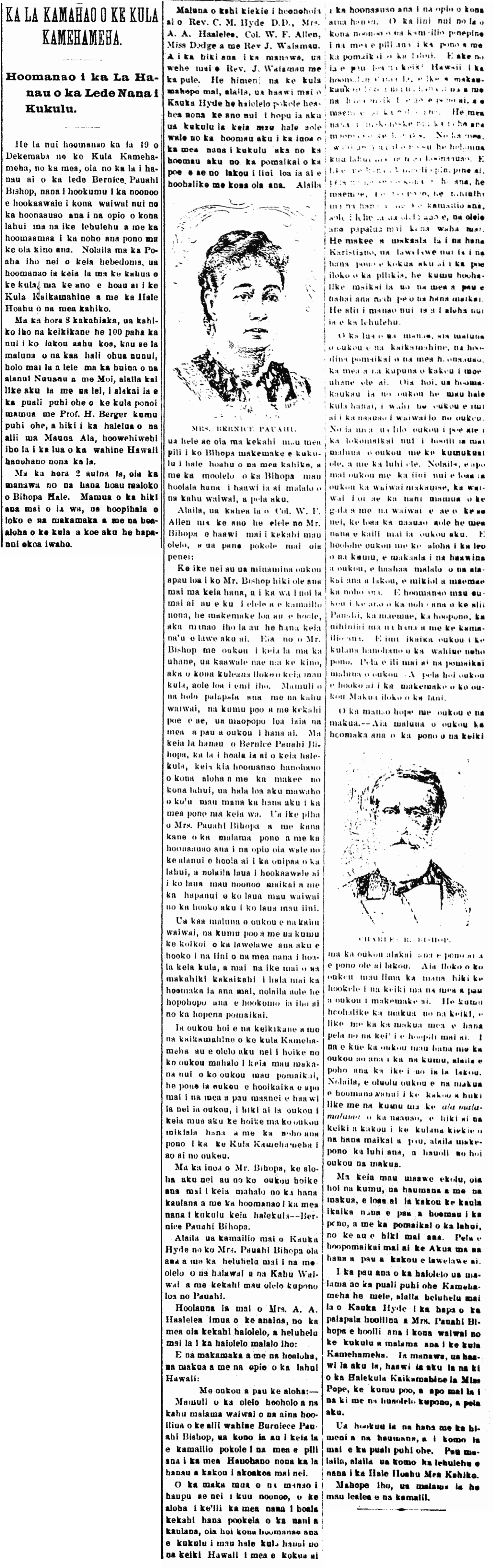
SPECIAL DAY FOR KAMEHAMEHA SCHOOL.

Remembrance of the Birthday of the Founding Lady.

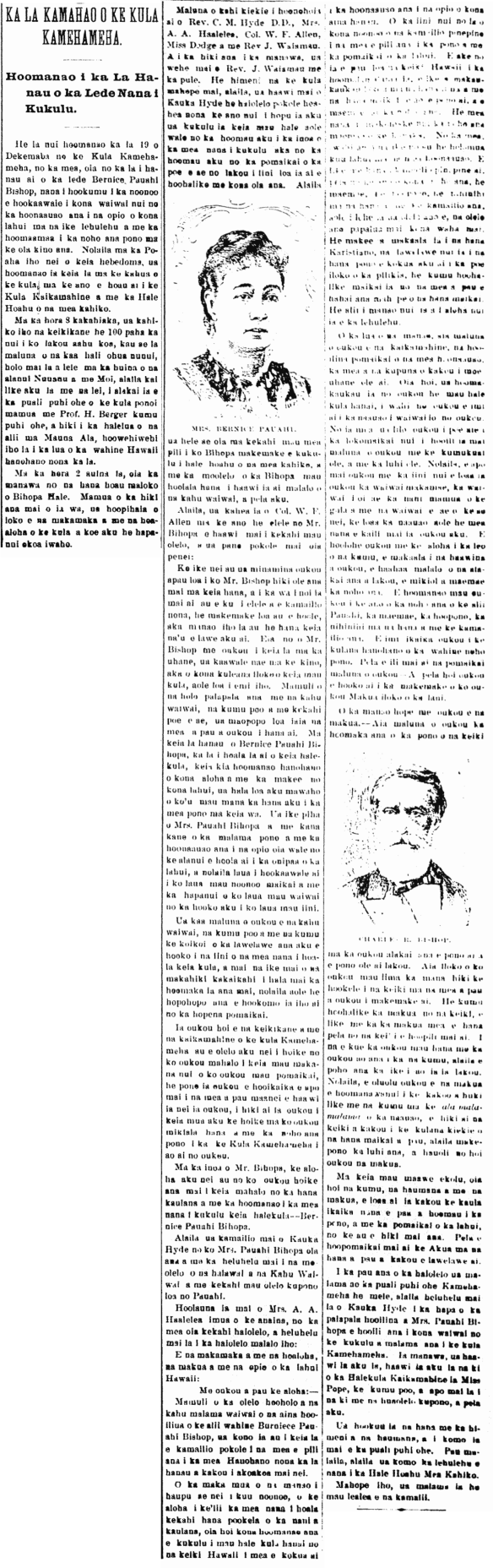
The 19th of December is a much celebrated day for Kamehameha School, for it is the day of birth of the lady, Bernice Pauahi Bishop, the one who came up with the idea to set aside her great estate for the educating of the youth of her people in the many fields of knowledge and in living healthily. Therefore on the past Thursday, the day was commemorated on the grounds of the school, by dedicating the Girls’ School and the Museum.

At 8 o’clock in the morning, perhaps 100 boys were dressed in military uniform and put aboard and rode trolleys [kaa hali ohua nunui], getting off at the corner of Nuuanu and King Streets, and from there they marched with lei, led by the school’s band in front, with Prof. H. Berger as the conductor, until the crypt of the alii at Mauna Ala, where they decorated the grave of the honorable Hawaiian woman for whom the day was for.

2 o’clock in the afternoon was the time for the dedication in Bishop Hall [Bihopa Hale]. Before the hour, the room was filled with intimates and friends of the school with a majority outside.

Rev. C. M. Hyde, D. D.; Mrs. A. A. Haalelea; Col. W. F. Allen; Miss Dodge; and Rev. J. Waiamau were sitting in a raised area. And when the time came, Rev. J. Waiamau began with a prayer. After that was a hymn by the school, and then Doctor Hyde gave a short speech of welcome of which the gist was that these structures were built not just to memorialize the name of the founder, but for the continued benefit of those who it is hoped will emulate her life. Thereafter…

MRS. BERNICE PAUAHI.

he moved on to matters dealing with Bishop’s desire to build a museum, and the story of Bishop’s planning given under the board of trustees, and so forth.

Then Col. W. F. Allen was called up as a representative for Mr. Bishop to give some words, and he spoke shortly in this manner:

I know that you all regret the absence of Mr. Bishop on this occasion, and when asked to represent and speak for him I should much rather have declined but felt it a duty to accept. That Mr. Bishop is with you today in spirit you all know, and though absent in person, he interest in these schools never wanes. By correspondence with the trustees, principals, and others, he has kept well posted in all the progress you have made. On this the natal day of Bernice Pauahi Bishop, the founders day of this Institution, such a grand monument to her love and care for her people, it is beyond my powers to do justice to the occasion or theme. Both Mrs. Bishop and her husband fully realized that the proper care and teaching of the young was the only way to insure the stability of the people, and so they have devoted their best thought, and much of their property to carry out these ideas.

To you, trustees, principals and teachers the responsibility of carrying out the wishes of the founders of this institution belongs, and from the experience of the few years since the opening, no fears are entertained of the ultimate result.

To you, boys and girls of Kamehameha School, I would say that to show your appreciation of the great gifts of your benefactors, you should ever strive to take advantage of all that is here offered you, so that in the future you can show by your industrious and virtuous lives what the Kamehameha School has done for you.

On behalf of Mr. Bishop, I thank you all for showing such an appreciation for the grand work and memory of the founder of this institution—Bernice Pauahi Bishop. [English for W. F. Allen’s speech taken from Hawaiian Star, 12/19/1894, p. 3.]

Then Dr. Hyde spoke about Mrs. Pauahi Bishop’s life, and read the minutes of meetings of the Board of Trustees as well as some appropriate words about Pauahi.

Mrs. A. A. Haalelea was introduced before the assembly because she was one of the speakers, and she read the following speech below:

O Associates and Friends, Parents and Youth of the Hawaiian People:

With all of you is my aloha:—

Because of the decision of the trustees of the estate of Bernice Pauahi Bishop, I was invited on this day to speak a bit about the Honorable one for whose birthday we are gathered.

The first thing to come to mind, is that it was the aloha of this alii which initiated this greatest work of beauty and fame, that is her idea to build boarding schools for the Hawaiian children to help educate the youth of her homeland. That was her great desire and spoke often things pertaining to the good and benefit of the lahui. [Image is unclear for a number of lines.] She was devout and vigilant in her Christian duties; she undertook many worthy causes to help those in need, and she is a fine example for all to follow after in good deeds. She was an alii who was thought much of and well loved by the people.

The second point: upon you, O Girls, is the inheritance of education, something our kupuna did not dream of. That being for you is prepared some boarding schools where you can find knowledge that will be truly valuable for you. So you will be indebted for the great kindness given upon you at no expense or trouble. Therefore, strive with great effort to acquire this precious treasure, a treasure more beautiful than gold or any of the other riches of this world; should you gain an education, there is no one that can take it away from you. Listen with aloha to the teachings of your instructors, pay attention to the lessons, be humble to their instruction, and be neat and clean in your daily life. Constantly recall the character of the alii Pauahi: her purity, righteousness, and decorum in actions and words. Always strive for the honorable standing of a woman who lives properly. In that way, you will be blessed. And in that way you will be carrying out the desire of your Father in heaven.

The last thought goes to you, O Parents.—Upon you lie the beginnings of the good character of your children…

CHARLES R. BISHOP.

…by your guidance will your children be upright or not so. Within your hands is the power to steer the children towards all that you desire. The parents are examples for the children; for instance, how a parent acts is what a child will follow. Should your actions and your instructions contradict those of the teachers’, then what is taught to them will be wasted. Therefore, O Parents, please strive to support and cooperate with the teachers on the pathway to knowledge, so that our children may reach a high level in all fine occupations, an this will make the effort worthwhile, and you, O Parents, will rejoice.

With these three plies, that being the teachers, the students, and the parents, we can get a strong cord which will hold fast and push forward the righteousness and blessings of the lahui for the coming age. In that way will God bless us in all our endeavors.

At the end of her speech, the Kamehameha band played a song, then Dr. Hyde read the portion of the will of Mrs. Pauahi Bishop giving her wealth for the building and caring for the Kamehameha School. This is when the keys of the Girls’ School handed over to Miss Pope, the principal, and she took the keys with some appropriate words, and so forth.

The activities were let out with the singing of the students, along with the band. When that was done, the crowd went in to see the Museum.

After that, some fun activities for the children were held.

[Much of the text on the top of the column on the right is hard to read. It is time that these Hawaiian-Language Newspapers were rescanned as cleanly as possible! If you can’t read the information, is it really information?]

(Kuokoa 12/22/1894, p. 2)
KA LA KAMAHAO O KE KULA KAMEHAMEHA.

Ka Nupepa Kuokoa, Buke 33, Helu 51, Aoao 2. Dekemaba 22, 1894.

More from Bishop Museum and Kamehameha Schools, 1894.

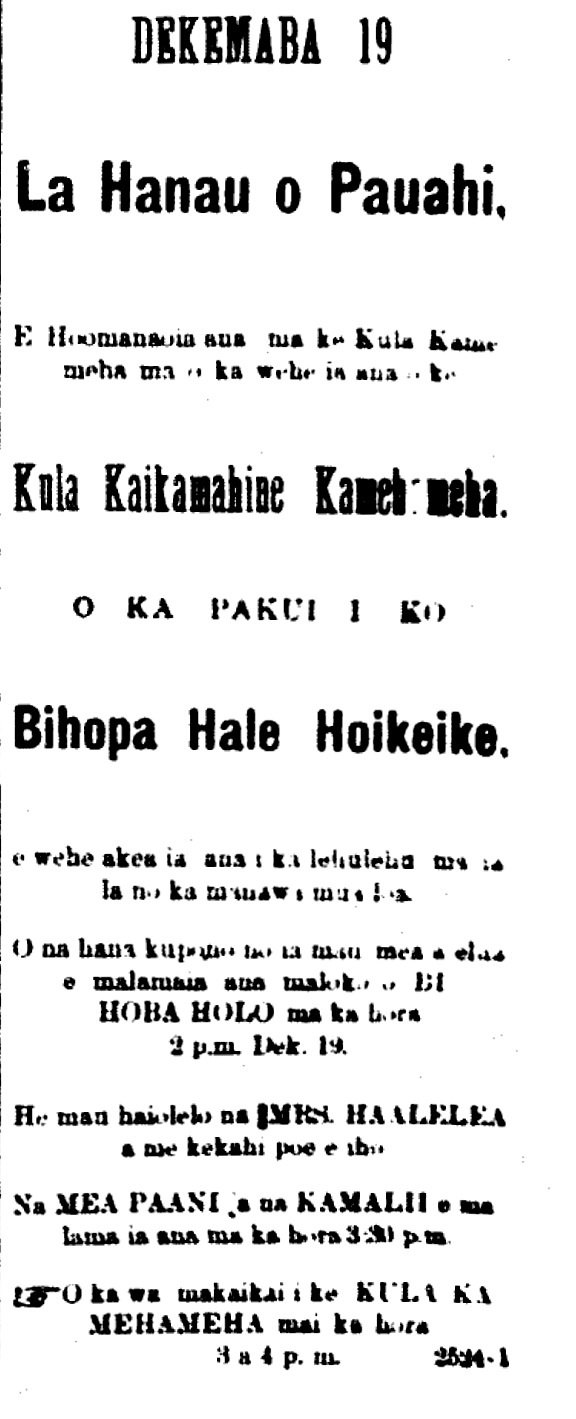
DECEMBER 19

Birthday of Pauahi.

Commemorated at the Kamehameha School with the opening of the

Kamehameha School for Girls.

THE ANNEX TO

Bishop Museum.

will be opened to the public on that day for the very first time.

Those are two fitting events held in BISHOP HALL [BiHOBA HOLO] at the hour of 2 p. m. Dec. 19.

Speeches by MRS. HAALELEA and some others.

GAMES for CHILDREN will be held at 3:30 p. m.

Period for touring the KAMEHAMEHA SCHOOL from 3 to 4 p. m.

[Mahalo to DeSoto Brown for commenting on this opening. This Annex to the Bishop Museum was unveiled to the public on the 19th of December, 1894, became Polynesian Hall, and today is reopening to the public after extensive renovations as Pacific Hall! If you are here on Oahu, go check it out!! Free admission all day today (Saturday, September 21, 2013, until 9:00 p. m.)!!!]

(Kuokoa, 12/15/1894, p. 2)

DEKEMABA 19 La Hanau o Pauahi

Ka Nupepa Kuokoa, Buke XXXIII, Helu 50, Aoao 2. Dekemaba 15, 1894.

The Kamehameha Museum and the Kamehameha Schools, 1894.

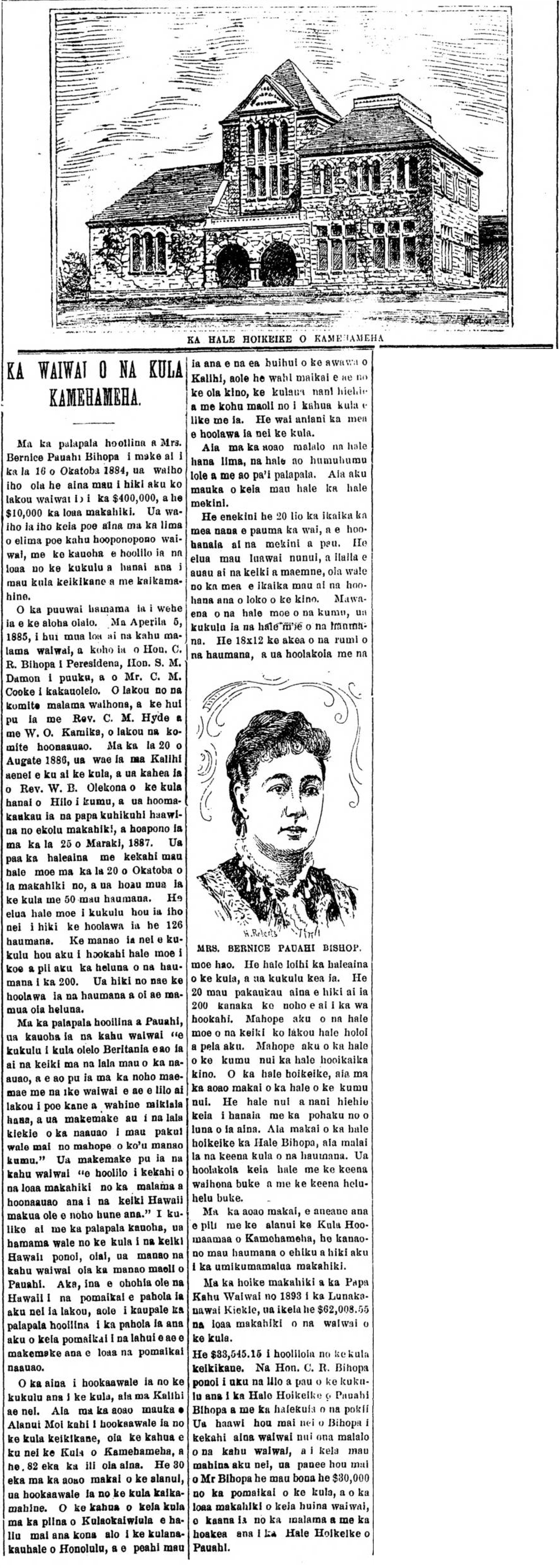
KA HALE HOIKEIKE O KAMEHAMEHA

THE ASSETS OF THE KAMEHAMEHA SCHOOLS.

In the will of Mrs. Bernice Pauahi Bishop, who died on the 16th of October 1884, she set aside lands whose true value comes to $400,000, with $10,000 profit per year. These lands are in the hands of five trustees, with the stipulation that the profits go to the building and caring for a school for boys and girls.

This generosity was based on true aloha. On the 5th of April, 1885, the trustees met for the first time and selected the Hon. C. R. Bishop as President, Hon. S. M. Damon as treasurer, and Mr. C. M. Cooke as secretary. They are the finance committee, along with Rev. C. M. Hyde and W. O. Smith, made the education committee. On the 20th of August, 1886, up in Kalihi was chosen as the place where the school would stand, and Rev. W. B. Olsen of the Hilo boarding school to be a teacher, and the curriculum for three years was prepared and approved on the 25th of March, 1887. The cafeteria and some dormitories were completed on the 20th of October of that same year, and the school began with 50 students. There were two dormitories just built, which can house 126 students. One more dormitory is planned which will increase the number of students to 200. However more than that number of students can be accommodated.

In the will of Pauahi, the trustees were instructed to “build an English-language school where the children were to be educated in the regular branches of knowledge, and they were also to be educated to live morally and with important knowledge to make them industrious men and women, and I want high branches of knowledge to supplement those basics.” It is desired that the trustees “use a portion of the profits to go to the education and care of the indigent orphaned Hawaiian children.” As per the will, the school is opened to native Hawaiians, being that the trustees believe that was the true intent of Pauahi. However, the Hawaiians are not interested in the good put before them, the will does not preclude the the provision of those blessings to the other races who want to receive the benefits of an education.

The land set aside for the building of the school is up in Kalihi. The land mauka of King Street is set aside for the boys’ school; this is where the Kamehameha School now stands; the area of that land is 82 acres. There are 30 acres makai of the street, which is set aside for the girls’ school. The area for this school is in the heights of Kulaokaiwiula with it face overlooking the cit of Honolulu, and it is constantly fanned by the cool air of the valley of Kalihi; there is no other finer place for the health, the beauty, and the suitability as a school campus like this. Clear water is supplied to the school.

Below that are the workshops, the sewing shop and the printing shop. And mauka of these buildings is the mechanic shop.

The strength of the engine pumping the water is 20 horses, and the total power is utilized. There are two huge pools where the children will bathe until clean, and that is what will keep their bodies working strong. Between the sleeping quarters of the teachers were built the dormitories of the students. The student rooms are 18 x 12 wide, and are furnished with…

MRS. BERNICE PAUAHI BISHOP.

…iron beds. The schools cafeteria is a long building, and it was built in the form of a cross. There are 20 dining tables accommodating 200 people at a time. Behind the children dormitories, are their laundry building, and so forth. Behind the principal’s house is the gymnasium. The museum is on the makai side of the principal’s house. This is a grand a beautiful structure constructed with rock from atop the land. Makai of the museum is Bishop Hall, and this is where the school rooms of the students are. This building is furnished with a library and a reading room.

On the makai side, almost adjacent to the road is the Kamehameha Preparatory School; there are sixty students from seven until twelve years of age.

In the yearly report of the Trustees for 1893 to the Chief Justice, it was seen that the school’s annual income was $62,008.55.

$33,545.15 was spent on the boys’ school. It was the Hon. C. R. Bishop who paid for the entire cost of the building of the Pauahi Bishop Museum and the preparatory school. Bishop also recently gave some of his valuable land holdings under the trustees, and several months ago, Mr. Bishop forwarded bonds of $30,000 for the benefit of the school, and the yearly income of these assets will be apportioned for the care and the expansion of the Pauahi Museum.

[It was just serendipity that caused me to notice this article the other day, and I thought with the re-opening of the new Pacific Hall at the Bernice Pauahi Bishop Museum, there was no better time to post this article about the actual beginnings of the Museum and of the Kamehameha Schools.

Check the early years of this familiar building (minus the dome) on campus as well, from an earlier post!

The public opening of Pacific Hall is tomorrow. Admission is free! Go check out all of the special events, and the newly redone Pacific Hall!!]

(Kuokoa 5/26/1894, p. 1)

KA WAIWAI O NA KULA KAMEHAMEHA.

Ka Nupepa Kuokoa, Buke XXXIII, Helu 21, Aoao 1. Mei 26, 1894.

Festivities at Hilo Union School, 1927.

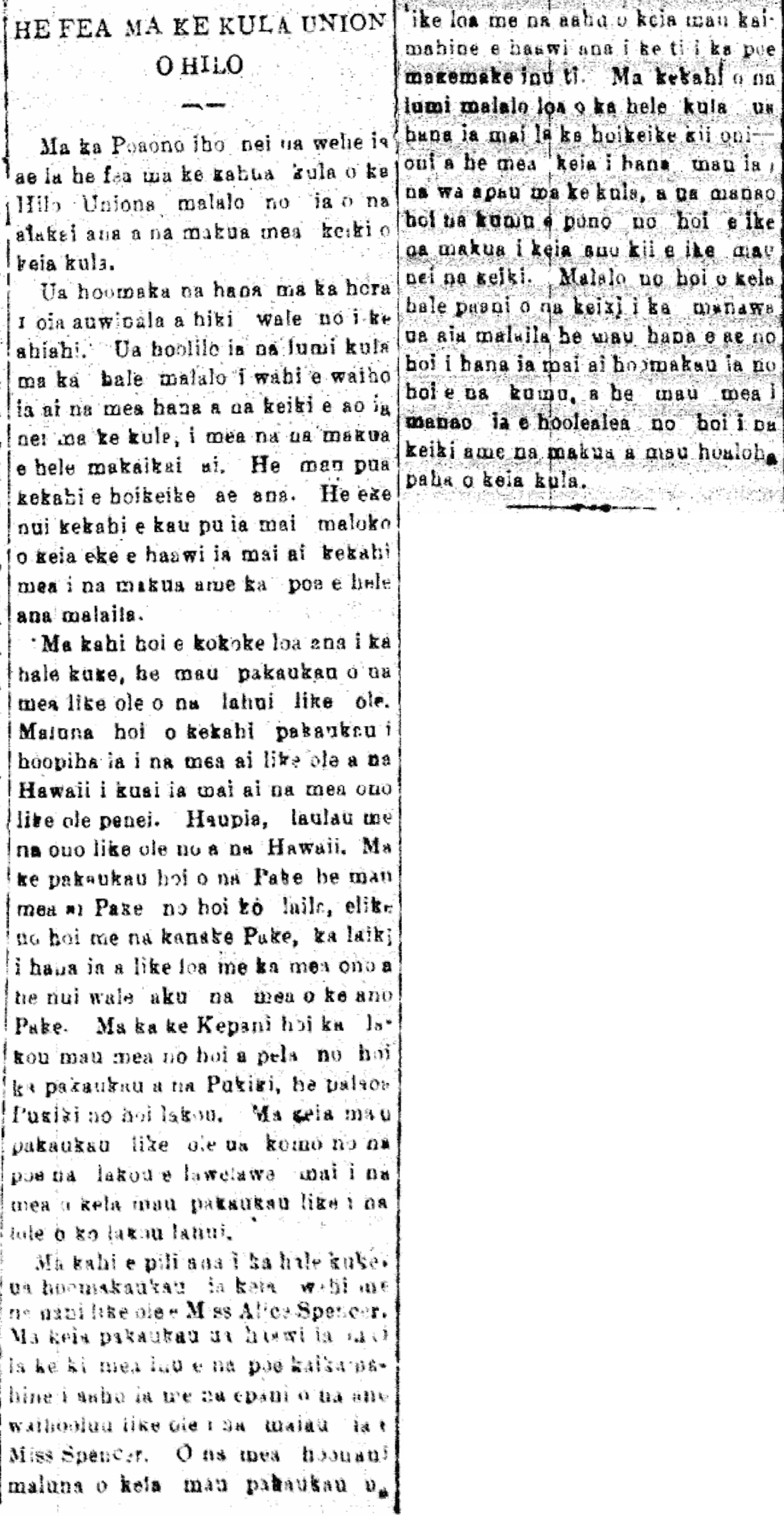
A FAIR AT HILO UNION SCHOOL

This past Saturday there was held a fair on the school grounds of Hilo Union, under the direction of the parents of the students of this school.

The activities began at 1 in the afternoon until the evening. The classrooms on the first floor was where the work of the children being taught at that school were placed, so that the parents could view them. There were also flowers on display. There was also a large bag, and from within this bag an item was given to the the parents and the people who came.

In an area near the kitchen, there were tables of all sorts of goods from all the ethnicities. One of the tables was filled with all the many delicacies of the Hawaiians. Haupia, laulau, and the other good foods of the Hawaiians. On the table of the Chinese, there was Chinese foods like Chinese candy, rice made into sweets, and many other Chinese items. On the Japanese one, was Japanese goods, and so too with the Portuguese table, they had Portuguese bread. On all of these tables, the people taking care of the items were dressed in the clothing of their people.

Near the kitchen, there was a place decorated by Miss Alice Spencer. On this table, tea to drink was served by girls dressed in aprons of all colors skillfully [made?] by Miss Spencer. The decorations on these tables were identical to the clothes of the girls serving tea to those who wanted to drink tea. In one of the rooms all the way at the bottom of the school, a movie was shown, and this is something always done, and the teachers thought it would be good for the parents to see the type of movie seen all the time by the children. Below that play house of the children in times of rain, there were other activities to do, set up by the teachers, and it was thought that these activities would entertain the children, parents, and friends of this school.

[Just passed by Hilo Union the other day and thought I’d put this article up that I had put aside some time ago.]

(Hoku o Hawaii, 5/3/1927, p. 2)

HE FEA MA KE KULA UNION O HILO

Ka Hoku o Hawaii, Buke XX, Helu 49, Aoao 2. Mei 3, 1927.

The children are your future! 1909 / timeless.

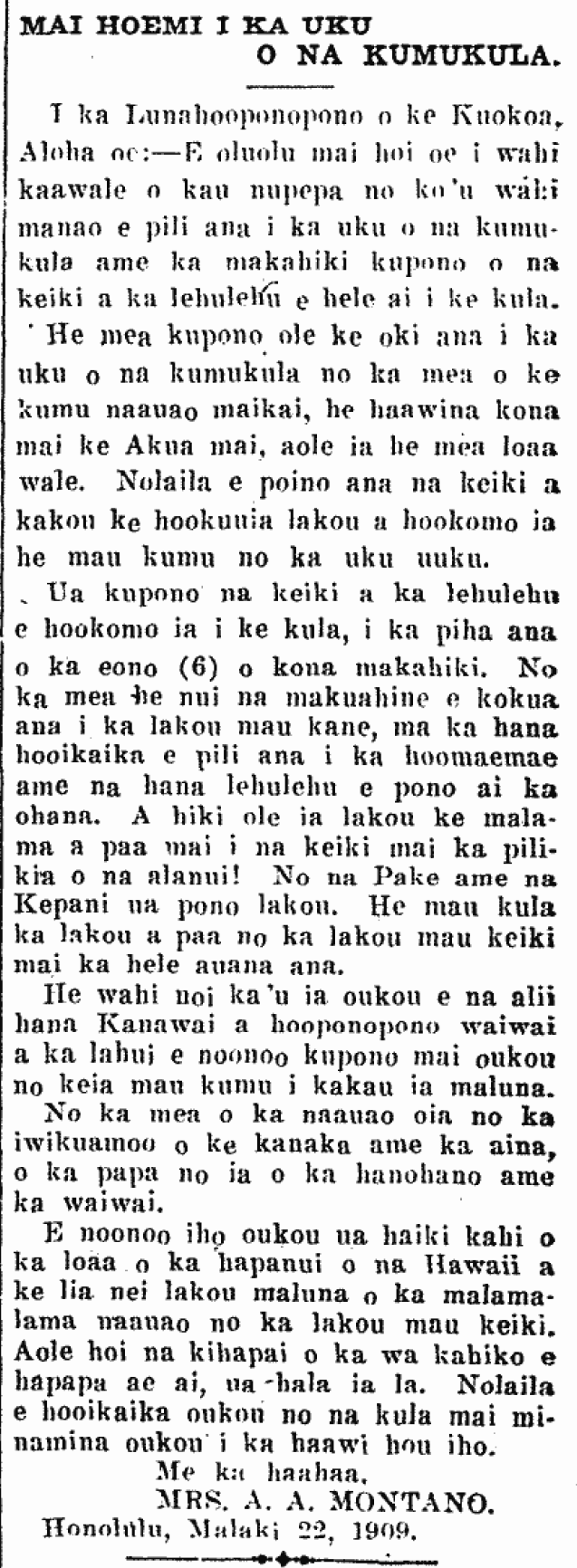
DON’T DECREASE THE PAY OF THE TEACHERS.

To the Editor of the Kuokoa, Aloha oe:—Please allow me some space in your newspaper for my humble thoughts dealing with the salary of teachers and the age at which children of the public should attend school.

It is wrong to cut the teachers’ pay because a well-educated teacher has a gift from God; it is not something readily gotten. And our children will be hurt should we let those teachers go and employ teachers for little pay.

The children of the people should be enrolled in school when they turn six (6) years of age. For there are many women who assist their husbands by endeavoring to take care of the many duties for the good of the family. And they are not able to care for and keep their children from the harm of the streets! As for the Chinese and the Japanese, they are fine. They have schools and their children are kept from wandering about.

I beseech all of you leaders who make Laws and who regulate public funds, do think carefully about these thoughts written above.

For knowledge is the backbone of man and his nation; it is the basis for fame and wealth.

Consider that the income of the majority of the Hawaiians is limited, and they are counting on the light of education for their children. The plantations of the old days are not to be reached out for, for those days are past. So all of you, please put effort into the schools, and don’t feel hesitant in investing more.

Sincerely,

MRS. A. A. MONTANO.

Honolulu, Malaki 22, 1909.

[Times have changed. Hopefully we learn from the past…

This letter is written by famed composer, Mary Jane Kekulani Montano.]

(Kuokoa, 3/26/1909, p. 4)

MAI HOEMI I KA UKU O NA KUMUKULA.

Ka Nupepa Kuokoa, Buke XLVI, Helu 13, Aoao 4. Maraki 26, 1909.

Response to hula commentary, 1891.

THE HULA AND THE “P. C. ADVERTISER.”

Another example of the “P. C. Advertiser’s” moral attitude appears int the announcement, that a hula given by the Hon. J. A. Cummins at his resident at Waimanalo was a glorious affair.—We have no doubt, that the display was exceptionally fine, since the ex-Premier has a well earned reputation as a connoiseur in that line, and is said to use the collection of females, formerly of boat house fame, second to none in the country.—Still there is something about the hula, that has so far excluded it from the programs of church festivals and school exercises.—It has never been recommended to lure the mind to thoughts of higher and better things or to produce rigid uprightness of morals.

The hula is a graceful and rhythmic representation of certain actions of the human animal. There is no doubt, that from the earliest ages the physiology of reproduction has been the most intrinsically interesting known to man. After the question of food and personal safety, it is the most important consideration in the lives of man, savage and civilized. The Hindoos and Budhists covered their temples and public buildings with indecent pictures, which in some instances took the form of a cross. This was imported to Rome together with the worship of Isis. So every spire on a Christian Church represents a resurrection of the flesh. But civilized society has decided for good reason to cover Isis with a vail and put Osiris in a straight-jacket. It is only those, who believe in the infallibility and prerogatives derived from gold—as some of our friends—who may wish to go back to the first principles and have the hula taught as an accomplishment in our public schools, so that it might prove more attractive in catching a husband and certainly in domesticating him when caught, than the art of piano playing or embroidery. There are great posibilities in the hula! But at present it is prohibited by the law, and we are sorry to see the law violated by those who ought to know better.

(Leo o ka Lahui, 5/14/1891, p. 4)

THE HULA AND THE "P. C. ADVERTISER."

Ka Leo o ka Lahui, Buke II, Helu 193, Aoao 4. Mei 14, 1891.

Introduction to the reminiscences of Hawaiian missionary James Kekela, 1901.

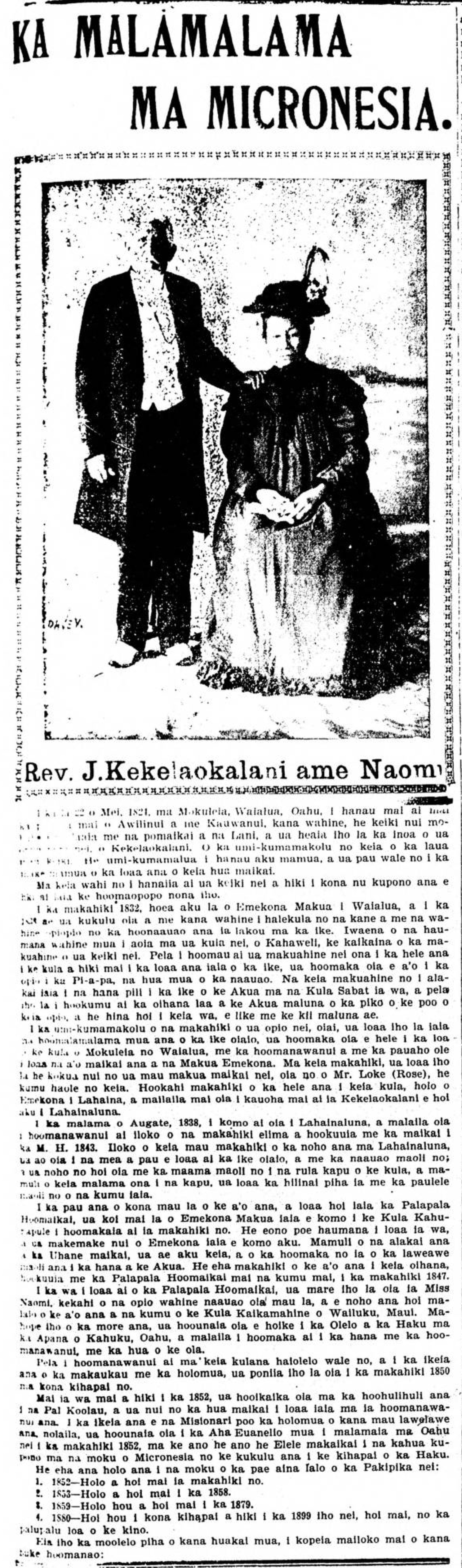
THE LIGHT IN MICRONESIA.¹

Rev. J. Kekelaokalani and Naomi

On the 22nd of May, 1821, at Mokuleia, Waialua Oahu, born of Awilinui and Kauwanui, his wife, was a big well filled-out baby with the blessings of the Heavens, and child was called by the name Kekelaokalani. This was the thirteenth of their children. Twelve were born prior, and with the [unclear phrase] of that fine offspring.

It was here that that child was raised until he was capable of understanding things for himself.

In the year 1832, Emerson, Sr. [Emekona Makua] arrived in Waialua, and in the following 1833 [unclear] he built a schoolhouse with his wife for the young men and women to enlighten them with knowledge. From among the first women to be taught there at that school was Kahaweli, the younger sister of the mother of that child. And following her, his mother as well attended the school until she was educated; and she began teaching the children the alphabet [Pi-a-pa], the beginnings of knowledge. It was this mother who guided him at that time in the knowledge about God and Sunday School, and it was thus that the sacred work of God was instilled a top the fontanel of the head [piko o ke poo] of this child, which is silver now, as in the picture above.

When that child was thirteen years old, being that he had received the beginnings of the light of true knowledge, he began to travel the width of the plain of Mokuleia for Waialua, with patience and without exhaustion, to receive the good teachings of the elder Emersons. In this year, those fine elders got great help in the form of Mr. Rose (Loke), a haole teacher. After one year of attending this school, Emerson went to Lahaina, and from there he told Kekelaokalani to come to Lahainaluna.

In August 1838, he entered Lahainaluna, and there he patiently remained for five years and he graduated in the year 1843. During those years at Lahainaluna, he learned everything about the true knowledge, as well as actual knowledge; and he remained, following the rules of the school, and as a result of his following the rules, he gained the full trust and total faith of the teachers.

After his days of learning were over, and he received his Diploma [Palapala Hoomaikai], Emerson, Sr. encouraged him to join the school for the clergy [Kula Kahunapule] that was started that very year. There were six students at the time, and Emerson wanted greatly for him to join. And because of the guidance of the righteous Spirit, he agreed, and so began his actual performing of the work of God. He spent four years at this work, and graduated with a Diploma from the teachers, in the year 1847.

When he received his Diploma, he married Miss Naomi, one of the educated young women of the time, and was living under the instruction of the teachers of the Girls’ School of Wailuku, Maui. After they were wed, he was sent to teach the Word of the Lord in the District of Kahuku, Oahu, and there he began his work with patience, with the word of life.

And he thus patiently continued as but a preacher; and when his readiness and progress was seen, he was ordained at his own parish.

From then until 1852, he strove to convert the Koolau Cliffs, and the fruits of his patience were many. When the head Missionaries saw his progress of his work, he was sent by the first Evangelical Convention held here on Oahu in the year 1852 as a Representative to travel to the places suitable to build parishes of the Lord in the Micronesian Islands.

He went to the islands of the South Pacific four times:

1. 1852—Went and returned that same year.

2. 1853—Went and returned in 1858.

3. 1859—Went again and returned in 1879.

4. 1880—Returned to his parish until this past year 1899, and came back, in feeble health.

Here is the entire story of his first excursion, copied from his journal:

[A long account follows. Perhaps i will post it here one of these days…]

¹Kekela was based in the Marquesas Islands, and not the Micronesian Islands.

(Kuokoa, 1/18/1901, p. 5)

KA MALAMALAMA MA MICRONESIA.

Ka Nupepa Kuokoa, Buke XXXIX, Helu 3, Aoao 5. Ianuari 18, 1901.