Duke on the American Olympic Team, 1912.

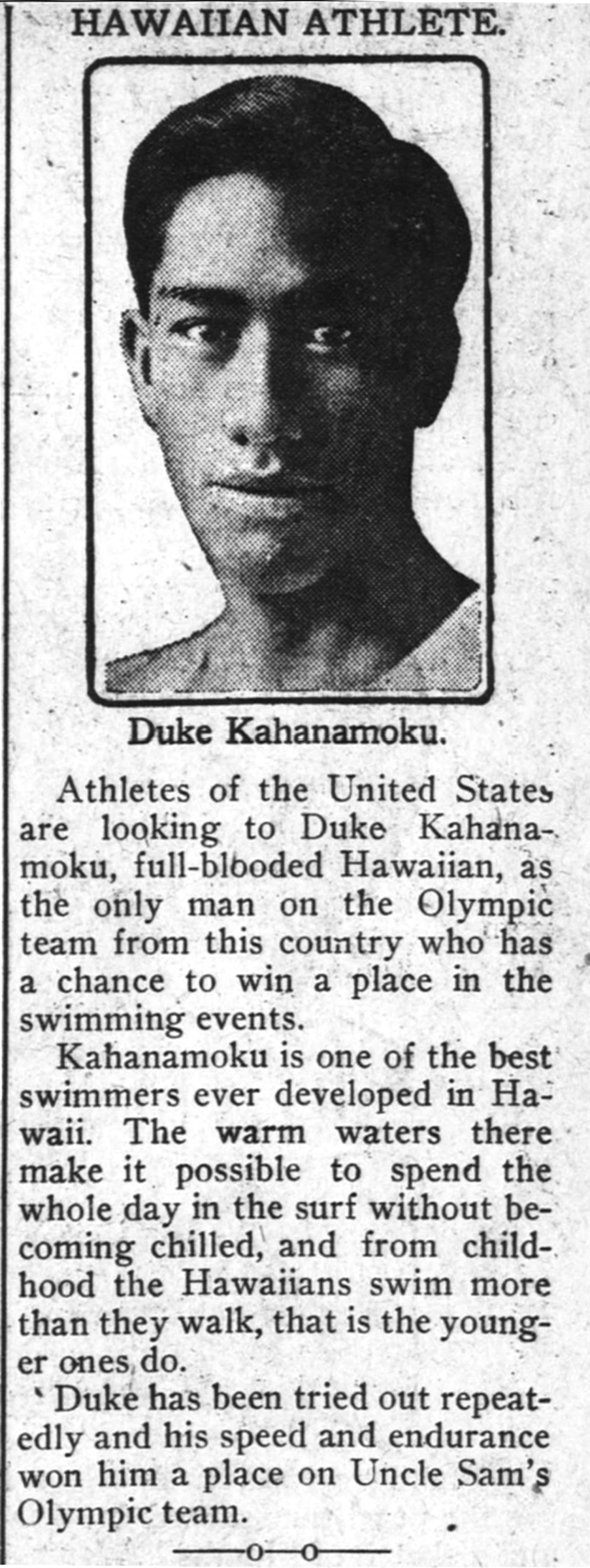
HAWAIIAN ATHLETE.

Duke Kahanamoku.

Athletes of the United States are looking to Duke Kahanamoku, full-blooded Hawaiian, as the only man on the Olympic team from this country who has a chance to win a place in the swimming events.

Kahanamoku is one of the best swimmers ever developed in Hawaii. The warm waters there make it possible to spend the whole day in the surf without becoming chilled, and from childhood the Hawaiians swim more than they walk, that is the younger ones do.

Duke has been tried out repeatedly and his speed and endurance won him a place on Uncle Sam’s Olympic team.

(Day Book, 7/3/1912, p. 29)

HAWAIIAN ATHLETE.

The Day Book, Volume 1, Number 240, Page 29. July 3, 1912.

Restoration Day celebration, day number 3! 1844.

THIRD DAY, AUGUST 2D.

At 4 o’clock, P. M., the guests re-assembled at Mauna Kilika, and formed in nearly the same order of procession as the day before; being this day joined by the ladies of His Majesty’s naturalized subjects—Executive officers—to whom places were courteously assigned, immediately succeeding their Majesties. On this day, no order prescribed the dresses of the ladies, and they consulted their own fanices. The display was rich, and, in contrast with the uniforms of the soldiery, pleasing and highly creditable to their tastes. The entertainment went off with great spirit, and the utmost good humor prevailed. After the regular toasts to their Majesties, the King and Queen, to the Premier, and high officers of State, were given, others rapidly followed, succeeded by short and pithy addresses, which occasioned great applause. On this occasion, the Hon. G. P. Judd, Governor Young, Mr. Ii, J. Ricord, Esq., and Mr. J. F. B. Marshall, spoke: the latter gentleman alluded, with great feeling, to the high commission with which he had been entrusted by His Majesty, the past year, and the respect with which the Envoys of His Majesty, had been received abroad; and concluded with the following sentiment:—

“A speedy return, and hearty welcome to Mess. Haalilio and Richards.”

The dinner was prolonged for several hours, and the house illuminated. In the evening, four veterans of the father of his present Majesty, were introduced, who having seated themselves before the King and Queen, and Premier, after the old Hawaiian custom, with their calabash drums between their legs, commenced a mele, accompanying their song with rapid, and very skillful, manipulations upon their drums, and gesticulations expressive of the sentiment of their song, which was commemorative of the deeds of his warrior father, and in praise of himself and the Premier. These men are almost the only ones remaining who understand the chanting of their ancient meles after this manner, and one of them, from nineteen years disuse, failed before the conclusion. Liholiho, in his reign, kept them constantly about his person, but the taste for their exercises, seems to have almost altogether declined, as but little interest was manifested, by the guests generally, in the performance. It was interesting, however, as a relic of the past, and from its analogy to a custom of the Celtic tribes of Europe, in their era of barbarism. The pleasures of the evening were not confined to the walls of the banqueting house; a numerous crowd was assembled outside, diverted by the music of the band.

At 8 o’clock, P. M. a salute was fired from Punch-bowl, with very grand effect [not legible because of fold in paper] cloud rested over the hill, and when the guns belched forth their thunder in quick succession, lighting up the hill by their flashes, and shaking the houses beneath with their heavy reverberations, it required no lively imagination to fancy that the old crater had awakened from its slumber of ages, and was about to pour a fiery flood upon the town beneath.

Soon after, the troops were re-formed, and His Majesty and the court proceeded to the house of the young chiefs, where the company were very agreeably entertained by Mr. and Mrs. Cooke, the teachers of the Royal children; and by the princes and princesses themselves, by their performances on the piano, and social music, both of which was highly creditable to themselves, and gratifying to their parents. The Royal party next proceeded to the mansion of the Hon. Secretary of State. The band assembled in front of the house, playing lively dancing tunes, while the officers of the troops formed themselves into groups and danced with great vigor and animation.

The effect by torch-light was peculiarly striking: all, at intervals waving their swords on high, and joined by the soldiers, giving utterance to deafening cheers, which were borne in the stillness of the night, far and wide.

After experiencing the hospitality of the lady of the Secretary of State, the procession re-formed and marched at quick step towards his Majesty’s residence. The cheering in their progress through the streets was loud and enthusiastic. At 10 o’clock the company took leave of their Majesties.

(Polynesian, 8/10/1844, p. 47)

THIRD DAY, AUGUST 2D.

The Polynesian, New Series, Volume 1,—Number 12, Page 47. August 10, 1844.

Restoration Day celebration, day number 2! 1844.

SECOND DAY OF THE FESTIVAL, AUGUST 1ST.

Thursday morning, Aug. 1st, at 10 o’clock A. M.—a procession was formed of all the juvenile members of temperance societies to the number of one thousand eight hundred of all ages and both sexes. They were well dressed, and divided into companies bearing appropriate banners, marching in couples to the fort, where they were joined by Their Majesties, the King and Queen, Her Royal Highness the Premier, and the chief nobles and officers of the court and kingdom. Attended by the military, they marched to the stone church, which was crowded to excess, inside and out; doors, windows and every available space being occupied by the eager multitude; and a more pleasing sight than so many happy children, (with their gratified parents) zealous in the noble cause of temperance, and sustained both by the precept and example of the highest magnates of their country, was never witnessed at these Islands. The King and Premier both addressed the audience, and their remarks were received with fixed attention. It was remarked that his Majesty spoke with much spirit and feeling and with a very happy…

(Polynesian, 8/10/1844, p. 46)

SECOND DAY OF THE FESTIVAL, AUGUST 1ST.

The Polynesian, New Series, Volume 1.—Number 12, Page 46. August 10, 1844.

…effect. Mr. Ii, of his Majesty’s Privy Council, then spoke, and commanded the attention of all present by his grace and eloquence. Mr. Ii is an orator by nature, and to native vigor of expression, adds the charm of polished and commanding action. We are sure, that none who understood the Hawaiian language, could fail of deriving great pleasure and profit from his remarks; and those who were unacquainted with it, scarcely less of the former from his peculiarly impressive manner. The address referred to the great and glorious change brought about by the adherence to the tee-total principle by the chiefs and people generally, and the striking contrast between the former periods of wild mis-rule and intemperance, and the bright days of order and prosperity that are now dawning upon the kingdom. All spoke with feeling, because it was a subject that came home to their hearts—bitter and sweet experience, both were theirs—the former, past—the latter, present. Dr. Winslow addressed the audience also, in some appropriate remarks and bestowed a high compliment upon the government and people, and also upon G. P. Judd, Esq., for the zeal and success with which he had labored in their cause. But want of space compells us to be brief. A temperance glee was sung by the young chiefs, accompanied by one of them on the piano, which afforded great satisfaction to their royal auditors. Rev. Mr. Armstrong asked the children if they were going to continue to keep the pledge. The thousands rose en masse, and made the lofty roof ring and ring again with their loud and enthusiastic “ae.” The whole exercises were of the most interesting nature, and we are happy to add, gave great pleasure to the strangers present. The procession then returned to the fort, and there dispersed.

At 4 o’clock, P. M., a procession was again formed at the Fort, to march to the Feast which was given to the subjects of His Majesty, in the same house as the day before. His Majesty’s household guards, in neat uniform—150 strong—headed the procession, commanded by Colonel Stephens; next came the band. Her Majesty, the Queen, supported by the King, and the Secretary of State. The Premier, attended by C. Kanaina and her pages, with kahilis. The Governess of Kauai, by Governor Young and Mr. Ii; the other female chiefs, according to their rank, attended by officers of the government, (on their right, the Royal standard bearers and guards: outside of them, and on both sides, His Majesty’s body guard) the governors, chiefs, and officers, generally, in full uniform, (the commanders of the soldiery, and the aids of Governor Kekuanaoa, on horseback,) and a long procession formed by those invited, (black being the costume of the ladies,) and escorted, on either side, by double files of soldiers, in white uniforms. The procession marched through the principal streets, which were crowded by the concourse of spectators, to Beretania, where the guests were seated at the feast, in nearly the same order as the day before. The first toast was

By Her Royal Highness, the Premier:—”His Hawaiian Majesty, Kamehameha III.”—”God save the King”, by the band;—21 guns, and [?????] cheers.

The second toast was

By the Secretary of State:—”Her Royal Highness, the Premier.” Music, and loud applause.

The third toast was

By the Attorney General:—”Her Majesty, Kalama, Queen of the Hawaiian Islands.” Music, and shouts of applause.

Great good humor prevailed, and toasts followed in quick succession.

His Majesty gave:—”The prospective King, Queen, Premier, and Rulers, of the Kingdom”,—which was received with loud cheers—three times three.

“The Hon. Secretary of State,”—”The Officers of the Government,”—”The absent Envoys, Messrs. Haalilio and Richards,”—and many other toasts, were drunk with great applause, and called forth several short, but spirited addresses.

“The Memory of ‘Kamehameha, the Great,'” standing, and in silence.

After remaining two hours at the table, His Majesty arose, the procession was reformed, and returned to the Fort, where the King was received with loud cheers by his subjects; after which the trops were dismissed, and the company dispersed.

(Polynesian, 8/10/1844, p. 47)

effect. Mr. Ii, of his Majesty's...

The Polynesian, New Series, Volume 1,—Number 12, Page 47. August 10, 1844.

Multi-day Restoration Day celebration! 1844.

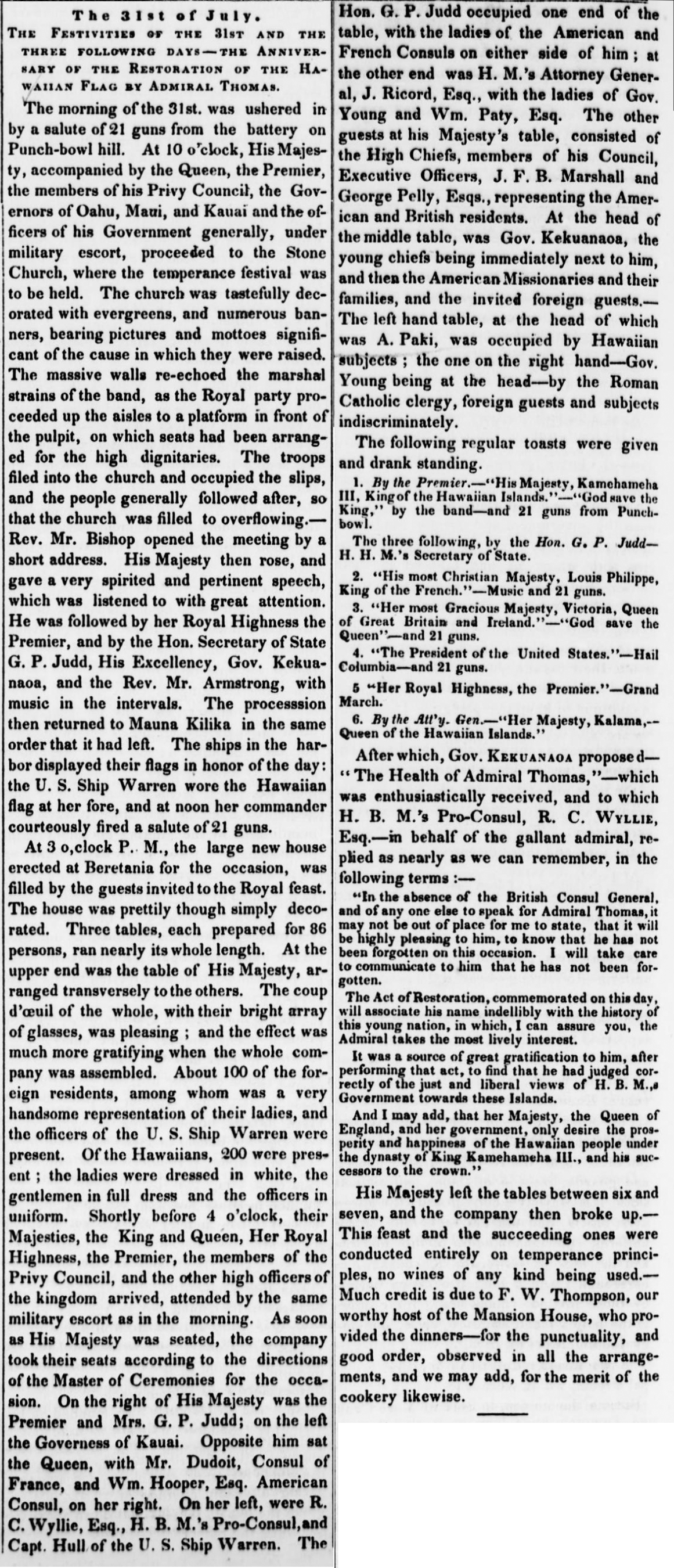
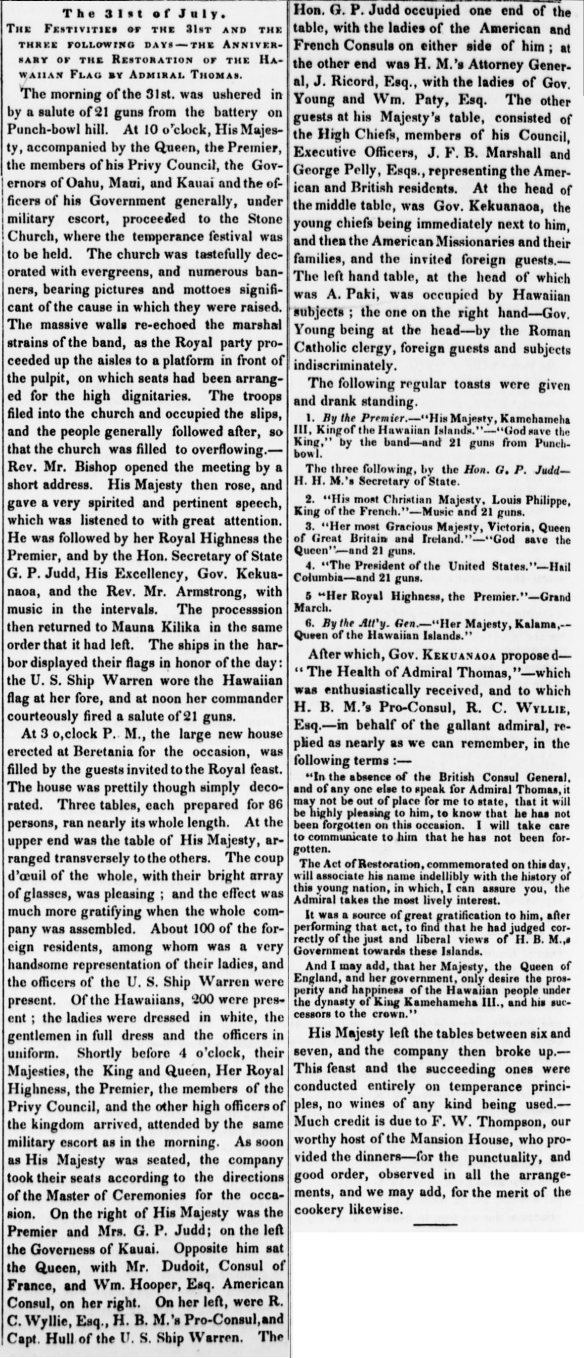
The 31st of July.

The Festivities of the 31st and the three following days—the Anniversary of the Restoration of the Hawaiian Flag by Admiral Thomas.

The morning of the 31st, was ushered in by a salute of 21 guns from the battery on Punch-bowl hill. At 10 o’clock, His Majesty, accompanied by the Queen, the Premier, the members of his Privy Council, the Governors of Oahu, Maui, and Kauai and the officers of his Government generally, under military escort, proceeded to the Stone Church [Kawaiahao Church], where the temperance festival was to be held. The church was tastefully decorated with evergreens, and numerous banners, bearing pictures and mottoes significant of the cause in which they were raised. The massive walls re-echoed the marshal strains of the band, as the Royal party proceeded up the aisles to a platform in front of the pulpit, on which seats had been arranged for the high dignitaries. The troops filed into the church and occupied the slips, and the people generally followed after, so that the church was filled to overflowing.—Rev. Mr. Bishop opened the meeting by a short address. His Majesty then rose, and gave a very spirited and pertinent speech, which was listened to with great attention. He was followed by her Royal Highness the Premier, and by the Hon. Secretary of State G. P. Judd, His Excellency, Gov. Kekuanaoa, and the Rev. Mr. Armstrong, with music in the intervals. The procession then returned to Mauna Kilika in the same order that it had left. The ships in the harbor displayed their flags in honor of the day: the U. S. Ship Warren wore the Hawaiian flag at her fore, and at noon her commander courteously fired a salute of 21 guns.

At 3 o’clock P. M., the large new house erected at Beretania for the occasion, was filled by the guests invited to the Royal feast. The house was prettily though simply decorated. Three tables, each prepared for 86 persons, ran nearly its whole length. At the upper end of the table of His Majesty, arranged transversely to the others. The coup d’œuil of the whole, with their bright array of glasses, was pleasing; and the effect was much more gratifying when the whole company was assembled. About 100 of the foreign residents, among whom was a very handsome representation of their ladies, and the officers of the U. S. Ship Warren were present. Of the Hawaiians, 200 were present; the ladies were dressed in white, the gentlemen in full dress and the officers in uniform. Shortly before 4 o’clock, their Majesties, the King and Queen, Her Royal Highness, the Premier, the members of the Privy Council, and the other high officers of the kingdom arrived, attended by the same military escort as in the morning. As soon as His Majesty was seated, the company took their seats according to the directions of the Master of Ceremonies for the occasion. On the right of His Majesty was the Premier and Mrs. G. P. Judd; on the left the Governess of Kauai. Opposite him sat the Queen, with Mr. Dudoit, Consul of France, and William Hooper, Esq. American Consul, on her right. On her left, were R. C. Wyllie, Esq., H. B. M.’s Pro-Consul, and Capt. Hull of the U. S. Ship Warren. The Hon. G. P. Judd occupied one end of the table, with the ladies of the American and French Consuls on either side of him; at the other end was H. M.’s Attorney General, J. Ricord, Esq., with the ladies of Gov. Young and William Paty, Esq. The other guests at his Majesty’s table, consisted of the High Chiefs, members of his Council, Executive Officers, J. F. B. Marshall and George Pelly, Esqs., representing the American and British residents. At the head of the middle table, was Gov. Kekuanaoa, the young chiefs being immediately next to him, and then the American Missionaries and their families, and the invited foreign guest.—The left hand table, at the head of which was A. Paki, was occupied by Hawaiian subjects; the one on the right hand—Gov. Young being at the head—by the Roman Catholic clergy, foreign guests and subjects indiscriminately.

The following regular toasts were given and drank standing.

1. By the Premier.—”His Majesty, Kamehameha III, King of the Hawaiian Islands.”—”God save the King,” by the band—and 21 guns from Punchbowl.

The three following, by the Hon. G. P. Judd—H. H. M.’s Secretary of State.

2. “His most Christian Majesty, Louis Philippe, King of the French.”—Music and 21 guns.

3. “Her most Gracious Majesty, Victoria, Queen of Great Britain and Ireland.”—”God save the Queen”—and 21 guns.

4. “The President of the United States.”—Hail Columbia—and 21 guns.

5. “Her Royal Highness, the Premier.”—Grand March.

6. By the Att’y. Gen.—”Her Majesty, Kalama,—Queen of the Hawaiian Islands.”

After which, Gov. Kekuanaoa proposed—”The Health of Admiral Thomas,”—which was enthusiastically received, and to which H. B. M.’s Pro-Consul, R. C. Wyllie, Esq.—in behalf of the gallant admiral, replied as nearly as we can remember, in the following terms:—

“In the absence of the British Consul General, and of any one else to speak for Admiral Thomas, it may not be out of place for me to state, that i will be pleasing to him, to know that he has not been forgotten on this occasion. I will take care to communicate to him that he has not been forgotten.

The Act of Restoration, commemorated on this day, will associate his name indellibly with the history of this young nation, in which, I can assure you, the Admiral takes the most lively interest.

It was a source of great gratification to him, after performing that act, to find that he had judged correctly of the just and liberal views of H. B. M.’s Government towards these Islands.

And I may add, that her Majesty, the Queen of England, and her government, only desire the prosperity and happiness of the Hawaiian people under the dynasty of King Kamehameha III., and his successors to the crown.”

His Majesty left the tables between six and seven, and the company then broke up.—This feast and the succeeding ones were conducted entirely on temperance principles, no wines of any kind being used.—Much credit is due to F. W. Thompson, our worthy host of the Mansion House, who provided the dinners—for the punctuality, and good order, observed in all the arrangements, and we may add, for the merit of the cookery likewise.

(Polynesian, 8/10/1844, p. 46.)
The 31st of July.

The Polynesian, New Series, Volume 1, Number 12, Page 46. August 10, 1844.
Red Cross knitting drive, 1917.

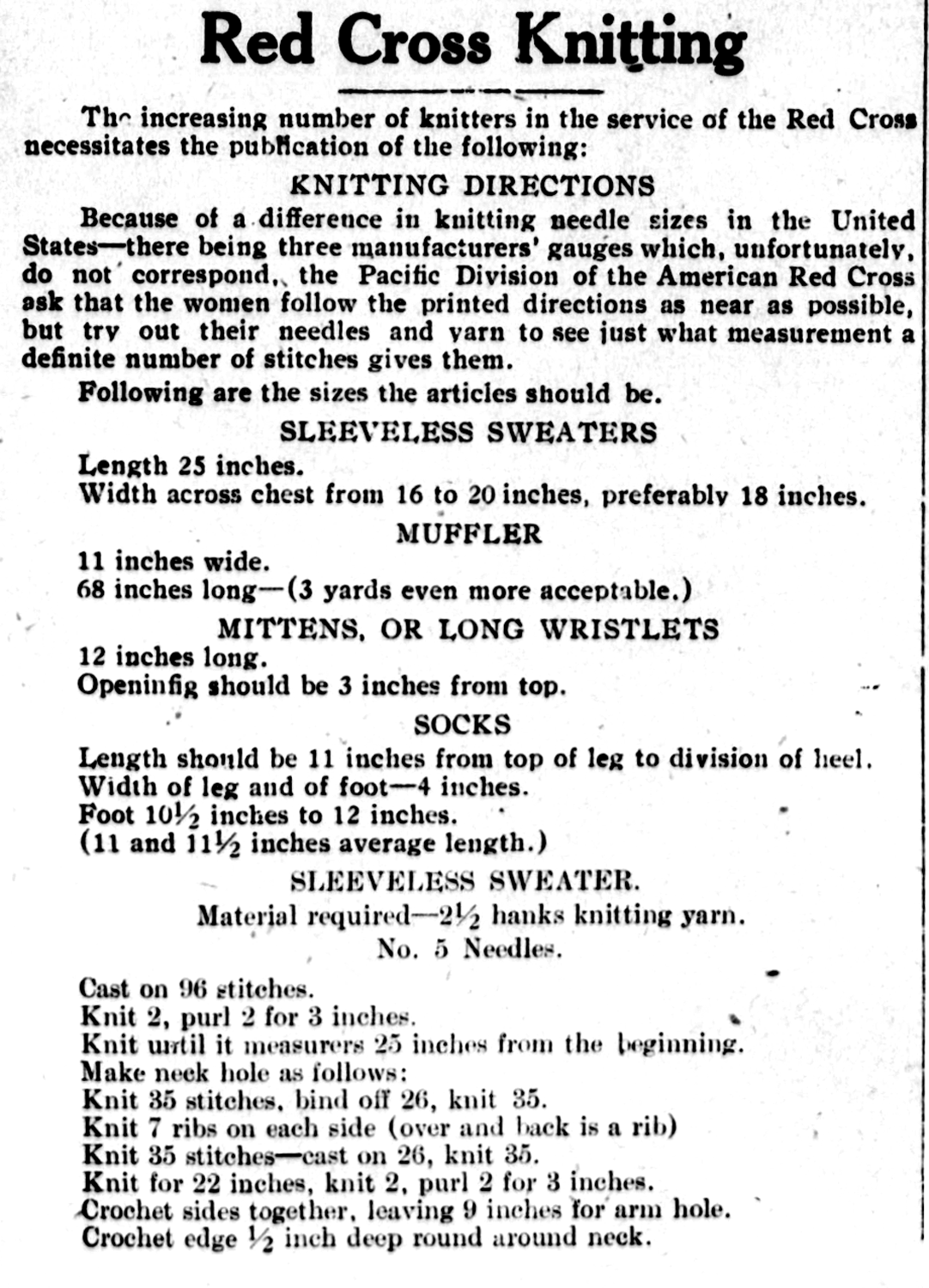
Red Cross Knitting

The increasing number of knitters in the service of the Red Cross necessitates the publication of the following:

KNITTING DIRECTIONS

Because of a difference in knitting needle sizes in the United States—there being three manufacturers’ gauges which, unfortunately, do not correspond, the Pacific Division of the American Red Cross ask that the women follow the printed directions as near as possible, but try out their needles and yarn to see just what measurement a definite number of stitches gives them.

Following are the sizes the articles should be.

SLEEVELESS SWEATERS

Length 25 inches.
Width across chest from 16 to 20 inches, preferably 18 inches.

MUFFLER

11 inches wide.
68 inches long—(3 yards even more acceptable.)

MITTENS, OR LONG WRISTLETS

12 inches long.
Openifig should be 3 inches from top.

SOCKS

Length should be 11 inches from top of leg to division of heel.
Width of leg and of foot—4 inches.
Foot 10½ inches to 12 inches.
(11 and 11½ inches average length.)

SLEEVELESS SWEATER.
Materials required—2½hanks knitting yarn.
No. 5 Needles.

Cast on 96 stitches.
Knit 2, purl 2 for 3 inches.
Knit until it measures 25 inches from the beginning.
Make neck hole as follows:
Knit 35 stitches, bind off 26, knit 35.
Knit 7 ribs on each side (over and back is a rib)
Knit 35 stitches—cast on 26, knit 35.
Knit for 22 inches, knit 2, purl 2 for 3 inches.
Crochet sides together, leaving 9 inches for arm hole.
Crochet edge ½ inch deep round around neck.

(Garden Island, 12/4/1917, p. 4)

Red Cross Knitting

The Garden Island, Volume 13, Number 49, Page 4. December 4, 1917.

Opeapea from Hilea, 1887.

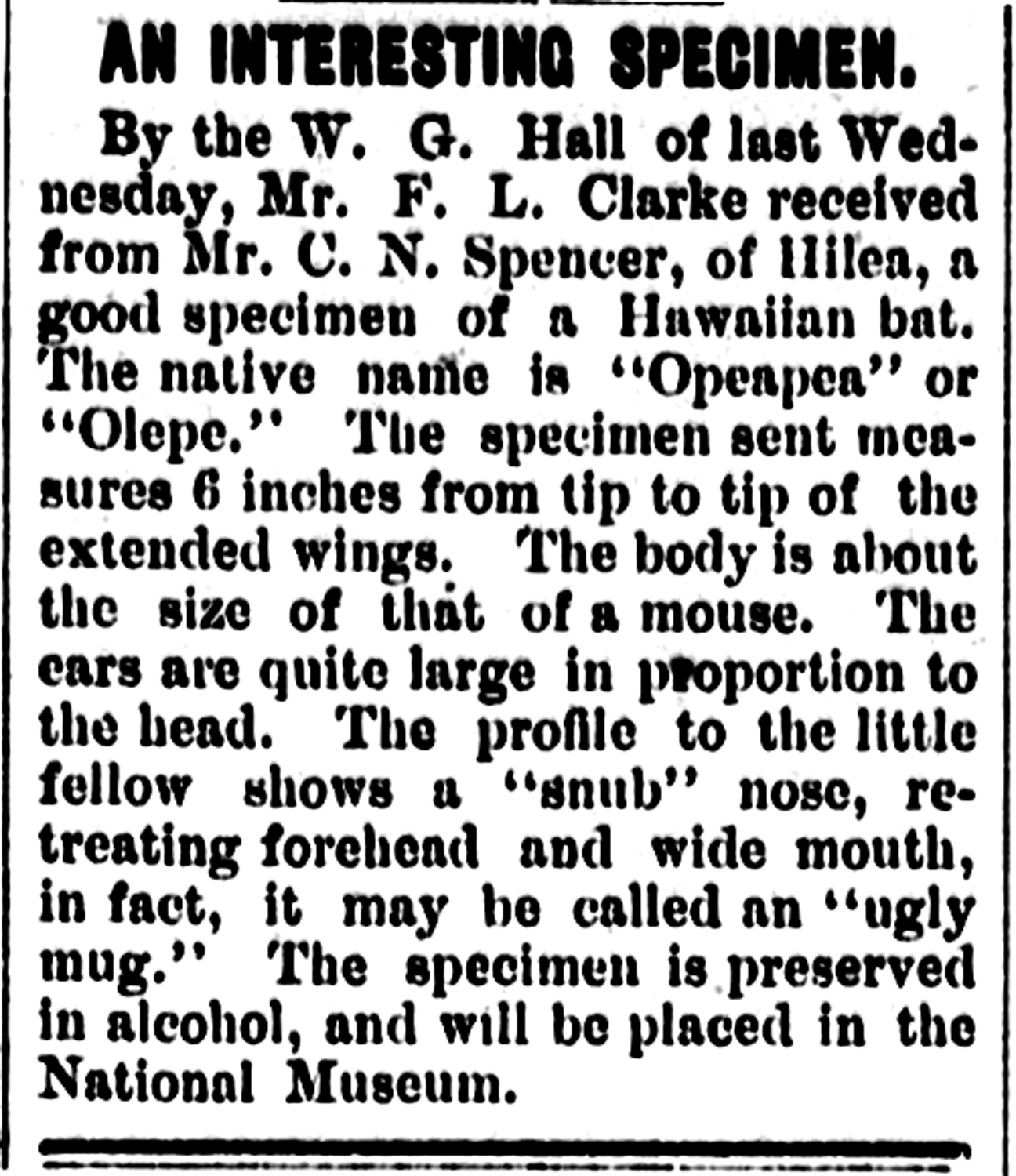
AN INTERESTING SPECIMEN.

By the W. G. Hall of last Wednesday, Mr. F. L. Clarke received from Mr. C. N. Spencer, of Hilea, a good specimen of a Hawaiian bat. The native name is “Opeapea” or “Olepe.” The specimen sent measures 6 inches from tip to tip of the extended wings. The body is about the size of that of a mouse. The ears are quite large in proportion to the head. The profile to the little fellow shows a “snub” nose, retreating forehead and wide mouth, in fact, it may be called an “ugly mug.” The specimen is preserved in alcohol, and will be placed in the National Museum.

(Daily Bulletin, 2/17/1887, p. 2)

AN INTERESTING SPECIMEN.

The Daily Bulletin, Volume XI, Number 1562, Page 2. February 17, 1887.

Pueo found in Kalihi, 1902.

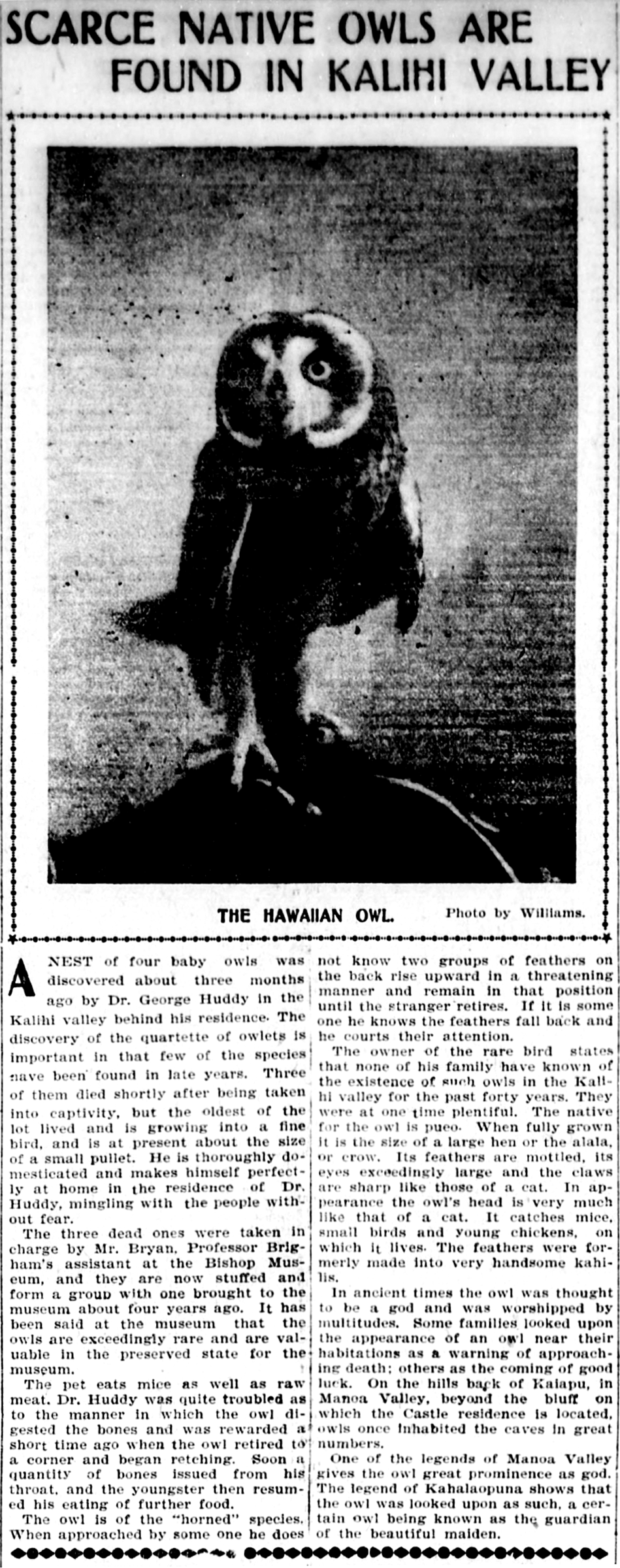
SCARCE NATIVE OWLS ARE FOUND IN KALIHI VALLEY

THE HAWAIIAN OWL.  Photo by Williams.

A NEST of four baby owls was discovered about three months ago by Dr. George Huddy in the Kalihi valley behind his residence. The discovery of the quartette of owlets is important in that few of the species have been found in late years. Three of them died shortly after being taken into captivity, but the oldest of the lot lived and is growing into a fine bird, and is at present about the size of a small pullet. He is thoroughly domesticated and makes himself perfectly at home in the residence of Dr. Huddy, mingling with the people without fear.

The three dead ones were taken in charge by Mr. Bryan, Professor Brigham’s assistant at the Bishop Museum, and they are now stuffed and form a group with one brought to the museum about four years ago. It has been said at the museum that the owls are exceedingly rare and are valuable in the preserved state for the museum.

The pet eats mice as well as raw meat. Dr. Huddy was quite troubled as to the manner in which the owl digested the bones and was rewarded a short time ago when the owl retired to a corner and began retching. Soon a quantity of bones issued from his throat, and the youngster then resumed his eating of further food.

The owl is of the “horned” species. When approached by some one he does not know two groups of feathers on the back rise upward in a threatening manner and remain in that position until the stranger retires. If it is some one he knows the feathers fall back and he courts their attention.

The owner of the rare bird states that none of his family have known of the existence of such owls in the Kalihi valley for the past forty years. They were at one time plentiful. The native for the owl is pueo. When fully grown it is the size of a large hen or the alala, or crow. Its feathers are mottled, its eyes exceedingly large and the claws are sharp like those of a cat. In appearance the owl’s head is very much like that of a cat. It catches mice, small birds and young chickens, on which it lives. The feathers were formerly made into very handsome kahilis.

In ancient times the owl was thought to be a god and was worshipped by multitudes. Some families looked upon the appearance of an owl near their habitation as a warning of approaching death; others as the coming of good luck. On the hills back of Kalapu, in Manoa Valley, beyond the bluff on which the Castle residence is located, owls once inhabited the caves in great numbers.

One of the legends of Manoa Valley gives the owl great prominence as god. The legend of Kahalaopuna shows that the owl was looked upon as such, a certain owl being known as the guardian of the beautiful maiden.

[Does anyone know of kahili made with pueo feathers?]

(Hawaiian Gazette, 2/11/1902, p. 5)

SCARCE NATIVE OWLS ARE FOUND IN KALIHI VALLEY

Hawaiian Gazette, Volume XXXVII, Number 12, Page 5. February 11, 1902.


Hawaii Ponoi Society performance, 1907.

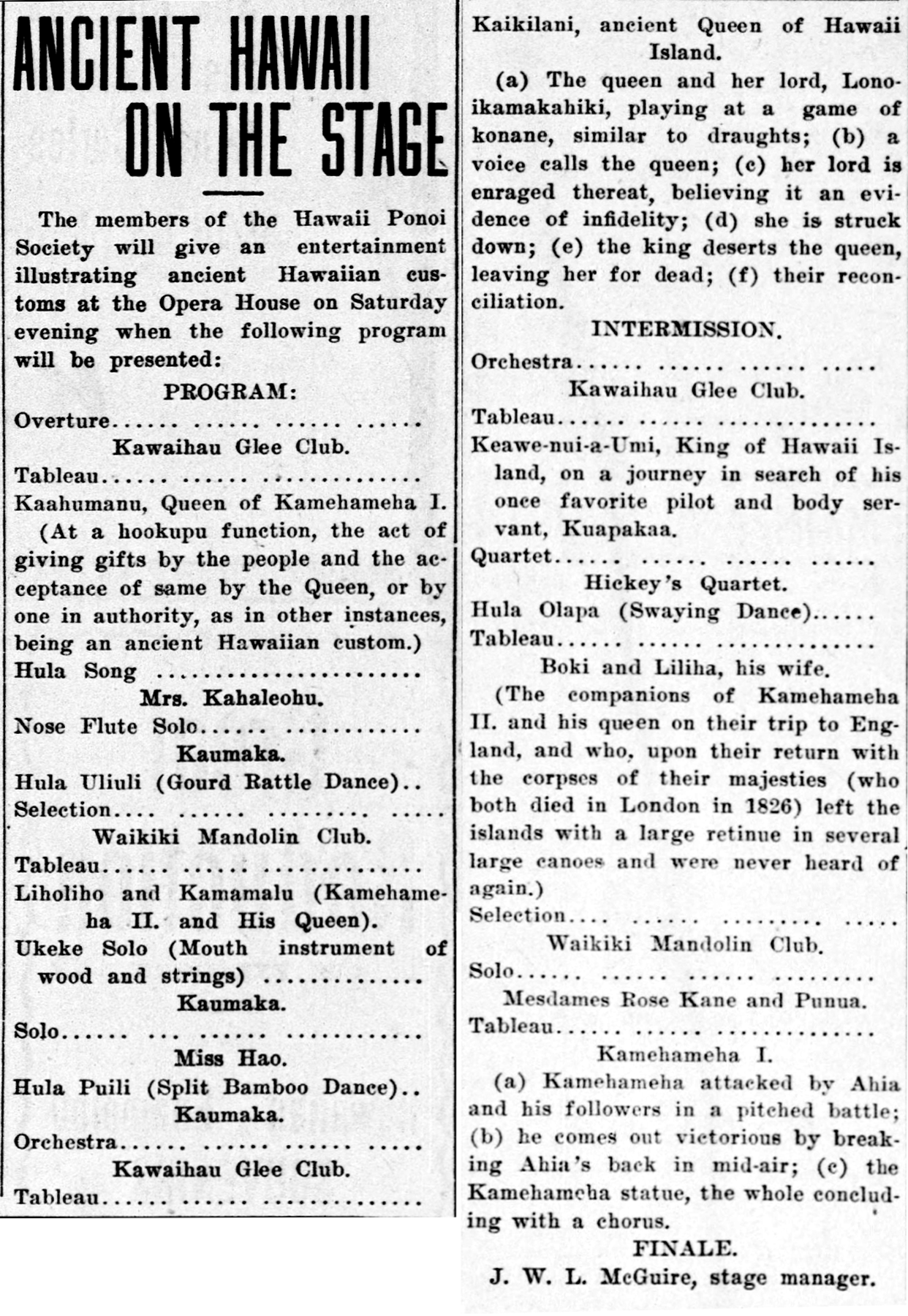
ANCIENT HAWAII ON STAGE

The members of the Hawaii Ponoi Society will give an entertainment illustrating ancient Hawaiian customs at the Opera House on Saturday evening when the following program will be presented:

PROGRAM:

Overture

Kawaihau Glee Club

Tableau

Kaahumanu, Queen of Kamehameha I.

(At a hookupu function, the act of giving gifts by the people and the acceptance of same by the Queen, or by one in authority, as in other instances, being an ancient Hawaiian custom.)

Mrs. Kahaleohu.

Nose Flute Solo

Kaumaka.

Hula Uliuli (Gourd Rattle Dance)

Selection

Waikiki Mandolin Club.

Tableau

Liholiho and Kamamalu (Kamehameha II. and His Queen).

Ukeke Solo (Mouth instrument of wood and strings)

Kaumaka.

Solo

Miss Hao.

Hula Puili (Split Bamboo Dance)

Kaumaka.

Orchestra

Kawaihau Glee Club.

Tableau

Kaikilani, ancient Queen of Hawaii Island.

(a) The queen and her lord, Lonoikamakahiki, playing at a game of konane, similar to draughts; (b) a voice calls the queen; (c) her lord is enraged thereat, believing it an evidence of infidelity; (d) she is struck down; (e) the king deserts the queen, leaving her for dead; (f) their reconciliation.

INTERMISSION.

Orcestra

Kawaihau Glee Club.

Tableau

Keawe-nui-a-Umi, King of Hawaii Island, on a journey in search of his once favorite pilot and body servant, Kuapakaa.

Quartet

Hickey’s Quartet.

Hula Olapa (Swaying Dance)

Tableau

Boki and Liliha, his wife.

(The companions of Kamehameha II. and his queen on their trip to England, and who, upon their return with the corpses of their majesties (who both died in London in 1826) left the islands with a large retinue in several large canoes and were never heard of again.)

Waikiki Mandolin Club.

Solo

Mesdames Rose Kane and Punua.

Tableau

Kamehameha I.

(a) Kamehameha attacked by Ahia and his followers in a pitched battle; (b) he comes out victorious by breaking Ahia’s back in mid-air; (c) the Kamehameha statue, the whole concluding with a chorus.

FINALE.

J. W. L. McGuire, stage manager.

(Pacific Commercial Advertiser, 3/15/1907, p. 6)

ANCIENT HAWAII ON THE STAGE

The Pacific Commercial Advertiser, Volume XLV, Number 7675, Page 6. March 15, 1907.

Grand performance on Maui by the Hawaiian Woman’s Club, 1922.

“A Night in Hawaii” Will Prove a Beautiful Picture

Pageants wherein the characters will be clad in the costumes of the old days in Hawaii, tableaux, meles, singing of Hawaiian songs and melodies, instrumental music by Hawaiian musicians and just an interspersal of hula dancing by little folk to show really graceful and beautiful was the old dancing at its best, these go to make up the program which will be offered at the Territorial Building in Kahului, Saturday in “A Night in Hawaii” as arranged by and for the benefit of the Hawaiian Woman’s Club. The program, which is printed below gives promise of the best entertainment of its king that has been offered on this island.

Almost daily rehearsals have been held of late, especial attention having been given to the drilling of the children’s chorus in their songs and their parts, so much attention was not necessary of the older ones most of whom have participated in affairs of this kind before, but groups have worked here, and other groups there, and finally all of the groups have been brought together and welded into one great company for the coming performance.

Following the rendition of the program there will be a dance.

The Hawaiian Woman’s Club which is conducting the entertainment is a benevolent association of the Hawaiian women of Maui working in the interest of Hawaiians who may be in need of assistance such as the club can give. Something of its activities have been told previously, what it has done of the Kula Sanitarium when first organized, for the education of some of the young Hawaiians and in other directions. One of its latest good works was a generous contribution for a chapel for the home for non-leprous children of lepers at Kalihi, Oahu. In many directions it reaches out to do good and all profits of the entertainment will go in the carrying out of such purposes.

The program for Saturday night follows:

 I. OPENING CHORUS ….. “Eleile”

II. TABLEAU ….. Hawaiian Royalty

1. Queen Liliuokalani—”Makalapua” ….. Mrs. J. W. Kalua

2. Princess Kaiulani—”He Inoa No Kaiulani” ….. Mrs. H. H. Holt

3. Queen Emma—””Na Hala o Naui” ….. Mrs. George Hardy

Hula—Ida Long

4. Princess Pauahi Bishop—”Pauahi Lani” (Blest Type of Womanhood) ….. Mrs. C. C. Conradt

5. Queen Kaahumanu—”Kaahumanu” ….. Mrs. D. Kapohakimohewa

a. Kahili Bearers—Alice Allen, Elizabeth Wailehua.

6. King Kamehameha I.—”He Inoa No Kamehameha” ….. Mr. C. F. N. Rose

a. Attendants—Walter Garcia, Edward Wilson.

b. Hookupu bearers—David Kaumeheiwa, Kaiwi Moikeha.

III. HAWAIIAN MELES — ….. Kumanaiwa

1. A Mele to Kamehameha.

2. Ili.

3. Ukeke.

4. Uliuli.

IV. SONGS—

1. “Pua Mohala”

2. “Old Plantation”

Messrs. Charles Waiwaiole, John Waiwaiole, Kama Apo, George Kauwenaole

3. “No Moku o Hawaii”

Mrs. J. Waiwaiole, Mrs. Huakini Enos, Kama Apo, J. H. Waiwaiole

4. “Kuu Iini”

Mrs. A. Garcia

5. “Maid of Honolulu”

R. Plunkett, N. Opiopio, F. Robinson, J. Brown

V TABLEAU—

1. “Koni Au I Ka Wai”

Elizabeth Wailehua and Chorus

2. “Pulupe Nei Ili I Ke Anu”

Alice Allen and Chorus

3. Hula Olapa

a. Entrance Dance

b. “Emma Lani”

c. “Nani Wale I ka Mahina”

d. “Maia Lau Kapalili”

4. “Na Lei o Hawaii”

Hawaii—Alice Kia

Maui—Blanche Garcia

Oahu—Edna Alo

Kauai—Mary Kaumeheiwa

Molokai—Sophie Waiwaiole

Lanai—Jackie Rosario

Kahoolawe—Florence Kaumeheiwa

Niihau—Dollie Wilson

Molokai—Lei Dunn

5. “Sweet Lei Lehua”

Blanche Garcia and Chorus

6. “Palolo”

Hula by Paddy Bal

7. “Moani Keala”

Sophie Waiwaiole and Chorus

8. “Hawaii Ponoi”

9. “Star Spangled Banner”

“Hawaii”—Lei Dunn

“Uncle Sam”—Paddy Bal

(Maui News, 6/9/1922, p. 5)

"A Night in Hawaii" Will Prove a Beautiful Picture

Semi-Weekly Maui News, 22nd Year, Number 1173, Page 5.June 9, 1922.