Opening of the legislature a hundred years ago, 1913.

The Seventh Local Legislature of the Territory of Hawaii Opens.

Top from the left to right—E. J. McCandless, D. Kupihea, J. K. Paele, J. M. Poepoe, J. S. Kalakiela, Dr. A. Irwin, H. L. Kawewehi, E. K. Kaaua, John Wilcox, P. J. Goodness, C. K. Makekau, E. da Silva, C. H. Cooke, N. Watkins, S. S. Paxson, D. K. Kaupiko, W. R. Kinalea, A. Robertson, J. W. Asch, R. P. Spalding, J. K. Lota, G. P. Cooke, H. M. Kaniho, W. J. Sheldon, Vice-Speaker J. H. Coney, Speaker H. L. Holstein, E. Waiaholo, Dr. G. D. Huddy. Not included in this picture—A. F. Tavares and N. K. Lyman.

[Kuokoa 1913 should be “Buke XLIX” but the Volume number in this issue is mislabeled as “Buke L” and later issues are mislabeled as “Buke VL” and “Buke LI”. Eventually the rest of this year is labeled “Buke LI” and the following 1914 as a result is called “Buke LII”.

Hopefully one day soon the Hawaiian-Language Newspapers will be rescanned so we can see clearer images of pictures like these from its pages!]

(Kuokoa, 2/21/1913, p. 1)

Weheia Ke Kau Ehiku o Ka Ahaolelo Kuloko o Ke Teritore o Hawaii Nei

Ka Nupepa Kuokoa, Buke XLIX, Helu 8, Aoao 1. Feberuari 21, 1913.

More on Kaheleiki trial: “Something not to be forgotten.” 1863.

Voyage of the Hawaiian Chiefs to San Francisco.

This past Wednesday morning [4/15/1863], the Honorable C. Gordon Hopkins [Hapakini], John Ii [Ioane Ii], Kaisara Kapaakea [Caesar Kapaakea], and J. Koii Unauna, along with the one who is involved in the dispute for whom they went to testify for, namely Harry Kaheleiki, came to shore riding aboard the ship, Yankee; and we are pleased to report the public that they are in good health.

During the trial of Harry Kaheleiki in San Francisco, there were many witnesses strongly against him; however, with the arrival of the alii mentioned above, there was true testimony in favor of the accused, and the error of those who testified against him was clear. The newspapers of San Francisco were filled with thoughts of appreciation for this Nation sending witnesses at much expense to have one of its citizens wrongly charged in a foreign land set free; according to one of the papers, this is a benevolent act not done by the enlightened Nations of the world, and so the Hawaiian Nation has taken the lead in this fine action. This is truly an act of aloha, and it is something not to be forgotten for all times.

The reason it was heard that a Hawaiian was being imprisoned in San Francisco was because of Doctor Gulick [Gulika], the one who was previously living in the islands of Micronesia, and due to weakening health, arrived in California. While he was in San Francisco several months ago, he heard that there was a Hawaiian man being held in one of the Jails there on the charge of murder; he therefore went quickly to meet with the man, and when he got there, he spoke with the aforementioned Kaheleiki, and though this conversation, it was clear in Doctor Gulick’s mind that the accused was innocent. And because Kaheleiki asked him if they could wait until witnesses were sent for from Hawaii for him, there would be many who would testify that he was innocent of the charges against him. So Doctor Gulick immediately went to the office of the Hawaiian Consul, Mr. Hitchcock [Kanikela Hawaii o Mr. Hikikoki], and told him about the circumstances of Kaheleiki and how he was certain that Kaheleiki was innocent of the charges. When the Hawaiian Consul heard of this, he went at once to meet with the accused, and upon seeing his demeanor and what he had to say, he knew for himself that Kaheleiki was innocent. He then went quickly to see the Judge to ask that the trial of Kaheleiki be postponed until he heard from here; for he had witnesses here for him. And that is how time was given to send his witnesses, and that is how he was freed. And when he sent for witnesses here, along with a letter from Doctor Gulick, and when His Highness L. Kamehameha heard of this, he along with Sheriff W. C. Parke put great effort into finding appropriate witnesses to testify for Kaheleiki, the one who was falsely charged. We are filled with appreciation for the Royal One, His Highness, and the Sheriff.

We must thank Doctor Gulick, and we are truly thankful for him in the name of all who desire that the innocent who are persecuted be freed, and in the name of all who strive to find ways to free the innocent from the hands of those who oppose them, while they live in foreign lands. God shall free the righteous.

[There are countless stories like this in the Hawaiian-Language Newspapers that should be relearned and retold and retold again, so they are not forgotten!]

(Kuokoa, 4/18/1863, p. 3)

Ka Huakai a na 'Lii Hawaii i Kapalakiko.

Ka Nupepa Kuokoa, Buke II, Helu 16, Aoao 3. Aperila 18, 1863.

More on the Kaheleiki trial, 1863.

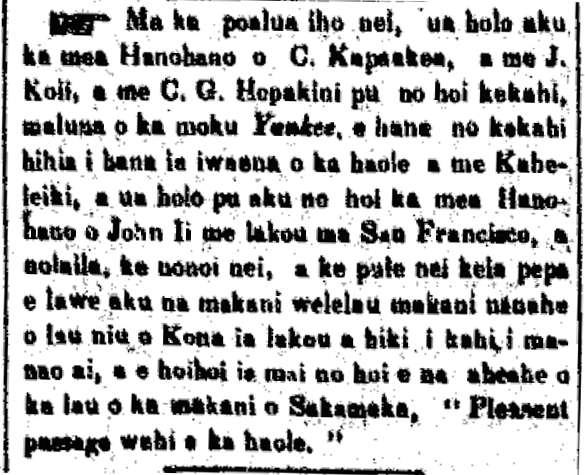
This past Tuesday [2/17/1863], the Honorable C. Kapaakea, and  J. Koii, and C. G. Hopkins also went aboard the ship Yankee, to appear in a case raised between the haole and Kaheleiki; the Honorable John Ii also accompanied them to San Francisco, and this paper hopes and prays that the fringes of the winds; the gentle winds of the coconut fronds of Kona take them to their destination, and that they are brought back by the soft puffs of the wind of Sakameka [? Sacramento]; “Pleasant passage,” according to the haole.

(Hoku o ka Pakipika, 2/19/1863, p. 2)

Ma ka poalua iho nei...

Ka Hoku o ka Pakipika, Buke 2, Helu 19, Aoao 2. Feberuari 19, 1863.

Mahalo to MAB for pointing to this article on the Kaheleiki trial, 1863.

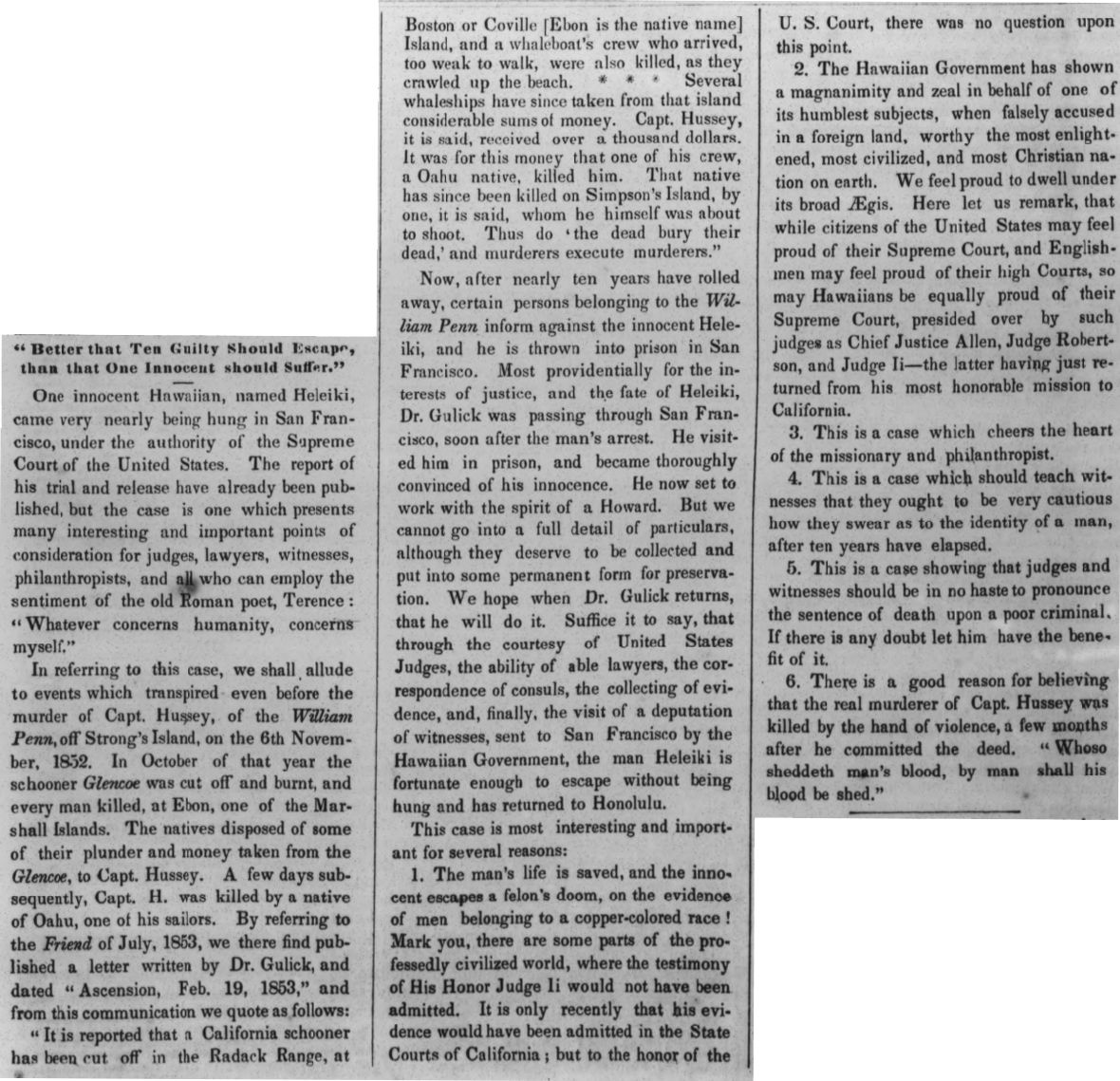
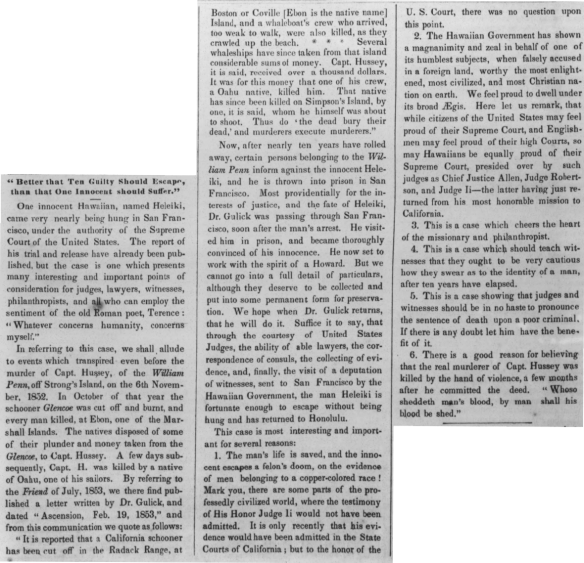
“Better that Ten Guilty Should Escape, than that One Innocent should Suffer.”

One innocent Hawaiian, named Heleiki, came very nearly being hung in San Francisco, under the authority of the Supreme Court of the United States. The report of his trial and release have already been published, but the case is one which presents many interesting and important points of consideration for judges, lawyers, witnesses, philanthropists, and all who can employ the sentiment of the old Roman poet, Terence: “Whatever concerns humanity, concerns myself.”

In referring to this case, we shall allude to events which transpired even before the murder of Capt. Hussey, of the William Penn, off Strong’s Island, on the 6th of November, 1852. In October of that year the schooner Glencoe was cut off and burnt, and every man killed, at Ebon, one of the Marshall Islands. The natives disposed of some of their plunder and money taken from the Glencoe, to Capt. Hussey. A few days subsequently, Capt. H. was killed by a native of Oahu, one of his sailors. By referring to the Friend of July, 1853, we there find published a letter written by Dr. Gulick, and dated “Ascension, Feb. 19, 1853,” and from this communication we quote as follows:

“It is reported that a California schooner has been cut off in the Radack Range, at Boston or Coville (Ebon is the native name) Island, and a whaleboat’s crew who arrived, too weak to walk, were also killed, as they crawled up the beach. * * * Several whaleships have since taken from that island considerable sums of money. Capt. Hussey, it is said, received over a thousand dollars. It was for this money that one of his crew, a Oahu native, killed him. That native has since been killed on Simpson’s Island, by one, it is said, whom he himself was about to shoot. Thus do ‘the dead bury their dead,’ and murderers execute murderers.”

Now, after nearly ten years have rolled away, certain persons belonging to the William Penn inform against the innocent Heleiki, and he is thrown into prison in San Francisco. Most providentially for the interests of justice, and the fate of Heleiki, Dr. Gulick was passing through San Francisco, soon after the man’s arrest. He visited him in prison, and became throughly convinced of his innocence. He now set to work with the spirit of a Howard. But we cannot go into a full detail of particulars, although they deserve to be collected and put into some permanent form for preservation. We hope when Dr. Gulick returns, that he will do it. Suffice it to say, that through the courtesy of United States Judges, the ability of able lawyers, the correspondence of consuls, the collecting of evidence, and, finally, the visit of a deputation of witnesses, sent to San Francisco by the Hawaiian Government, the man Heleiki is fortunate enough to escape without being hung and has returned to Honolulu.

This case is most interesting and important for several reasons:

1. The man’s life is saved, and the innocent escapes a felon’s doom, on the evidence of men belonging to a copper-colored race! Mark you, there are some parts of the professedly civilized world, where the testimony of His Honor Judge Ii would not have been admitted. It is only recently that his evidence would have been admitted in the State Courts of California; but to the honor of the U. S. Court, there was no question upon this point.

2. The Hawaiian Government has shown a magnanimity and zeal in behalf of one of its humblest subjects, when falsely accused in a foreign land, worthy the most enlightened, most civilized, and most Christian nation on earth. We feel proud to dwell under its broad Ægis. Here let us remark, that while citizens of the United States may feel proud of their Supreme Court, and Englishmen may feel proud of their high Courts, so may Hawaiians be equally proud of their Supreme Court, presided over by such judges as Chief Justice Allen, Judge Roberson, and Judge Ii—the latter having just returned from his most honorable mission to California.

3. This is a case which cheers the heart of the missionary and philanthropist.

4. This is a case which should teach witnesses that they ought to be very cautious how they swear as to the identity of a man, after ten years have elapsed.

[See earlier article: Government officials to go to California to defend a Hawaiian citizen. 1863.]

(Friend, 5/1/1863, p. 33)
"Better that Ten Guilty Should Escape, than that One Innocent should Suffer."

The Friend, New Series, Volume 12, Number 5, Page 33. May 1, 1863.

Government officials to go to California to defend a Hawaiian citizen. 1863.

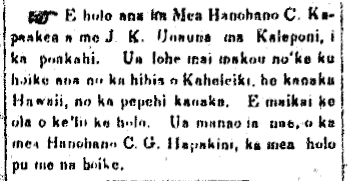
The Honorable C. Kapaakea and J. K. Unauna are headed to California on Monday. We have heard it is to serve as witness in the murder case of Kaheleiki, who is a Hawaiian. May the alii going remain in good health. It is however believed that the Honorable C. G. Hopkins [Hapakini] will accompany the witnesses.

(Hoku o ka Pakipika, 2/5/1863, p. 2)

E holo ana ka Mea Hanohano C. Kapaakea...

Ka Hoku o ka Pakipika. Buke 2, Helu 17, Aoao 2. Feberuari 5, 1863.

More from Puheemiki on C. Strawn in Kalawao, 1883.

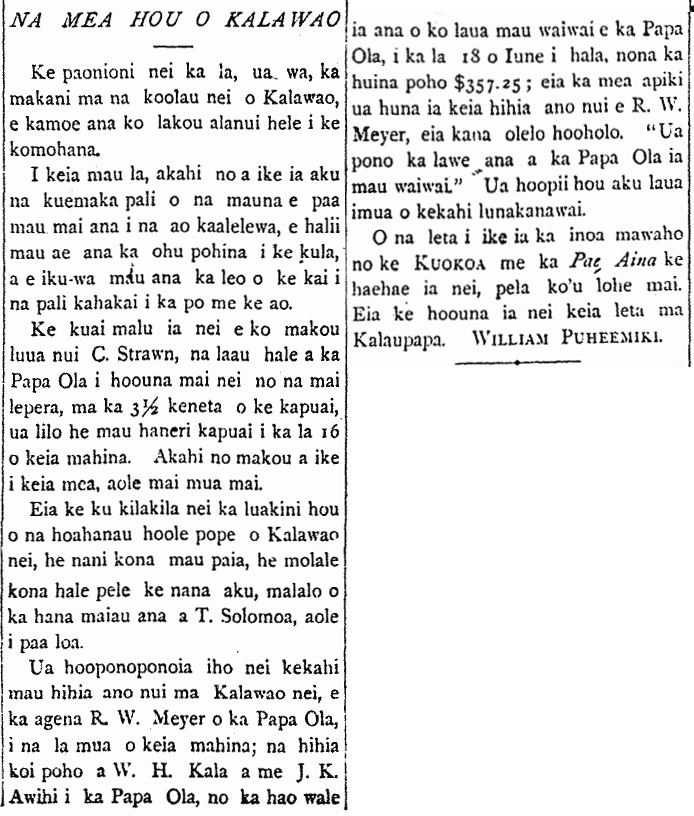
THE NEWS OF KALAWAO

The sun is shining; this wind is howling in the Koolau of Kalawao; their path lies to the west.

These days, it is the first time the brows of the cliffs of the mountains have been sighted, which are constantly blocked by floating clouds; the fields are constantly covered by gray mist; and the voice of the ocean constantly roars in the sea cliffs both night and day.

Our superintendent, C. Strawn, is secretly selling the house lumber that the Board of Health sent for the patients, at 3½ cents per yard, and hundreds of yards were sold on the 16th of this month. We just found out about this, we didn’t know from earlier.

The new church of the protestant brethren of Kalawao stands proudly, her walls are beautiful, and her bell tower is stands unobstructed; this was done skillfully under T. Solomoa [T. Solomona], but it is not completed.

Some major problems here in Kalawao were remedied by the agent of the Board of Health, R. W. Meyer, earlier this month; the claim for damages by W. H. Kala and J. K. Awihi against the Board of Health, for the seizing of their property by the Board of Health on the 18th of this past June, totaling $357.25; here is the deceitful thing: this important claim was hidden away by R. W. Meyer, and this was his decision. “The Board of Health was justified in the seizing of this property.” They two of them filed suit once again before a judge.”

Letters seen addressed outside to the Kuokoa or the Pae Aina¹ are torn apart; that is what I hear. This letter is being sent at Kalaupapa.  William Puheemiki.

[Does anyone know which Protestant church in Kalawao this would be being built in 1883?]

¹Ko Hawaii Pae Aina

(Kuokoa, 8/25/1883, p. 3)

NA MEA HOU O KALAWAO

Ka Nupepa Kuokoa, Buke XXII, Helu 34, Aoao 3. Augate 25, 1883.

Suicide in Kalawao, 1883.

HANGING IN KALAWAO.

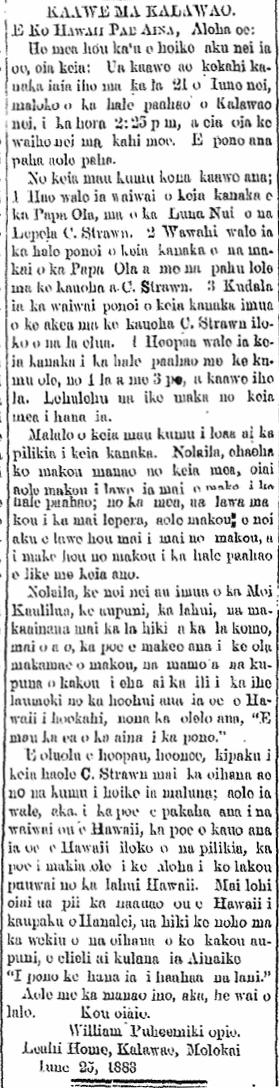
O Ko Hawaii Pae Aina, Aloha oe:

I have something to report to you, and that is this: A man hung himself on the 21st of this June, in the jail here in Kalawao, at 2:25 p. m., and he is now left to rest. Perhaps it will be set right, perhaps not.

Here is why he hung himself; 1. The estate of this man was confiscated by the Board of Health, the the superintendent of the Lepers, C. Strawn. 2. The residence of this man was torn down by the officers of the Board of health as well as his clothes trunk by the orders of C. Strawn. 3. The property of this man was auctioned off to the public by orders of C. Strawn over two days. 4. This man was imprisoned in the jail for no reason for 4 days and 3 nights, at which point he hung himself. There are many witnesses to what was done.

This is all why this man was troubled. And so we are pained by this, for we were not brought here to die in jail; because it is enough that we are inflicted with leprosy; we don’t wish for more sickness to befall us or for us to die again in jail like this.

Therefore I ask before King Kaulilua,¹ the nation, the lahui, the makaainana from where the sun rises to where it sets, from that side to this, those who care for our dear lives, the descendants of our kupuna who were wounded by the barbed spears to unify you O Hawaii as one, for whom is said, “E mau ke ea o ka aina i ka pono.”²

Please dismiss, transfer, and expell this haole C. Strawn from his job for the reasons shown above; and not just him, but those who plunder the wealth of you, O Hawaii; the people who drag you, O Hawaii into difficulties; and those who hold no aloha in their hearts for Hawaii. Don’t take your time, for your knowledge, O Hawaii, has climbed the heights of Hanalei, and you are qualified to occupy the highest positions of our government and be respected for your knowledge [e elieli ai kulana ia Ainaike.]

This is not said in spite, but for just cause [he wai o lalo]. Sincerely,

William Puheemiki, Jr.

Leahi Home, Kalawao, Molokai

June 25, 1883.

¹Kaulilua is another name for Kalakaua.

²”Ua mau ke ea o ka aina i ka pono,” is the famous proclamation of Kauikeaouli, Kamehameha III.

(Ko Hawaii Pae Aina, 7/7/1883, p. 4)

KAAWE MA KALAWAO.

Ko Hawaii Pae Aina, Buke VI, Helu 27, Aoao 4. Iulai 7, 1883.

New library to open, 1913.

CEREMONY WILL OPEN PUBLIC LIBRARY

All Invited to Attend Special Program Tomorrow Afternoon

Governor Frear will be the first patron of the new Carnegie Library. He will receive Registration Card No. 1, and will be the first to enter the big building when it is formally thrown open to the public tomorrow afternoon.

Unique and appropriate exercises will characterize the formal opening of the library tomorrow. The program for the exercises was completed yesterday afternoon by A. Lewis, Jr., president of the board of library trustees, Secretary W. H. Babbitt and other members of the board. The splendid new building, made possible by Andrew Carnegie’s gift of $100,000, will be the scene of a notable gathering.

With Mr. Lewis and Governor Frear as the central figures in the ceremony, the program will begin at 3 o’clock, when the Royal Hawaiian Band, arranged for by Secretary Babbitt and Mayor Fern, begins an hour of music.

At four o’clock the ceremony proper will begin. Mr. Lewis will make a short address appropriate to the occasion and will then introduce Prof. M. M. Scott, principal of McKinley High School, who has been prominent in the work for the new library. Chairman Lewis will then, as president of the library board, give to Governor Frear Card No. 1. Then the chairman will unlock the big front doors of the building and will escort Governor Frear inside. According to the little ceremony arranged, the governor will then proceed to the central desk and will be met by Miss Edna I. Allyn, the librarian, who will issue to the executive the first book from the new institution.

As soon as the governor has entered, the public will follow, the entire library building being open to visitors, with the assistant librarians and employees detailed as escorts.

The Outdoor Circle of the Kilohana Club has furnished a number of beautiful palms and ferns with which the interior will be decorated.

Registration cards will be generally issued tomorrow and intending patrons of the library can sign the cards and be enrolled from four to six o’clock.

The new library, it is emphasized by the board of trustees, is absolutely free to everyone and books will be issued upon presentation of the properly signed registration card. There is also a traveling library feature, the committee on which is headed by Robbins B. Anderson.

[Tomorrow will be a hundred years since the library opened! See the many related activities going on in commemoration of this great historical event! It seems that the Royal Hawaiian Band will be there tomorrow morning to celebrate just as they did a hundred years ago!!

I am not sure why I could not find an article in the Hawaiian-Language Newspapers announcing this opening. But there is this from a couple of years later!]

(Honolulu Star-Bulletin, 1/31/1913, p. 1)

CEREMONY WILL OPEN PUBLIC LIBRARY

Honolulu Star-Bulletin, Volume XX, Number 6499, Page 1. January 31, 1913.

CEREMONY WILL OPEN LIBRARY

Honolulu Star-Bulletin, Volume XX, Number 6499, Page 4. January 31, 1913.

Death announcement for John W. Moanauli, 1913.

THE HONORABLE MOANAULI PASSES.

He Grew Weary of this Life at His Daughter’s Place in Waikiki.

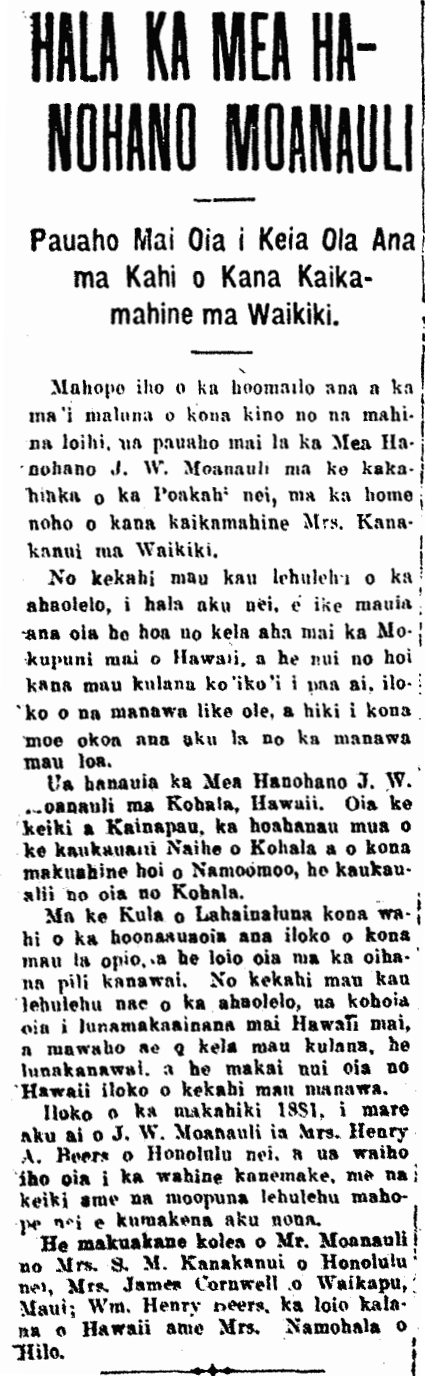
After many months of his body growing thinner with sickness, the Honorable J. W. Moanauli passed away, this Monday morning at the home of this daughter, Mrs. Kanakanui, in Waikiki.

He was seen for many sessions of the legislature in the past, a representative from the island of Hawaii; and there were many important positions that he held during various times, up until he went to sleep for all times.

The Honorable Moanauli was born in Kohala, Hawaii. He was the child of Kainapau, the first cousin of the kaukau alii Naihe of Kohala, and his mother was Namoomoo, who was a kaukau alii from Kohala.

It was at Lahainaluna School where he was educated during his youth, and he was a lawyer practicing law. For a number of sessions of the legislature, he was chosen as the representative from Hawaii, and outside of that position, he was a judge, as well as a sheriff of Hawaii for several terms.

In the year 1881, J. W. Moanauli married Mrs. Henry A. Beers of Honolulu, and he leaves his widow and children and many grandchildren behind to grieve for him.

Mr. Moanauli was a stepfather [makuakane kolea] to Mrs. S. M. Kanakanui of Honolulu; Mrs. James Cornwell of Waikapu, Maui; William Henry Beers, the county attorney [loio kalana] of Hawaii; and Mrs. Namohala of Hilo.

[Much of the more detailed genealogical information is usually available outside of the regular Vital Statistics Column. Many times beginning in the early 1900s, there is a photograph attached to death notices.

Compare this to the Vital Statistics Column announcing John W. Moanauli’s death in the same issue of the Kuokoa.]

(Kuokoa, 1/24/1913, p. 1)

HALA KA MEA HANOHANO MOANAULI

Ka Nupepa Kuokoa, Buke XLIX, Helu 4, Aoao 1. Ianuari 24, 1913.