Patriotism, 1893.

THE PEOPLE OF HAWAII HAVE ALOHA FOR THEIR ALII.

From ancient times, from all the way into the realm of po, from early on, from the very beginning, born was the aloha of Hawaiian Men, Hawaiian Women, and the Offspring of their loins, for their Alii, all the way until this very day; it would seem that it is greater than anything else pertaining to their sovereign, and it would seem there is no greater proof than the words pronounced by our King Kauliluaikeanuwaialeale [Kalakaua], when he went on that famous trip around the world in the year 1881, and upon his treading once more upon his birth sands; this is what he stated:

KE KAENA A KA MOI KALAKAUA.

Ua kaahele au maluna o ka ilihonua me ka moana,
A Inia mamao, a me Kina kaulana,
Hoea i na aekai o Aferika, a na palena o Europa,
A halawai me ka ikaika o na aina a pau,
A ia’u i ku ai ma ka aoao o na Poo Aupuni,
Ka poe mana maluna o ka lakou ma ka hiehie Alii,
Hoomaopopo iho la i ka uku-iki, a nawaliwali o Ko’u,
Me Ko’u Nohoalii i hookahuaia maluna o kahi puu Pele,
A ma kahi o na miliona i hooko i ka keia mau Moi,
He mau tausani wale iho no malalo o Ko’u malu,
Aka, ka upu nei loko, Na’u ke Kaena hiki,
Aia he mau nani maloko o na poai o Ko’u mau aekai—
I oi aku ka makamae i ka O’u mau hoa Moi,
Aohe O’u kumu hopo maloko o Ko’u Aupuni,
He hiki ke hui me Ko’u lahui me ka weli ole,
Aohe maka’u No’u iho, me ke kiai pili-paa ole ia,
A Na’u ke Kaena, he momi i hoounaia mailuna mai Na’u—
Eia ia’u ke aloha oiaio o Ko’u Lahui.

[The first time I heard these powerful words was from a Palani Vaughan record (and looking back, I think he is one of the many reasons why this blog exists today). I heard it and thought man, that is definitely not a boast that could seriously be claimed by any other of his fellow leaders of his time (so much less by those of today). And when I first saw Kalakaua’s words restated in this article after the overthrow, it made the statement even more profound. This, by the way, was so important that they reprinted it again on 1/21/1893!

For the English version from an article right after Kalakaua’s return, click here! Learn the stories!! Pass them forward!!!]

(Hawaii Holomua, 1/18/1893, p. 3)

HawaiiHolomua_1_18_1893_3.png

Hawaii Holomua, Buke III, Helu 141, Aoao 3. Ianuari 18, 1893.
English coverage of the Heen/Notley wedding, with better pictures, 1906.

POPULAR COUPLE WEDDED

MR. AND MRS. WM. H. HEEN.

An impressive ceremony at St. Andrew’s cathedral last evening united Miss Lily Notley and Mr. William H. Heen in marriage. The ceremony was performed in the presence of a large number of friends. The bride was attended by Mrs. Leslie, as matron of honor, and the groom was served by his brother, Mr. Afong Heen, as best man. Rev. F. Fitz officiated.

The church was simply decorated, a border of waxy white flowers mingled with fern leaves adorning the chancel rail. The bride was given away by her father, Mr. Charles Notley. Continue reading

Heroes, 1966.

These four boys rescued two youths from drowning in California a week ago. They are from left, Robert L. Kuhaulua, George K. Kupihe, Melvin D. Kalahiki and Robert K. Brown.—Photo by Pan American.

Isle job corpsmen save two from drowning on W. Coast

The rescue of two Santa Rosa, California, youths from drowning at Salmon Creek Beach a week ago today was told by four returning job corpsmen yesterday.

The corpsmen, who returned with 11 others from California on a Pan American plane, were Robert L. Kuhaulua, George K. Kupihe, Melvin D. Kalahiki and Robert K. Brown. Continue reading

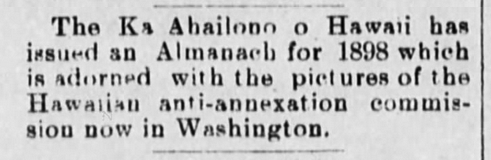
Calendar featuring pictures of the commission who took the anti-annexation petition to D.C., 1898.

[Found under: “LOCAL AND GENERAL NEWS”]

The Ka Ahailono o Hawaii has issued an Alamanach for 1898 which is adorned with the pictures of the Hawaiian anti-annexation commission now in Washington.

[This is just another thing I wish I could see. As of today, there are no extant copies found of Ahailono o Hawaii (which first appeared on 6/7/1897). Maybe one of these days, someone will come across some. Please be on the look out.]

(Independent, 1/15/1898, p. 3)

Independent_1_15_1898_3

The Independent, Volume VI, Number 790, Page 3. January 15, 1898.

Impressions of Hawaiians and the Mammoth Anti-Annexation Petitions, 1897.

OUR NEW DIALECT.

How the Coffee-Colored Gentleman From Hawaii Greets Us.

Washington Post.

Four coffee-colored gentlemen, native Hawaiians, were at the capitol yesterday, at work against annexation. Their cards read as follows:

Hon. David Kolauokalani [Kalauokalani], president Hawaiian Association Hui.

Joseph Helehuhe [Heleluhe], K. C. K., secretary and agent H. M. Liliuokalani, commissioner Hawaiian Patriotic League.

Hon. James K. Kaulia, president Hawaiian Patriotic League.

Colonel John Richardson, K. C. K., commissioner Hawaiian Patriotic League. Continue reading

Patriots celebrate La Hoihoi Ea in lands afar! 1862.

[For the Kuokoa.]

Hoihoi Ea Banquet

FOR THE HAWAIIAN NATION, ON THE 31st OF JULY, 1862.

The 31st of July is a day celebrated by the Hawaiian Nation because it is the day on which the sovereignty of the land was restored, from the year 1843 until this year in which it is remembered. Therefore, we, the natives of Hawaii who live in this strange land, because of our aloha for our land of birth, make this a day of remembrance and a day of prayer, setting aside our labors.

This is what was done on that day: Before that day, food was purchased, and in the morning of that day, the food was cooked first, and all the food was assembled on a table that was covered with the green foliage of the Puluki;¹ and when the conch was sounded, the fellow diners came and sat upon their own seats. Then L. H. Kapuaa stood and spoke of the nature of activities of the day; before the singing. This is one of the songs composed by the youths of the Snow Flurry [na keiki o ka Ehu Hau]. This is it below.

  1. Aloha i ka aina,
    I ke one hanau,
    O ke ao lewa he inoa,
    O ka Haku ka Moi,
    Na keiki kamaaina,
    Na pua ala mau,
    Ua hoihoi mai ka ea,
    Kau  hou ka Hae Hawaii.
    .
  2. Nolaila e na hoa,
    E ku a mele pu,
    Hauoli like kakou,
    Ma keia waoakua,
    Ua nui na la i hala,
    Aole kakou i hoomanao,
    Ua hoihoi mai ka ea,
    Kau hou ka Hae Hawaii.
    .
  3. O Thomas ka mama,
    Ma na ale o ke kai,
    A hiki ma Hawaii,
    Kuka me ka Moi,
    Me na Luna Aupuni,
    Holo ke kuikahi,
    Ua hoihoi mai ka ea,
    Kau hou ka Hae Hawaii.
    .
  4. Hoopauia o Lokeoki,
    Hoi nele aku ia,
    Ka moana Pakipika,
    Hauoli Hawaii,
    I ka la hope o Iulai,
    Ala ae kakou,
    Ua hoihoi mai ka ea,
    Kau hou ka Hae Hawaii.
    .
  5. E ala e na keiki,
    O ka Ehu Hau,
    Mele me ka hauoli,
    Hoonani ke Akua,
    Nana kokua mai,
    Ka ea o ka aina,
    Ua hoihoi mai ke ea,
    Kau hou ka Hae Hawaii.

Continue reading

Bird poop was a big business back in the day, 1859.

Pertaining to the Guano Islands.

O Hae Hawaii:

Aloha oe:—On the 28th of Mei, 1859, we sailed from Honolulu, six days we spent at sea, and on the seventh day, that being the 4th of June, we saw Paukeaho [Jarvis Island], which looks like a very low-lying land; living there is Kale, Livai, and 50 men, who are guano workers. There was one trade ship docked, and three buoys to secure boats to, and a fine pier to transfer the guano; Kale’s men make fast work. He has 80 men. The eighty men can produce 2,640 bags per day. There is much food and water brought from Honolulu aboard the “Josephine,” a speedy ship which makes 300 miles per day if the wind is good; if the wind is bad, 280 miles per day. Continue reading

Might these be the feathers the Hawaiians were wearing in Salt Lake City? 1898.

CORSETS, HATS AND JEWELRY.

Some Late Fashion Hints—Philadelphia Physician Shows Women How to Lace.

A NEW PARIS COAT.

IBIS FEATHERS.

The promises of May are already being made, and tender hearts who will not have the plumage or bodies of dead songsters in their hats can this spring trim the hats with lovely ibis feathers that cost no avian lives, and are fair to look upon. Of course the purple ibis feathers from Egypt are to be classed among the costly beauties of millinery, but we have our own American scarlet ibis to borrow tail feathers from and fix in our new wide-brimmed hats.

This delicate plumage is, however, dyed many handsome colors, and, beside this and ostrich feathers, to be safely adopted by any Audubonite, we are going to have lovely hats later on trimmed so gracefully and economically with nothing but masses of shot taffeta silk cut on the bias and every edge closely pinked. This piece silk will assume, in fact, has already largely taken the place of ribbon bows for the trimming of simpler hats. Nothing can be more alluringly daring than a sapphire blue felt, with just a yard of cerise taffeta twisted about the crown, perky bows and ends starting up in every direction. Here and there the taffeta was caught down with cheap pins set with mock sapphires and rhinestones.

Nobody yet dares to assume which ways hats are going to tilt for spring wearing, but just in this midseason a tendency is making toward piling everything in front. Thake a look, for instance, at the crowning glory on the head of the model in the braided coat. It is typical of the daring frontage now used. Here the hat brim is of modes proportions; it is the mounting black and white ostrich tips that lend the stately effect. Another hat worth mentioning boasted a brim four and one-half inches wide, and this was turned directly off the face, bent into three perpendicular flutes, and over the edge of the brim, finished by puffings of black chiffon, nodded the heavy heads of half a dozen prize tall feathers.

(Salt Lake Hearld, 1/16/1898, p. 15)

SaltLakeHerald_1_16_1898_15.png

(The Salt Lake Herald, Number 49, Page 15. January 16, 1898.

Hoapili and Kiliwehi in New Zealand, 1866.

VISIT TO THE MAORI KING MATUTAERA.

The correspondent of the Southern Cross at Waiuku sends the  following description of a visit recently paid by him to the quarters of the Maori king Matutaera, in company with two visitors from the Sandwich Islands:— Continue reading