On sacred stones, 1921.

THE STONE FISH GODDESS “MALEI” TO BE RETURNED TO MAKAPUU

Hawaiians have not forgotten the story about the stone goddess called “Malei,” a stone deity cared for and worshiped by the Hawaiian fishermen in the olden days; the great fish that the stone deity always brought to shore was the uhu, as is seen in the story of Hiiaka:

“Aia la o ka uku kai o Makapuu,
He i’a ia na Malei na ka wahine e noho ana i ka ulu a ka makani,
I Koolau ke ola i ka huaka’i malihini,
Kanaenae a Hiiaka i ka poli o Pele,
E Malei e, i halekipa ke aloha, e uwe mai!’

[There are the uhu of Makapuu which swim in procession,
Fish of Malei that dwells in the rising winds,
In Koolau lies the sustenance for the unfamiliar travellers,
Hiiakaikapoliopele prays,
O Malei, welcome us in love; let us weep!]

Continue reading

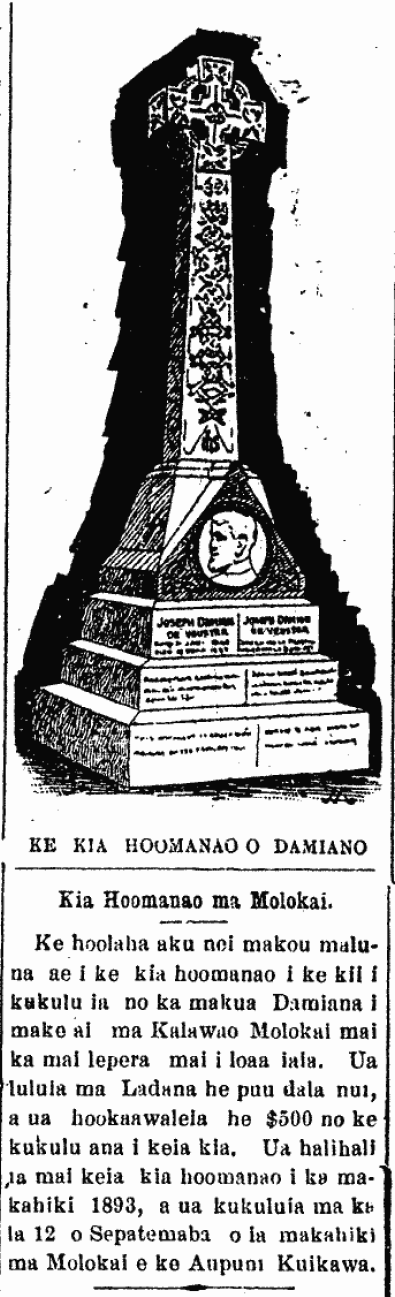
Monument to Father Damien, 1894.

MEMORIAL TO DAMIEN

Monument on Molokai.

We are publishing above the monument; the statue built for father Damiana who died at Kalawao, Molokai, from leprosy which he contracted. A large sum of money was donated at London and $500 was put aside to build this monument was constructed. This memorial was brought here in 1893 and erected on the 12th of September of this year on Molokai by the Provisional Government.

(Kuokoa, 5/19/1894, p. 1)

Kuokoa_5_19_1894_1.png

Ka Nupepa Kuokoa, Buke XXXIII, Helu 20, Aoao 1. Mei 19, 1894.

Death of Simeon Kaiu, 1835.

PERTAINING TO THE DEATH OF SIMEONA KAIU.

Waimea, September 26, 1835.

Aloha to you, O Tinker. This is my thought for you. One of our fellow travellers has recently died, Simeon Kaiu, he has died. He was not terribly sick, and he died. Perhaps one of his blood vessels severed in his chest, and he could not breathe, and he died. September 11 was the day he died. We know how he lived, when we travelled to Nuuhiwa and came back. His was as kindly as ever, as he did the work of the Lord. Simeon and Deborah [Debora] were in Wailua a few months ago spreading the word of God. They showed those ignorant ones of enlightenment. He lived there, where he died. He was a greatly beloved brethren on Kauai. He is much mourned for in this land. He is one of the first fruit picked here in Hawaii. He was baptized in the month of December, 1825. The baptism took place in Honolulu with Kaahumanu. From that time until he died, we know not of any wrong he committed, from what we saw he only did good. Simeona did not make clear what his thoughts were upon his leaving, for he died quickly. When he lived amongst us, we witnessed the fruit of the Spirit. Therefore we believe that he is doing well in that life. “Blessed is that servant, whom his lord when he cometh shall find so doing.”—Luke xii—43.

By Whitney.

[According to S. M. Kamakau, on December 4, 1825, baptized were: E. Kaahumanu, Kalanimoku, A. Keliiahonui, Lidia Namahana, Kekuaipiia, Gikeona Laanui, Simeona Kaiu, Debora Kapule Haakulou, and R. Kalaaiaulu.]

(Kumu Hawaii, 10/14/1835, p. 165)

KumuHawaii_10_14_1835_165.png

Ke Kumu Hawaii, Buke 1, Pepa 21, Aoao 165. Okatoba 14, 1835.

Marble memorial to Lorenzo Lyons, 1886.

A CALL TO THE SUNDAY SCHOOLS ALL AROUND THE ARCHIPELAGO.

By the kindness of the Father, God, and Lord Jesus Christ, taken from the circle of our living was our dearly beloved father, Rev. L. Laiana, and he left behind his benevolent works for which our people are greatly indebted, as a monument [kia hoomanao] before our eyes, and before all of the Sunday School students around the Archipelago [Pae Aina].

Therefore, at the meeting of your Executive Committee [Komite Hooko], held on the 9th of November, at Kaumakapili, it was unanimously decided to erect a Marble Monument for the father, Rev. L. Laiana, and to enclose it in a fine iron fence.
Continue reading

“A Night in Hawaii of Old,” by Kaai Glee Club, 1913.

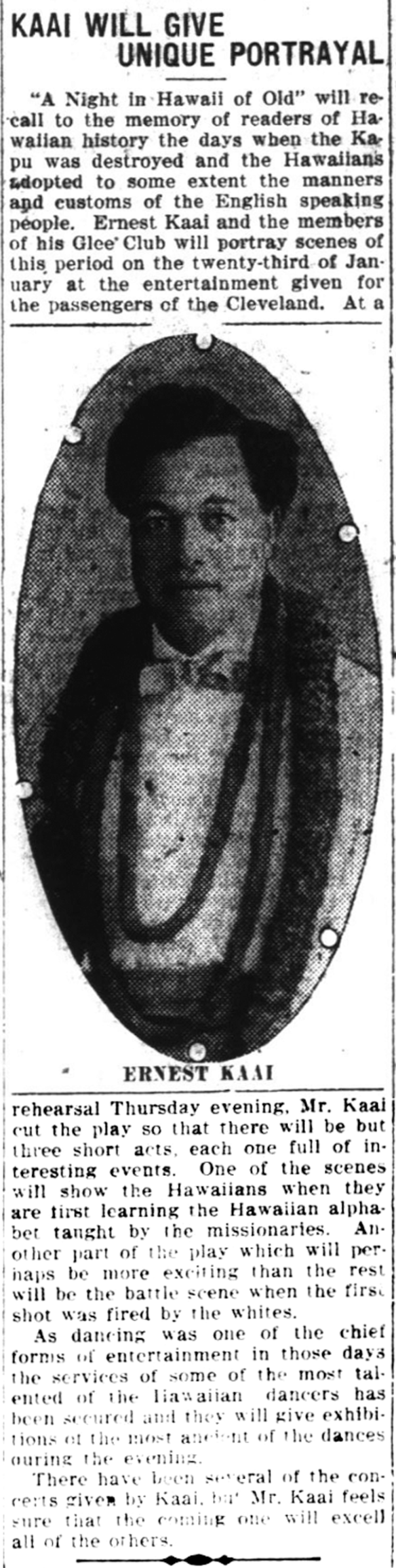
KAAI WILL GIVE UNIQUE PORTRAYAL

“A Night in Hawaii of Old” will recall to the memory of readers of Hawaiian history the days when the Kapu was destroyed and the Hawaiians adopted to some extent the manners and customs of the English speaking people. Ernest Kaai and the members of his Glee Club will portray scenes of this period on the twenty-third of January at the entertainment given for the passengers of the Cleveland. At a…

ERNEST KAAI

…rehearsal Thursday evening, Mr. Kaai cut the play so that there will be but three short acts, each one full of interesting events. One of the scenes will show the Hawaiians alphabet taught by the missionaries. Another part of the play which will perhaps be more exciting than the rest will  be the battle scene when the first shot was fired by the whites.

As dancing was one of the chief forms of entertainment in those days the services of some of the most talented of the Hawaiian dancers has been secured and they will give exhibitions of the most ancient of the dances during the evening.

There have been several of the concerts given by Kaai, but Mr. Kaai feels sure that the coming one will excell all of the others.

(Star-Bulletin, 1/20/1913, p. 12)

StarBulletin_1_20_1913_12.png

Honolulu Star-Bulletin, Volume XX, Number 6489, Page 12. January 20, 1913.

Lorenzo Lyons preached, “Never be a double-faced traitor,” 1894.

TOPICS OF THE DAY.

We made a suggestion yesterday for the benefit of the Advertiser in regard to a new version of Hawaii Ponoi as desired by the churchly morning paper. An esteemed contemporary sends us a song composed by the late venerable Father Lyons of Waimea, Hawaii, which he thinks would be fitting to be used as a National Anthem and sung every Sunday at the Central Union Church by the descendants of the true missionaries, as of great benefit for then present and future spiritual welfare. If “Professor” Lyons instead of Sec’y Taylor will “presided” at the organ the effect would be magnificent indeed. This is what good Father Lyons taught the Hawaiians to sing:

Paa mau kuu manao aloha
Paa mau, paa mau,
Paa mau, kuu manao aloha
I kuu aina hanau e!

CHORUS:

Aole au e kipi
No No No, No No, No,
Aole au e kipi, kumakaia
He aloha aina mau.

For the benefit of those of the members of the Central Union who lately have “forgotten” the Hawaiian language we present a free translation:

Everlasting my love shall be
Steadfast ever, steadfast ever
Everlasting my love shall be
To my own, my native land.

CHORUS:

I will never be a traitor
No no no, no no, no
Never be a doublefaced traitor
My love shall ever be true.

(Hawaii Holomua, 1/10/1894, p. 2)

HawaiiHolomua_1_10_1894_2.png

Hawaii Holomua, Volume II, Number 8, Page 2. January 10, 1894.

A new scathing “Hawaii Ponoi,” 1894.

TOPICS OF THE DAY.

The Advertiser with its usual ingenuity has finally found the cause for all the opposition among the Hawaiians to the P. G., and to the annexation cause. It is all on account of Hawaii Ponoi, our national anthem, and the morning organette demands, and immediate change in the words of that time-honored song. The new version given by the Advertiser will hardly be adopted, and we therefore take the liberty to substitute some words which we submit to the kind consideration of all loyal Hawaiians who are to be forbidden to sing the anthem of their native land. How is this brother Castle?

HAWAII PONOI HOU.

Pakaha Hawaii,
Kipi i ka lahui,
Na welo mikanele,
Na Pi Gi.

Ino ka ia e,
Ia Kolekaaka,
Pale i ka nani,
Me ka uahoa.

[NEW HAWAII PONOI

They plunder Hawaii
Conspire against the people,
Those missionary descendants,
The P. G.

How vile he is,
That Kole Kaaka,*
Pushing aside beauty,
With his cruelty.]

*”Kole Kaaka” can be found in the dictionary. Look it up. This term with a negative connotation is used often during this period. Might it also be a play on the name Dole? “Wretched Dole”?

(Hawaii Holomua, 1/9/1894, p. 2)

HawaiiHolomua_1_9_1894_2.png

Hawaii Holomua, Volume II, Number 7, Page 2. January 9, 1894.

Recollections of Kauai boy, William E. Rowell, 1916.

INTERVIEW WITH W. E. ROWELL
Dec. 6, 1915

The following interview with the late W. E. Rowell, who died recently in Honolulu, was read at the meeting of the Kauai Historical Society last week by J. M. Lydgate:

I was born at Hanalei in 1845. My father followed Alexander there for a couple of years. When I was about one year old were moved to Waimea. We came by canoe I believe, bag and baggage. No I don’t remember anything about it. Mr. Gulick I understand had built the house at Waimea. Mr. Whitney had died I think just before our arrival or soon after so that the whole work and responsibility of the station fell on my father. The Whitney house stood just about where the Hofgaard house is now, while ours stood near by. No, no, the Whitney house wasn’t built of adobie, but of stone coral sand stone. I remember very distinctly how it cracked because of imperfect foundation and the walls bulged out and had to be shoved up with heavy timber props. The house was demolished finally for the stone which was taken to build the Kekaha chimney. I think they paid $100 for it. Mother Whitney lived there for a good many years. In the division of the mission sands there was some difficulty about coming to an amicable decision, for, you know, these old missionaries were quite human in spite of the fact that they were missionaries. Mrs. Whitney wanted about everything that was any good.

We got a piece of pasture land on the east of the river called Mahai-hai: it was there we kept our stock, and in dry times they fairly grubbed up the roots of the manienie.

We had an old man who took the stock back and forth: he took them to the river and they swam across and when he wanted them he called them and they came across the river.

When Mrs. Whitney died she left her land to the native church. The minister was to live at the Whitney place, but that was inconvenient so an exchange was made for a kuleana in the valley, and I bought the balance of the land for $1800. That is the basis of the church fund to this day.

There was a grass church in those days down on the beach west of the river, where afterwards the school house stood and about where the Chinese church is now. There were two services on Sunday and a prayer meeting on Wednesday afternoon. No, the crowds were not very large and the church was not as big as the stone church built later. The church was built of pili grass, closed in, as I remember it, on the mauka and windward side, but open makai on the lee side. There were no windows, at least no glazed windows. The people sat on mats on the floor. The matter of windows, reminds me that I made quite a little money in my boyhood days, making window and door cases for Hawaiian grass houses. Yes, all the houses at that time were of grass. Continue reading

J. E. Chamberlain, collector for the Hawaiian National Museum, 1876.

Curios for the Government Museum.

The Morning Star brought up for the Hawaiian Government the following curios, corals, &c. Two sets Gilbert Island armor complete with helmets; also shark teeth sword and spear, mats and native dresses; eel basket; common fish basket; umbrella coral, three feet six inches in diameter, perfect, from Apian by Mr. Randolph.

From Marshall Island: Spears, Male fringe petticoats and woman’s mat dress; carved figure-head; model of canoe fully rigged; paddles; red coral; black coral; platter coral, bone adzes from Strong’s Island. Continue reading

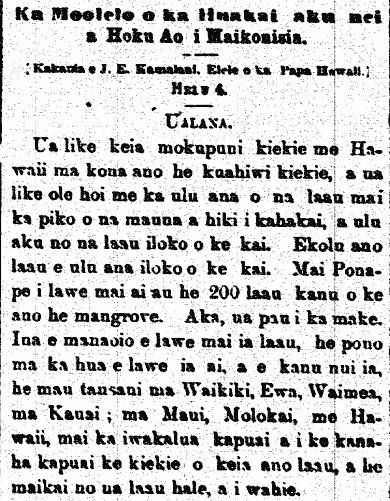
Mangrove for Hawaii? 1876.

[Found under: “Ka Moolelo o ka Huakai aku nei a Hoku Ao i Maikonisia.”]

Ualana.

This high island is similar to Hawaii being that it is a high mountain, but it is different in that there are trees that grow from the mountain peaks all the way to the ocean, and there are trees that grow in the ocean. There are three kinds of trees growing in the ocean. I brought from Ponape 200 mangrove plants. But they all died. If we really want to bring in that plant, it should be brought in by seed, and planted extensively; thousands in Waikiki, Ewa, Waimea on Kauai, on Maui, Molokai, and Hawaii; this tree reaches from twenty to forty feet high, and is good as lumber for house building and for firewood.

[This appears in a description of travels of the Morning Star to Micronesia, written by Jeremiah E. Chamberlain, the representative of the Board of Hawaiian Missions.]

(Lahui Hawaii, 4/6/1876, p. 2)

LahuiHawaii_4_6_1876_2.png

Ka Lahui Hawaii, Buke II, Helu 15, Aoao 2. Aperila 6, 1876.