More information sought on Opukahaia and others by the pastor in Cornwall, Connecticut, 1895.

[Found under: “NU HOU HAWAII”]

Who are these people:—The pastor at Cornwall, Conn, where the missionary school was built in 1817, dearly wants to know the personal stories of these students from Hawaii. 1, Opukahaia; 2, Honolii; 3, Kanui; 4, Kaumualii; 5, Hopu; 6, Alohekaa; 7, Kupalii; 8, Haia; 9, Ilipuaa; 10, Kaleiula; 11, Kamahoula [? Kamohoula]; 12, Kapoo; 13, Kapoli; 14, Komo [? Kemo]; 15, Kapali [? Kapuhi]. Those who know, could they please send the stories pertaining to these boys, or perhaps others, to C. M. Hyde, P. O. Box 67 [pahu leta 67], Honolulu.

(Kuokoa, 5/11/1895, p. 3)

Kuokoa_5_11_1895_3.png

Ka Nupepa Kuokoa, Buke XXXIV, Helu 19, Aoao 3. Mei 11, 1895.

Death of Stephen William Kekuewa, 1920.

THE REV. S. W. KEKUEWA PASSES ON

After being worn away by a debilitating illness for some time, the Rev. Stephen William Kekuewa grew weary of this life, at the home of his daughter, Mrs. John P. Kapua, on School Street, at four o’clock in the afternoon, on Wednesday of this past week; and in the afternoon of this past Sunday, his remains were carried to the Maemae Cemetery.

The Rev. S. W. Kekuewa was born at Luakaha, Nuuanu, on the 25th of February, 1842, therefore when he died he was over seventy-eight years old.

During his youth, he was educated at Lahainaluna School, under his teachers, S. E. Bishop and C. B. Andrews; and for some years he lived on the island of Micronesia on a mission he was sent on by the Hawaiian Evangelical Board [Papa Hawaii].

Because the health of his wife was not good, they returned to Hawaii nei, and he served as the kahu of the chruch at  Iole, Kohala, Hawaii for many years.

Because of the letter of the members of the church of Waianae which called for him to be the kahu of that church, he left the church of Kohala and went to live at Waianae; at that church he lived and worked until he was called by his Lord, and he went to his permanent home beyond. Continue reading

Real gentlemen from a hundred years ago, 1915.

THE WORDS OF A HAWAIIAN

A while ago while some Hawaiian Youths were in Washington and riding an electric car, some haole women boarded the car, and not one of haole men near where those haole women were gave their seat to any of the women. When the Keiki Hawaii saw these Ladies standing, that is when these Hawaiian Youths stood and gave their seats to these white women. The women accepted the kindness of the Hawaiians. These Hawaiian Boys then heard one of the Haole reading a newspaper ridicule them, saying:

“They are probably some foreigners, giving their seats to those women.” It was like he was calling them “country bumpkins.” When S. L. Desha Jr., heard these words of the Haole reading the paper, as he spoke disparagingly of this action by the Hawaiian Boys, that was when he spoke without hesitation to that Haole, perhaps because he was with his fellow Hawaiians. Continue reading

Henry and Anna Dimond celebrate golden anniversary, 1884.

Golden Marriage.

This past Monday, Nov. 3, was the 50th anniversary of Mr. and Mrs. Dimond of this town, in the golden bond of holy marriage, and there are but a few of our kamaaina living here who have reached this milestone. And as something done for couples who reach this milestone, a festive party is prepared for the reaching of this “golden anniversary” and so forth; however this is not being done being barred by one thing, that being the weakness of Mrs. Dimond. The two were married in New York, America. November 3, 1834; and at the same time Mr. and Mrs. E. O. Hall were married. Mr Dimond came to Hawaii nei as a book binder for the Missionaries, while Mr. Hall came as a printer.

(Kuokoa, 11/8/1884, p. 2)

Mare Gula.

Ka Nupepa Kuokoa, Buke XXIII, Helu 45, Aoao 2. Novemaba 8, 1884.

The Hawaiian Flag and those who worked against it, 1893.

THE NATURE OF THE HAWAIIAN FLAG.

The Hawaiian Flag is one of the most glorious Flags, and it is so pleasant to look upon, and like the nature of the Flag, so too the People.

The brown-skinned [ili ulaula] Hawaiian Lahui are a kind People, are modest, treasure malihini, are welcoming, have open hearts, and so forth.

But even if the Hawaiian Flag and her People are kindhearted, they have been trampled upon by the descendants of the missionaries, and are being paid back with poisonous words, even more so than the Auhuhu.¹

It is being said that they are a Lahui that is stupid, know nothing, pagan, idol worshiper, and on and on.

That is what we the Hawaiian People get in return.

But notwithstanding all of their abuse, we are not full of hate at the actions of these missionary descendants. Continue reading

David Malo and a prediction, 1894.

The prediction of David Malo.

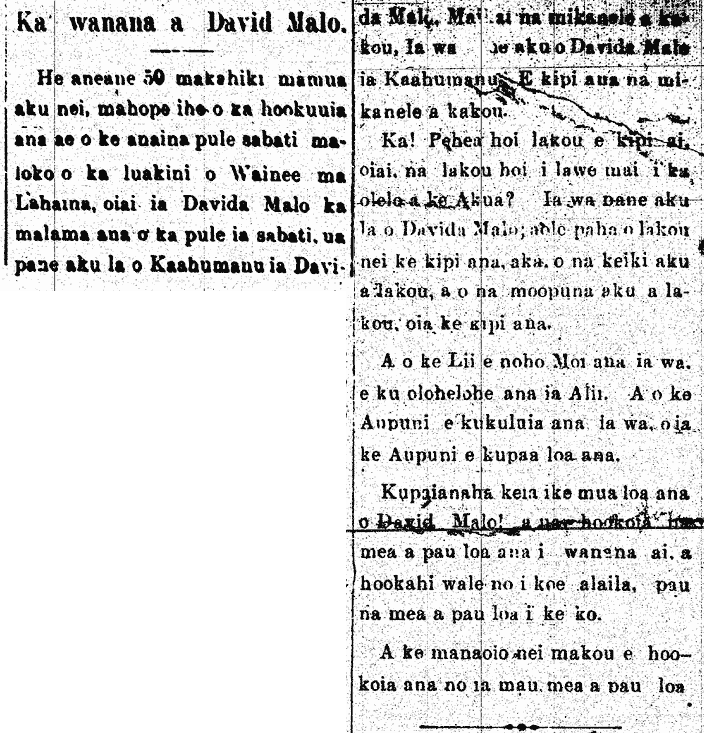
Nearly 50 years ago, after the sunday service was let out from the Wainee Church in Lahaina, while it was Davida Malo who gave the prayer that sunday, Kaahumanu said to Davida Malo, “Our missionaries are good.” Davida Malo then replied to Kaahumanu, “The missionaries of ours will conspire against us [kipi].

“Tsa! How will they revolt, being that it was they who brought the word of God?” To which Davida Malo answered, “Perhaps they will not revolt, but the children after them, and the grandchildren after them; they will be the rebels.

“And the Alii who is ruling as Monarch at the time, that Alii will stand bare. And the Nation built then, that is the Nation that will stand securely.”

How astonishing is this great foresight of David Malo! and everything he predicted [wanana] has come true, except one remains, and then everything will have come true.

And we believe that all of this will come true.

(Leo o ka Lahui, 9/7/1894, p. 2)

Ka wanana a David Malo.

Ka Leo o ka Lahui, Buke II, Helu 1022, Aoao 2. Sepatemaba 7, 1894.

A patriotic mele criticizing the Rev. Joseph S. Emerson, 1893.

THE KAPUUKOLO CHURCH SCANDAL.

There is a saintly son of a gun,
Whose name is J. S. Emerson,
Who goes about in pious style,
To ease his anti-monarch bile.
And enters with his devout brother,
Hawaiian’s meeting: tries to smother,
All aloha for their Queen and land,
By fairy tales of witchcraft brand.
And sweetly says: “My christian friends,
“In order now to gain our ends,
“Will you ally yourselves with one,
“Who being but a native son.
“Has dared to infringe the haole’s plan
“And makes himself (deceitful man)
“The priest of God and Baal too?
“Shall such associate with you?
“Perish the thought! No! brethren dear,
“Not though my father’s sons, ’tis clear,
“Have robbed you of your lands and living,
“And taught you not that way to heaven.
“We’ll sweetly sing, in chorus clear
“The haole takes the government here
“Having taken all else, and let your Queen,
“Rely on none who here are seen.
“Associate she with heathens foul,
“Pig, kahunas, chickens, awa bowl!
“Shall such be helped with christian prayer,
“And our God asked for her to care.”
He stayed his speech and called for votes,
The answer from indignant throats,
Came fast and furious on his ears:
“Take out from here your lying sneers.
“Hypocrite! usurper! rebel! beast!
“Such words become your family least,
“Who live on what the royal hand,
“Gave bounteous of Waialua’s land.
“As pay for early prayer and praise,
“Raised by your father in those days,
“When missionaries first came here,
“And taught us a new God to fear.
“Go, hound! unto your wealthy home,
“Reflect on whence your creature comforts come,
“Think if you can what doom will be,
“Ingratitude’s God will bring to thee.
“Hide your grey locks in deepest shame
“Let another take your father’s name,
“Go, and ne’er again pollute,
“This sacred place with your foul boot.”
They went: None blessed their homeward way:
All seemed relieved: Arose the lay,
Of praise to God: and all agree,
To pray for Queen and Hawaii.

[Here is an article with descriptions of what led to this mele.]

(Hawaii Holomua, 2/11/1893, p. 4)

THE KAPUUKOLO CHURCH SCANDAL.

Hawaii Holomua, Buke III, Helu 7, Aoao 4. Feberuari 11, 1893.

Joseph Emerson interrupts meeting at the Kapuukolo Church, 1893.

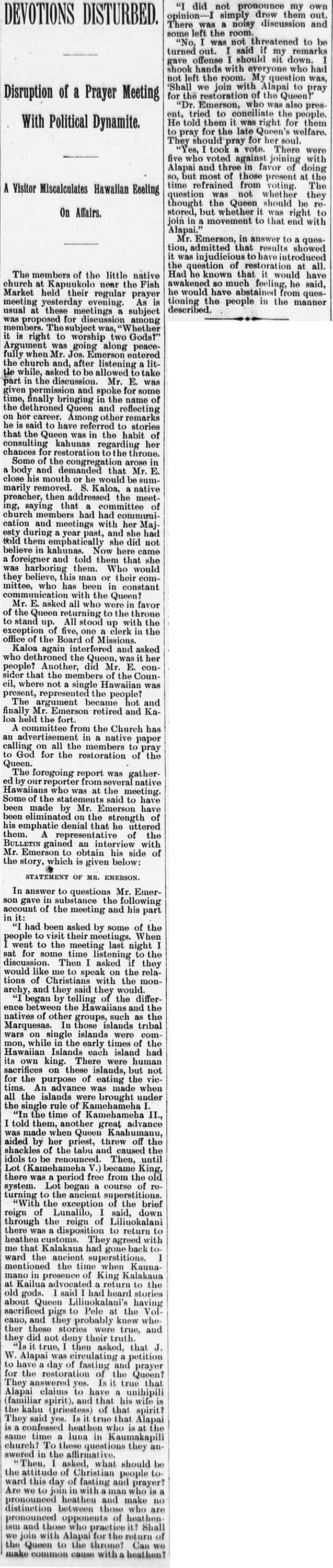
DEVOTIONS DISTURBED.

Disruption of a Prayer Meeting With Political Dynamite.

A Visitor Miscalculates Hawaiian Feeling On Affairs.

The members of the little native church at Kapuukolo near the Fish Market held their regular prayer meeting yesterday evening. As is usual at these meetings a subject was proposed for discussion among members. The subject was, “Whether it is right to worship two Gods?” Argument was going along peacefully when Mr. Jos. Emerson entered the church and, after listening a little while, asked to be allowed to take part in the discussion. Mr. E. was given permission and spoke for some time, finally bringing in the name of the dethroned Queen and reflecting on her career. Among other remarks he is said to have referred to stories that the Queen was in the habit of consulting kahunas regarding her chances for restoration to the throne.

 Some of the congregation arose in a body and demanded that Mr. E. close his mouth or he would be summarily removed. S. Kaloa, a native preacher, then addressed the meeting, saying that a committee of church members had had communication and meetings with her Majesty during a year past, and she had told them emphatically she did not believe in kahunas. Now here came a foreigner and told them that she was harboring them. Who would they believe, this man or their committee, who has been in constant communication with the Queen?

Mr. E. asked all who were in favor of the Queen returning to the throne to stand up. All stood up with the exception of five, one a clerk in the office of the Board of Missions.

Kaloa again interfered and asked who dethroned the Queen, was it her people? Another, did Mr. E. consider that the members of the Council, where not a single Hawaiian was present, represented the people?

The argument became hot and finally Mr. Emerson retired and Kaloa held the fort.

A committee from the Church has an advertisement in a native paper calling on all the members to pray to God for the restoration of the Queen.

The foregoing report was gathered by our reporter from several native Hawaiians who was at the meeting. Some of the statements said to have been made by Mr. Emerson have been eliminated on the strength of his emphatic denial that he uttered them. A representative of the Bulletin gained an interview with Mr. Emerson to obtain his side of the story, which is given below:

STATEMENT OF MR. EMERSON.

In answer to questions Mr. Emerson gave in substance the following account of the meeting and his part in it:

 “I had been asked by some of the people to visit their meetings. When I went to the meeting last night I sat for some time listening to the discussion. Then I asked if they would like me to speak on the relations of Christianity with the monarchy, and they said they would.

“I began by telling of the difference between the Hawaiians and the natives of other groups, such as the Marquesas. In those islands tribal wars on single islands were common, while in the early times of the Hawaiian Islands each island had its own king. There were human sacrifices on these islands, but not for the purpose of eating the victims. An advance was made when all the islands were brought under the single rule of Kamehameha I.

“In the time of Kamehameha II., I told them, another great advance was made when Queen Kaahumanu, aided by her priest, threw off the shackles of the tabu and caused the idols to be renounced. Then, until Lot (Kamehameha V.) became King, there was a period free from the old system. Lot began a course of returning to the ancient superstitions.

“With the exception of the brief reign of Lunalilo, I said, down through the reign of Liliuokalani there was a disposition to return to heathen customs. They agreed with me that Kalakaua had gone back toward the ancient superstitions. I mentioned the time when Kaunamano in the presence of King Kalakaua at Kailua advocated a return to the old gods. I said I had heard stories about Queen Liliuokalani’s having sacrificed pigs to Pele at the Volcano, and they probably knew whether these stories were true, and they did not deny their truth.

“Is it true, I then asked, that J. W. Alapai was circulating a petition to have a day of fasting and prayer for the restoration of the Queen? They answered yes. Is it true that Alapai claims to have a unihipili (familiar spirit), and that his wife is the kahu (priestess) of that spirit? They said yes. Is it tre that Alapai is a confessed heathen who is at the same time a luna in Kaumakapili church? To these questions they answered in the affirmative.

“Then, I asked, what should be the attitude of Christian people toward this day of fasting and prayer? Are we to join in with a man who is a pronounced heathen and make no distinction between those who are pronounced opponents of heathenism and those who practice it? Shall we join with Alapai for the return of the Queen to the throne? Can we make common cause with a heathen?

“I did not pronounce my own opinion—I simply drew them out. There was a noisy discussion and some left the room.

“No, I was not threatened to be turned out. I said if my remarks gave offense I should sit down. I shook hands with everyone who had not left the room. My question was, ‘Shall we join with Alapai to pray for the restoration of the Queen?’

“Dr. Emerson, who was also present, tried to conciliate the people. He told them it was right for them to pray for the late Queen’s welfare. They should pray for her soul.

“Yes, I took a vote. There were five who voted against joining with Alapai and three in favor of doing so, but most of those present at the time refrained from voting. The question was not whether they thought the Queen should be restored, but whether it was right to join in a movement to that end with Alapai.”

Mr. Emerson, in answer to a question, admitted that results showed it was injudicious to have introduced the question of restoration at all. Had he known that it would have awakened so much feeling, he said, he would have abstained from questioning the people in the manner described.

[This article was translated in Leo o ka Lahui, 2/9/1893, p. 2. It is interesting that there is a note appended to the end of the translated article that they did not have time to translate Emerson’s response.]

(Daily Bulletin, 2/7/1893, p. 3)

DEVOTIONS DISTURBED.

The Daily Bulletin, Volume V, Number 644, Page 3. February 7, 1893.
Rufus Anderson arrives, 1863.

[Found under: “NA MEA HOU O HAWAII NEI.”]

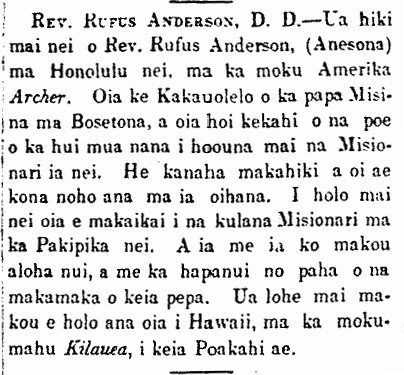
Rev. Rufus Anderson, D. D.—Rev. Rufus Anderson (Anesona) has arrived in Honolulu nei, aboard the American ship, Archer. He is the secretary of the Mission Board in Boston, and he is one of the original members of the board that sent Missionaries here. He served in that occupation for forty years or more. He came to check on the condition of the Missionaries here in the Pacific. With him is our great aloha, along with perhaps the majority of the friends of this paper. We heard that he will be going to Hawaii aboard the steamship Kilauea this coming Monday.

(Kuokoa, 3/7/1863, p. 2)

Rev. Rufus Anderson, D. D.

Ka Nupepa Kuokoa, Buke II, Helu 10, Aoao 2. Maraki 7, 1863.

Rufus Anderson, “Hawaiian Islands: Their Progress and Condition Under Missionary Labors,” 1865.

Anderson’s Writings About Hawaii nei.

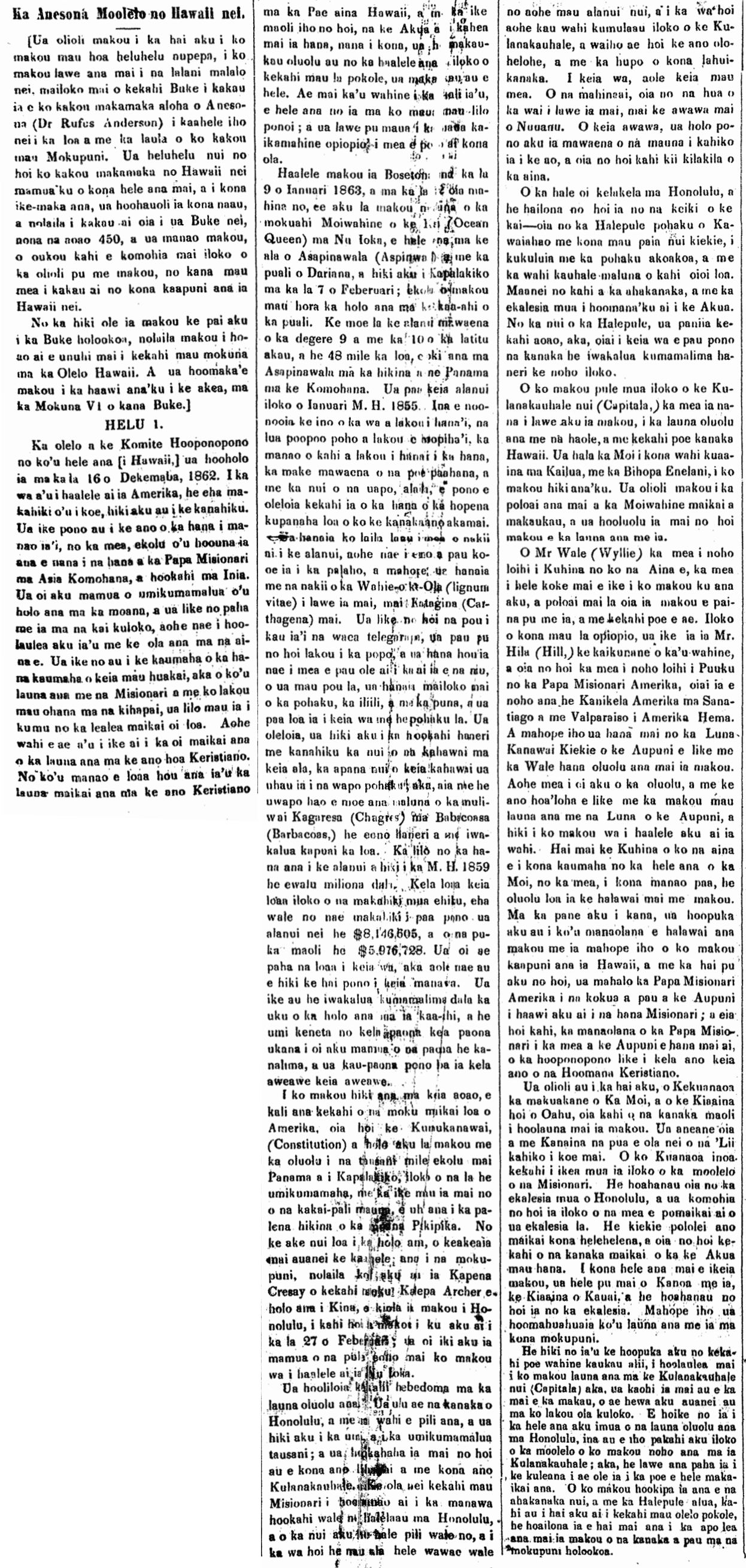
(We are pleased to tell you, our dear readers, that we are taking the lines below from a Book written by our beloved friend, Anesona (Dr. Rufus Anderson) who travelled the width and breadth of our Islands. Our friend read greatly about Hawaii nei before coming here, and when he saw it for his own eyes, his heart was gladdened, and therefore, he wrote this Book of 450 pages, and we believe that you all will also join in the pleasure along with us, for what he wrote about his travels around Hawaii nei.

Because we are unable to print the Book in its entirety, therefore, we tried to translate some chapters into Hawaiian. And we are beginning to provide it for the public from Chapter VI of his Book.)

[This is the introduction to a translation of Rufus Anderson’s “Hawaiian Islands: Their Progress and Condition Under Missionary Labors” which appears as a serial in the Kuokoa from 1/19/1865 to 6/8/1865. The English is available on Google Books here. It is interesting that this serial describing travels through the archipelago is immediately followed by Kamakau’s serial on travels describing famous places, kupua, and ancient alii from Hawaii to Niihau.]

(Kuokoa, 1/19/1865, p. 1)

Ka Anesona Moolelo no Hawaii nei.

Ka Nupepa Kuokoa, Buke IV, Helu 3, Aoao 1. Ianuari 19, 1865.