Hula in Hanapepe, 1863.

[Found under: “NA MEA HOU O HAWAII NEI.”]

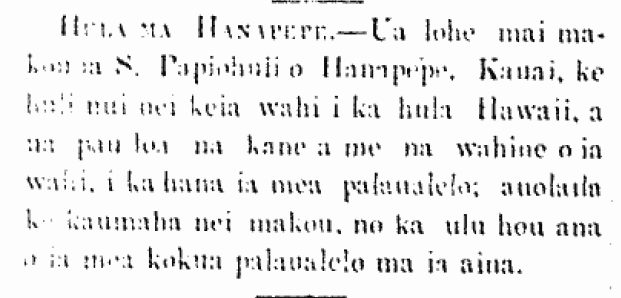
Hula in Hanapepe.—We hear from S. Papiohuli of Hanapepe, Kauai, that the people of this place are turning to the Hawaiian hula, and all of the men and women of the area are doing that idle activity; therefore, we are dismayed at this resurgence of this encouragement of indolence in that place.

(Kuokoa, 8/29/1863, p. 2)

Hula ma Hanapepe.

Ka Nupepa Kuokoa, Buke II, Helu 35, Aoao 2. Augate 29, 1863.


Brother Dutton on Molokai, 1911.

25 Years on Molokai.

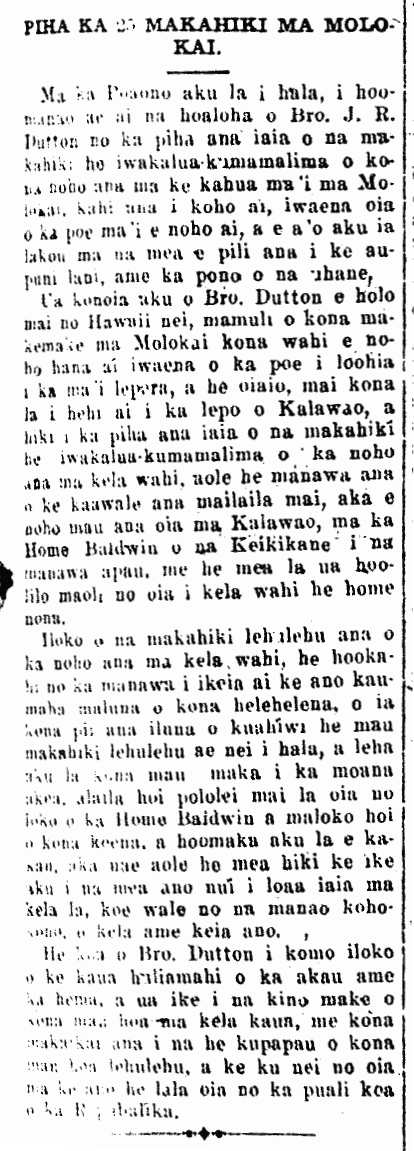
Last Saturday, the friends of Bro. J. R. Dutton celebrated the twenty-fifth anniversary of his living at the sanatorium at Molokai, where he chose to be amongst the patients, and to teach them of the kingdom of heaven and the righteousness of the spirit.

Bro. Dutton was invited to come to Hawaii as a result of his desire to minister on Molokai amongst the people afflicted with leprosy; and it is true, from the moment he stepped upon the soil of Kalawao, until living there for 25 years, there was not a single moment he spent away, but he remained there at Kalawao at the Baldwin Boys’ Home at all times, as if he made this his home.

In his many years living there, there was only a single time he showed signs of grief, when he climbed into the hills many years ago, his eyes looked out to the wide ocean, and he returned immediately to the Baldwin Home to his room. He then began to write. However, it is unknown what happened that day, except through conjecture.

Bro. Dutton was a soldier engaged in a fierce battle between the north and the south; and he saw the dead bodies of his comrades in battle. He visited the graves of his many friends, and he remains a member of the soldiers of the Republic.

(Kuokoa, 8/4/1911, p. 5)

PIHA KA 25 MAKAHIKI MA MOLOKAI.

Ka Nupepa Kuokoa, Buke XLVII, Helu 31, Aoao 5. Augate 4, 1911.

Words of comfort in the face of the passing of Nahienaena? 1837.

HE MELE.

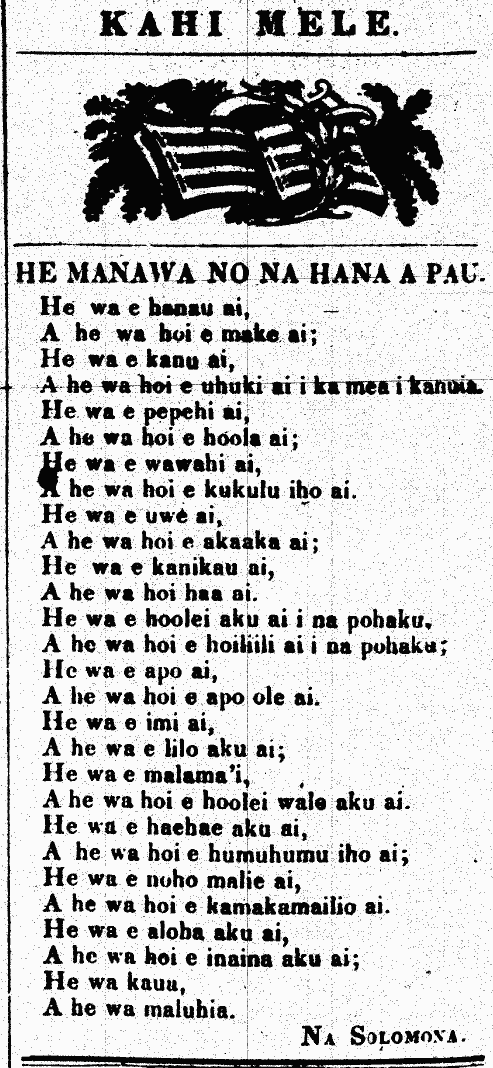
HE MANAWA NO NA HANA A PAU.

He wa e hanau ai,
A he wa hoi e make ai;
He wa e kanu ai,
A he wa hoi e uhuki ai i ka mea i kanuia.
He wa e pepehi ai,
A he wa hoi e hoola ai;
He wa e wawahi ai,
A he wa hoi e kukulu iho ai.
He wa e uwe ai,
A he wa hoi e akaaka ai;
He wa e kanikau ai,
A he wa hoi [e] haa ai.
He wa e hoolei aku ai i na pohaku,
A he wa hoi e hoiliili ai i na pohaku;
He wa e apo ai,
A he wa hoi e apo ole ai.
He wa e imi ai,
A he wa e lilo aku ai;
He wa e malama’i,
A he wa hoi e hoolei wale aku ai.
He wa e haehae aku ai,
A he wa hoi e humuhumu iho ai;
He wa e noho malie ai,
A he wa hoi e kamakamailio ai.
He wa e aloha aku ai,
A he wa hoi e inaina aku ai;
He wa kaua,
A he wa maluhia.

Na Solomona.

A Mele.

THERE IS A TIME FOR ALL THINGS.

A time to be born,
And a time to die;
A time to plant,
And a time to pluck up that which is planted;
A time to kill,
And a time to heal;
A time to break down,
And a time to build up;
A time to weep,
And a time to laugh;
A time to mourn,
And a time to dance;
A time to cast away stones,
And a time to gather stones together;
A time to embrace,
And a time to refrain from embracing;
A time to get,
And a time to lose;
A time to keep,
And a time to cast away;
A time to rend,
And a time to sew;
A time to keep silence,
And a time to speak;
A time to love,
And a time to hate;
A time of war,
And a time of peace.

By Solomon.

(Kumu Hawaii, 2/15/1837, p. 76)

KAHI MELE.

Ke Kumu Hawaii, Buke 2, Pepa 19, Aoao 76. Feberuari 15, 1837.

Fancy typesetting, 1874.

The Wine Glass.

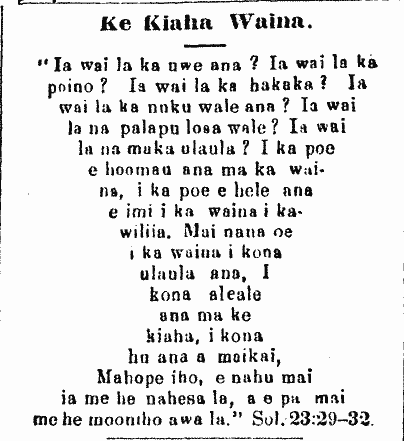
“Who hath woe? who hath sorrow? who hath contentions? who hath babbling? who hath wounds without cause? who hath redness of eyes?  They that tarry long at the wine; they that go to seek mixed wine. Look not thou upon the wine when it is red, when it giveth his colour in the cup, when it moveth itself aright.At the last it biteth like a serpent, and stingeth like an adder.” Proverbs 23:29–32.

(Kuokoa, 8/8/1874, p. 4)

Ke Kiaha Waina.

Ka Nupepa Kuokoa, Buke XIII, Helu 32, Aoao 4. Augate 8, 1874.

Schools in Hawaii nei, 1844.

[Found under: “KA AHAOLELO MISIONARI.”]

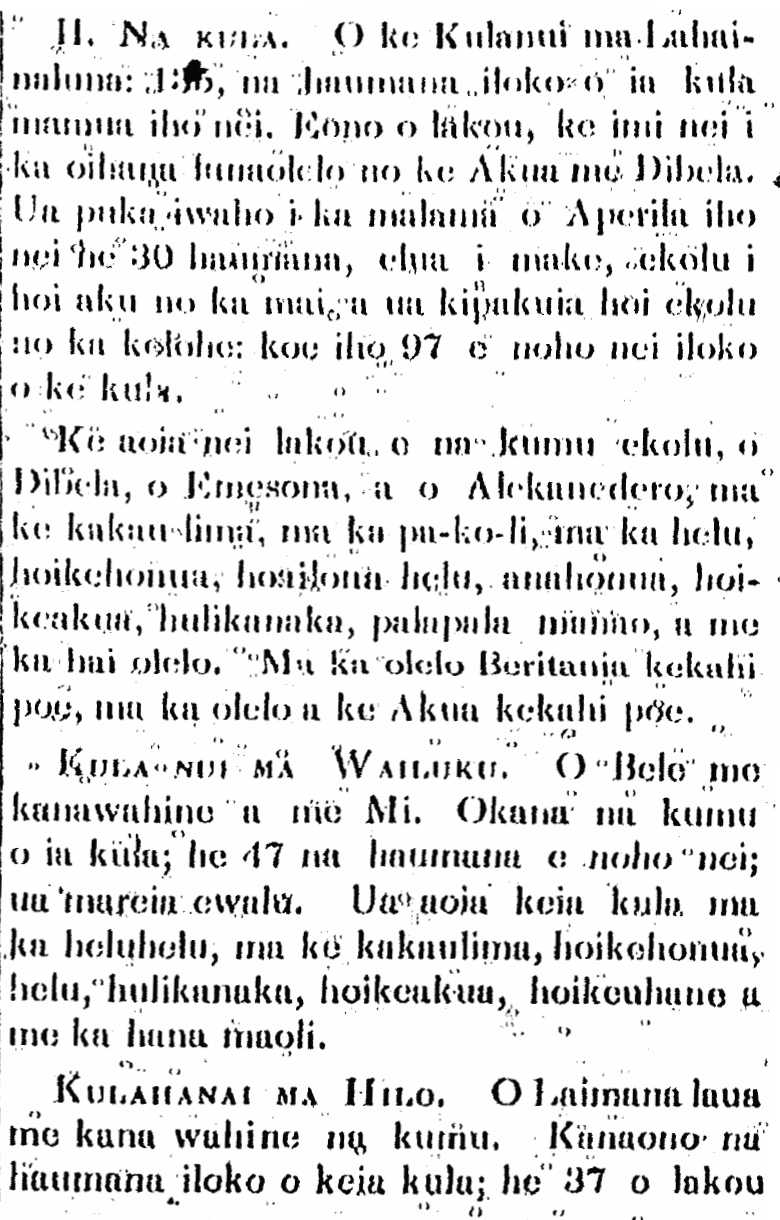
II. The Schools. Lahainaluna College: there were 135 students enrolled in the school just recently. Six of them are studying the apostles of God with Dibela [Dibble]. In April, 30 students graduated, four died, three went home because of illness, and three were expelled for rule violations; that leaves 97 remaining at the school.

They are being taught by three teachers, Dibble, Emesona [Emerson], and Alekanedero [Alexander], in penmanship, in music, math, geography, algebra, surveying, theology, philosophy, composition, and speech. Some study in English, others study in the word of God.

College at Wailuku. The teachers at the school are Bele me kana wahine [Mr. and Mrs. Bailey] and Mi. Okana [Miss Ogden]; there are 47 students living there and eight are married. At the school is taught reading, penmanship, geography, math, philosophy, theology, spirituality and actual work.

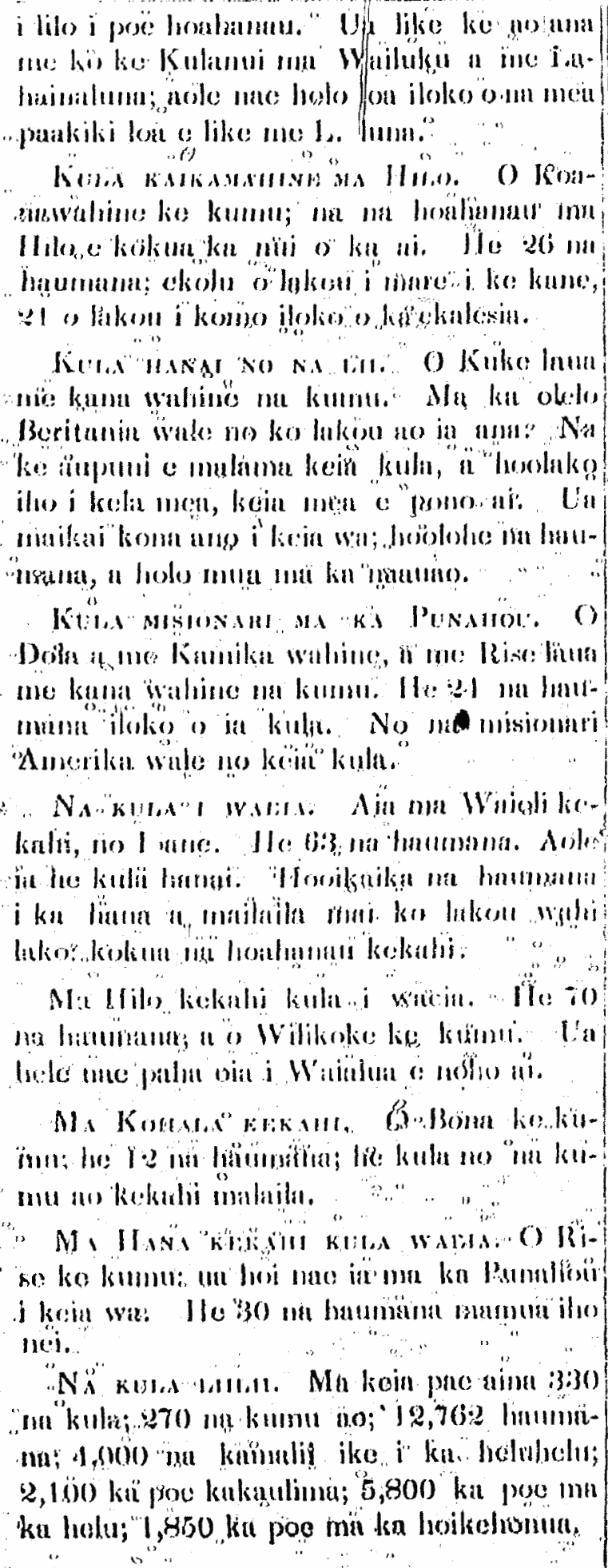
Boarding School at Hilo. Laimana laua me kana wahine [Lyman and his wife] are the teachers. There are sixty students at the school; 37 of them have become members in the church. The instruction is like that of the Colleges at Wailuku and Lahainaluna; however they are not progressing far in the difficult subjects like at Lahainaluna.

Girls’ School at Hilo. Koanawahine [Mrs. Coan] is the teacher; most of the food is donated by the church members in Hilo. There are 26 students; there of them are married to husbands, 21 of them have joined the church.

Boarding School of the Alii. Kuke laua me kana wahine [Cooke and his wife] are the teachers. They are instructed only in the English language. The government sponsors this school, and supplies all necessities. It is doing well currently: the students are obedient and are progressing in their knowledge.

Missionary School at Punahou. Dola [Dole] and Kamika wahine [Mrs. Smith] and Rise laua me kana wahine [Rice and wife] are the teachers. There are 24 students at the school. This school is solely for the American missionaries.

Select Schools. There is one in Waioli under Ioane [Johnson]. There are 63 students. It is not a boarding school. The students put effort into working, and it is from this that they get their supplies, and the church members give assistance as well.

In Hilo is another select school. There are 70 students, and Wilikoke [Wilcox] is the teacher. But he might have gone to Waialua to live.

In Kohala is another. Bona [Bond] is the teacher; there are 12 students; there is schooling for teachers there also.

There is a select school at Hana. Rice was the teacher, but he has returned to Punahou now. There were recently 30 students.

Small Schools. In these Islands there are 330 schools; 270 teachers; 12,762 students; 4,000 children can read, 2,100 can write; 5,800 can do math; 1,850 know geography.

[The state of the schools in Hawaii nei was part of what was discussed at a missionary conference held in 1844. This description starts with “II.” because i left the first part of the discussion out which was “I. Pertaining to the Church“.
It would be very helpful if there was online a “comprehensive” list of all variant names for people, like these for many of the missionaries which was published in the Elele Hawaii in 1848.]

(Nonanona, 7/9/1844, pp. 35–36.)
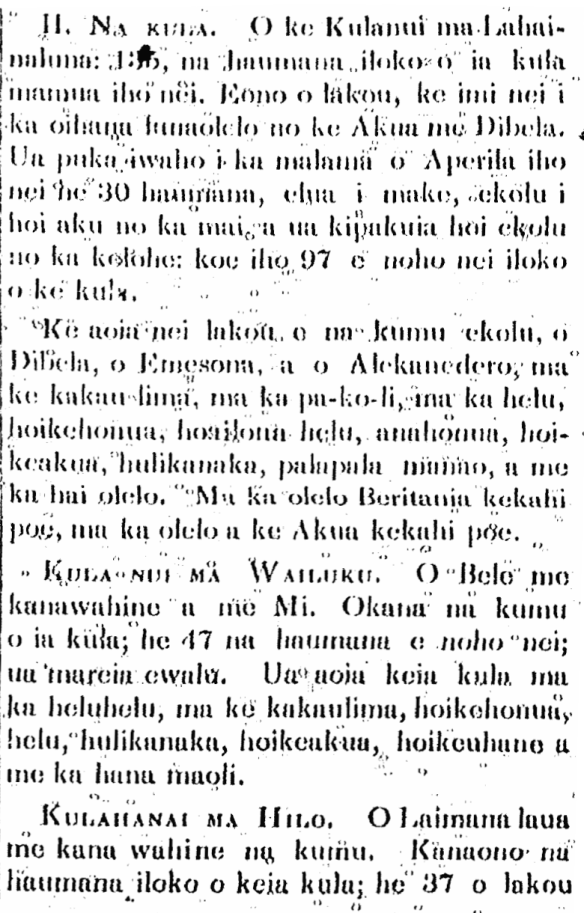
II. Na Kula.

Ka Nonanona, Buke 4, Pepa 6, Aoao 35. Iulai 9, 1844.
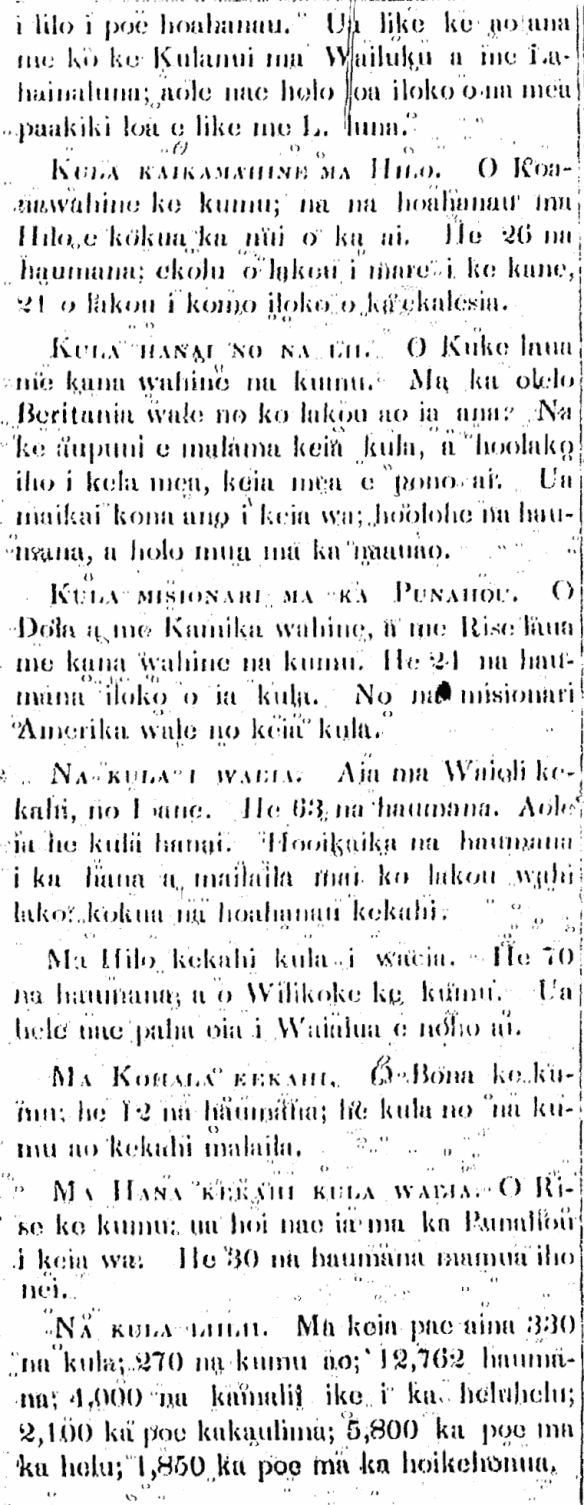
Ma Hilo...

Ka Nonanona, Buke 4, Pepa 6, Aoao 36. Iulai 9, 1844.

Opening of Punahou School, 1842.

THE SCHOOL AT KA PUNAHOU.

On the 11th of this July, this school began; there were 5 boarders and 12 day schoolers. Its work is currently progressing well.

On the 12th of July, Emerson folks left for Lahainaluna to live.

(Nonanona, 7/19/1842, p. 16)

KE KULA MA KA PUNAHOU.

Ka Nonanona, Buke 2, Pepa 4, Aoao 16. Iulai 19, 1842.

The beginnings of Punahou School, 1841.

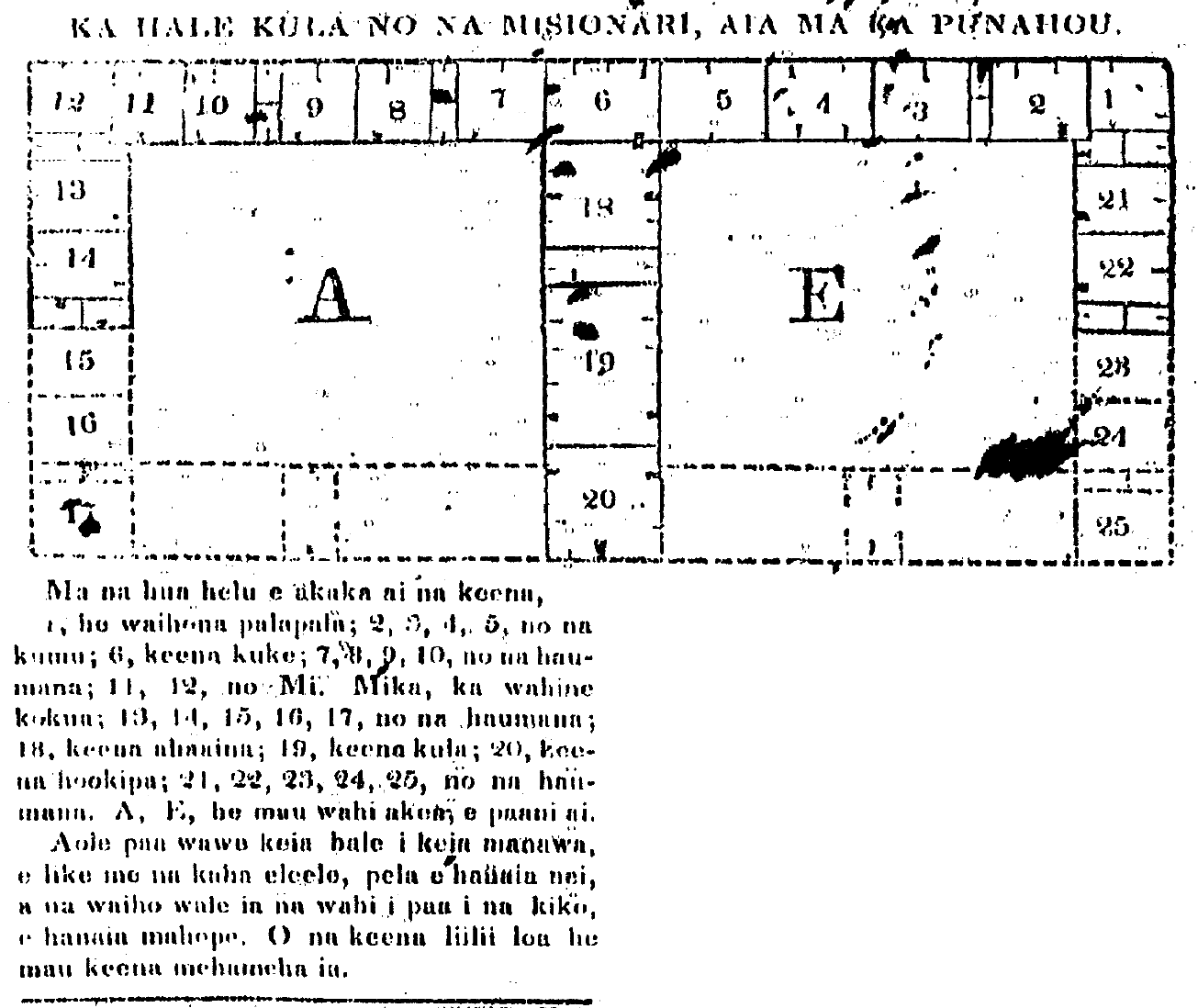
SCHOOLHOUSE FOR THE MISSIONARIES, AT KA PUNAHOU.

The rooms are explained by the numbers,

1, a library; 2, 3, 4, 5, for the teachers; 6, kitchen; 7, 8, 9, 10, for the students; 11, 12, for Mi. Mika [?] the woman helper; 13, 14, 15, 16, 17, for the students; 18, cafeteria; 19, school room; 20, room for entertaining guests; 21, 22, 23, 24, 25 for the students. A, E, wide areas to play.

This will not be completed quickly at this time; the places with solid lines are being constructed, and the areas surrounded by dashes are left to complete at a later date. The most tiny rooms are solitary rooms.

[Earlier, i posted a diagram of the layout of the Chiefs’ Children’s School. Here from about the same time is the school for missionary children at Kapunahou, the precursor to today’s Punahou School.

The school began instruction on July 11, 1842, with 5 boarders and 12 day schoolers.]

(Nonanona, 11/23/1841, p. 44)

KA HALE KULA NO NA MISIONARI, AIA MA KA PUNAHOU.

Ka Nonanona, Buke 1, Pepa 11, Aoao 44. Novemaba 23, 1841.

“Missionary Herald,” 1821–.

 Here is another reference available online. This publication was put out by the American Board of Commissioners for Foreign Missions (ABCFM), reporting home to America on their work throughout the world. Of particular interest to us is what they say about Hawaii. Here for instance is an article appearing in the year of the overthrow, 1893.

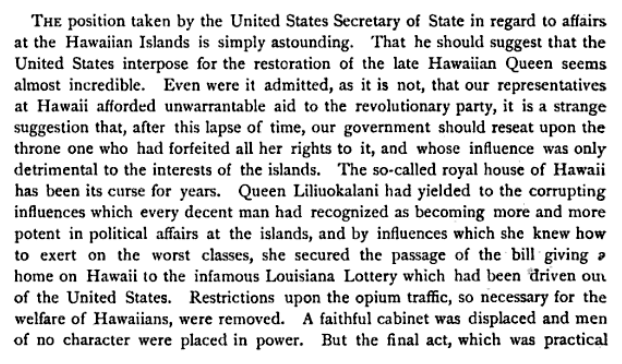
The position taken by the United States Secretary of State in regard to affairs at the Hawaiian Islands is simply astounding. That he should suggest that the United States interpose for the restoration of the late Hawaiian Queen seems almost incredible. Even were it admitted, as it is not, that our representatives at Hawaii afforded unwarrantable aid to the revolutionary party, it is a strange suggestion that, after this lapse of time, our government should reseat upon the throne one who had forfeited all her rights to it, and whose influence was only detrimental to the interests of the islands. The so-called royal house of Hawaii has been its curse for years. Queen Liliuokalani had yielded to the corrupting influences which every decent man had recognized as becoming more and more potent in political affairs at the islands, and by influences which she knew how to exert on the worst classes, she secured the passage of the bill giving a home on Hawaii to the infamous Louisiana Lottery which had been driven out of the United States. Restrictions upon the opium traffic, so necessary for the welfare of Hawaiians, were removed. A faithful cabinet was displaced and men of no character were placed in power. But the final act, which was practical…

(Missionary Herald, 12/1893, p. 510.)


The position taken...

The Missionary Herald, Volume LXXXIX, Number XII, Page 510. December 1893.

…suicide of the monarchy, was the attempt on her part to abrogate the Constitution and by sheer force establish a new one of her own making. Even her subservient ministers refused to endorse the scheme, yet she insisted upon it and sought to incite the populace to stand by her in her autocratic plans. It was then that all the better classes united as one man and deposed her. Never was there a revolution more warranted by facts, never was one more peacefully accomplished, and a queen of worthless character was set aside and the monarchy by its own act came to an end. If Minister Stevens or the commander of the Boston erred in judgment in any transaction, which we are not prepared to admit, yet there is no valid ground for the interference of our government to reverse the revolution months after it was consummated. We do not speak here of the political question as to what it is expedient for the United States to do in reference to a protectorate or to annexation. Opinions of these points may differ, but it would seem as if there were no room for difference of opinion in regard to this question of reestablishing the old monarchy on Hawaii. The best portion of her citizens have asked for some form of connection with the United States. Our government has a perfect right to say yes or no to all these proposals. And the Provisional Government at Honolulu has a right to say to us, “Either accept our proposal or hands off.” We regret to be obliged to speak in such terms of propositions that come from our national administration. We certainly should not do so did we not believe that any attempt to restore the Hawaiian Queen to her throne would be a gross outrage, and would be followed by the most serious consequences to the moral and religious interests of the islands, as well as to their material prosperity. We cannot think that our people will tolerate any intervention which has for its object the replacing upon the throne of a sovereign whose influence will be only for evil.

(Missionary Herald, 12/1893, p. 511.)

Continue reading

Missionary Album, 1969.

MISSIONARY ALBUM

Portraits and Biographical Sketches of the
American Protestant Missionaries
to the Hawaiian Islands

Enlarged from the Edition of 1937

Sesquicentennial Edition
Published by the
Hawaiian Mission Children’s Society

1969

Honolulu, Hawaii

[This is a great reference if you are looking for information on Protestant missionaries to Hawaii nei. It was put out by the Mission Children’s Society. Unfortunately, it seem that the list of missionaries to Micronesia and the Marquesas was left out of the publication to make room for the index.

I am not sure if it still available for purchase at the Mission Houses, because I cannot find it online, as they seem to be doing an overhaul of their gift shop portion of their online site, which can be found here.

And don’t forget that this is a useful list when researching missionaries!]

(Missionary Album, 1969.)

Missionary Album, 1969.

Missionary Album, 1969.

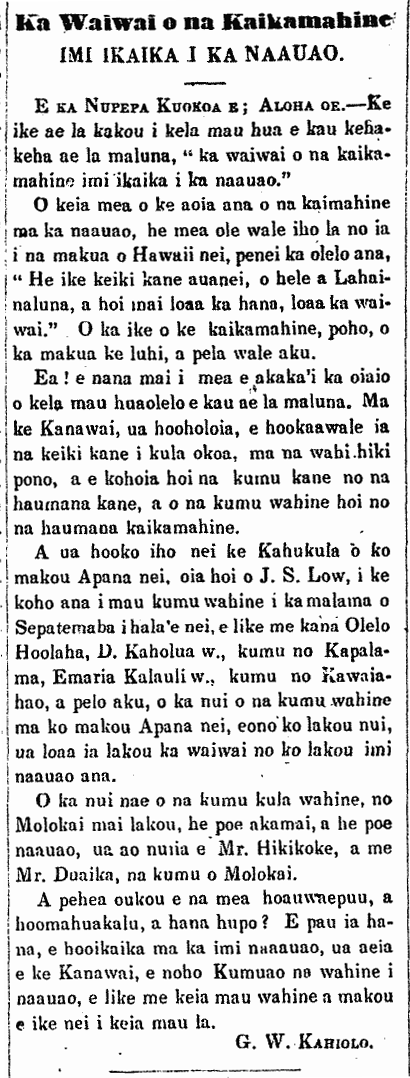
G. W. Kahiolo / G. W. Poepoe, feminist of his day, 1864.

The Value of Girls

SEEKING KNOWLEDGE EARNESTLY.

O Kuokoa Newspaper; Aloha oe.—We see the words placed proudly above, “the value of girls seeking knowledge earnestly.”

Teaching girls knowledge is something not important for Hawaiian parents, who say, “When boys are educated, they can go on to Lahainaluna, and return and find a job and get riches.” But educating girls is a waste of their parents efforts, and so forth.

Come now! look at this that makes clear the truth of the words above. The Law was passed that boys would be segregated in separate schools where possible, and men teachers would be selected for the boy students, and women teachers for the girl students.

And the Principal of our District, J. S. Low, has put this into practice, selecting women teachers in this past September, as per his Announcement: D. Kaholua (f), as teacher for Kapalama; Emaria Kalauli (f), teacher for Kawaiahao; and so forth; the number of female teachers in our District is six; they have reaped the wealth from their seeking education.

However, the majority of women teachers are from Molokai; they are intelligent and educated, they were taught well by Mr. Hitchcock [Hikikoke] and Mr. Dwight [Duaika], the teachers of Molokai.

What about you all, indifferent ones, skeptics, and the foolish? Stop this; put effort into education; the Law has allowed knowledgeable women to become Teachers, like these women that we see these days.

G. W. Kahiolo.

(Kuokoa, 1/16/1864, p. 3)

Ka Waiwai o na Kaikamahine

Ka Nupepa Kuokoa, Buke III, Helu 4, Aoao 3. Ianuari 16, 1864.