On the death of Beniamina Kaiminaauao Poepoe, and so much more, 1909.

BENIAMINA KAIMINAAUAO POEPOE HAS DEPARTED THIS LIFE.

In the afternoon of this Monday, July 11, the life of Beniamina Kaiminaauao Poepoe returned once more to He who first gave him to us in the year 1898. He was forty-one years old when he passed. He was born in Waipio, Hamakua, Hawaii, and that is his Aina where he was raised until he was older. He was fetched by their older brother [Joseph Mokuohai Poepoe], that being the current editor of this newspaper, to go live with him in North Kohala, Hawaii; and Beniamina lived with him while being instructed in the English Language. Later he came to Oahu nei. He lived in Laie and married a woman there. They had children, but only two of their daughters are still living. His wife passed to the other side first, and he was left with their daughters, and his older sibling, and his younger brother, Gulstan Kiliona Poepoe, one of the Owners of the News magazine, “Ka Lanakila,” which is now in publication. He was an Elder [Lunakahiko] of the Church of Jesus Christ of Latter-Day Saints [ka Ekalesia o Iesu Karisto o na Poe Hoano o na La Hope nei]. He was a candidate in the Labor Party [Aoao Limahana] for representative of the Fifth District, in the past year. His field of expertise is engineering.

And while he was working in that position on one of the water pumps of the Kahuku plantation, an accident befell him when he fell off from the pump house which he climbed on, and he broke the bones of his left leg. Continue reading

Kaipoleimanu, okolehao, place names, and such, 1895 / 2014.

KAIPOLEIMANU.

This Tuesday, Captain Kalei of the Schooner Rob Roy, which is a schooner travelling between Honolulu nei and Molokai, was arrested for having an Okolehao jug containing liquor; there were a great many officers sent to the seaside to arrest the Captain of the schooner.

There was much found in a dark room: four gin jugs, two Whiskey jugs, but the majority found were bottles that were empty with no whiff of Okolehao.

One of the sailors of this ship, distanced himself with a dismal look on his face, and another scratched his head while looking pale.

When it was clear to an officer that he saw alcohol was brought into Honolulu town to be sold, and because of orders received by the officers, should there be a person or persons that were confirmed to have alcohol, they were to be taken to Jail [Halewai], that indeed is what happened as per what was ordered; and the officers and some others went along to the Jailhouse while bringing in a Demijohn [“basketry filled with a bottle”] containing some Okolehao; there was the stench of Ipoleimanu, and this made us recall these lines of mele.

He manao he aloha,
No Kaipoleimanu,
He manu ku’u hoa,
Noho mai ka nahele,
Iiwi a o uka,
Polena i kaua,
Ua ao Hanalei,
Anu au maeele,
[Ua anu hoi au
I ka ua noe anu
Na hau o Maihi
Au ana i ke kai
Na ulu o Weli
Punohu mai ana
E mapu mai ana
Ke ala o ka Hala
Hala o Mapuana
Honi ana i ka ihu
Ke ala pua rose
Hooheno i kuu poli
Naue kuu kino
Ko hiki ana mai
Haina ia ka puana
No ka ipo leimanu.]

¹Kaipoleimanu was during this time a slang for okolehao.

[I took a step back from “Hawaii’s Story,” but not too far. This mele by Queen Kapiolani for her King Kalakaua, Kaipoleimanu, is still widely sung today. But who today still knows that along with Hanalei, Maihi, Weli, and Mapuana, that Kaipoleimanu is a place on Kauai. In a Hawaii where we are so used to places called Diamond Head, Pearl City, Bowls, Sunset, Yokohama, and the like, is there value in re-membering more traditional names?

On that note, before i take some time away from these posts, i thought i would try a little survey. If you have the time, please think about the question rationally, then choose an answer or add one of your own. And as always, do feel free to leave comments in the box all the way at the bottom.]

(Oiaio, 8/23/1894, p. 3)

KAIPOLEIMANU.

Nupepa Ka Oiaio, Buke VII, Helu 25, Aoao 3. Augate 23, 1895.

Another example of “Hilo Aihue”, 1912.

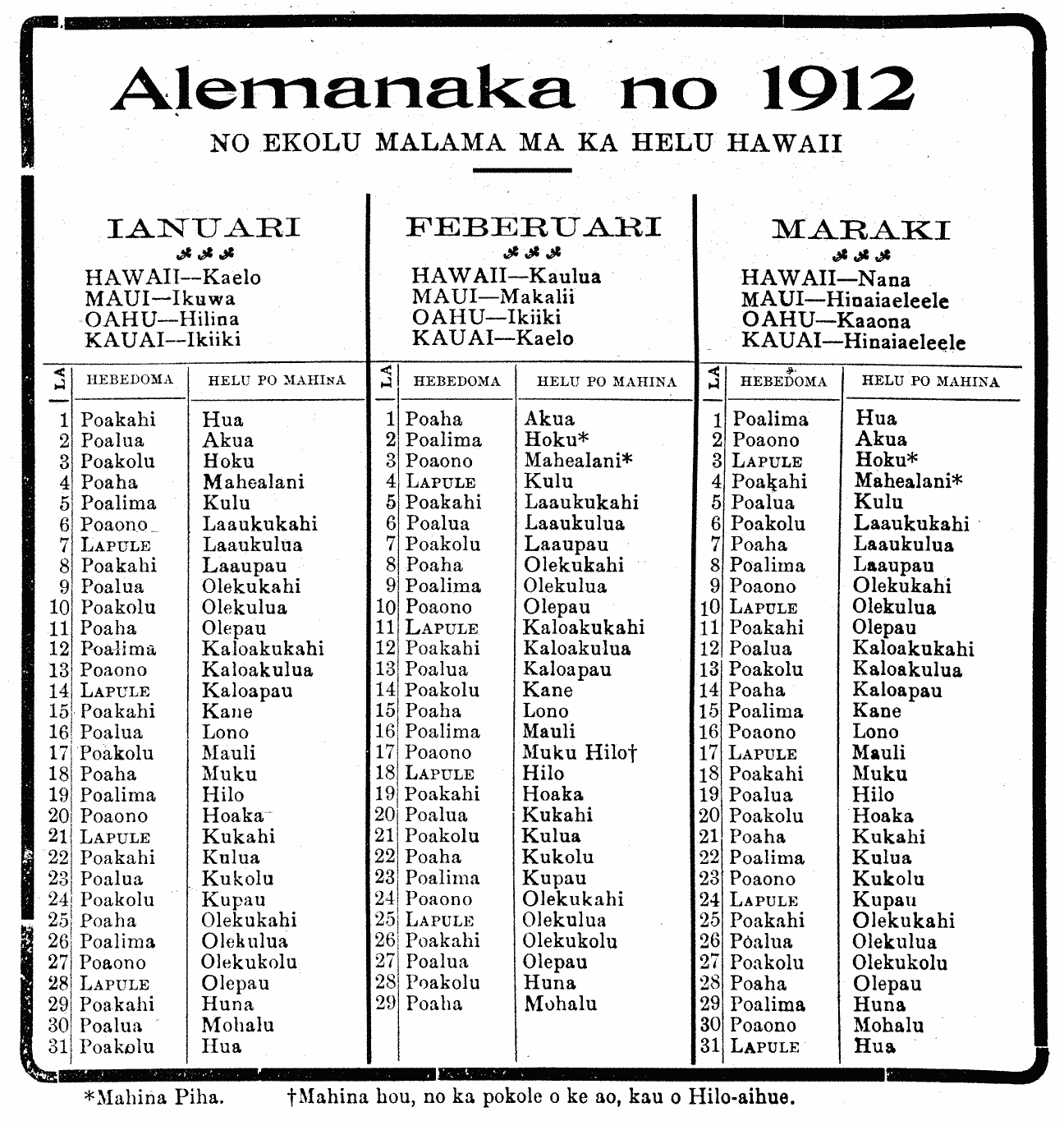
Calendar for 1912

FOR THREE MONTHS IN THE HAWAIIAN RECKONING

January February March
HAWAII—Kaelo HAWAII—Kaulua HAWAII—Nana
MAUI—Ikuwa MAUI—Makalii MAUI—Hinaiaeleele
OAHU—Hilina OAHU—Ikiiki OAHU—Kaaona
KAUAI—Ikiiki KAUAI—Kaelo KAUAI—Hinaiaeleele
DAY WEEK NAME OF THE NIGHT DAY WEEK NAME OF THE NIGHT DAY WEEK NAME OF THE NIGHT
1 Monday Hua 1 Thursday Akua 1 Friday Hua
2 Tuesday Akua 2 Friday Hoku* 2 Saturday Akua
3 Wednesday Hoku 3 Saturday Mahealani* 3 Sunday Hoku*
4 Thursday Mahealani 4 Sunday Kulu 4 Monday Mahealani*
5 Friday Kulu 5 Monday Laaukukahi 5 Tuesday Kulu
6 Satuday Laaukukahi 6 Tuesday Laaukulua 6 Wednesday Laaukukahi
7 Sunday Laaukulua 7 Wednesday Laaupau 7 Thursday Laaukulua
8 Monday Laaupau 8 Thursday Olekukahi 8 Friday Laaupau
9 Tuesday Olekukahi 9 Friday Olekulua 9 Satuday Olekukahi
10 Wednesday Olekulua 10 Satuday Olepau 10 Sunday Olekulua
11 Thursday Olepau 11 Sunday Kaloakukahi 11 Monday Olepau
12 Friday Kaloakukahi 12 Monday Kaloakulua 12 Tuesday Kaloakukahi
13 Satuday Kaloakulua 13 Tuesday Kaloapau 13 Wednesday Kaloakulua
14 Sunday Kaloapau 14 Wednesday Kane 14 Thursday Kaloapau
15 Monday Kane 15 Thursday Lono 15 Friday Kane
16 Tuesday Lono 16 Friday Mauli 16 Satuday Lono
17 Wednesday Mauli 17 Satuday Muku Hilo† 17 Sunday Mauli
18 Thursday Muku 18 Sunday Hilo 18 Monday Muku
19 Friday Hilo 19 Monday Hoaka 19 Tuesday Hilo
20 Satuday Hoaka 20 Tuesday Kukahi 20 Wednesday Hoaka
21 Sunday Kukahi 21 Wednesday Kulua 21 Thursday Kukahi
22 Monday Kulua 22 Thursday Kukolu 22 Friday Kulua
23 Tuesday Kukolu 23 Friday Kupau 23 Satuday Kukolu
24 Wednesday Kupau 24 Satuday Olekukahi 24 Sunday Kupau
25 Thursday Olekukahi 25 Sunday Olekulua 25 Monday Olekukahi
26 Friday Olekulua 26 Monday Olekukolu 26 Tuesday Olekulua
27 Satuday Olekukolu 27 Tuesday Olepau 27 Wednesday Olekukolu
28 Sunday Olepau 28 Wednesday Huna 28 Thursday Olepau
29 Monday Huna 29 Thursday Mohalu 29 Friday Huna
30 Tuesday Mohalu 30 Saturday Mohalu
31 Wednesday Hua 31 Sunday Hua

* Full Moon.  †New Moon; because of the short day, Hilo-aihue is the moon.

(Au Hou, 1/24/1912, p. 1)

Alemanaka no 1912

Ke Au Hou, Buke 3, Helu 3, Aoao 1. Ianuari 24, 1912.

More on traditional calendars, 1906.

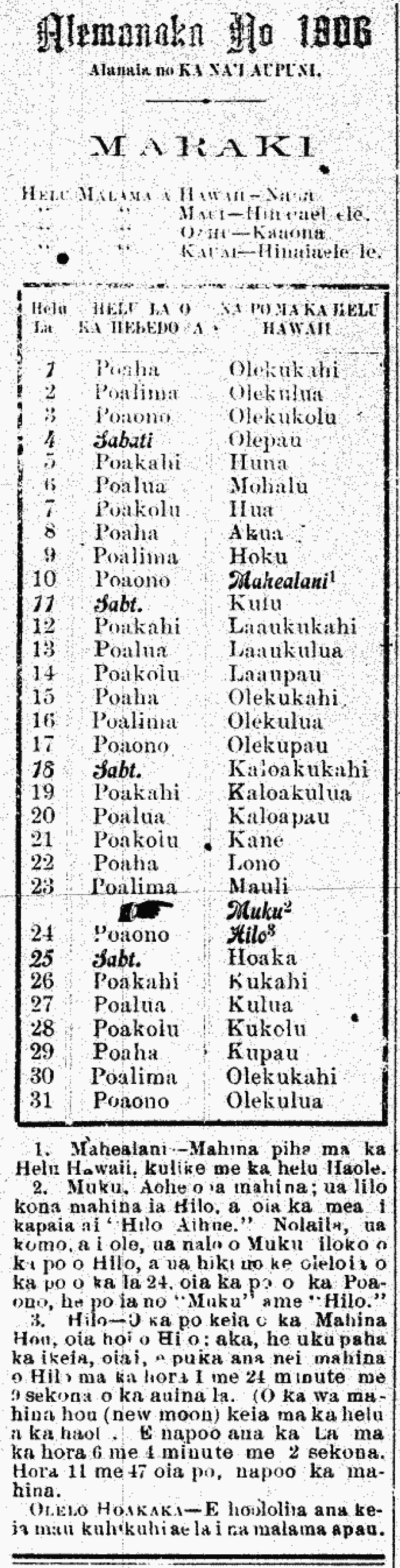
Calendar for 1906

Offered from KA NA’I AUPUNI.

MARCH

Name of Month of Hawaii [Island]—Nana.
” ” Maui—Hinaiaeleele.
” ” Oahu—Kaaona.
” ” Kauai—Hinaiaeleele.

Day of the Month DAY OF THE WEEK NIGHT BY HAWAIIAN COUNT
1 Poaha [Thurs] Olekukahi
2 Poalima [Fri] Olekulua
3 Poaono [Sat] Olekukolu
4 Sabati [Sabbath] Olepau
5 Poakahi [Mon] Huna
6 Poalua [Tues] Mohalu
7 Poakolu [Wed] Hua
8 Poaha Akua
9 Poalima Hoku
10 Poaono Mahealani¹
11 Sabt. Kulu
12 Poakahi Laaukukahi
13 Poalua Laaukulua
14 Poakolu Laaupau
15 Poaha Olekukahi
16 Poalima Olekulua
17 Poaono Olekupau
18 Sabt. Kaloakukahi
19 Poakahi Kaloakulua
20 Poalua Kaloapau
21 Poakolu Kane
22 Poaha Lono
23 Poalima Mauli
Muku²
24 Poaono Hilo³
25 Sabt. Hoaka
26 Poakahi Kukahi
27 Poalua Kulua
28 Poakolu Kukolu
29 Poaha Kupau
30 Poalima Olekukahi
31 Poaono Olekulua

1. Mahealani—Full moon by Hawaiian count, and same as the Haole count.

2. Muku—There is no moon; its moon is taken by Hilo, and that is why it is called “Hilo Aihue” [Thieving Hilo]. Therefore, Muku enters or is lost into the night of Hilo, and it can be said that the night of the 24th, is the night of Saturday, and is a night of “Muku” as well as “Hilo.”

3. Hilo—This is the night of the New Moon, that being Hilo: however, it might be only seen for a bit, being that this moon, Hilo, appears at 1:24 and 9 seconds in the afternoon. (This is the time of the mahina hou (new moon) according to the haole). The sun will set at 6:04 and 2 seconds. At 11:47  that night, the moon will set.

Clarification—This explanation will be changed every month.

[I recently ran across this term “Hilo Aihue” once again after not seeing it for a number of years. The earliest i have seen it used is by a man commonly known as J. L. Kukahi. He actually gives his name as being Joseph Liwai Kawohikukahi, and his explanation of “Hilo Aihue” appears in an ongoing argument with D. M. Punini, Jr. (David M. Punini, Jr.) over the traditional Hawaiian calendar. See Makaainana, 4/22/1895, p. 3.]

(Na’i Aupuni, 3/26/1906, p. 3)

Alemanaka no 1906

Ka Na’i Aupuni, Buke I, Helu 102, Aoao 3. Maraki 26, 1906.

Speaking of Prendergast… 2013.

It is good to know if you are doing research on this name that the Hawaiianized version of Prendergast is Penikalaka. I am looking for a site that will host a database that will give alternate names for historical people, like Armstrong is Limaikaika, or Lincoln McCandless is Lina or Linekona Eliwai, and so forth. It would also be ideal if people could add to this list with a citation of where they found the alternate name. This would make for better/easier research in Hawaiian-language material, not just in newspapers.

Still more on the Makee, the Malulani, and a reminder on naming, 1897.

[Found under: “ALL ALONG THE DOCKS”]

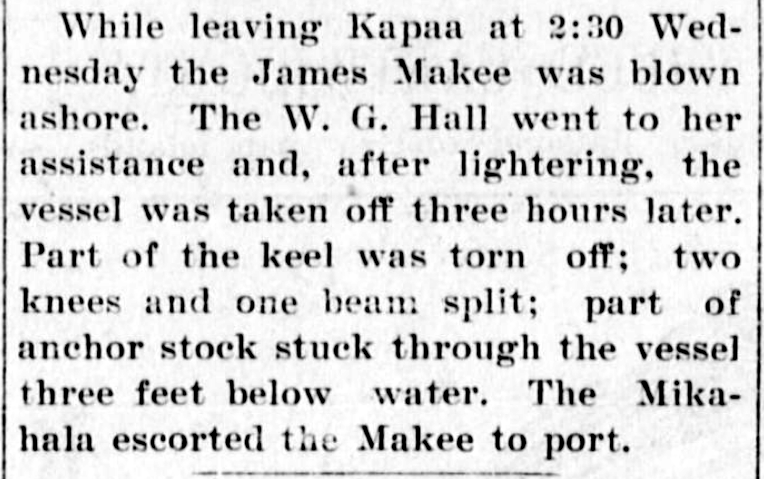
While leaving Kapaa at 2:30 Wednesday the James Makee was blown ashore. The W. G. Hall went to her assistance and, after lightering, the vessel was taken off three hours later. Part of the keel was torn off; two knees and one beam split; part of the anchor stock stuck through the vessel three feel below water. The Mikahala escorted the Makee to port.

[It is good to at least be aware that many times, Hawaiians called things (boat, for instance) a different name from what it was called in English. Here you see the W. G. Hall mentioned. It might sound more familiar to you as the Malulani.

Spelling is also varied in Hawaiian on occasion. You would expect in the Hawaiian-Language Newspapers, the James Makee to be written Kimo Maki (which it is at times), but it is also seen as Kimo Makee, James Maki, and James Makee as well! On a somewhat related note, Ena Road in Waikiki is not pronounced like “ena” as is so often heard today from the youngsters, but it is pronounced like “ina” and refers to the old-time Ing Family. So you will see in the Hawaiian-Language Newspapers, John Ena, John Ina, Keoni Ena, Keoni Ina…

I would like to see an easy online reference done for English/Hawaiian name variants done!]

(Hawaiian Star, 1/2/1897, p. 2)

While leaving Kapaa at 2:30...

The Hawaiian Star, Volume III, Number 1160, Page 2. January 2, 1897.

More Hawaiians in the military, 1917.

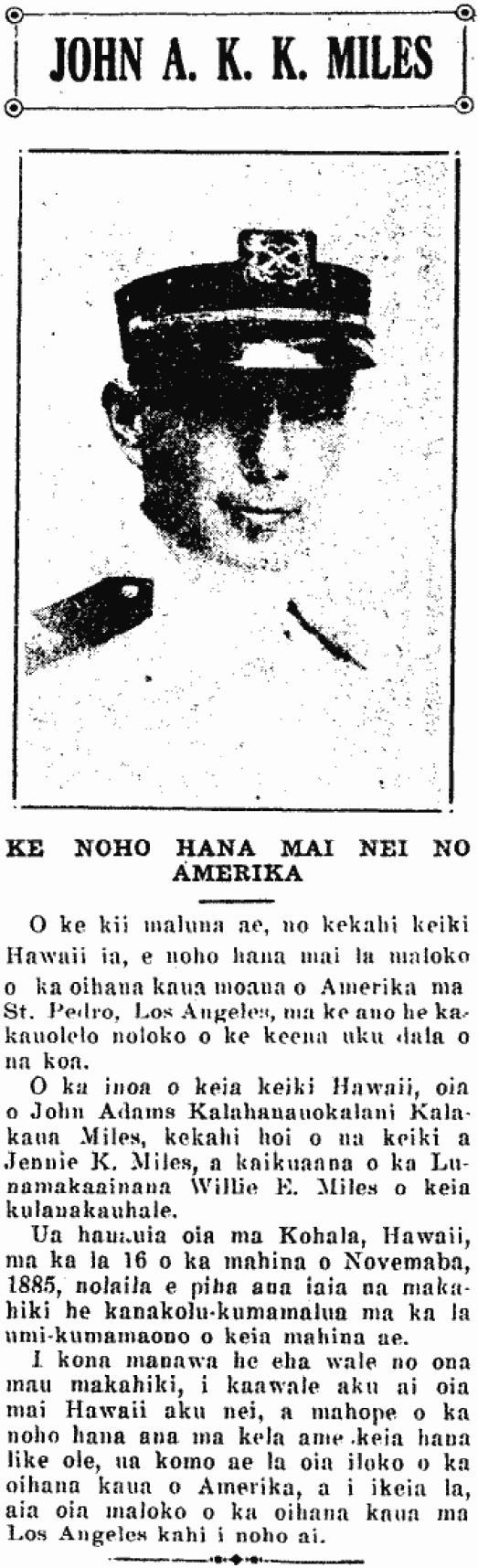
JOHN A. K. K. MILES

WORKING IN THE SERVICE OF AMERICA

The picture above is of a Hawaiian boy who is working in the navy of America at St. Pedro, Los Angeles, as a secretary in the department of the payroll of the military.

The name of this Hawaiian youth is John Adams Kalahanauokalani Kalakaua¹ Miles, a child of Jennie K. Miles and the older brother of Legislator Willie E. Miles of this city.

He was born in Kohala, Hawaii, on the 16th of November, 1885, and therefore he will make 32 on the 16th of next month.

When he was but four years old, he was taken from Hawaii nei, and after working at various jobs, he joined the military of America. And today, we see that he is in the service in Los Angeles, where he resides.

¹One way names were given traditionally was after important events, whether happy or sad. This is a nice and clear example of a commemorative name. John A. K. K. Miles was born on November 16, 1885, on the birthday of King Kalakaua. He was therefore named literally “The birthday of the royal one Kalakaua”.

(Kuokoa, 10/19/1917, p. 4)

JOHN A. K. K. MILES

Ka Nupepa Kuokoa, Buke LV, Helu 42, Aoao 4. Okatoba 19, 1917.

Royal Order of Kamehameha: the early days, 1903.

The Secret Society of the True Natives.

On the 11th of this month, on the day of Ka Na’i Aupuni [Kamehameha Day], a number of native youths established a secret society called “Kamehameha Order”. There are many respected Hawaiians who joined this association, and Prince Kalanianaole is the head of this group.

It is stated that this association will be spread across this Archipelago, and native Hawaiians will be allowed to join, should they be fitting.

One of their major functions will be trying to search out and to care for things from times of old, and the designating of the storied places [wahi pana] all over these islands.

Currently, there is a Historical Society [Ahahui Moolelo o ke Au Kahiko]¹, and they have a lot, but the oiwi Hawaii themselves must do something so that the famed ones of times past will live on, and also to foster things that will let the name of Hawaii live on in perpetuity.

¹The roster of active members of the Hawaiian Historical Society of 1903 read:

“Ables, L. C.; Achi, W. C.; Alexander, S. T.; Alexander, W. D.; Allen, S. C.; Allen, W. F.; Baldwin, H. P.; Banning, B. R.; Beckwith, Rev. E. G.; Beckwith, Miss Martha; Bertram, Bro. G.; Bishop, Rev. S. E.; Bolte, C.; Bowen, W. A.; Boyd, J. H.; Brown, Cecil; Brown, C. A.; Bryan, Wm. A.; Carter, A. W.; Carter, G. R.; Carter, Mrs. H. A. P.; Carter, J. O.; Cartwright, Bruce; Castle, G. P.; Castle, J. B.; Castle, W. R.; Catton, R.; Cooke, A. F.; Cooke, C. M.; Cooke, Jos. P.; Cunha, E. S.; Damon, F. W.; Damon, S. M.; Day, Dr. F. R.; Dayton, D.; Desha, G. L.; Dickey, C. H.; Dickey, L. A.; Dillingham, B. F.; *Dimond, W. W.; Dole, E. P.; Dole, Hon. S. B.; Dowsett, J. M.; Emerson, J. S.; Emerson, Mrs. J. S.; Emerson, Dr. N. B.; Emerson, Rev. O. P.; Emmeluth, J.; Fisher, J. H.; Frear, Hon. W. F.; Giffard, W. M.; Goodale, W. W.; Graham, W. M.; Haalelea, Mrs. A. A.; Hackfeld, J. F.; Hall, W. W.; Hartwell, A. S.; Hatch, F. M.; Henriques, E.; Herrick, C. F.; Hobron, T. W.; Ho Fon; Humphreys, A. S.; Hustace, C.; Irwin, W. G.; Jones, P. C.; Judd, Albert F.; Lewers, Robert; Logan, D.; Lowrey, F. J.; Lucas, George; Lyle, James; Lyons, C. J.; Mclanahan, E. B.; McGonagle, Chas.; McIntyre, H. E.; Mackintosh, Rev. A.; Magoon, J. A.; May, Thos.; Mott-Smith, E. A.; Nakuina, M. K.; Nolte, H. J.; Parke, W. C.; Peacock, W. C.; Pearson, Arthur W.; Pond, Percy M.; Potter, Geo. C.; Rhodes, C. L.; Robinson, M. P.; Rodgers, Dr. C. T.; *Ropert, Rev. F. G., Bishop of Panopolis; Rowell, W. E.; Schaefer, F. A.; Schmidt, H. W.; Searle, J. C.; Sedgwick, T. F.; Smith, G. W.; Smith, Henry; Smith, Walter G.; Smith, W. O.; Stokes, John; Swanzy, F. M.; Timmons, L. D.; Towse, Ed.; Thrum, T. G.; Thurston, L. A.; von Holt, H.; Walker, T. R.; Wall, W. E.; Waterhouse, H.; Weaver, P. L.; Westervelt, Rev. W. D.; Whiting, W. A.; Whitney, Dr. J. M.; Wichman, H. F.; Wilcox, A. S.; Wilcox, C.; Wilcox, G. N.; Williams, H. H.; Wilson, W. F.; Wodehouse, E. H.; Wood, Dr. C. B.; Wood, Edgar; Wundenberg, F.
*Deceased.

(Kuokoa, 6/26/1903, p. 1)

Ka Hui Malu o na Oiwi Ponoi.

Ka Nupepa Kuokoa, Buke XLI, Helu 26, Aoao 1. Iune 26, 1903.

Set of mele composed in honor of King Kalakaua, 1881.

HE KAPA NO KALAKAUA.

O mai o Kalakaua nona ke Alii ke kapa hulu manu,
I hana ia mai e Halulu ka Manu Alii mai Kahiki,
Hiki i Hawaii nei i haku kapa hulu manu nou e Kalani Kalakaua,
Ke keiki makahiapo a Kapaakea ko makuakane,
A Keohokalole ko makuahine ke ola—la,
E kii ke kapa o ka hulu o ka Aeto,
A i kapa aahu no Kalani,
A e kii ko kapa o ka hulu o ka Iwa,
A i kapa aahu no Kalani,
A e kii ko kapa a ka hulu o ka Oo,
A i kapa aahu no Kalani,
A e kii ko kapa o ka hulu o ka Mamo,
A i kapa aahu no Kalani,
A e kii ko kapa o ka hlu o ka Iiwi,
A i kapa aahu no Kalani,
A e kii ko kapa o ka hulu o ka Pikake,
A i kapa aahu no Kalani,
A haina ke Alii nona ke kapa,
O Kalakaua kuu Lani.
Mrs. Kaleihiwahiwa.

HE OHU NO KALAKAUA.

Aia i ka Lani ko ohu e kohu ai,
Ua hana mua ia e ka Makua mana loa,
E kii ko lei ohu e Kalani,
O ke anuenue pio i ka lewa,
E kii ko lei ohu e Kalani,
O ka Waipuilani pio i ke kai,
Kinikohu oe e Kalani,
Ko ohu anuenue,
Kau mai oe i ka nuu,
Noho pono i ke Kalaunu,
He uwila kela—ua hiki mai nei,
He anapu keia maluna o Likelike,
He uila kela o ka papahi ohu,
He anapu keia Lehua o Hilo one,
He uwila kela—i ohu kahiko,
He anapu keia—no Kalakaua,
He uwila kela e o mai oe,
He anapu keia—e Kalakaua,
He uwila kela ko ohu kahiko,
He uwila kela,
Kohu i ke Kalaunu—He anapu keia,
He ohu no Kalakaua,
Mrs. Kaleihiwahiwa.

HE HANAU NO KALAKAUA.

Aia Iolani Kauikalani,
O ke Kini nui o Hawaii nei,
A o oe ka pua i oi loa ae,
Maluna o ke ao malamalama,
He uwila ka hoa e kaulike ai,
Ma na iliwai a o ka honua,
Hiki aku ka lohe la i ka hikina,
I ka la hanau o Kawaihau,
O ke aiwaiwa la o na lani,
A i hanau ia me ka opua,
Haina ke Alii i hanau ia,
O ka Wohikukahi la e—o mai.
Aia i Kauai o Kawaihau,
O ka Hui Mahi-ko o Kealia,
Alia oe la e Kapiolani,
E pulale e aku i ka hole ko,
Aia ike pono oe i ka nua,
Lawe ae oe a kau i ka nio,
Mai puni aku oe i ka puhikole,
I ka ili puakea oloko o Mareka,
A he mea hoopau poe-a-poe,
No ka mea Aupuni o Hawaii nei,
Ua ike maka iho no hoi oe,
A o oe ka heke i oi loa ae,
Haina ke Alii i hanau ia,
O ka Wohikukapu la e o mai.
Mrs. Kaleihiwahiwa.

HE INOA NO KALAKAUA.

Auhea wale oe e ka liko,
E ke koolua a o ka lehua,
Homai ke aloha ia nei;
A i honi kuwili ia aku,
Ke hoomau ae nei hoi,
I ke onaona la oia pua,
A’u i kui ai a lawa,
I lei no’u no ka Hikina,
No ka la hiki ma Kumukahi,
Kahiko ae la i Haehae,
O ka wela ka i kua o ka la,
Hulili i ka Pahoehoe,
Nonono ka pua o ka lehua,
Luhiehu i ke kula o Malama,
I ka hoope ia e ka ua,
Uluau kii wai o ka uka,
No uka ka wahine kia manu,
Aohe kepau pili ole,
O ke ani a Laukapalili,
Koe manu ole i ka wekiu,
E o e ka Wohikukahi,
O Kawaihau no he inoa.
Auhea oe Keonaona,
E ka hoapili o kuu kino,
A o oe a owau kai ike,
I ka hana hoi a ka makemake,
Kaua pu no ilaila,
I ka nahele lualai ke aloha,
Hiaai ka manao e ike,
I ka uka paoa i ke ala,
He ala o ka wai Iliahi,
Hoapili o Mailekaulahea,
Hea mai ke ahi a ka wahine,
O ke ala ia o ka malihini,
A e hiki ai i Kaauea,
I ka hale Kamala a ka noe,
Uhi wai anu o ka mauna,
I mehana i ke kono a loko,
Mea ole ke awa o ka uka,
Ka hanuna a ka ihu o ka lio,
I ke one aku o Kahualoa,
Loa wale ka noho’na o Kalani.
I Hiwahiwa no ke ao nei,
A i pua nani no Hawaii,
E o e ka Wohikukahi,
O Kawaihau he inoa.
Kaua i ka nani o Hilo,
I ka ua loku o Hanakahi,
Akahi no ko’u manene,
Ka me-eu hoi o ko’u oho,
He ula leo o Pahanakaiwi,
Ikuwa mai la i Haili,
Ilihia i ka leo o ka Mamo,
E wa mai la i Olaa,
Ua laa ia pua ia nei,
Eia i ko’u kiaha,
Ua hoolawa ia e Lia,
Me na lehua i Panaewa,
Kuhi no paha oe e Malio,
Hookahi halau i ao ai,
E like ai na mea hana,
O na mea hoonui ike,
He makau hala ole keia,
Ua lou ia e ka ia nui,
Ua moni ia ka’u maunu,
E Moananuikalehua,
Ua paa i ka lino pa-walu,
I malia i ke aho makalii,
Kuhi oe i ka Hilu-noenoe,
A he ia ia no ke kohola,
O ka lale au o Kaiona,
I noho i ka malu ohai,
Aohe hana a Malamanui,
Ua kau ke keha i Kaala,
O ka iki nioi pepa ia,
Holo ka wela i na aa koni,
Ka Upena nae mai keia,
Aohe ia koe ke hei mai,
He hului au no ia kai,
No ka moana kai hohonu,
E o e ka Wohikukapu,
O Kawaihau no he inoa,
Mrs. Kaleihiwahiwa
Ka-ua Paakea o Hale-kela.

(Elele Poakolu, 4/20/1881, p. 2)

HE KAPA NO KALAKAUA...

Ka Elele Poakolu, Buke II, Helu 7, Aoao 2. Aperila 20, 1881.