Ernest Kaai’s Hawaiian Troubadours in New Zealand, 1925.

AMUSEMENTS.

“NIGHT IN HONOLULU.”

The ukulele, the hula-hula, and the steel guitar, as entertaining products of Hawaii, are known all over the civilised world that comes under the influence of vaudeville circuits, but such segregated examples as have hitherto been shown in Auckland are mere museum specimens compared with the living actuality of the performance given in His Majesty’s Theatre on Saturday night by Ernest Kaai’s Hawaiian troubadours. These minstrels exhibited ukulele and guitar with all the sweet setting of their native haunts, the strains of the strings enriched by vocal harmonising in which the Hawaiian exccels, and the harmonising enhanced by quaint falsetto and yodelling effects that thoroughly delighted a house packed to the doors.

The curtain rose on a pretty palm-fringed beach scene, when it could be seen, for the house was in darkness when a harmonious chorus of Hawaiian voices, with stringed instrument accompaniment, was lifted in song to welcome the doming dawn. It was a native harmonising chorus set to music by Queen Liliuokalani, and entitled “Aloha Oe,” which swells to a paean of joy as the rising sun lights up the expectant world—in this case quite an effective stage scene. A similar characteristic effort of voice, strings, and light, symbolising twilight, with the stage fading melodiously into darkness, marked the ending of the first part of the programme, while in between dawn and twilight came a series of novel, interesting and thoroughly entertaining items. An Island folk-song by eddie Kniley, a ballad by Frank Luiz, hula dances by Gertila Byrnes and Layley Leywood, and a steel  guitar selection by Thelma Kaai were given with effective voice and string accompaniments. It was the part-singing in trios, however that most captivated the audience. One such number by David Kaili, Thelma Kaai and Eddie Kinley was emphatically encored, but when Queenie and David Kaili and Thelma Kaai appeared in whimsical part songs in which Queenie appeared as a soubrette of talent with a quaint gift for vocal ornamentation, the house was so vastly entertained and amused that the party were recalled four or five times. Continue reading
Hawaiian music in Aotearoa, 1925.

NEW ZEALAND IS JOYFUL WITH HAWAIIAN MUSIC.

A news item published in the newspaper Auckland Star on the 20th of April past described the enthusiasm of the people of New Zealand for Hawaiian songs, given at the concert held by Ernest Kaai and his band which is going around New Zealand.

When one of the concerts opened in the theater, the interior of the theater was decorated with greenery, and the theater was darkened, and when the music began, accompanied by the voices of the singers, it was as if the scene then was the coming of light at the break of dawn; and the audience held their breath when Aloha Oe was sung, as the instruments played along. Continue reading

Books to teach Maori English arrive, 1878.

Maori Books.

We return our hearty thanks to a Brother Editor of the New Zealand Press for some nice Maori books forwarded by last mail. They are destined for the instruction of the Maoris in the English language. The Maori title of one of these books is:—He Akoranga i te reo Ingarihi mo te kura Maori, or, “Lessons in the English Language for Maori Schools.” Published at Wellington “by authority” by George Didsbury, Government Printer. Continue reading

Bags to ship sugar to be woven of lauhala or akaakai? 1873.

Wanted.

Here is something that is much sought after by the producers of sugar. Bags that are woven with strips [ko-ana] of bulrush [akaakai] or lauahala perhaps, to put brown sugar [ko-paa eleele] in and ship to Australia or America. The previous week, a schooner brought 15,000 bags of this type from New Zealand, and the haole traders greatly appreciated them. The length of the bags are 33 inches, and 17 inches wide. If bags like these are woven here at a reasonable price, and a thousand are made, they will be sold out in a year. Continue reading

Peter Buck to become an American citizen, 1943.

Resolution Approved

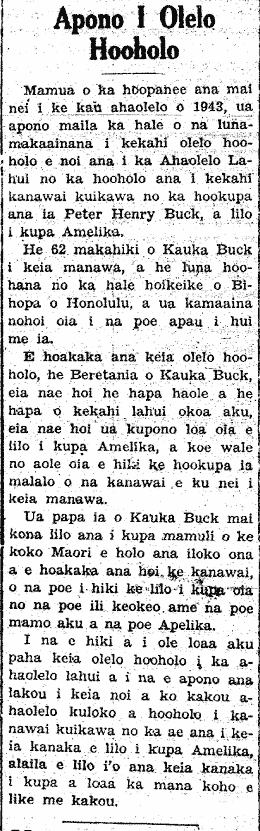
Before the session of the legislature of 1943 was postponed, the house of representatives approved a resolution asking Congress [Ahaolelo Lahui] to pass a special law to naturalize Peter Henry Buck, and make him an American citizen.

Dr. Buck is 62 years old now, and he is the director of the Bishop Museum of Honolulu, and he is a kamaaina to all the people he meets.

This resolution clarifies that Dr. Buck is English, however he is half haole and half another ethnicity, but it is appropriate that he be naturalized as an American citizen, but he cannot become a citizen under the current laws.

Dr. Buck is restricted from becoming a citizen because of the Maori blood flowing through him, and the law states that those who are able to become citizens a whites and descendants of African people.

If this resolution reaches or is received by the senate, and should they approve this request of our local legislature, and they pass a special law to allow this man to become an American citizen, then this man will indeed become a citizen and he will be able to vote like we do.

(Hoku o Hawaii, 5/5/1943, p. 1)

Apono I Olelo Hooholo

Ka Hoku o Hawaii, Volume XXXVIII, Number 2, Aoao 1. Mei 5, 1943.

The Maori and Hawaiians, 1911.

Hawaiians and Maori Talk to Each Other.

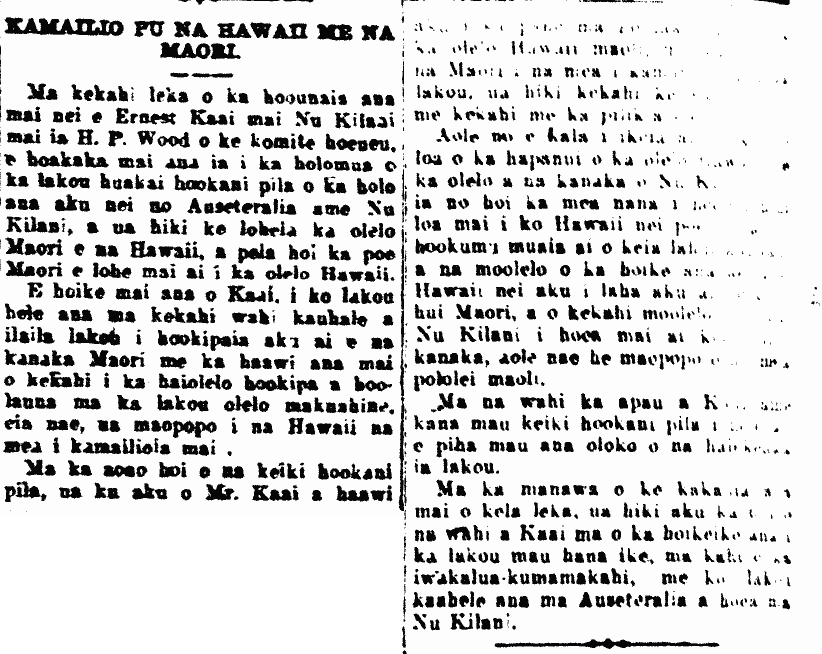
In a letter sent by Ernest Kaai from New Zealand to H. P. Wood of the Hawaiian Promotion Committee [which seems to be a precursor to the visitor’s bureau], he shows the progress of their musical touring of Australia and New Zealand. The Hawaiians could hear the Maori language and the Maori could hear the language of Hawaii.

Kaai said that when they went to some villages, they were hosted by Maori people, where one of them said words of welcome and friendship in their mother tongue. But the Hawaiians understood what was being said.

From the side of the musicians, Mr. Kaai stood and gave [rest of the paragraph unclear].

It was not long ago that [also unclear here, but they seem to be talking about the relationship between Aotearoa and Hawaii].

Everywhere that Kaai and his musical group went, the theaters would be filled with them.

When this letter was written, the number of places that Kaai them performed at was about 21, with them going around Australia and reaching New Zealand[?]

[A great deal of the Hawaiian Language Newspapers are bound into book form, and because they were purposely printed without much empty margins, often the printed portions that fall in the margin area of the books are not legible, especially when scanned. To get a clear image of the entire page, the books will have to be unbound first. That, it seems, takes a great amount of funding.]

(Kuokoa, 6/30/1911, p. 8)

KAMAILIO PU NA HAWAII ME NA MAORI.

Ka Nupepa Kuokoa, Buke XLVII, Helu 26, Aoao 8. Iune 30, 1911.

Emma Nakuina educates teachers on Hawaiian history, 1920.

HAWAIIAN STORIES PRESENTED BEFORE THE TEACHERS’ SCHOOL.

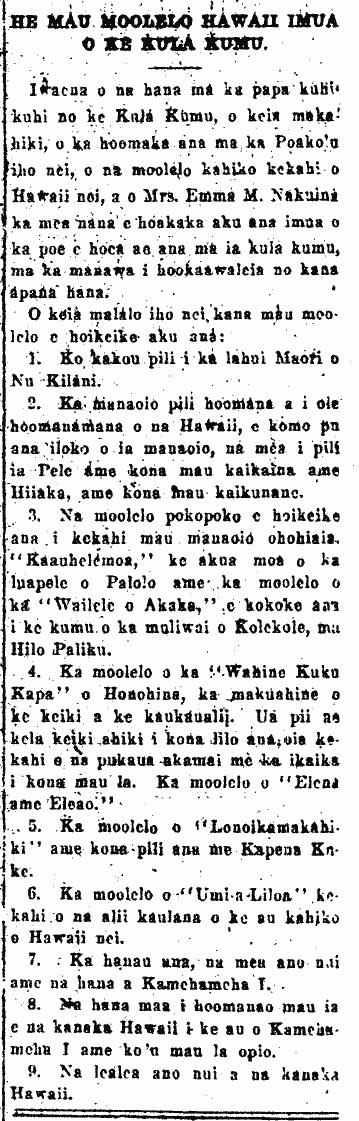
In the syllabus of the School of Education this year, beginning on this past Wednesday, were old moolelo of Hawaii nei. And it is Mrs. Emma M. Nakuina who is teaching them before those who come to the teachers’ school during the time set aside for her course.

These below are the moolelo that she will be teaching:

1. Our ties with the Maori of New Zealand.

2. The religion or superstition of the Hawaiians, and along with those beliefs are things relating to Pele and her younger sisters and Hiiaka, along with her brothers.

3. Short stories which show amazing beliefs, like the story of “Kaauhelemoa,” the chicken god of the crater of Palolo and the story of “Akaka Waterfall,” which is close to the head of the Kolekole River in Hilo Paliku.

4. The story of “The Kapa-Beating Woman” of Honohina, the mother of the chiefly child. That child grew up to become one of the strong and skilled warriors of his time. The story of “Elena [Eleau?] and Eleao.”

5. The moolelo of “Lonoikamakahiki” and his association with Capt. Cook.

6. The moolelo of “Umi-a-Liloa,” one of the famous alii of old Hawaii nei.

7. The birth, the important things, and accomplishments of Kamehameha I.

8. The usual activities recalled by Hawaiians in the time of Kamehameha I as well as during my childhood.

9. The major entertainments of Hawaiians.

(Kuokoa, 7/9/1920, p. 4)

HE MAU MOOLELO HAWAII IMUA O KE KULA KUMU.

Ka Nupepa Kuokoa, Buke LVIII, Helu 28, Aoao 4. Iulai 9, 1920.

Maori in Hawaii, 1899.

Speech of the New Zealander.

Wheraliko Rawei, a man from New Zealand [Nu Kilani], gave [a speech] in the YMCA building [Hale o ka Hui Opio] of Honolulu nei. The topic of his presentation pertained to New Zealand, the land of the Maori people.

He is a native New Zealander, and is fluent in English. He was well educated in that language in schools of the land of his birth.

His presentation was enhanced with lime light pictures [kii hoolele aka]; these pictures were of the very famous places of his homeland. His speech was made very delightful with songs of New Zealand.

There were many people of this town who showed up to listen to his speech. All of the seats were filled by the spectators, and some people stood. He gave another presentation on this past Thursday.

(Kuokoa, 9/29/1899, p. 1)

Haiolelo a ka Nu Kilani.

Ka Nupepa Kuokoa, Buke XXXVIII, Helu 39, Aoao 1. Sepatemaba 29, 1899.