Churches in town, 1856.

PLACES OF WORSHIP.

SEAMEN’S BETHEL—Rev. S. C. Damon Chaplain—King street, near the Sailors’ Home. Preaching on Sundays at 11 A. M. and 7½ P. M. Seats free. Sabbath School after the morning services.

FORT STREET CHURCH—Services at present in the Court House, up stairs—Rev. J. D. Strong, Pastor. Preaching on Sundays at 11 A. M. and 7½ P. M. Seats free. Sabbath School meets at 10 A. M.

METHODIST CHURCH—Nuuanu avenue, corner of Tutui street—Rev. Wm. S. Turner, Pastor. Preaching every Sunday at 11 A. M. and 7½ P. M. Seats free. Sabbath School meets at 10 A. M.

KING’S CHAPEL—King street, above the Palace—Rev. E. W. Clark Pastor. Pulpit supplied at present by Rev. Messrs. Armstrong and Bishop. Services, in Hawaiian every Sunday at 9½ A. M. and 3 P. M.

CATHOLIC CHURCH—Fort street, near Beretania—under the charge of Rt. Rev. Bishop Maigret, assisted by Abbe Modeste. Services every Sunday at 10 A. M. and 2 P. M.

SMITH’S CHURCH—Beretania street, near Nuuanu street—Rev. Lowell Smith Pastor. Services in Hawaiian, every Sunday at 10 A. M. and 2½ P. M.

[It is interesting to see Tutui street which we see today as Kukui. The King’s Chapel, also known as the Stone Church, is Kawaiahao Church.]

(Pacific Commercial Advertiser, 11/20/1856, p. 2)
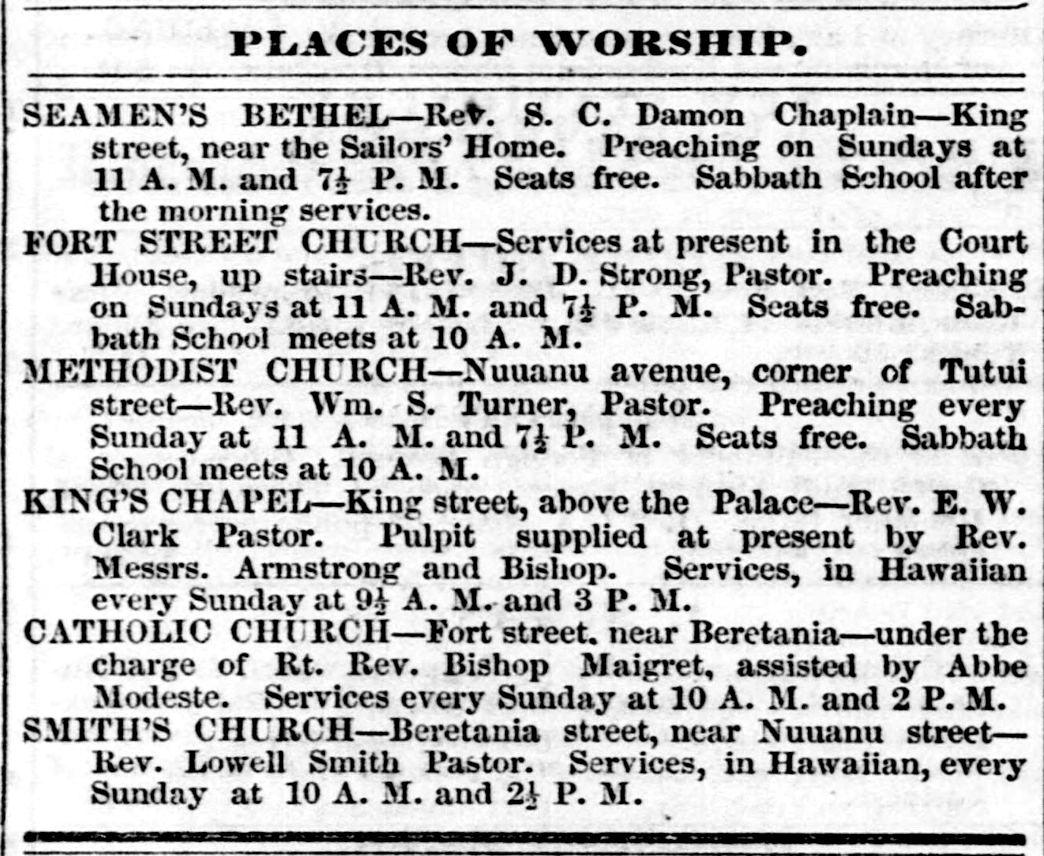
PLACES OF WORSHIP.

The Pacific Commercial Advertiser, Volume I, Number 21, Page 2. November 20, 1856.
 

43rd birthday of John Kekipi Maia, 1922.

BIRTHDAY CELEBRATION OF THE KAHU OF KE ALAULA O KA MALAMALAMA.

REV. JOHN KEKIPI MAIA.

On Thursday the 13th of this month of April, held was a service to commemorate the birthday of Rev. John Kekipi K. Maia, the replacement for his father who is at rest, Rev. Kekipi Maia, and his elder brother who is at rest, John E. K. Maia, at the Christian Science [Hoomana Naauao] church.

He has been sojourning in this world for 43 years, and has spent three years as the kahu of Ke Alaula o ka Malamalama and president of the Christian Science of Hawaii began by his deceased father, Rev. John Kekipi Maia. Continue reading

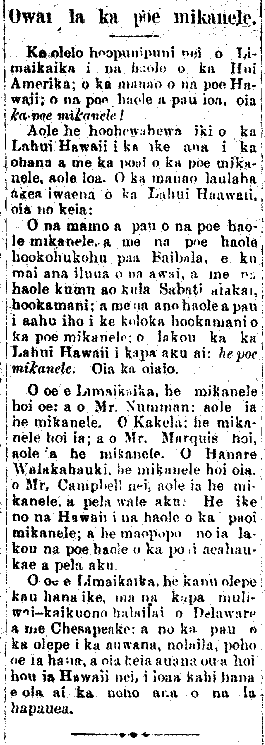
Missionary descendants, 1894.

Who indeed are the missionaries.

Armstrong is telling lies to the American League [Hui Amerika] about the thoughts of the Hawaiians; that all of the haole are the missionaries!

The Hawaiians are not mistaken in the least as to their recognition of the family and circle of missionaries, not at all. The general thought amongst the Lahui Hawaii is this:

All of the descendants of the haole missionaries and the haole who make as if they are steadfast to the Bible, who stand at the pulpit, and of the hypocritical haole Sunday school leaders; and all of the haole who wear the disguise of the missionary; those are who the Lahui Hawaii call: the missionaries. That is the truth.

You, O Armstrong, you are a missionary; and Mr. Neumann, he is not a missionary. Castle, he is a missionary; and Mr. Marquis though is not a missionary. Henry Waterhouse, he is a missionary; Mr. Campbell is not a missionary, and so forth. The Hawaiians do indeed know who is in the circle of missionaries; and they know who the haole are who are in the circle of vagrants.

As for you, O Armstrong, your trade is growing oysters on the banks of the calm Delaware and Chesapeake River and Bay, and due to the oysters going elsewhere, you took a loss and that is why you wandered back here to Hawaii nei, to find a job to support you in your old age.

[I am not sure who the “Mr. Marquis” referred to here is.]

(Oiaio, 2/16/1894, p. 2)

Owai la ka poe mikanele.

Ka Oiaio, Buke VI, Helu 7, Aoao 2. Feberuari 16, 1894.

Render unto Caesar… 1893.

The Pastor, the Pulpit, and the Church.

[Written for Ka Leo o ka Lahui.]

A pastor is one who travels. He goes far and wide. A pastor is knowledgeable and enlightened; he has spiritual wisdom, and his spirit is filled with aloha and patience; he does not grumble, is not snappy, nor impatient, nor hurtful; he has no contempt for others, when misfortune befalls him. He is truly devout, and prays sincerely for all, leaving none out; it is not right for a pastor to say:—”Ah! He will fall for he disregards the teachings of the pious.” The pastor should not say: “Because of his sins, he is cast out by God from above.”

When Christ was on this earth, he said: Do no harm to those that bring harm to you; love your enemy and pray for those who hurt you.

A Doctor is there for the sick, while a pastor is there to teach the sinners. Continue reading

Rev. Robert Stewart McArthur rails on the monarchy, 1895.

M’ARTHUR ON HAWAII.

Kalakaua and Liliuokalani Responsible for Heathenism.

CONVERTS AMONG THE NATIVES.

Great Hopes for the Hawaiians Now that They Are in the Enjoyment of a Pure and Free Government—Officers of State are Especially Praised.

NEW YORK, Dec. 2.—The Rev. Robert Stewart McArthur delivered a sermon in the Calvary Baptist church last night on “The Responsibility of Kalakaua and Liliuokalani.”

After referring to the characteristics of the Hawaiians he quoted figures to show the falling off in the number of Christian converts among the natives since the reign of Kamehameha V, who removed all restraint from the Hula masters and Kahuna influence and thereby sided the spread of idolatry. Continue reading

A description of Honokohau, Maui, 1872.

The Features of Honokohau.

O Nupepa Kuokoa; Aloha oe:

May it please you and your Editor to insert this bundle of aloha in some open space of your depository, and it will be for you to share it amongst our masses.

Looking at the lay of the land, it is a beautiful place indeed; there is a deep river, and there is much taro; the area planted with kalo is approximately 5 miles long.

Pertaining to the evenness of the land.—The flat lands here are on the east side of the river, that being the famous plains of Kalaulaolao, and a mele for this fame is written of by the people of old.

Pertaining to the crops.—Things that are planted grow stuntedly [kakanalii] because of aphids [Eleao]; talk of the Eleao is all over Hilo Paliku. Continue reading

Hiram Bingham and history, 1835.

Hear me, O Kepookulou, and those with knowledge, who have heard of the way of life of the alii of Hawaii of which you showed to us. You told us of the genealogy of this line of alii for fifty-seven generations, and we publish it in the Kumu Hawaii so that it is permanent, so that all the people and youth of Hawaii nei will understand from now into the future.

Where are these alii? They have all died. There is just one remaining. How did they live? People who know and who have heard, do tell us. When did they rule? We know the time of Liholiho and Kamehameha and Kalanikupuapaikalaninui, but the majority of them, we don’t know when they ruled. Continue reading

The importance of things past, 1864.

Ancient matters of Hawaii nei.

Those who have knowledge of what the people of Hawaii were like in the old days are disappearing, and if these things are not written down and saved, the knowledge will be gone for good. Therefore I encourage those who know to write it down at once and make it known, so that those of the future generations will know what their kupuna were like. Here below are some ancient things to search out and to publish. Continue reading

Christmas at Washington Place, 1858.

NOTES OF THE WEEK.

Christmas—passed off in the good old fashioned style. The eve was ushered in by the assemblage, about 7 o’clock, of a large number of children and their parents at Washington Place, the Mansion of Mrs. Dominis, where Santa Claus had given out that he would hold his court, and distribute the gifts which he had ordered for the occasion. A magnificent “Christmas Tree” had been provided in one of the upper chambers, and the little folks, as they gathered about it with sparkling eyes and clattering tongues, found it all lighted up with candles, and the branches bending under the weight of gifts. Prompt as old father Time ever was, the bells were heard at the windows announcing:

“A miniature sleigh with eight tiny reindeer,
With a little old driver so lively and queer.” Continue reading

A mele for Kalakaua, 1874.

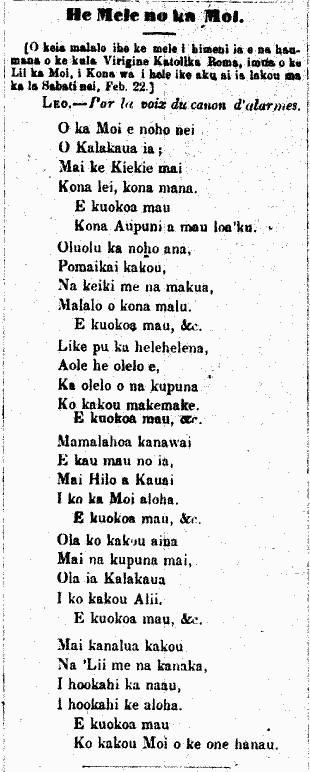
A Song for the King.

(This below is a mele sung by the students of the school run by the Catholic Roman Nuns, before the Alii, the King, when He went to see them on this past Sunday, February 22.)

Tune.—Par la voix du canon d’alarmes.

O ka Moi e noho nei
O Kalakaua ia;
Mai ke Kiekie mai
Kona lei, kona mana.

E kuokoa mau
Kona Aupuni a mau loa’ku.

Oluolu ka noho ana,
Pomaikai kakou,
Na keiki me na makua,
Malalo o kona malu.

E kuokoa mau, &c.

Like pu ka helehelena,
Aole he olelo e,
Ka olelo a na kupuna
Ko kakou makemake.

E kuokoa mau, &c.

Mamalahoa kanawai
E kau mau no ia,
Mai Hilo a Kauai
I ko ka Moi aloha.

E kuokoa mau, &c.

Ola ko kakou aina
Mai na kupuna mai,
Ola ia Kalakaua
I ko kakou Alii.

E kuokoa mau, &c.

Mai kanalua kakou
Na ‘Lii me na kanaka,
I hookahi ka naau,
I hookahi ke aloha.

E kuokoa mau
Ko kakou Moi o ke one hanau.

(Ko Hawaii Ponoi, 3/4/1874, p. 1)

He Mele no ka Moi.

Ko Hawaii Ponoi, Buke I, Helu 37 [38], Aoao 1. Maraki 4, 1874.