National Anthem, 1883.

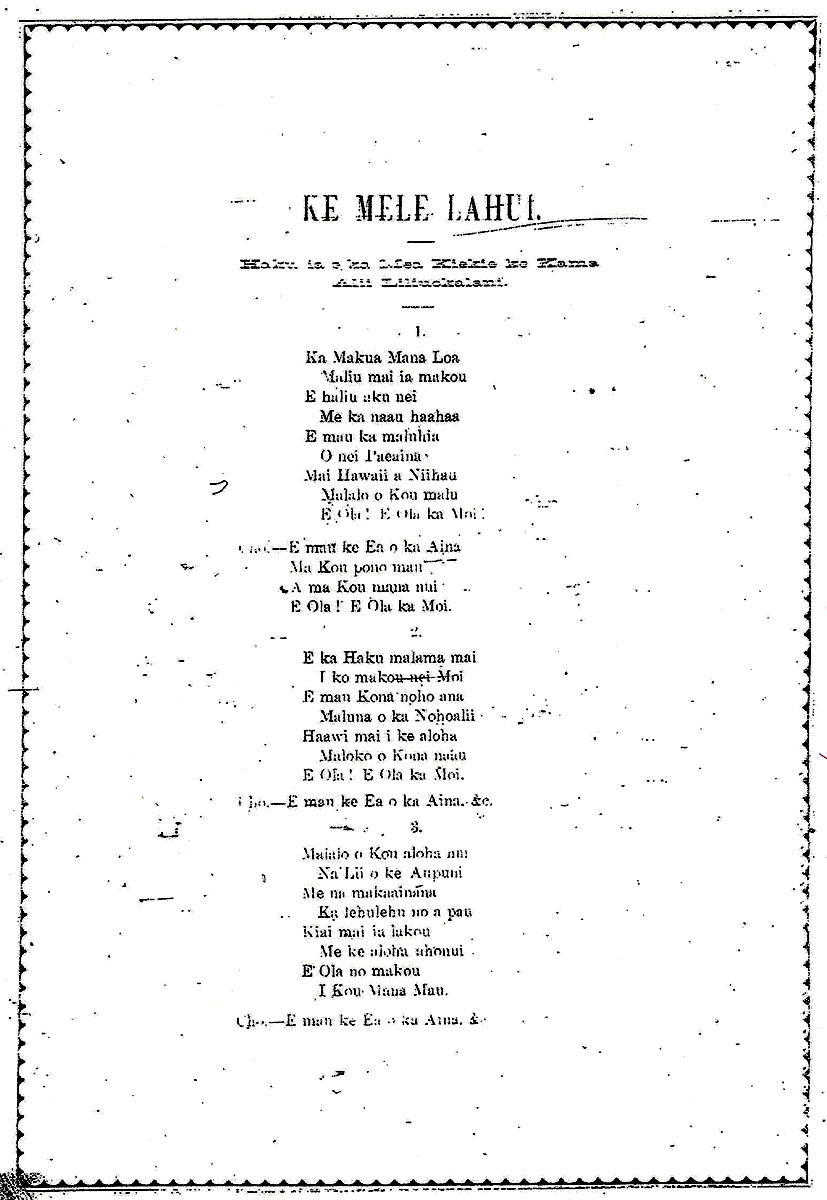
KE MELE LAHUI.

Composed by Her Highness
Princess Liliuokalani.

1.

Ka Makua Mana Loa
Maliu mai ia makou
E Haliu aku nei
Me ka naau haahaa
E mau ka maluhia
O nei Paeaina
Mai Hawaii a Niihau
Malalo o Kou malu
E Ola! E Ola ka Moi!

Cho.—E mau ke Ea o ka Aina
Ma Kou pono mau
A ma Kou mana nui
E Ola! E Ola ka Moi.

2.

E ka Haku malama mai
I ko makou nei Moi
E mau Kona noho ana
Maluna o ka Nohoalii
Haawi mai i ke aloha
Maloko o Kona naau
[A ma Kou ahonui]
E Ola! E Ola ka Moi.

Cho.—E mau ke Ea o ka Aina, &c.

3.

Malalo o Kou aloha nui
Na’Lii o ke Aupuni
Me na makaainana
Ka lehulehu no a pau
Kiai mai ia lakou
Me ke aloha ahonui
E Ola no makou
I Kou Mana Mau.

Cho.—E mau ke Ea o ka Aina, &c.

(Koo o Hawaii, 8/15/1883, p. 11)

KE MELE LAHUI.

Ke Koo o Hawaii, Buke 1, Helu 1, Aoao 11. Augate 15, 1883.

Ghosts at Nohili, 1912.

BEWILDERING GHOSTS OF THE NIGHT ATOP OF THE RUMBLING SANDS OF NOHILI

O Mr. Editor of the Kuokoa Newspaper, Aloha amongst us:—Please extend your patience and your kindness in inserting these words above, so that the intimates and friends will see this astonishing news that is so bewildering.

On the 8th of this past month, my fellow travellers and I were riding aboard an automobile headed for the famous Rumbling Sands of Nohili [One Kani o Nohili], it was between 10 p. m. and 11 p. m. on Sunday night mentioned above.

We went that night to go fishing at the shores around that place at night.

But when we arrived there, my travelling companions headed to the top of the Rumbling Sands of Nohili; one was a German and one was a Japanese, their names being Louis Seghorn and Kamisato; and other than the two, there was myself and my son below the hill of the Sands of Nohili.

While we sat, my son urged for us to climb on the rumbling sands, and I agreed to his idea; we went up, and while we were climbing to the middle of the hill of rumbling sands, I heard a faint voice saying, “Don’t go up.”

I stopped in the middle of that sand hill, and due to the insistence of my son that we go up, we climbed up and met up with my companions who were lying on the sand.

While we sat, the German left us, and proceeded to head toward the other side of the rumbling sands to see the conditions.

The time that he went and we sat, it was pitch dark. While he was walking, we saw him walking until he fell down; he tried calling out, but couldn’t, and we did not hear him calling; when I got there, I started massaging him until we both were there; at which point I saw ghost [uhane] coming out of the sand, and I urged that we should return to where we were sitting.

When we sat there again, that German wanted to go and see again to make sure, so we all went together. When we went to where this German first walked, and he reached a flat area, it was as if there was a magnet pulling him right up to a huge specter, and there met up face to face; at which point, he started to shrink back but was unable to; when this was happening, I didn’t see that ghost [uhane lapu].

As he was being twisted about here and there, he fell down face upwards; he saw a ghost holding his throat and two young ghosts holding down his hands, one on the left hand and one on the right; while my Japanese friend and I were overwhelmed during this dire time, being that we could no longer see nor hear our friend then, and we were thinking of a way to revive him from this second fall; the Japanese tried to pull him by his hand, but to no avail, for his hands were held fast by those ghosts.

Afterwards, I had an idea from what I heard being said by the kamaaina of this land; urine is the cure should you meet up with a ghost of that sort in the night; I started to urinate on the body of our friend who was lying down, from head to foot, without any thought to whether or not it was working; but the problem was solved.

As the two of us saw our friend shaking until it stopped, while I was urinating, I saw so many ghosts coming out of one of the hills of sand; I could not fathom the number of ghosts. Here is the awful thing: while I was carrying out this action to help our travelling companion, right behind me was something scorching like fire; I turned to look back, and there was the hand of a ghost [kanaka uhane] grabbing me; it was a fat ghost, and I besmeared myself with my leftover urine and that is when this ghost left; I immediately urged my friends that we should return at once without waiting any longer; we then went back and got on the automobile, heading for town without going fishing.

I speak truthfully of the things my eyes have witnessed from my youth until now when I am an adult, and shall have grandchildren should I live; this is the first time I’ve seen this truly amazing thing.

I am a native of this area, and the sun-snatching island of Kauai is the land of my birth.

We sincerely are the two witnesses along with the writer who saw the ghosts of the night.

E. H. KANAHELE, JR.,
LOUIS SEGHORN,
J. P. KAAPUWAI.

Kekaha, Kauai, Sept. 16, 1912.

(Kuokoa, 9/27/1912, p. 3)

KA UHANE LAPU HOOKALAKUPUA O KA PO I KA PIKO O KE ONE KANI O NOHILI

Ka Nupepa Kuokoa, Buke XLVIII, Helu 39, Aoao 3. Sepatemaba 27, 1912.

News from today, 2012.

Knowing better what happened in history can empower us to make better decisions for Hawaii and the world… Consider this article reposted from Civil Beat, written by hauMĀNA, an organization of young thinkers at the University of Hawaii at Manoa.

De-Militarize Hawaii.

[The passage deleted by Civil Beat may have been a link to one of many videos on YouTube from Okinawa: Futenma protest of Osprey deployment 9/9/2012.]

Vital Statistics, 1912.

MARRIAGES.

Ah Kai to Hannah Kaikaina, Sept. 11.
Pang See to Mary Freitas, Sept. 16.
Joseph Kekoa Ross to Josephine Kekaha, Sept. 18.
Roy Alexander Craw to Lily L. Williams, Sept. 19.
Dan R. Vida to Ruth M. Vrellero [Viellero], Sept. 20.
N. K. Hahola to Kahikina Lewis, Sept. 21.

BIRTHS.

To J. B. Perkins and Jennie Mitchell, a son, Sept. 3.
To Tmezo [Tamezo] Hasegawa and Abbie Rober, a son, Sept. 9.
To W. Mead and Rose Bush, a daughter, Sept. 9.
To Jacob Ai Ah Kwa and Angeline Jonah, a daughter, Sept. 14.
To William Hoopai and Agnes K. Haili, a son, Sept. 15.
To Nawai Kahooleawai and Aliikapeka, a son, Sept. 23.
To Ah Kong Ah Loy and Hele Halemano, a son, Sept. 24.

DEATHS.

Peter Akeau, Jr., on the road to the Insane Asylum, Sept. 16.
Kalaiki, at Queen’s Hospital, Sept. 16.
D. Hilo Hakuole, at Aleong House, Sept. 17.
Naiwi, at Lunalilo Home, Sept. 19.
Kohia, at Queen’s Hospital, Sept. 20.
Mary English, on the corner of Liliha and School Streets, Sept. 21.
Jonathan Kupau Holi, on Liliha Street, Sept. 21.
David Kanealoha, at Queen’s Hospital, Sept. 22.
Kahooleawai, on Fernandez Lane, Sept. 23.
Charles Ai Kamakele, Jr., at the Children’s Hospital, Sept. 23.
Coney Miranda, at the Children’s Hospital, Sept. 24.

(Kuokoa, 9/27/1912, p. 8)

NA MARE. / NA HANAU. / NA MAKE.

Ka Nupepa Kuokoa, Buke XLVIII, Helu 39, Aoao 8. Sepatemaba 27, 1912.

Children rescued out at sea, 1924.

CHILDREN RESCUED FROM DEATH

Because of the quick arrival of help at the right time, three small children were saved, named Alfred Vieira, Jr., Jose Lima, and Alfred Silva, Jr., from death, when their canoe overturned outside of Kahala, on this past Friday, and they were in dire straits.

According to the story of this near tragedy of the little children, they boarded a waa and travelled about Kahala; it was a day of rough seas and the waves were huge, and as they were approaching a crashing wave, their waa was covered over by the wave and went under.

There was but one of the three children who knew how to swim, that being Alfred Vieira, Jr., and he was the one who helped his two friends in holding on to their waa until help arrived: James Reid and Theodore P. Melin, who returned the little children to land safely.

[I wonder how this one act changed Hawaii’s future…]

(Kuokoa, 6/5/1924, p. 5)

PAKELE HE POE KEIKI MAI KA MAKE MAI

Ka Nupepa Kuokoa, Buke LXIII, Helu 23, Aoao 5. Iune 5, 1924.

Canoe Building, 1924.

The Art of Canoe Building is Being Revived in Hawaii

In the olden days of Hawaii nei, canoe building [kalaiwaa] was one of the occupations deftly done by Hawaiians, but during the years since, this work has gone down to but a fraction; but these days, it is being started up once again in Honaunau, South Kona, Hawaii.

Charley Apo along with his assistants are undertaking this endeavor of carving waa from large koa trees growing on the land of Paris and Company [Hoahana Parika ?].

The koa is fell in the high mountains, then it is roughly carved out into the form of a waa, and then dragged to sea by animals.

Twelve large waa are being carved by Charley Apo in a building prepared for this work, and he is able to fill all orders that he receives as per specifications wanted, from large to small.

In the picture on the far left, Davis Paris can be seen with two waa that are unfinished; to the right is Charley Apo ; to the right of that are many unfinished waa. Below on the left is a nearly finished waa; in the middle is an assistant of Charley Apo; to the right of that is a roughly completed waa for Alika Dowsett.

[I wish the newspapers were reshot clearly so not only the words are sharp and legible, but so that pictures and images are as clear as possible…]

(Kuokoa, 6/5/1924, p. 2)

Ke Hoalaia Mai Nei ka Oihana Kalaiwaa ma Hawaii

Ka Nupepa Kuokoa, Buke LXIII, Helu 23, Aoao 2. Iune 5, 1924.

If everyone took care of their kuleana instead of looking for the easiest way out of it… 1899/2012.

THE OLD FARMING MEN

AND THE

OLD FISHERMEN

In times long ago, there lived in Kapalilua, South Kona, Hawaii, four old men; two of them were farmers and the other two were fishermen; the farmers would always supply the fishermen with their vegetable foods, and so too the fishermen would provide for the farmers, and so they shared for a long time.

One day when the fishermen were returning and almost ready to land, they saw the farmers coming down to the plains with a basket of sweet potato; one fisherman said to the other, there are those farmers who gorge on fish. It would be good if we acted cunningly to those old farmers so that those old men don’t get our fish.

So let’s hide the fish under the fish trap [ie] and place the leftover bait [poo maunu] on top, and when they approach the canoe, we’ll say, “O Farmers, we’ve got a problem, we’ve no fish, only the leftover bait;” the two fishermen decided to carry out this treacherous idea.

When they got to the beach, there stood the elderly farmers. The fishermen said in a smooth [nalali ?] voice, “O Farmers, we’ve got a problem, there’s no fish on this canoe, we’ve just turned back for today, with just the leftover bait for this day;” the fishermen opened the cover of the trap [hinai] and said to the farmers, “this is the remaining bait, and so it that,” and so forth, and the farmers were left disappointed.

It was a rule for fishermen not to give away the leftover bait to others; it was something that the fishermen ate. And so that day, the farmers went without fish and ate only some taro [kuala] without any fish, while the fishermen had their vegetable food and fish as they laughed; so it went the next day; the farmers were left without fish because of the actions of the fishermen.

On another day, while the farmers were headed up to their fields, they arrived at a resting point where they took a break, and one said to the other, “Hey, listen to this, we are being troubled by the fishermen.” “Yes, the fishermen are troublesome.”

“Today, let us act wisely; let’s go upland for sweet potato for us to eat, and when we descend, let’s stick in the vines growing from broken pieces of sweet potato [ohulu] and when we get to the shore, and the fishermen return, let’s say, ‘You fishermen have a problem; we only have broken bits of potato [ku-oo] to eat;’ then they’ll eat their fish without vegetable, and we’ll have our vegetable without fish; we will not die, it is they that will die.”

The two of them went into the uplands and got their food, and commenced breaking and crumbling up the uala; they then walked down and when they came to the harbor where the fishermen came ashore, they landed and said, “You two are in a bind again, O Farmers; we only have leftover bait.”  The Farmers replied, “Yeah, should you two fishermen have nothing, that is a problem for us, and we have nothing.”

Then, the old farmers said, “That goes for us as well, we kept searching our patch, and there was no whole potatoes, just pieces. So you fishermen are in trouble, there are only pieces;” showing them, “Look, these are only pieces, those are pieces,” and so forth.

So the fishermen went home and ate their fish without vegetable, and the farmers ate their vegetable without fish, but the farmers were satisfied.

That night, the fishermen went fishing for aweoweo, and while they fished, one said to the other, “We are being troubled by the farmers; it is certain that we cannot live if we just have fish to eat;” the other agreed, “Yes, those old men are so crafty, yes, they are so clever.”

“So the right thing for us to do is to fish, and when we’re done, we come back and kill those old men.”

The place these fishermen were talking was outside of Olelomoana, and while these old fishermen were talking, the plot of the fishermen was heard by the farmers in the upland. At that, the farmers crawled that night from Olelomoana until Kolo, and that is why those places are called Olelomoana [Ocean Talking] and Kolo [Crawl], being that there was talking at Olelomoana and there was crawling to Kolo.

Kapalilua was the only name before, but because of these old men, those places are named these names until this day, and the Honorable W. C. Achi is the owner of those amazing land sections [Ahupuaa]. And so it is said that the fishermen were troubled by the farmers because of the mischief they did to the other.

Kailua Baka Ona

(Lahui Hawaii, 9/16/1899, p. 2)

NA ELEMAKULE MAHIAI a me na ELEMAKULE LAWAIA.

Ka Lahui Hawaii, Buke 1, Helu 34, Aoao 2. Sepatemaba 16, 1899.

Post Brown Bag: “The People of Kalaupapa as Active Participants in Their Own History.” 2012.

Much appreciation goes out to all the good people at the Center for Biographical Research at UHM! And to Anwei Skinsnes Law and Henry Law for their presentation today!! I came out of it feeling upbeat, and excited that there are people out there looking at Hawaiian-Language source material for a window into the past (outside of the University).

I encourage people to go check out the talk, questions and answers, and book signing put on by Native Books from 3 to 5 in the afternoon this Sunday.

Kalaupapa: A Collective Memory

Kalaupapa: A Collective Memory

One year since the Republic transferred power to the United States, 1899.

THE 12th OF AUGUST.

This is the Day that made a year since the day that the Hawaiian Flag was taken down and the American Flag was raised on the flag pole of Iolani Palace.

The hurt down in our guts [naau] is unimaginable when remembering this; for there is no Hawaiian that can say that his naau is happy with what was done. Because if we are not mistaken, branded withing the hearts of Hawaiians is the love and pride for his Beloved Flag. The flag which holds memories of many years spreading its wings in peace over the cheeks of Hawaii nei. And for which none of us can say that we were robbed and saddened under its protection. Not at all! Our hearts will only cherish for all times, the loving memories and peace; and as such, are not each and every Kanaka Hawaii burning with aloha for it?

The falling of the Hawaiian Flag from where it proudly fluttered on the tips of the warm breezes of Hawaii nei, is like the death of origin and foundation of this people [lahuikanaka]; and it is clear that the branches and leaves of this tree (The Hawaiian Nation) will wither and fade, a tree that was greatly admired by other nations for its lush and verdant growth. What was called the “Paradise of the Pacific [Paredaiso o ka Pakipika].”

Therefore, where is it today? It has gone, and died; and it is but the wisps that are budding, without a parent to feed its nourishing waters. For the trunk has been chopped.

Because of this heart-wrenching thing, the Lahui Hawaii invites all of you, native Hawaiians. From this day forward, to discard your living indifferently, lazily, wastefully, off others, and all of your childish ways; and for each and everyone of you to stand and fight against the obstructions in this world with patience, caution, independence, and righteousness; and it is through this that Hawaii nei will once again regain its success and pride. Now is the time, and it is only now that we can do the mending while this striped cloth has not become too ragged. (Inoa Lahui.)

(Lahui Hawaii, 8/12/1899, p. 4)

KA LA 12 O AUGATE.

Ka Lahui Hawaii, Buke 1, Helu 29, Aoao 4. Augate 12, 1899.