Mauna a Kea, Moana a Kea: Hawaii nei is sacred in its entirety, from the sun above to the land and ocean below. 1866 / today and the future.

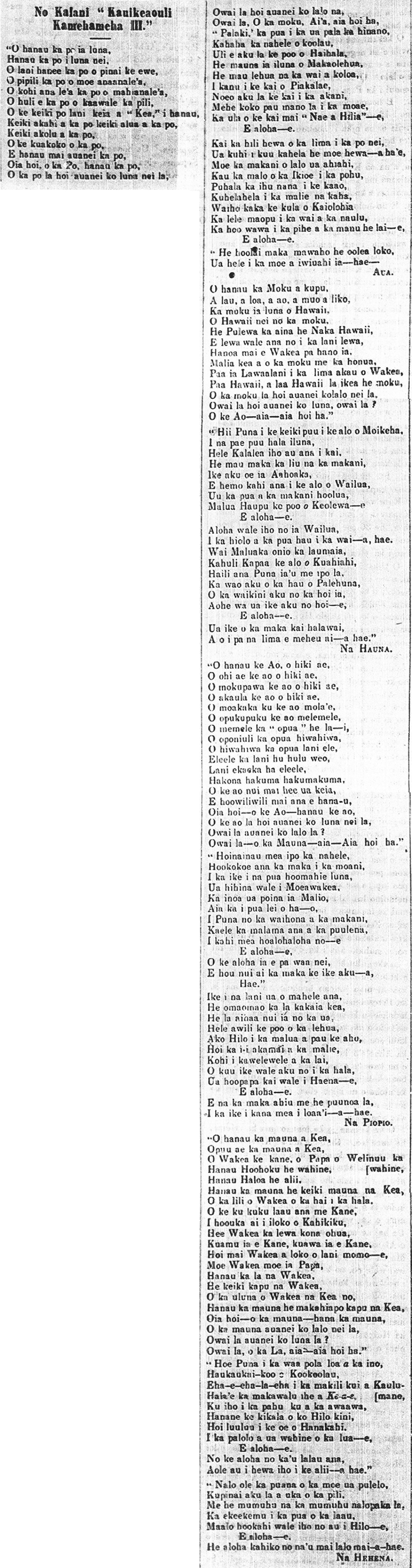
No Kalani “Kauikeaouli Kamehameha III.”

“O hanau ka po ia luna,
Hanau ka po i luna nei,
O lani hanee ka po o pinai ke ewe,
O pipili ka po o moe anaanale’a,
O kohi ana le’a ka po o mahianale’a,
O huli e ka po o kaawale ka pili,
O ke keiki po lani keia a “Kea,” i hanau,
Keiki akahi a ka po keiki alua a ka po,
Keiki akolu a ka po,
O ke kuakoko o ka po,
E hanau mai auanei ka po,
Oia hoi, o ka Po, hanau ka po,
O ka po la hoi auanei ko luna nei la,
Owai la hoi auanei ko lalo na,
Owai la, O ka moku, Ai’a, aia hoi ha,
“Palaki,” ka pua i ka ua pala ka hinano,
Kahaha ka nahele o koolau,
Uli e aku la ke poo o Haihala,
He mauna ia iluna o Makaolehua,
He mau lehua na ka wai a koloa,
I kanu i ke kai o Piakalae,
Noeo aku la ke kai i ka akani,
Mehe koko pau mano la i ka moae,
Ka ula o ke kai mai “Nae a Hilia”—e,
E aloha—e.

Kai ka hili hewa o ka lima i ka po nei,
Ua kuhi i kuu kahela he moe hewa—a ha’e,
Moe ka makani o lalo ua ahiahi,
Kau ka malo o ka Ikioe i ka pohu,
Puhala ka ihu nana i ke kaao,
Kuhelahela i ka malie na kaha,
Waiho kaka ke kula o Kaiolohia,
Ka lele maopu i ka wai a ka naulu,
Ka hoo wawa i ka piha a ka manu he lai—e,
E aloha—e.

[Na] AUA.

O hanau ka Moku a kupu,
A lau, a loa, a ao, a muo a lilo,
Ka moku ia luna o Hawaii,
O Hawaii nei no ka moku,
He Pulewa ka aina he Naka Hawaii,
E lewa wale ana no i ka lani lewa,
Hanoa mai e Wakea pa hano ia,
Malia kea a o ka moku me ka honua,
Paa ia lawaalani i ka lima akau o Wakea,
Paa Hawaii, a laa Hawaii la ikea he moku,
O ka moku la hoi auanei kolalo nei la,
Owai la hoi auanei ko luna, owai la?
O ke Ao—aia—aia hoi ha.”

“Hii Puna i ke keiki puu i ke alo o Moikeha,
I na pae puu hala iluna,
Hele Kalalea iho au ana i kai,
He mau maka ka liu na ka makani,
Ike akuu oe ia Aahoaka,
E hemo kahi ana i ke alo o Wailua,
Uu ka pua a ka makani hoolua,
Malua Haupu ke poo o Keolewa—e
E aloha—e.

Aloha wale iho no ia Wailua,
I ka hiolo a ka pua hau i ka wai—a, hae,
Wai Maluaka onio ka laumania,
Kahuli Kapaa ke alo o Kuahiahi,
Haili ana Puna ia’u me ipo la,
Ka wao aku o ka hau o Palehuna,
O ka waikini aku no ka hoi ia,
Aohe wa ua ike aku no hoi—e,
E aloha—e.
Ua ike o ka maka kai halawai,
A o i pa na lima e meheu ai—a hae.”

Na HAUNA.

“O hanau ke Ao, o hiki ae,
O ohi ae ke ao o hiki ae,
O mokupawa ke ao o hiki ae,
O akaula ke ao o hiki ae,
O moakaka ku ke ao mola’e,
O opukupuku ke ao melemele,
O memele ka “opua” he la—i,
O oponiuli ka opua hiwahiwa,
O hiwahiwa ka opua lani ele,
Eleele ka lani hu hulu weo,
Lani ekaeka ha eleele,
Hakona hakuma hakumakuma,
O ke ao nui mai hee ua keia,
E hoowiliwili mai ana e hana-u,
Oia hoi—o ke Ao—hanau ke ao,
O ke ao la hoi auanei ko luna nei la,
Owai la auanei ko lalo la?
Owai la—o ka Mauna—aia—Aia hoi ha.”

“Hoinainau mea ipo ka nahele,
Hookokoe ana ka maka i ka moani,
I ka ike i na pua hoomahie luna,
Ua hihina wale i Moeawakea,
Ka inoa ua poina ia Malio,
Aia ka i pua lei o ha—o,
I Puna no ka waihona a ka makani,
Kaele ka malama ana a ka puulena,
I kahi mea hoalohaloha no—e,
E aloha—e,
O ke aloha ia e pa waa nei,
E hou nui ai ka maka ke ike aku—a,
Hae.”

Ike i na lani ua o mahele ana,
He omaomao ka la kakaia kea,
He la aihaa nui ia no ka ua,
Hele awili ke poo o ka lehua,
Ako Hilo i ka malua a pau ke aho,
Hoi ka i-i akamai a ka malie,
Kohi i kawelewele a ka lai,
O kuu ike wale aku no i ka hala,
Ua hoopapa kai wale i Haena—e,
E aloha—e.
E na ka maka ahiu me he puunoa la,
I ka ike i kana mea i loaa’i—a—hae.

Na PIOPIO.

“O hanau ka mauna a Kea,
Opuu ae ka mauna a Kea,
O Wakea ke kane, o Papa o Welinuu ka wahine,
Hanau Hoohoku he wahine,
Hanau Haloa he alii,
Hanau ka mauna he keiki mauna na Kea,
O ka lili o Wakea o ka hai i ka hala,
O ke ku kuku laau ana me Kane,
I hoouka ai i iloko o Kahikiku,
Hee Wakea ka lewa kona ohua,
Kuamu ia e Kane, kuawa ia e Kane,
Hoi mai Wakea a loko o lani momo—e,
Moe Wakea moe ia Papa,
Hanau ka la na Wakea,
He keiki kapu na Wakea,
O ka uluna o Wakea na Kea no,
Hanau ka mauna he makahiapo kapu na Kea,
Oia hoi—o ka mauna—hana ka mauna,
O ka mauna auanei ko lalo nei la,
Owai la auanei ko luna la?
Owai la, o ka La, aia—aia hoi ha.”

“Hoe Puna i ka waa pola loa a ka ino,
Haukaukai—koo o Kookoolau,
Eha—e—eha—la—eha i ka makili kui a Kaulumano,
Hala’e ka makawalu ihe a Ko-a-e,
Ku iho i ka pahu ku a ka awaawa,
Hanane ke kikala o ko Hilo kini,
Hoi luuluu i ke oe o Hanakahi,
I ka palolo a ua wahine o ka lua—e,
E aloha—e.
No ke aloha no ka’u lalau ana,
Aole au i hewa iho i ke alii—a hae.”

“Nalo ole ka puana o ka moe ua pulelo,
Kupinai aku la a uka o ka pili,
Me he mumuhu na ka mumuhu nalopaka la,
Ka ekeekemu i ka pua o ka laau,
Maalo hookahi wale iho no au i Hilo—e,
E aloha—e.
He aloha kahiko no na’u mai lalo mai—a—hae.

Na HEHENA.

(Kuokoa, 3/24/1866, p. 4)
No Kalani "Kauikeaouli Kamehameha III."

Ka Nupepa Kuokoa, Buke V, Helu 12, Aoao 4. Maraki 24, 1866.

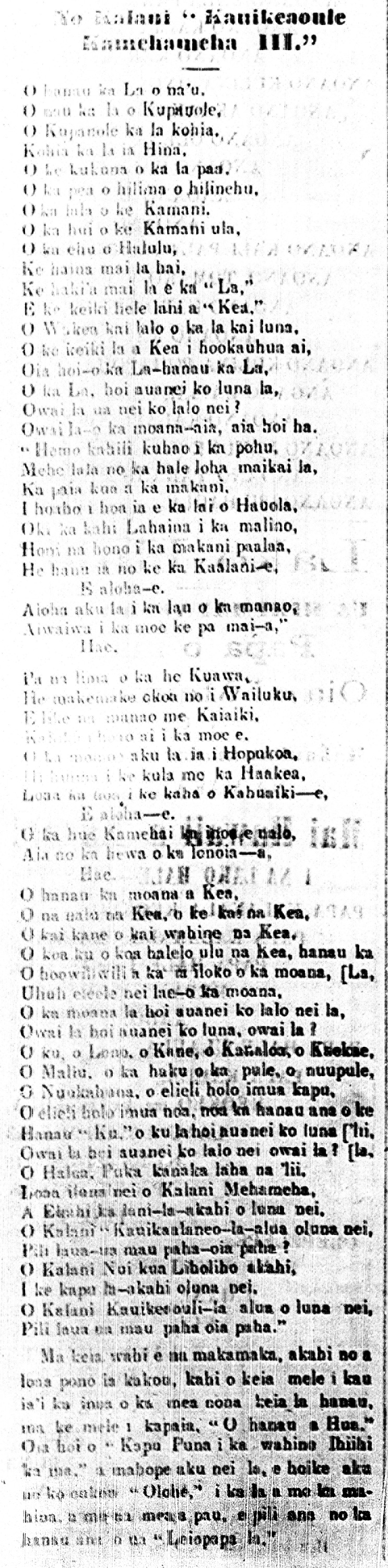
No Kalani “Kauikeaoule Kamehameha III.” [No Kalani “Kauikeaouli Kamehameha III.”]

O hanau ka La o na’u,
O nau ka la o Kupauole,
O Kupauole ka la kohia,
Kohia ka la ia Hina,
O ke kukuna o ka la paa,
O ka pea o hilima o hilinehu,
O ka lala o ke Kamani,
O ka hui o ke Kamani ula,
O ka ehu o Halulu,
Ke haina mai la hai,
Ke haki’a mai la e ka “La,”
E ke keiki hele lani a “Kea,”
O Wakea kai lalo o ka la kai luna,
O ke keiki la a Kea i hookauhua ai,
Oia hoi—o ka La—hanau ka La,
O ka La, hoi auanei ko luna la,
Owai la ua nei ko lalo nei?
Owai la—o ka moana—aia, aia hoi ha,
“Hemo kahili kuhao i ka pohu,
Mehe lala no ka hale loha maikai la,
Ka paia kua a ka makani,
I hoaho i hoa ia e ka lai o Hauola,
Oki ka kahi Lahaina i ka malino,
Honi na hono i ka makani paalaa,
He hanu ia no ke ka Kaalani—e,
E aloha—e.
Aloha aku la i ka lau o ka manao,
Aiwaiwa i ka moe ke pa mai—a,”
Hae.

Pa na lima o ka he Kuawa,
He makemake okoa no i Wailuku,
E like na manao me Kaiaiki,
Kahiko i hoao ai i ka moe e,
O ka momoe aku la ia i Hopukoa,
Hi hininu i ke kula me ka Haakea,
Loaa ka hoa i ke kaha o Kahuaiki—e,
E aloha—e.
O ka hue Kamehai ka inoa e nalo,
Aia no ka hewa o ka lonoia—a,
Hae.

O hanau ka moana a Kea,
O na nalu na Kea, o ke kai na Kea,
O kai kane o kai wahine na Kea,
O koa ku o koa halelo ulu na Kea, hanau ka La,
O hoowiliwili a ka ia iloko o ka moana,
Uliuli eleele nei lae—o ka moana,
O ka moana la hoi auanei ko lalo nei la,
Owai la hoi auanei ko luna, owai la?
O ku, o Lono, o Kane, o Kanalua, o Kaekae,
O Maliu, o ka haku o ka pule, o nuupule,
O Nuukahana, o elieli holo imua kapu,
O elieli holo imua noa, noa ka hanau ana o ke ‘lii,
Hanau “Ku” o ku la hoi auanei ko luna,
Owai la hoi auanei ko lalo nei owai la?
O Haloa, Puka kanaka laha na ‘liii,
Loaa iluna nei o Kalani Mehameha,
A Ekahi ka lani—la—akahi o luna nei,
O Kalani “Kauikaalaneo—la—alua oluna nei,
Pili laua—ua mau paha—oia paha?
O Kalani Nui kua Liholiho akahi,
I ke kapu la—akahi oluna nei,
O Kalani Kauikeaouli—la alua o luna nei,
Pili laua ua mau paha oia paha.”

Here O Friends is the first time we actually have the part of this mele in which is the name of the one whose birthday it is, in the mele called, “O hanau a Hua.” That being “Kapu Puna i ka wahine Ihiihi ka ma,” and after that, I, your “Expert,” will tell you of the day, and the months, and everything pertaining to the birthday of that “Leiopapa.”

[This genealogical mele for Kamehameha III was printed a number of times over the years in various Hawaiian-Language Newspapers. It was important enough back then, and it is just as important for us today, if not more so. The gods gave birth to all above and all below—it is all sacred. Let us treat all our land and ocean with that in mind.

Unfortunately much of the columns in which these appear are not digitized clearly, and are hard to read…]

(Kuokoa, 3/31/1866, p. 4)
No Kalani Kauikeaoule Kamehameha III."

Ka Nupepa Kuokoa, Buke V, Helu 13, Aoao 4. Maraki 31, 1866.


The death of Prince Albert Kunuiakea, 1903.

PRINCE ALBERT KUNUIAKEA’S BODY BORNE IN STATE TO THE CAPITOL

Kamehameha III.  Prince Albert.  Queen Kalama.

PRINCE ALBERT AS AN INFANT.

From a picture hanging on the walls of the home of the late Prince Albert Kunuiakea. Made about 1853.

The Program of the Ceremonies Today.

In the old throne room of the Capitol Building, where royalty once held sway, the remains of Prince Albert Kunuiakea were laid in state yesterday afternoon. At 6 o’clock to the accompaniment of muffled drums and the solemn tread of soldiery the casket containing the body of the last heir presumptive of the Kamehamehas was brought from his late residence in Palama to the old royal estate where the Prince as a boy had been raised in the family of Kamehameha III. The procession from the residence was headed by a drum corps followed by four companies of the First Regiment of the National Guard of Hawaii. Behind the troops came the hearse bearing the royal casket, flanked by young Hawaiian chiefs bearing large and small feather kahilis. These were novel in the startling array of beautiful colored feathers and in the adaptation of ancient funeral customs. Behind the hearse came the mourners, the chiefs and chiefesses according to rank as recognized among the Hawaiians. When the military filed into the Capitol grounds they divided on each side of the driveway allowing the hearse to pass between serried lines of soldiers standing at present arms. Col. Soper and Capt. Hawes of the Governor’s staff, in full uniform, met the remains at the front entrance of the Capitol.

The casket was carried into the throne room and deposited upon a bier overspread with a beautiful pall of heavy black velvet faced with yellow silk. At the head was a magnificent feather kahili of black and yellow and candelabra authorized by the Roman Catholic church. Four huge kahilis, the tabu marks of the royal presence, designated the sacred enclosure and within this, six chiefs, three on each side of the bier, were placed upon watch, waving small kahilis in unison over the casket. From the old throne of the Kalakauas the crown flag of Hawaii was suspended and over the entrances the Hawaiian colors were draped. A beautiful array of palms upon the dais, together with the picturesque old throne room chairs, formed a pleasing picture. When the beautiful crystal candelabra were illuminated the scene beneath was spectacular.

The main staircase from the hallway was lined with palms. The waving of the kahilis, and the chanting of the genealogy of the Prince were continued through the night and will be a part of the weird ceremony until the casket is borne from the palace.

The committee on decorations was as follows: Mrs. Carrie Robinson, Mrs. Helen Holt, Mrs. Mary Beckley, Mrs. Ena, Mrs. A. P. Taylor, Mrs. Emmeline Magoon, Mrs. Alice Hutchinson, Miss Hilda Burgess, Miss May Low, Harry Davison, J. McGuire.

From 11 a. m. to 1 p. m. today the body will lie in state in the old throne room of the Capitol. From 1 to 1:20 p. m. the Roman Catholic service will be said, Pro Vicar Libert officiating. A detail of the National Guard was assigned as a guard of honor yesterday afternoon and will remain under arms until the procession moves this afternoon.

The order of procession today appears elsewhere in a By Authority notice.

[Might anyone know where this portrait is today?]

(Pacific Commercial Advertiser, 3/15/1903, p. 1)

PRINCE ALBERT KUNUIAKEA'S BODY BORNE IN STATE TO THE CAPITOL

Sunday Advertiser, Volume I, Number 11, Page 1. March 15, 1903.

A protest by the United States of America, 1843.

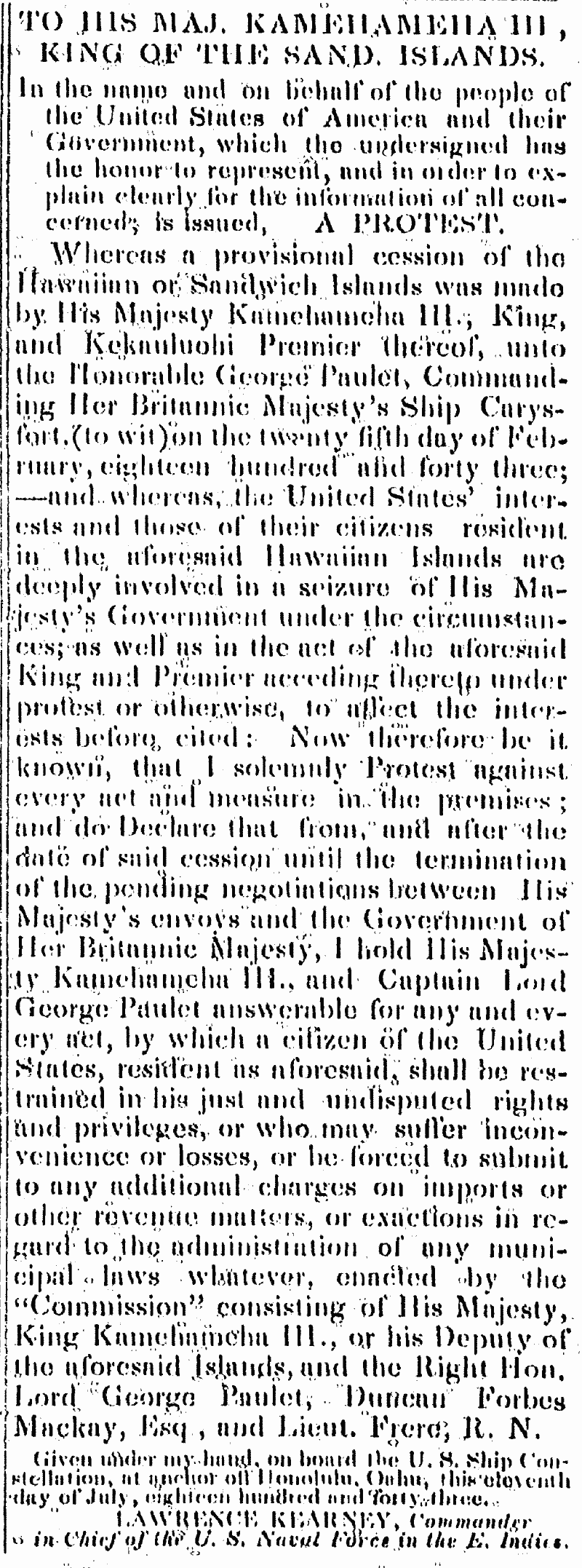
TO HIS MAJ. KAMEHAMEHA III, KING OF THE SAND. ISLANDS.

In the name and on behalf of the people of the United States of America and their Government, which the undersigned has the honor to represent, and in order to explain clearly for the information of all concerned, is issued, A PROTEST.

Whereas a provisional cession of the Hawaiian or Sandwich Islands was made by His Majesty Kamehameha III., King, and Kekauluohi Premier thereof, unto the Honorable George Paulet, Commanding Her Britannic Majesty’s Ship Carysfort, (to wit) on the twenty fifth day of February, eighteen hundred and forty three;—and whereas, the United States’ interests and those of their citizens resident in the aforesaid Hawaiian Islands are deeply involved in a seizure of His Majesty’s Government under the circumstances; as well as in the act of the aforesaid King and Premier acceding thereto under protest or otherwise, to affect the interests before cited: Now therefore be it known, that I solemnly Protest against every act and measure in the premises; and do Declare that from, and after the date of said cession until the termination of the pending negotiations between His Majesty’s envoys and the Government of Her Britannic Majesty, I hold His Majesty Kamehameha III., and Captain Lord George Paulet answerable for any and every act, by which a citizen of the United States, resident as aforesaid, shall be restrained in his just and undisputed rights and privileges, or who may suffer inconvenience or losses, or be forced to submit to any additional charges on imports or other revenue matters, or exactions in regard to the administration of any municipal laws whatever, enacted by the “Commission” consisting of His Majesty, King Kamehameha III., or his Deputy of the aforesaid Islands, and the Right Hon. Lord George Paulet, Duncan Forbes Mackay, Esq., and Lieut. Frere, R. N.

Given under my hand, on board the U. S. Ship Constellation, at anchor off Honolulu, Oahu, this eleventh day of July, eighteen hundred and forty three.

LAWRENCE KEARNEY, Commander in Chief of the U. S. Naval Force in the E. Indies.

(Nonanona, 7/25/1843, p. 21)

TO HIS MAJ. KAMEHAMEHA III., KING OF THE SAND. ISLANDS.

Ka Nonanona, Buke 3, Pepa 5, Aoao 21. Iulai 25, 1843.

Palapala hoole na Amerika Huipuia, 1843.

NA KAMEHAMEHA III., KE LII O KO HAWAII NEI PAE AINA.

Ma ka inoa, a ma ka aoao hoi o na kanaka o Amerika Huipuia a me ko lakou aupuni, (owau, ka mea i kakauia ka inoa malalo, he luna au no ia aupuni) a i mea hoi e hoakaka aku i na kanaka a pau i kuleana ma keia mea, ua hoopukaia’ku nei,

KEIA PALAPALA HOOLE.

No ka hoolilo ana o Kamehameha III, ke alii, a me Kekauluohi ke kuhina, i keia pae aina o Hawaii nei ia George Paulet, kapena o ka moku Beritania, Carysfort, ma ka la 25 o Feberuari, 1843; a no ka owiliia hoi o ka waiwai a me na hana a ko Amerika poe noho maanei, i loko o ia kaili ana o keia aupuni, a iloko hoi o ia hana a ke alii, a me ke kuhina, ma ia hoolilo ana, (me ka hoole paha, me ka ole paha)—

Nolaila, ke hoike aku nei au i keia: Ke hoole ikaika aku nei au i keia mau hana a pau.

Eia hoi ka’u e hai aku ai: Mai ka la ma i lilo ai keia aupuni a hiki i ka wa e pau ai ka hana pu ana a na luna o Kamehameha III, me ko Beritania aupuni, maluna o Kamehameha III, a me Kapena Haku George Paulet e kau ai ka hewa o kela hana, keia hana e poho ai ka pono akaka o ko Amerika poe e noho nei i keia pae aina. [O laua no ke hewa] ina paha e keakeaia ke kahi kanaka o Amerika Huipuia, a ina paha e poho ko lakou waiwai, a ina paha e koiia lakou e uku i dute hooi ma ka waiwai i laweia mai, a ma na mea e paha o ke aupuni, a ina paha e hooukuia lakou ma ka hooko ana i kekahi o na kanawai a pau i hanaia e “ka poe luna Beritania,” oia hoi ke alii, Kamehameha III, a o kona pani hakahaka paha, a me Haku George Paulet, a me Duncan Forbes Mackay Esquire, a me Lieutenant Frere, no ka manuwa Beritania.

Hanaia keia ma kuu lima maluna o ka moku manuwa o Amerika Huipuia, o Constellation ka inoa, a ke ku nei ia mawaho, ma Honolulu (Oahu.) i keia la umikumamakahi o Iulai, 1843.

LAWRENCE KEARNY, aliii nui maluna o na manuwa a pau o Amerika Huipuia ma Asia.

(Nonanona, 7/25/1843, p. 21)

NA KAMEHAMEHA III., KE LII O KO HAWAII NEI PAE AINA.

Ka Nonanona, Buke 3, Pepa 3, Aoao 21. Iulai 25, 1843.

The “Kearny Cloak” at Tiffany & Co., 1893.

THE WAR CLOAK OF KAMEHAMEHA I.

AN INTERESTING HAWAIIAN RELIC TO BE SEEN IN THIS CITY.

The recent proposed annexation of the Sandwich Islands has revived much forgotten lore concerning the people of Hawaii and their history, and nothing perhaps is more interesting than specimens of the handiwork of this semi-barbarous people who possessed certain arts for ingenuity and patient labor that cannot be equalled by the boasted civilization of the nineteenth century. In Tiffany & Co.’s window, in Union Square, there is on exhibition for a few days a feather war cloak or namo, once the property of Hawaii’s giant King, Kamehameha I (The Lonely One), which tradition says cost the labor of several generations of skilled workers. The body consists of a fine network of homespun cord, make from the native hemp or olona, the meshes of which vary from an eight to a thirty-second of an inch; over this is laid the feather-work in small bunches of three or four feathers each, tied with a minute thread highly twisted, made from the same fibre. The cloak is almost semicircular in shape, and cut to fit in at the neck. The meshwork being made in sections of various shapes, allows it, when placed on a tall man’s shoulders, to fall in graceful lines about his body. Continue reading

Road construction, 1848.

[Found under: “Na Palapala Maoli.”]

Kahalii, Hilo, October 2, 1848.

This is news from Waipio, in Hamakua, there is a Government road. The cliff of Waipio was carved into, and there is what appears to be a fine road, not from the people of old, not from Liloa, from Hakau, from Umi, from Kamehameha I; but it is from the reign of Kamehameha III in which the bad areas were fixed.

This project was started from Pueohulunui all the way to Koaekea, and it reached to the top of the cliff of Kahuahine, and came out below Waimihi.

There are three new noted places [pana] on this road: Puehu, Pohakalae, and Kamaipualo; a man and his Horse can travel from below, as well as oxen with a load of poi on its back, until the reach the top; The people of Waipio are beloved; they made a fine road that is nice looking, like a Nuhekalawela; their Tax Collector [Lunaauhau], Kapau put in effort, and all the bad areas were worked out; Hilo is the land that is bad that has not been worked on; people go to Hamakua, to Puna, but the cliffs of Hilo have not been dug up; let’s dig up the cliffs. With appreciation,

By E. S. Kalauwaka.

(Elele Hawaii, 10/24/1848, p. 37)

Kahalii, Hilo...

Ka Elele Hawaii, Buke 4, Pepa 10, Aoao 37. Okatoba 24, 1848.

Birthday of the Prince Regent, Leleiohoku, 1875.

Birthday of the Heir to the Throne.

This coming Sunday, the 10th of January, is the birthday of Prince W. P. Leleiohoku, and he will be twenty years old. He was born on the 10th of January, 1855, on the day of King Kauikeaouli’s funeral, and for that reason, he is called Kalahoolewa. According to what we have heard, the day will be held as a holiday [la hoomanao kulaia]; however, because the day falls on a Sunday, the commemoration will be postponed until Monday, that being the 11th of January this year; and this will be the first time that his birthday will be widely celebrated, for us to give high tribute to the one who is Prince Regent in place of his Brother the King who has left for lands afar. With stirrings of expectation, we are hopeful that this will be a day set aside as a holiday that will be celebrated all over the kingdom appropriately.

[King Kalakaua was away from the Kingdom, travelling to Washington, DC, to secure a reciprocity treaty with the United States. Leleiohoku served as Prince Regent during this period from the Kalakaua’s departure on the morning of 11/17/1874 until his return on the morning of 2/15/1875.

For more, check out Nanea Armstrong Wassel’s Instagram page!]

(Lahui Hawaii, 1/1/1875, p. 2)

La Hanau o ka Hooilina Moi.

Ka Lahui Hawaii, Buke I, Helu 1, Aoao 2. Ianuari 1, 1875.

Leleiohoku’s birthday, 1868.

A Birthday Feast.—At 3 o’clock on this past Friday, a birthday party was held at Kaakopua, the home of the Royal Governess of the big island, to celebrate the day of birth of her hanai, the one who is named after the day of the funeral [hoolewa] of the departed King Kamehameha III, that is Kalahoolewa.

“Heia ka mano o ka ua i Alakai,
Nahae ka mauna weluwelu e ka noe,
Kau liilii i ke kiu wai ahulu,
Kapa ia mai e Waimea, he kiu
Ke komikomi la i ka wai pao—e.” Continue reading

Kauikeaouli, Kamehameha III, dies a hundred and sixty years ago, 1854.

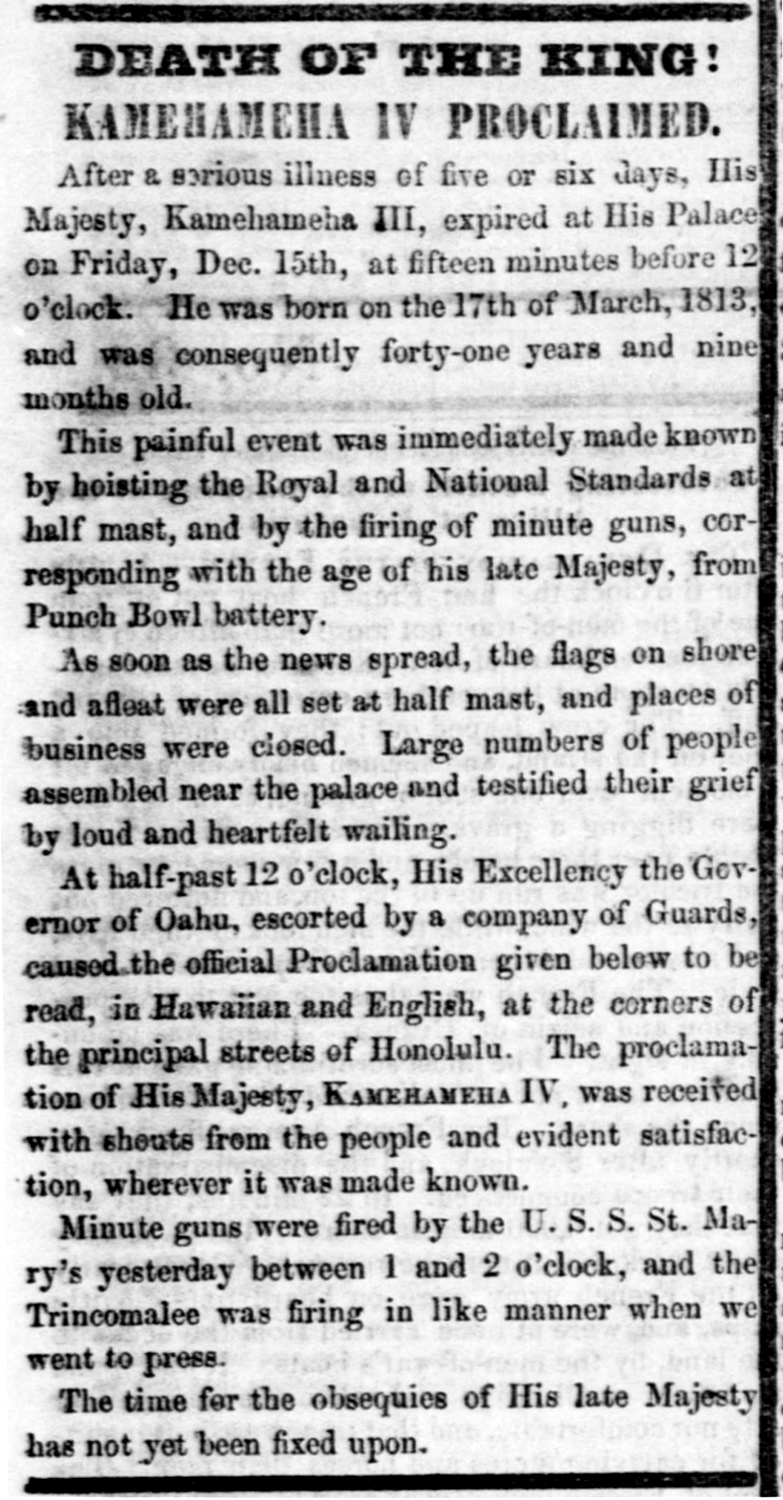
DEATH OF THE KING!

KAMEHAMEHA IV PROCLAIMED.

After a serious illness of five or six days, His Majesty, Kamehameha III, expired at His Palace on Friday, Dec. 15th, at fifteen minutes before 12 o’clock. He was born on the 17th of March, 1813, and was consequently forty-one years and nine months old.

This painful event was immediately made known by hoisting the Royal and National Standards at half mast, and by the firing of minute guns, corresponding with the age of his late Majesty, from Punch Bowl battery.

As soon as the news spread, the flags on shore and afloat were all set at half mast, and places of business were closed. Large numbers of people assembled near the palace and testified their grief by loud and heartfelt wailing.

At half-past 12 o’clock, His Excellency the Governor of Oahu, escorted by a company of Guards, caused the official Proclamation given below to be read, in Hawaiian and English, at the corners of the principal streets of Honolulu. The proclamation of His Majesty, Kamehameha IV, was received with shouts from the people and evident satisfaction, wherever it was made known.

Minute guns were fired by the U. S. S. St. Mary’s yesterday between 1 and 2 o’clock, and the Trincomalee was firing in like manner when we went to press.

The time for obsequies of His late Majesty has not yet been fixed upon.

[Unfortunately, the Hawaiian-Language Newspaper running at the time, Ka Nupepa Elele is not available digitally or on microfilm at this time.

The dark borders as seen here are found in newspapers when report of someone of import dies.]

(Polynesian, 12/16/1854, p. 2)

DEATH OF THE KING!

The Polynesian, Volume XI, Number 32, Page 2. December 16, 1854.

W. D. Alexander on Restoration Day, 1896.

A MEMORABLE DAY

Admiral Thomas Declines the Provisional Cession of the Islands.

Professor Alexander’ Brief But Graphic Description of the Important Events of 1843

On the 10th of February 1843, the British frigate Carysfort, commanded by Lord George Paulet, arrived at Honolulu, and showed displeasure by withholding the usual salutes. The commander seems to have placed himself completely under the direction of Mr Alexander Simpson. The United States sloop-of-war Boston, Captain Long, arrived on the 13th.

The king who had been sent for at Lord Paulet’s request, arrived from Lahaiua on the 16th. Lord Paulet refused to treat with him through Dr. Judd, his agent, and late in the evening of the 17th sent him a peremptory letter, inclosing six demands with the threat that if they were not complied with by four o’clock p. m. the next day, “immediate coercive steps would be taken.” The substance of these demands was as follows:

1st. That an attachment laid on Charlton’s property, at the suit of an English firm for an old debt, be removed, that the land claimed by him be “restored,” and reparation to his representatives for the losses which they had suffered through the alleged injustice of the government.

2d. The immediate recognition of Mr. Simpson as British Consul, and a salute of twenty-one guns to the British flag.

3d. A guarantee that no British subject should be put in irons, unless for a felony.

4th. That a new trial should be held in the case of Skinner vs. Dominis.

5th. That all disputes between British subjects and others be referred to mixed juries, one half of whom should be British subjects approved by the consul.

6th. A direct communication between the king and the Acting British Consul for the immediate settlement of all complaints on the part of British subjects. Continue reading