Robert Wilcox sounds off, 1898.

SOME GENEOLOGY

R. W. Wilcox Corrects Statements in Ex-Queen’s Book.

ANCESTRY OF LILIUOKALANI

Only Surviving Members of Royal School Destined to Be Rulers of Hawaii.

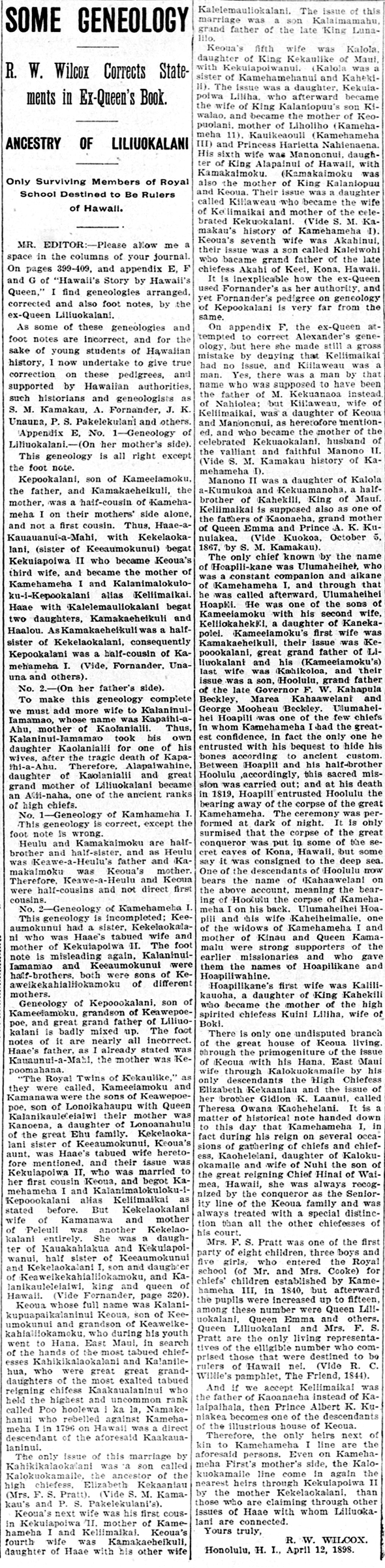
MR. EDITOR:cPlease allow me a space in the columns of your journal. On pages 399–409, and appendix E, F and G of “Hawaii’s Story by Hawaii’s Queen,” I find geneologies arranged, corrected and also foot notes, by the ex-Queen Liliuokalani

As some of these geneologies and foot notes are incorrect, and for the sake of young students of Hawaiian history, I now undertake to give true correction on these pedigrees, and supported by Hawaiian authorities, such historians and geneologists as S. M. Kamakau, A. Fornander, J. K. Unauna, P. S. Pakelekulani and others.

Appendix E, No. 1—Geneology of Liliuokalani.—(On her mother’s side).

This geneology is all right except the foot note.

Kepookalani [Kepoookalani], son of Kameeiamoku, the father, and Kamakaeheikuli, the mother, was half-cousin of Kamehameha I on their mothers’ side alone, and not a first cousin. Thus, Haae-a-Kauauanui-a-Mahi, with Kekelaokalani, (sister of Keeaumokunui) begat Kekuiapoiwa II who became Keoua’s third wife, and became the mother of Kamehameha I and Kalanimokuioku-i-Kepookalani alias Keliimaikai. Haae with Kalelemauliokalani begat two daughters, Kamakaeheikuli and Haalou. As Kamakaeheikuli was a half-sister of Kekelaokalani, consequently Kepookalani was a half-cousin of Kamehameha I. (Vide, Fornander, Unauna and others).

No. 2.—(On her father’s side).

To make this geneology complete we must add more wife to Kalaninui-Iamamao, whose name was Kapaihi-a-Ahu, mother of Kaolanialii. Thus, Kalaninui-Iamamao took his own daughter Kaolanialii for one of his wives, after the tragic death of Kapaihi-a-Ahu. Therefore, Alapaiwahine, daughter of Kaolanialii and great grand mother of Liliuokalani became an Alii-naha, one of the ancient ranks of high chiefs.

No. 1—Geneology of Kamehameha I.

This geneology is correct, except the foot note is wrong.

Heulu and Kamakaimoku are half-brother and half-sister, and as Heulu was Keawe-a-Heulu’s father and Kamakaimoku was Keoua’s mother. Therefore, Keawe-a-Heulu and Keoua were half-cousins and not direct first cousins.

No. 2—Geneology of Kamehameha I.

This geneology is incompleted; Keeaumokunui had a sister, Kekelaokalani who was Haae’s tabued wife and mother of Kekuiapoiwa II. The fott note is misleading again, Kalaninui-Iamamao and Keeaumokunui were half-brothers, both were sons of Keaweikekahialiiokamoku of different mothers.

Geneology of Kepoookalani, son of Kameeiamoku, grandson of Keawepoepoe, and great grand father of Liliuokalani is badly mixed up. The food notes of it are nearly all incorrect. Haae’s father, as I already stated was Kauaunui-a-Mahi [Kauauanui-a-Mahi], the mother was Kepoomahana.

“The Royal Twins of Kekaulike,” as they were called, Kameeiamoku and Kamanawa were the sons of Keawepoepoe, son of Lonoikahaupu with Queen Kalanikauleleiaiwi their mother was Kanoena, a daughter of Lonoanahulu of the great Ehu family. Kekelaokalani sister of Keeaumokunui, Keoua’s aunt, was Haae’s tabued wife heretofore mentioned, and their issue was Kekuiapoiwa II, who was married to her first cousin Keoua, and begot Kamehameha I and Kalanimalokuloku-i-Kepoookalani alias Keliimaikai as stated before. But Kekelaokalani wife of Kamanawa and mother of Peleuli was another Kekelaokalani entirely. She was a daughter of Kauakahiakua and Kekuiapoiwanui, half sister of Keeaumokunui and Kekelaokalani I, son and daughter of Keaweikekahialiiokamoku, and Kalanikauleleiaiwi, king and queen of Hawaii. (Vide Fornander, page 320).

Keoua whose full name was Kalanikupuapaikalaninui Keoua, son of Keeumokkunui [Keeaumokunui] and grandson of Keaweikekahialiiokamoku, who during his youth went to Hana, East Maui, in search of the hands of the most tabued chifesses of Kahikikalaokalani and Kalanilehua, who were great great grand-daughters of the most exalted tabued reigning chiefess Kaakaualaninui who held the highest and uncommon rank called Poo hoolewa i ka la, Namakehanui who rebelled against Kamehameha I in 1796 on Hawaii was a direct descendant of the aforesaid Kaakaualaninui.

The only issue of this marriage by Kahikikalaokalani was a son called Kalokuokamaile, the ancestor of the high chiefess, Elizabeth Kekaaniau (Mrs. F. S. Pratt). (Vide S. M. Kamakau’s and P. S. Pakelekulani’s).

Keoua’s next wife was his first cousin Kekuiapoiwa II, mother of Kamehameha I and Keliimaikai. Keoua’s fourth wife was Kamakaeheikuli, daughter of Haae with his other wife Kalelemauliokalani. The issue of this marriage was a son Kalaimamahu, grand father of the late King Lunalilo.

Keoua’s fifth wife was Kalola, daughter of King Kekaulike of Maui with Kekuiapoiwanui. (Kalola was a sister of Kamehamehanui and Kahekili). The issue was a daughter, Kekuiapoiwa Liliha, who afterward became the wife of King Kalaniopuu’s son Kiwalao, and became the mother of Keopuolani, mother of Liholiho (Kamehameha II), Kauikeaouli (Kamehameha III) and Princess Haarietta Nahienaena. His sixth wife was Manononui, daughter of King Alapainui of Hawaii, with Kamakaimoku. (Kamakaimoku was also the mother of King Kalaniopuu and Keoua. Their issue was a daughter called Kiilaweau who became the wife of Keliimaikai and mother of the celebrated Kekuokalani [Kekuaokalani]. (Vide S. M. Kamakau’s histor of Kamehameha I). Keoua’s seventh wife was Akahinui, their issue was a son called Kaleiwohi who became grand father of the late chiefess Akahi of Keei, Kona, Hawaii.

It is inexplicable how the ex-Queen used Fornander’s as her authority, and yet Fornander’s pedigree on geneology of Kepookalani [Kepoookalani] is very far from the same.

On appendix F, the ex-Queen attempted to correct Alexander’s geneology, but here she made still a gross mistake by denying that Keliimaikai had no issue, and Kiilaweau was a man. Yes, there was a man by that name who was supposed to have been the father of M. Kekuanaoa instead of Nahiolea; but Kiilaweau, wife of Keliimaikai, was a daughter of Keoua and Manononui, as heretofore mentioned, and who became the mother of the celebrated Kekuaokalani, husband of the valiant and faithful Manono II. (Vide S. M. Kamakau history of Kamehameha I).

Manono II was a daughter of Kalola-a-Kumukoa and Kekuamanoha, a half-brother of Kahekili, King of Maui. Keliimaikai is supposed also as one of the fathers of Kaonaeha [Kaoanaeha], grand mother of Queen Emma and Prince A. K. Kunuiakea. (Vide Kuokoa, October 5, 1867, by S. M. Kamakau).

The only chief known by the name of Hoapili-kane was Ulumaheihei, who was a constant companion and aikane of Kamehameha I, and through that he was called afterward, Ulumaheihei Hoapili. He was one of the sons of Kameeiamoku with his second wife, Keliiokahekili, a daughter of Kanekapolei. Kameeiamoku’s first wife was Kamakaeheikuli, their issue was Kepoookalani, great grand father of Liliuokalani and his (Kameeiamoku’s) last wife was Kahikoloa, and their issue was a son, Hoolulu, grand father of the late Governor F. W. Kahapula Beckley, Maraea Kahaawelani and George Mooheau Beckley. Ulumaheihei Hoapili was one of the few chiefs in whom Kamehameha I had the greatest confidence, in fact the only one he entrusted with his bequest to hide his bones according to ancient custom. Between Hoapili and his half-brother Hoolulu, accordingly, this sacred mission was carried out; and at his death in 1819, Hoapili entrusted Hoolulu the bearing away of the corpse of the great Kamehameha. The ceremony was performed at dark of night. It is only surmised that the corpse of the great conqueror was put in some of the secret caves of Kona, Hawaii, but some say it was consigned to the deep sea. One of the descendants of Hoolulu now bears the name of Kaawelani on the above account, meaning the bearing of Hoolulu the corpse of Kamehameha I on his back. Ulumaheihei Hoapili and his wife Kaheiheimalie, one of the widows of Kamehameha I and mother of Kinau and Queen Kamamalu were strong supporters of the earlier missionaries and who gave them the names of Hoapilikane and Hoapiliwahine.

Hoapilikane’s first wife was Kalilikauoha, a daughter of King Kahekili who became the mother of the high spirited chiefess Kuini Liliha, wife of Boki.

There is only one undisputed branch of the great house of Keoua living through the primogeniture of the issue of Keoua with his Hana, East Maui wife through Kalokuokamaile by his only descendants the High Chiefess Elizabeth Kekaaniau and the issue of her brother Gidion K. Laanui [Gideona K. Laanui], called Theresa Owana Kaohehelani. It is a matter of historical note handed down to this day that Kamehameha I, in fact during his reign on several occasions of gathering of chiefs and chiefess, Kaohelelani, daughter of Kalokuokamaile and wife of Nuhi the son of the great reigning Chief Hinai of Waimea, Hawaii, she was always recognized by the conqueror as the Seniority line of the Keoua family and was always treated with a special distinction than all the other chiefesses of his court.

Mrs. F. S. Pratt was one of the first party of eight children, three boys and five girls, who entered the Royal school (of Mr. and Mrs. Cooke) for chiefs’ children established by Kamehameha III, in 1840, but afterward the pupils were increased up to fifteen, among these number were Queen Liliuokalani, Queen Emma and others. Queen Liliuokalani and Mrs. F. S. Pratt are the only living representatives of the elligible number who comprised those that were destined to be rulers of Hawaii nei. (Vide R. C. Willie’s pamphlet, The Friend, 1844).

And if we accept Keliimaikai was the father of Kaoanaeha instead of Kalaipaihala, then Prince Albert K. Kuniakea [Albert K. Kunuiakea] becomes one of the descendants of the illustrious house of Keoua.

Therefore, the only heirs next of kin to Kamehameha I line are the aforesaid persons. Even on Kamehameha First’s mother’s side, the Kalokuokamaile line come in again the nearest heirs through Kekelaokalani, than those who are claiming through other issues of Haae with whom Liliuokalani are connected.

Yours truly,

R. W. WILCOX.

Honolulu, H. I., April 12, 1898.

[It is worth noting that Wilcox repeatedly calls Liliuokalani, “ex-Queen” and submits this critique to the Pacific Commercial Advertiser, a newspaper which is at this time ostensibly against the monarchy. His criticisms are written in English most certainly because the Queen’s book was published in English.

If you still haven’t got the recently published new and revised edition of the Queen’s Story, you should consider picking up a copy!]

(Pacific Commercial Advertiser, 5/25/1898, p. 5)
SOME GENEOLOGY

The Pacific Commercial Advertiser, Volume XXVII, Number 4928, Page 5. May 25, 1898.
The Queen’s Birthday, 1914.

On this past Wednesday, Queen Liliuokalani’s 76th birthday was celebrated. There was an audience held by [??????]. “Long live! Long live Liliuokalani,” is our prayer.

[The digital images for this newspaper are very bad, and I almost could not find this tiny mention of the Queen’s birthday a hundred years ago.]

(Holomua, 9/5/1914, p. 4)

Ma ka Poakolu...

Ka Holomua, Buke I, Helu 49, Aoao 4. Sepatemaba 5, 1914.

Birthday of the Queen, 1902.

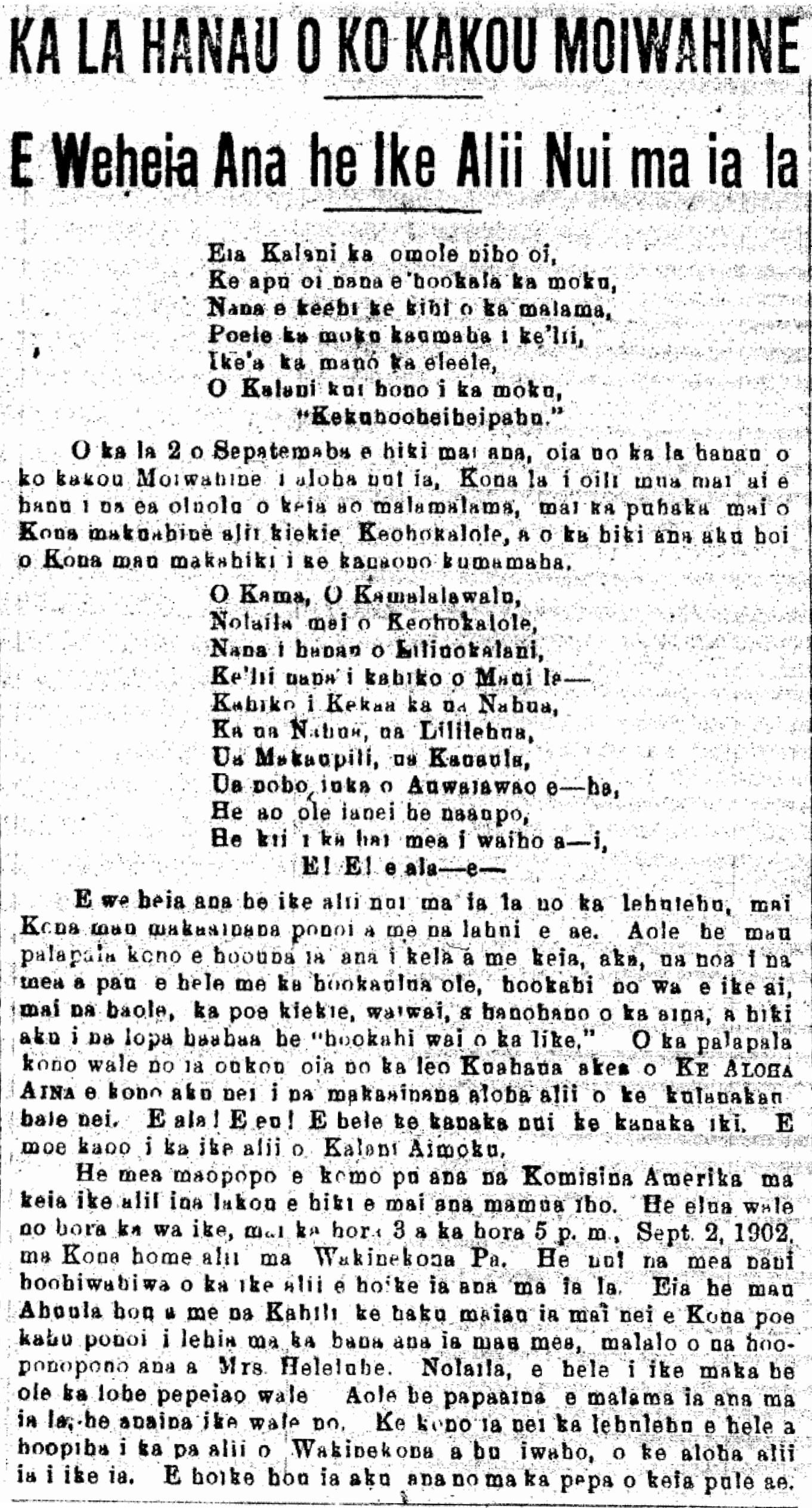
THE BIRTHDAY OF OUR QUEEN

There Will be a Great Royal Audience on That Day

Eia Kalani ka omole niho oi,
Ke apu oi nana e hookala ka moku,
Nana e keehi ke kihi o ka malama,
Poele ka moku kaumaha i ke’lii,
Ike’a ka mano ka eleele,
O Kalani kui hono i ka moku,

“Kekuhooheiheipahu.”

The coming 2nd of September is the birthday of our dearly beloved Queen, the day that She first arrived and breathed in the sweet air of this world of light, from the loins of Her mother, high chiefess Keohokalole, and She has now reached the age of sixty-four.

O Kama, O Kamalalawalu,
Nolaila mai o Keohokalole,
Nana i hanau o Liliuokalani,
Ke’lii nana i kahiko o Maui la—
Kahiko i Kekaa ka ua Nahua,
Ka ua Nahua, ua Lililehua,
Ua Makaupili, ua Kauaula,
Ua noho iuka o Auwaiawao e—ha,
He ao ole ianei he naaupo,
He kii i ka hai mea i waiho a—i,
E! E! e ala—e—

There will be a great royal audience for the people that day, from Her own makaainana to the people of other ethnicities. There will not be invitations sent out to each person, but it is open to all without hesitation, and there will be but one audience, from the haole, the rich and prestigious of the land all the way to the humble peasants; they are all the same. The only invitation to you all will be this public Announcement by the Aloha Aina inviting all those of this town who have aloha for the monarch. Rise! Get going! Go forth, big man and little man. File along to the royal audience with the Queen.

It is understood that the American Commissioners [the Subcommittee on Pacific Islands and Porto Rico] will be present at this royal audience if they arrive before then. The audience will only be for two hours, from 3 to 5 p. m., Sept. 2, 1902, and Her royal residence at the grounds of Washington Place [Wakinekona Pa]. There will be many beautiful adornments displayed that day at the royal audience. There are new Feather Capes [Ahuula] and Kahili being skillfully crafted by Her own attendants who are skilled at the making of such things, under the guidance of Mrs. Heleluhe. So go and see for yourself, and not just hear about it. There will  not be a meal presented that day, only an audience. The public is invited to go a fill the yard of Washington Palace until it overflows, showing the love for the alii.  This will be shown once more in the paper of this coming week.

(Aloha Aina, 8/23/1902, p. 1)

KA LA HANAU O KO KAKOU MOIWAHINE

Ke Aloha Aina, Buke VIII, Helu 34, Aoao 1. Augate 23, 1902.

Mafia? 1893.

AN AMERICAN MAFIA.

“The Queen never will be restored to the throne, for she will be shot within 24 hours, and every man who takes office under her will be shot also—we have men secretly sworn to do it.”

Such was the remark made to the writer by a brainless young sprig of the “citizens reserve,” such is the tenor of numerous open threats of the canaille composing the annexation club, the citizens reserve and the American league organizations that pretending to be patriotically American are in fact veritable nests of socialism, fenianism and mafia.

To their shame be it said that these mafias are organized under men calling themselves Americans, men who heretofore have been regarded as respectable and intelligent citizens: Hatch, Castle, Wilder, Jones, Smith, McGrew, Emerson, and so on, whose names will pass into history as knavish pirates in a plot to steal a nation and compel America to receive the stolen goods.

A recent article in the Holomua warned that a wave of insanity had struck Honolulu in accordance with a well known theory of cycles. The malady appears to be growing worse, for certain it is, that all the men and women concerned in the overthrow of the Queen, the terrorism and misgovernment of a P. G. military despotism, and the present display of hostilities against the United States, all act like people demented. Continue reading

Restoration Day celebration by true patriots, 1894.

LA HOIHOI EA.

Fitting Remembrances for that Great Day.

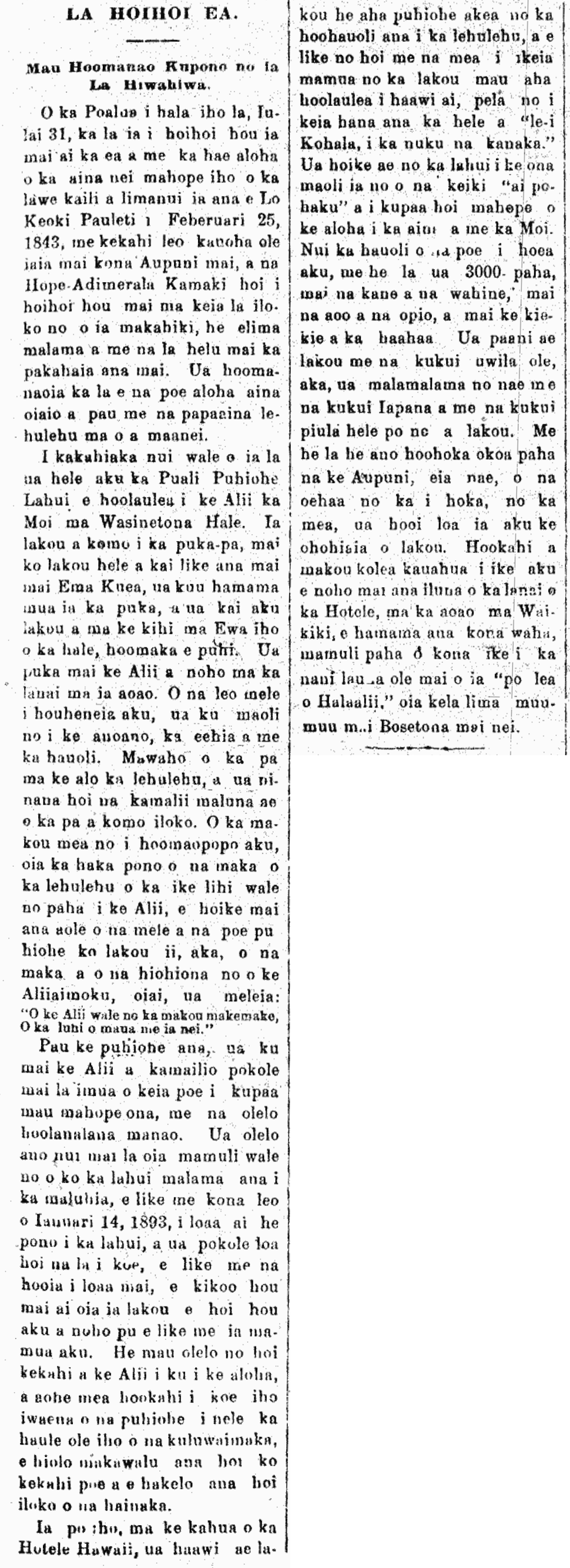
This past Tuesday, July 31, was the day that the independence and the beloved flag of this land was restored after being seized and forcefully taken by Lord George Paulet [Lo Keoki Pauleti] on February 25, 1843, without orders from his Nation, and Rear-Admiral Thomas [Hope-Adimerala Kamaki] was the one who restored it on this day in that very year, five months and some days after it was stolen. This day is celebrated by all true patriots with many feasts all over the place.

In the early morning, the Royal Hawaiian Band [Puali Puhiohe Lahui] went to entertain the Alii, the Monarch, at Washington Place. When they entered the yard after marching from Emma Square [Ema Kuea], the door was swung open and they marched to the Ewa corner of the house and began to play. The Alii came out and sat on the lanai on that side. The songs that were played were full of reverence, awe, and joy. Outside before the front yard were the masses, and children climbed the fence and went inside. From what we saw, the crowd was looking intensely to try and maybe get a glimpse of the Alii, showing that the songs by the band wasn’t what they desired, but it was the sight of the face and the appearance of the Ruler that they were after, as it is sung: “Our desire is but for our Alii, The one we care for.” [“O ke Alii wale no ka makou makemake, O ka luhi o maua me ia nei.”]

After the music was over, the Alii stood and spoke briefly before these people who stood steadfast behind her, with words of encouragement. She stressed that the lahui keep the peace, like her statement of January 14, 1893, for the welfare of her people, and that it would be but a few more days before, according to assurances she received, that she will once again have them [? e kikoo hou mai ai oia ia lakou] go back to their lives just as before. The Alii had as well some words filled with aloha, and there was not one from amongst the members of the band who did not shed tears; some shed great many tears while blowing their noses into handkerchiefs.

That night, on the grounds of the Hawaiian Hotel [Hotele Hawaii], they gave an open concert to entertain the public, and just as was seen at the performance they put on earlier, so too was this one, and it was very well attended. Those who attended were very happy, there being perhaps 3000, from men to women, from the old to they young, and from those of high stature to low. They played without electric lights, but were illuminated by Japanese lanterns and their pewter lanterns. It would appear as if they were totally thwarted by the Government [P. G.], but in fact it was the deceitful ones who were disappointed, because they were all the more delighted. There was a single wealth-seeking haole [kolea kauahua] that we saw sitting on the lanai of the Hotel, on the Waikiki side, with his mouth wide open, maybe because he witnessed the unmatched beauty of that great night of entertainment, that person was the one with a maimed hand from Boston.

[Let the story never be forgotten. Ua mau ke ea o ka aina i ka pono!]

(Makaainana, 8/6/1894, p. 1)

LA HOIHOI EA.

Ka Makaainana, Buke II—-Ano Hou, Helu 6, Aoao 1. Augate 6, 1894.

Senator John T. Morgan replies, 1897.

MORGAN’S REPLY.

The Senator From Alabama Answers J. K. Kaulia’s Open Letter.

He Defends the Position of Himself and the Annexationists.

Honolulu, Oct. 12, 1897.

Mr. James K. Kaulia,

Dear Sir,—A pressure of engagements has necessarily delayed an answer to your open letter.

Having no disposition to interfere in Hawaiian affairs or to attempt to influence the opinions of the Hawaiians on the subject of annexation to the United States, or to any country, I do not wish to enter upon a discussion, which you invite, as to any views I have heretofore expressed on that subject.

A preference is quite a different matter from an alternative, when the latter is forced upon us by circumstances beyond our control. As my government has not submitted to a vote of our people, the question of our willingness to accept the annexation of Hawaii, and has not a proceeding so unusual and so idle, I have not thought it necessary, or fair, that this question should be submitted to a popular vote in Hawaii, Your Constitution provides for annexation without such a vote. But I would regret to have you feel that I am indifferent to the wishes of your people on this subject; I wish them to feel that our motives are honorable; that our sentiments are only those of sincere regard for their happiness, and that our course towards them will be wise and just.

I have said in the Senate that if I was a Hawaiian citizen I would not prefer annexation to any country. If I were a Cuban I would have the same preference for a separate and independent Republic, won by Cuban blood. This is in the sense of national pride, which must always yield to national safety.

But the present condition of Cuba and of Hawaii does not admit of such a preference.

Cuba has found that she must be a republic in order to escape the terrors of foreign monarchial rule, and Hawaii must also remain a republic to avoid sinking into a like condition.

If Hawaii relapses into monarchy she will be cut off from any reliance on the protection of the United States. In that event we could not accept her into our Union, nor could we, in any event, accept Hawaii as a dependency, or colony. We have no such powers under our Constitution.

When the alternative is presented as it is, whether I would prefer annexation to the United States rather than have Hawaii sink into a petty monarchy, to be ruled by some foreign country, I would prefer to save the liberties of the people, through annexation, to a tawdry show of royalty by a few persons set in authority over them, who would be compelled to do the bidding of some monarch. In the American Union Hawaii would be really independent, and would be forever safe against any foreign interference. She would not be smothered with Asiatic immigrants, nor would she ever become a sugar colony of a monarch, as Cuba is, to be robbed and oppressed by non-resident nabobs, and then flayed alive on the first utterance of a plea or protest in the name of humanity. Finding that it is necessary to act in order to meet the clandestine movements of some citizens and others who are subjects of foreign monarchies, for the destruction of republican government in Hawaii, I would prefer annexation to the United States, rather than risk the danger of having to fight for the life of the country, as Cuba is forced to do.

When Japau wished to annex Formosa to her Empire, she did not consult the Chinese there, to ascertain their wishes. When by a process of emigration Japan has filled these islands with her people, who still owe allegiance to the Emperor, she will ask no questions of the Hawaiians whether they wish to become Japanese subjects; nor will your people be able to resist this quiet process of absorption, you will sink, as the rains sink into the thirsty soil.

If your people were all united in their preference for republican government, I would, if I were a citizen of Hawaii, now prefer her separate independence, as a matter of pride, yet I remember how costly, to Ireland, a like feeling has been, and how it has lost to her people all hope of separate national independence, but the Hawaiian Islands are not independent of fate, however much their native people may desire a separate government. If I belonged to that race I would sacrifice any preference, either of pride or convenience, rather than be suffocated with people who have nothing in common with them in religion, or in their ideas of government. I would unite with the American people in their support of free, constitutional government rather than see any republic relapse into a monarchy, in this Western Hemisphere.

Very respectfully,

John T. Morgan.

(Independent, 10/16/1897, p. 3)

MORGAN'S REPLY.

The Independent, Volume V, Number 716, Page 3. October 16, 1897.

James Keauiluna Kaulia speaks to America, 1897 / 2014.

AN OPEN LETTER.

From J. K. Kaulia to Senator Morgan.

Let the United States Undo the Great Wrong Perpetrated Upon the Hawaiian People by Minister Stevens, and then Consult Them as to Annexation.

There is cause for congratulating ourselves, we who have yet faith in the justice and honor of the great United States, our greatest friend and nearest neighbor, at the presence in our midst of that noble representative of the Senate of the United States Hon. John T. Morgan, of Alabama. Tho Senator comes not hither unknown, unhonored or unsung, for thousands have heard his voice, only a few weeks ago in the Capital City of California, and tributes of esteem have met him at every turn. To those who have no knowledge of Senator Morgan’s character or position it was sufficient to say that the gentleman is Chairman of the Committee on Foreign Relations of the United States Senate, a Committee which will, in the near future, pass upon questions of grave importance to little Hawaii, and the result of which means an honorable life as an independent nation or the sending out of national existence the only representative nation in the Pacific. Senator Perkins, a long time friend of Senator Morgan, says: “if there is one that ever occupied the position of a Senator with a conscientious desire to do his duty faithfully to the whole people, it is the distinguished Senator from Alabama.” And the words that Senator Morgan given public voice to, before leaving the City of San Francisco, shows his mission hither; he says, “I am going as far as the Hawaiian Islands for the purpose of trying to understand the geographical, commercial and other situations which I conceive to be very important for the people and the Government of the United States and (mark) necessary to enable me to conscientiously discharge duties incumbent on me and my colleagues in the House and the Senate.”

Again, later on, in the speech delivered by him in San Francisco on the evening of tho 6th of September, Senator Morgan gave expression to sentiments which do honor to his heart and head and enables one to place great confidence in this leading American Senator for he said: “I think that an American citizen who is an honest man faithful to his duties and who has a trust reposed in him by the voice of a constituency when he pursues that cause unfalteringly, honestly, imparcially and justly is entitled to the encomium at least of ‘Well done thou good and faithful servant.’ When we come to the end of our earthly career, if a higher power shall say to each and all of us, ‘Well done thou good and faithful servant,’ we will feel that we have not insufficiently served the Master who can bestow on us benedictions like that.” To us here in Hawaii, who still love Hawaii and hope for the long-delayed but expected justice at the hands of the United States, Senator Morgan voicing such sentiments, would prove a good advocate when time and opportunity makes him familiar with the surroundings of the coup d’etat which caused Hawaii to be the petitioner to her great and good friend, “Uncle Sam,” to have right and justice done her.

To ask for bread and receive but a stone would hardly be provocative of obtaining the praise and blessing of the Just One so aptly alluded to by Senator Morgan. And, Senator Morgan coming here, as he does, on an honest survey, 2,100 miles across the blue Pacific, shut off for several weeks from his people, came not alone but in company of other distinguished members of the Congress of the United States. But why should those distinguished people come so far? when, as Senator Morgan truly says, “The United States Government, great, majestic, powerful and splendid as it is, is still in its formative period. We are not yet a complete Government.” True, Senator, such has been said before and will be again, and as you yourself say, Mr. Senator, “Look at Alaska, that vast body of land which is developing more wealth, both in the supply of human food from the sea and gold from the land, and timber. Look at it. It has not yet a Governor. It has no Legislature; it has a mere form of a judicial system. New Mexico and Arizona are yet under a territorial Government.” But, is it because the goods are of better quality in Hawaii and practically unprotected that the desire for attainment becomes so prominent to-day. The destiny of Hawaii, situated in the Mid-Pacific as she is, should be that of an independent nation and so she would be were it not for the policy of greed which pervades the American Legislators and the spirit of cowardice which is in the breasts of those who first consummated the theft of Hawaiian prestige.

But from Senator Morgan, we hope for bettor results than might be expected when he already has mapped out that the boundary line, The “outside boundary of the United States is to begin at the island of Pioka, 600 miles west of Honolulu, in the Aleutian Peninsula, and swooping from there to the Hawaiian group, then to the land 12 miles below San Diego on the Mexican border.” But “man proposes and God disposes,” and the Senator, who was a sturdy champion of the cause of succession when it threatened to disrupt that great country of his which he now speaks of so fervently, the Senator knows that the ways of Providence are inscrutable and God defends the right.

Again it seems as though it were a great waste of time and labor for Senator Morgan to leave the shores of California when there is so much there to be done in throttling the gigantic steals which are, as he states he has knowledge of, being perpetrated on the United States Government and the people of California. The Senator states that there is now an attempt being made to steal $25,000,000, and that there is “need for the people of California to take immediate action.” In the next few words the Senator tells those same people, American citizens, and members of that “majestic and splendid Government,” that this great wrong that he speaks of is about being carried out in his own grand country (to which he seeks to annex yet virtuous little Hawaii), this monstrous steal of which the honorable gentleman facetiously remarks that 25,000,000 was taken “for pocket lining,” this wrong is being consummated, and will be consummated, and before Congress meets in next December, * * * we will then have presented to us the judgment of a court upon a great case, and you and I, sir, will be asked to swallow it,” and the Senator plainly tells them that they, the people, are practically helpless in a matter of this kind.”

But let us here in  Hawaii aid the Senator in his excursion of some 6000 miles for knowledge on a question which he pleads lack of inform-

(Independent, 10/11/1897, p. 1)

An Open Letter.

The Independent, Volume V, Number 711, Page 1. October 11, 1897.

ation although it seems that the name of the Senator has become attached to at least one official brochure which loomed with thoughts upon Hawaii and the annexation to the United States of America. The logical way to debate this question, Mr. Senator Morgan, would be, first, to prove that the United States has a right to annex these islands, for if the coveted territory were a gold mine of inestimable value, if annexation be an unjust act, the United States should positively refuse to add the Hawaiian Islands to her territory, and Senator Morgan, an honorable representative of that great Government, anxious to do his duty conscientiously, with the seeming love for God in his heart and the desire for the approbation of being “a good and faithful servant” on his lips, should be last man to aid, over so little, in the consummation of a wrong. Then let us reason together, Mr. Senator, on the justice of the question. It cannot be foreign to your knowledge, sir, that, in dispatch numbered 74 of ex-American Minister Stevens, that gentleman previous to the so-called revolution of January 16, 1893, published the fact that he was engaged with certain American citizens to overthrow the Hawaiian Government. In this dispatch sent to Washington some fifty days before the revolution, the then American Minister asks for “wise and bold action” to overthrow the monarchy and rescue the property owners. Can the United States in consistency with past principles annex these islands until she has made herself right before the world by undoing everything that this Minister has done? Can the United States afford to have annexation of the Hawaiian Islands go down into history as having been previously worked up by the United States Minister and American citizens? And let us see fully the hand that the American Minister had in the overthrow of a friendly sovereign. After the Queen had withdrawn the proposed Constitution after an official proclamation had been issued congratulatory on the peace and order which had prevailed, when the usual routine of business and pleasure was again at work, and the Hawaiians had settled down again to their usual quiet life, when no riot had occurred nor no life been lost, Mr. Stevens, the American Minister, writes to Captain Wiltze, commanding the U. S. S. Boston, then in Honolulu Harbor:

“Sir.—In view of the existing critical circumstances in Honolulu, including an inadequate legal force I request you to land marines and sailors from the ship under your command for the protection of the United States Legation and the United States Consulate, and to secure the safety of American life and property.”

Now, Mr. Senator Morgan, where, think you, were the “critical circumstances?” Not in the Government, nor among the Hawaiians. No. The “critical circumstances” were a little knot of foreigners (Americans) trying to overthrow the Constitutional Government so that they could offer the Hawaiian Islands to the United States for annexation, and at the time they did not have a single soldier in arms. It was “critical circumstances” indeed. The Queen with her one thousand or more determined men could have destroyed the conspiracy quickly, but Mr, Stevens, the American Minister, landed the United States troops and held the Queen and the army at bay until the conspirators had organized to overthrow the Government. When the then United States representative (Mr. Blount) arrived here some thirty days after the Provisional Government, which was offering itself and its stolen property to the United States, was still under the protection of Mr. Stevens and the army and navy of America. And Mr. Senator Morgan let me draw your attention to the fact that the Queen did not surrender to the Provisional Government but to the United States and declared in a published statement that, “I yield to the superior force of the United States.” En passant it may be worthy your attention that the protest of Her Majesty to her great and good friend Uncle Sam yet remains unanswered.

Now, Mr. Senator, let us place this state of things as happening in America and at a time, Mr. Senator when you had knowledge from personal experience, of the surrounding circumstances. Let us suppose that at the time the people of the South were working up their great conspiracy to divide the Union that a large Union army was in readiness to squelch the conspiracy. Suppose at this time England with a much larger and stronger army had landed and marched between the forces of the North and South and had held the people of the North at bay until the South had so organized their forces as to be enabled to overthrow the Government! England would have been just as guilty and responsible as if she had taken the American Capital by storm. Do you not think so, Mr. Senator?

But let us consider the position of the United States if this proposed scheme of annexation is consummated. By such act the established policy of the United States is at once broken and the change of national policy is a grave proceeding, it involves the fate of the nation that changes it. The complex territorial interests both at home and abroad of the European powers has forced upon those powers relations of a most intricate character. Territory is the bone of their contention. Intervention is the policy of European nations but it is not the policy of the United States. Instead of being surrounded by rivals, America lives in a sphere essentially her own. No armies or navies are needed to preserve a “Balance of Power,” for there is none to preserve. She is so far distant from the complications of the other great nations that to her it matters not whether the star ascendant of Europe be that of England, France, Germany, Russia or Austria. Her territorial isolation has enabled her to pursue an isolated policy, a policy of “Friendship with all nations and entangling alliances with none” has been the motto of all administrations from Washington on.

The American people delivered from the desire and fear of war sentiments, from standing armies and great navies have been free to take the leading place in this world’s industrial development. But a change of conditions must bring a change of policy. The ocean territories are largely in the possession of other powers; an extension of American domain into the same regions means an identification of American foreign interests with other powers and the consequent entanglement and complications which American policy has always sought to avoid. And why this greed for the Hawaiian Islands? Is it a naval station that is needed? For that it would seem that American home ports are much in need of such protection. Is it a coaling station that is desired? That is obtainable by treaty. Or is it the islands’ wealth that America desires? If so, then America will desire to annex the earth. The shore lines of American policy once crossed is crossed for ever and one acquisition leads but to another. And Mr. Senator, let me say in closing that, annexation or no annexation “Fiat justitia ruat cœlum;” there is a preferred charged of wrong-doing and justice against the United States, let there not be another and graver one of direct subjugation. Ask for the voice of Hawaii on this subject Mr. Senator, and you will hear it with no uncertain tones ring out from Niihau to Hawaii—”Independence now and forever.”

Then Mr. Senator, let The Great Republic of America undo the wrong that has been done to the Hawaiian Nation by its Representatives, and when you come to the end of your earthly career a High Power will say “Well done thou good and faithful Servant.”

James Keauiluna Kaulia.

Honolulu, Oct. 11, 1897.

(Independent, 10/11/1897, p. 4)

ation although...

The Independent, Volume V, Number 711, Page 4. October 11, 1897.

More on the Hawaiian National Anthem, 1867.

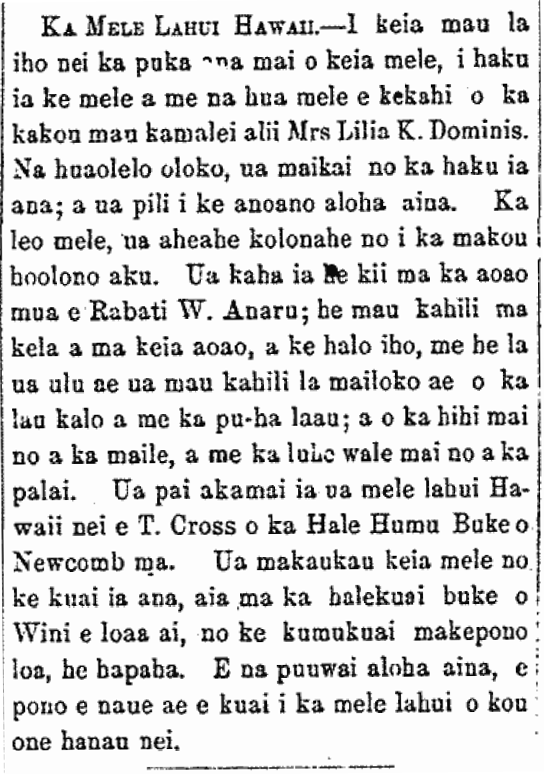
The Hawaiian National Anthem.—A few days ago, this mele was printed, of which the lyrics and music were composed by one of our young royals, Mrs. Lilia K. Dominis. The words are well chosen, and are worthy of the reverence of patriotism. The music is soft and sweet to our ears. The image in front was drawn by Robert W. Andrews [Rabati W. Anaru], with kahili on both sides, and if you look good, it appears as if the kahili are growing from amongst taro leaves and the hollows of trees; and the crawling of maile and the cascading of ferns. The National Anthem of Hawaii nei was printed skillfully by Thomas Cross of the Book Bindery of Newcomb and Company. This song is now for sale at the bookstore of Whitney at a reasonable cost, a quater. O Patriotic hearts, you must go and purchase this national anthem of your land of birth.

(Au Okoa, 5/30/1867, p. 2)

Ka Mele Lahui Hawaii.

Ke Au Okoa, Buke III, Helu 6, Aoao 2. Mei 30, 1867.

“Mele Lahui Hawaii,” the National Anthem, 1867.

[Found under: “NU HOU KULOKO: Oahu.”]

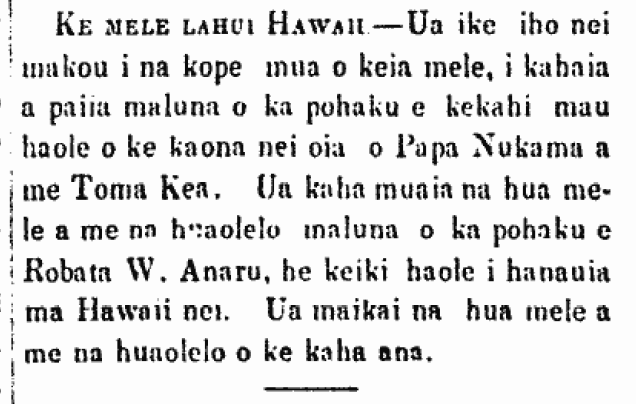
The Hawaiian National Anthem—We just saw the first printings, drawn on and printed on stone [lithograph] by some haole of this town, they being Robert Newcomb [Papa Nukama] and Thomas Cross [Toma Kea]. The notes and lyrics were printed first on the stone by Robert W. Andrews [Robata W. Anaru], a haole boy born in Hawaii nei. The notes and lyrics were carved finely into the stone.

[I just saw a post by Nanea Armstrong-Wassel on the Hawaiian Historical Society’s Facebook page mentioning that among its many treasures is a copy of this sheet music! This is but just one of their countless links to the past! Priceless!!

For more of Nanea’s posts, see: here on Instagram, or on Facebook.]

(Kuokoa, 4/13/1867, p. 2)

Ke Mele Lahui Hawaii.

Ka Nupepa Kuokoa, Buke VI, Helu 15, Aoao 2. Aperila 13, 1867.

The people speak, 1894.

PROTEST OF THE PEOPLE.

Three Thousand Hawaiians Declare Their Objection to the Republic.

A very short and a very insufficient call was made for a mass meeting on Palace Square at 5 o’clock yesterday afternoon, to protest against the promulgation of the Republic while the question of the revolution was still in the hands of the United States Executive as arbitrator. Scarcely anybody knew a meeting of the kind was intended until yesterday morning. Nevertheless, when the hour arrived there had assembled a thousand people, this number being tripled by the time proceedings began.

The premises of Mr. Nacayama were kindly allowed for the use of the meeting. In the small elevated pavilion overlooking the square were seated Mr. and Mrs. H. A. Widemann, Mr. and Mrs. James Campbell, Mr. and Mrs. John A. Cummins, Mrs. Nawahi, Mrs. Aholo, Mrs. Fernandez and Miss Peabody. In front were Messrs. J. O. Carter, J. Nawahi, J. E. Bush, R. W. Wilcox, J. K. Kaulia and press reporters. There were also stationed at the front the Government shorthand reporter, J. W. Jones, and interpreter, W. L. Wilcox, to catch any sedition that might be talked to the crowd.

Mr. Nawahi called the meeting to order and introduce in turn Mr. Kaulia to read the resolution in Hawaiian, and Mr. Carter to perform the same office in English. The resolution is a follows:

“Be it resolved, that the Hui Aloha Aina and other Patriotic Leagues, together with the Loyal subjects of the Hawaiian Kingdom, in Mass Meeting assembled, representing by far the greater majority of the legitimate voters of this country, do hereby most solemnly protest against the promulgation of a new Constitution, formed without the consent and participation of the People, and we also protest against changing the form of government from the one under which we have lived peacefully and prosperously for many years. And that we maintain that the will of the majority of the legitimate voters of Hawaii should be the supreme power of the land, as such power is so recognized and accepted by all the enlightened countries and by all the enlightened governments of the world.”

Mr. Bush then delivered the following address in both languages:

Fellow Citizens and Friends:

We are convened here this afternoon under the broad canopy of heaven, to enunciate broad and important principles. We are not here to express any personal grievances, nor to make any personal complaints, but as a large body of the people we are here, to express our wishes in a peaceful and orderly manner, against the promulgation  of a document which we deem subversive of our rights as free citizens of this country. We are here in the interests of every individual present, and of every individual absent, whom some of us as associated bodies here represent, and of every unit of this government. We are here to set forth the inherent rights of every man and woman in Hawaii nei, and to object to any act restrictive of their rights, and are doing our duty. However, we are not unmindful of the just and legitimate authority vested in those who have assumed the governmental power to administer the affairs of the governed. We recognize the right of civil government to be, and the duty is divinely enjoined upon all rendering to the governmental power, provisional as well as permanent, that which legitimately belongs to it.

We believe that civil governments are ordained of God for the good of every man, woman and child, through the will of the people, and as long as so administered for their good and with their consent, we should give our adherence to it. We are not in sympathy with anarchy or with the creation of social disorder, believing that all our troubles can be more easily and more intelligently adjusted by the peaceful process of free and untrammeled appeal to the people, from whom all just power to govern belongs, and from whence it should emanate.

And it is because the fundamental principles of just government have been studiously and wilfully ignored by the powers that have been set up over us, through the armed intervention of the forces of a nation presumed to be on friendly intercourse with us, that we are gathered here to make protest against the further encroachment upon those principles and upon our rights as free citizens of an independent country, and especially against the promulgation of a constitution in which, by unusual restrictions, the people have been debarred from participating in, if they so desired. However, we have had other reasons for not participating in the framing of such a document, i.e., that we are pledged to respect the position of the Chief Executive of the American Nation, who, for the honor of his country, and for our benefit, is made a party to our affairs, as arbiter.

Until the United States, through its chosen head, is heard from, we find ourselves on the verge of being made a party, by tacit consent, to an act that sets aside all sense of honor, all moral obligation, yes, to participate in a flagrant insult toward and breach of confidence in a nation to whom we have submitted our differences for arbitration and readjustment. If for no other rea-

(Daily Bulletin, 7/3/1894, p. 1)

PROTEST OF THE PEOPLE.

The Daily Bulletin, Volume VII, Number 1074, Page 1. July 3, 1894.

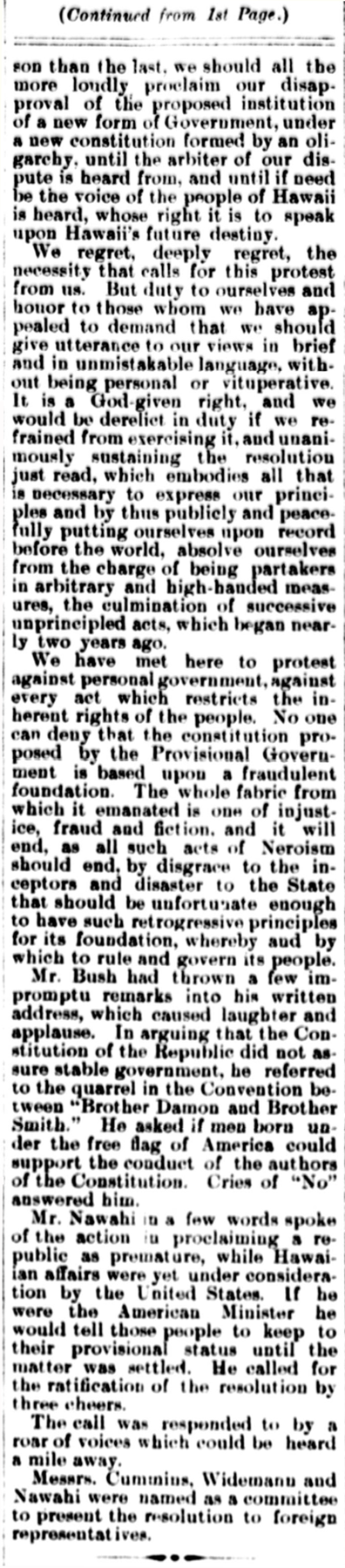
son than the last, we should all the more loudly proclaim our disapproval of the proposed institution of a new for of Government, under a new constitution formed by an oligarchy, until the arbiter of our dispute is heard from, and until if need be the voice of the people of Hawaii is heard, whose right it is to speak upon Hawaii’s future destiny.

We regret, deeply regret, the necessity that calls for this protest from us. But duty to ourselves and honor to those whom we have appealed to demand that we should give utterance to our views in brief and in unmistakable language, without being personal or vituperative. It is a God-given right, and we would be derelict in duty if we refrained from exercising it, and unanimously sustaining the resolution just read, which embodies all that is necessary to express our principles and by thus publicly and peacefully putting ourselves upon record before the world, absolve ourselves from the charge of being partakers in arbitrary and high-handed measures, the culmination of successive unprincipled acts, which began nearly two years ago.

We have met here to protest against personal government, against every act which restricts the inherent rights of the people. No one can deny that the constitution proposed by the Provisional Government is based upon a fraudulent foundation. The whole fabric from which it emanated is one of injustice, fraud and fiction, and it will end, as all such acts of Neroism should end, by disgrace to the inceptors and disaster to the State that should be unfortunate enough to have such retrogressive principles for its foundations, whereby and by which to rule and govern its people.

Mr. Bush had thrown a few impromptu remarks into his written address, which caused laughter and applause. In arguing that the Constitution of the Republic did not assure stable government, he referred to the quarrel in the Convention between “Brother Damons and Brother Smith.” He asked if men born under the free flag of America could support the conduct of the authors of the Constitution. Cries of “No” answered him.

Mr. Nawahi in a few words spoke of the action in proclaiming a republic as premature, while Hawaiian affairs were yet under consideration by the United States. If he were the American Minister he would tell those people to keep to their provisional status until the matter was settled. He called for the ratification of the resolution by three cheers.

The call was responded to by a roar of voices which could be heard a mile away.

Messrs. Cummins, Widemann and Nawahi were named as a committee to present the resolution to the foreign representatives.

[The “Nacayama” who offers his premises to be used for this meeting must be G. O. Nacayama, seen also as G. O. Nakayama, the Inspector-in-Chief of Japanese Immigrants who lived on Merchant Street near the Opera House, as per PCA article 7/11/1894, p. 3.]

(Daily Bulletin, 7/3/1894, p. 4)


son than the last...

The Daily Bulletin, Volume VII, Number 1074, Page 4. July 3, 1894.