Patients released from Kalaupapa, 1917.

NEWS FROM THE LAND OF SUFFERING, KALAUPAPA, MOLOKAI.

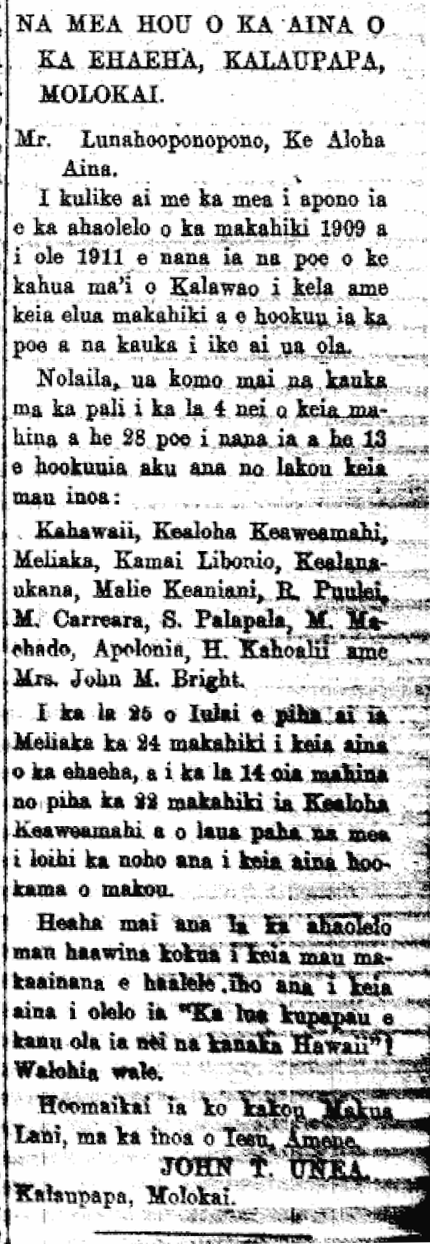
Mr. Editor, Ke Aloha Aina.

In accordance with what was approved of by the legislature of 1909 or 1911, the people of the patient colony of Kalawao will be examined every two years and the people who are determined by the doctor to be cured will be released.

Therefore, the doctors entered the pali on the 4th of this month, and 28 people were examined and 13 will be released, whose names are:

Kahawaii, Kealoha Keaweamahi, Meliaka, Kamai Libonio, Kealanaukana, Malie Keaniani, R. Puulei, M. Carreara, S. Palapala, M. Machado, Apolonia, H. Kahoalii and Mrs. John M. Bright.

On the 25th of July, Meliaka will have spent 24 years in this land of suffering, and on the 14th of that very month, Kealoha Keaweamahi will have spent 22 years, and the two of them are perhaps the ones who have lived the longest in this land which we adopt.

How will the legislature assist these citizens who will leave this land called, “The grave where Hawaiians are being buried alive”? How heart wrenching.

Blessed be our Heavenly Father, in the name of Jesus, Amen.

JOHN T. UNEA.

Kalaupapa, Molokai.

(Aloha Aina, 4/13/1917, p. 1)
NA MEA HOU O KA AINA O KA EHAEHA, KALAUPAPA, MOLOKAI.

Ke Aloha Aina, Buke XXII, Helu 15, Aoao 1. Aperila 13, 1917.
More on fishing laws, 1915.

A LAW PROTECTING FISH IS WANTED.

There was a petition carried around to the citizens of Kaneohe, Heeia, and all the other areas on the Koolau side of the island of Oahu which asks the legislature to pass a law prohibiting the Japanese fishermen from going into those areas with their small-meshed nets and indiscriminately taking all kinds of fish from those waters, so that fish will be left for the people of those Koolau cliffs.

In times past, there was an abundance of fish seen in those waters, and the Hawaiian people of the place were greatly blessed, in that fish were easily caught making life easy because of this bounty of fish; however, these days, it is changed, because with their huge nets which are 600 feet or more long, the Japanese go about, and being that the eyes of their nets are tiny, caught haphazardly are all sorts from big to small; and these day you hardly see fish that were regularly seen before.

Desperately Wanting a Law Passed.

It is hoped by a great number of the people of the (two) Koolau that a law is passed soon by the legislature banning the Japanese from fishing in those waters with nets, because it will save the fish from being wiped out by the Japanese, and fish will be left to propagate for the benefit of the people of the entire island. One very good law being worked on by the legislature, is the limiting of fish prices, because when you observe the selling of fish in fish markets of Honolulu nei these days, the prices are so high that the poor and indigent can’t afford it.

(Kuokoa, 2/19/1915, p. 2)

MAKEMAKE I KANAWAI HOOKAPU I NA I'A

Ka Nupepa Kuokoa, Buke LIII, Helu 8, Aoao 2. Feberuari 19, 1915.

New fishing laws for amaama (mullet), 1911.

Ban on Amaama.

There are many people in this Territory who donʻt know that they have been breaking the law since the first of this month, December; those law breakers are the owners of fish ponds, and those who sell amaama at markets. According to the law passed during this past Legislative Session of 1911, eating of amaama is banned from the 1st of December until the 1st of March.

Therefore, Attorney General Lindsay sent notice to the fish sellers at the markets that the sale of amaama over the counter will not be allowed anymore from next Tuesday on. Both ocean amaama and pond amaama are banned.

With this restriction on amaama during these months, there will be seen fish shortages in town on occasion in the future. It is known that during stormy times and when the sea is rough you canʻt get ocean fish. Amaama is a fish you can get all the time, in good and bad weather, and it is a favorite fish of the people.

This law prohibiting its sale to the public will make it disappear for several months before reappearing again. And dining tables in the upcoming holidays will be without this familiar fish of the land.

(Aloha Aina, 1/23/1911, p. 1)

KAPU KA AMAAMA.

Ke Aloha Aina, Buke XVI, Helu 51, Aoao 1. Dekemaba 23, 1911.

James Keau writes from Apia, Upolu, Samoa, 1887.

[Found under: “Correspondences from Friends”]

From Samoa.

Apia, Upolu, Samoa, Oct. 19, 1887.

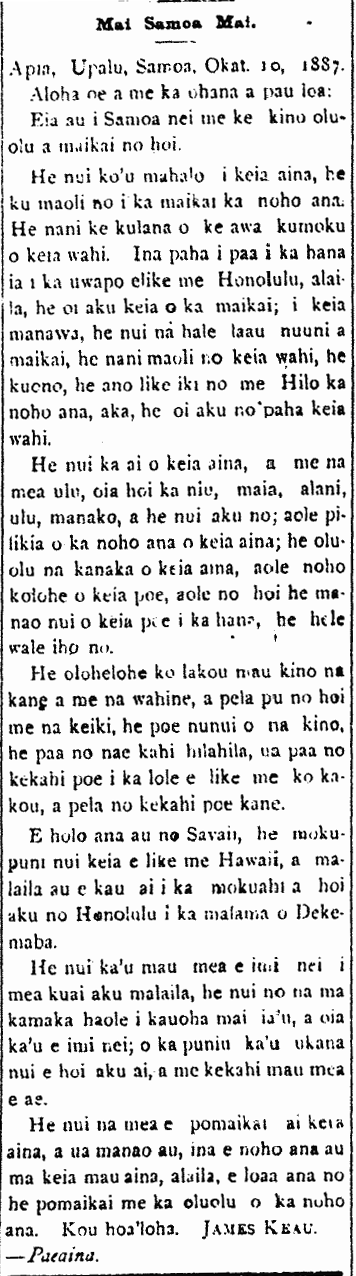
Aloha to you and your whole family:

Here I am in Samoa in good health.

I am very taken by this land; life is good. The lay of the harbor is fine. If it was built well like the harbor of Honolulu, then this one would be better; currently, there are many lovely huge wooden houses and life here is somewhat like that in Hilo, but perhaps it is better here.

There is much food in this land, and fruits like coconuts, bananas, oranges, breadfruit, mango, and much more; life is easy here; the people are pleasant, people do not make trouble, they do not think much of work, they just go about their way.

Their bodies are bare: the men, women, and children as well; they have big bodies, and they cover their privates; some of them wear clothes as we do, and so do some men [?]

I will be going to Savaii, a large island like Hawaii, and there I will board a steamship and return to Honolulu in the month of December.

I am looking for all sorts of things to sell there; many haole acquaintances put in orders, and that is what I look for; coconut bowls are mainly the goods that I bring back, as well as some other things.

There are many things which this place is blessed with, and I feel that if I were to live here, I will have a blissful existence. Your friend, JAMES KEAU.

Paeaina [probably from the newspaper Ko Hawaii Paeaina (of which the May to December 1887 issues are missing…)]

(Kuokoa, 11/5/1887, p. 4)

Mai Samoa Mai.

Ka Nupepa Kuokoa, Buke XXVI, Helu 45, Aoao 4. Novemaba 5, 1887.

Deaths from Kalawao, Molokai, 1887.

[Found under: “Correspondences from Friends”]

Kalawao, Molokai.

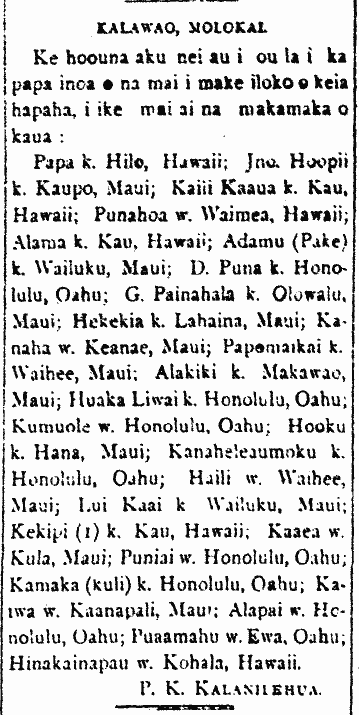
I am sending to you the list of names of the patients who died in this quarter, so that our friends may know:

Papa m. Hilo, Hawaii; Jno. Hoopii m. Kaupo, Maui; Kaiii Kaaua m. Kau, Hawaii; Punahoa f. Waimea, Hawaii; Alama m. Kau, Hawaii; Adamu (Chinese) m. Wailuku, Maui; D. Puna m. Honolulu, Oahu; G. Painahala m. Olowalu, Maui; Hekekia m. Lahaina, Maui; Kanaha f. Keanae, Maui; Paomaikai m. Waihee, Maui; Alakiki m. Makawao, Maui; Huaka Liwai m. Honolulu, Oahu; Kumuole f. Honolulu, Oahu; Hooku m. Hana, Maui; Kanaheleaumoku m. Honolulu, Oahu; Haili f. Waihee, Maui; Lui Kaai m. Wailuku, Maui; Kekipi (1) m. Kau, Hawaii; Kaaea f. Kula, Maui; Puniai f. Honolulu, Oahu; Kamaka (deaf) m. Honolulu, Oahu; Kaiwa f. Kaanapali, Maui; Alapai f. Honolulu, Oahu; Puaamahu f. Ewa, Oahu; Hinakainapau f. Kohala, Hawaii.

P. K. KALANILEHUA.

[This is one of the better lists, giving not only name, but whether male or female, and also where they were from (although the death date is not given)! Many times, there is just a list of names given…]

(Kuokoa, 11/5/1887, p. 4)

KALAWAO, MOLOKAI.

Ka Nupepa Kuokoa, Buke XXVI, Helu 45, Aoao 4. Novemaba 5, 1887.

More on traditional stories, and variation within, 1862.

About Kaao and Moolelo.

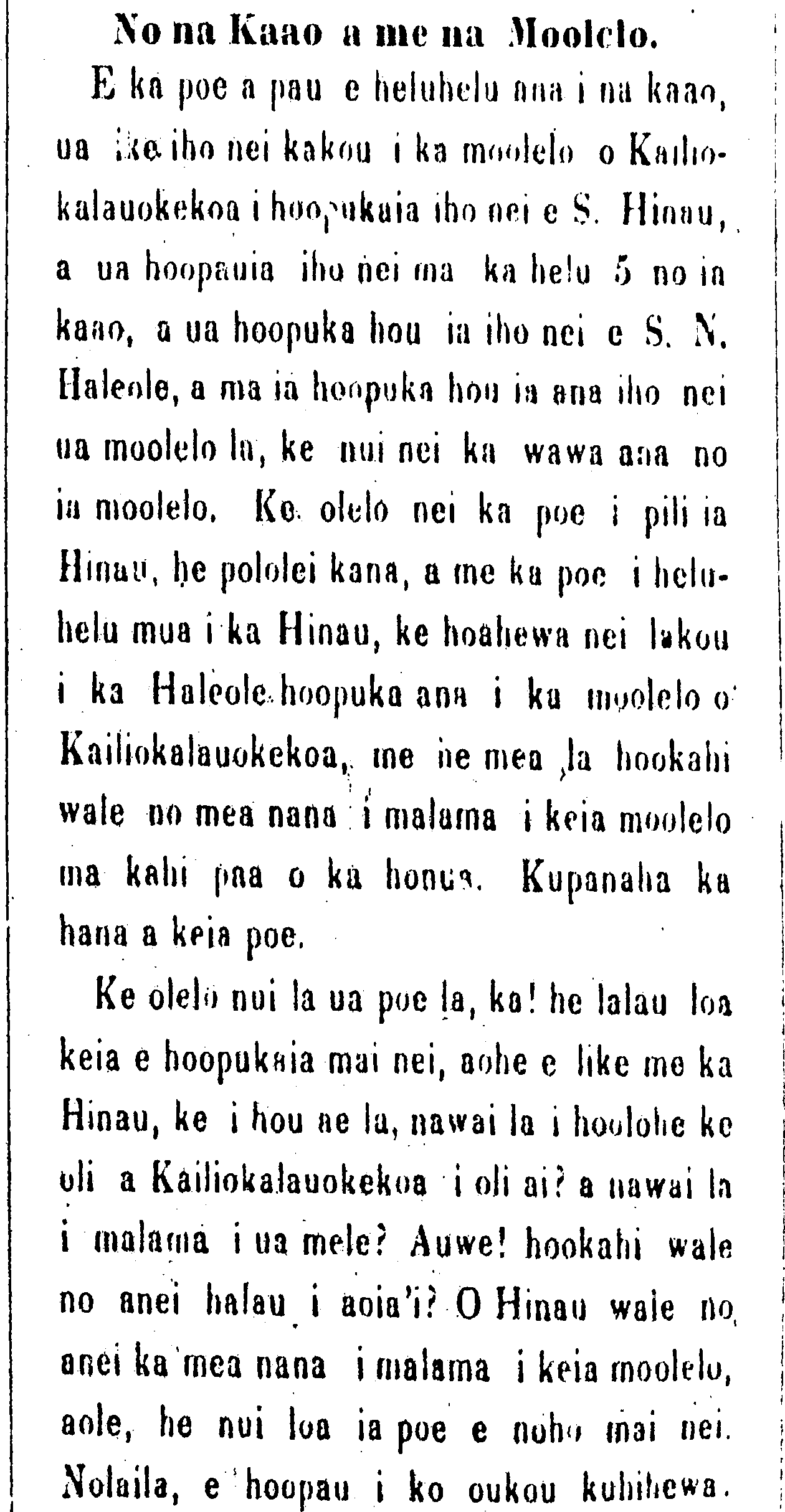
O Readers of kaao, we have seen the story of Kailiokalauokekoa that was published by S. Hinau, and it was just completed with the 5th installment [this series, “He Moolelo no Kailiokalauokekoa,” probably started on 10/24/1861 (which is missing) and S. Hinau closes his telling on 12/5/1861]; S. N. Haleole has just started that story again [which begins with genealogy, on 12/12/1861, restarts with installment 6 on 12/19/1861, and probably ended with installment 10, on 1/30/1862 (which sadly is also missing)], and with that retelling of the story, there has been quite the uproar. Those who are with Hinau say that his is correct, and those that read Hinau’s first fault Haleole’s publishing of Kailiokalauokekoa, as if there is but one person who retained this story on this solid earth. The actions of these people are unbelievable.

Those people go on and on saying, “oh please! this series is so misguided and not like Hinau’s”; further more, “Who has heard those oli which were chanted by Kailiokalauokekoa? and who kept those mele?” Auwe! Is there only one school where it was taught? Is it only Hinau who has kept this story? No, there are many people today. So stop with your unfounded ideas.

(Hoku o ka Pakipika, 1/16/1862)

No na Kaao a me na Moolelo.

Ka Hoku o ka Pakipika, Buke 1, Helu 17, Aoao 4. Ianuari 16, 1862.

On traditional stories and finishing properly what you begin, 1862.

Words of Advice.

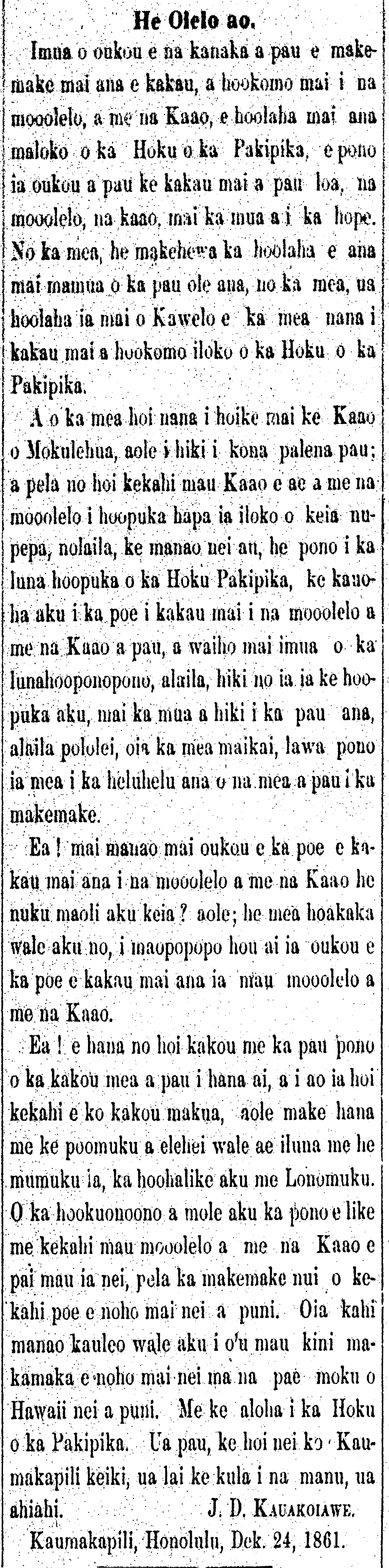
Before you, all those who want to write and publish stories (mooolelo and kaao) in the Hoku o ka Pakipika: you must all write the whole story from the beginning all the way until the end. Because it will be a waste of time to start printing before it is completed, as Kawelo by the person who submitted it, was printed in the Hoku o ka Pakipika [“Mooolelo no Kawelo” by S. K. Kawailiula from 9/26/1861 to 12/5/1861—5 helu total].

And as for the person who submitted the story of Mokulehua, he did not get to the end [“He wahi Kaao no Mokulehua” begins on 11/28/1861, and in the Helu 2 (12/5/1861), there is a note from the editor at the bottom, “Send in more of the story of Mokulehua; make it quick lest the Hoku o ka Pakipika give you a kick.” Helu 3 in the next issue (12/12/1861) is very short, and there is a long hiatus until well after this letter is published. It finally reappears as “He Moolelo no Mokulehua on 3/13/1862 to 3/27/1862, 6 Helu in total, by B. K. H.**.]; and so too of some other kaao and mooolelo that were published partially in this newspaper; therefore, i feel that it is necessary for the editor of the Hoku o ka Pakipika to require that those who write in mooolelo and kaao to complete it and then to put it before the editor, and then it can be printed from beginning to end, and it is right and good, and everyone who reads it will be satisfied.

Now then! all you people who write in mooolelo and kaao, don’t take this as a critique; no, it is just clarification, so that you all know.

Now then! let’s all finish everything we start properly, as some of us were taught by our parents: don’t do things leaving off the beginning, cutting off the top like a maimed one, imitating Lonomuku. What is necessary is to make it well-rooted, as are some of the mooolelo and kaao that are being published, and that is what what people all over really want. This is just encouragement to all my friends living throughout these Hawaiian islands. With aloha to the Hoku o ka Pakipika. I am done, Kaumakapili’s child returns, as the fields are tranquil with birds and it is eventide.  J. D. KAUAKOIAWE.

Kaumakapili, Honolulu, Dec. 24, 1861.

(Hoku o ka Pakipika, 1/2/1862, p. 4)

He Olelo ao.

Ka Hoku o ka Pakipika, Buke 1, Helu 15, Aoao 4. Ianuari 2, 1862.

Happy Birthday Pauahi, Ka Wahine Hele La o Kaiona! 1911.

[Found under: “Local News”]

This past Tuesday [100 years ago, on 12/19/1911], the students of the Kamehameha Schools celebrated the birthday of Mrs. Bernice Pauahi Bishop; there were a number of cars which brought them to the cemetery at Maemae; and Queen Liliuokalani was amongst the people who arrived to see the ceremonies held at the cemetery.

(Kuokoa, 12/22/1911, p. 8)

Ma ka Poalua nei i hoomanao ae...

Ka Nupepa Kuokoa, Buke XLVII, Helu 51, Aoao 8. Dekemaba 22, 1911.