Lahapa Smith passes away, 1925.

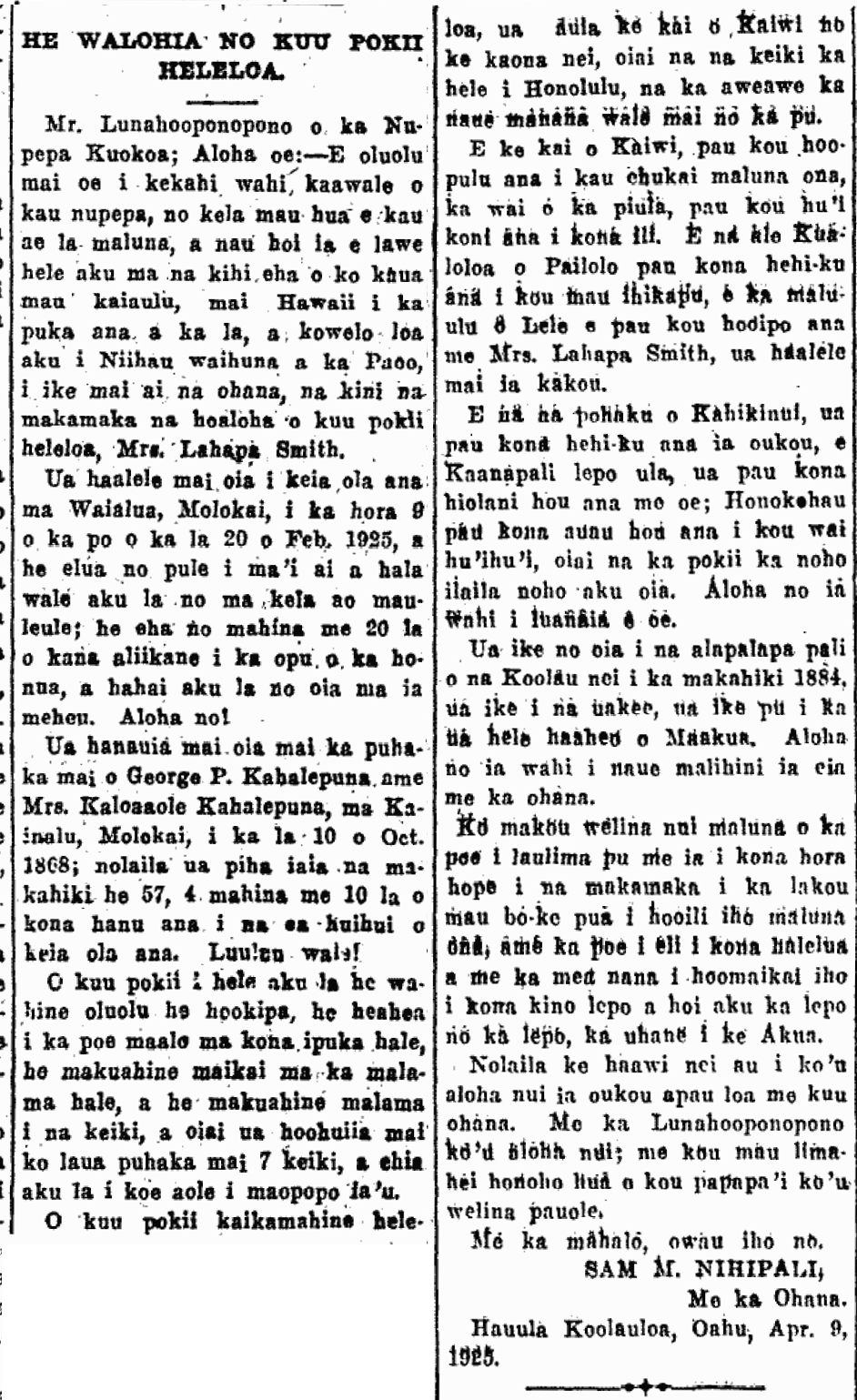
A EULOGY FOR MY YOUNGER SIBLING WHO HAS GONE.

Mr. Editor of Ka Nupepa Kuokoa; Aloha to you:—Please let me have some space in your newspaper for those words above, and you will be the one to take them to the four corners of our commuity, from Hawaii where the sun rises to where it trails to in Niihau with its hidden waters of the Paoo fish; so that the family and the many aquaintances and friends of my lost younger sister, Mrs. Lahapa Smith will know.

She left this life at Waialua, Molokai, at 9 at night on the 20th of Feb. 1935, and she was sick two weeks after which she left to that faint realm; her husband was four months and 20 days in the bowels of the earth, when she followed in his footsteps. How sad!

She was born from the loins of George P. Kahalepuna and Mrs. Kaloaaole Kahalepuna, at Kainalu, Molokai, on the 10th of Oct. 1868; so she had 57 years old, 4 months, and 10 days of breathing the cool air of this life. How depressing!

My younger sister who left was a kind woman, and welcoming woman, she called out to those who passed before her door; she was a fine mother, and took care of the house, and she was a mother who cared for her children; although their loins brought forth 7 children, I don’t know how many still remain.

My younger sister who is gone, she traversed the Kaiwi channel for the town here, because her children came to Honolulu, her connection to them drew her here.

O Kaiwi channel, gone are the days where you drench her with your sea spray, never more will you chill her skin. O great swelled Pailolo, no more will she tread on your sacredness; O ulu shelter of Lele [Lahaina], no more are the days where you will love Mrs. Lahapa Smith; she has left us.

O stones of Kahikinui, no more are the days where she will tread on you; O Kaanapali of red earth, she will no longer lounge with you; O Honokohau, she won’t again bathe in your cool waters; because my younger sister lives lives over there. Aloha to that place where you enjoyed yourself.

She saw the ridged pali of the two Koolau in the year 1884; she saw the uakee [?], and she also saw the proudly travelling rain of Maakua. Aloha to the places traversed as malihini by her and her family.

Our great affection to those people who helped her in her last hours; those friends for their flower bouquets for her; and to the people who dug her grave; those who blessed her body, and the dust to dust, and the spirit to God.

Therefore, I give my aloha to all of you and my family. My great aloha to the Editor; and to your typesetters of your press, my endless affections.

With my thanks, sincerely,

SAM M. NIHIPALI,

And the Family.

Hauula, Koolauloa, Oahu, Apr. 9, 1825.

(Kuokoa, 4/23/1925, p. 5)

HE WALOHIA NO KUU POKII HELELOA.

Ka Nupepa Kuokoa, Buke LXIV, Helu 17, Aoao 5. Aperila 23, 1925.

Hattie K. Nihipali passes, 1924.

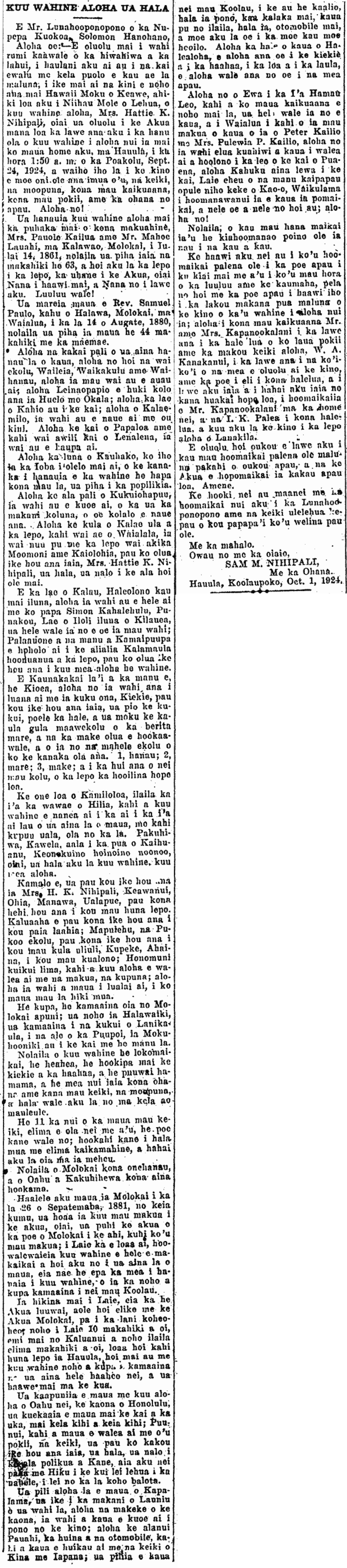
My Beloved Wife Has Passed On

Mr. Editor of Ka Nupepa Kuokoa, Solomon Hanohano.

Greetings to you:—Please allow me some space within the pride of the people [Ka Nupepa Kuokoa], that I may speed across the eight seas with that parcel shown above, so the many living from Hawaii, the lands of Keawe, all the way to Niihau and the foundation of Lehua might know that my beloved wife, Mrs. Hattie K. Nihipali who was greatly loved, that her life breath has been taken, by the grace of almighty God. Her last breath was taken from our home in Hauula, at 1:50 a. m. on Wednesday, Sept. 24, 1924, and her restless sleeping body was left before me, the children and the grandchildren, her elder sisters, her younger siblings and all of the rest of the family. Aloha no!

My beloved wife was born from the loins of her parents, Mrs. Pauole Kailua and Mr. Mahoe Lauahi, at Kalawao, Molokai on July 14, 1861, therefore she was 63 years old, when dust returned to dust and her soul returned to God, as it was He that giveth and He that taketh away. How sad.

We were wed by Rev. Samuel Paulo, the kahu of Halawa, Molokai, at Waialua, on the 14th of August, 1880, and so we were married untainted for 44 years.

Aloha to the linked cliffs of our homeland; aloha to the three waters, Waileia, Waikakulu and Waihanau; aloha to the the waters where we bathed; aloha to Leinaopapio which pulls along with it, Huelo and Okala; aloha to the point of Kahio extending into the sea; aloha to Kalaemilo, where you and your family travelled about. Aloha to the sea of Papaloa and where the fresh water mixes with sea of Lenalena, the waters where you walked.

Aloha to the uplands of Kauhako, where Job’s words come true, “Man born of woman is of few days and full of trouble.”

Aloha to the cliff paths of Kukuiohapuu, where you walked; the rain and wind above, and you below moving along. Aloha to the plains of Kalae with its red dirt, and the waters of Waialala, that water filled with the acidic water of Moomoni and Kaiolohia; you will never again see Mrs. Hattie K. Nihipali; she has left, gone on the path of no return.

O point of Kalau [Kalaau], and Haleolono above; aloha to those places you went with your father [papa?] Simon Kahalehulu—Punakou, the point of Iloli above Kilauea—those places were traversed by you; Palaauone where the birds of Kamaipuupa run about on the salt beds and Kalamaula piled with dirt, you will no longer see my beloved, my wife.

O Kaunakakai, peaceful place of the kioea bird; aloha to that place where she was together with her tutu, Kiekie, you will not see her again; her light is extinguished, the house is darkened, and the gold three-ply cord or the covenant of marriage is severed, and it is death that has separted you, and those are the three divisions of a man’s life. 1, birth; 2, marriage; 3, death; and it is with the coming together of these three, dust is the final inheritance.

That vast sands of Kamiloloa is where the kicked fish of Hilia is, where my wife enjoyed eating the leaf-eating fish of that land of ours, along with some sweet potato, they were our sustenance. Pakuhiwa, Kawela, frangrant with the blossoms of Kaihuanu, Keonekuina is grieved, as my wife has gone, my beloved.

O Kamalo, you are not again to see Mrs. H. K. Nihipali; Keawanui, Ohia, Manawa, Ualapue, she will no longer step on your soil. Kaluaaha, she will no longer see your sacred walls; Mapulehu, the three Pukoo, she will not see once more your green fields; Kupeke, Ahaina, and your ridges; Honomuni of the joined hands, where my loved one relaxed with her parents and grandparents; aloha to those places where we were at ease, when we first arrived.

She is a native, a kamaaina of the entirety of Molokai; she lived in Halawaiki; she was kamaaina to the kukui of Lanikaula, to the waves of Puupoi, and to Mokuhooniki which juts into the sea like a bird.

My wife was kind-hearted, hospitable, she welcomed all from high to low, and she was open-hearted; her family was important to her as well as was her children, grandchildren—and she has gone to that faint realm.

We had 11 children, five are living with me, all boys. One boy has past as well as five girls, and she has followed in those footsteps.

Molokai is her birth land, and Oahu of Kakuhihewa is where her adopted land.

We left Molokai on the 26th of September 1881, for this reason: my parents were confused by the god, because the god of Molokai was burned in fire, and my parents thought that it would be found in Laie; and my wife was lured into going and travelling around there and then returning to our place. But my wife was tricked, and she remained and became kamaaina to these Koolau.

When she arrived in Laie, there was a god of baptism, not like the God of Molokai; touch the sky and tumble down—she stayed in Laie for about 10 years, and then down in Kaluanui for over five years. She then got some land in Hauula and I joined my beloved wife and we lived there until becoming kamaaina of that proud land, which I carried upon my back.

We travelled about Oahu, the town of Honolulu, we searched from ocean to mountain, from this corner to that. It was in Puunui that we enjoyed ourselves with my younger sibling and children. We shall no longer see her; she has left, she is gone to the dark path of Kane; perhaps she is with Hiku stringing lei of lehua in the forests, a lei for election day.

We were loved by Kapalama; we saw the Launiu winds of that place, that place were we walked for our health; aloha to Pauahi Street, the crossing of automobiles; that place where we were confused with the children of China and Japan; we were acquainted with these Koolau in the horse cart days; when those were insufficient, came the days of the truck and we were there; with the days of the automobile, you sleep the sleep of winter. Aloha to our home, Halealoha; you gave your aloha to those of high and low status, to the length and breadth, you gave your aloha to all.

Aloha to Ewa with its hushed crustacean [oyster], where our elder sibling lives; we went there; and to Waialua, the place of our makua (aunties and uncles), Peter Kailio and Mrs. Pulewia P. Kailio; aloha to those two mountains where we enjoyed ourselves and listened to the voice of the sea of Puaena; aloha to Kahuku, the land that floats on the sea, Laie borne on the wings of birds; Kaipapau with its angry opule; Kaoo and Waikulama, we were constantly blessed; but you are left without, and i am left without; how sad!

All of your kind deeds for me are an unforgettable memorial of you for all times.

I offer my appreciation to all of the people who stood with me in my hours of grief and sorrow, as well as to all the people who gave their gift of flowers atop the body of my beloved wife; aloha to her elder siblings, Mr. and Mrs. Kapanookalani for their taking of their younger sister to the cemetery, and our beloved child, W. A. Kanakanui for his taking the important things which will bring comfort to the body, as well as the people who dug her grave, and those who took her and who followed her in her last journey, blessed by Mr. Kapanookalani in this house, and I. K. Palea for the grave, and the body was put in the beloved earth at Lanakila.

Please accept my boundless appreciation for each of you, and may God bless us all. Amen.

I close here with my appreciation to the Editor, and to the children who set the type of your printing press my endless regards.

With mahalo,

Sincerely, SAM M. NIHIPALI,

and the Family.

Hauula, Koolaupoko, Oct. 1, 1924.

(Kuokoa, 10/16/1924, p. 5)
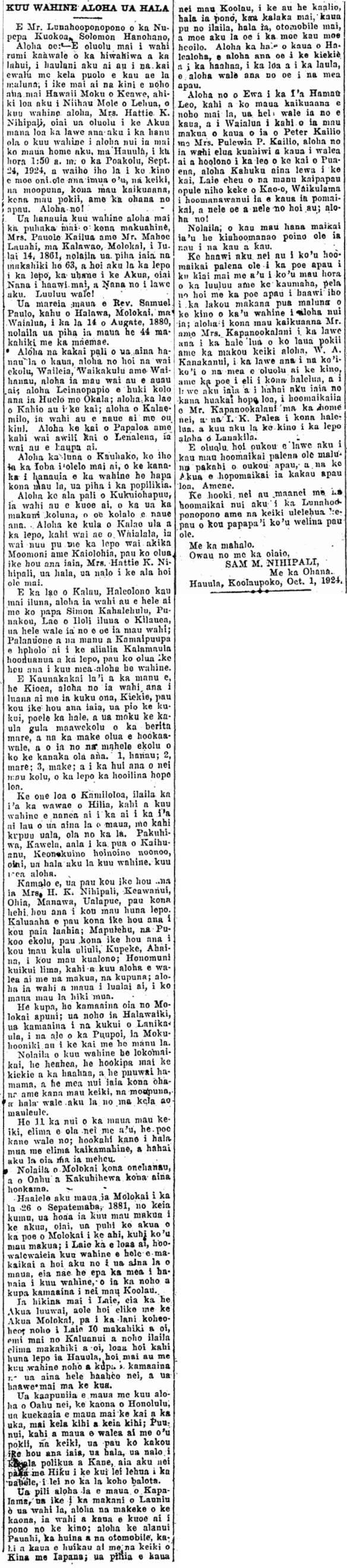
KUU WAHINE ALOHA UA HALA

Ka Nupepa Kuokoa, Buke LXIII, Helu 42, Aoao 5. Okatoba 16, 1924.

Denial of intent to annex Hawaii, 1891.

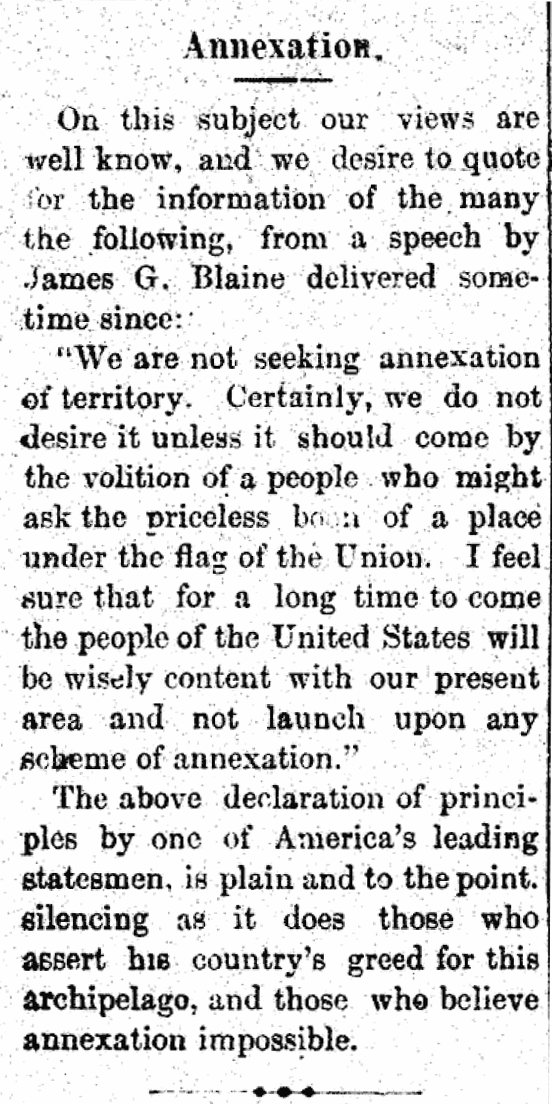
Annexation.

On this subject our views are well known, and we desire to quote for the information of the many the following, from a speech by James G. Blaine delivered sometime since:

“We are not seeking annexation of territory. Certainly, we do not desire it unless it should come by the volition of a people who might ask the priceless boon of a place under the flag of the Union. I feel sure that for a long time to come the people of the United States will be wisely content with our present area and not launch upon any scheme of annexation.”

The above declaration of principles by one of America’s leading statesman is plain and to the point, silencing as it does those who assert his country’s greed for this archipelago, and those who believe annexation impossible.

(Leo o ka Lahui, 9/11/1891, p. 4)

Annexation.

Ka Leo o ka Lahui, Buke II, Helu 278, Aoao 4. Sepatemaba 11, 1891.

More Westerners expecting their host nation to change instead of them assimilating to the host culture. 1863.

Pertaining to Japan

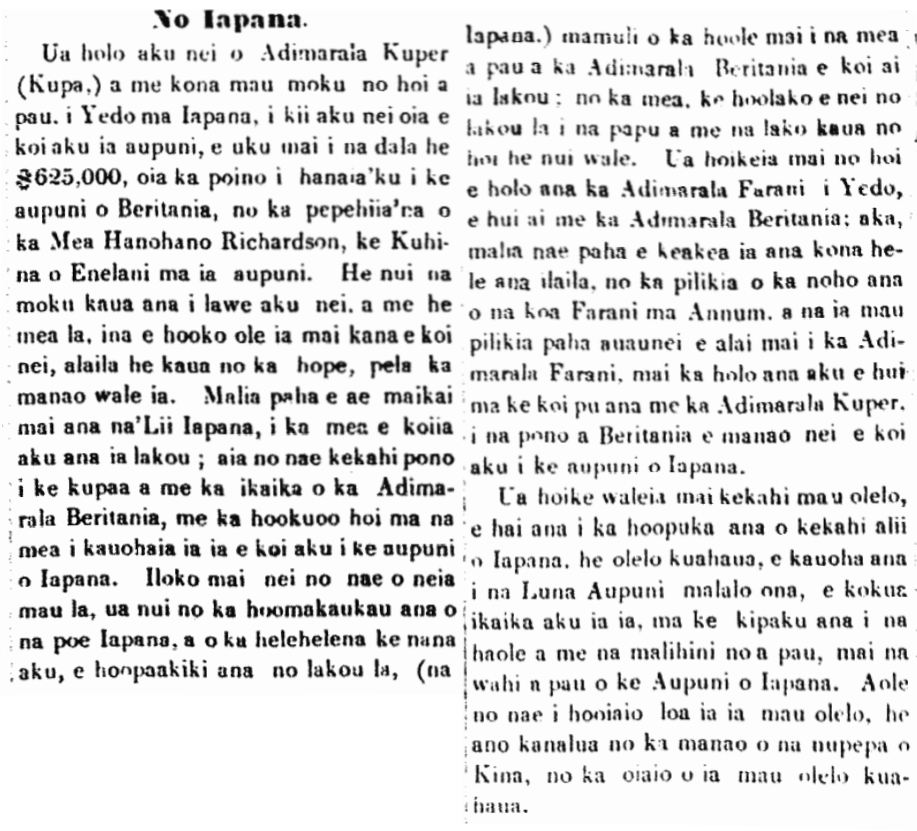
Admiral Kuper and all of his ships left for Yedo in Japan to demand from the government the payment of $625,000, which are the damages acted against the British nation in the killing of the Honorable Richardson, the English ambassador to Japan. He took with him many warships, and it seems  that should his demands not be met, there will be war; that is what is believed. Perhaps the alii of Japan will acquiesce graciously to what is being demanded of them; being that the British Admiral’s insistence and force is justified as he solemnly carries out the demands to Japan that he was ordered to do. There have been however during these past days much preparations made by the Japanese; and their countenances are hardening, in order to refuse all that the British Admiral will demand from them; for they are greatly supplying the forts and war provisions in preparation. It was announced that the French Admiral was headed for Yedo to meet with the British Admiral; his way there however may be impeded because of the trouble the French soldiers are having stationed in Annum [Annam?], and these difficulties may obstruct the French Admiral from going and joining Admiral Kuper in claiming the rights that Britain decided to demand from the nation of Japan.

Some words spoken by an alii of Japan were brought out into the open: a proclamation ordering all of the Government Officials under him to assist him with expelling the haole and all foreigners from all over the Nation of Japan. However those words were not verified, and the thoughts amongst the newspapers in China are unsure about the veracity of the words of that proclamation.

[It was just recently the 150th anniversary of the Namamugi Incident (Richardson Affair), where a British national was killed for not dismounting his horse when encountering the oncoming procession of a daimyo, Shimazu Hisamitsu, which was a sign of disrespect. The West was not amused.

Newspapers were the major means through which Hawaii learned not only national news, but international news as well.]

(Kuokoa, 7/4/1863, p. 2)

No Iapana.

Ka Nupepa Kuokoa, Buke II, Helu 27, Aoao 2. Iulai 4, 1863.

Another Hawaii Theater Ad, 1920.

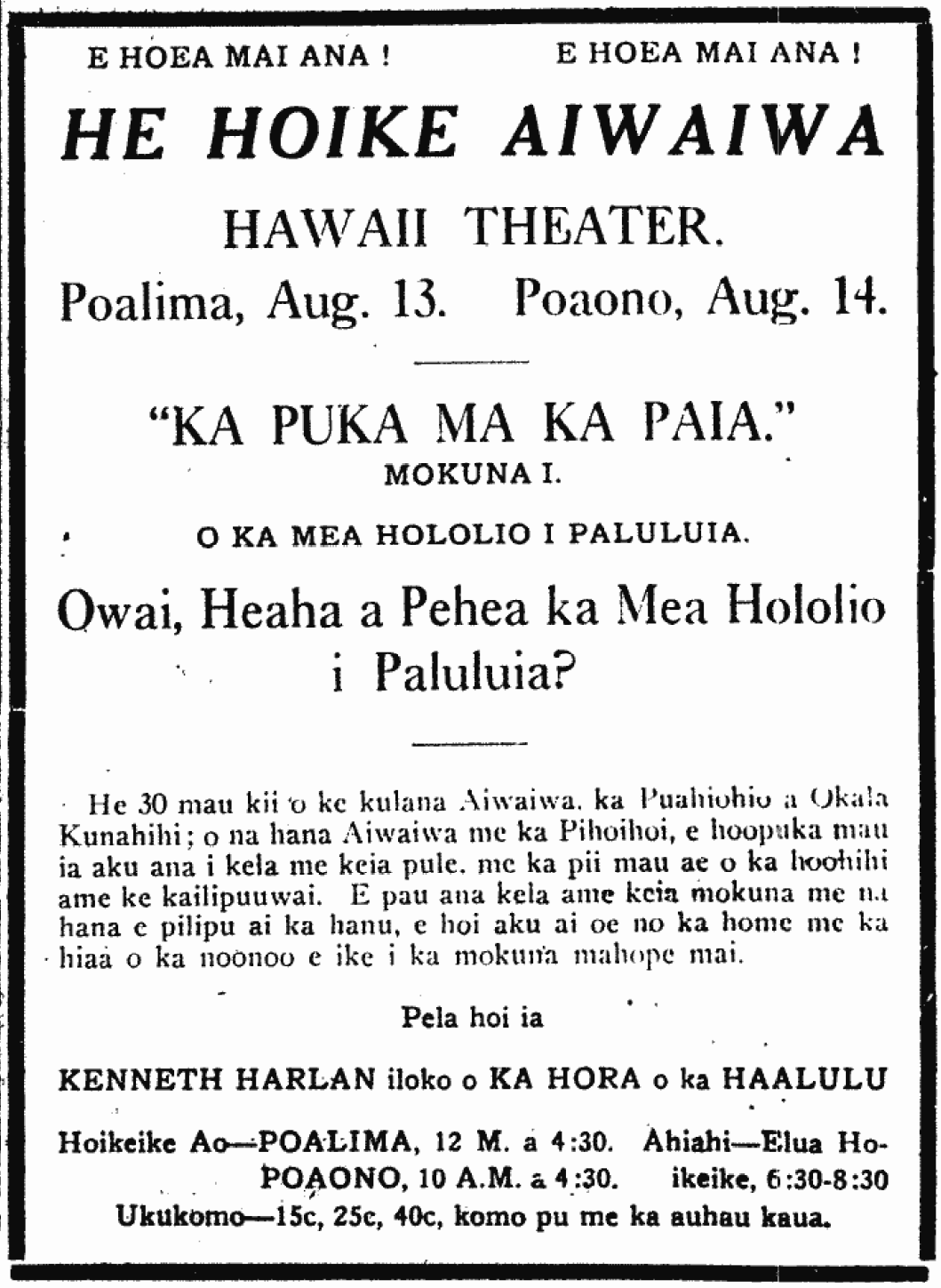
COMING! COMING!

AN AMAZING PERFORMANCE

HAWAII THEATER.

Friday, Aug. 13  Saturday, Aug. 14.

“THE HOLE IN THE WALL.”

EPISODE I.

THE MASKED RIDER.

Who, What and How is the Horseman Masked?

There are 30 films that are Amazing, with Fast Action [Puahiohio?] and Chicken skin; the amazing and astonishing acts will be shown weekly, ever increasing in fascination and emotion. Each episode will end with something that will leave you having a hard time breathing, and you will return home unable to sleep thinking about seeing the coming episode.

So too of

KENNETH HARLAN in THE TREMBLING HOUR

Matinees—FRIDAY, 12 M. and 4:30. Evening—Two Showings, 6:30-8:30.

SATURDAY, 10 A. M. and 4:30.

Entrance—15c, 25c, 40c, including war tax [auhau kaua].

[The things you can find on the internet these days! See here for more information on this movie, and a clip!!]

(Kuokoa, 8/13/1920, p. 3)

E HOEA MAI ANA! E HOEA MAI ANA!

Ka Nupepa Kuokoa, Buke XVIII, Helu 33, Aoao 3. Augate 13, 1920.

Play of Pele and Lohiau at Hawaii Theater, 1925.

Tableau of the Hawaiian Dramatic Club

The Tableau of Pele and Lohiau shown in the Hawaii Theater [Halekeaka Hawaii] last Friday by the Hawaiian Dramatic Club. The play will be shown at Los Angeles, on the journey of the Royal Order of Kamehameha [Ahahui Kamehameha] for the city day coming up in June.

(Kuokoa, 4/23/1925, p. 5)

Tabalo a ka Haw'n Dramatic Club

Ka Nupepa Kuokoa, Buke LXIV, Helu 17, Aoao 5. Aperila 23, 1925.

Response to claim that Lahainaluna was banning the use of Hawaiian, 1868.

FROM LAHAINALUNA.

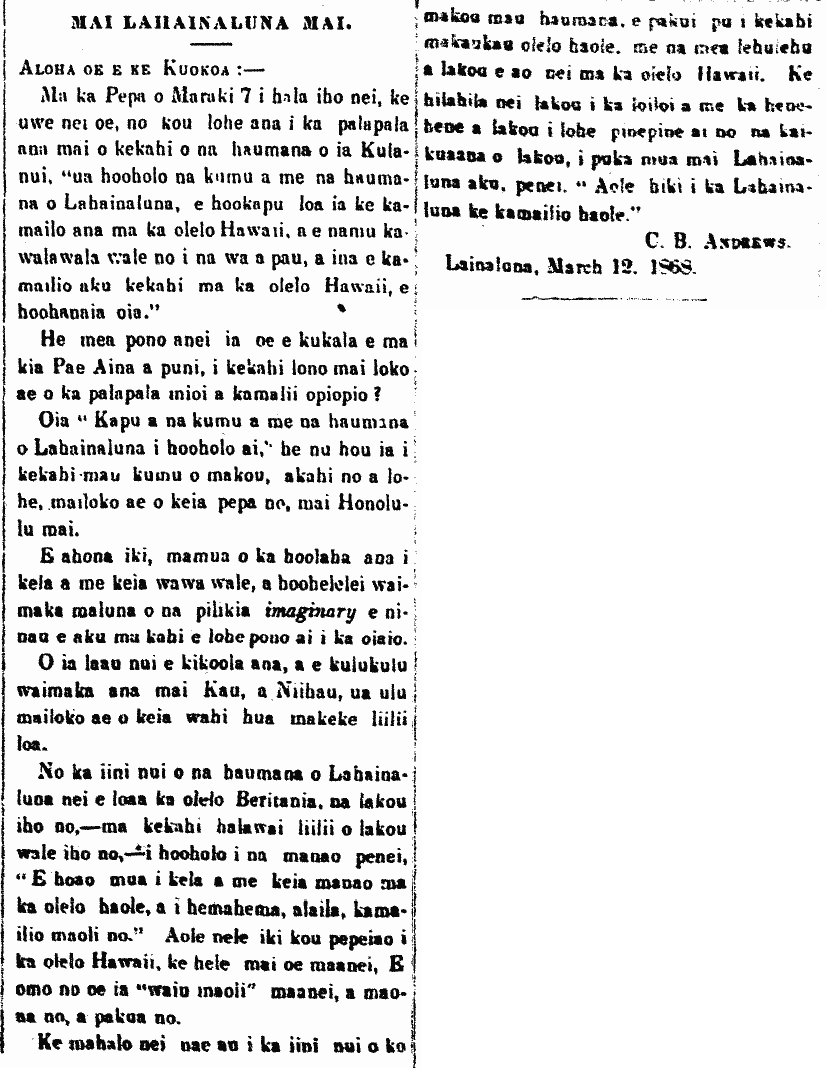
Aloha to you O Kuokoa:—

In the paper of this past March 7th, you wail over your hearing through a letter from one of students of that College, “the teachers and students of Lahainaluna have decided to ban speaking Hawaiian and to speak solely in English instead at all times, and someone speak in Hawaiian, he will be made to work.”

Is it right for you to spread all across this Archipelago something you hear in a pushy letter from a youngster?

That “Ban that the teachers and students of Lahainaluna passed,” is news to some of our teachers, first heard from this paper from Honolulu.

It would be somewhat better if before announcing publicly this or that rumor and shedding tears over an imaginary [“imaginary” in English] tragedy, that you inquire of someplace where you can hear the truth.

That great tree that grows haphazardly, for which tears are being shed from Kau to Niihau, it grew from a tiny mustard seed [hua makeke].¹

Because of the great desire of the students of Lahainaluna to speak English, it was they who—in a small meeting amongst only themselves—decided thusly: “To try first to speak their thoughts in English, and if it comes out  not clearly, then to speak in Hawaiian [kamailio maoli].” Your ears will not miss the Hawaiian language should you come here. You will drink “real milk” here, and have your fill, and it will be a regular thing.

I do however appreciate the great desire of our students to supplement the English language, along with all the many other things they are learning in Hawaiian. They are embarrassed at the judgement and the ridicule that their elder siblings receive, that graduated from Lahainaluna before them, in this manner: “The Lahainaluna students cannot speak English.”

C. B. Andrews.

Lahainaluna, March 12, 1868.

¹Hearkening back to the parable of the mustard seed and the kingdom of heaven in Matthew.

[This is one a response found to the article posted yesterday about the banning of Hawaiian language at Lahainaluna. It is always important to look for responses and followups in later papers and in other newspapers of the time, both in Hawaiian and English (and in other languages if available), to get a clearer picture of what is happening!]

(Kuokoa, 3/21/1868, p. 3)

MAI LAHAINALUNA MAI.

Ka Nupepa Kuokoa, Buke VII, Helu 12, Aoao 3. Maraki 21, 1868.

Description of Yedo, capital of Japan, 1860.

Yedo.

This is the capital of the nation of Japan; it is a grand city. It is built by the sea, by a great and fine harbor; but large ships cannot approach it.

The land surrounding that city is beautiful, and is well farmed, and there are many shade trees and fruit trees. Inland of the city of Yedo, there is a tall mountain from 12,000 to 16,000 feet, almost like Mauna Kea; it is topped by snow and a caldera like Mauna Loa. It is a sacred mountain for the people there, they go there to worship and to repent for their sins.

In the city of Yedo, there are five forts which are equipped with cannons; there are a great number o people, and houses are crowded together, but the houses are not nice, they are dilapidated. They are not painted, and not improved.

Shops are small, not like here in Honolulu. Some houses however, of the distinguished people, are nice, and they are surrounded by fine trees. The streets of the city are wide, and straight, and clean as well. The houses of the alii there are restricted, men and women cannot enter; only when given permission can they enter. They are surrounded by great and tall walls. The length of this city is twenty miles, and the width is twelve miles. The population is not clear; it is said that the number of people in that city is almost three million.

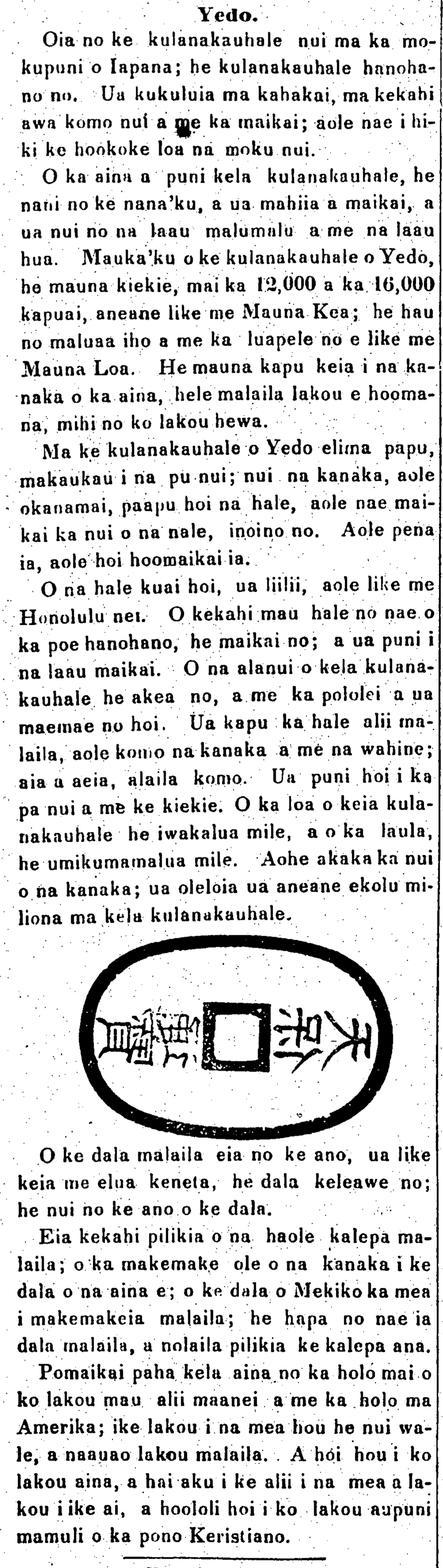
The currency there is like this; this is similar two cents, and it is a copper coin; there are a many variety of currency.

Here is a problem that the haole traders have there: the fact that people there don’t want foreign money; Mexican currency is what is wanted, and so trading is problematic.

Perhaps this land would benefit by their chiefs coming here and to America; they would see many new things and get educated. And they’d return to their land and tell the alii what they saw, and then reform their land following the tenants of Christianity.

[This is just a few years after Japan was forced to end its sakoku policy by the United States and Perry (1854).

The image of the coin is a mirror image.]

(Hae Hawaii, 3/21/1860, p. 202)

Yedo.

Ka Hae Hawaii, Buke 4, Helu 51, Aoao 202. Maraki 21, 1860.

Hawaiian Language banned at Lahainaluna and Hawaii to become a state of the United States? 1868.

Hawaiian Banned at

LAHAINALUNA.

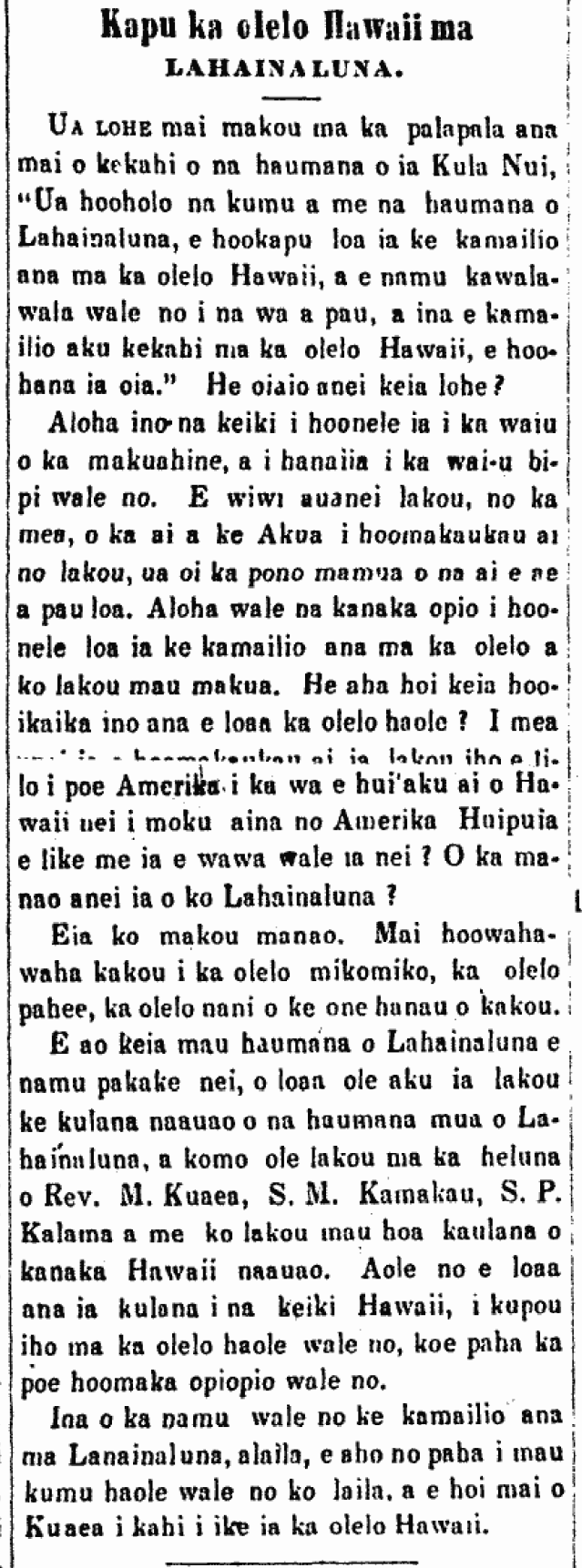
We have heard through a letter from one of the students at the College, “The teachers and students have decided to ban the speaking of Hawaiian, and instead to speak English [namu kawalawala] all the time; and should anyone speak in Hawaiian, he will be made to work.” Is what we hear correct?

How sad for children to be denied their mother’s milk, and fed only cow’s milk. They will end up malnourished, for the nourishment God prepared for them is better than all other foods. How tragic is it for the youth to be denied speaking the language of their parents. What is this big push to acquire the English language [olelo haole]? Is it to prepare them to become Americans when Hawaii joins as a state of the United States as is being rumored about? Is that the idea at Lahainaluna?

This is what we think. Let us not treat with contempt this eloquent language, this graceful language, this beautiful language of our homeland.

These students of Lahainaluna who speak English [namu pakake] will not attain the high education of the early students of Lahainaluna, and they will not join the ranks of Rev. M. Kuaea, S. M. Kamakau, S. P. Kalama, and their fellow famed educated Hawaiians. This level will not be reached by the Hawaiian youth who attempt to speak only English, except perhaps for those who start young.

If only English is spoken at Lahainaluna, then it would be better were there only haole teachers there, and Kuaea should be sent somewhere that Hawaiian Language is recognized.

[Does anyone know if this ban ever took place in the late 1860s?

And what does “S. P.” stand for in “S. P. Kalama”?]

(Kuokoa, 3/7/1868, p. 2)

Kapu ka olelo Hawaii ma LAHAINALUNA.

Ka Nupepa Kuokoa, Buke VII, Helu 10, Aoao 2. Maraki 7, 1868.

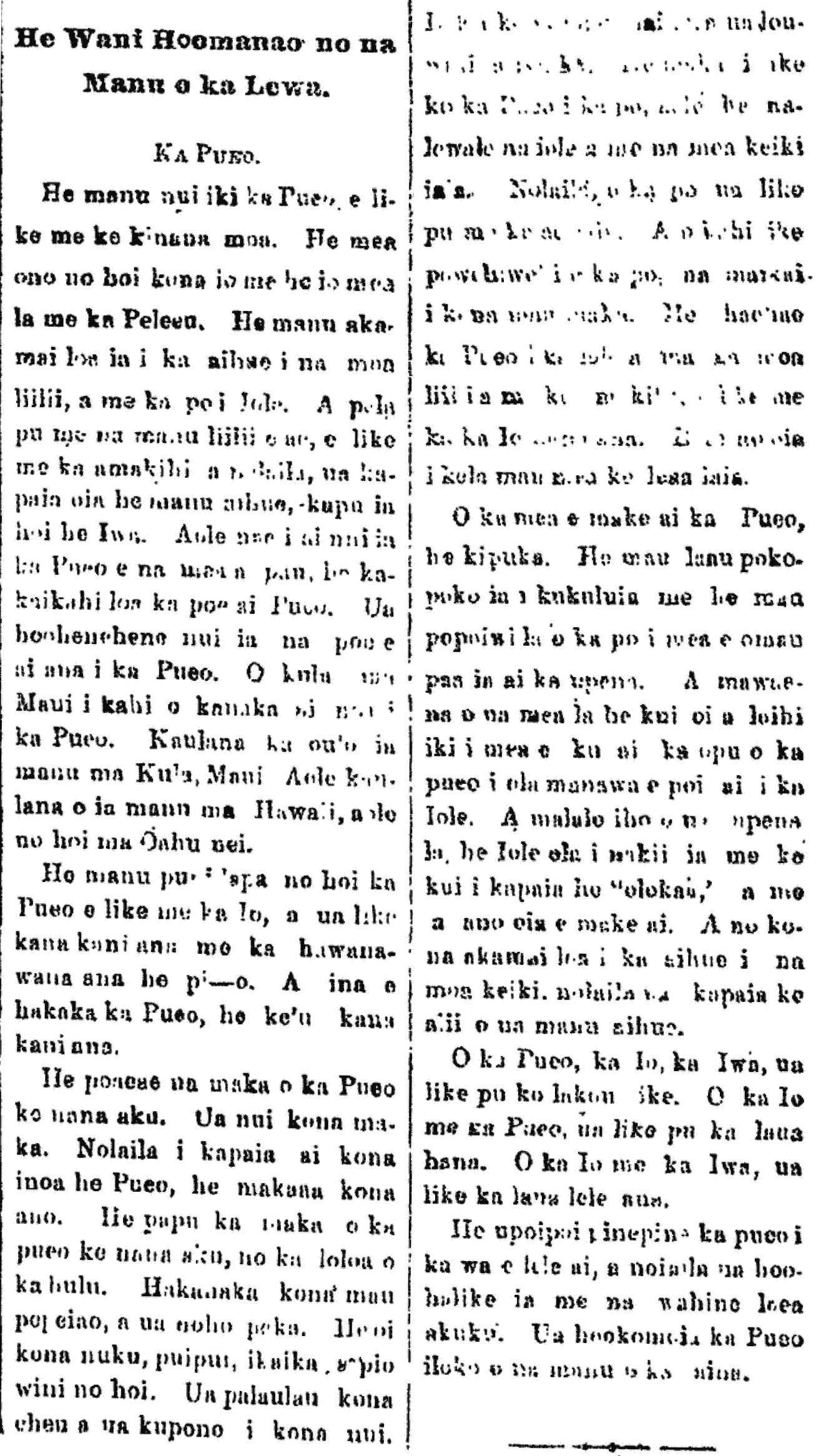
On Owls and wishing organizations who have kuleana would fund reshooting the newspapers, 1893/2012.

Some Recollections about Birds

The Owl.

The Pueo is a smaller large bird, like a hen of a chicken. Its flesh is delicious like chicken or Turkey. It is a very intelligent bird in stealing chicks by swooping down. So too other small birds, like the amakihi, and therefore, it is called a thieving bird, and called an Iwa [Frigate bird]. The owl is not eaten regularly by most people, there are only a few that eat Pueo. Those who eat it are greatly ridiculed. It is in Kula, on Maui, that people eat a lot of Pueo. The perching of that bird is famous at Kula, Maui. This bird is not famous on Hawaii or here on Oahu.

The Pueo is ???? like a Hawk [Io], and its cry is like a whispering “pi——o”. And if the Pueo fights, it hoots.

The eyes of a Pueo are round. Its eyes are large. That is why it is called a Pueo, as it has staring eyes…

[This article goes on, but most of it is hard to make out. I am not even sure about that part that says Kula people ate a lot of owls because of the bad image. Maybe now that Hamilton Library has a super scanner, there can be progress made on reshooting all of the Hawaiian-Language Newspapers?!

Also this is part of a series on birds, but much of it and a lot of this paper in general is hard to read because of the bad images now available.]

(Lei Momi, 7/27/1893, p. 2)

He Wahi Hoomanao no na Manu o ka Lewa.

Ka Lei Momi, Buke I, Helu 30, Aoao 2. Iulai 27, 1893.