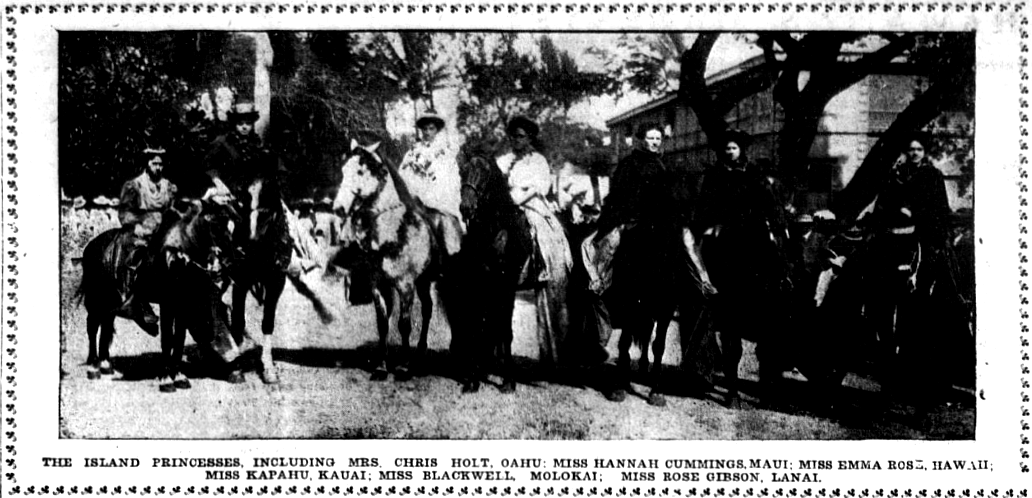
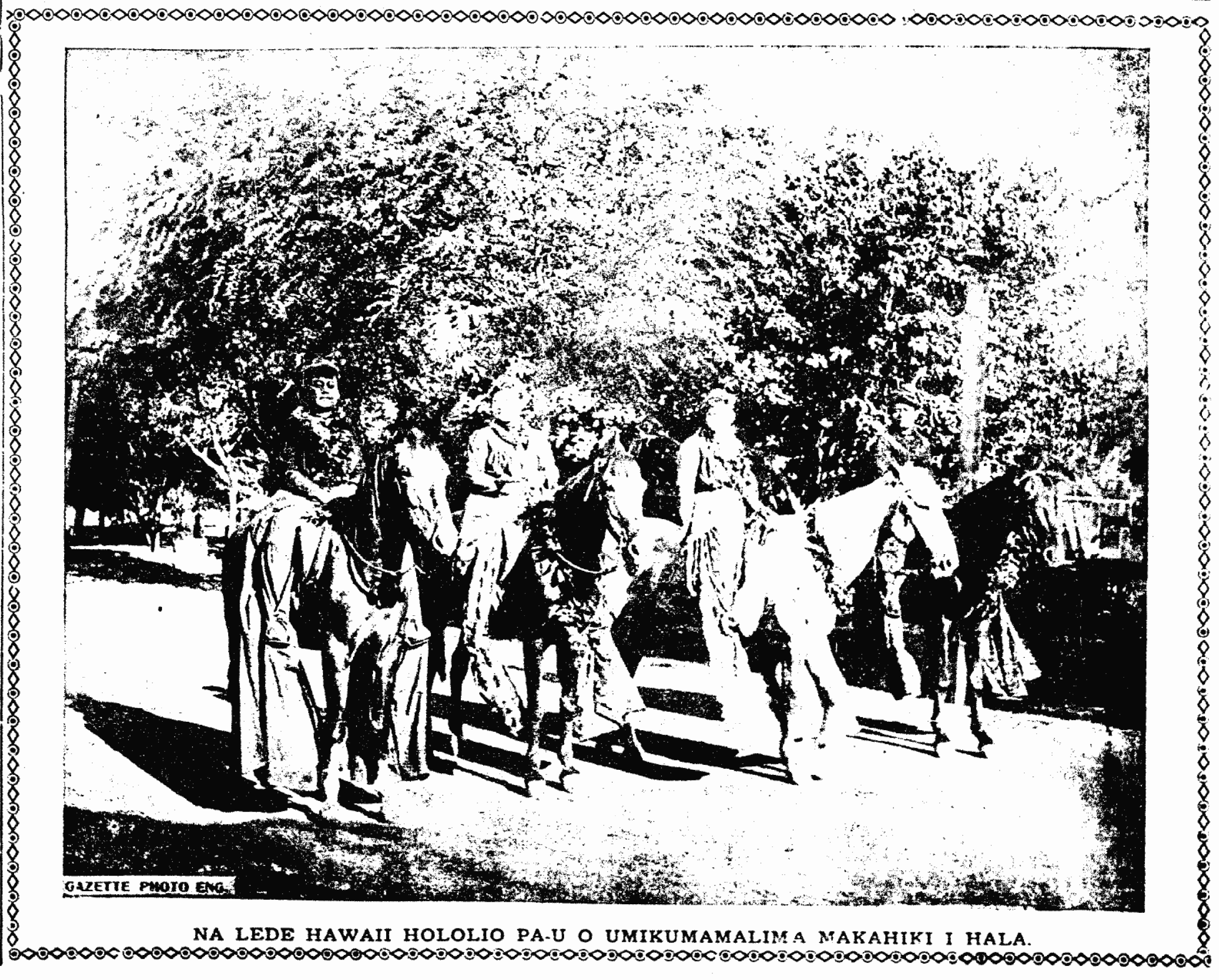
More pāʻū riders, 1909.

THE ISLAND PRINCESSES, INCLUDING MRS. CHRIS HOLT, OAHU; MISS HANNAH CUMMINGS, MAUI; MISS EMMA ROSE, HAWAII; MISS KAPAHU, KAUAI; MISS BLACKWELL, MOLOKAI; MISS ROSE GIBSON, LANAI.

(Hawaiian Gazette, 2/23/1909, p. 5)

THE ISLAND PRINCESSES...

Hawaiian Gazette, Volume LI, Number 120, Page 5. February 23, 1909.

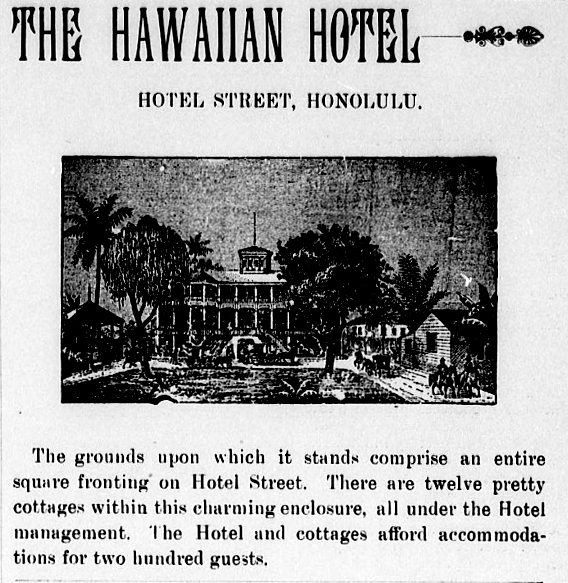
Hawaiian Hotel on Hotel Street, 1899.

THE HAWAIIAN HOTEL

HOTEL STREET, HONOLULU.

The grounds upon which it stands comprise an entire square fronting on Hotel Street. There are twelve pretty cottages within this charming enclosure, all under the Hotel management. The Hotel and cottages afford accommodations for two hundred guests.

(Austin’s Hawaiian Weekly, 6/24/1899, p. 11)

THE HAWAIIAN HOTEL

Austin’s Hawaiian Weekly, Volume I, Number 2, Page 11. June 24, 1899.

Hawaiian Language classes on Maui, 1941.

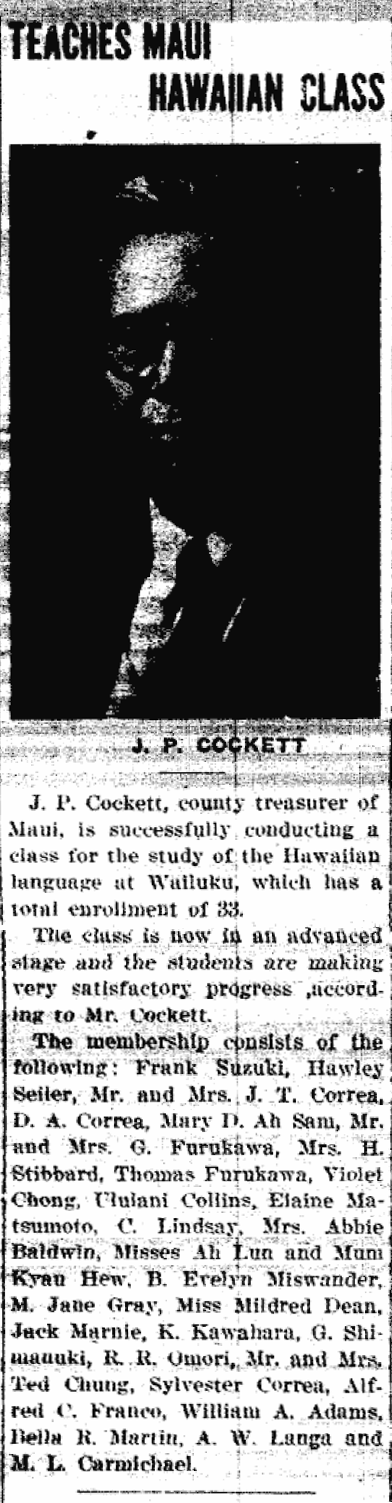
TEACHES MAUI HAWAIIAN CLASS

J. P. COCKETT

 J. P. Cockett, county treasurer of Maui, is successfully conducting a class for the study of the Hawaiian language at Wailuku, which has a total enrollment of 33.

The class is now in an advanced stage and the students are making very satisfactory progress according to Mr. Cockett.

The membership consists of the following: Frank Suzuki, Hawley Seiler, Mr. and Mrs. J. T. Correa, D. A. Correa, Mary D. Ah Sam, Mr. and Mrs. G. Furukawa, Mrs. H. Stibbard, Thomas Furukawa, Violet Chong, Ululani Collins, Elaine Matsumoto, C. Lindsay, Mrs. Abbie Baldwin, Misses Ah Lum and Mum Kyau Hew, B. Evelyn Miswander, M. Jane Gray, Miss Mildred Dean, Jack Marnie, K. Kawahara, G. Shimanuki, R. R. Omori, Mr. and Mrs. Ted Chung, Sylvester Correa, Alfred C. Franco, William A. Adams, Bella R. Martin, A. W. Langa and M. L. Carmichael.

(Star of Hawaii, April 30, 1941, p. 4)
TEACHES MAUI HAWAIIAN CLASS

The Star of Hawaii, Volume XXXVI, Number 1, Page 4. April 30, 1941.
Restoration Anthem, 1843.

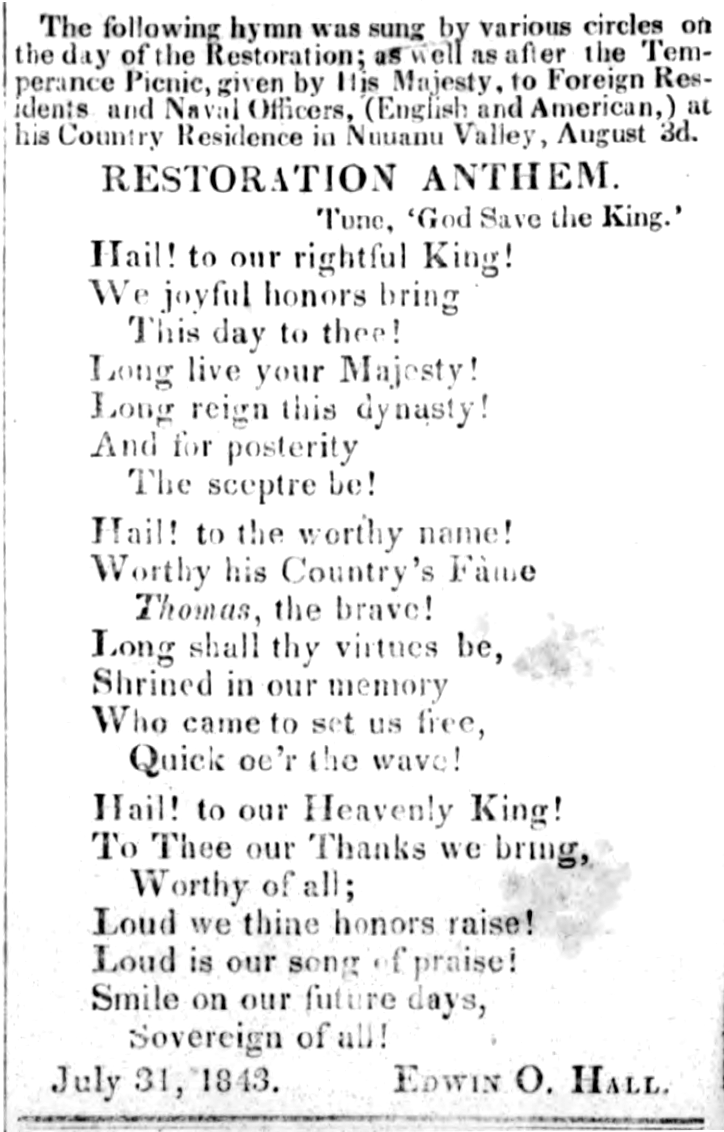
The following hymn was sung by various circles on the day of the Restoration; as well as after the Temperance Picnic, given by His Majesty, to Foreign Residents and Naval Officers, (English and American,) at his Country Residence in Nuuanu Valley, August 3d.

RESTORATION ANTHEM.

Tune, ‘God Save the King.’

Hail! to our rightful King!
We joyful honors bring
This day to thee!
Long live your Majesty!
Long reign this dynasty!
And for posterity
The sceptre be!

Hail! to the worthy name!
Worthy his Country’s Fame
Thomas, the brave!
Long shall they virtues be,
Shrined in our memory
Who came to set us free,
Quick oe’r the wave!

Hail! to our Heavenly King!
To Thee our Thanks we bring,
Worthy of all;
Loud we thine honors raise!
Loud is our song of praise!
Smile on our future days,
Sovereign of all!

July 31, 1843.  Edwin O. Hall.

[This post may be just a little early this year, but it is good to not just remember momentous events like Ka La Hoihoi Ea just one day of the year. Last year, the Hawaiian Historical Society put up handwritten lyrics of this mele on their Facebook page on the 27th of July. Here we find it in print, just a few days following its being penned by Edwin O. Hall!]

(Temperance Advocate and Seamen’s Friend, 8/11/1843, p. 42)

RESTORATION ANTHEM.

Temperance Advocate and Seamen’s Friend, Volume I, Number VIII, Page 42. August 11, 1843.

Temperance Advocate and Seamen’s Friend, 1843–1954.

The Friend

Rev. Samuel Chenery Damon was sent by the American Seamen’s Friend Society to be chaplain in Honolulu. The Damons sailed from New York March 10, 1842 aboard the Victoria, Captain Spring, and arrived in Honolulu October 19, 1842. He was the pastor of the Bethel Union Church, Seamen’s Chapel for 42 years and was the publisher and editor of the periodical The Friend from 1843 — 1885, when he retired.

The first issue was published in Jan. 1843, originally under the name Temperance Advocate, then as Temperance Advocate and Seamen’s Friend, with the Advocate and Friend being published as an extra, then as The Friend of Temperance and Seamen, with The Friend as an extra, and finally simply as The Friend, beginning January 1, 1845.

From 1885 through 1887, it was co-edited by the Revs. Cruzan and Oggel. The editorship then passed to Rev. Sereno Bishop, who held the post until the publication of the paper fell under the auspices of the Board of the Hawaiian Evangelical Association in April of 1902 where it remained until June 1954. Since then, it has continued in a different format under the Hawaii Conference-United Church of Christ up to the present day, making it the oldest existing newspaper in the Pacific.

The Friend began as a monthly newspaper for seamen, which included news from both American and English newspapers, and gradually expanded to adding announcements of upcoming events, reprints of sermons, poetry, local news, editorials, ship arrivals and departures and a listing of marriages and deaths. Rev. Damon published between a half million and a million copies of The Friend, most of which he personally distributed.

Because of its longevity, The Friend is an excellent resource for scholars of nineteenth-century Hawaiian history.

This collection contains 1,396 issues comprising 21,030 pages and 50,904 articles.

On Hooulu Lahui, 1876.

SATURDAY, MARCH 4.

REPOPULATION.

The following is the text of the memorial of citizens which was presented to His Majesty on Tuesday last, by a committee of signers:

To His Majesty the King,

Sire:—We, the undersigned, subjects and residents of this kingdom and friends of your Royal Person, in view of what we deem a grave condition of public affairs, take the liberty to address you in a spirit of frankness and loyalty in order to point out the danger that threatens the state, and at the same time the necessary measures to avoid the national peril.

We desire to say at the outset, that we are prompted to take part in this address not only on account of a loyal and friendly regard for Your Majestyʻs person, but also by reason of our strong desire to see maintained, with ample honor and prosperity, the Independence of the Hawaiian Kingdom.

The propriety of according the privileges of independent sovereignty to a state so much reduced in people as Your Majestyʻs dominions is very much questioned, and the discussion is most detrimental to the dignity and permanence of the throne. This question was even raised in past years, when Hawaii numbered far more souls than at this time within her borders. When the commissioners of Kamehameha III presented the claims of this archipelago for recognition as an independent state to the Government of Great Britain in 1843, they were met at first with a peremptory refusal from Lord Aberdeen, the British foreign minister, on the ground that the state of Hawaii was a mere chieftaincy under foreign influences, and too small to be entitled to diplomatic courtesies and treaty making powers. And if such a view could be taken of our state thirty-three years ago, when we numbered about one hundred thousand people, what must be thought of our capability for independence now when perhaps we number barely fifty thousand souls, natives and foreigners all told? Continue reading

Re-population in the eyes of the haole, 1876.

Palapala Hoopii i ka Moi.

Ka Hooulu Lahui.

[This memorial urging re-population of the nation was probably an English document, translated here into Hawaiian. For the English and the interesting list of signatures, see the following post.]

(Kuokoa, 3/18/1876, p. 1)

Palapala Hoopii i ka Moi.

Ka Nupepa Kuokoa, Buke XV, Helu 12, Aoao 1. Maraki 18, 1876.

Words for/from the youth of today, 2014.

Silent Constituencies and Building a Voice

I am a millennial and this year I am registering to vote.

The August primary will be my first opportunity to cast a ballot for publicly elected officials since I voted for Al Gore in a 1st grade presidential practice election.

I am genuinely eager to have my voice heard in the political sphere for the first time, even if it is in the form of one small piece of paper.

What makes me excited is that I’ve heard that those small pieces of paper can add up.

I am also a Hawaiian who is registering to vote…

[This obviously does not come from the the historic Hawaiian newspapers, but this same issue was written about time and time again in its pages, and it is interesting that we see this call for action being renewed today. For the entire article by Wyatt Bartlett of the island of Kama appearing on Civil Beat, see: Silent Constituencies and Building a Voice.]

Follow up on previous post about Peter K. Morse, 1926.

KAINANA HIRAM PASSES ON TO OTHER WORLD

At eleven o’clock in the night of last Tuesday, Mrs. Hiram, who was a kamaaina to the people of this town, Mrs. Elizabeth Kainana Puahi Hiram, grew weary of this life at her home on Makee Road¹ in Waikiki.

She was born on the 22nd of June, 1853, therefore, at her passing, she was 73 years old.

On the evening of this past Sunday, her funeral was held at the mortuary of M. E. Silva.

¹Although spelled Makee, this is pronounced Makī, just as how Ena of Ena Road is pronounced Ina.

(Kuokoa, 8/5/1926, p. 6)

HALA O KAINANA HIRAM MA KELA AO

Ka Nupepa Kuokoa, Buke LXV, Helu 31, Aoao 6. Augate 5, 1926.