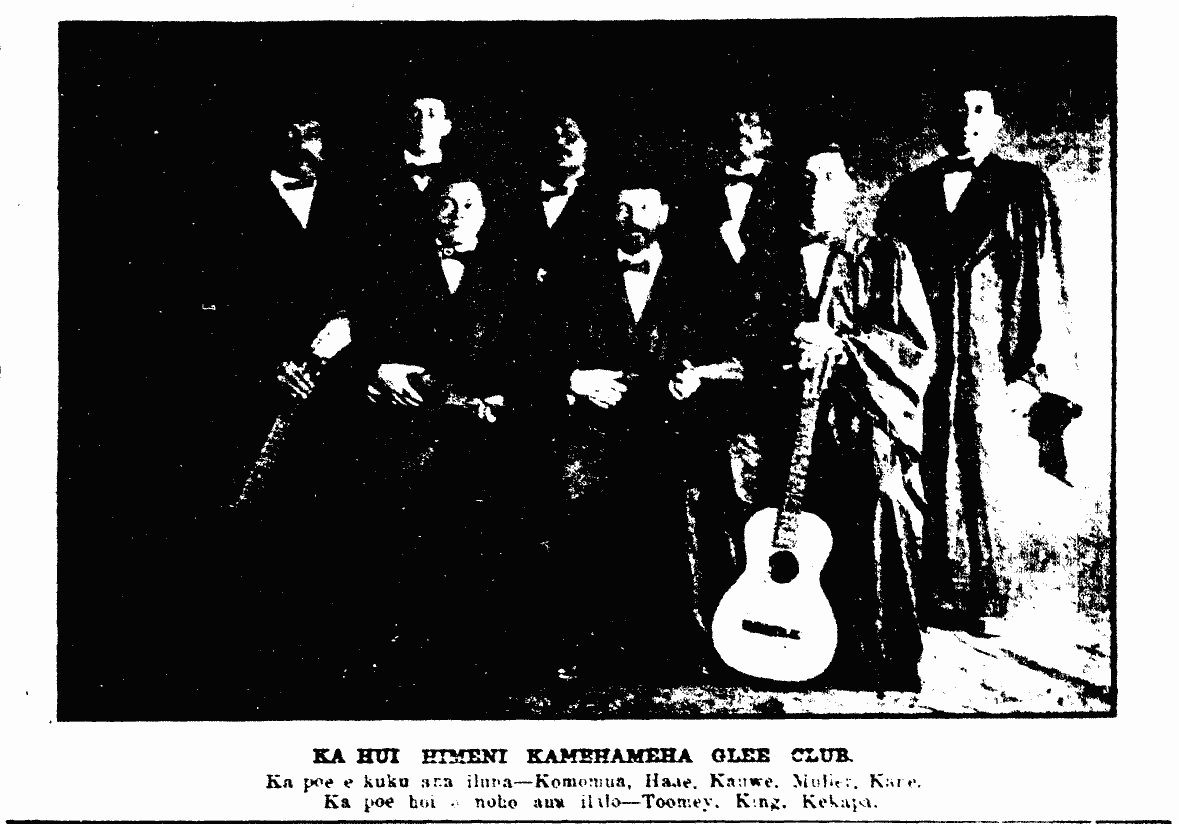
THE SINGING GROUP KAMEHAMEHA GLEE CLUB.
The people standing up—Komomua, Haae, Kauwe, Muller, Kane.
The people sitting down—Toomey, King, Kekapa.
(Kuokoa, 8/2/1912, p. 4)
Ka Nupepa Kuokoa, Buke XLVIII, Helu 31, Aoao 4. Augate 2, 1912.

The people standing up—Komomua, Haae, Kauwe, Muller, Kane.
The people sitting down—Toomey, King, Kekapa.
(Kuokoa, 8/2/1912, p. 4)
Ka Nupepa Kuokoa, Buke XLVIII, Helu 31, Aoao 4. Augate 2, 1912.
Mr. Patient Editor of the Nupepa Kuokoa, Aloha oe:—May it please your open heart to place upon the deck of your precious, my baggage of tears so that those who live from where the sun appears at Ha’eha’e to the setting of the sun at Lehua, will know about my beloved, my wife, who has gone, undoing the supporting bond within.
For dust has returned to dust, and the soul to the One who created it; and this is what I endlessly grieve over, for my beloved, my wife, being that she has gone together on that road of no return with the first fruit of our loins of our youth, which is the reason for her being taken so early in her life.
For Lahaina, Maui, is the birthplace of my Ellen Pukila, and we were married here in Wailau, Molokai in the month of October, 1911, and we lived faithfully together in the holy covenant of matrimony, and she has grown weary of this life on July 24, 1912, at 10 a. m.; we were together all over Wailau; and I ask of the high heavens to lighten my grief for my dear wife who has gone afar.
Her beloved husband,
GEORGE PAUOLE KAMAI.
Wailau, Molokai, July 29, 1912.
(Kuokoa, 8/2/1912, p. 4)

Ka Nupepa Kuokoa, Buke XLVIII, Helu 31, Aoao 4. Augate 2, 1912.
Dr. Buck Terms Early Polynesians Greatest Mariners World Has Ever Known
HONOLULU, Nov. 29—Dr. Peter Buck, director of the Bishop Museum, last night termed the early Polynesians the greatest mariners the world has ever known.
Dr. Buck, who will leaves soon for Yale University to lecture on primitive religions, spoke at a dinner in his honor attended by almost 200 persons. He was introduced by Frank Atherton.
He said it was probable that some of the early Polynesians reached the shores of America. He traced the possibility in similarity of certain words, such as that for sweet potato itself was brought into the South Seas from the American continent. Continue reading
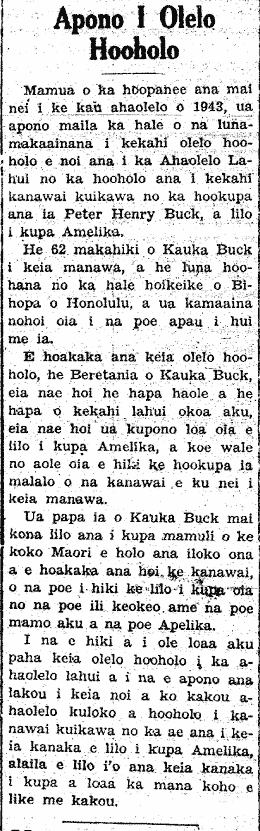
Before the session of the legislature of 1943 was postponed, the house of representatives approved a resolution asking Congress [Ahaolelo Lahui] to pass a special law to naturalize Peter Henry Buck, and make him an American citizen.
Dr. Buck is 62 years old now, and he is the director of the Bishop Museum of Honolulu, and he is a kamaaina to all the people he meets.
This resolution clarifies that Dr. Buck is English, however he is half haole and half another ethnicity, but it is appropriate that he be naturalized as an American citizen, but he cannot become a citizen under the current laws.
Dr. Buck is restricted from becoming a citizen because of the Maori blood flowing through him, and the law states that those who are able to become citizens a whites and descendants of African people.
If this resolution reaches or is received by the senate, and should they approve this request of our local legislature, and they pass a special law to allow this man to become an American citizen, then this man will indeed become a citizen and he will be able to vote like we do.
(Hoku o Hawaii, 5/5/1943, p. 1)
Ka Hoku o Hawaii, Volume XXXVIII, Number 2, Aoao 1. Mei 5, 1943.
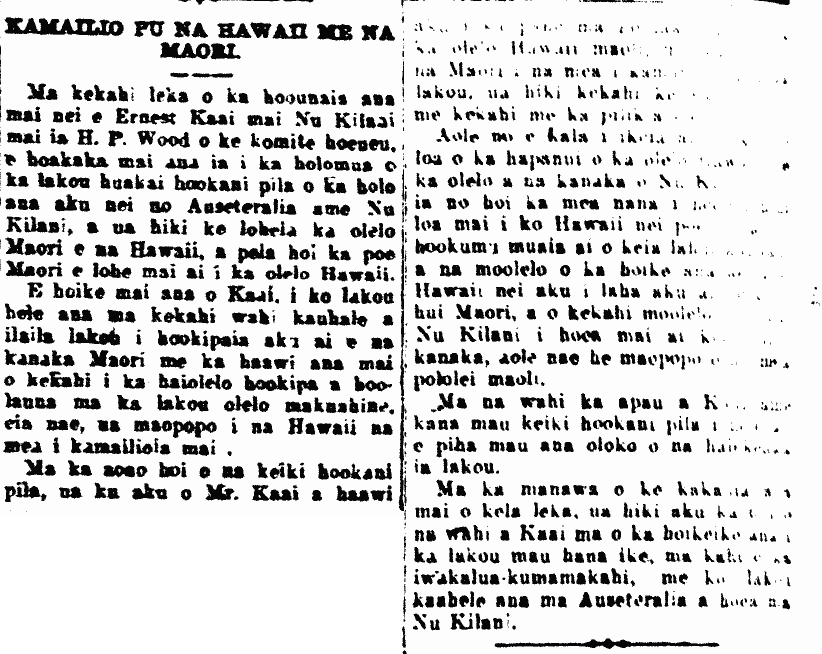
In a letter sent by Ernest Kaai from New Zealand to H. P. Wood of the Hawaiian Promotion Committee [which seems to be a precursor to the visitor’s bureau], he shows the progress of their musical touring of Australia and New Zealand. The Hawaiians could hear the Maori language and the Maori could hear the language of Hawaii.
Kaai said that when they went to some villages, they were hosted by Maori people, where one of them said words of welcome and friendship in their mother tongue. But the Hawaiians understood what was being said.
From the side of the musicians, Mr. Kaai stood and gave [rest of the paragraph unclear].
It was not long ago that [also unclear here, but they seem to be talking about the relationship between Aotearoa and Hawaii].
Everywhere that Kaai and his musical group went, the theaters would be filled with them.
When this letter was written, the number of places that Kaai them performed at was about 21, with them going around Australia and reaching New Zealand[?]
[A great deal of the Hawaiian Language Newspapers are bound into book form, and because they were purposely printed without much empty margins, often the printed portions that fall in the margin area of the books are not legible, especially when scanned. To get a clear image of the entire page, the books will have to be unbound first. That, it seems, takes a great amount of funding.]
(Kuokoa, 6/30/1911, p. 8)
Ka Nupepa Kuokoa, Buke XLVII, Helu 26, Aoao 8. Iune 30, 1911.
Gone on the road of no return on the 30th of this past month, at Kawanui Uka, North Kona; death took away the last breath of Laimakua Kaiwipunakea. She left behind a husband, 3 children, and grandchildren who grieve for her. She was born in the year 1816, married her husband in 1836, and they had 13 children, and 10 have gone before with 3 still living. She was a mother who loved her children as well as her husband. Her remains were carried from the home of her daughter and buried on the grounds of Lanakila Church. “Blessed are the dead who die in the Lord.”
Kaiwipunakea Opio.
(Alakai o Hawaii, 1/7/1888, p. 4)

Ke Alakai o Hawaii, Buke 1, Helu 1, Aoao 4. Ianuari 7, 1888.
A great time is spent by the women of Hookena weaving lauhala hats to trade for bags of flour; two hats for one bag of flour, and there is life.
(Kuokoa, 8/16/1901, p. 3)
Ka Nupepa Kuokoa, Buke XXXIX, Helu 34, Aoao 3. Augate 16, 1901.
Kahalii, Hilo, October 2, 1848.
This is news from Waipio, in Hamakua, there is a Government road. The cliff of Waipio was carved into, and there is what appears to be a fine road, not from the people of old, not from Liloa, from Hakau, from Umi, from Kamehameha I; but it is from the reign of Kamehameha III in which the bad areas were fixed.
This project was started from Pueohulunui all the way to Koaekea, and it reached to the top of the cliff of Kahuahine, and came out below Waimihi.
There are three new noted places [pana] on this road: Puehu, Pohakalae, and Kamaipualo; a man and his Horse can travel from below, as well as oxen with a load of poi on its back, until the reach the top; The people of Waipio are beloved; they made a fine road that is nice looking, like a Nuhekalawela; their Tax Collector [Lunaauhau], Kapau put in effort, and all the bad areas were worked out; Hilo is the land that is bad that has not been worked on; people go to Hamakua, to Puna, but the cliffs of Hilo have not been dug up; let’s dig up the cliffs. With appreciation,
By E. S. Kalauwaka.
(Elele Hawaii, 10/24/1848, p. 37)

Ka Elele Hawaii, Buke 4, Pepa 10, Aoao 37. Okatoba 24, 1848.
Konohi Day of the Chinese.
The new year of the Chinese began on this past Monday, and the activities of the boys of China were worthy of great admiration.
On Tuesday, the 27th, Nailima held a konohi party at his residence, to celebrate the birthday of his beloved daughter, and there were many who were invited.
When they were ready to eat, there rose a disturbance between the home owner and some people who were bedecked with the delicacies of the konohi day; the people split up and fled and some of their voices had become slurred because they were drowsy on “the chilly waters of the dew,” and the glory of the day became as of naught.
I will stop here. Yours truly,
Henry L. Kauanoano.
Waiakea, Hilo, Jan. 22, 1890.
(Kuokoa, 2/8/1890, p. 3)
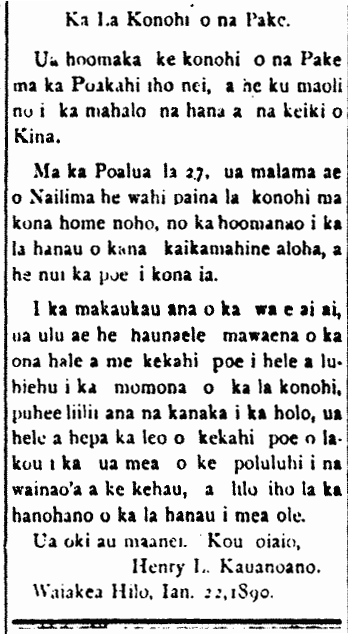
Ka Nupepa Kuokoa, Buke XXIX, Helu 6, Aoao 3. Feberuari 8, 1890.
Just as usual with the Chinese people, they will again this year, celebrate their one important day of the year known by them as the Konohi day.
These past years however, they have split up and some of them celebrate the day we celebrate, that being the 1st of January, while some celebrate their day from ancient times. It is a day when some of our people go quickly about celebrating the konohi at houses of the Chinese, and they are a welcoming people to those who visit their homes on that day.
There is but one humbug thing about that day, that is they do not sleep that night and wake up everyone with their sounding off fireworks from night to day, and it is bad for those who have to go work the next day.
¹China is referred to in Hawaiian as the “Aina Pua,” or the “Flower Land.”
(Alakai o Hawaii, 2/14/1929, p. 2)

Ke Alakai o Hawaii, Buke 1, Helu 42, Aoao 2. Pepeluali 14, 1929.
 nupepa