Kauka Judd opens a clinic for Hawaiians, 1871.

Treatment for Hawaiians.

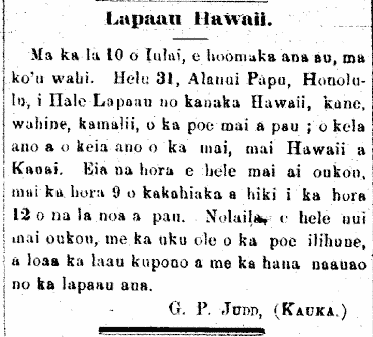
On the 10th of July, I will commence at my place. Number 31, Fort Street, Honolulu, a Clinic for Hawaiian, men, women, children, everyone; with any illness, from Hawaii to Kauai. These are the hours for you all to come by, from 9 o’clock in the morning until 12 on weekdays [la noa]. Therefore, come all; there is no pay for the indigent, and you will get proper medicine with enlightened treatment.

G. P. Judd, (Kauka.)

[Although the title of this advertisement, “Lapaau Hawaii,” can be seen as “Treatment for Hawaiians,” I think the first idea that comes to mind would be “Hawaiian Medicine.” I wonder if that was done on purpose…]

(Au Okoa, 7/20/1871, p. 2)

Lapaau Hawaii.

Ke Au Okoa, Buke VII, Helu 14, Aoao 2. Iulai 20, 1871.

King Lunalilo passes, 1874.

THE DEATH OF LUNALILO

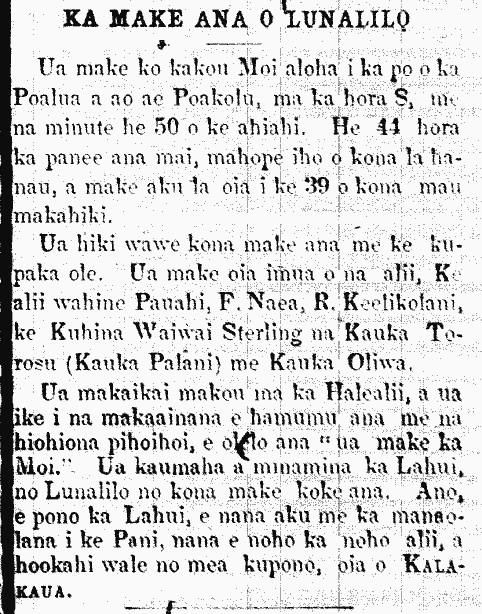
Our beloved King died from the night of Tuesday to the day of Wednesday [February 3, 1874], at 8 o’clock and 50 minutes in the evening. 44 hours went by after his birthday, and he died at 39 years old.

His death was quick without a struggle. He died before the alii, Ke alii Pauahai, F. Naea, R. Keelikolani, the Minister of Finance Sterling, Dr. Trousseau (Kauka Palani), and Dr. Oliver.

We visited the Palace and saw the makaainana murmuring about with worried faces, saying, “The King is dead.” The Lahui are sad and grieve over the quick passing of Lunalilo. The Lahui must at once look with hope to his Replacement, the one who will occupy the throne, and there is but one who is fitting, that is Kalakaua.

(Nuhou Hawaii, 2/10/1874, p. 3)

KA MAKE ANA O LUNALILO.

Ka Nuhou Hawaii, Buke I, Helu 15, Aoao 3. Feberuari 10, 1874.

Aloha Aina calls for submissions, 1915.

Listen to This.

The columns of the Aloha Aina are open to publishing ideas and letters from friends on all sorts of topics, however it should be based on intelligent and proper subjects. We do not believe in personal criticisms and reviling. We do not take responsibility for the letters and editorials from friends, but this falls under their own names. We want all letters and editorials to come in Monday evenings. Write clearly.

(Aloha Aina, 2/13/1915, p. 2)

E Hoolohe i Keia.

Ke Aloha Aina, Buke XIX, Helu 72, Aoao 2. Feberuari 13, 1915.

Masquerade party at the palace, 1874.

[Found under: “Nu Hou Kuloko.”]

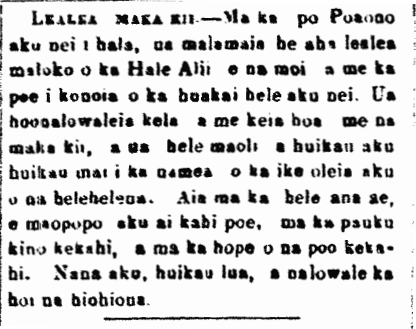
Masked Entertainment.—In the evening of this past Saturday, a party was held in the Palace by the monarchs and those who were invited to go there. Each person was hidden behind a mask [maka kii], and everyone was befuddled because the features of people could not be seen. You went up to someone to figure out who it was, maybe by their figure, or the back of the head. You turned away, and you were confused once again, as people’s features were hidden.

(Kuokoa, 5/2/1874, p. 2)

Lealea maka kii.

Ka Nupepa Kuokoa, Buke XIII, Helu 18, Aoao 2. Mei 2, 1874.

More the celebrating the better? 1915.

[Found under: “Na Kuhinia o ka Manawa.”]

The celebration [hi’uwai] of the people of China [Aina Pua] is approaching, but perhaps there will only be a few because New Years was celebrated by some Chinese on this past New Years Day.

[Konohi is the lunar calendar new year. It probably comes from the Hawaiianization of the Chinese Kung Hei as in Kun Hei Fat Choi (恭喜發財).]

(Aloha Aina, 2/6/1915, p. 3

Ke hookokoke mai nei...

Ke Aloha Aina, Buke XIX, Helu 71, Aoao 3. Feberuari 6, 1915.

E o, e Namaka! 1921.

[Found under: “Nuhou Kuloko”]

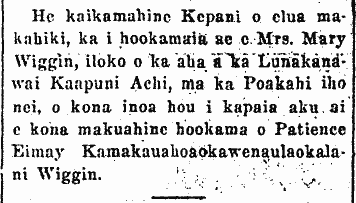
A Japanese girl of two years old was adopted by Mrs. Mary Wiggin, in the court of the Circuit Court Judge Achi, on this past Monday; her new name that she is being called by her adopted mother is Patience Eimay Kamakauahoaokawenaulaokalani [Namakauahoaokawenaulaokalaniikiikikalaninui] Wiggin.

See much more in Nanea Armstrong Wassel’s Instagram post!

[Hauoli la hanau, e Aunty!]

(Kuokoa, 8/19/1921, p. 4)

He kaikamahine Kepani...

Ka Nupepa Kuokoa, Buke LIX, Helu 33, Aoao 4. Augate 19, 1921.

First birthday celebration of Keelikolani’s birthday, 1871.

Birthday of the Alii, the governess of Hawaii.

O Nupepa Kuokoa; Aloha oe:—

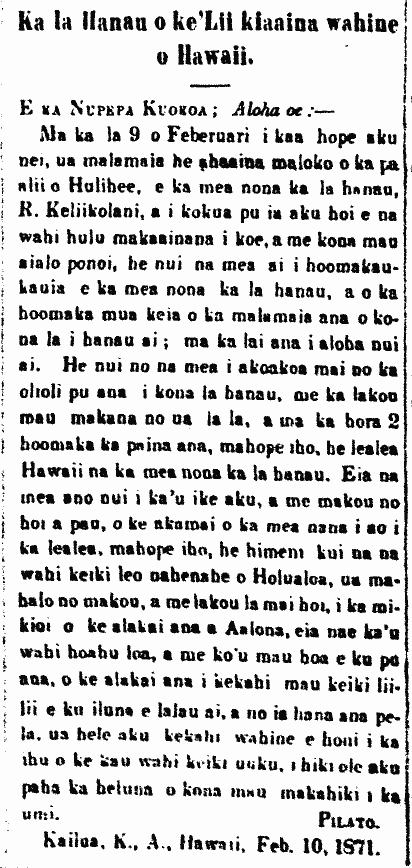
On the 9th of February past, a banquet was held on the estate of Hulihee by the person whose birthday it was, R. Keelikolani, assisted by her dear makaainana remaining, and her personal attendants; there was much food prepared by the one whose birthday it was, this being the very first celebration of her birthday; and it was appreciated for the calmness of the day. There were many gathered to celebrate her day of birth, with their gifts for that day, and at 2 o’clock, the feast began, followed by Hawaiian entertainment [lealea Hawaii] furnished by the one whose birthday it was. Here are is the main thing which I saw and all of us as well, that being the skill of the person who instructed the entertainment [o ke akamai o ka mea nana i ao i ka lealea], and this was followed by a joint choir of the sweet-voiced children of Holualoa; we and they give praise to the excellent leadership of Aalona; but this is what I did not like the most, along with my friends who stood with me, that being the guiding of some children to stand up and go astray [eia nae ka’u wahi hoahu loa, a me ko’u mau hoa e ku pu ana, o ke alakai ana i kekahi mau keiki liilii e ku iluna e lalau ai], and for that some women went and “kissed the nose” [honi i ka ihu] of the small children who were probably no more than ten years old.

Pilato.

Kailua, Kona Akau, Hawaii, Feb. 10, 1871.

[Many times people will be referred to by their position and not by their actual name. When doing searches for Keelikolani for instance, she is often referred to as the governor of the island of Hawaii, ke kiaaina o ka mokupuni o Hawaii (1855–1874).]

(Kuokoa, 2/25/1871, p. 2)

Ka la Hanau o Ke'lii kiaaina wahine o Hawaii.

Ka Nupepa Kuokoa, Buke X, Helu 8, Aoao 2. Feberuari 25, 1871.

Champion follows the Iwalani, 1894.

The Champion [Kamepion] Leaves.

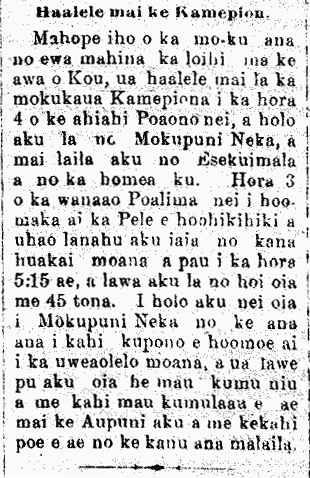
After remaining in the port of Kou for nine months, the warship Champion left at 4 in the late afternoon this past Saturday, and headed to Necker Island [Mokupuni Neka], and from there on to Esquimalt [Esekuimala] and then on home. At 3 o’clock in the dawn of the following Friday, the Pele began to fetch and scoop up coal for its long ocean voyage, and was through at 5:15, and it was filled with 45 tons. It left for Necker Island to map the proper route to lay the ocean telegraph cable [uweaolelo moana], and he took with them some coconut trees  and some other trees from the Government with some others to plant there.

(Makaainana, 8/27/1894, p. 1)

Haalele mai ke Kamepion.

Ka Makaainana, Buke II—-Ano Hou, Helu 9, Aoao 1. Augate 27, 1894.

Necker claimed for Hawaii, 1894.

THE JOURNEY OF THE IWALANI!

NECKER BECOMES HAWAII’S!

The Islands of the Hawaiian Archipelago!

In the afternoon of May 25, this town was all astir at the news that the steamship Iwalani was headed on a long expedition. At 5:20 of that evening, the Iwalani sailed on its mystifying mission. On board was J. A. King, Minister of the Interior, and the crew was increased by ten more sailors. Ka Leo¹ newspaper was much alarmed thinking that the Provisional Government was looking for a place to keep all of the royalists [anee alii]. The royalists proved this worthless piece of news by Ka Leo printing a letter that they found in some dung, but the people…

THE HAWAIIAN ARCHIPELAGO.

…of proper thinking, they were not anxious. The wonder of the people was highly escalated because the British warship Champion followed half an hour after the Iwalani left. And as is usual in Honolulu nei, news soon spoke of the warship chasing after the Iwalani. These senseless ideas were let go when the Iwalani returned on Tuesday evening, May 29.

From what was said by Captain Freeman of the Iwalani, they passed Nihoa in the evening of Saturday, May 26, and at 11 o’clock on the following morning, May 27, the anchor of the Iwalani was let down on the leeward side of Necker [Neka] Island, 41 hours sailing from Honolulu. The skiff was let down and Captain King, Captain Freeman, engineer Norton, along with seven sailors went on.

NECKER ISLAND.

This island is a heap of rocks, and is 260 feet tall. There is a steep cliff rising from the ground, and it was with great effort that they climbed up until a proper place to where Captain King stood a flagpole and the Hawaiian flag waved in the wind. This island was annexed to the Hawaiian nation, and this is the proclamation that Captain King read: Continue reading

Hawaiians come to Hawaii for the first time, 1940.

Hawaiian Malihini.

The picture above is a picture of a Hawaiian family who came to Hawaii as malihini to this land. They are Hawaiians by skin, but they are newcomers to the land. This is the first time they are seeing in person the land of their parents and kupuna. Arrived by the Aorangi was Mrs. Antone Pai, who was born in San Francisco, and her children who were born in Portland, Oregon. In the front line is Robert, 3; Sylvia, 6, and Antone Jr., 4. In the middle line is Katherine, 9; Antoinette, 8; and Helena, 11. In the back is Mrs. Pai and her brother, Francis Sylvia, who was born in Seattle.

Hawaiians Visiting Hawaii

Question: When is a Hawaiian called a malihini?

Answer: When they have not seen Hawaii before.

These are two generations of Hawaiians that saw Hawaii for the first time when they arrived in Honolulu last week on the Steamer Aorangi from Vancouver. Neither Mrs. Pai nor her children had seen Hawaii before, nor had her brother, Francis Sylvia, 22, who arrived with this family. All of them were born in America to Hawaiian families.

“It is just so beautiful,” according to Mrs. Pai as her voice choked up.

“You see that everything is green,” said one of her children. Continue reading