A Hawaiian Co-Op, 1918.

KA “HUI LOKAHI O NA HAWAII” KAUPALENAIA.

These passing day, Hawaiians like Mayor Joseph J. Fern, David Kalauokalani, Samuel C. Dwight, James L. Holt, Hon. William P. Jarrett, Hon. C. P. Iaukea and a number of other Hawaiians are joining together to establish a company that will deal in the sale of poi, beef, salmon, dried fish, and so forth; with the intent to help Hawaiians in all ways that will lessen their household expenses; because it is very clear these days that because the poi factory of Kalihi is not making poi now, the current poi manufacturers are greatly raising the price of poi to five cents per pound; this is a price not seen in the past ten years or more; so too with the price of beef; the Chinese are buying very fine beef from the company of C. J. Waller [Wala], but the Chinese are charging Hawaiians 35 cents per p0und; it is an exorbitant price which has never been seen before; and it is heard from the talk of the Chinese that they will raise the price of poi once again to 6 cents a pound; it was this that encouraged the Hawaiians to establish a company that could hold back the severe increasing of the prices of our foods, O Hawaiians, by the Chinese.

The establishing of a company amongst Hawaiians is important and crucial; but if we Hawaiians do not implement an endeavor that will help ourselves, there will  be no one else who will help us.

If we turn back and look at the history of Hawaii nei, we will see that the dissension amongst us Hawaiians was what wrenched away small businesses from us Hawaiians as well as all the other endeavors. Continue reading
Hasn’t the time come that Hawaiians try to help in the economic endeavors of their own people? 1914.

Announcement

KA HUI KUAI POI O KALIHI (“KALIHI TARO AND LAND CO., LTD.”)

To those who read this.

With aloha:—Whereas all of the shares of the Company named above has been acquired by W. C. Achi and some Hawaiians, and being that they are the only Hawaiians carrying out the growing of taro and the selling of poi, the food of our kupuna and makua; therefore, they humbly ask you, O Hawaiians, that you give them your assistance, by you buying your poi from their group.

The production of the poi at their poi factory is truly sanitary, and your orders will be filled with great haste.

Hasn’t the time come that Hawaiians try to help in the economic endeavors of their own people? Continue reading

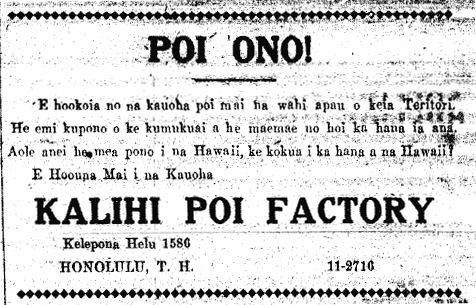
Kalihi Poi Factory advertisement, 1916.

TASTY POI!

Orders for poi from all over the Territory will be filled. The cost is reasonable and the production is hygienic. Isn’t it right that Hawaiians should assist in the efforts of Hawaiians?

Send in your Orders.

KALIHI POI FACTORY

Telephone Number 1586

HONOLULU, T. H.  11-2716

(Aloha Aina, 4/15/1916, p. 4)

AlohaAina_4_15_1916_4

Ke Aloha Aina, Buke XXI, Helu 27, Aoao 4. Aperila 15, 1916.

Uluniu, land of the former home of King Kalakaua, sold, 1915.

A PORTION OF THE HOUSE LOT OF KUHIO WAS SOLD.

That section of the land known as Uluniu which faces Kalakaua Avenue stretching from Ainahau to the area very close to the residence of Representative Kuhio, went to the new owner, Percy M. Pond, through a sale on the morning of this past Friday.

The land is almost six acres, and includes a majority of the house lot in Waikiki previously owned by Prince Kuhio. According to what is being said in public, it went for the price of $32,500. Continue reading

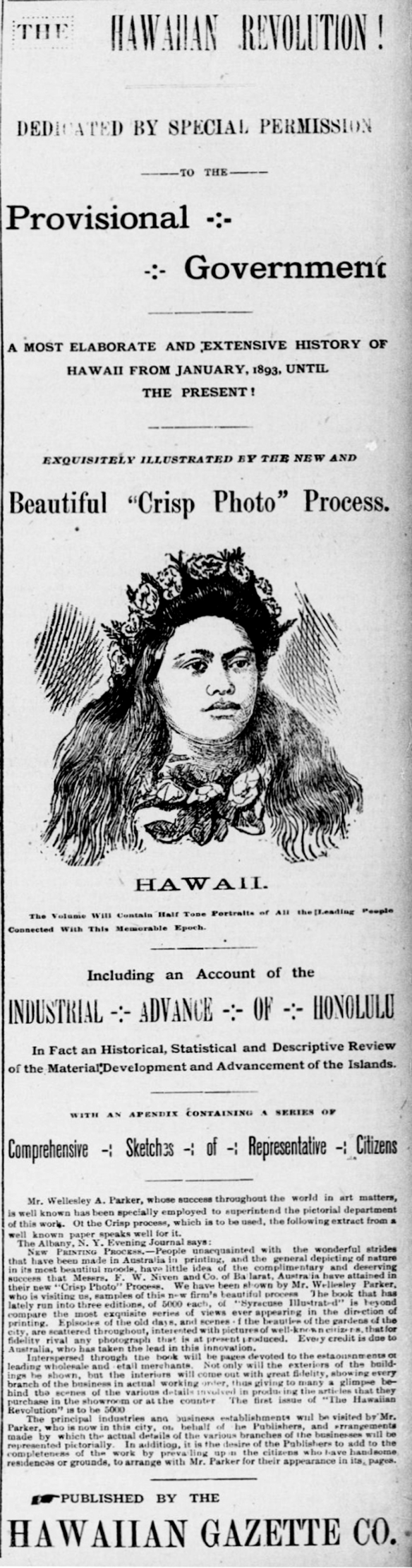
“The Hawaiian Revolution!” 1894.

THE HAWAIIAN REVOLUTION!

DEDICATED BY SPECIAL PERMISSION

TO THE

Provisional Government

A MOST ELABORATE AND EXTENSIVE HISTORY OF
HAWAII FROM JANUARY, 1893, UNTIL
THE PRESENT!

EXQUISITELY ILLUSTRATED BY THE NEW AND

Beautiful “Crisp Photo” Process.

HAWAII.

The Volume Will Contain Half Tone Portraits of All the Leading People Connected With This Memorable Epoch.

Including an Account of the

INDUSTRIAL ÷  ADVANCE ÷ OF ÷ HONOLULU

In Fact an Historical, Statistical and Descriptive Review of the Material Development and Advancement of the Islands.

WITH AN APENDIX CONTAINING A SERIES OF

Comprehensive ÷ Sketches ÷ of ÷ Representative ÷ Citizens

Mr. Wellesley A. Parker, whose success throughout the world in art matters, is well known has been specially employed to superintend the pictorial department of this work. Of the Crisp process, which is to be used, the following extract from a well known paper speaks well for it.

The Albany, N. Y. Evening Journal says:

New Printing Process.—People unacquainted with the wonderful strides that have been made in Australia in printing, and the general depicting of nature in its most beautiful moods, have little idea of the complimentary and deserving success that Messrs. F. W. Niven and Co. of Ballarat, Australia have attained in their new “Crisp Photo” Process. We have been shown by Mr. Wellesley Parker, who is visiting us, samples of this new firm’s beautiful process. The book that has lately run into three editions, of 5000 each, of “Syracuse Illustrated” is beyond compare the most exquisite series of views ever appearing in the direction of printing. Episodes of the old days, and scenes of the beauties of the gardens of the city, are scattered throughout, interented with pictures of well-known citizens, that for fidelity rival any photograph that is at present produced. Every credit is due to Australia, who has taken the lead in this innovation.

Intersperced through the book will be pages devoted to the estaousnments or leading wholesale and retail merchants. Not only will the exteriors of the buildings be shown, but the interiors will come out with great fidelity, showing every branch of the business in actual working order, thus giving to many a glimpse behind the scenes of the various details involved in producing the articles that they purchase in the showroom or at the counter. The first issue of “The Hawaiian Revolution” is to be 5000.

The principal industries and business establishments will be visited by Mr. Parker, who is now in this city, on behalf of the Publishers, and arrangements made by which the actual details of the various branches of the businesses will be represented pictorially. In addition, it is the desire of the Publishers to add to the completeness of the work by prevailing upon citizens who have handsome residences or grounds, to arrange with Mr. Parker for their appearance in its pages.

PUBLISHED BY THE

HAWAIIAN GAZETTE CO.

[Does anyone know if this book ever got published?]

(Pacific Commercial Advertiser, 4/25/1894, p. 3)

PCA_4_25_1894_3.png

The Pacific Commercial Advertiser, Volume XIX, Number 3671, Page 3. April 25, 1894.

Lorenzo Lyons’ composition on patriotism, 1868.

ALOHA AINA.

THE TRUE PATRIOT.

Golden Censer.

1. Paa kuu manao aloha
Yes, yes, yes yes, yes, yes.
Paa kuu manao aloha
I ka aina hanau o’u.
Aole au e kipi,
No, no, no, no, no, no.
Aole kumakaia,
E aloha oia mau.
Kuu lima pu me kuu naau,
E lilo nona, nona mau,
Kuu lima pu me kuu naau
E lilo nona mau.

Cho.—Yes, yes, yes, yes, yes, yes,
Paa kuu manao aloha
Yes, yes, &c
Paa kuu manao aloha
I ka aina hanau o’u;
Aole au e kipi,
No, no, &c
Aole kumakaia,
E aloha oia mau. Continue reading

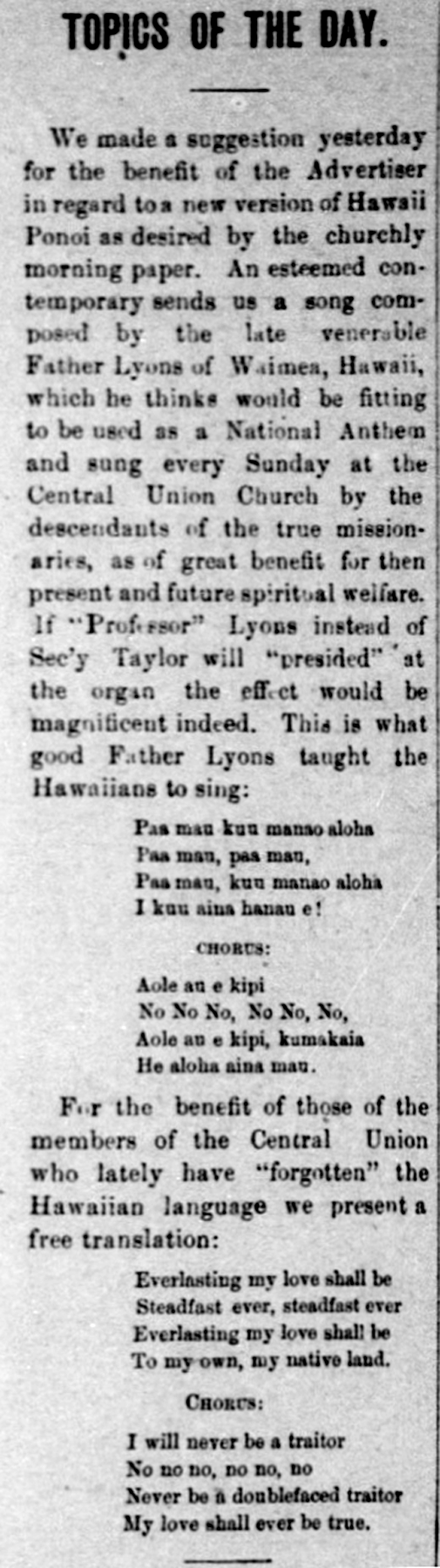
Lorenzo Lyons preached, “Never be a double-faced traitor,” 1894.

TOPICS OF THE DAY.

We made a suggestion yesterday for the benefit of the Advertiser in regard to a new version of Hawaii Ponoi as desired by the churchly morning paper. An esteemed contemporary sends us a song composed by the late venerable Father Lyons of Waimea, Hawaii, which he thinks would be fitting to be used as a National Anthem and sung every Sunday at the Central Union Church by the descendants of the true missionaries, as of great benefit for then present and future spiritual welfare. If “Professor” Lyons instead of Sec’y Taylor will “presided” at the organ the effect would be magnificent indeed. This is what good Father Lyons taught the Hawaiians to sing:

Paa mau kuu manao aloha
Paa mau, paa mau,
Paa mau, kuu manao aloha
I kuu aina hanau e!

CHORUS:

Aole au e kipi
No No No, No No, No,
Aole au e kipi, kumakaia
He aloha aina mau.

For the benefit of those of the members of the Central Union who lately have “forgotten” the Hawaiian language we present a free translation:

Everlasting my love shall be
Steadfast ever, steadfast ever
Everlasting my love shall be
To my own, my native land.

CHORUS:

I will never be a traitor
No no no, no no, no
Never be a doublefaced traitor
My love shall ever be true.

(Hawaii Holomua, 1/10/1894, p. 2)

HawaiiHolomua_1_10_1894_2.png

Hawaii Holomua, Volume II, Number 8, Page 2. January 10, 1894.

A new scathing “Hawaii Ponoi,” 1894.

TOPICS OF THE DAY.

The Advertiser with its usual ingenuity has finally found the cause for all the opposition among the Hawaiians to the P. G., and to the annexation cause. It is all on account of Hawaii Ponoi, our national anthem, and the morning organette demands, and immediate change in the words of that time-honored song. The new version given by the Advertiser will hardly be adopted, and we therefore take the liberty to substitute some words which we submit to the kind consideration of all loyal Hawaiians who are to be forbidden to sing the anthem of their native land. How is this brother Castle?

HAWAII PONOI HOU.

Pakaha Hawaii,
Kipi i ka lahui,
Na welo mikanele,
Na Pi Gi.

Ino ka ia e,
Ia Kolekaaka,
Pale i ka nani,
Me ka uahoa.

[NEW HAWAII PONOI

They plunder Hawaii
Conspire against the people,
Those missionary descendants,
The P. G.

How vile he is,
That Kole Kaaka,*
Pushing aside beauty,
With his cruelty.]

*”Kole Kaaka” can be found in the dictionary. Look it up. This term with a negative connotation is used often during this period. Might it also be a play on the name Dole? “Wretched Dole”?

(Hawaii Holomua, 1/9/1894, p. 2)

HawaiiHolomua_1_9_1894_2.png

Hawaii Holomua, Volume II, Number 7, Page 2. January 9, 1894.

Denial of “Hawaii Ponoi,” 1894.

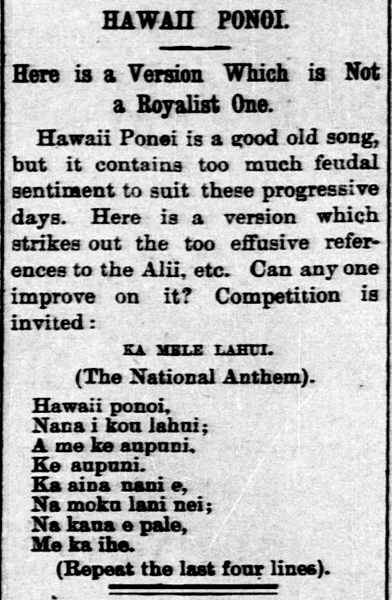
HAWAII PONOI.

Here is a Version Which is Not a Royalist One.

Hawaii Ponoi is a good old song, but it contains too much feudal sentiment to suit these progressive days. Here is a version which strikes out the too effusive references to the Alii, etc. Can any one improve on it? Competition is invited:

KA MELE LAHUI.

(The National Anthem).

Hawaii ponoi,
Nana i kou lahui;
A me ke aupuni,
Ke aupuni.
Ka aina nani e,
Na moku lani nei;
Na kaua e pale,
Me ka ihe.

(Repeat the last four lines).

(Pacific Commercial Advertiser, 1/8/1894, p. 4)

PCA_1_8_1894_4.png

The Pacific Commercial Advertiser, Volume XIX, Number 3580, Page 4. January 8, 1894.

Book of Nationalistic Songs, 1896.

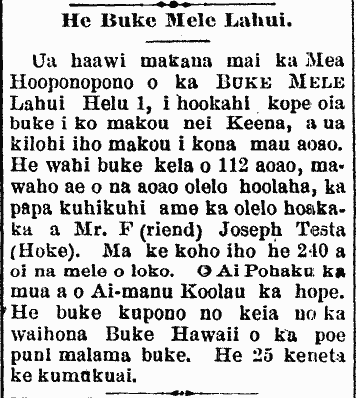
He Buke Mele Lahui.

The Editor gifted a copy of the Buke Mele Lahui, Volume 1 to this Office, and we glanced through its pages. It is a book of 112 pages aside from the advertisements, table of contents and introduction by Mr. F (riend) Joseph Testa (Hoke). There are approximately 240 or more mele within. The first mele is Ai Pohaku and the last is Ai-manu Koolau. This is a good book for the Hawaiian libraries of those who like to keep books. The price is 25 cents.

[This publication was reprinted by the Hawaiian Historical Society in 2003, and is available in hardback for $60, or if you are a member of the Historical Society, $48! Check out the many books available from the Historical Society here.]

(Kuokoa, 1/10/1896, p. 2)

Kuokoa_1_10_1896_2

Ka Nupepa Kuokoa, Buke XXXV, Helu 2, Aoao 2. Ianuari 10, 1896.