“What always carries the crowd away,” 1893 / today / forevermore.

WHAT THEY SING.

What Always Carries the Crowd Away.

The patriotic song, “Kaulana na Pua o Hawaii,” composed and sung by the Hawaiian National Band at their concerts, has been put into English by “Makee Aupuni”:

Standing by our native land
Are we sons of Hawaii nei,
Daring a false and treacherous band,
Whose minions come from o’er the sea.

Responds our hearts from isle to isle,
Resolved to die before we yield,
Our ancient birthright ne’er defile,
We’ll spill our blood on freedom’s shield.

Responds Hawaii of Keawe
To farthest sands of green Mano,
Piilani’s land, and Kakuhihewa’s sand,
Shall witness that we face the foe. Continue reading
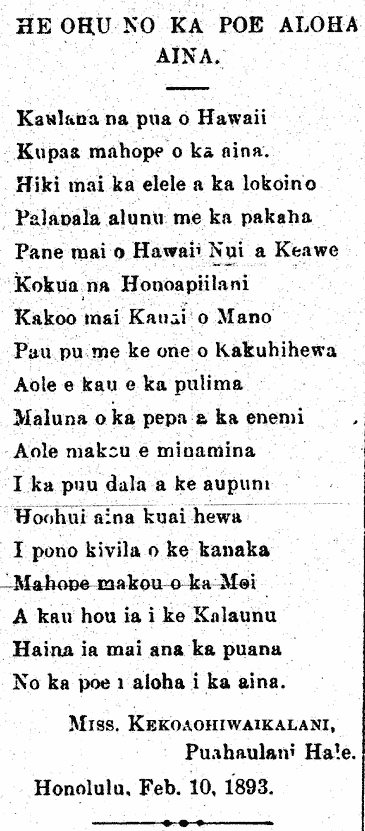
“An Adornment for the Patriots,” 1893.

HE OHU NO KA POE ALOHA AINA.

Kaulana na pua o Hawaii
Kupaa mahope o ka aina
Hiki mai ka elele o ka lokoino
Palapala alunu me ka pakaha
Pane mai o Hawaii Nui a Keawe
Kokua na Honoapiilani
Kakoo mai Kauai o Mano
Pau pu me ke one o Kakuhihewa
Aole e kau e ka pulima
Maluna o ka pepa a ka enemi
Aole makou e minamina
I ka puu dala a ke aupuni
Hoohui aina kuai hewa
I pono kivila o ke kanaka
Mahope makou o ka Moi
A kau hou ia i ke Kalaunu
Haina ia mai ana ka puana
No ka poe i aloha i ka aina.

Miss Kekoaohiwaikalani,

Puahaulani Hale.

Honolulu, Feb. 10, 1893.

[This is perhaps the very first publication of Ellen Kekoaohiwaikalani Prendergast’s “Kaulana na Pua:” “An Adornment for the Patriots.” Was the idea about eating stones not in the original composition and added on after the Hawaiian National Band [Bana Lahui] was told by Herny Berger that they would have to sign their names to the annexation club roll lest they end up having to eat stones? The first time it seems that the lines about eating stones was published was under the title “He Inoa no na Keiki o ka Bana Lahui” [A Name Song for the Boys of the Hawaiian National Band]  in 3/23/1893 on the second page of Hawaii Holomua.]

(Leo o ka Lahui, 2/24/1893, p. 3)

LOKL_2_24_1893_3.png

Ka Leo o ka Lahui, Buke II, Helu 649, Aoao 3. Feberuari 24, 1893.

Death of John Polapola, 1896.

[Found under: “KELA A ME KEIA.”]

A little after 10 o’clock on the night of Tuesday last, the breath of Keoni Polapola left him, at his residence makai of Honuakaha, Queen Street. He was seen that afternoon in good health, and as it got dark, he started having a pain in his head until his death. His land of birth was Tahiti, and he lived in Hawaii nei becoming a citizen and kamaaina, and married a woman and had children. Aloha for him!

(Makaainana, 4/27/1896, p. 8)

Makaainana_4_27_1896_8

Ka Makaainana,  Buke V—-Ano Hou, Helu 17, Aoao 8. Aperila 27, 1896.

John Polapola, proud eater of stones! 1893.

I SHALL EAT STONES.

This past Wednesday, John Polapola was dragged along by a traitor to his motherland. This is what he said to Jno. Polapola, as he held on tightly to his hand.

Let’s go.

Where are we going? said John [Keoni].

The traitor responded: To the Annexation Office, where you will sign your name, because you should think about your crackers and beef, and how you can continue to work.

This is the answer of the patriotic man: The job that I have now is in no way sufficient; Not at all! But I tell you, “I will eat stones;” that is better than me agreeing to sign my name under the Annexationists. For I love my land, and my Queen, and if you want to take away your jobs, I am now prepared. Continue reading

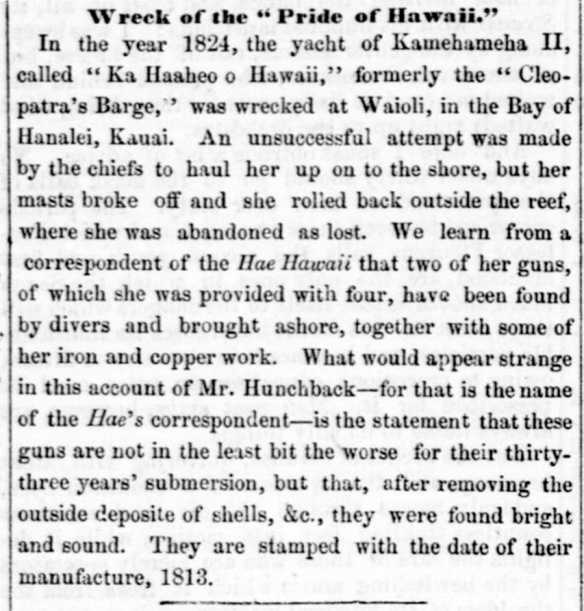
Cannons from the Haaheo o Hawaii wreck, 1857.

Wreck of the “Pride of Hawaii.”

In the year 1824, the yacht of Kamehameha II, called “Ka Haaheo o Hawaii,” formerly the “Cleopatra’s Barge,” was wrecked at Waioli, in the Bay of Hanalei, Kauai. An unsuccessful attempt was made by the chiefs to haul her up on to the shore, but her masts broke off and she rolled back outside the reef, where she was abandoned and lost. We learn from a correspondent of the Hae Hawaii that two of her guns, of which she was provided with four, have been found by divers and brought ashore, together with some of her iron and copper work. What would appear strange in the account of Mr. Hunchback—for that is the name of the Hae‘s correspondent—is the statement that these guns are not in the last bit the worse for their thirty-three year’s submersion, but that, after removing the outside deposite of shells, &c., they were found bright and sound. They are stamped with the date of their manufacture, 1813.

(Polynesian, 5/23/1857, p. 5)

Polynesian_5_23_1857_5.png

The Polynesian, Volume XIV, Number 3, Page 5. May 23, 1857.

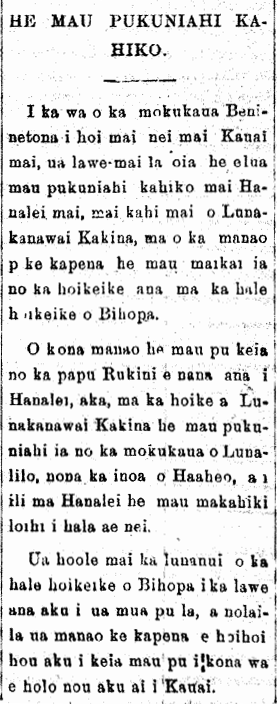
What was the Bishop Museum Director thinking, 1898.

OLD CANNONS.

When the warship Bennington returned from Kauai, it brought two old cannons from Hanalei, from the place of Judge Thurston [Lunakanawai Kakina], with the thought of the captain that these would be fine objects for the Bishop Museum to display.

He believed that these were cannons from the Russian fort facing Hanalei, but according to Judge Thurston’s statement, they were cannons form the warship of Lunalilo named Haaheo [Haaheo o Hawaii], and it ran aground at Hanalei many years ago.

The director of the Bishop Museum refused to take the guns, and so the captain thinks he will return the guns when he returns to Kauai.

[This was the ship of Liholiho, Kamehameha II, and not Lunalilo. There was much press about it last year! Go check out the exhibit at Kauai Museum on the Haaheo, showing now!! Does anyone know what became of these cannons?]

(Aloha Aina, 12/3/1898, p. 1)

AlohaAina_12_3_1898_1.png

Ke Aloha Aina, Buke VI, Helu 49, Aoao 1. Dekemaba 3, 1898.

Whale vs Shark, 1909.

WHALE BATTLES SHARK

Seeing a fight between a Shark and a Whale was something entranced the tourists of the Moana Hotel outside of Waikiki at ten o’clock or so in the morning of this past Wednesday.

Just as the tourists usually do when staying at that hotel, they often go out to the lanai to watch the steamships leaving Honolulu Harbor, and that is why they gathered on the lanai to watch the departure of the Steamship Alameda.

When the Alameda was nearing directly outside of the hotel, the jumping of a huge whale was seen, as it kept striking its tail upon the surface of the sea. Continue reading

Another beached whale, 1901.

WHALE WASHED ASHORE AT KEEI

NATIVES WAX RICH FROM BIG FIND MADE ON HAWAII LAST WEEK.

Some of the natives living at Keei, Hawaii made a rich find last Saturday. They caught a 32 foot whale. The leviathan was not harpooned while in the deep water but was washed ashore and caught close to the beach.

Just how the whale came to be washed ashore is not certain. It was alive when it was first discovered in the shallow water early Saturday morning. It is not improbable that a drove of sharks attacked the monster and in desperation the whale swam madly in shore in the hopes of escaping from the attacks of the sharks. If such had been the desire, the attacks of the sharks were escaped but the surer attacks from the natives followed. Continue reading

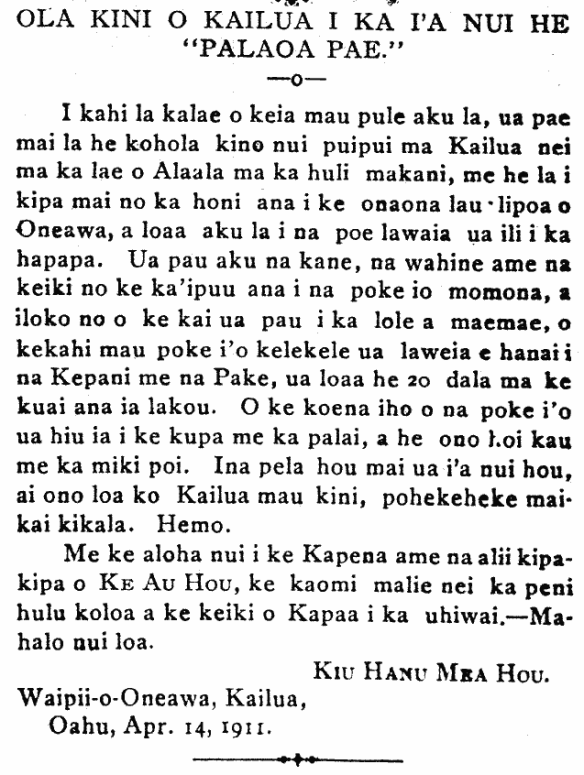
Beached whale at Kailua, 1911.

THE MANY OF KAILUA WERE SAVED BY THE GREAT FISH, THE “PALAOA PAE.”

One clear day some weeks ago, a large, heavy-bodied whale landed here in Kailua at the cape of Alaala on the windward side, and it was if we were visited by the scent of the sweet lipoa seaweed of Oneawa, and it was found by fishermen beached in the shallows. The men, women, and children all went and divided up the fatty pieces of flesh, and they all went into the water with their clothes on to get cleaned up; some of the chunks of oily flesh was taken to feed the Japanese and Chinese; 20 dollars was gotten through the sale. The remainder of the meat was thrown into soup and fried, and it was tasty with dabs of poi. If a large fish comes again, Kailua’s multitudes will eat with relish, and their hips will be nicely plump. Satisfaction.

With much aloha for the Captain and the officers [??? alii kipakipa] of Ke Au Hou; the duck feather pen of the son of Kapaa in the mist presses gently down.—Mahalo nui loa.

THE ONE WHO SNIFFS OUT NEWS

Waipii-o-Oneawa, Kailua,

Oahu, Apr. 14, 1911.

(Au Hou, 4/19/1911, p. 21)

AuHou_4_19_1911_21.png

Ke Au Hou, Buke 2, Helu 16, Aoao 21. Aperila 19, 1911.

Conclusion of the Interview of William E. Rowell, 1916.

INTERVIEW WITH W. E. ROWELL
Dec. 6, 1915

(Continued from last issue.)

The shingles were imported and were boiled in whale oil before they were put on. They lasted a long, long time, 25 years, until they were fairly worn out, by explosure to the elements.

Yes, as you say, my father was a good mechanic. He had a lathe with which he litterally turned out four poster koa beds, and other articles of furniture, and up in the mountains he had a saw-pit where he whip-sawed out koa and kauwila lumber, one man above and one below with the log resting on skids. You say there is some of that koa lumber there in the house now?—yes very likely, we left a lot of it there.

We had kauwila posts I remember, for our front fence. I sent my brother, in New York, some of them, out of which he had furniture made, and this cane that I carry and which is so useful to me in my blindness, is made out of one of them. You say it ought to go to some historical society, [???] that first church table, well perhaps so.

My father was very much of a student as you say; yes he always read from the Greek Testament at family worship. Continue reading