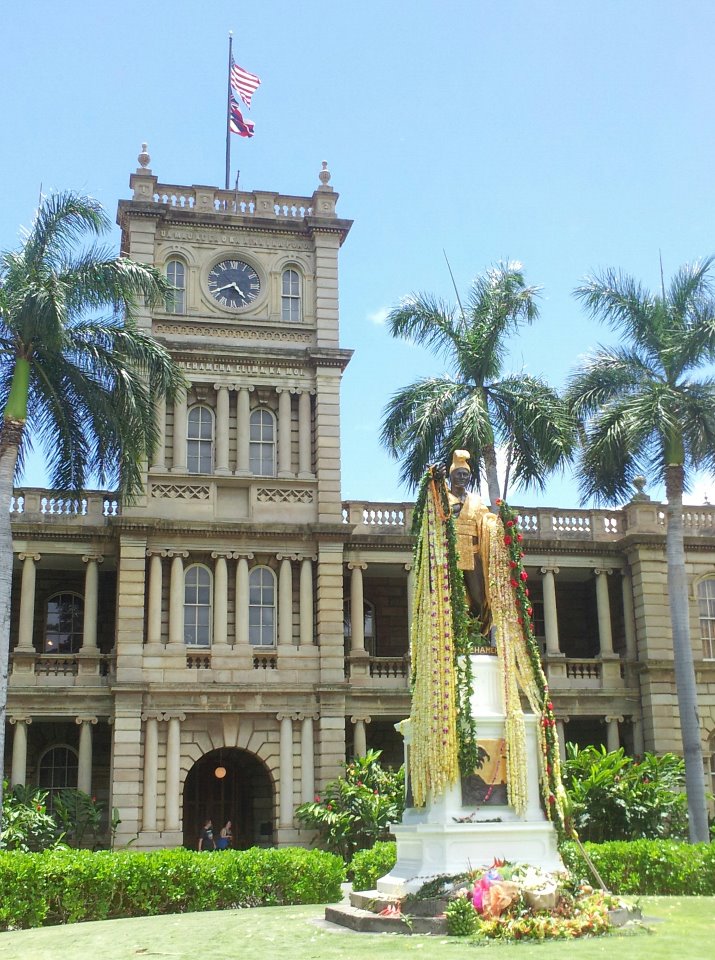
Kamehameha Statue. June 9, 2012.

Kamehameha Statue. June 9, 2012.
All members of the Ahahui Kamehameha Division 1 are requested to assemble in the Building of the Secret Society, Odd Fellows, at 10 in the morning of this coming Sunday, June 9, 1912, to go on to pray in Kawaiahao Church, as is done in all past years; and they are also ordered to assemble within Kapiolani Hale at half past 8 on the morning of Tuesday, the 11th of June, 1912, to go and decorate the statue of Kamehameha I in front of the Government Building. Do not forget this order!
(Kuokoa, 6/7/1912, p. 8)
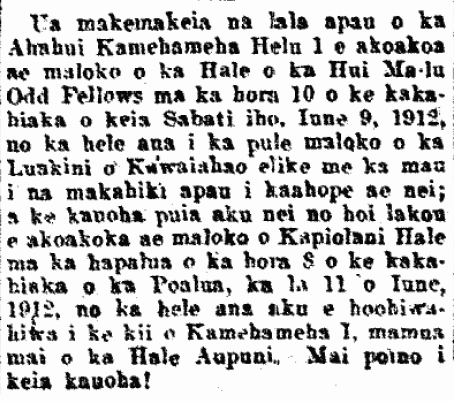
Ka Nupepa Kuokoa, Buke XLVIII, Helu 23, Aoao 8. Iune 7, 1912.
On the 22nd of April, the King spoke at Lanakila Church in Hauula, and at the end of his royal speech, Keaunui brought his youngest daughter before the King; the King kissed the small girl, and the King asked, “Is this your daughter?” Keaunui said, “Yes, she is mine, her mother is over there, she is pregnant again.” The King responded, “When she gives birth, name the baby Kahooululahui,”¹ and the word of the King was agreed to. On the night of the 24th, when the King was in Ewa, at 2 o’clock at night, Mrs. Hellen K. Keaunui gave birth to a son, with J. L. Keaunui, and he was immediately named David Kahooululahui. He was the 13th of their children, they are just a small bit of the growing of the lahui; how blessed would be the nation if all the women from Hawaii to Kauai were like her.
¹”Hooulu Lahui” was Kalakaua’s famed motto, encouraging the increasing of the nation/race.
(Kuokoa, 5/9/1874, p. 2)

Ka Nupepa Kuokoa, Buke XIII, Helu 19, Aoao 2. Mei 9, 1874.
This day known to everyone, the day of the return of independence to the Islands and the day chosen by the Monarchs as a day for the two of them to join the new faith which has recently arrived.
On the morning of that day, at the hour of 10½, the Alii arrived at the Church and the National troops [koa o ke Aupuni], the Honolulu Rifles [koa Rifles?], the Hawaii Kiai [?], and the Cavalry [Puali Kaua Lio] were all lined up.
When the Alii arrived and passed through the entrance, the Bishop came and layed his hand and blessed them. They then entered within and sat down; following them was a procession, and they entered while chanting one of the psalms. After this was done, the laying on of hands began, and they were confirmed as brethren of the new church.
The beauty that is imbued in all creatures of the earth is what left all of their subjects who went there awe-stricken. Some wept, some fled [hoonaholoholopoo?], some were downcast, and some shuddered in awe, appearing as if the spirit from the heavens was accepted in the Monarchs joining into the circle of eternal life.
Present was Her Highness Princess V. K. Kaahumanu, the Honorable M. Kekuanaoa, the Honorable R. C. Wyllie, the Honorable Chief Justice E. H. Allen, the Honorable C. R. Bishop and his wife, the Honorable C. Kapaakea, the Honorable Colonel D. Kalakaua, Colonel McKibbin Jr., Colonel W. C. Lunalilo, Major Hasslocher, Kekaaniau, the Dowager Queen K. Hakaleleponi, Mrs. Haalelea, the wives of the Supreme Court Judges, and the Honorable Ii. There also was W. W. F. Synge and his wife, along with the Consuls of Foreign Nations.
The building was filled with those wanting to witness the joining of the Monarchs as brethren, and everyone felt much appreciation for the beauty of the Royals, the Alii, and the ceremony performed. God save the King.
¹La Kuokoa [Hawaiian Independence Day]
(Hoku o ka Pakipika, 12/4/1862, p. 2)

Ka Hoku o ka Pakipika, Buke 2, Helu 8, Aoao 2. Dekemaba 4, 1862.
The Kamehameha I Statue brought by the captain of the clipper ship Dalhousie [Earl of Dalhousie], and purchased by the Government, was set up on the Waikiki side of the grounds of the Government Building. A small structure was built and the statue stands within it. It is heard that the plan of the Managing Committee is that all the flaws be redone.
(Kuokoa, 5/6/1882, p. 3)
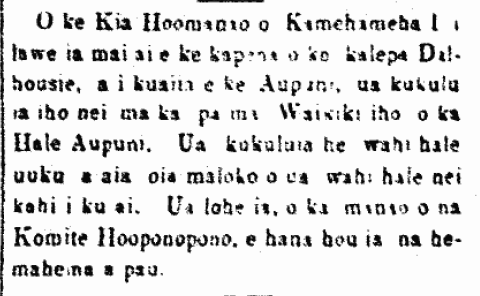
Ka Nupepa Kuokoa, Buke XXI, Helu 13, Aoao 3. Mei 6, 1882.
Under the Republic of Hawaii that stands now, the crown lands have been returned and added with the other lands of the government, and are referred to as government lands. Currently, the entirety of these lands are under the authority of a Commission appointed for that purpose under the law. The Commission is active today and its members are putting into order matters that pertain to their duties as per the laws. The finding of all lands that are not to be owned by someone, as well as the leasing, selling, and dividing of lands that are recognized as lands fitting to be homes for people without homesteads for themselves. This idea was devised by Mr. S. B. Dole while he was a member of the Legislature for a session under the monarchy.
It seems that this was what he focused on, for the good of those without. He kept at this idea until it became law, amidst much skepticism by friends and fellow representatives.
But he did not relent until he succeeded, and now he is working to move forward his loving idea for his fellow man, to increase, and to make prosperous, the poor people. Under his law and its revisions, this Government Lands Commission was created.
At this time, the Commission is trying to carefully carry out their duties so that the lahui will not once again be hurt like under the benefits intended for the masses with the quiet land titles in the time of Kauikeaouli’s rule. They are surveying parcels from areas suited for a man and his family to live. The doors to this great right is opened and Hawaiians will receive land before all other ethnicities and then thereafter those from the outside. There are some Hawaiians taking advantage of this opportunity, along with some haole and other ethnicities. But the majority of those that know of the good offered up by this law are the people of foreign lands, the ones who know the value of land for which one is able to say that he is patriotic to the land of his birth.
By this law, power is give to advertise land to those who claim land for themselves, under the condition that they cannot use it for profit. The land is available to those without land or those with wetlands of less than an acre under his name, or under the husband or wife in some other area of the archipelago; they will live on the land for six years after the request for land and should they meet the qualifications under the law, the applicant will receive a lease or 999 years. The requirements for the application and stipulations of the lease are shown in full in sections 31–54 of the Land Act of 1895.
[Just as it is today, it was back then. Different newspapers and sources had different stances. It is perhaps not best thing to base your opinions on a single article or the words of a single person. It is important to try and see all that was written and handed down in other ways (for ink and paper is not necessarily the best way that information is passed down), and then decide what you think on the subject…
Oh, and see here for the Land Act of 1895.]
(Oiaio Puka La, 4/3/1896, p. 2)
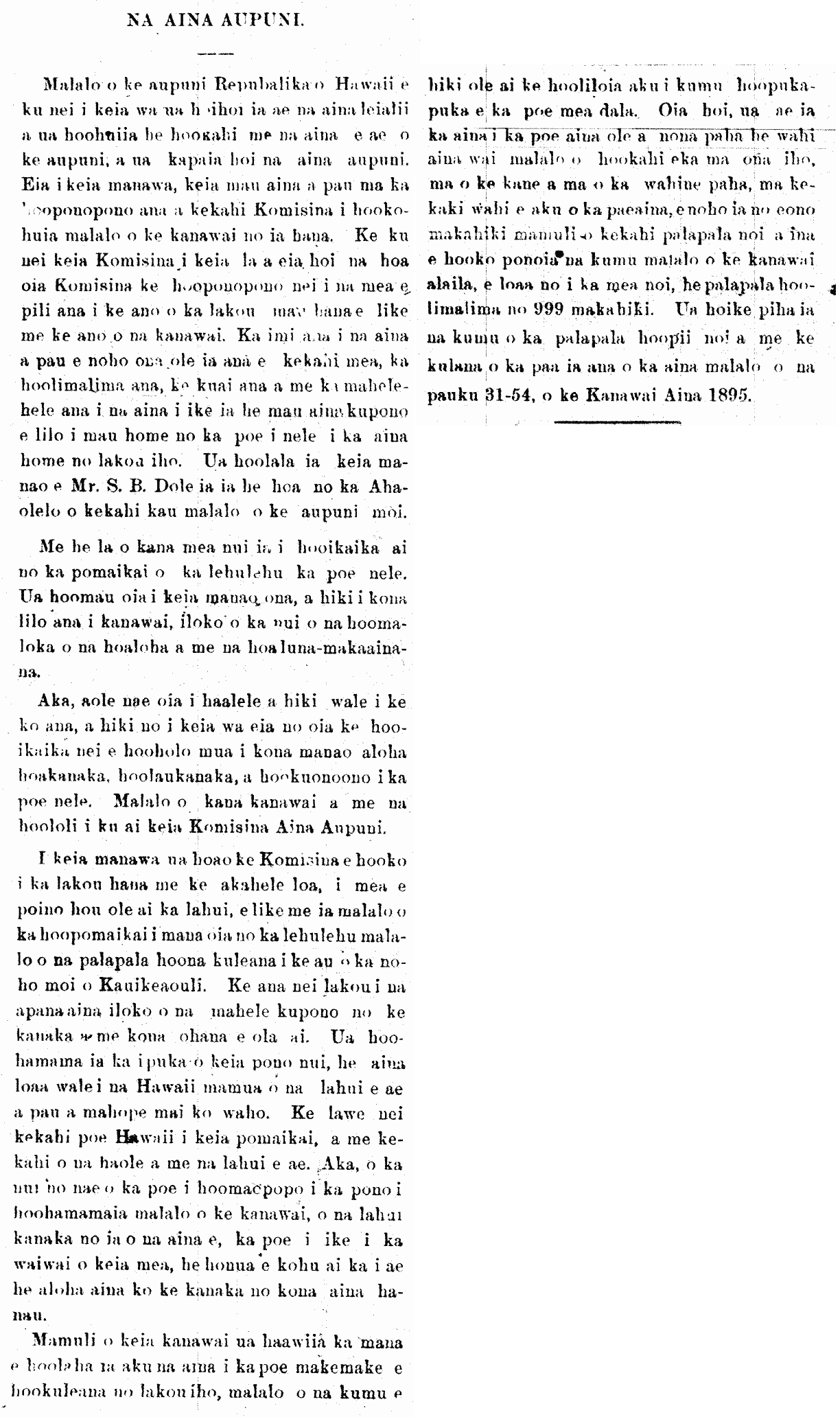
Ka Oiaio Puka La, Buke I, Helu 67, Aoao 2. Aperila 3, 1896.
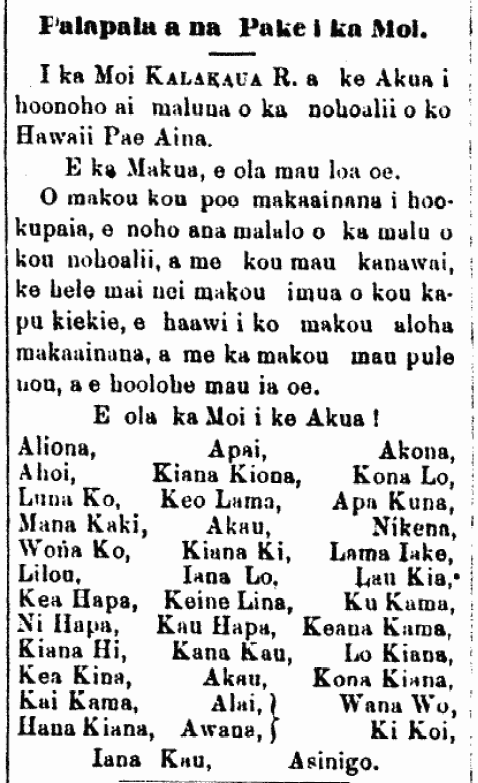
This past 17th, Sunday, was the day of remembrance for all true Hawaiians, of the King Kauikeaouli, the Benevolent one. There are two different historical accounts of this day. Fornander states in his account that Kauikeaouli was born of Keopuolani on 11 August 1813, and that this information was from Emalia Keaweamahi, the wahine of Kaikioewa, the governor of Kauai. This date of A. Fornander is supported by Prof. Alexander in his “Brief History of the Hawaiian People.” However, in the account of Mr. James Jackson Jarves, a scholar of Hawaiian history who arrived here in Hawaii nei in 1837, Kauikeaouli was born on 17 March 1813. This historian arrived here but 24 years after the birth of Kauikeaouli, and it would seem that he obtained clear information about the true birth date of the Benevolent King, while he was living here. This statement by Jarves is supported by the reviving prayer that Kapihe offered for Kauikeaouli. Look below at line 11 [42?] in the “Pule a Kapihe.” Ikiiki is the month of March according to the reckoning of Oahu people, and according to Molokai people it is August.
Kauikeaouli was born at Ooma, Keauhou, in Kailua, in the moku of Kona. However, Prof. Alexander, in his history of Hawaii, says Kauikeaouli was born in Kailua.
The name Kauikeaouli is a name from his ancestors, that being the name of his grandfather, Keoua (Keaoua), the one called Kalanikupuapaikalaninui Kauikeaouli. This name puts on high the sacred kapu of Keoua–his chiefly kapu extends above and touches the great heavens, and rests upon the dark clouds. So therefore, the importance of the names Keaouli and Keaoua, is the dark, black, thick, esteemed cloud. This cloud is a rain cloud. A Orator of the old times said that the name Kauikeaouli is the bank of clouds that Kapihe, the prophet, saw spread high in the heavens when he was called to go to see if the child that Keopualani gave birth to was alive or not alive. He was not breathing and was totally lifeless. However, when this kahuna and prophet arrived to where the child was placed, he offered this prayer while waving a coconut frond in his hand. This is the prayer by which Kapihe made Kauikeaouli live, according to the story:
1 O ke Kukaikapaoa ka lani, ae alii,
2 He ‘lii haoa lani, haoa—a
3 He a ia m u lani ku makomako
4 He lani no Kahuku maka pali pohaku
5 He mau lani pohaku na Lono kaeho
6 No Lono ka la i poniia i ka wai niu
7 I haua i ka puaa hiwa
8 I ka puaa hiwa, puaa hiwa a Lono,
9 E Lono—e. Eia ko maka lani
10 Ko lau, ko mu’o, ko ao, ko liko
11 Ko alii kapu e Kahai-piilani
12 Ko maka Kuanahai ka malama
13 Malama ia ka lau kapu o Keaka
14 Ka lau oheohe o Keakamahana
15 I kupu a kapalulu, a kapalule
16 Ka pua, ka pua Ololo hemahema no Kaikilani
17 Nona ia lau ololo no Kanaloa
18 No ka ilio hulu panio, i poni ka maka
19 I noho ka eleele iloko o ka onohi
20 O ke kakau kioki onio i ka lae
21 O ke kioki o ke kikakapu
22 O ka i’a kapuhili au awahia
23 Awahia, awahia ia lani
24 Na Keaka wahine kea
25 Kupu mala o kea Keakealani
26 Ia laua haki ka haka o ke kapu
27 He haka i ka momona o na ‘lii nui
28 He mau alii ku moku, ai moku nui,
29 He nui hoi ka uhi, ka lawalu iwaho
30 He kai papa neenekona aina
31 He kai papa holo papa no Kahiki
32 I iki Keawe, ke kaupu kiau moku
33 Ka hua hookahi a ka A-o i ka lani
34 Na Kalani Ka’ani Kauleleiaiwi
35 Na Keawe, Keawe keia lani
36 Na kela eke hulu o Piilani
37 Lilo nei Keawe ia Piilani
38 Ahu kooka o na ‘lii
39 He mau alii ka ikena ‘ku
40 He mau lani haele wale iho no
41 Hele, hahi i ka lihilihi o ka La
42 I ka malama hanau i o Ikiiki—la
43 I ka malama hanau i o Ikiiki—la
—Mahele—
44 Ikiiki ka lani iluna
45 Ua uiha i ka malama
46 Ka pili o ho-ehu ka ua
47 Ke iloli nei ka honua
48 Naku ka mauna wai kali lia (waikaheia)
49 Ua kai lewa ia na aina
50 Ua lewa ka houpo o ka moku
51 O e au o Malela, o Kuala, o Kanaka ki o a moku
52 O ka u-u-ina i Wawau-e-aha-o
53 Ko Aupuni-la-nana-i-a
—Mahele—
54 Nana ia ae Holaniku
55 Kilohiia i kua o Wakea
56 I ke ake a Laukapalili
57 Me ke kalo o Laukapalala
58 He maka ia no Luaipo—e
59 O na ‘lii no ia o ka Nuupele
60 O I ko o maua ka Moo—
61 O ka hina kai o Haloa
62 Oia ia paha—e
63 Ke pahapaha la i ka makemakeia
64 A hiki mai ka ole hoi ana—e
[Amazingly, this is the only issue of this entire year that seems to have survived! If this newspaper could be reshot nicely, we could get a clear/clearer reading of this important mele!
And I put up the mele as is (although the image is not clear in some areas, so there are some questionable lines), so that words and phrases will be searchable on this blog or on google right now, instead of having to wait for some time in the future…]
(Kuokoa Home Rula, 3/22/1907, p. 4)
Kuokoa Home Rula, Buke V, Helu 12, Aoao 4. Maraki 22, 1907.
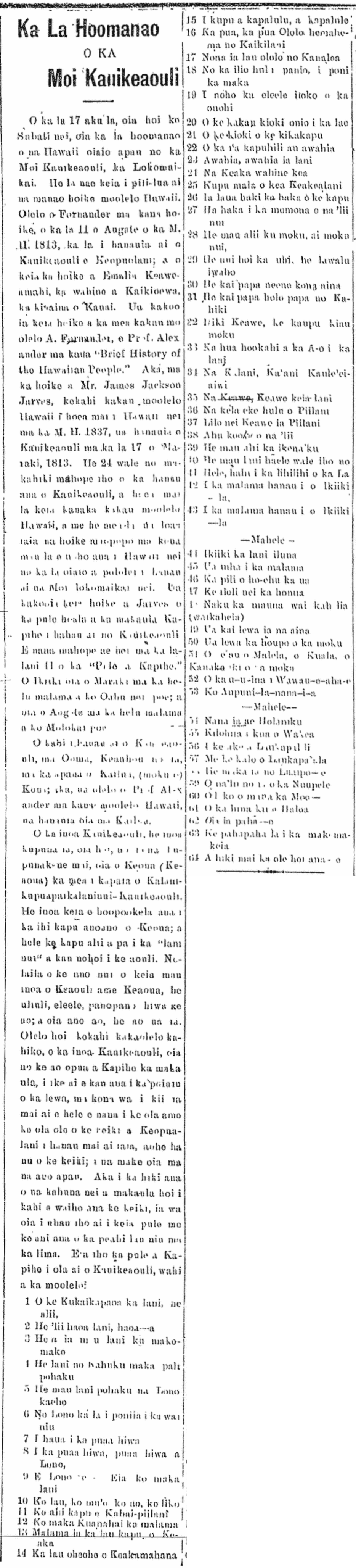
Honolulu, Feb. 26, 1898.
I have Six dollars and sixty cents ($6.60) for the well-being of the Representatives of the nation, from J. D. B. Kuakahela from the Pres. of the Members of the Patriotic League of Hoopuloa, South Kona, Island of Hawaii; it was sent along with a list of names of the Patriots who donated the money, and we are publishing it in the newspaper Loea Kalaiaina. Thank you very much to you all.
J. K. Kaunamano
Vice President,
Enoch Johnson
Head Secretary.
SOUTH HOOPULOA
J. D. B. Kuakahela, 50 ”
Kapapa, 25 ”
Sela, 25 ”
D. S. Kaui, 25 ”
Kukana, 25 ”
Makaula, 25 ”
Samuela, 25 ”
Mia, 25 ”
Keao, 10 ”
Waiwaiole, 25 ”
Gomaka, 25 ”
Peniamina, 25 ”
Kekao, 25 ”
A. L. Kapawai, 50 ”
Kaiwakapu, 25 ”
Mahoe, 25 ”
Kaanaana, 50 ”
Annie, 25 ”
D. W. Pohina, 50 ”
Kema Puako, 25 ”
Ai Pake, 50 ”
Pauila, 50 ”
Total, $6.60
J. D. B. Kuakahela
Committee.
(Loea Kalaiaina, 3/21/1898, p. 3)
Ka Loea Kalaiaina, Buke II, Helu 12, Aoao 3. Maraki 21, 1898.
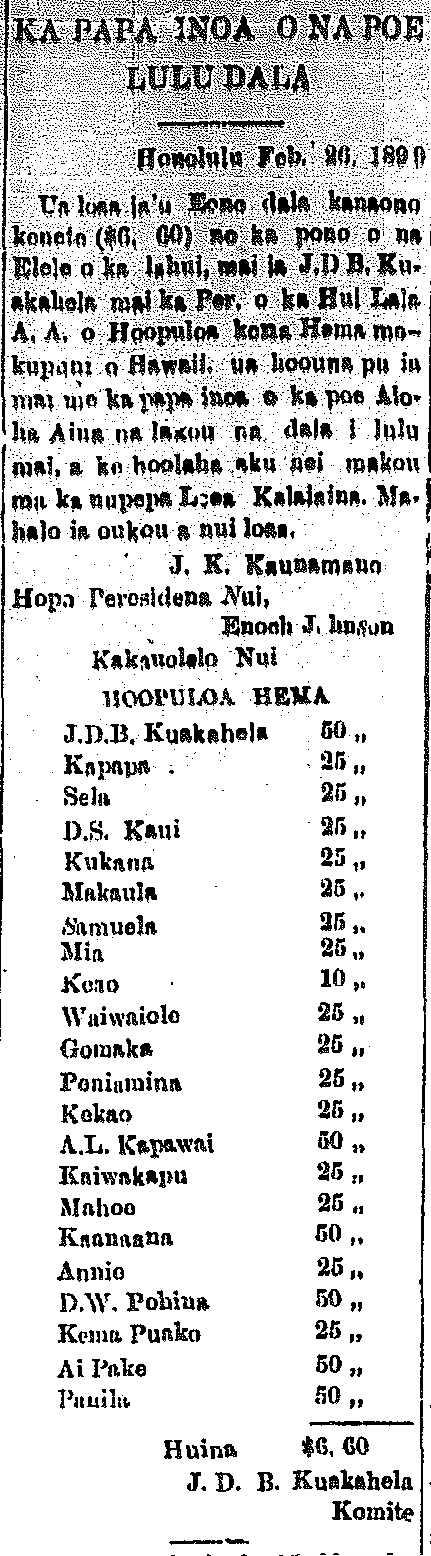
FOR THE REPRESENTATIVES
FROM BALDWIN HOME
We are the Aloha Aina boys whose hearts are full of true aloha from deep within.
We are donating our few cents for the well-being of the Representatives with unified hearts and to attest to this, we affix our names.
MOLOKAI.
B. Lapilio, 50 cents
Nakeu, 50 ”
Halekauhola, 50 ”
E. D. T. Sing, 50 ”
John Lono, 50 ”
Moluhi, 50 ”
John Hao, 50 ”
Kukaukama, 50 ”
Kaomea Kaui, 50 ”
J. Namaielua, 50 ”
Jeo Kahilahila, 50 ”
Kalua, 50 ”
Mahi Kaio, 50 ”
S. Pilipo, 50 ”
Kauluwehiwehi, 50 ”
Hanaole, 50 ”
Micah Kaui, 50 ”
Kalauahea, 50 ”
Pohano, 50 ”
Kaukua, 50 ”
Kihauna, 50 ”
Ake, 50 ”
Hoopii, 50 ”
Moses Holi, 50 ”
S. Kauhahaa, 50 ”
Pihana, 50 ”
Isaia Wai, 50 ”
Pali, 50 ”
Hukia, 25 ”
Kanakahoa, 25 ”
Lai Kilauea, 25 ”
John Papu, 10 ”
Hakau, 10 ”
Kaonohiliilii, 10 ”
Kahikina, 1.00 ”
John Haloi, 1.00 ”
J. K. Laanui, 1.95 ”
D. W. J. Kaopuiki, 1.00 ”
Total: $20.00
D. W. J. Kaopuiki
Committee.
The boys of Baldwin Home are speedy.
[The newspaper Ka Loea Kalaiaina (and many other Hawaiian-Language Newspapers) are for some reason still not available online in searchable text form or even in image form. This is unfortunate, for although most people are familiar with the anti-annexation petitions (“Kū‘ē Petitions”), many have not seen the many lists of donations collected from all over the islands for the expenses of the commission carrying the petition to Washington D. C.
This particular list of donors and donations are from Kalawao! These patients were forced to live isolated from mainstream society, and yet they remained staunch patriots!!
This image is difficult to read, and I hope that clear images of these pages will be made, so if they are typed out to be word-searchable online, people will be able to find their kupuna—it will be near impossible to find a name if there is an “@” somewhere within it…]
(Loea Kalaiaina, 3/14/1898, p. 3)
Ka Loea Kalaiaina, Buke II, Helu 11, Aoao 3. Maraki 14, 1898.
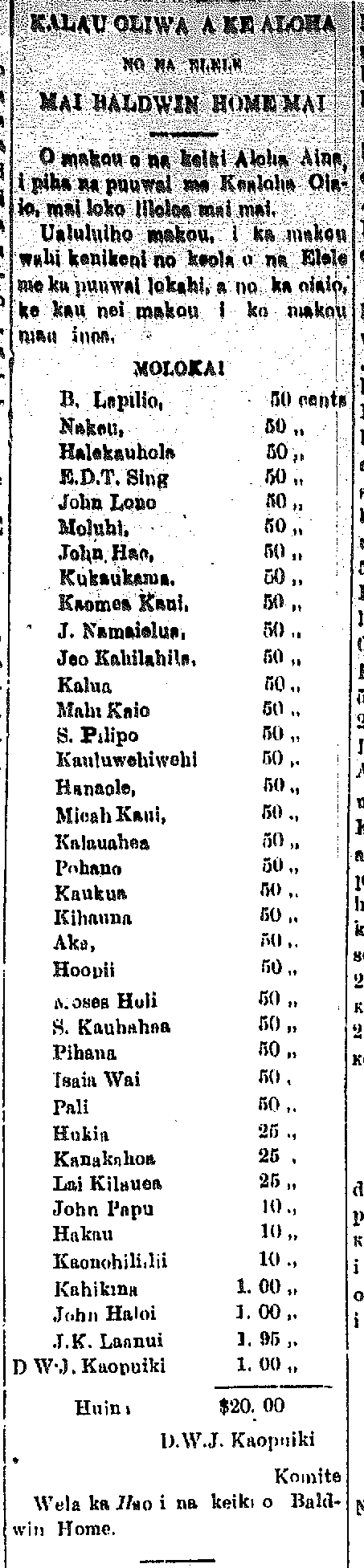
To King Kalakaua Rex, whom God has placed on the throne of the Hawaiian Archipelago.
Oh Father, long may you live.
We are your citizens who have been naturalized, living in under the protection of your rule and your laws; we come before your high kapu, to offer you our aloha from your citizens, as well as our prayers for you, and we shall always heed you.
Let the King live Through God!
Aliona, Apai, Akona, Ahoi, Kiana Kiona, Kona Lo, Luna Ko, Keo Lama, Apa Kuna, Mana kaki, Akau, Nikena, Wona Ko, Kiana Ki, Lama iake, Lilou, Iana Lo, Lau Kia, Kea Hapa, Keine Lina, Ku Kama, Ni Hapa, Kau Hapa, Keana Kama, Kiana Hi, Kana Kau, Lo Kiana, Ke Kina, Akau, Kona Kiana, Kai Kama, Alai, Wana Wo, Hana Kiana, Awana, Ki Koi, Iana Kau, Asinigo.
(Kuokoa, 3/21/1874, p. 1)
Ka Nupepa Kuokoa, Buke XIII, Helu 12, Aoao 1.
 nupepa