Death of the translator of Twenty-Thousand Leagues Beneath the Sea, Oniula, George W. Kanuha, 1876.

A Solemness, an  Expression of Affection for G. W. Kanuha.

[Aia aku la paha oe i ka aina hanau,
Ia Kona kai opua i ka lai,
Opua hinano ua malie
Hiolo na wainaoa a ke kehau,
Aole—eia ka paha i na hono a Piilani,
I ka lai o Hauola,
I ka malu o ka Ulu o Lele
E holoholo kuaua paupili ana.
Auwe! Aloha ino.]

Perhaps you are at the land of your birth,
Kona of the billowing clouds on the sea in the calm,
The clouds white like hinano blossoms,
Where the chilling waters of the Kehau mists fall,
No—maybe you are here amongst the bays of Piilani,
In the calm of Hauola,
In the shade of the Breadfruit of Lele,
Travelling about like the Paupili showers.
Auwe! How sad.

George W. Kanuha was born in 1845 in the town of Kailua, North Kona, Hawaii, of the streaked sea, the peaceful sea at Kalaiaehu, ever moistened by the amazing rains of the land of his birth in the face of the clouds. And he passed on to the other side of the black river, that line before the animals life and plant life which forever moves toward the final Great Revelation in the City of heaven. On the 16th day of this month, G. W. Kanuha travelled one last time in the shade of the ulu trees of Lele [Lahaina] in the sparkling sun and the red dirt of his welcoming home, sinking into the eternal home, the belly of the earth following after papa and mama. Aloha ino.

Ahukinialaa Wahineiki was his father, a student of Lahainaluna College, from the very beginning of the school in 1831, he boarded at that school until he graduated with the fluttering flag upon his Diploma. Mrs. Kealoha Wahineiki was his mother. G. W. Kanuha was an only child. Continue reading
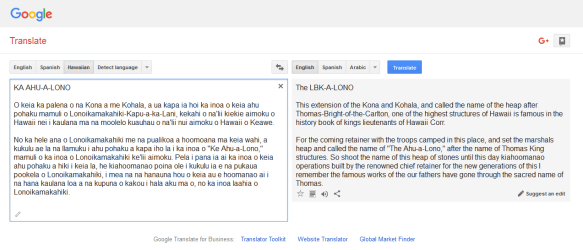

Google Translate, 2016.

I was excited when I read the news this morning in the Honolulu Star Advertiser. I thought I might have been able to give this site up… I guess we all have to start somewhere!

The LBK-A-LONO

This extension of the Kona and Kohala, and called the name of the heap after ThomasBrightoftheCarlton, one of the highest structures of Hawaii is famous in the history book of kings lieutenants of Hawaii Corr.

For the coming retainer with the troops camped in this place, and set the marshals heap and called the name of The Ahua-Lono,” after the name of Thomas King structures. So shoot the name of this heap of stones until this day kiahoomanao operations built by the renowned chief retainer for the new generations of this I remember the famous works of the our fathers have gone through the sacred name of Thomas.

Google_Translate

Ok, that was unrealistic, but:

Google_Translate.png

I am sure there will come a day that it will read better. I applaud Google for this first step!

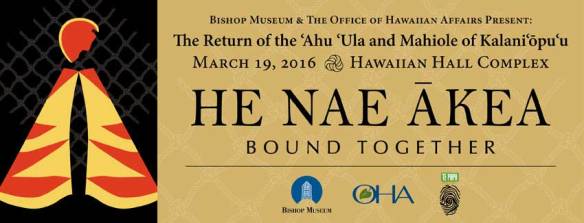
Kalaniopuu’s ahuula and mahiole that he placed on Cook, 1779 / 2016.

I just put up the short excerpt the other day describing Kalaniopuu giving James Cook his ahuula and kahili. And now there is this exciting announcement from the Bernice Pauahi Bishop Museum!

he-nae-akea

[It should be perhaps made clear however that the ahuula at least has made its way back to Hawaii nei two times since 1779, courtesy of the Dominion Museum, the predecessor of Te Papa Tongarewa]. The first time was in 1960:

DOMINION MUSEUM FEATHER CLOAK

Each year the Museum attempts to bring back for the Aloha Week exhibit a fine example of Hawaiian featherwork from abroad. This year the Dominion Museum of Wellington, New Zealand, has generously loaned a large Hawaiian feather cloak, which to the best of our knowledge, was presented to Captain Cook’s expedition in 1779. Aloha Week marks the first return of this cloak to Hawaii.

(Conch Shell: News of the Bishop Museum, October 1960)

The second time was for the “Artificial Curiosities” exhibit at the Bishop Museum which ran from January 18 to August 31, 1978.

Also, check out this previous post on an amazing story about other featherwork given to Cook by Kalaniopuu!

Ka Leo Hawaii, 1972 / 2016.

A labor of love

When Larry Kimura and his students first arrived at KCCN in Honolulu with a pitch for a new Hawaiian-language radio show, the station manager had one question.

“Do you have an audience?”

It was 1972. Hawaiian was dying out. Most native speakers were kupuna — and there were not many left. It was still technically illegal to speak Hawaiian in schools. Who was going to listen to a program conducted entirely in Hawaiian?

“But he was kind enough to say, ‘All right,’” Kimura, now 69 and an associate professor of Hawaiian language and culture at the University of Hawaii at Hilo, recalled last week. Continue reading at Hawaii Tribune Herald

[Check out this awesome article from the Hawaii Tribune Herald. I wonder who the station manager of KCCN was in 1972!]

Happy Birthday, Aunty! 2016.

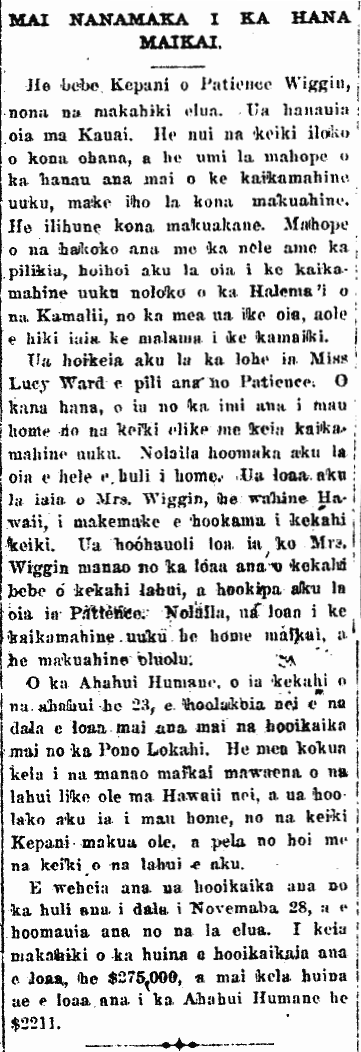
DON’T BE INDIFFERENT TO GOOD WORKS.

Patience Wiggin is a Japanese baby who is two years old. She was born on Kauai. There are many children in her family, and ten days after the birth of this little girl, her mother passed away. Her father is poor. After fighting with destitution and troubles, he returned the tiny girl to the Children’s Hospital, for he knew he could not care for this child.

The news was told to Miss Lucy Ward about Patience. Her job is to find homes for children like this small girl. So she began to go around searching for a home. She found Mrs. Wiggin, a Hawaiian, who wanted to adopt [hookama] a child. Mrs. Wiggin’s mind was delighted to find a baby of a different ethnicity, and welcomed in Patience. So the young girl gained a fine home and a kind mother.

The Humane Society is one of 23 associations that is provided with funds that are collected for United Welfare [Pono Lokahi] drive. This is something which promotes good will between the different ethnicities of Hawaii nei, and it will provide homes for Japanese orphans and also for children of other races.

Efforts to raise funds will begin on November 28 and continue for two days. This year the goal to be collected is $275,000, and from that sum, the Humane Society will receive $2211.

[For and earlier post, click here. And for even more on Aunty, click here.

If it wasn’t for the young girl in the story, I certainly would not be doing this blog. Hauoli la hanau e Aunty Pat! O KU O KA!!]

(Kuokoa, 11/25/1921, p. 4)

Kuokoa_11_25_1921_4

Ka Nupepa Kuokoa, Buke LIX, Helu 47, Aoao 4. Novemaba 25, 1921.

List of name variants, 2016.

Kililika? C. Lui?

I have been trying to get various major organizations to host a page that would list different names of historical people (both famous and not so famous), along with any other information that’s available on them, like birth and death dates, pictures, &c.

Just looking at the last posted article, if you were searching for Havekost or Lewers, there is no way you would have found this information about them. This is not only true for haole names, but there are often different names Hawaiians were known as as well. Hopefully this listing will be helpful not only for the researcher of history, but for anyone looking up information about their family and community.

I plan on updating this list every so often with what I find. I don’t have the time nor the means to include information that other people may have collected. It will always be available on the right margin of this page under “LISTS”.

If you think this is a good idea, perhaps encourage an organization that you think has kuleana in collecting and sharing this kind of information to host a list!

PapaInoa

Lorenzo Lyons, translator of “The Raven”! 1871.

I posted the awesome translation of Poe’s “The Raven” back in 2013, but back then I did not realize that “Hawaii” was Lorenzo Lyons! Wow.

Ma ke aumoe pouliuli, ia’u i nalu a luluhi
Ma na mea kahiko loa, ane nalo aku no,
Kimo au la, ane moe, hikilele i ka lohe
I ka mea me he kikoni i koni ma ka puka o’u,
He malihini wahi au, i koni ma ka puka o’u,
Oia wale iho no….

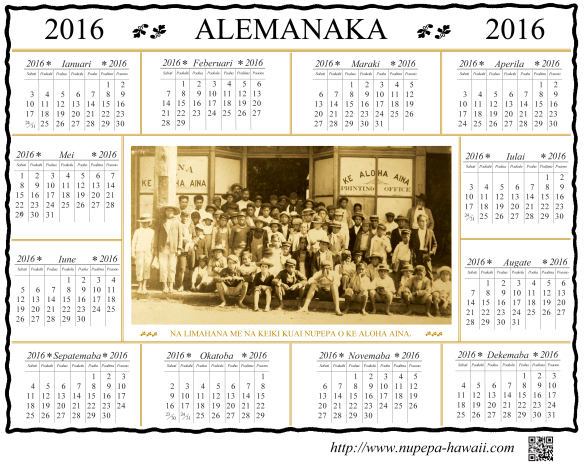
Hauʻoli 2016!

I just wanted to wish everyone a year filled with joy and laughter. And mahalo a nui to all of those people who find the time to repost and talk about the articles they think are worth repeating. That is one way to get the word out that history is not just something you read in a book and that there is not just one history.

www.nupepa-hawaii.com

2016 Alemanaka

John Kahawaiolaa passes on, 1919.

OUR YOUNGER BROTHER, JOHN KAHAWAIOLAA, HAS GONE.

JOHN KAHAWAIOLAA.

Mr. Sol. Hanohano, Editor of the Kuokoa, Aloha oe: Please extend your patience in allowing an open space of our tireless precious one, and it will carry around the sad news to all the islands of Hawaii nei, and the family, the associates, the friends, and the laborers from the appearing of the sun at Kumukahi to the taking of the sun at Lehua.

On Saturday, July 5, between the hours of 2 and 3 occurred the accident at work under the supervisors, those who built the church of Baldwin at Paia, Maui and the church of the Church of the Later Day at Laie, under those supervisors. [There might perhaps be things left out from the original.]

John Kahawaiolaa was born in Hanamaulu, Kauai, on the 28th of February, in the year 1889, and he was 30 years, 4, months, and 7 days old; and he left behind his birth mother [luaui makuahine], and his sisters and one older brother grieving with heavy heart for him.

The words of the Great Book are realized: dust to dust, and the spirit to the one who created it.

In closing these bemoaning and heavy thoughts for my beloved younger sibling [pokii], I ask that the ohana, friends, coworkers, and bosses of our beloved younger brother who left this life behind, to take our boundless thanks for all of your gifts of flower lei to honor the remains of our beloved pokii, and for your meeting with us at the funeral, and may God help us all, amene.

We, the family.

MRS. KAOHELE KAHAWAIOLAA,

MRS. HELEN KAHANU,

MRS. KELUIA HOOMANA,

JOSEPH KAHAWAIOLAA,

MRS. CARRIE K. KILIA,

MRS. LUIKA AIOKA.

[I am thinking that the picture as it appears in the original newspaper is much better than this. Maybe one day soon they will be rescanned clearly, so not only the words are legible, but the pictures will reproduced as clear as possible!]

(Kuokoa, 7/18/1919, p. 4)

KO MAKOU POKII KAIKUNANE, JOHN KAHAWAIOLAA, UA HALA

Ka Nupepa Kuokoa, Buke LVII, Helu 29, Aoao 4. Iulai 18, 1919.