Martha Poepoe Hohu and three Hilo women honored, 1929.

THREE HILO STUDENTS HONORED

Honolulu, Dec. 11—Three Students from here in Hilo, who are boarding at the Teachers’ School in Honolulu, were honored by being initiated as members of the Society of “Sigma Eta Omega,” which is the Association of the Students who were honored for doing good works among that Association of those in the Teachers College [Kula Ao Kumu] in Honolulu. This Association is honorably named in Greek, and they are bestowed this position because of their standing in this Teachers College of Hawaii.

The ones from Hilo upon whom were bestowed this honored name, were Miss Wilhelmina Roback, the daughter of Mr. and Mrs. William Roback of Hilo nei.

This honor was conferred upon this girl from Hilo because of her singing abilities at that Teachers College.

This honor was also conferred upon Veronica Lui Kwan, the President of this Association, and this honor was bestowed upon her because of her skill in organizing the association; and to Mrs. Georgian Sutherland for her progress in studies. There were others as well receiving this honor and were initiated into this Greek Honors Society, the only society established in Hawaii nei; the daughter of Rev. H. K. Poepoe was also one included in this honored position, that being the Organist of Kaumakapili Church, Mrs. Martha Hohu.

A gathering was held at the College to initiate those who were honored, and on the evening of that day a celebratory party was held at the Blaisdell Hotel.

[Hoku o Hawaii, the last of the historic Hawaiian-Language Newspapers and one of the longest running (1906–1948) was printed in Hilo. For some reason, there seems to be at this time no issues online from before 5/31/1917. Eleven years of this paper is available on microfilm, but are not online as of yet. Hopefully, this newspaper can get reshot in entirety soon, because much of the available images are hard to read.]

(Hoku o Hawaii, 12/17/1929, p. 1)
HOOHANOHANO IA HE EKOLU HAUMANA O HILO NEI

Ka Hoku o Hawaii, Buke XXIII, Helu 27, Aoao 1. Dekemaba 17, 1929.
More on Jane Loeau, 1867.

[Found under: “LOCAL NEWS: Hawaii.”]

Instrument is sought after.—Eleio, Hawaii is putting effort into raising money to purchase a melodeon [melodiana] for its church house. If they should obtain one, then it will be Jane Loeau who will play it. An English school is also being taught by her there. It is hoped that her education effort for her dark-skinned [iliulaula] race will progress

(Kuokoa, 1/12/1867, p. 2)

Makemake e loaa ka pila.

Ka Nupepa Kuokoa, Buke VI, Helu 2, Aoao 2. Ianuari 12, 1867.

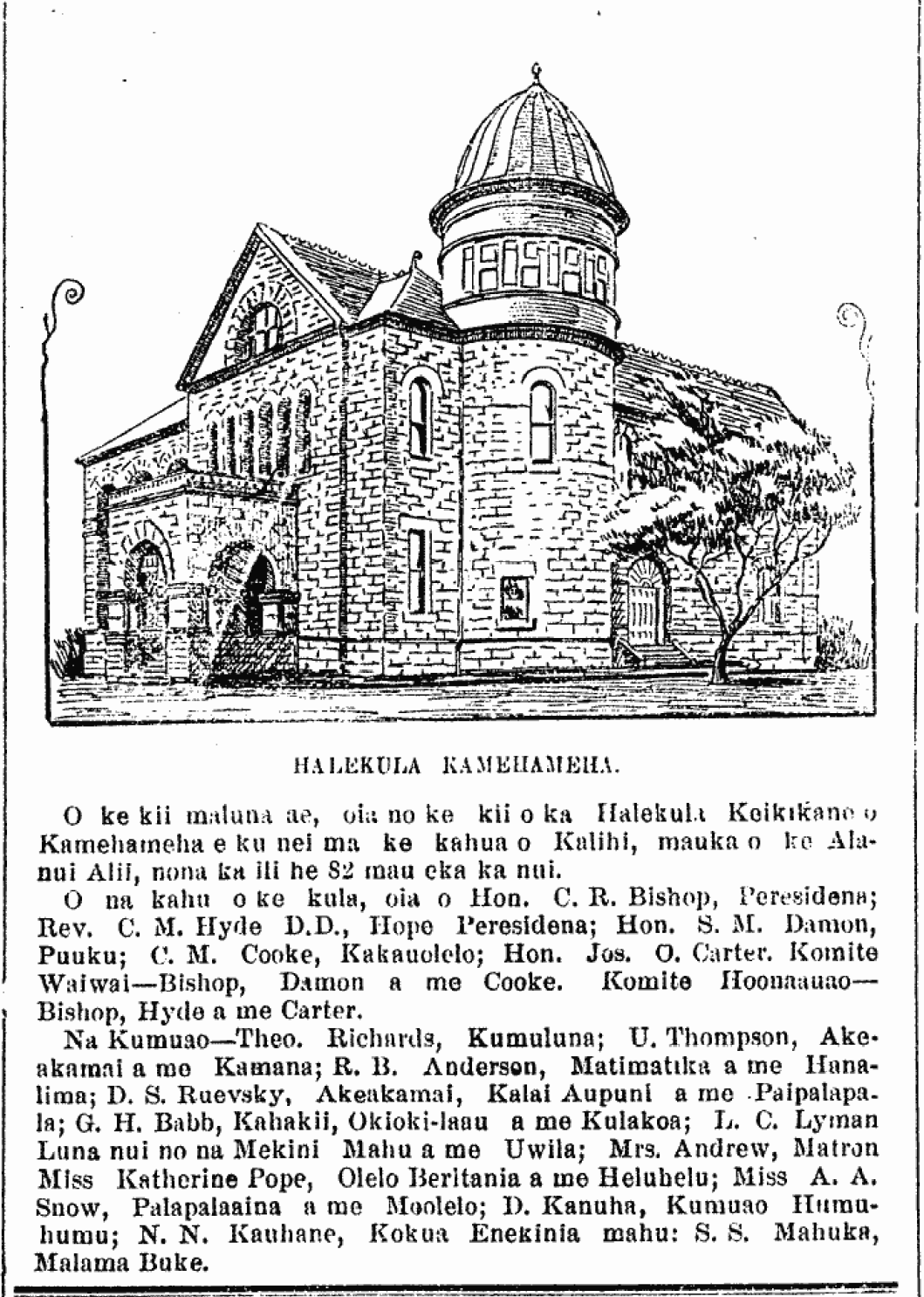
Kamehameha Boys’ School, Bishop Hall, 1894.

KAMEHAMEHA SCHOOLHOUSE.

The picture above is a picture of the Kamehameha Boys’ Schoolhouse, which stands on the grounds in Kalihi, upland of King Street [Alanui Alii], and its area is 82 acres.

The school supervisors are the Hon. C. R. Bishop, President; Rev. C. M. Hyde, D. D., Vice President; Hon. S. M. Damon, Treasurer; C. M. Cooke, Secretary; Hon. Joseph O. Carter. Financial Committee—Bishop, Damon, and Cooke. Education Committee—Bishop, Hyde, and Carter.

Instructors—Theodore Richards, Principal; U. Thompson, Science and Carpentry; R. B. Anderson, Mathematics and Manual Labor; D. S. Ruevsky, Science, Political Science, and Printing; G. H. Babb, Drawing, Wood Shop, and Military Education; L. C. Lyman, Head of the Steam and Electric Engines; Mrs. Andrews, Matron; Miss Katherine Pope, English Language and Reading; Miss A. A. Snow, Geography and History; D. Kanuha, Sewing Teacher; N. N. Kauhane, Assistant Steam Engineer; S. S. Mahuka, Librarian.

(Kuokoa, 6/2/1894, p. 1)

HALEKULA KAMEHAMEHA.

Ka Nupepa Kuokoa, Buke XXXIII, Helu 22, Aoao 1. Iune 2, 1894.

A haole kamaaina’s advice on teaching English instead of Hawaiian, 1872.

Pertaining to the English Language.

O Kuokoa Newspaper: Aloha oe:—

In the year 1866, I asked a missionary, “What is the reason English isn’t being taught in the government schools,” and he replied, “That is what I think as well, but we are weak, there are not enough of us, and we teach Hawaiian, and from amongst our students we find teachers.”

The Hawaiians are often astounded at seeing how quickly the haole gains wealth, and one asked me, “How does the haole get rich?” I answered this way, “Why is the cow in the fields fatter than the cow that works, isn’t it because it isn’t tamed? or because it is independent? or because it refuses to have it’s neck put in a yoke? That’s it. So when shown the yoke of the haole, your necks are put within it and your noses are soon wired; some may say, ‘How are we to live if we don’t work under the haole; they have the work, to them belongs the land, because soon our land will all be taken by you.’ It is true, you cannot survive without working for the rich (haole), but you can think about your children, lest they fall into the abyss with you. This race was called a race of slaves in a newspaper in New York, and I say to you that this will soon be true. ‘Your noses will be put through with a wire.’ until the day when the English language spreads amongst you, then you’ll will be able to remove your yokes and associate with the haole.

If you all understand the language and the knowledge of the haole, then you’d be able to climb the path and meet up with them in law, medicine, &c.

What is the reason that the college of Lahainaluna is not changed, having only English taught there?

This college is currently a waste. And so too the other schools, the government schools. We must all think carefully about the good of our children. That is no reason for them to forever more work under yearly contracts, for we’ve worked under yearly contracts during out lifetimes.

If the schools were changed so that just English was taught, I predict that after fifteen years, and if the haole leave, then you’d become your own leaders in the government, and not only haole would be appointed.

Kamaaina haole.

Lahaina, Maui.

{This is a letter written by a haole, and it is for us to determine his competence.}

[The argument over what language should be taught in schools is a heated topic that can be seen throughout the life of the Hawaiian-Language Newspapers. At first the argument is whether or not to teach English, and in later years when more and more schools are taught in English, the argument for teaching Hawaiian in schools will become prominent. Most everyone it seems were concerned with the future of the children (whether they were for English or Hawaiian-language education).]

(Kuokoa, 10/26/1872, p. 2)

No ka Olelo Haole.

Ka Nupepa Kuokoa, Buke XI, Helu 43, Aoao 2. Okatoba 26,1872.

Announcement for the opening of Kamehameha School for Boys, 1887.

THE KAMEHAMEHA SCHOOL FOR
BOYS

THE KAMEHAMEHA SCHOOL FOR BOYS
will be ready for the admission of students on the

First Tuesday of October, 1887

Only a limited number of Students will be received this year, and those desiring to enter the School in the future must apply on the 1st day of September 1887.

Each student will occupy a separate room furnished with bed, table, and chair; and a list of items to be furnished by each student will be sent if asked for in advanced to the teacher.

Each student will be allowed to carry out 12 hours a week of manual labor. For industrial arts, two hours a day, and five days a week. Military drilling and physical education will be a portion of the curriculum everyday.

Arithmetic, English Language, Popular Science [Akeakamai], Elementary Algebra [Anahonua], Free-hand and Mechanical Drawing [Kakau me Kaha Kii], Practical Geometry [Moleanahonua], Bookkeeping [malama Buke Kalepa], tailoring [tela humu lole], printing [pai palapala], masonry [hamo puna], and other similar things, and blacksmithing.

tuition for the schooling.

($40) FORTY DOLLARS PER YEAR.

$20 to be paid at the beginning of each quarter.

The students must get prior approval from the Doctor attesting to their good health, and letters of recommendation from other schools.

Examinations for those entering will be held on MONDAY, OCTOBER 25, 1887, at the schoolhouse at Palama, 8:30 A. M. They will show their knowledge in reading, writing, geography, the four rules of Arithmetic, writing in English, and the spelling of 100 English words.

As for anything else, you may find out by asking the principal.

REV. WILLIAM B. OLESON.

[See also the English-language announcement found in the May 24th issue of the Hawaiian Gazette. It is interesting to note especially the difference in the wording for the part about manual labor.]

(Kuokoa 5/28/1887, p. 2)

KE KULA KAMEHAMEHA NO NA KEIKIKANE.

Ka Nupepa Kuokoa, Buke XXVI, Helu 22, Aoao 2. Mei 28, 1887.

E o, e Kaleleonalani! Queen Emma and Kamehameha Schools, 1887.

KAMEHAMEHA SCHOOL.

The gates of the Kamehameha School for boys will open in October of this current year. The imperfections of one of the dormitories of 30 x 64 [feet] are almost smoothed out, and another was complete before. These dormitories are two storied, bottom floor and top floor, and each of them have 24 rooms of 8 x 12, and a hallway [keena waena loloa]. One room of each house is furnished with facilities to wash up and clean, and the rest of the rooms are bedrooms, each being supplied with a iron bed, desk, chair, closet, and some other furnishings. The rooms are clean and lighted, and well-furnished for the student.

The dining hall of 29 x 81 feet is a separate building, and it is 18 feet from the bottom to the ceiling, and it will fit two-hundred people. A stone building will be built behind this, which will be the kitchen and and a place to store the food and all cookware and dinnerware.

A proper schoolhouse will be built after the buildings that are desired to be completed quickly are done, and in the meantime, parts of the dining hall will be set aside as school rooms.

A clear spring will supply the school with water and it is by steam pumps that the water will be brought up and filled into a separate water tank, and from there into many pipes laid all over the grounds and buildings.

The curriculum at this school teaches thoroughly the branches of the English language; and outside of that are the teaching of industrial arts. Some rooms of the school house will be set aside as rooms for carpentry, printing, tailoring, blacksmithing, and masonry. The instruction will take place under the direction of a mechanic [mekanika]. Some time will also be set aside for military drilling, physical development, and so forth.

There are fun and cheerful activities for the students. This school sits on a serene site, living there is pleasant, and it is separated from the town of Honolulu.

In a section of this paper, the reader will see the advertisement dealing with this School. This is the educating home established for the benefit of Hawaii’s children who seek education, and built by way of the estate of the late Dowager Queen Ema Kaleleonalani. This home stands in the plain of Kaiwiula in Kalihi, and it is near completion. On the first Tuesday of October 1887, this school will open to students.

It has been heard that the assets of the school will be increased for the good of the children, and for now, parents who want their children to progress forward are being urged to rush to this new home where knowledge is increased. Much benefits will be gained if patient and if the aloha of the royal parent Ema Kaleleonalani is held resolute as well by Hawaii’s children, the one who left this great gift behind. Look at its published notice.

[On this, the day after Queen Emma’s 177th birthday, i thought it would be a good thing  to look back at her role in the establishment of the Kamehameha Schools, a role which she is not recognized often for today.

Notice the difference between the article appearing in the May 24th edition of the Hawaiian Gazette, “The Kamehameha Schools.” (probably what the article is based upon) and this Hawaiian-Language article.]

(Kuokoa, 5/28/1887, p. 2)

KE KULA KAMEHAMEHA.

Ka Nupepa Kuokoa, Buke XXVI, Helu 22, Aoao 2. Mei 28, 1887.

Hugo Kawelo, sent to Glasgow to study, returns, 1886.

HAWAIIAN YOUTH RETURNS.

On the ship that brought the Portuguese laborers, Mr. Hugo Kawelo, one of the youths sent to Scotland [Sekotia] to seek education by working [unclear word] in an iron works factory. Because of sickness, he returned, but when he arrived back, he was the epitome of a robust and vigorous man. It was as if the air of the open ocean brought him back to health. He wishes to return to complete his education in the iron [unclear word] industry, should his health be good.

[Hugo Kawelo is one of the select Hawaiians sent abroad by Kalakaua to study and to bring back this knowledge to move Hawaii forward. For more on this program, see for instance: Agnes Quigg’s “Kalakaua’s Hawaiian Studies Abroad Program” from the Hawaiian Journal of History.

Here is one another example of a badly imaged newspaper. I guessed the meaning of some of the passage.

One of our readers, Lynda Fitzgerald, asked who can be contacted to get the original Hawaiian-Language Newspapers reshot clearly. I don’t have a specific name, but the more people that know how important this is, the more likely it will be done. So talk to your friends and coworkers and heads of boards and kumu hula and civic club officers and the aunty down the street. Why do you think seeing all of this information clearly is important…]

(Nupepa Elele, 3/6/1886, p. 2)

HAWAII OPIO UA HOI MAI.

Ka Nupepa Elele, Buke VII, Helu 36, Aoao 2. Maraki 6, 1886.

On the perpetuation of the Hawaiian Language, 1911.

THE HAWAIIAN LANGUAGE

Before the Legislature is a bill put forth by the Honorable W. J. Sheldon of Waimea, Kauai, which seeks to perpetuate the mother tongue of this land; but the committee announced that the bill will be tabled; to which the father of the bill asked that they wait for a bit until the following Saturday, April 1.

The intent of the bill is to allow for time in some schools to teach the Hawaiian language. “Here are the Japanese,” said the Honorable One, “they are caring for their mother tongue, and so too of the Chinese; but we, the native children of this land, our native language is disappearing from our own land. It is imperative that we try to perpetuate our beautiful language even just a little longer. I feel remorse in letting the beautiful language of our ancestors go. The government pays for travelling instructors to teach singing and lace making [hana lihilihi ?] in public schools, so why not choose people like that to go and teach for one hour every school day? It will not be a great expense like what is imagined by the committee.”

We believe that these are very wise responses by the Honorable One of Waimea, and if indeed means are not sought to perpetuate the beloved language of our birth land, then it will not be long before the Hawaiian language will disappear completely.

The Hoku gives its mahalo to the Honorable One of the Waiula Iliahi¹ of Waimea for his consideration and aloha for the beautiful language of the Paradise of the Pacific Ocean.

¹Waiula Iliahi is one of the two branches of the Waimea River, and the other being Waikea, and they merge at Kikiaola.

(Hoku o Hawaii, 3/30/1911, p. 2)

KA OLELO HAWAII

Ka Hoku o Hawaii, Buke 5, Helu 47, Aoao 2. Maraki 30, 1911.

English version of David Kanewanui’s Death Announcement, 1902.

DEATH OF DAVID KANEWANUI, EDITOR OF WEEKLY KUOKOA

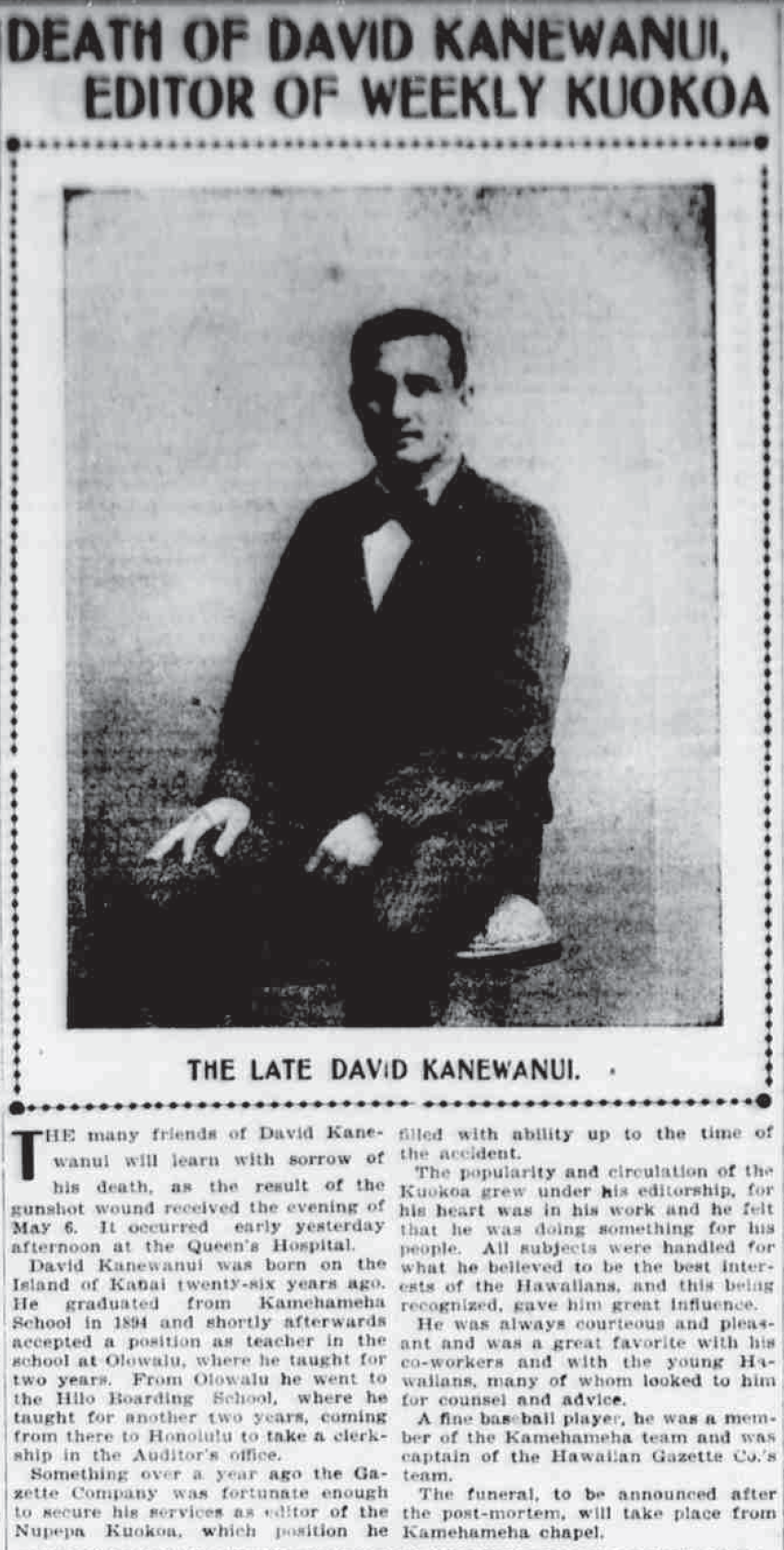
THE LATE DAVID KANEWANUI.

THE many friends of David Kanewanui will learn with sorrow of his death, as the result of the gunshot wound received the evening of May 6. It occured early yesterday afternoon at the Queen’s Hospital.

David Kanewanui was born on the Island of Kauai twenty-six years ago. He graduated from Kamehameha School in 1894 and shortly afterwards accepted a position as teacher in the school at Olowalu, where he taught for two years. From Olowalu he went to the Hilo Boarding School, where he taught for another two years, coming from there to Honolulu to take a clerkship in the Auditor’s office.

Something over a year ago the Gazette Company was fortunate enough to secure his services as editor of the Nupepa Kuokoa, which position he filled with ability up to the time of the accident.

The popularity and circulation of the Kuokoa grew under his editorship, for his heart was in his work and he felt that he was doing something for his people. All subjects were handled for what he believed to be the best interests of the Hawaiians, and this being recognized, gave him great influence.

He was always courteous and pleasant and was a great favorite with his co-workers and with the young Hawaiians, many of whom looked to him for counsel and advice.

A fine baseball player, he was a member of the Kamehameha team and was captain of the Hawaiian Gazette Co.’s team.

The funeral, to be announced after the post-mortem, will take place from Kamehameha chapel.

(Hawaiian Gazette, 5/23/1902, p. 5)

DEATH OF DAVID KANEWANUI, EDITOR OF WEEKLY KUOKOA

The Hawaiian Gazette, Volume XXXVII, Number 39, Page 5. May 23, 1902.