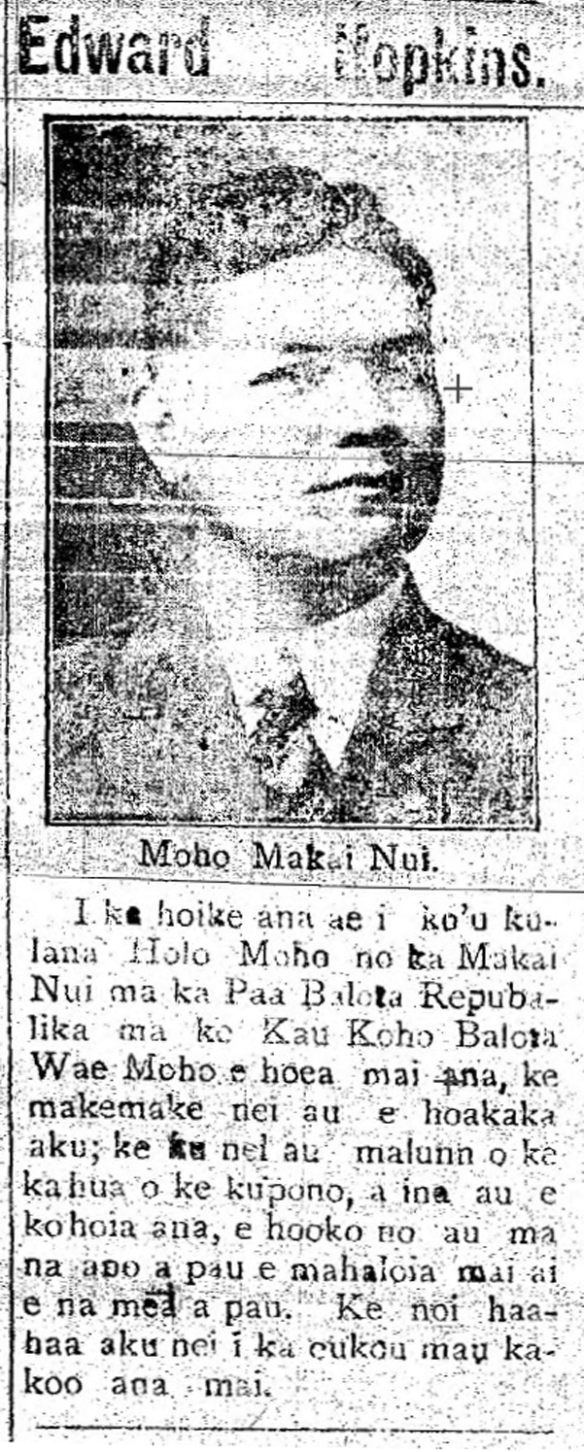
Edward Hopkins runs for Sheriff, 1917.

Edward Hopkins.

Candidate for Sheriff.

As I announce my candidacy for Sheriff on the Republican Ballot in the upcoming Election Season, I would like to make clear that I stand on the platform of good, and should I be elected, I will carry out all things so that everyone will be pleased. I ask humbly for your support.

(Puuhonua o na Hawaii, 5/25/1917, p. 4)

PONH_5_25_1917_4.png

Ka Puuhonua o na Hawaii, Buke IV, Helu 21, Aoao 4. Mei 25, 1917.

Short biography of the great Joseph Mokuohai Poepoe, 1912.

JOSEPH MOKUOHAI POEPOE

This candidate for the legislature in the Democratic party of Oahu nei was born at Honomakau, which is famous for the saying: “No youth of Kohala goes out unprepared” [“Aohe u’i hele wale o Kohala”]. This also is the birthplace of the Hon. H. M. Kaniho. He was born on the 27th of March, 1852. When he was small, he was brought to Honolulu. He entered into the districts schools [kula apana] here in Honolulu, and also in Kalauao, Ewa. And thereafter he attended the Royal School at Kehehuna, and its head Instructor was Mr. Beckwith. After two years there, he entered Ahuimanu College in Koolaupoko, under the instruction of the Fathers Elekenio, Remona, Livino, and the many other teachers. He was taught law in North Kohala under Judge P. Kamakaia. He returned here to Honolulu and studied law at the law school of W. R. Castle [W. R. Kakela], as well as at the law school of S. B. Dole. He studied law with lawyers Davidson and Lukela. In 1884, he received his full license to practice law in all Courts of Hawaii nei, and he still retains his law license. He was an editor for many of the Hawaiian-language newspapers in this town. Currently, he is the editor for KE ALOHA AINA. He was a teacher at the boarding school of Rev. E. Bond [Rev. E. Bona] in Kohala. He was the first to establish an English language school in North Kohala, Hawaii. He was an assistant teacher at the British Government School at Ainakea, under H. P. Wood, and thereafter under E. N. Dyer. For many years he tried to join the Legislature, so that the lahui would see him pass laws that would benefit the lahui in need; but the people did not assent. Now his hope is that it will be in the upcoming election that the voters will come through, making him a Representative, whereupon he will show his works for the good of the land and for the advancement of the lahui.

[Poepoe played a huge part in the history of the Hawaiian-Language Newspapers! I was happy to find this. Also, I just saw this morning more on the Catholic school at Ahuimanu on Nanea Armstrong-Wassel’s instagram page. Go check it out. There is a picture of the school as well!]

(Aloha Aina, 10/26/1912, p. 1)

AlohaAina_10_26_1912_1.png

Ke Aloha Aina, Buke XVII, Helu 43, Aoao 1. Okatoba 26, 1912.

William Kamaalea Hussey, political advertisement, 1922.

MUCH APPRECIATION.

O Ladies and gentlemen, my citizen lords of the Fifth District of the Island of Oahu nei; Aloha to you all.

With a heart of true aloha, I extend my great appreciation to you, my beloved lahui, the native offspring of Hawaii, my beloved land, for your presenting upon me the magnificent supreme lei of 3426 votes of your aloha, along with your trust in me, and with that aloha, I have become a representative and a servant for you all, and for the people from Hawaii to Niihau.

Therefore, my dear citizen lords, I humbly ask that you look for, search for, and think about work that I should do in this coming legislative session; your voice and your command is what I will carry out for the equal rights of the people and for the people. As for all of your orders to me, I can speak with you at all times that you want me.

Long live the Hawaiian Lahui and the Aina.

Your humble servant.

WILLIAM KAMAALEA HUSSEY,

Honolulu, Nov. 11, A. D. 1922.

(Kuokoa, 11/16/1922, p. 7)

HE HOOMAIKAI NUI.

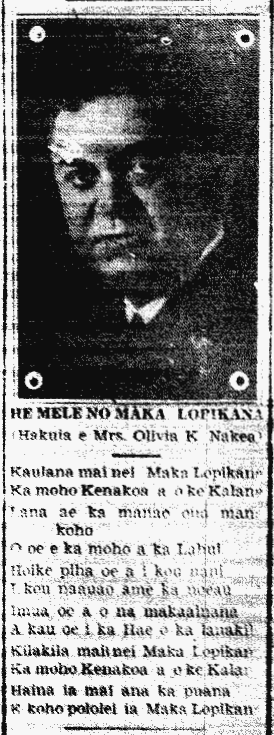
Political Mele for Mark Robinson, 1930.

HE MELE NO MAKA LOPIKANA

(Hakuia e Mrs. Olivia K. Nakea)

Kaulana mai nei Maka Lopikana
Ka moho Kenakoa a o ke Kalana
Lana ae ka manao ona mana koho
O oe e ka moho a ka Lahui
Hoike piha oe a i kou nani
I kou naauao ame ka noeau
Imua oe a o na makaainana
A kau oe i ka Hae o ka lanakila
Kilakila mai nei Maka Lopikana
Ka moho Kenakoa a o ke Kalana
Haina ia mai ana ka puana
E koho pololei ia Maka Lopikana

[A SONG FOR MARK ROBINSON

(Composed by Mrs. Olivia K. Nakea)

Famous is Mark Robinson
The Senatorial candidate of the County
The voters are hopeful
That you are the representative of the Lahui
Reveal fully of your beauty
Of your expertise and wisdom
You appear before the people
Displaying the flag of victory
Majestic is Mark Robinson
The Senatorial candidate of the County
Let the refrain be told
Vote straight away for Mark Robinson]

(Alakai o Hawaii, 7/9/1930, p. 1)

HE MELE NO MAKA LOPIKANA

Ke Alakai o Hawaii, Buke 3, Helu 10, Aoao 1. Iulai 9, 1930.

Duke runs for reelection as sheriff of the city and county of Honolulu, 1936.

Duke Kahanamoku Asks Sheriff Re-election On Basis of Present Record

Kahanamoku, scion of one of the few remaining full-blooded Hawaiian families in the islands, was responsible for returning the sheriff’s office, for the first 25 years of city and county government always held by a Democrat, to the Democratic fold after it had lapsed momentarily into the hands of the Republicans with results that are too well known and too well remembered by every resident of Hawaii to repeat here.

Perhaps the most famous living exponent of the Hawaiian race is Duke P. Kahanamoku, who first spread the name of the Territory over the newspapers and magazines of the world by his swimming prowess and is now seeking re-election as sheriff of the city and county of Honolulu on the Democratic ticket.

For Sheriff

DUKE P. KAHANAMOKU

The Duke first took the world by storm when, and absolutely unknown, he went to the quadrennial Olympic games as one of the American team and made a clean sweep of all the swimming events in which he was entered, establishing several world’s records that stood for many years. He repeated this performance in the following Olympic games and ruled supreme in acquatic affairs until his voluntary retirement from active competition.

On his return to Hawaii the gratitude of the citizens of the Territory was expressed in the form of a public fund which was used to provide a residence for the Kahanamoku family.

The Duke declares in his speeches that he carries on the duties of sheriff of the city and county in the clean and sportsmanlike manner which distinguished his athletic career.

Despite inadequate appropriations provided for the greatly needed new construction at the city and county jail, which is under the jurisdiction of the sheriff’s office, Kahanamoku has established an efficient record in the conduct of this institution—a record on which he is asking renomination at re-election.

“I am a man of few words,” the Duke declares. “When I was representing Hawaii against the best swimmers in the world, I never predicted that I would win any particular race—but I think I won my share. It is the same with the present race for the sheriff’s office.”

[Duke seems to have followed in the footsteps of his father. Duke P. Kahanamoku’s father, Duke K. Kahanamoku served in various positions in the police department, ultimately reaching the rank of captain.]

(Alakai o Hawaii, 9/24/1936, p. 1)

Duke Kahanamoku Asks Sheriff Re-election On Basis of Present Record

The Hawaii Democrat, Volume 9, Number 24, Page 1. September 24, 1936.

Another political mele for Curtis Piehu Iaukea, 1904.

C. P. IAUKEA THE REPRESENTATIVE THAT WILL SAVE HAWAII.

P—Piha hauoli na mokupuni,
I—I ke Alakai hou o Hawaii,
E—Eia mai ka Elele Lahui,
H—Hanohano ai oe e Hawaii,
U—Ua kohu pono ma ia kulana.

I—Imua kakou e ka lahui,
A—A welo hou e ka Hae Hawaii,
U—Ua lokahi na makaainana,
K—Kakoo like i ka Moho Lahui,
E—E ola ka Elele Demokalaka,
A—A au i ke kai me ka lanakila.

[The islands are filled with joy,
In the new Leader of Hawaii,
Here is the Representative,
In whom you, O Hawaii, will be proud,
He will be right for the position.

Let us move forward, O Lahui,
And let the Hawaiian Flag flutter once more,
The citizens are unified,
And support together the Candidate of the People,
Long live the Democratic Representative,
And travel the sea in victory.]

[Once again inspired by a post by Nanea Armstrong-Wassel. Here is the mele she speaks of  by Ernest Kaai, “Lanakila Iaukea,” found in the Kuokoa, 10/26/1906, p. 4, here.]

(Aloha Aina, 11/5/1904, p. 4)

C. P. IAUKEA KA ELELE OLA HAWAII.

Ke Aloha Aina, Buke X, Helu 46, Aoao 4. Novemaba 5, 1904.

Another political mele for William Haehae Heen, 1923.

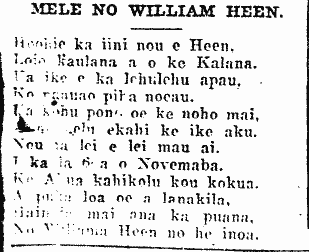
A MELE FOR WILLIAM HEEN.

Hoohie ka iini nou e Heen,
Loio kaulana a o ke Kalana.
Ua ike e ka lehulehu apau,
Ko naauao piha noeau.
Ua kohu pono oe ke noho mai,
[Unclear passage] ekahi ke ike aku.
Nou ia lei e lei mau ai,
I ka la 6 [?] a o Novemaba.
Ke Akua kahikolu kou kokua,
A puka loa oe a lanakila.
Haina ia mai ana ka puana,
No Wiliama Heen no he inoa.

[The dignified is the desire for you O Heen
Famous attorney of the County
All are aware
Of your knowledge filled with wisdom
[Unclear passage] is foremost to see
On the 6th [?] of November.
The Trinity is your aid,
And you will win the election.
Let the story be told,
The name song of Wiliama Heen.]

[This is just another of the many political mele for William Haehae Heen. This post was inspired by a post earlier this week by Nanea Armstrong-Wassel!]

(Kuokoa, 11/1/1923, p. 5)

MELE NO WILLIAM HEEN.

Ka Nupepa Kuokoa, Buke LXII, Helu 44, Aoao 5. Novemaba 1, 1923.

St. Andrew’s, the early days, 1909.

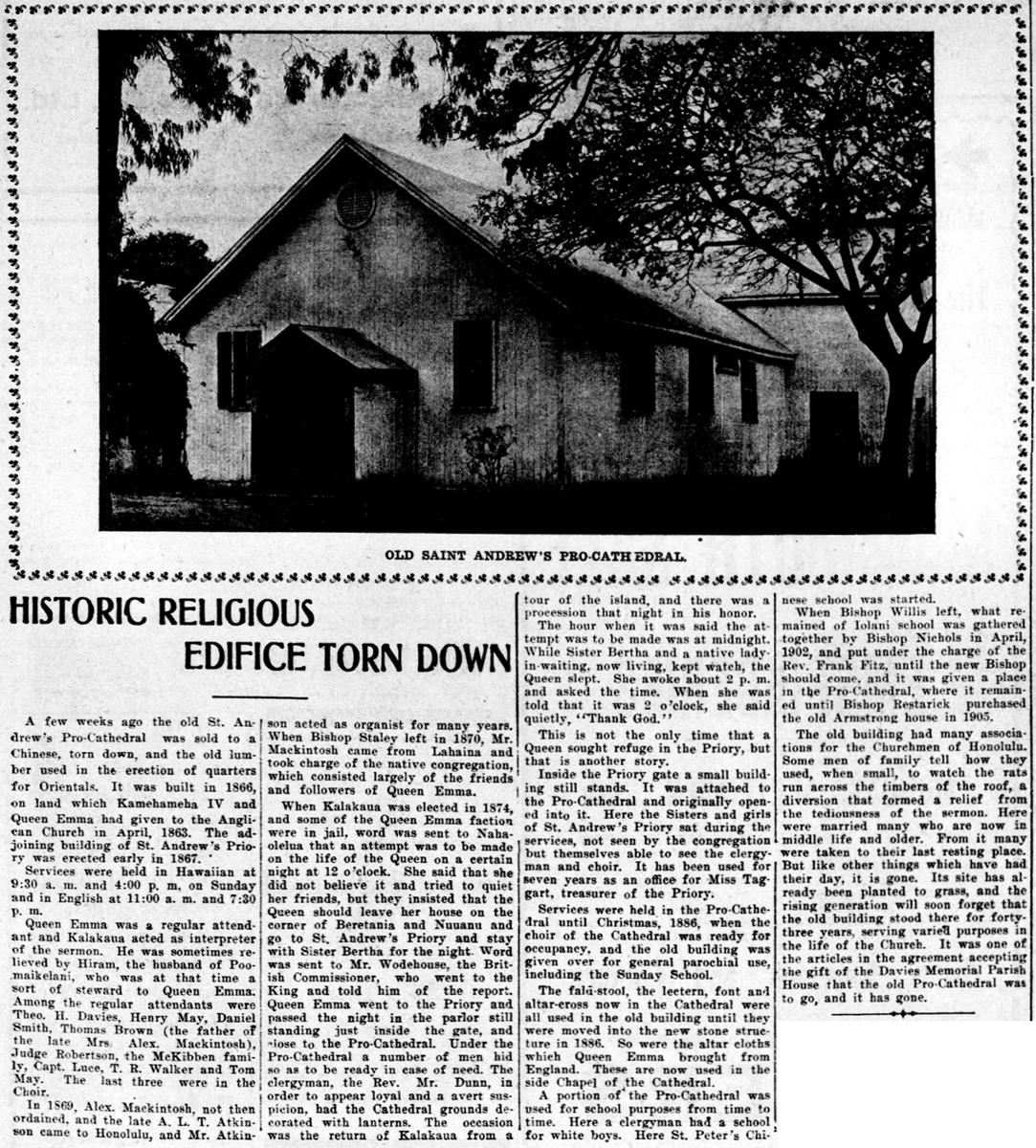
OLD SAINT ANDREW’S PRO-CATHEDRAL.

RELIGIOUS EDIFICE TORN DOWN

A few weeks ago the old St. Andrew’s Pro-Cathedral was sold to a Chinese, torn down, and the old lumber used in the erection of quarters for Orientals. It was built in 1866, on land which Kamehameha IV and Queen Emma had given to the Anglican Church in April 1863. The adjoining building of St. Andrew’s Priory was erected in 1867.

Services were held in Hawaiian at 9:30 a. m. and 4:00 p. m. on Sunday and in English at 11:00 a. m. and 7:30 p. m.

Queen Emma was a regular attendant and Kalakaua acted as interpreter of the sermon. He was sometimes relieved by Hiram, the husband of Poomaikelani, who was at that time a sort of steward to Queen Emma. Among the regular attendants were Theo. H. Davies, Henry May, Daniel Smith, Thomas Brown (the father of the late Mrs. Alex. McKintosh), Judge Robertson, the McKibben family, Capt. Luce, T. R. Walker and Tom May. The last three were in the Choir.

In 1869, Alex. Mackintosh, not then ordained, and the late A. L. T. Atkinson came to Honolulu, and Mr. Atkinson acted as organist for many years. When Bishop Staley left in 1870, Mr. Mackintosh came from Lahaina and took charge of the native congregation, which consisted largely of the friends and followers of Queen Emma.

When Kalakaua was elected in 1874, and some of the Queen Emma faction were in jail, word was sent to Nahaolelua that an attempt was to be made on the life of the Queen on a certain night at 12 o’clock. She said that she did not believe it and tried to quiet her friends, but they insisted that the Queen should leave her house on the corner of Beretania and Nuuanu and go to St. Andrew’s Priory and stay with Sister Bertha for the night. Word was sent to Mr. Wodehouse, the British Commissioner, who went to the King and told him of the report. Queen Emma went to the Priory and passed the night in the parlor still standing just inside the gate, and close to the Pro-Cathedral. Under the Pro-Cathedral a number of men hid so as to be ready in case of need. The clergyman, the Rev. Mr. Dunn, in order to appear loyal and a avert suspicion, had the Cathedral grounds decorated with lanterns. The occasion was the return of Kalakaua from a tour of the island, and there was a procession that night in his honor.

The hour when it was said the attempt was to be made was at midnight. While Sister Bertha and a native lady-in-waiting, now living, kept watch, the Queen slept. She awoke about 2 p. m. and asked the time. When she was told that it was 2 o’clock, she said quietly, “Thank God.”

This is not the only time that a Queen sought refuge in the Priory, but that is another story.

Inside the Priory gate a small building still stands. It was attached to the Pro-Cathedral and originally opened into it. Here the Sisters and girls of St. Andrew’s Priory sat during the services, not seen by the congregation but themselves able to see the clergyman and choir. It has been used for seven years as an office for Miss Taggart, treasurer of the Priory.

Services were held in the Pro-Cathedral until Christmas, 1886, when the choir of the Cathedral was ready for occupancy, and the old building was given over for general parochial use, including the Sunday School.

The fald-stool, the lectern, font and altar-cross now in the Cathedral were all used in the old building until they were moved into the new stone structure in 1886. So were the altar cloths which Queen Emma brought from England. These are now used in the side Chapel of the Cathedral.

A portion of the Pro-Cathedral was used for school purposes from time to time. Here a clergyman had a school for white boys. Here St. Peter’s Chinese school was started.

When Bishop Willis left, what remained of Iolani school was gathered together by Bishop Nichols in April, 1902, and put under the charge of the Rev. Frank Fitz, until the new Bishop should come, and it was given a place in the Pro-Cathedral, where it remained until Bishop Restarick purchased the old Armstrong house in 1905.

The old building had many associations for the Churchmen of Honolulu. Some men of family tell how they used, when small, to watch the rats run across the timbers of the roof, a diversion that formed a relief from the tediousness of the sermon. Here were married many who are now in middle life and older. From it many were taken to their last resting place. But like other things which have had their day, it is gone. Its site has already been planted to grass, and the rising generation will soon forget that the old building stood there for forty-three years, serving varied purposes in the life of the Church. It was one of the articles in the agreement accepting the gift of the Davies Memorial Parish House that the old Pro-Cathedral was to go, and it has gone.

(Pacific Commercial Advertiser, 9/18/1909, p. 3)
HISTORIC RELIGIOUS EDIFICE TORN DOWN

The Pacific Commercial Advertiser, Volume L, Number 8459, Page 3. September 18, 1909.

Napoleon Kalolii Pukui supporting Charles E. King for delegate to Congress, 1922.

Truth of Truths.

There was something new heard from my candidate, Charles E. King [Kale E. Kini], when he announced on the past 18th, that being this past Monday, that he met with Papai (Clarence Crabbe), the manager of John Wise [Keoni Waika], who relayed his thoughts to my candidate. “We were given the endorsement from the prominent ones [maka nunui] of five sugar plantations, and here in the palm of my hand is the money to push John Wise into the win, the candidate of their choice.

“Therefore, you and Lyman [Laimana] have no hopes for winning.”

That was wen my candidate replied back to him, “Hey, Papai [“Crab”], wasn’t it you who came before me in person three times asking for me to run as a candidate this season?” So I said to you, What about John Wise? And you told me that I cannot trust him; you are the one that I trust, more than him; and now you are tossing me aside. This is not something that will make me give up; I will run for the win and the victory.”

This is what Papai’s answer was to him, “I really don’t want this job, my being prodded on at this work by the big wigs of the Sugar Plantations.”

So therefore friends, we see the sugar plantation’s representative and fishing konohiki; we scope out the name of the fish of the fisherman, a “Papai,” and that is the fish caught in the fish trap [hinai] of John Wise, his fish is a crab.

He will not catch the delectable travelling uhu of Kaena Point, the craving of the daughter of Kakuhihewa. How is that fisherman throwing out his chum; he probably did not consider first the flow of the current; he just threw out his chum where the current will carry it out to Mauiloa, and so the fisherman will return home with nothing, his fish will be the crab, the crab with its menacing claws.

We all know that money is being thrown about these days; take it and fill your palms, but on election day, think carefully. Let Charles King be yours.

Sincerely,

NAPOLEON K. PUKUI

[The word play in the original Hawaiian is very fun. N. K. Pukui was a character!]

(Kuokoa, 10/5/1922, p. 7)

KA OIAIO O NA OIAIO.

Ka Nupepa Kuokoa, Buke LXI, Helu 40, Aoao 7. Okatoba 5, 1922.