More on Moanalua Park, 1899.

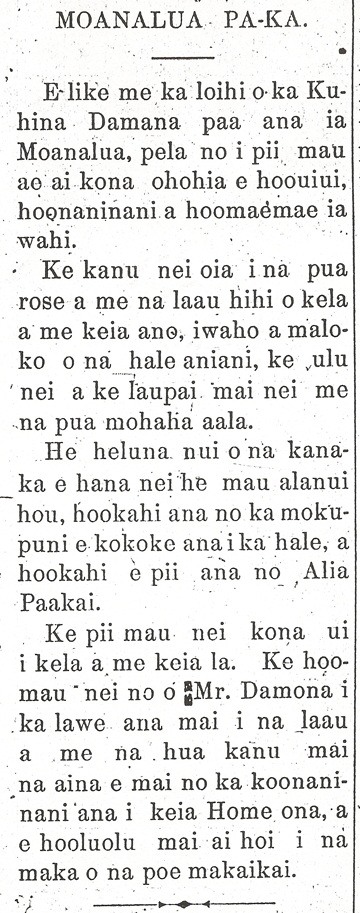
MOANALUA PARK.

As long as Minister Damon [Damana] has been in possession of Moanalua, his desire to beautify, ornament, and to clean up the area has been increasing.

He is planting roses and vines of all sorts and these are growing and increasing inside and outside of the glass houses with their blossoming fragrant blossoms.

There are many people constructing new roads; one will be for the island which will be close to the house and one will go up to Alia Paakai.

Its beauty is intensifying every day. Mr. Damon will continue to bring in plants and fruits from other lands to adorn this Home of his, and it will please the eyes of those who visit.

(Lahui Hawaii, 3/25/1899, p. 5)

MOANALUA PA-KA.

Ka Lahui Hawaii, Buke 1, Helu 9, Aoao 5. Maraki 25, 1899.

Mild hula ku’i and California Midwinter International Exposition, 1894.

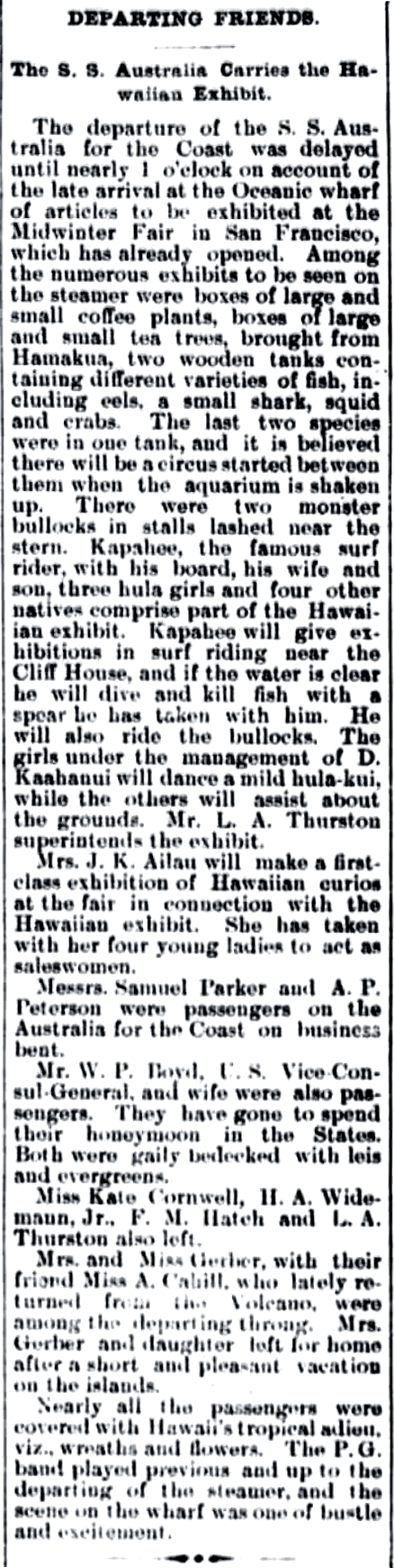
DEPARTING FRIENDS.

The S. S. Australia Carries the Hawaiian Exhibit.

The departure of the S. S. Australia for the Coast was delayed until nearly 1 o’clock on account of the late arrival at the Oceanic wharf of articles to be exhibited at the Midwinter Fair in San Francisco, which has already opened. Among the numerous exhibits to be seen on the steamer were boxes of large and small coffee plants, boxes of large and small tea trees, brought from Hamakua, two wooden tanks containing different varieties of fish, including eels, a small shark, squid and crabs. The last two species were in one tank, and it is believed there will be a circus started between them when the aquarium is shaken up. There were two monster bullocks in stalls lashed near the stern. Kapahee, the famous surf rider, with his board, his wife and son, three hula girls and four other natives comprise part of the Hawaiian exhibit. Kapahee will give exhibitions in surf riding near the Cliff House, and if the water is clear he will dive and kill fish with a spear he has taken with him. He will also ride the bullocks. The girls under the management of D. Kaahanui will dance a mild hula-kui, while the others will assist about the grounds. Mr. L. A. Thurston superintends the exhibit.

Mrs. J. K. Ailau will make a first-class exhibition of Hawaiian curios at the fair in connection with the Hawaiian exhibit. She has taken with her four young ladies to act as saleswomen.

Messrs. Samuel Parker and A. P. Peterson were passengers on the Australia for the Coast on business bent.

Mr. W. P. Boyd, U. S. Vice-Consul-General, and wife were also passengers. They have gone to spend their honeymoon in the States. Both were gaily bedecked with leis and evergreens.

Miss Kate Cornwell, H. A. Widemann, Jr., F. M. Hatch and L. A. Thurston also left.

Mrs. and Miss Gerber, with their friend Miss A. Cahill, who lately returned from the Volcano, were among the departing throng. Mrs. Gerber and daughter left for home after a short and pleasant vacation on the islands.

Nearly all the passengers were covered with Hawaii’s tropical adieu, viz., wreaths and flowers. The P. G. band played previous and up to the departing of the steamer, and the scene on the wharf was one of bustle and excitement.

(Daily Bulletin, 1/6/1894, p. 2)

DEPARTING FRIENDS.

The Daily Bulletin, Volume VII, Number 924, Page 2. January 6, 1894.

Pineapples in Wahiawa, 1920.

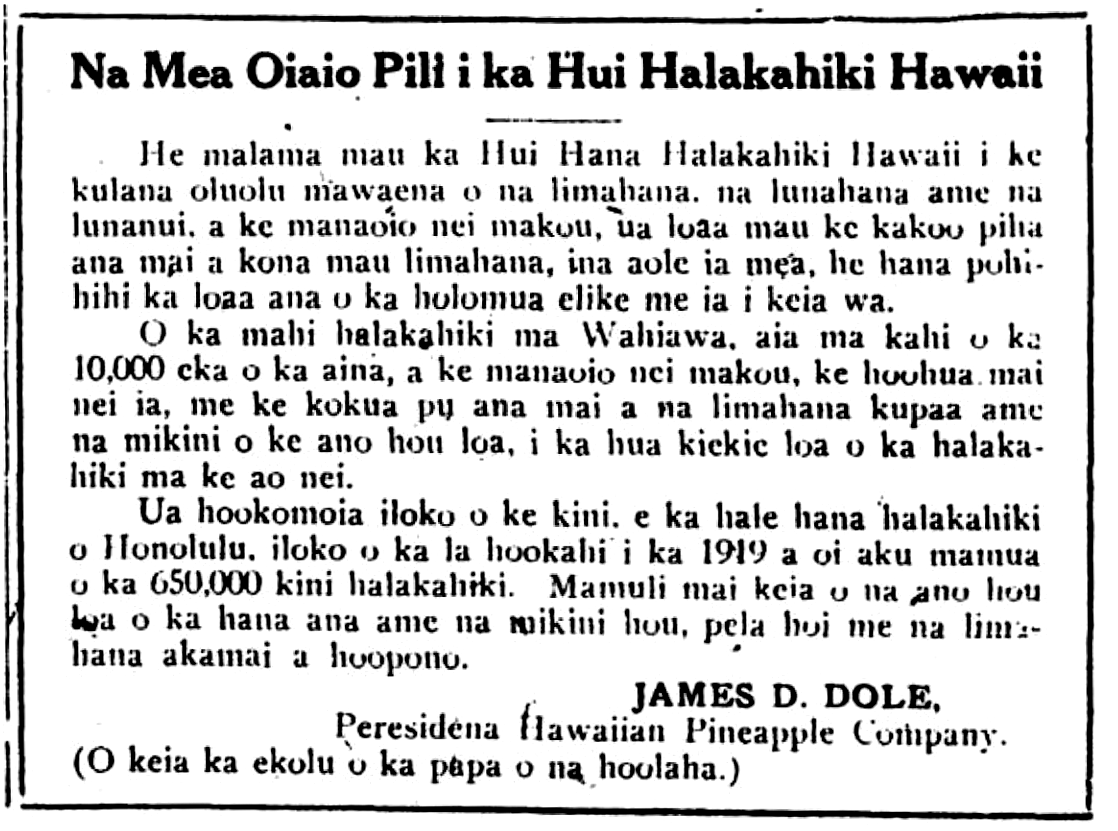
Truth About the Hawaiian Pineapple Company

The Hawaiian Pineapple Company always upholds good relations amongst its employees, supervisors, and heads, and we believe we always have the full backing of our employees, and if that weren’t the case, gaining the progress we have today would be incomprehensible.

The farming of pineapples in Wahiawa is on about 10,000 acres of land, and we believe that it is producing, with the aid of the steadfast workers and machinery of the newest model, the finest pineapple of the world.

Canned at the pineapple plant in Honolulu, in a single day from 1919 on, more than 650,000 cans of pineapple. This is due to the modern processes and new machinery, along with the skilled and careful workers.

JAMES D. DOLE,

President of the Hawaiian Pineapple Company.

(This is the third advertisement.)

(Kuokoa, 6/25/1920, p. 4)

Na Mea Oiaio Pili i ka Hui Halakahiki Hawaii

Ka Nupepa Kuokoa, Buke LVIII, Helu 25, Aoao 4. Iune 25, 1920.

1836, the beginnings of sericulture on Kauai. 1843.

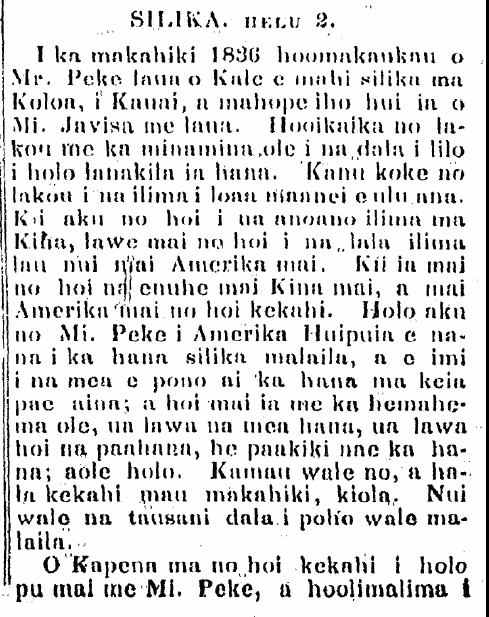
SILK. NUMBER 2.

In the year 1836, Mr. Peke and Kale made ready to farm silk [silika] in Koloa, Kauai, and afterwards the two were joined by Mr. Jarvis [Mi. Javisa]. They put much effort into this without caring about money spent to make it a success. They immediately planted ilima found growing here. They went to get ilima [? mulberry] seeds from China and brought back branches of the ilima lau nui from America. Mr. Peke went to the United States of America to see silk production there, and to find what it took to raise them in this archipelago; he returned without anything lacking, with the necessary gear, and sufficient workers, but the work was difficult and did not move forward. They kept at it, and some years went by, and they gave up. Many thousands of dollars was wasted on it.

Kapena and others also came with Mr. Peke, and leased other lands in Koloa, with thoughts of raising silk there. He planted ilima, built a residence, a building to raise the worms, and a house for the workers. They began the work, but in not much time, it was a bust. Here are the reasons that it was a waste of time in Koloa: there is a strong wind so the ilima does not grow well as the leaves are torn in the strong wind and wilt, the worms don’t grow well there; and the people also, they are not eager and do not keep at the work; they come some days and slack off, are lazy and leave. Today, the ilima of those silk lands are all pulled out and sugar is planted there. So sad for those foreigners who wasted their money in this endeavor. A new enterprise almost started there to make the nation rich.

(Nonanona, 1/3/1843, p. 78)

SILIKA. HELU 2.

Ka Nonanona, Buke 2, Pepa 16, Aoao 78, Ianuari 3, 1843.

(Nonanona, 1/3/1843, p. 79)

...kekahi aina okoa ma Koloa...

Ka Nonanona, Buke 2, Pepa 16, Aoao 79. Ianuari 3, 1843.

More on rubber cultivation in Hawaii nei. 1907.

A RUBBER ASSOCIATION TO BE ESTABLISHED ON MAUI.

MAUI. June 1.—A business meeting was held at the Kahului Baldwin National Bank [Banako Lahui a Baldwin o Kahului] by people seriously planting and raising rubber [raba] in this Archipelago, and the outcome of the meeting was the establishment of an Association called “Ka Ahahui Hawaii a ka Poe Hooulu Raba [Hawaiian Rubber Growers’ Association]”.

It seems that when looking at this, this is the first association of its kind established in the whole of the United States of America, and it is a fact that it will start and strive to push forward the planting and growing of rubber in the Archipelago.

In the meeting, D. C. Lindsay was chosen as president, and Doctor E. C. Waterhouse as vice president, Hugh Howell, the Secretary and Treasurer, and H. A. Baldwin and James L. Coke as fellow advisors.

And after consideration, Messrs. Lindsay and Coke and Pogue were chosen as members of the committee to draft bylaws and rules for the Association.

Also at this meeting was Mr. J. G. Smith of the American Agricultural Experiment Station [Kahua Hoao Houlu Meakanu o Amerika] in Honolulu and he gave some valuable advice relating to the planting and the wide distribution of rubber. At a proper time, another meeting will be held.

In the thoughts of Mr. Smith, after he searched and investigated about growing rubber in Hawaii, he found that it is a very valuable endeavor that will bring good fortune to the land and it is well that the growing of rubber in Hawaii be called a rich mine. This declaration was perhaps enough of a statement befitting the importance of this effort to raise rubber. This is a truly lucrative endeavor.

(Kuokoa, 6/7/1907, p. 5)

KUKULUIA HE AHAHUI RABA MA MAUI.

Ka Nupepa Kuokoa, Buke XLII, Helu 23, Aoao 5, Iune 7, 1907.

Rubber cultivation on Maui, 1906.

RUBBER PLANTS GROWING PROFUSELY IN THE RUBBER PLANTATION OF NAHIKU.

[The picture seems to be signed F. T. P. Waterhouse. Hopefully the newspapers will be rescanned clearly soon, so that not only text can be read clearly, but pictures like this can be seen clearly!]

(Kuokoa, 12/7/1906, p. 6)

NA LAAU RABA E ULU NUI NEI  MA KA MAHI RABA O NAHIKU.

Ka Nupepa Kuokoa, Buke XLV, Helu 49, Aoao 6. Dekemaba 7, 1906.

Tobacco grown in Hawaii, 1863.

[Found under: “NEWS OF HAWAII NEI.”]

Chewing Tobacco.—Hawaiian tobacco leaves are have begun to be made into chewing tobacco and smoking tobacco as well, just like foreign tobacco. Mr. J. Dudoit is the one undertaking this. We have but heard from those who smoke tobacco and chew tobacco that it is excellent. It is available for purchase at the store of A. S. Cleghorn [Ake].

(Kuokoa, 8/22/1863, p. 2.)

Pakanau Hawaii.

Ka Nupepa Kuokoa, Buke II, Helu 34, Aoao 2. Augate 22, 1863.

Cotton grown in Hawaii, 1863.

[Found under: “NEWS OF HAWAII NEI.”]

Growing well.—We have seen the cotton plantation at Mililani, of the Honorable John Ii [Ioane Ii]; and we are in admiration at how well it is growing. What about us, O Friends? Shouldn’t we emulate the efforts of the Honorable One? We must follow the good example put before us and plant our land with cotton, that thing which will make us rich.

(Kuokoa, 8/22/1863, p. 2)

Maikai ka ulu ana.

Ka Nupepa Kuokoa, Buke II, Helu 34, Aoao 2. Augate 22, 1863.

Rice cultivation in Hana, Maui, 1862.

[Found under: “NEWS OF HAWAII NEI.”]

RICE.—We are overjoyed to see that rice is planted by one of our friends, S. Kamakahiki, in Hana, East Maui; there is a lot of grain and it is of good quality; why O Friends, are you dallying on planting this good source of money? We are amazed at the small number of people undertaking the growing of rice in Hana, for this is how it is, according to the letter of S. Kamakahiki, like this:

“I am the only one growing Rice here in Hana; I am harvesting the Rice and storing it at my house; I am filled with joy that I have found this good occupation.”

(Kuokoa, 2/15/1862, p. 2)

Raiki.

Ka Nupepa Kuokoa, Buke I, helu 12, Aoao 2. Feberuari, 15, 1862.