In the Queen’s words, 1895 / 1898.

Proceedings against me, personally, were not modified. Every day thereafter papers were brought to me from the office of President Dole, a legal service, I suppose it is called, being made on me by Major George C. Potter, an aide-de-camp of the president’s staff. In the first of these I found myself charged with the crime of “treason.” After about a week had gone by, the accusation was changed to “misprision of treason.” The substance of my crime was that I knew my people were conspiring to re-establish the constitutional government, to throw off the yoke of the stranger and oppressor; and I had not conveyed this knowledge to the persons I had never recognized except as unlawful usurpers of authority, and had not informed against my own nation and against their friends who were also my long-time friends.

The names of those who had informed, and by whose testimony I was to be convicted, were Captain Samuel Nowlein, Charles H. Clark, W. W. Kaae, Charles Warren, Keahikaauwai, George H. Townsend, and Captain Davies of the steamer Waimanalo.

February 5th was to be the day of my trial. After the summons had been served, Mr. Paul Neumann, in consultation with Mr. Wilson, called to consult with me, as it had been a question whether or not I should personally appear in court, as it would be undignified and humiliating. Humiliation! What had I left? It was the intention of the officers of the government to humiliate me by imprisoning me, but my spirit rose above that. I was a martyr to the cause of my people, and was proud of it. So I told them that I would attend; and on the morning of the 8th, at the hour appointed, Sergeant Kenake appeared, and conducted me, attended by Mrs. Wilson, to the court-room.

(Hawaii’s Story by Hawaii’s Queen, 1898.)

Queen Liliuokalani being tried in military court, 1895.

MILITARY COURT.

Most of the previous week was spent trying just one case, that of V. V. Ashford, accused of misprision of treason [huna kipi]. He denied the charges, and defense witnesses were brought in. The defendant was also brought in to defend himself, however, the defense Lawyer did not had no planned words for the benefit of his client, and he was continuiously questioned for four days and more. But he put a request before the Military Court [Aha Koa] to release the prisoner [lawehala]. The Lawyer for the public for the Military Court will weigh the testimony of the accused and the testimony of the people, and will sentence the offender. His ruling of case is being considered.

When the Military Court convened in the afternoon of February 1, those imprisoned under the charge of treason: Keki, Keoho, Tommy Ai, Nameless [Listed as Olii in 2/1/1895 Hawaiian Star.], John Piko, W. Kekoa, Kaanaana, Ulukou, Elia, Sam Hookano, Kahikikolu, Koia Kapena, Waianae, Keawe, Hikileo, George Makalena, Kamae, Kalawalu, James H. Bush, Buff Moepali, Manuel Rosa, and John H. Wise.

Each of them were asked if they wanted a lawyer. Twenty-one of them answered in the negative, saying that they did not want a lawyer, and J. H. Wise was the only one who wanted to be defended by the attorney Neumann. Therefore Wise’s case was postponed to a later date, and he was taken out.

Ulukou was the only one of the prisoners who objected to Captain Camara sitting to judge, and Camara was dismissed from sitting on the Commission. The remaining members of the Military Commission were not objected to.

The charges were read, and each were asked for their response. The first seven named admitted to their guilt, and the rest denied the charges. With the questioning of the witnesses, it was made clear that they were only on the outside of the military camp where the weapons were ministered to, however, according to some people, they were urged and enticed, and that is the reason some of them went to the area of the military camp. Their verdict is being considered.

At 11:15 midday of Tuesday, February 5, Liliuokalani Dominis was taken from her room where she is held prisoner in the Executive Building [Iolani Palace], to the grand Room [throne room] where the Military Trials are being held, filled with spectators. Major Potter escorted Mrs. Dominis accompanied to the door by Mrs. C. B. Wilson, then Lieutenant Kenake brought her in and sat her to the left of her lawyer Neumann. Mrs. Dominis was wearing a black dress with a hat of the same color, and her honor and royal dignity of when she sat upon the throne had fallen and shattered. The charges were read to Mrs. Dominis, of the crime she was accused of, misprision of treason, however her attorney was criticized for asking that the trial be postponed until another day. On the following Wednesday and Thursday were the responses of the prisoner and the witnesses. Mrs. Dominis vehemently denied any knowledge of the planning for war, but did admit to appointing a new cabinet of Ministers for herself.

[When looking at anything, like this article, it is important to try and understand the context. The Kuokoa, during this period at least, seems to be pro-annexation and pro-American. By reading this and the rest of its pages, you can see it is definitely not pro-Monarchy!

What were the other Hawaiian-Language Newspapers saying? The Oiaio, which was a weekly, issued a paper on 1/4/1895, and only after 10 weeks, on 3/15/1895, did it/could it print its next issue. Leo o ka Lahui, a daily which printed from Mondays through Fridays, printed an issue on 1/4/1895, and stopped/was stopped from printing until 3/12/1895 (although this issue seems not extant). What were the other English-language newspapers saying? What were the other language papers reporting?]

(Kuokoa, 2/9/1895, p. 2)

KA AHA HOOKOLOKOLO KOA.

Ka Nupepa Kuokoa, Buke XXXIV, Helu 6, Aoao 2. Feberuari 9, 1895.

A mele for Grover Cleveland, 1894.

KA HOOLA O KA KAHUI [sic] HAWAII

He ohohia nui loa
Nou e Kalivalana
Peresidena oikelakela
Kaulana me ke kiekie
O ka puuwai hao kila
O ka naauao lua ole
Pookela oe o ka nani
O ka manao akea
No ka ninau lahui
O ka Pae Aina Hawaii
Kau olelo hooholo
E hoi o Liliuokalani
Ma Kona Noho Kalaunu
O ke Aupuni Moi
Mai a Kamehameha mai
Piha olioli na moku
Ia oe e Kalivalana
Hauoli na puuwai
O ka Lahui Hawaii
I ke aloha kamahao
O Amerika Huiia
Lohea he leo aloha
Mai Wasinetona mai
Lanakila oikelakela
Ka Aoao Demokarata
Haneri a oi aku
Na kakoo o Hawaii
Puhi i na Pi Gi
Na hoohui aina
Ua haule na ikaika
A ka poe lehelehe wale
E ka Lahui Hawaii
E i ae hoi ka Hoola
Ke kuokoa mau loa
No Hawaii Aina
Lahui me ka Moi
E o e Kalivalana
I kou inoa hiwahiwa
“Ka Wiwo ole o na Wiwo ole
Ka makuakane o Hawaii
Ka Puuhonua o ka Pakipika
E noho ana i ka puuwai
O ka Lahui Hawaii.”

W. L. Kaleiakalahui.

[THE SAVIOR OF THE HAWAIIAN PEOPLE

There is great delight
For you O Cleveland
The greatest President
Famous and exalted
With heart of steel
An intelligence second to none
You are in the heights of splendor
With open mind
On the question of the people
Of the Hawaiian Archipelago
Your decision
To return Liliuokalani
To Her Throne
Of the Monarchy
From Kamehameha
The islands are filled with joy
For you O Cleveland
Hearts are happy
Of the Hawaiian People
With wonderful love
Of the United States of America
A voice of aloha has been heard
From Washington
Great Victory
The Democratic Party
Hundred or more
Were the supporters of Hawaii
Blown away were the Provisional Government
The annexationists
The powerful have fallen
The people who are all mouth
O Hawaiian Nation
The Savior says
Let there be never-ending independence
For the Land of Hawaii
The People and the Sovereign
Answer O Cleveland
Your precious name song
“The Fearless one amongst Fearless ones
The father of Hawaii
The Refuge of the Pacific
Living in the hearts
Of the Hawaiian People.”

W. L. Kaleiakalahui.

The attitude of the Hawaiian nation towards Grover Cleveland on the most part was and is (as seen recently) much different than towards his successor, William McKinley.]

(Nupepa Aloha Aina, 3/17/1894, p. 3)

KA HOOLA O KA KAHUI HAWAII

Nupepa Aloha Aina, Buke I, Helu 11, Aoao 3. Maraki 17, 1894.

In the collections of the Bishop Museum, 1903.

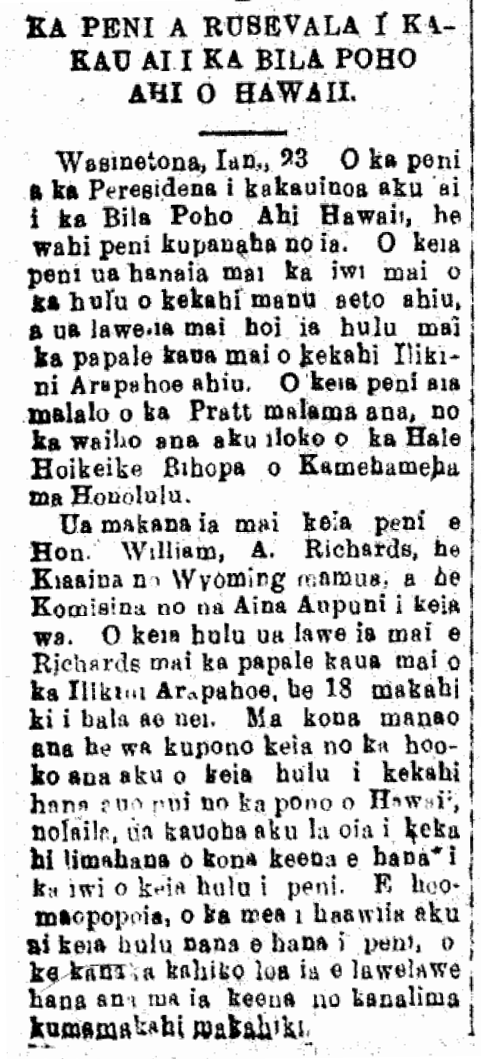
THE PEN WITH WHICH ROOSEVELT SIGNED THE FIRE CLAIMS BILL OF HAWAII.

Washington, Jan. 23. The pen with which the President signed the Hawaiian Fire Claims Bill [Bila Poho Ahi Hawaii] is a remarkable pen. This pen was made from the quill of a feather of a wild eagle, and that feather was taken from a war headdress of a wild Arapaho Indian. This pen is now in the care of Pratt to be placed in the Bishop Museum of Kamehameha in Honolulu.

This pen was gifted to the Hon. William A. Richards, a former Governor of Wyoming, and currently a Commissioner of Public Lands [Aina Aupuni]. This feather was taken by Richards from the headdress of an Arapaho Indian 18 years ago. He thought it was the right time for this feather to be put to some important use for Hawaii, therefore, he ordered one of the workers in his office to fashion the feather into a pen. Let it be remembered that this person who was given the feather to make a pen is a man of much seniority who was working in that office for fifty-one years.

(Aloha Aina, 2/7/1903, p. 1)

KA PENI A RUSEVALA I KAKAU AI I KA BILA POHO AHI O HAWAII.

Ke Aloha Aina, Buke IX, Helu 6, Aoao 1. Feberuari 7, 1903.

More on the missionaries, 1894.

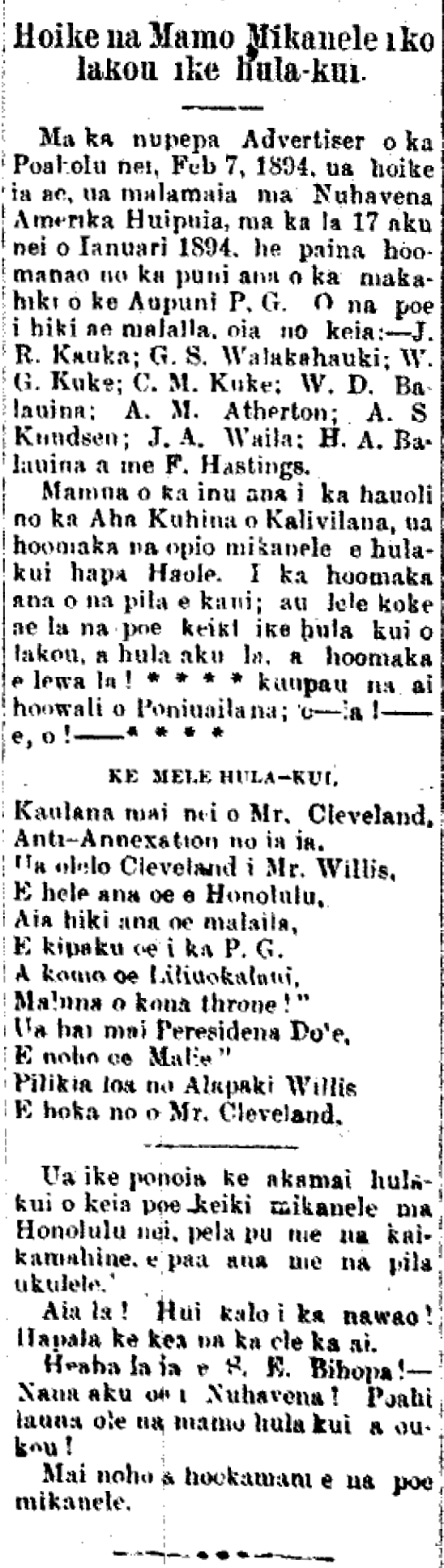
Missionary Descendants Show Their Knowledge of Hula Ku’i.

In the Advertiser of 2/7/1894, was shown that at New Haven, United States of America, on the past 17th of January 1894, there was held a party to commemorate the anniversary of the government by the P. G. Those present were: J. R. Kauka [James Robert Judd?], G. S. Walakahauki [George S. Waterhouse], C. M. Kuke [C. Montague Cooke, Jr.?], W. D. Balauina [William D. Baldwin], A. M. Atherton, A. S. Knudsen, J. A. Waila [James Austin Wilder], H. A. Balauina [Harry A. Baldwin], and F. Hastings.

Before drinking to the delight at the Cabinet of Ministers of Cleveland, the young missionaries danced a hula ku’i to a hapa haole song. When the music started, the youths among them who knew how to hula ku’i jumped up immediately and danced and started to sway! …the mixed poi of Poniuailana goes the limit; there you go!—answer the call!—…¹

KE MELE HULA-KUI.

Kaulana mai nei o Mr. Cleveland,
Anti-Annexation no ia ia,
Ua olelo Cleveland i Mr. Willis,
E hele ana oe e Honolulu,
Aia hiki ana oe malaila,
E kipaku oe i ka P. G.
A komo oe Liliuokalani,
Maluna o kona throne!”
Ua hai mai Peresidena Dole,
E noho oe Malie”
Pilikia loa no Alapaki Willis,
E hoka no o Mr. Cleveland.

A MELE HULA KU’I

Famed is Mr. Cleveland,
An Anti-Annexationist is he,
Cleveland said to Mr. Willis,
[“]You are going to Honolulu,
When you get there,
Banish the P. G.
And place Liliuokalani,
Upon her throne!”
President Dole spoke,
[“]You just sit still.”
Albert Willis is perplexed,
Mr. Cleveland is thwarted.

The adeptness at the hula ku’i by these missionary descendants was seen first hand here in Honolulu, along with the girls carrying ukulele.

There you go! Mixed up is the cultivated taro with the wild! The white is smeared; the black gets the score.

What is this S. E. Bishop!—Look to New Haven! Your people’s hula ku’i dancer descendants were  gyrating away!

You missionaries, don’t be hypocritical.

¹…kuupau na ai hoowali o Poniuailana; o—ia!—e, o!—…

[Does anyone have more information on the “Kuupau na ai hoowali o Poniuailana” phrase?]

(Nupepa Ka Oiaio, 2/9/1894, p. 3)

Hoike na Mamo Mikanele i ko lakou ike hula-kui.

Nupepa Ka Oiaio, Buke VI, Helu 6, Aoao 3. Feberuari 9, 1894.

The Hawaiian Moses? 1893.

“THE MISTAKES OF MOSES.”

We refer, of course, to the Hawaiian political Moses, who has recently broken camp, and set the faithful in motion through sea, desert and wilderness to the Land of Promise, beyond the shadow of the Throne. Yes! We refer to the Hawaiian political Moses, but whether his other name is Dole or Thurston, has not, at this writing, fully transpired. Still, the doubt as to his other name is a merely nominal doubt, not affecting the merits of the case. And as the original state—man of that name was not gifted with immunity from error, so neither has the Hawaiian Moses, even during his very brief pilgrimage, avoided all mistakes. It should ever be the part of a friend to note his friends’ infirmities, and, by bringing them mildly to their authors’ notice, suggest their reform, or convey a warning against their repetition.

———

We are all aware of the high pressure of seeming necessity under which the present government was formed. We can therefore appreciate, to some extent, the causes of the neglect to observe, towards the numerous Native element, those marks of regard and confidence without which no government can hope to endure in Hawaii. We repeat, that the pressure of the occasion must be the excuse of the gentlemen at the head of the movement for their seemingly unfriendly, and even hostile attitude toward the entire Native race, in the ordering of early events under the new dispensation.

———

The exclusion of Hawaiians from a participation in the beneficent project not only seemed, but was, and is complete. There may have been, and no doubt were reasons, seemingly sound to those who adopted them, for such a course,—reasons of which the public cannot judge, because the public know them not. Yet it would seem that one of two propositions must be true; viz.: either the Hawaiians were needlessly, and, therefore, harshly excluded from such participation in the reforming of their own government, or else the entire race were deemed by the leaders to be unfit to participate in such an enterprise.

———

If the former of the above propositions be true, one would naturally expect the mistake to be rectified at the earliest opportunity. That it has not been rectified would seem to stamp it as having been no mistake, but a course deliberately adopted, for, note the opportunity to retrieve the error, (if error it had been thought to be) in the filling of the four vacancies in the Advisory Council, on the 21st inst. It was then, as seems to us, the manifest duty of the government to seek out and appoint to those vacancies, men of Hawaiian blood, whose brains, interests and loyalty to the new idea bespoke than as deserving of such honor and confidence.

———

The failure of the government to attempt to bring even one Hawaiian to a seat at the Council Board is susceptible of only one of two meanings:—1st, that no Hawaiian could be found possessing those qualifications, or, 2nd, that the government were determined to ignore and exclude them, in any event.

———

If such exclusion was premeditated and malicious, the less said of it the better, as it is self-condemnatory. If on the other hand, there be no native Hawaiian fit to occupy a seat in the government councils, with what degree of candor or confidence can the Provisional Government request of expect the United States to incorporate our country into itself? What a commentary upon that request is the action of the government itself, in thus excluding from their confidence the entire aboriginal race, more completely than the Mongolian is now excluded from the Union. Forty odd thousand Hawaiians on these shores, and not one, (in the opinion of the government,) entitled or qualified to have a voice in the government of his native land. What a text for the American enemies of annexation, and how they will use it!

(Liberal, 1/25/1893, p. 2)

"THE MISTAKES OF MOSES."

The Liberal, Volume I, Number 39, Page 2. January 25, 1893.

Annexation or not? 1893.

[Found under: “THIS AND THAT.”]

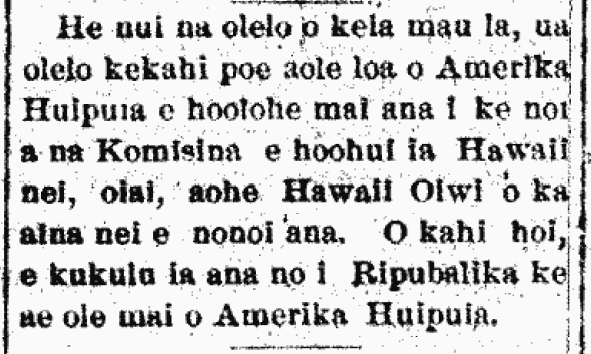
There is much talk these day; some say that there is no way that the United States of America will listen to the request of the Commission to annex Hawaii, being that there is no Native Hawaiian of the land asking for this. Some say that a Republic will be established if the U. S. doesn’t agree.

(Liberal, 1/25/1893, p. 4)

He nui na olelo o keia mau la...

The Liberal, Volume I, Number 39, Page 4. January 25, 1893.

C. C. Moreno on missionaries, 1893.

A Misunderstood People.

MORENO ON THE MISSIONARIES.

Editor Post: For several years your public-spirited paper has published correspondence and statements submitted by me about Hawaii in which was foreshadowed the present state of affairs. The revolution which has just taken place is the inevitable result of missionary rule; the long-standing and deep-rooted cause of the unrest.

The missionaries in Hawaii, as in China, Japan, and elsewhere, consider that country as their open hunting grounds, regardless of the rights, customs, wishes, and priviliges of the natives and of stipulations.

I positively know that the self-appointed four chiefs of the Provisional Government in the Hawaiian Islands and the five commissioners coming to Washington to negotiate a treaty of annexation are, without a single exception, missionariesʻ confederates. Not a single native Hawaiian is with them, therefore, they cannot be considered as the representatives of the Hawaiian nation, of which they are aliens and enemies, but only as the emissaries of one side (or of a higher), which is not the right side.

The truth about Hawaiian affairs has never reached the State Department and that is the reason why, in the department, the knife has always been taken by the blade instead of by the handle in dealing with the Hawaiian question.

The United States always sent third rate politicians as ministers and consult to Honolulu, hence the erroneous information about Hawaii. I have on the spot studied Hawaii and the Hawaiians, their troubles with the missionaries of all creeds, and when distant from the islands I have kept an uninterrupted correspondence with the leaders of the Hawaiian nation, such as the Hons. Wilcox, Bush, Testa, Kaai, Kapena, Kaunamano, Kimo Pelekane [James I. Dowsett], and others.

My views on the Hawaiian question I explained at length to President Hayes and Secretary of State Evarts, to President Cleveland and to Assistant Secretary of State Porter: later, to Senator Morgan and to Congressman McCreary, and these are the statesmen that ought to dispose of the Hawaiian question and render justice to the weak, ill-treated, honest, and generous Hawaiian people that have been continually misrepresented, misjudged, and grossly wronged.

In accordance with the good order of things the coming self-appointed and self-styled Hawaiian commissioners, with more appearance than substance, should not be received by the United States authorities, because their self-attributed mission to Washington is based only upon selfish and malignant motives.

This will be a good opportunity for the great people of the United States to show their sentiment for fair play and generosity toward the unfortunate, harmless, friendly, and oppressed Hawaiian people, worthy of sympathy and of help in this their hour of national distress.

Celco Cæsar Moreno.

(Liberal, 2/25/1893, p. 2)

A Misunderstood People.

The Liberal, Volume I, Number 48, Page 2. February 25, 1893.

Salt production, 1869.

[Found under: “LOCAL NEWS: Oahu.”]

Salt Storehouse.—We’ve seen makai of Kakaako in Honolulu nei, a huge wooden Structure is being constructed by the King [Kamehameha V], and the great riches that will be stored in that building is salt. This is the salt that now stands near the banks of the salt ponds. The past few days it has been drizzling a bit, and it would be best if it [the salt] was stored in a safe location.

(Kuokoa, 9/18/1869, p. 3)

HALE HOAHU PAAKAI.

Ka Nupepa Kuokoa, Buke VIII, Helu 38, Aoao 3. Sepatemaba 18, 1869.