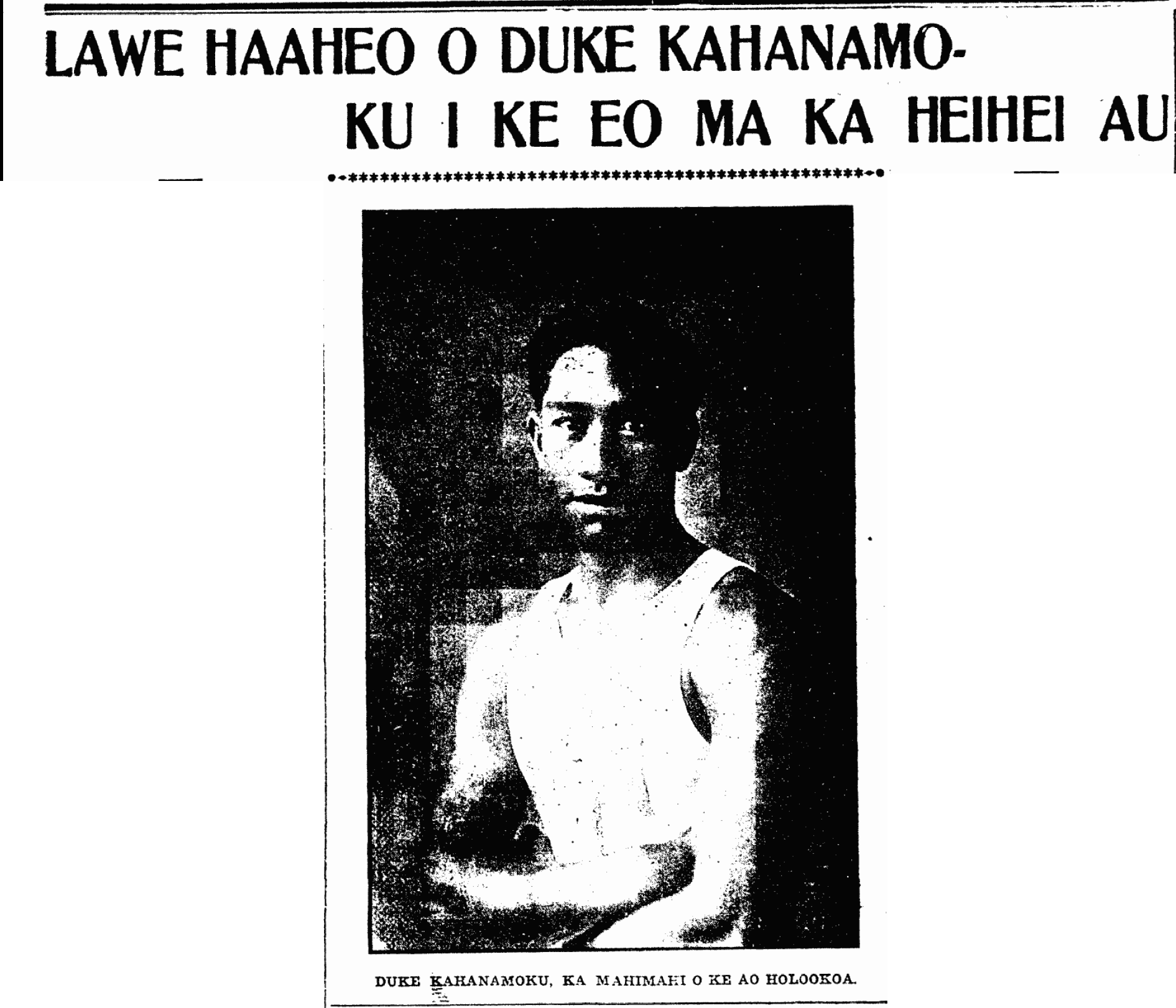
More from Duke Kahanamoku and the Olympics, 1912.

THE SWIMMING CHAMPION OF HAWAII IS HEARD FROM AGAIN.

KAHANAMOKU BREAKS HIS FASTEST RECORD IN GERMANY.

The news which had the town’s people in an uproar this past Monday was the news received by cable from Hamburg, Germany on that day, saying that Duke Kahanamoku could swim the distance of a hundred meters in a minute and a fifth of a second, which is the fastest time, not achieved by any other contender of the world.

Duke Kahanamoku holds the title of champion of the world for this distance of one hundred meters which he swam at Stockholm, Sweden, with a time of sixty-two and two-fifth seconds, but this record was broken by he himself, by two and one-fifth seconds, which has the people in town sure that he can swim this distance within sixty seconds, or a minute.

From that cable which arrived from Hamburg, Honolulu’s people can see that Kahanamoku is touring other lands before turning back to Hawaii.

This is the cable that was sent, telling of the joyful news to Hawaii’s people about Kahanamoku.

Hamburg, Germany. July 22—Today, Duke Kahanamoku, Jr. of Honolulu once again received the title of champion of the world in the 100 meter race held in the Olympic games. This is a new time for this distance, in a meet held here, in which many old-time athletes were invited. Kahanamoku swam the 100 meter race in one minute and a fifth of a second, which breaks his very own time of a minute two and two-fifth seconds which was gotten at Stockholm in a match for the championship.

(Kuokoa, 7/26/1912, p. 1)

LOHE HOU IS KA MOHO AU O HAWAII

Ka Nupepa Kuokoa, Buke XLVIII, Helu 30, Aoao 1. Iulai 26, 1912.

D. S. K. Pahu writes from the Philippines, 1912.

OUR LETTER FROM THE PHILIPPINES.

THAT BOY TELLS HIS FATHER OF THE GREAT AMOUNT OF GOVERNMENT LAND.

Baguio, Benguet, Philippines.

O My Beloved Father:

Here we are, the two of us, now living in the mountains. We got back on the 17th. Live here is good; the air is brisk, and the only trees that grow in abundance on this mountain are pine. I am thinking that we will be here until the last week of June.

It is not certain whether I will stay here for a full three years. This is a fertile land if you have a lot of money. I met up with a haole man who is the secretary of a Filipino organization here, and he wants me to write about sugar in Hawaii and to publish it in the local papers. He tells me that there are vast and much government lands that are left unfarmed because of lack of funding. If I want land, he can definitely help me to ask for government land. Looking at the worth of sugar in Hawaii, I believe that money can be made through this endeavor. there are a lot of sugar lands here, however, the sugar mills are decrepit and sugar has been pushed to the side; the people here do not understand the sugar industry as they do in Hawaii. That is what makes me want to write about sugar. Here’s something else: Hawaii’s people have their eyes set on here, and a couple of weeks ago, a haole man came from Hawaii to look at the land here with the intent of building a modern sugar mill like in Hawaii. If everything goes well, I am determined to leave this job and to start a large sugar plantation here, and I’ll return to Hawaii to work out the selling of shares [kea] and the purchase of a mill and so forth; I have written to some people in Honolulu about this venture, and if things go well, I will come home to Hawaii in two years, but if they do not go well, I suppose I will wait it out.

I saw the Exposition here [Philippine Exposition held in Manila, February 3–11, 1912], and there are many goods from here. Sugar, coconuts, manila rope, rice, gold, silver, charcoal, and so forth were the things on display. The wood of this land is beautiful, used to make chairs and tables. One of the tables was 10 feet long across the middle, and 40 feet long across the edges, made out of one tree without the addition of other boards. The performances by school children was full of beauty; the lace, household furnishings, hats, clothing, and so forth were lovely and fine. Better than Hawaii.

With aloha from the daughter and from me as well.

Me.

D. S. K. PAHU.

(Aloha Aina, 7/27/1912, p. 1)

KA MAKOU LETA MAI MANILA MAI.

Ke Aloha Aina, Buke XVII, Helu 30, Aoao 1. Iulai 27, 1912.

Olympics, Duke Kahanamoku and the King of Sweden, 1912.

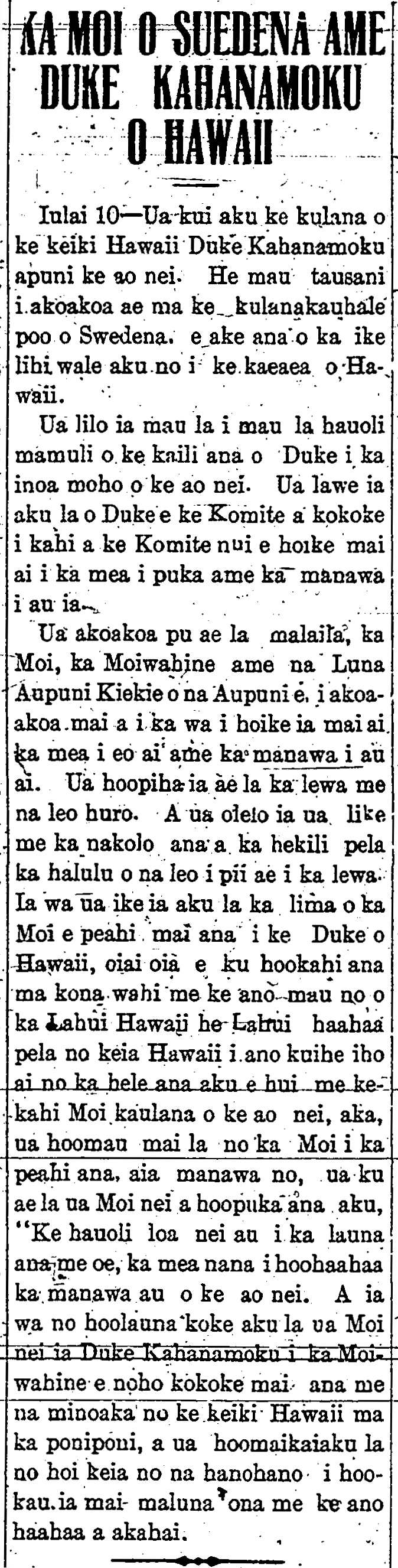
THE KING OF SWEDEN AND DUKE KAHANAMOKU OF HAWAII.

July 10—The news spread around the world of the standing of the Hawaiian boy, Duke Kahanamoku. There were thousands gathered in the capital of Sweden, wanting to catch a glimpse of the hero of Hawaii.

Those days became one of joyfulness because Duke captured the title, champion of the world. Duke was taken by the Committee in the vicinity of where the main Committee was announcing the finishers and their times in which they swam.

Gathered there as well was the King, Queen, and the Heads of State of other Nations, when the winner was announced along with his time. The skies were filled with cheers. And it is said that the voices ringing out in the skies were like the roar of thunder. At this time, the hand of the King was seen waving to the Duke of Hawaii, as he was standing all alone as is the general case with the Hawaiian People, a humble Lahui; and so of this Hawaiian, who hesitated to go and meet with a famed King of the world, but the King kept waving him forth, but at this time, the King stood and said, “I am happy to meet you, the one who dwarfed the swimming records of the world. And then right there after, the King introduced Duke Kahanamoku to the Queen who sat near by who had smiles for the dark-faced [maka poniponi] boy of Hawaii, and he thanked them for this honor granted him, humbly and unpretentiously.

(Hoku o Hawaii, 9/18/1912, p. 2)

KA MOI O SUEDENA AME DUKE KAHANAMOKU O HAWAII

Ka Hoku o Hawaii, Buke 7, Helu 7, Aoao 2. Iulai 18, 1912.

More from the Pacific Northwest, but a little more “recent,” 1912.

A LETTER FROM AFAR

(Written by Sam K. Nainoa.)

The following letter is written by Sam K. Nainoa from Seattle, after the passing of several weeks since he left his homeland with his queen, on their travels, explaining some major things that they saw in their sightseeing of these foreign lands, and this will be something which the readers of the Kuokoa will rejoice in because of the progress witnessed by the two of them made by the Hawaiian youths living in that foreign land.

SEATTLE, May 16, 1912, Aloha oe:—Here we are, staying in this town; we’ve been here almost two weeks, meeting with the Hawaiian boys, and we are full of joy.

There is a great number of my classmates living here, all of them Hawaiians; they are playing music and singing, and they are making a lot doing this work; and some of them married haole women, and they are truly taken by this land, with no desire at all to return to the land of their birth.

Some of them have land and are well off; according to what they tell me, their thoughts of returning to Hawaii are no more; this is where they will live and they will leave their bones in this foreign land.

We went touring around another area farther across this expansive ocean for a few days and came right back, and am writing this letter to you. We went sightseeing at a wood mill, at a place called Port Blakeley, which is one of the largest mills in the world.

What I saw was truly amazing. There are many Hawaiian boys indeed living there, and to go from one area to the next, you travel by steamship. The Hawaiians take a fancy to living there, and for work, they do lumbering.

Hawaiians have no problem with jobs there; they have work at all times.

Some boys from Port Blakeley came to Seattle and got together with us and the band boys who live in Seattle; they insisted that we go with them to where they live, and there was not refusing the hospitality of the kamaaina, so we went aboard a steamship, spending a few days there and immediately returning back.

There were two Hawaiian women there with their husbands, and they have become mothers to the Hawaiian boys there; their living is easy, and they get along lovingly; I would not be mistaken to say there is a place for them in this land without their parents [he mua a he hope ka noho ana o ka aina makua ole ?]

There is bountiful food there, and when we arrived, two pigs were roasted as is the custom of Hawaiians, and all the luau foods were prepared like inamona, limu eleele, dried fish, alamihi crab, raw fish, and their poi was poi palaoa [flour poi].

Here they have dried opelu and dried nehu and many other things so that Hawaiians living here have nothing to complain about; they have everything, perhaps even more than Hawaii.

We enjoyed ourselves, and there was but one thing to do, that is to sing and to play music, and we were terribly happy. There is an over abundance of palai fern there, it is protects your feet [he pale wawae ia mea he palai ?] and it grows all the way until the ocean. When we went pole fishing, we caught poopaa and also large kuahonu crabs. There is a fish that looks like opelu here, and perhaps it is opelu; so too with the puhikii, which is good eating raw.

There are so many delicacies here: salmon worked in with tomatoes and onions; and according to what these Hawaiians say, there is no food that you can’t get here, you have so much to choose from to satisfy your wants.

These people were very kind to us, and we are greatly indebted to them for their hospitality, and these Hawaiians of ours are blessed in making this place somewhere that they look for their livelihood.

This is enough for now, and maybe there will be more free time here after to write more of our travels. All the Hawaiians here give their aloha to our lahui.

Your friend,

S. K. NAINOA.

(Kuokoa, 6/7/1912, p. 6)

HE LEKA MAI NA AINA MAMAO MAIA

Ka Nupepa Kuokoa, Buke XLVIII, Helu 23, Aoao 6. Iune 7, 1912.

Hawaiians in the Pacific Northwest, 1865.

Travels From Washington Territory to Oregon.

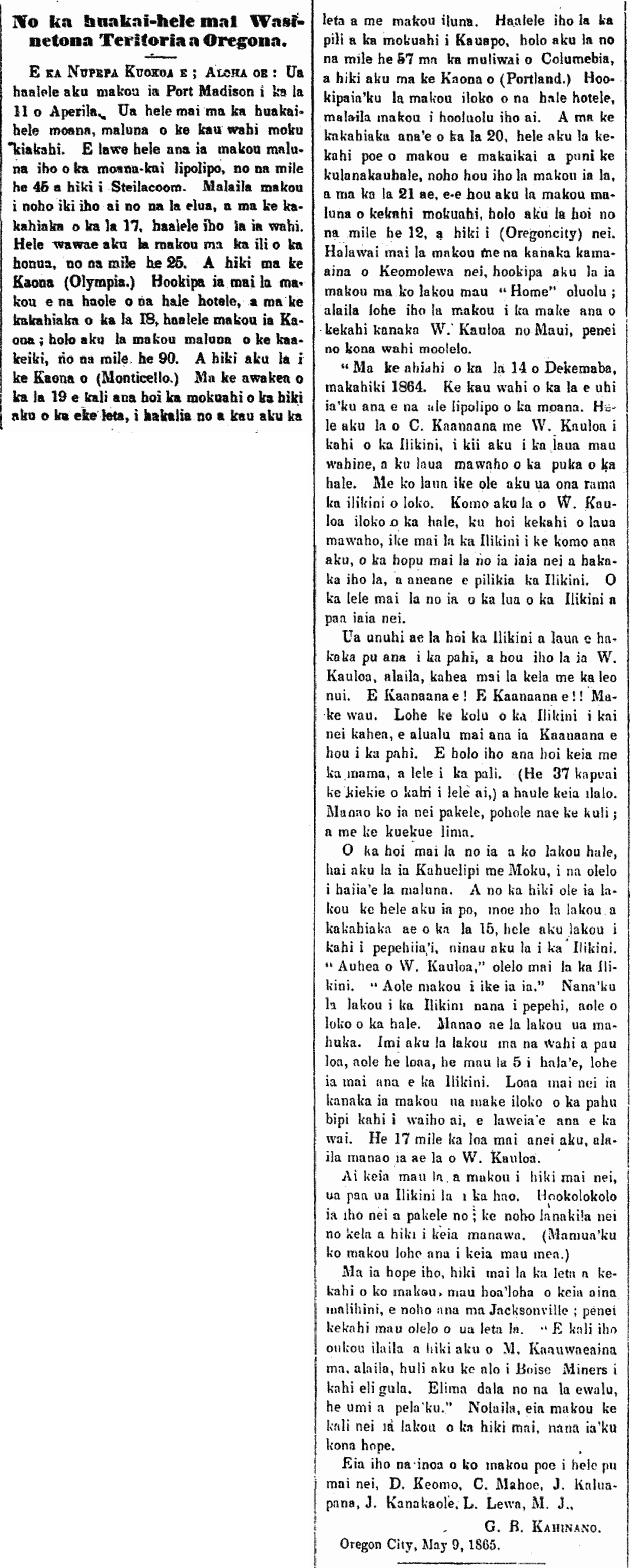
O Kuokoa Newspaper; Aloha to you: We left Port Madison on the 11th of April. We went by sea aboard a single-masted ship. It took us over the deep seas for 45 miles until Steilacoom. There we stayed for a short period of two days, and in the morning of the 17th, we left that place. We walked the surface of the earth for 25 miles. And we reached Town (Olympia). We were welcomed by the haole of the hotels, and on the morning of the 18th, we left Town; we went aboard carriage [kaa-keiki ?] for 90 miles. Then we reached the Town (of Monticello). Midday of the 19th, the steamship awaited the arrival of the letter bag, and right after the letters were loaded, we boarded. The ship left the harbor and went for 57 miles on the Columbia River and we reached the Town (of Portland). We were entertained in the hotels and that is where we rested. In the morning of the 20th, some of our party went to tour the town, and we stayed that day; on the 21st, we boarded another steamship, and went for 12 miles until arriving here (Oregon City).  We met with the Hawaiian kamaaina of Komolewa [Vancouver], and were welcomed into their pleasant homes [interesting that the quote “Home” in the original]; and we learned of the death of a Hawaiian, W. Kauloa of Maui, and this is his story:

“In the evening of the 14th of December, 1864. While some of the sun was covered over by the dark billows of the sea. C. Kaanaana went along with W. Kauloa to the place of the Indian [Ilikini] to fetch their wives, and they stood outside of the door of the house. With no idea that the Indians within were inebriated. W. Kauloa entered the house, and the other stood outside; the Indian saw him enter, at which point he grabbed him and started to fight, and the Indian was close to being in trouble. The second Indian jumped in and grabbed him.

The one Indian that was doing the  fighting pulled out a knife and stabbed W. Kauloa, at which point he called out in a loud voice, “Hey, Kaanaana! Hey Kaanaana!! I am dying. A third Indian heard him call out, and went after Kaanaana and stabbed him with a knife. He ran quickly and jumped off a cliff. (It was 37 feet high from where he jumped from,) and he fell to the ground. He believed that he was saved, although his knee was scraped, along with his elbow.

He returned to their house and told Kahuelipi and Moku of what was described above. And because they could not go that night, they slept until morning of the 15th, and went to the place of the killing and asked the Indian, “Where is W. Kauloa,” at which the Indian replied, “We don’t know him.” They looked for the Indian who did the killing, and he wasn’t in the house. They thought he escaped. They searched all over, and could not find him; 5 days later, they heard from the Indians. We found that man dead, left in a beef barrel, carried by the water. It was 17 miles away from here and thought to be W. Kauloa.

And during time when we arrived, that Indian was confined in shackles. He was just tried and was let go; he is living freely until now. (Before we heard this story.)

There after, there arrived a letter from one of our friends of this foreign lands, living in Jacksonville; here is some of what the letter said: “You all wait their until the arrival of M. Kaauwaeaina them, and then make for Boise Miners, where they are digging for gold. Five dollars per eight days or ten, and so forth.” Therefore, we are awaiting their arrival here and will see what happens later.

Here are the names of those who came with me: D. Keomo, C. Mahoe, J. Kaluapana, J. Kanakaole, L. Lewa, M. J.,

G. B. Kahinano.

Oregon City, May 9, 1865.

(Kuokoa, 6/15/1865, p. 4)

No ka huakai-hele mai Wasinetona Teritoria a Oregona.

Ka Nupepa Kuokoa, Buke IV, Helu 24, Aoao 4. Iune 15, 1865.

Hawaiians at the Alaska-Yukon-Pacific Exposition, 1909.

Check out this picture and more from the Hawaii delegation at the 1909 Alaska-Yukon-Pacific Exposition, online at the University of Washington Digital Collections site!

http://content.lib.washington.edu/cdm4/item_viewer.php?CISOROOT=%2Fayp&CISOPTR=538&DMSCALE=100&DMWIDTH=802&DMHEIGHT=623.4296875&DMMODE=viewer&DMFULL=1&DMX=0&DMY=0&DMTEXT=%2520hawaii&DMTHUMB=0&REC=12&DMROTATE=0&x=801&y=314

Hawaiian officials, hostesses, and musicians in front of the Hawaii Building, Alaska Yukon Pacific Exposition, Seattle, August 5, 1909.

How much do we know about how it was back then… 1909.

THE WORLD IS STILL IN THE DARK ABOUT HAWAII.

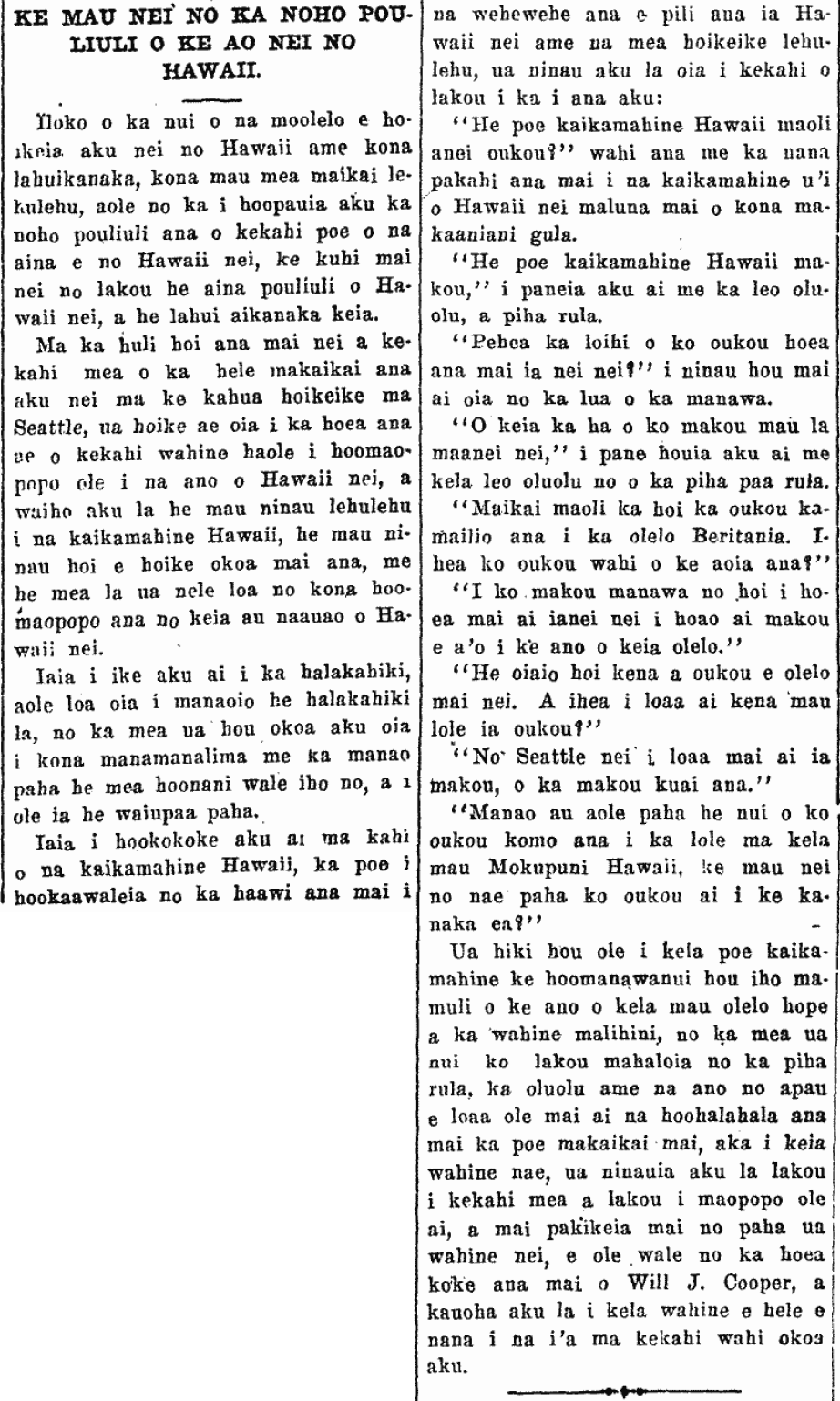
Although there has been so many stories heard talking about Hawaii and its people and its many wonderful things, in no way has the ignorance of some people in foreign lands about Hawaii been cleared; they assume Hawaii is an uneducated land and that we are cannibals.

On the return of someone who went to visit the fair in Seattle [Alaska-Yukon-Pacific Exposition], he spoke about the arrival of a haole woman who didn’t know about the conditions of Hawaii; and she put before the Hawaiian girls a great number of questions—questions which made it plain that she had no clue about this era of education here in Hawaii.

When she saw a pineapple, she didn’t believe that it was real, because she poked at it with her finger, perhaps thinking that it was just some decoration, or perhaps butter [butter sculpture seems to have been popular at the time].

When she approached the area where the Hawaiian girls were stationed to talk about Hawaii nei as well as to give various performances, she asked one of them:

“Are you all real Hawaiian girls?” she asked while peering at each one of the beautiful Hawaiian girls over her gold-rimmed glasses.

“We are all Hawaiian girls,” she was answered kindly and very politely.

“How long has it been since your arrival here?” She asked next.

“This is our fourth day here,” she was answered again, with a pleasant voice and decorum.

“Your English is quite good. Where did you all learn it?”

“Upon our arrival here, we tried learning this language.”

“Is that so. And where did you all get your clothes?”

“We got it here in Seattle; we purchased it.”

“I thought that maybe you all don’t much wear clothes in the Hawaiian Islands; but you all still are cannibals, right?”

These girls could not endure this any longer after those last words of that malihini woman; they were very well appreciated for their etiquette, pleasantness, and their entire conduct which would receive no criticism from the visitors; however, with this woman, they were asked questions that they could not fathom, and that woman perhaps was close to being railed at were it not for the arrival of Will J. Cooper who advised the woman to go and look at the fish located in a different area.

(Kuokoa, 8/27/1909, p. 6)

KE MAU NEI NO KA NOHO POULIULI O KE AO NO HAWAII.

Ka Nupepa Kuokoa, Buke XLVI, Helu 35, AoAo 6. Augate 27, 1909.

Letter from Iosepa, Utah, 1913.

A VOICE FROM UTAH.

Iosepa, Toole County. Dec. 19, 1912.

Solomon Hanohano, Editor of the Kuokoa, Aloha oe:—Because I want to know the news of the land of our birth, the desire to get a subscription to the Kuokoa grew. Being the the new year is coming, it would be a means for me to see the news of our home and the progress of the political scene or its regression, as well as the victories or discouragements of our fellow makaainana.

Not because Iosepa lacks newspaper subscribers, but for me to get a personal one.

This is one of the important years regarding the nation, being that the leadership of the power of the nation went to the Democrats; the big question is just this: Will the poor makaainana really benefit, or will they be left unstable once again like during the presidency of Cleveland, but it is only time that will tell.

If those elected could follow through on what their lips pledge to the masses, then we indeed will be blessed, however if it is like what Isaiah said, thusly: “These people come near to me with their mouth, but their hearts are far from me.” [Isaiah 29:13] Then comes those famous words of that old timer of Lahaina: “Saying, when indeed will that happen.” [“I mai hoi, ahea la ka hoi.”] The big-eyed images know that the small-eyed images are not watched. [Ikeia aku la no na kii maka nunui, nana oleia iho la na wahi kii maka liilii ??]

My aloha to the few Hawaiian makaainana left who are squeezed and assimilated [i ka opaia aku ua pili pu ?] until they are totally gone from the beloved face of Hawaii, along with the increase of the other races upon the land. And so too with the various diseases of the different races whose devastation spread to our people who lack immunity. Aloha to our people.

As for our living in this unfamiliar land, this land that true Mormons know as the chosen land, and a land to foster the believers in that one faith, all of the Hawaiians are in good health as well as the Samoans, from the old to the young.

I have faith that Iosepa will become a place where Hawaiians will multiply once again, and that these valleys will become full of true Hawaiians and Samoans, when the children are born, and grow up, and marry and give birth.

Some proof of this belief is the great desire of the president of the Mormons for the youths to marry of their own race so that this land is full of Hawaiians. For according to him, it is here that the people of the islands of the ocean will spread.

The town of Iosepa is growing. The church is building homes for the people without homes, lest they live in disarray as the Hawaiians before, with two or three families in a single dwelling.

The workers are paid a dollar every Saturday. The children are taught in the school here in Iosepa. Two children graduated from the local school of Iosepa, and are attending high school, they are Joseph H. Bird and William Pukahi, both are true Hawaiians.

I have been just chosen as judge, and George K. Hubbell as sheriff of the district. We are both Republicans, which also are the majority of the Hawaiians here.

Perhaps this will do.

Charles J. Broad.

Iosepa, Toole County, Utah.

(Kuokoa, 1/10/1913, p. 6)

HE LEO MAI UTAH MAI.

Ka Nupepa Kuokoa, Buke XLIX, Helu 2, Aoao 6. Ianuari 10, 1913.

A visit to the Mormon settlement, Iosepa, Utah, 1912.

Travelling to Find Hawaiians in Iosepa, Utah.

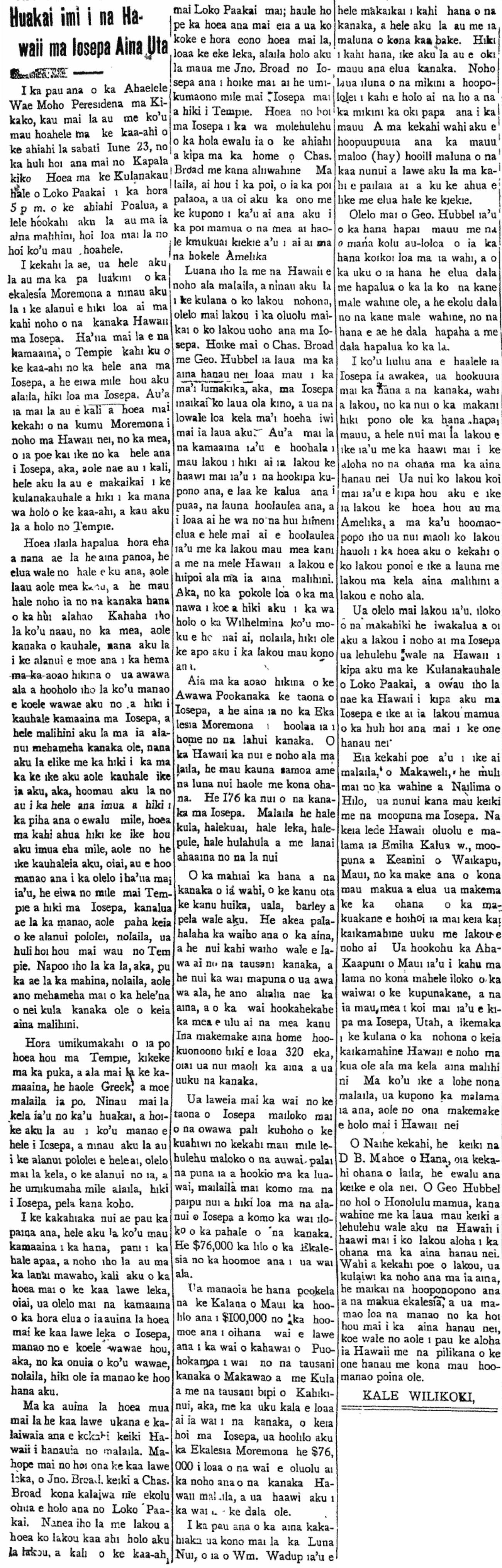
Following the Presidential Nominating Convention in Chicago, I boarded the evening train, along with my travelling companions, on the sabbath, June 23, to return to San Francisco. We arrived at Salt Lake City at 5 p. m. on Tuesday evening, and I jumped off alone in that foreign land while my companions continued all the way.

The next day, I went to grounds of the Mormon temple and asked for the way to get to where the Hawaiians lived in Iosepa. I was told by the locals that Tempie was where the train stopped to go to Iosepa, and eight more miles and you’d reach Iosepa. I was restrained to wait for one of the Mormon teachers who lived here in Hawaii, for they knew the way to Iosepa, but I did not wait, I toured about the city until the time the train departed, and I boarded for Tempie.

I arrived there at 4:30 and saw a barren land with but two buildings, no trees, no crops, and they were just houses for the men who worked on the railroad. I was shocked, because there was no one home; I looked at the road lying to the south, to the east of the valley and I decided to walk until the houses of the locals of Iosepa, and so I went as a malihini on that lonely deserted road; I looked as far as my eyes could see, and there were no homes in sight, but I continued walking forward for eight miles and reached a hillock from which I could see four more miles, but I couldn’t see any houses, while I recalled what was told to me, that it was eight miles from Tempie to Iosepa; I was confused, thinking that maybe this wasn’t the correct road, so I turned back once again for Tempie. The sun went down, but the moon came out, so the trip on this deserted foreign land was not forlorn.

I arrived back in Tempie at eleven that night, knocked on the door, and the kamaaina, who was a Greek, awoke, and I slept there that night. He asked me about my travels, and I told him that I was headed for Iosepa, and I asked him the right way to get there, and he told me that that was indeed the road but he estimated that it was fourteen miles before reaching Iosepa.

Early the next morning, we were done with breakfast, and my kamaaina went off to work; he locked up the house, and I sat out on the lanai, waiting for for the mail truck, since the locals told me that the letter truck to Iosepa arrived at two that afternoon; I thought to walk once again, but because of swelling of my legs, I couldn’t do it.

In the afternoon, a delivery truck driven by a Hawaiian youth born there arrived first. After him arrived the mail truck driven by John Broad, the son of Charles Broad, along with three passengers headed for Salt Lake. I spent time with them until their train arrived and they left; and I waited for the train from Salt Lake; its arrival ran late, and it came at about six; we got the mail bag, and I went along with Jno. Broad to Iosepa which he said was sixteen miles from Iosepa to Tempie. We arrived at Iosepa at dusk, at eight in the evening and visited the home of Charles Broad and his queen [wife]. There I ate poi once again, that being poi palaoa [poi made of flour], and this was much tastier and better than the expensive haole food that I had in the American hotels.

I spent time with the Hawaiians living there, and asked about how their lives were;  they said their way of life in Iosepa was pleasant. Charles Broad and George Hubbel told me that when they were home in the land of their birth, they were subject to frequent bouts of rheumatism but in Iosepa they were fine and this ailment giving them sore bones disappeared. I was asked to stay back by the kamaaina to spend [seems to be a dropped line here: “hoohala i mau lakou”] so that they can properly welcome me, like by roasting a pig, joining together in celebration, and allowing time for the two singing groups to  come and entertain me with their music and Hawaiian songs that they cherish in that foreign land. But because of my very short time left before the Wilhelmina, my ship upon which I was returning, was leaving, therefore, I could not accept their invitation.

The town of Iosepa is east of Skull Valley [Awawa Pookanaka], and it is land dedicated as a home for kanaka people. Hawaiians are the majority living there, and there are some kauna [forty] samoans and the head haole and his family. There are 176 people in Iosepa. There is a school house, store, post office, church, dance hall, and a lanai for parties on special occasions.

The work people do there is farming, planting oats, wheat, potatoes, barley, and so forth. The land is flat and stretches out, and there is much space, enough for a thousand people, and there is a lot of spring water in that valley, but the land is like a salt bed, and it is by irrigation that the crops grow. Should you want a homestead, you can get 320 acres, being that there is abundant land yet few people.

Water is brought in for the town of Iosepa from the deep, grooved ravines of the mountains for many miles in canals which are lined with cement and runs out to a reservoir, and from there the water runs into great pipes reaching the roads of Iosepa and entering the house lots of the people.  The Church spent $76,000 to lay the waterway.

It is thought that it was an ultimate feat of Maui County, which spent $100,000 to lay the water system to bring the water from Puohokamoa Stream as water for the thousands of people of Makawao and Kula and the thousands of cattle of Kahikinui, however, people have to pay to get the water; as for the water in Iosepa, the Mormon Church paid $76,000 to get the water to make the life of the Hawaiians there easy, and they give it for free.

After finishing breakfast, the Head Boss, William Wadup [Waddoups], invited me to  tour the work place of the people, and so I went with him aboard his vehicle [Not sure what a “kaa bake” is, but it appeared in an earlier article i put up]. We arrived at the place of work, and I saw two men cutting grass. They sat atop the machine, guided the horses straight, and the machine was what cut the grass. And at another location, the dried grass (hay) was piled onto a large truck and taken to where it was heaped up, and the pile was as tall as a two-story building.

George Hubbel told me that pitching hay with long-handled three-pronged pitch forks was the most important job there, and the pay for that job was two dollars and a half a day for a single man, and three dollars for a married man; for other jobs, the pay was a dollar quarter and  a dollar half a day.

As I made ready to depart Iosepa that afternoon, people were let off work, they told me because it was windy that they could not pitch hay, and they all came down to see me and to give their aloha to the families in the land of their birth. There was much asking for me to visit them again should I come back to America, and from what I saw, they were very happy at the arrival of one of their own who saw and visited with them in this foreign land upon which they live.

They told me that in the twenty or more years which they lived in Iosepa, there were a great many Hawaiians who visited Salt Lake City, but I was a Hawaiian who actually went to Iosepa to see them before returning here to the sands of our birth.

Here are some people I saw there: Makaweli, the last born of the wife of Nailima of Hilo, who has many children and grandchildren in Iosepa. It was this kind Hawaiian lady who took care of Emilia Kalua (f), the grandchild of Keanini of Waikapu, Maui, because both of her parents died; the family of her father wanted to bring back this young girl to live with them. The Circuit Court of Maui appointed me as executor for her portion of the estate of her grandfather, and these are they things which made me visit Iosepa, Utah, and to see firsthand how this Hawaiian girl was living without parents in this foreign land. From what I saw and heard about her there, she was being properly taken care of, and she did not want to come to Hawaii nei.

Also, there is Naihe, a child of D. B. Mahoe of Hana; he is family there; he has eight children living. George Hubbel formerly of Honolulu, his wife, and their children, and so many more other Hawaiians gave their aloha to their family here in the land of their birth. According to some of them, it is their homeland, the treatment of the church elders is good, and the thought to return to the land of their birth is very far away, except for the fact that their aloha for Hawaii is not gone, as for their kin at home with their never-ending thoughts of them.

KALE WILIKOKI [Charles Wilcox]

(Kuokoa Home Rula, 7/12/1912, p. 4)
Huakai imi i na Hawaii ma Iosepa Aina Uta

Kuokoa Home Rula, Buke X, Helu 28, Aoao 4. Iulai 12, 1912.