On Hooulu Lahui, 1876.

SATURDAY, MARCH 4.

REPOPULATION.

The following is the text of the memorial of citizens which was presented to His Majesty on Tuesday last, by a committee of signers:

To His Majesty the King,

Sire:—We, the undersigned, subjects and residents of this kingdom and friends of your Royal Person, in view of what we deem a grave condition of public affairs, take the liberty to address you in a spirit of frankness and loyalty in order to point out the danger that threatens the state, and at the same time the necessary measures to avoid the national peril.

We desire to say at the outset, that we are prompted to take part in this address not only on account of a loyal and friendly regard for Your Majestyʻs person, but also by reason of our strong desire to see maintained, with ample honor and prosperity, the Independence of the Hawaiian Kingdom.

The propriety of according the privileges of independent sovereignty to a state so much reduced in people as Your Majestyʻs dominions is very much questioned, and the discussion is most detrimental to the dignity and permanence of the throne. This question was even raised in past years, when Hawaii numbered far more souls than at this time within her borders. When the commissioners of Kamehameha III presented the claims of this archipelago for recognition as an independent state to the Government of Great Britain in 1843, they were met at first with a peremptory refusal from Lord Aberdeen, the British foreign minister, on the ground that the state of Hawaii was a mere chieftaincy under foreign influences, and too small to be entitled to diplomatic courtesies and treaty making powers. And if such a view could be taken of our state thirty-three years ago, when we numbered about one hundred thousand people, what must be thought of our capability for independence now when perhaps we number barely fifty thousand souls, natives and foreigners all told? Continue reading

Re-population in the eyes of the haole, 1876.

Palapala Hoopii i ka Moi.

Ka Hooulu Lahui.

[This memorial urging re-population of the nation was probably an English document, translated here into Hawaiian. For the English and the interesting list of signatures, see the following post.]

(Kuokoa, 3/18/1876, p. 1)

Palapala Hoopii i ka Moi.

Ka Nupepa Kuokoa, Buke XV, Helu 12, Aoao 1. Maraki 18, 1876.

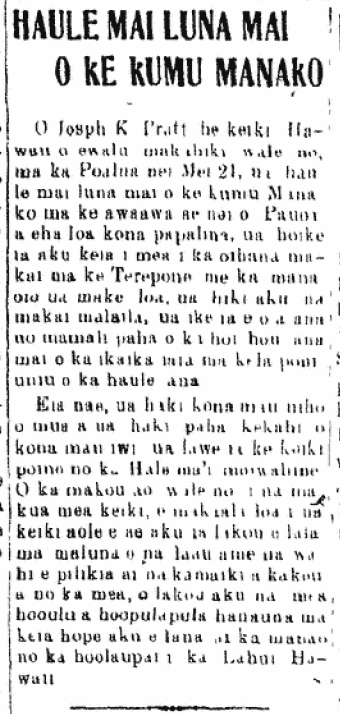
Speaking of Queen Kapiolani, here is a set of sweet mele composed in her honor! 1881.

HE KAPA NO KAPIOLANI.

O-mai o Kapiolani ka wahine nona ke kapa la,
I hana ia i ka lewa anuu i ka lewa lani;
I ka pae opua i kukulu o Kahiki—
Hiki ko kapa la i Hawaii,
He kapa la no Kapiolani
Ke Alii wahine nona ua kapa ke-o-la
O-mai ana hoi ko kapa la-e.
Aia i ka hikina ko kapa la
O ka la hiki ma Kumukahi
Hookahi no oe e ka Lani
Ko kapa o ka maka o ka la
Kukuna o ka la ko kapa
Hana ia mai e ke ao polohiwa
Ka onohi o ka la ko kapa
Hana ia mai e ke ao-lewa
Lihilihi o ka la ko kapa
Hana ia mai la e ka opua
I kapa aahu no ka Lani
No Kapiolani i ka iu o na moku,
E ola o ka Lani i ke ao
A kau i ka pua aneane.
Aia i ka mahina ko kapa,
Ke konane hohola i ka honua,
Hana ia i ka malu o ke ao,
I ka ihi ka-pu o na Lani,
Hii ia mai la e Hoohoku,
Laua me Mahealani,
I kapa aahu no ka Lani,
O Kapiolani i ka iu o ka moku
E ola o ka La ni i ke ao
A kau i ka pua aneane.
Aia i ka hoku ko kapa
O ke ao kaalewa i ka lani
Hana ia mai la e Makalii
Ko kapa o ke ao naulu
Hii ia mai la e Kaaona
Ko kapa nani o ka uila
I kapa aahu no ka Lani
O Kapiolani i ka iu o ka moku
E ola o ka Lani i ke ao,
A kau i ka pua aneane.
Aia i Kumulani ko kapa
O ka ua koko i ka ili kai
Ke hohola mai la i ka moana
Hii ia e ka ohuku ale
Punohu ko kapa e ka Lani
Hana ia e Kane Kanaloa
Loa wale ka noho’na a ka Lani
A kau i ka pua aneane.
Mrs. Kaleihiwahiwa.

HE HELE NO KAPIOLANI.

Ke hele mai nei ke Kuini,
O Kapiolani no he inoa,
Ua paihiihi ka honua,
I ka hele ana a Kapiolani,
Nau ka hele la i ike ia,
Ua haa ka opua i ka lewa,
Ku e ka punohu mamua,
I ka hele a ka Lani kiekie
Pio ana e ke anuenue,
Halii ana e ka ua koko,
Haina ka hele i ike ia,
No Kapiolani la e o mai.
Ke hele mai nei ke Kuini,
O Kapiolani no he inoa,
Nau ka hele la i ike ia,
Haa e Hawaii o Keawe,
Ui ae Hiiaka i ka poli;
Nawai neia kupueu,
Hai mai o Maui o Kama,
Moopuna wau na Makalii,
Ninau Molokai a Hina,
No ke aha nei hele a ka Lani,
Hai mai Oahu o Kuhihewa,
A he hele hooulu lahui,
I pono no ka makaainana,
Olioli Kauai o Mano,
Lohe aku Niihau me Lehua,
Eiae o ka Lani a hiki mai,
Haina ka hele i ike ia
O Kapiolani la e o mai.
Mrs. Kaleihiwahiwa.

HE PUA ROSE NO KAPIOLANI.

Auhea wale oe e ka ua,
Ma ka lau koa la o Nuuanu,
O ke Kamakahala ka’u pua,
A i koolua hoi no ka Ahihi,
E maliu mai e ke onaona,
Eia ko lei hulu mamo,
O ka oo manu o Lea,
Kuu laahia wale i ka leo,
I ka lahui ipo ahi
Mahea hoi au e ke hoa,
E hoopumehana ia ai,
Ma ko oealo iho au,
I ka poli i ka pili umauma,
O ke kapa ia e mehana ai,
O na po kehau anu,
Eia au a hiki aku,
Me ka mohai a ka hihio,
E aho au e hooko,
I ka leo  hoi o ke Kahuli,
I kuleana ai o Ulili,
E hone nei i ke kualono,
Ua kohu kanikani a ula,
Ke o i ka ili o ke kai,
Akahi a lana ka manao,
Eia i ko’u waihona,
I ka pa i—ki pili aoao,
Haina mai ana ka puana,
O Kapiolani i ka iu o luna.
Mrs. Kaleihiwahiwa.

HE INOA NO KE OHO O KAPIOLANI.

Akahi hoi au a ike la,
Ke konane lai a ka mahina la,
O ka noho nani a ke Kuini,
O Kapiolani no kuu lani,
Eia i ke one kaulana,
I ke one kapu o Kuhihewa,
Ua kuhi au o ka lau niu,—
A-e-he holu nape nei i ka makani,
Eia no ka o ke oho,
O ke oho kapu o na lani,
Haina ia ana ko oho,
O Maewaikalani he inoa,
E o mai oe e ka Iwa,
O Kapiolani i ka iu o luna.
Mrs. Kaleihiwahiwa.

HE INOA APO-LIMA O KAPIOLANI.

He inoa keia no ke Apo-lima,
No Kapiolani i ka iu o luna,
Eia ia la ke hulali nei,
Ke anapu mai la la i ko lima,
Ua hana ia mai e Kinigula,
A i apo-lima hoi no ke Kuini,
Hanohano oe la ke noho mai,
Ka alohi mai a ou map [mau] apo-lima,
Ua like me ka hau o ka mauna,
Ka ha-ale i ka piko o Maunakea,
Kinohinohi oe ke iho,
I na hana noiau a ka wahine,
Ua like pu me ka ula o ke ahi,
I ka a i ka poli ou e ka Iwa,
Haina nona ka ke apo,
O Kapiolani i ka iu o luna.
Mrs. Kaleihiwahiwa.

HE KOMO LIMA NO KAPIOLANI.

Nani wale ke Komo Kaimana,
Hana ia mai la e Rukini,
Ke a mai la i Ladana,
Ke anapu ae la i Parisa,
Na Pae Aina o Kahiki.
Hiki mai ka Uwila Olelo,
Ma ka Moana kai anu Hema,
Kau lia ia iho i ka Hema,
I pili pono i ka Akau,
Ua kau a like ka manao,
Ua iliwai like pono ia,
I na Ona Hui o Palani,
I uwepa ia i ka Puuwai,
I ka Elele uweke kapalili,
Liilii hua momi o Kina,
Waiwai kumukuai nu i,
Ua nui ua piha ke kaona,
Na mea hou o ka Nupepa,
Eia la hoapaapa ilaila,
Huli mai eia ka mehana,
Ho-iho a pulu i ka ua,
Aole i ka wai kehau,
Haina ia’e i lohe ia,
Ka Wahine hoi nona ke Komo,
Kapiolani i ka iu o luna,
Ke Kuini o Hawaii nei.
Mrs. Kaleihiwahiwa.

HE ALOHA NO KAPIOLANI.

Hoonani mau ia ke Kuini,
O Kapiolani no he inoa,
A he hiwahiwa no ke ao nei,
Mai ka Hikina a ke Komohana,
Hana mau ka waha o ka lokoino,
Kau mau ana i ka lehelehe,
Kumu ole ka hana a Hawaii,
Maluna hoi o nei lani,
E oni wale mai no oe,
Aohe e loaa ke’lii,
A he ihi a he kapu ia nei,
A he pua kau i ka wekiu,
Aole e loaa keʻlii,
Ia oe e ka Maukauka,
A heaha keia wahakani,
Au la e Hawaii o Keawe,
A he manu ke hoa e like ai,
Kau like i ka lae kahakai,
A he lohe olelo mai ko’u,
I ka nune o ke kaona,
E ola kuu Lani Ihikapu,
Ma ka inoa o ke Kahi-kolu.
Mrs. Kaleihiwahiwa.
Ka-ua Paakea o Hale-kela.
Kapalama, Aperila 12, 1881.

[This newspaper, Ka Elele Poakolu, is yet another one not available online even if it is microfilmed. I am not sure how ulukau.org missed digitizing this when they were under agreement many years ago to put up all of the available newspapers online… To view the pages, you have to find your way down to one of the institutions which have Hawaiian-Language Newspaper microfilms.

Might anyone have any biographical information on Mrs. Kaleihiwahiwa?]

(Elele Poakolu, 4/13/1881, p. 6)
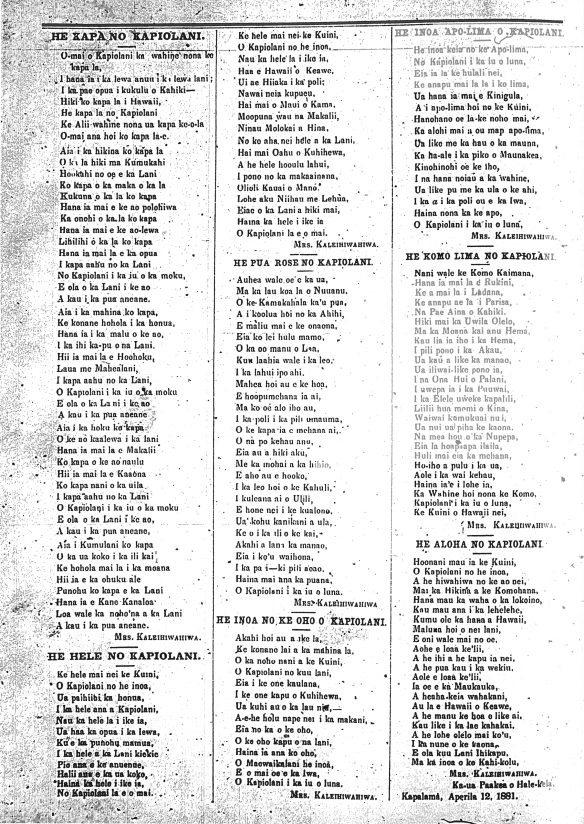
HE KAPA NO KAPIOLANI...

Ka Elele Poakolu, Buke II, helu 6, Aoao 6. Aperila 13, 1881.

Letter from Iosepa, Utah, 1913.

A VOICE FROM UTAH.

Iosepa, Toole County. Dec. 19, 1912.

Solomon Hanohano, Editor of the Kuokoa, Aloha oe:—Because I want to know the news of the land of our birth, the desire to get a subscription to the Kuokoa grew. Being the the new year is coming, it would be a means for me to see the news of our home and the progress of the political scene or its regression, as well as the victories or discouragements of our fellow makaainana.

Not because Iosepa lacks newspaper subscribers, but for me to get a personal one.

This is one of the important years regarding the nation, being that the leadership of the power of the nation went to the Democrats; the big question is just this: Will the poor makaainana really benefit, or will they be left unstable once again like during the presidency of Cleveland, but it is only time that will tell.

If those elected could follow through on what their lips pledge to the masses, then we indeed will be blessed, however if it is like what Isaiah said, thusly: “These people come near to me with their mouth, but their hearts are far from me.” [Isaiah 29:13] Then comes those famous words of that old timer of Lahaina: “Saying, when indeed will that happen.” [“I mai hoi, ahea la ka hoi.”] The big-eyed images know that the small-eyed images are not watched. [Ikeia aku la no na kii maka nunui, nana oleia iho la na wahi kii maka liilii ??]

My aloha to the few Hawaiian makaainana left who are squeezed and assimilated [i ka opaia aku ua pili pu ?] until they are totally gone from the beloved face of Hawaii, along with the increase of the other races upon the land. And so too with the various diseases of the different races whose devastation spread to our people who lack immunity. Aloha to our people.

As for our living in this unfamiliar land, this land that true Mormons know as the chosen land, and a land to foster the believers in that one faith, all of the Hawaiians are in good health as well as the Samoans, from the old to the young.

I have faith that Iosepa will become a place where Hawaiians will multiply once again, and that these valleys will become full of true Hawaiians and Samoans, when the children are born, and grow up, and marry and give birth.

Some proof of this belief is the great desire of the president of the Mormons for the youths to marry of their own race so that this land is full of Hawaiians. For according to him, it is here that the people of the islands of the ocean will spread.

The town of Iosepa is growing. The church is building homes for the people without homes, lest they live in disarray as the Hawaiians before, with two or three families in a single dwelling.

The workers are paid a dollar every Saturday. The children are taught in the school here in Iosepa. Two children graduated from the local school of Iosepa, and are attending high school, they are Joseph H. Bird and William Pukahi, both are true Hawaiians.

I have been just chosen as judge, and George K. Hubbell as sheriff of the district. We are both Republicans, which also are the majority of the Hawaiians here.

Perhaps this will do.

Charles J. Broad.

Iosepa, Toole County, Utah.

(Kuokoa, 1/10/1913, p. 6)

HE LEO MAI UTAH MAI.

Ka Nupepa Kuokoa, Buke XLIX, Helu 2, Aoao 6. Ianuari 10, 1913.

On the decline of native birds, 1871.

Locals of the Tuahine Rain are no more.

O Ke Au Okoa:—Aloha to you:

I am sending you a small gift atop your outstretched foundation, should your captain and Editor be so kind, and it will be for you to take it to the shores of these islands so that my newspaper-reading companions may see it, it being the letters placed above: “Some Locals of the Tuahine Rain¹ are no more,” and it has been ten or more years which they have not been seen.

And my friends are probably puzzled about these locals that have gone missing, and you, our old-timers, are all likely saying, not them, here they are, and some people have passed away, but we knew of their passing; but the departure of these kamaaina which I speak of was not witnessed. And this is it, the kamaaina birds of our uplands: the Iwi, the O-u, the Akakane, the Amakihi, the Oolomao, the Elepaio; these are the native birds of these uplands who have disappeared.

And some of you may be questioning, what is the reason for this disappearance? I tell you, it is because of the spread of the evil birds from foreign lands, in our plains, mountains, ridges, valleys, cliffs, forests, terraced taro patches, seashores, and rivers; that is why these kamaaina have gone, because of the spreading of these evil birds among us, and they are damaging the crops, and the food from the forests; rice planted by some are being eaten by these evil birds; and the bananas of the forests are all eaten up by these birds.

What do we gain from these evil birds being spread in Hawaii, and protecting them so that they are not killed? I say that we gain nothing from these evil birds which are hurting our native birds and crops and foods from the forests; because in the past, before the spread of these birds, if a kamaaina of this land wanted to go into the mountains to get thatching or some shrimp, or some oopu, they did not pack food with them, because they thought that there was food in the mountains, like banana, hawane fruit, and uhi; banana would ripen on the plant and then fall, without anything damaging them, but now, the bananas don’t ripen on the plant; they are eaten by these banana-eating mu [mu ai maia] of the forest; bananas don’t ripen, and [now] when you go into the mountains, there is just the oka-i [blossom container of bananas] left and the bananas are lost to these birds; and the kamaaina birds are gone. Where to? Perhaps they all went to Hawaii island.

And I say without any hypocrisy, the decrease of this people was because the arrival of the evil haole to Hawaii nei; it was they who spread the evil sicknesses: gonorrhea [pala] and syphilis [kaokao]. Smallpox [hepera] and leprosy [mai pake] are the reasons that our lahui was decimated, because of the arrival of the evil haole; if all the people who came to Hawaii were like the people who brought the light [missionaries],  then this lahui would not have decreased in number; so too with the arrival of the evil birds to Hawaii nei, which hurt our native birds and plants; this is like the decrease of our lahui with the arrival of the evil haole who spread gonorrhea and syphilis and similar diseases.

Therefore, I feel aloha for the kamaaina birds of my beloved land because they are all gone, and the youngsters of these days question, what are those birds like? They are tiny birds with beautiful voices, and their feathers as well, and they were an enjoyment in our childhood; when times of strong winds arrived, all the birds of the mountains would alight and show up at the doors of the houses which was entertaining for us to watch them flitting amongst the leaves of the ilima in our childhood and they were a playmate in our youth.

Before the arrival of these birds, there was a great abundance of Iwi, Amakihi, Akakane, O-u, Oolokela, and Elepaio, right here above us, atop the clumps of aliipoe, bushes of hau, noni trees, and more upland, the number of birds was amazing, atop the flowers of lehua of the mountain apples, and on the Ahihi and the Lehua Kumakua;  those uplands were so enjoyable but these days, they have all vanished, maybe because there were aggravated by these evil birds.

Here is another thing; if only the coming session of the Legislature could revise the law pertaining to birds from foreign lands, for there are destructive birds that have been imported as well from foreign lands.

And this is a supplication to you, O Ke Au Okoa. With aloha to the one who steers you, and also to the boys of the Government Printing Press. The boy from the uplands is turning back for the Tuahine rain of the land is spreading about.

T. N. Penukahi.

Manoa, June 24, 1871.

¹Tuahine [Kuahine] is the famous rain of Manoa.

(Au Okoa, 6/29/1871, p. 3)

He mau wahi kamaaina no ka ua Tuahine, ua nalowale.

Ke Au Okoa, Buke VII, Helu 11, Aoao 3. Iune 29, 1871.

Dangers of Mango Season, 1912.

FELL FROM A MANGO TREE.

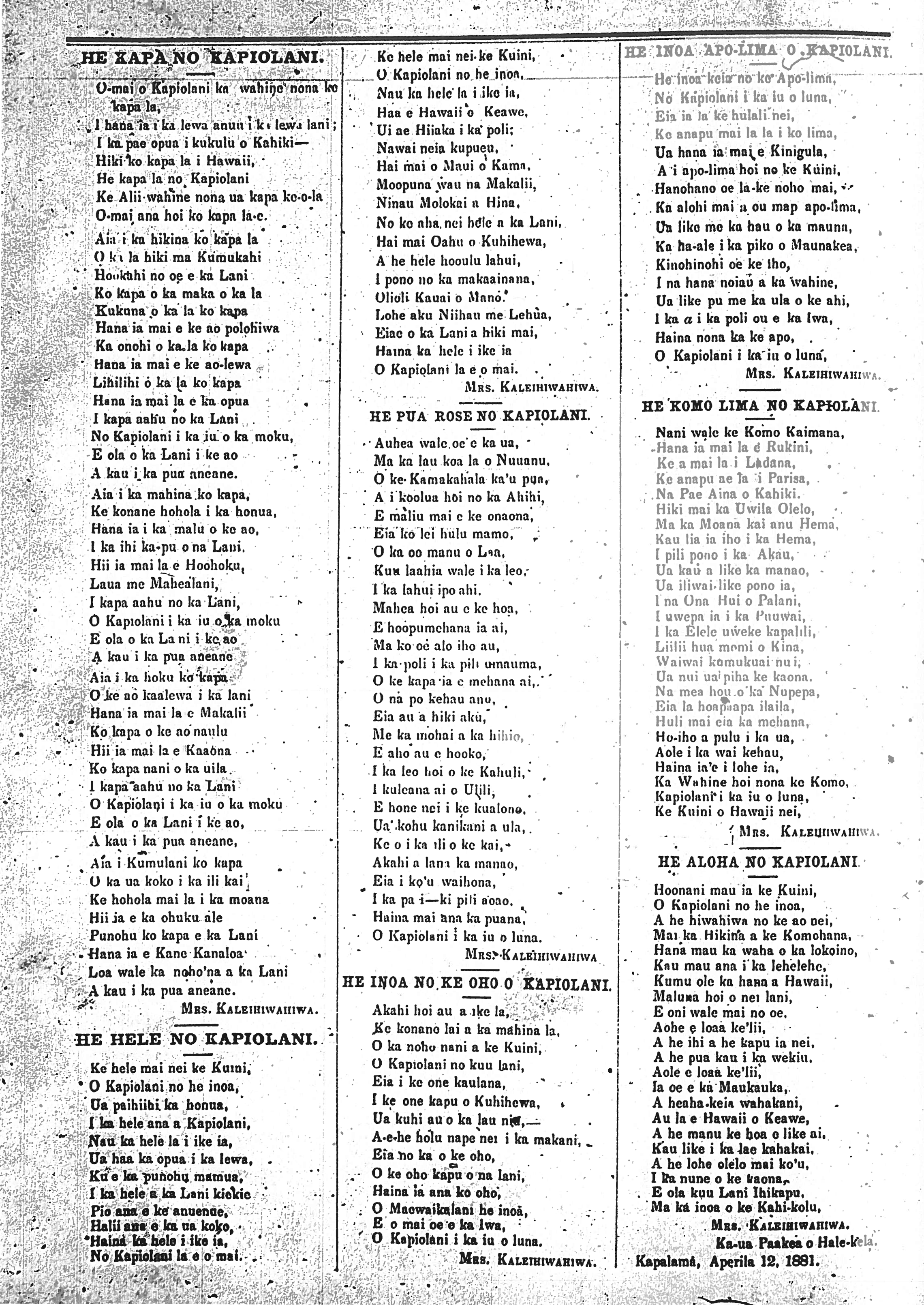
Joseph K. Pratt, a Hawaiian boy of just eight years of age, on this Tuesday, the 21st of May, fell from a Mango tree in Pauoa Valley, and his cheek was severely hurt; this information was given to the police department over the Telephone with belief that he was dead, but the police arrived there and it was seen that he was alive, perhaps because he regained consciousness from the dizziness after falling.

However, he broke his front teeth and maybe he broke some of his bones; the injured child was taken to Queen’s Hospital. Our instruction to parents of children is to watch over them and not allow them to climb on trees and places that would put the children of ours in danger, for they are the ones who will increase and procreate the generations here forward and through which there is hope for the increase of the Hawaiian Race.

[Words to live by: whether in 1912 or a hundred years later in 2012.]

(Kuokoa Home Rula, 5/24/1912, p. 1)

HAULE MAI LUNA MAI O KE KUMU MANAKO

Kuokoa Home Rula, Buke X, Helu 21, Aoao 1. Mei 24, 1912.