More on Katsu Goto, 1889.

THAT MURDER AT HAMAKUA.

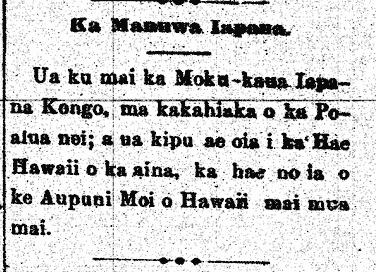
The body of the Japanese doctor* Goto at Hamakua was found dangling, killed by unknown people; news was received this week that three haole sugar plantation workers suspects were arrested, and they are being brought from Laupahoehoe aboard the Kinau to be detained at the Hilo jail.

Their names are T. G. Steel [T. G. Steele], J. Richmond and W. C. Blabon.

By the kindness of Mr. J. Kaulahea, we received the letter below from one of his friends in Honokaa:

The news of Honokaa nei is that a Hawaiian and haole are being arrested, suspected that they beat and hung the Japanese from the telephone pole.

These are who were arrested and taken to Hilo: 1 Hawaiian and 3 haole. However the arrests amongst the haole are not over. Continue reading

Katsu Goto murder trial, 1890.

AN INFORMER’S EVIDENCE.

The Testimony Given by John Richmond in the Honokaa Murder Case.

John Richmond sworn, stated—My name is J. Richmond and I live in Honokaa. I was stable man for Mr. Overend. I was there in October last; I know defendants; Mr. Steele is luna for Mr. Overend; my house i on the west side of the stable; from Overend’s house it is three or four hundred feet; October 28th last I was there; Mr. Steele came after me sometime after I was in bed and asked me to go to the Jap quarters, and told me to watch for Jap and find out where he went to, and I was to carry the information to the schoolhouse; (map shown and Overend’s house, stables and schoolhouse located. Schoolhouse where he was told to go); I do not know what time it was, I had been asleep and no one was with me; I stood by wood pile watching for Jap about half an hour; I did not know Goto; I did not know who I was watching for; I went up and saw Jap come out and get on horse and then I went up Government road to the schoolhouse; I met Mr. Steele there; I was on foot; I walked as fast as I could going up a hill; took me about ten minutes to go up and I met Steele there; I told him that the Jap had started and went towards big quarters; I then said, I will go back and he said “no, wait awhile, I may need you;” I saw him mount his horse; I stayed by cemetery fence and he told me to stop there till he called for me; I sat down then on the edge of the road; there is grass there and a fence; I could not say how long I stayed there, and I saw Jap coming on horseback. He was walking his horse up the hill; I was on the west side of the road and Jap was near that side; when Jap got there I saw Lala, Blabon and Steele rush out for the horse. Blabon and Steele pulled the man from the horse, and Lala grabbed the horse by the bridle; there was grass there; Steele grabbed the Jap by the head, back of the head and mouth, and Blabon took hold of the man’s body; Jap came off the horse kind of on his knees; he was then taken in to the opposite lot and laid on his face; I could not tell how long he was lying there; Jap in the end was hung; this was all done within an hour. Steele, Blabon Watson and Mills carried him up from the road; after they got there they tied his hands behind his back; Blabon tied his feet; I heard Jap say, Pau, pau; after he was down on his feet I did not hear anything more; heard no groan; and then after he was tied he was carried up to the Government road running through Honokaa; he was carried to the makai side of the road near trail and left; this last place is about 200 feet from telephone post; he was laid down and Mills asked me to go over to telephone post and get a rope; it was a new rope about ¾ inch thick; I found the rope at the telephone post; it lay coiled up in coil, and had a noose made on the end; it was regular hangman’s knot; other end was unrolled and one strand was cut off a short distance up; the rope was a new one. (The rope is brought in and recognized as the rope found at the telephone pole.) I gave the rope to Watson; I was gone a few minutes; I took the rope where man was lying; I gave it to Watson; Then somebody said “My God! He is dead.” I stooped down and put my hand on the man’s heart, but could not feel and pulse; I helped to carry him over; Blabon, Steele and Mills also helped; Watson came with the rope; there was no struggle on the part of the Jap after we got to the telephone pole; the rope was crossed over arm at post; Watson cast the rope; Mill’s raised the body up and cast the rope over Jap’s neck and then we pulled him up; I last saw Lala when he was taking horses up to Lyceum; he was tied to hitching rack inside the Lyceum yard; I did not see Lala any more that night.

By a Juryman—The Jap was carried to the same pole where I found rope.

By the Court—Mr. Mills pointed to the pole and said to go and get that rope.

Examination continued—Steele was on horseback; Steele’s horse was tied by Lala right near the road; tied near gate post; other end of the rope was made fast to the telephone pole; I do not know exactly who made it fast; Mill’s made the remark that they would ask the man some questions, and after they thought he was dead, Mills said: “Well, he will not sell any more goods;” the body was entirely unresisting when we carried him; Steele caught him at the  back of the head and over the mouth; Steele was afoot at the time; Goto the Jap was medium sized; kind of slim built; not a heavy man; the horse I could not say as to his weight, but he was about 14 or 15 hands high; Steele was on the same side of the horse that I was; they stopped the horse and the Jap called “Pau, pau,” and Steele caught him by the mouth; the Jap was leaning over the side a little; after the Jap was hanged we stopped around a few minutes; I was told not to tell any one who had done it; Mills cautioned me: after that I went home; the Jap was dressed in light clothes, shirt and pair of blue overalls; I think dungaree pants; I could not describe the hat; I had hold of the fee when I carried him. [Pants shown and identified as same kind that he wore; as to the shirt it was something like shirt shown.] He did not have stockings on; I did not recollect any shoes at all; hat placed I do not know where; Mills had a cap on; peaks and ear flaps to it, and had on kind of cloak. (Cap shown and identified as cap and cloak shown and identified as cloak). I know Mr. Mills, have known him about eighteen months; I have know Steele and Watson ever since I have been at Overend’s plantation; Blabon I had seen once before; I am in no doubt who the persons were that night; I do not know Lala and I have nothing to do with him, and I did not know who he was till that night; I suppose that Lala was told to told the horse; some one spoke to him; Mills called him and told him something in kanaka and he went and took the horses and tied them; Mills said that we will not say anything about it; I spoke up and said we will know nothing about it at all; others assented; after this I went home and that is all I know; I came home and went to bed; from stable to my room about twenty-five feet; I have a window in my room that I can look right out of to the front of the stable; I was woke up by hearing some talking; I saw Steele and Watson leaving the stable; I could not tell what they were saying; I had gone to bed a few minutes after 8 when Steele came and called me first; my work is to get cane tops and feed horses; I had to take care of seven horses; Mr. Steele’s horse was in the stable; the horse that Steele uses all of the time is a white horse; Lala took Steele’s horse; Overend had one white saddle horse and two black horses; horses are cleaned every night when they get through work, about 7:30; Steele’s and Overend’s horses were groomed and cleaned that night; the next morning they had saddle marks on them; that showed that they had been used during the night.

(Pacific Commercial Advertiser, 5/22/1890, p. 3)

PCA_5_22_1890_3.png

The Pacific Commercial Advertiser, Volume XI, Number 121, Page 3. May 22, 1890.

One year after Pearl Harbor, 1942.

This Makes a Full Year

Monday last was a year since the bombing of Puuloa by the those who carried out the coup and stole the lives of people thinking that is what will give them victory.

The 7th of December is a day we probably will never forget for all times, for while the navy and the land of America were enjoying their time, the raider carried out his work which was planned ahead of time, to fly to America to the path of Puuloa, and let down messengers of destruction to cripple the condition of the military of the United States of America.

With America being secretly attacked, that served as a needle poking at the side of the Americans like a spur [kui ke-pa] being thrust into the underside of a horse.

In response to these actions by the raider and assassin, the one who stirred the coals that are burning in the hearts of true Americans, and it became something that inflamed the thoughts of Americans. Continue reading

Less than four months before Pearl Harbor, 1941.

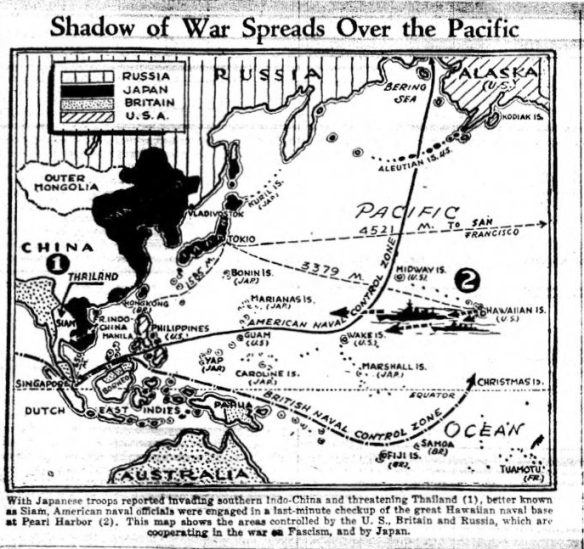
Shadow of War Spreads Over the Pacific

With Japanese troops reported invading southern Indo-China and threatening Thailand (1), better known as Siam, American naval officials engage in a last-minute checkup of the great Hawaiian Naval base at Pearl Harbor (2). This map shows the areas controoled by the U. S., Britain and Russia, which are cooperating in the war on Fascism, and by Japan.

(Hoku o Hawaii, 8/20/1941, p. 6)

HokuoHawaii_8_20_1941_6.png

The Star of Hawaii, Volume XXXVI, Number 17, Page 6. August 20, 1941.

A Hawaiian Co-Op, 1918.

KA “HUI LOKAHI O NA HAWAII” KAUPALENAIA.

These passing day, Hawaiians like Mayor Joseph J. Fern, David Kalauokalani, Samuel C. Dwight, James L. Holt, Hon. William P. Jarrett, Hon. C. P. Iaukea and a number of other Hawaiians are joining together to establish a company that will deal in the sale of poi, beef, salmon, dried fish, and so forth; with the intent to help Hawaiians in all ways that will lessen their household expenses; because it is very clear these days that because the poi factory of Kalihi is not making poi now, the current poi manufacturers are greatly raising the price of poi to five cents per pound; this is a price not seen in the past ten years or more; so too with the price of beef; the Chinese are buying very fine beef from the company of C. J. Waller [Wala], but the Chinese are charging Hawaiians 35 cents per p0und; it is an exorbitant price which has never been seen before; and it is heard from the talk of the Chinese that they will raise the price of poi once again to 6 cents a pound; it was this that encouraged the Hawaiians to establish a company that could hold back the severe increasing of the prices of our foods, O Hawaiians, by the Chinese.

The establishing of a company amongst Hawaiians is important and crucial; but if we Hawaiians do not implement an endeavor that will help ourselves, there will  be no one else who will help us.

If we turn back and look at the history of Hawaii nei, we will see that the dissension amongst us Hawaiians was what wrenched away small businesses from us Hawaiians as well as all the other endeavors. Continue reading

Hasn’t the time come that Hawaiians try to help in the economic endeavors of their own people? 1914.

Announcement

KA HUI KUAI POI O KALIHI (“KALIHI TARO AND LAND CO., LTD.”)

To those who read this.

With aloha:—Whereas all of the shares of the Company named above has been acquired by W. C. Achi and some Hawaiians, and being that they are the only Hawaiians carrying out the growing of taro and the selling of poi, the food of our kupuna and makua; therefore, they humbly ask you, O Hawaiians, that you give them your assistance, by you buying your poi from their group.

The production of the poi at their poi factory is truly sanitary, and your orders will be filled with great haste.

Hasn’t the time come that Hawaiians try to help in the economic endeavors of their own people? Continue reading

Beached whale at Kailua, 1911.

THE MANY OF KAILUA WERE SAVED BY THE GREAT FISH, THE “PALAOA PAE.”

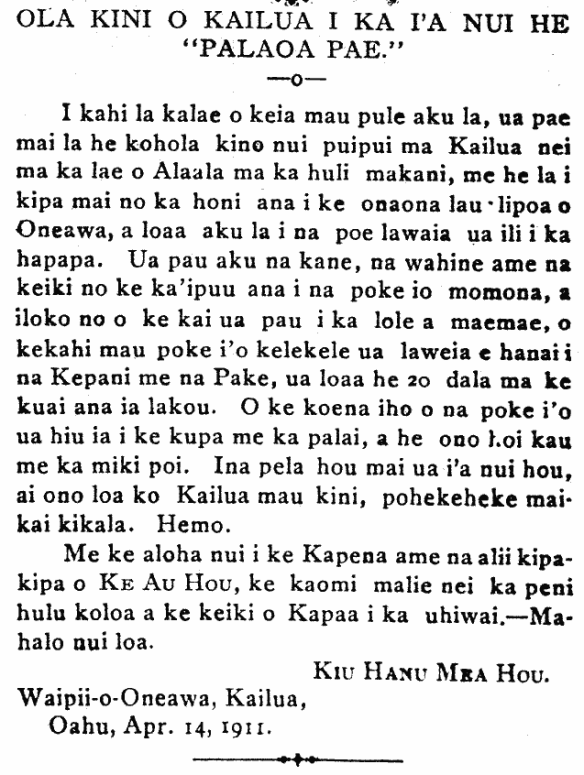
One clear day some weeks ago, a large, heavy-bodied whale landed here in Kailua at the cape of Alaala on the windward side, and it was if we were visited by the scent of the sweet lipoa seaweed of Oneawa, and it was found by fishermen beached in the shallows. The men, women, and children all went and divided up the fatty pieces of flesh, and they all went into the water with their clothes on to get cleaned up; some of the chunks of oily flesh was taken to feed the Japanese and Chinese; 20 dollars was gotten through the sale. The remainder of the meat was thrown into soup and fried, and it was tasty with dabs of poi. If a large fish comes again, Kailua’s multitudes will eat with relish, and their hips will be nicely plump. Satisfaction.

With much aloha for the Captain and the officers [??? alii kipakipa] of Ke Au Hou; the duck feather pen of the son of Kapaa in the mist presses gently down.—Mahalo nui loa.

THE ONE WHO SNIFFS OUT NEWS

Waipii-o-Oneawa, Kailua,

Oahu, Apr. 14, 1911.

(Au Hou, 4/19/1911, p. 21)

AuHou_4_19_1911_21.png

Ke Au Hou, Buke 2, Helu 16, Aoao 21. Aperila 19, 1911.

“You are not permitted to use your own judgement but are blandly told that you don’t know what you are talking about when you venture to express an opinion that is contrary to what is said to be an established fact,” Clarence E. Edwords, 1896.

The Hawaiian Situation.

They protest too much.

This is the conclusion that is reached by the careful observer who talks with the adherents of the present Government [the Provisional Government] of the Hawaiian Islands.

They seem too anxious to impress upon you the fact that it is a most serene and peaceful atmosphere. You are not permitted to use your own judgement but are blandly told that you don’t know what you are talking about when you venture to express an opinion that is contrary to what is said to be an established fact. Of course no fault can be found with such procedure. It is a part of politics. They want certain conditions to obtain and the desire is so great that by long effort to fool others the “P. G.’s” eventually fool themselves. It may seem presumptuous for one who spent but a month in the island republic to give an opinion as to the real political status of the island, but there is so much evidence obtainable that such opinion can easily be formed, even if it does happen to be against the desire of those who now hold the reins of Government.

The stranger who visits Honolulu almost immediately feels that he is surrounded by an air of uneasiness. Things evidently are not as they seem. There is an indefinable something in the atmosphere that makes one feel as if he should be watching over his shoulder. Where the impression comes from it is difficult to say, but if you will talk politics for five minutes with any resident you cannot help but notice the lowered tone of voice, the careful watch of passers-by or the graurded manner, as if there were a constant fear of spies. Nor is this noticeable alone when talking with royalists. The adherents of the Republic are just as guarded and just as careful.

It looks as if they feared a change of Government and as if their expressions might be treasured up against them.

Yet the Republicans and the papers are persistent in their declarations that the islands were never more peaceful than at present.

Perhaps this is true, but if the the present Government is not sitting over a smouldering political volcano, then the signs are wrong, and this same Government has not failed to realize this fact. Nor has it failed to prepare a soft place to light after the explosion.

What is this soft place?

When a man who had been a resident of the islands but ten months made the public announcement of a new Government, that announcement was successful because of the American Minister, who backed up the revolutionists with the force of an American warship and the naval support of the United States. Liliuokalani was dethroned and the Re-…

(Independent, 7/11/1896, p. 1)

The Hawaiian Situation.

The Independent, Volume III, Number 323, Page 1. July 11, 1896.

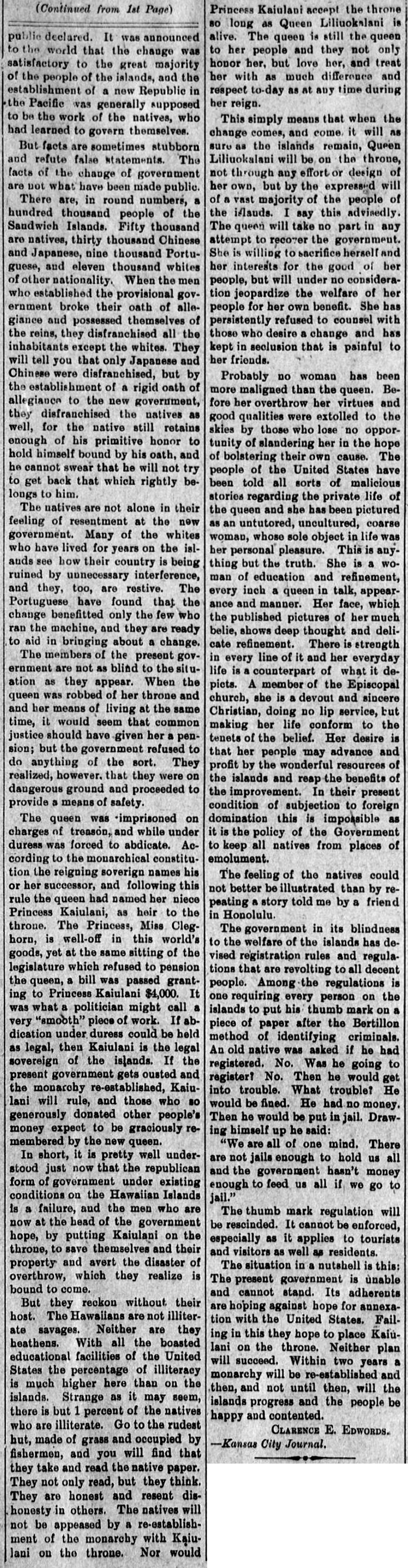
…public declared. It was announced to the world that the change was satisfactory to the great majority of the people of the islands, and the establishment of a new Republic in the Pacific was generally supposed to be the work of the natives, who had learned to govern themselves.

But facts are sometimes stubborn and refute false statements. The facts of the change of government are not what have been made public.

There are, in round numbers, a hundred thousand people of the Sandwich Islands. Fifty thousand are natives, thirty thousand Chinese and Japanese, nine thousand Portuguese, and eleven thousand whites of other nationality. When the men who established the provisional government broke their oath of allegiance and possessed themselves of the reins, they disfranchised all the inhabitants except the whites. They will tell you that only Japanese and Chinese were disfranchised, but by the establishment of a rigid oath of allegiance to the new government, they disfranchised the natives as well, for the native still retains enough of his primitive honor to hold himself bound by his oath, and he cannot swear that he will not try to get back that which rightly belongs to him.

The natives are not alone in their feeling of resentment at the new government. Many of the whites who have who have lived for years on the islands see how their country is being ruined by unnecessary interference, and they, too, are restive. The Portuguese have found that the change benefitted only the few who ran the machine, and they are ready to aid in bringing about a change.

The members of the present government are not as blind to the situation as they appear. When the queen was robbed of her throne and and her means of living at the same time, it would seem that common justice should have given her a pension; but the government refused to do anything of the sort. They realized, however, that they were on dangerous ground and proceeded to provide a means of safety.

The queen was imprisoned on charges of treason, and while under duress was forced to abdicate. According to the monarchical constitution the reigning soverign names his or her successor, and following this rule the queen had named her niece Princess Kaiulani, as heir to the throne. The Princess, Miss Cleghorn, is well-off in this world’s goods, yet at the same sitting of the legislature which refused to pension the queen, a bill was passed granting to the Princess Kaiulani $4,000. It was what a politician might call a very “smooth” piece of work. If abdication under duress could be held as legal, then Kaiulani is the legal sovereign of the islands. If the present government gets ousted and the monarchy re-established, Kaiulani will rule, and those who so generously donated other people’s money expect to be graciously remembered by the new queen.

In short, it is pretty well understood just now that the republican form of government under existing conditions on the Hawaiian Islands is a failure, and the men who are now at the head of the government hope, by putting Kaiulani on the throne, to save themselves and their property and avert the disaster of overthrow, which they realize is bound to come.

But they reckon without their host. The Hawaiians are not illiterate savages. Neither are they heathens. With all the boasted educational facilities of the United States the percentage of illiteracy is much higher here than on the islands. Strange as it may seem, there is but 1 percent of the natives who are illiterate. Go to the rudest hut, made of grass and occupied by fisherman, and you will find that they take and read the native paper. They not only read, but they think. They are honest and resent dishonesty in others. The natives will not be appeased by a re-establishment of the monarchy with Kaiulani on the throne. Nor would Princess Kaiulani accept the throne so long as Queen Liliuokalani is alive. The queen is still the queen to her people and they not only honor her, but love her, and treat her with as much difference and respect to-day as at any time during her reign.

 This simply means that when the change comes, and come it will as sure as the islands remain, Queen Liliuokalani will be on the throne, not through any effort of design of her own, but by the expressed will of a vast majority of the people of the islands. I say this advisedly. The queen will take no part in any attempt to recover the government. She is willing to sacrifice herself and her interests for the good of her people, but will under no consideration jeopardize the welfare of her people for her own benefit. She has persistently refused to  counsel with those who desire a change and has kept in seclusion that is painful to her friends.

Probably no woman has been more maligned than the queen. Before her overthrow her virtues and good qualities were extolled to the skies by those who lose no opportunity of slandering her in the hope of bolstering their own cause. The people of the United States have been told all sorts of malicious stories regarding the private life of the queen and she has been pictured as an untutored, uncultured, coarse woman, whose sole object in life was her personal pleasure. This is anything but the truth. She is a woman of education and refinement, every inch a queen in talk, appearance and manner. Her face, which the published pictures of her much belie, shows deep thought and delicate refinement. There is strength in every line of it and her everyday life is a counterpart of what it depicts. A member of the Episcopal church, she is a devout and sincere Christian, doing no lip service, but making her life conform to the tenets of the belief. her desire is that her people may advance and profit by the wonderful resources of the islands and reap the benefits of the improvement. In their present condition of subjection to foreign domination this is impossible as it is the policy of the Government to keep all natives from places of emolument.

The feeling of the natives could not better be illustrated than by repeating a story told me by a friend in Honolulu.

The government in its blindness to the welfare of the islands has devised registration rules and regulations that are revolting to all decent people. Among the regulations is one requiring every person on the islands to put his thumb mark on a piece of paper after the Bertillon method of identifying criminals. An old native was asked if he had registered. No. Was he going to register? No. Then he would get into trouble. What trouble? He would be fined. He had no money. Then he would be put in jail. Drawing himself up he said:

“We are all of one mind. There are not jails enough to hold us all and the government hasn’t money enough to feed us all if we go to jail.”

The thumb mark regulation will be rescinded. It cannot be enforced, especially as it applies to tourists and visitors as well as residents.

The situation in a nutshell is this: The present government is unable and cannot stand. Its adherents are hoping against hope for annexation with the United States. Failing in this they hope to place Kaiulani on the throne. Neither plan will succeed. Within two years a monarchy will be re-established and then, and not until then, will the islands progress and the people be happy and contented.

Clarence E. Edwords.
—Kansas City Journal.

(Independent, 7/11/1896, p. 4)
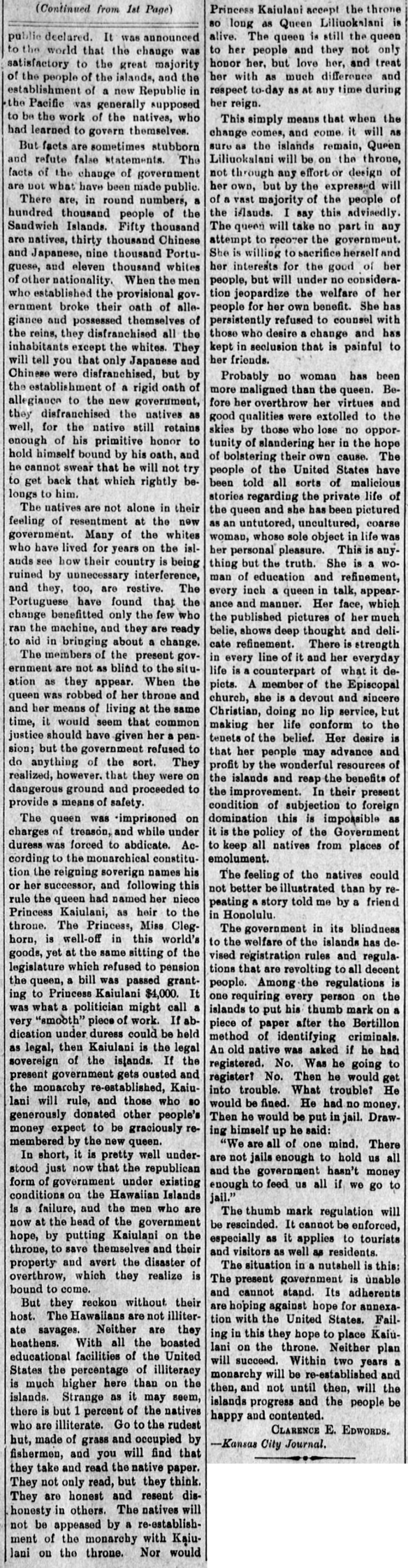
...public declared...

The Independent, Volume III, Number 323, Page 4. July 11, 1896.

Atomic bomb destroys Hiroshima, 1945.

Hiroshima is Leveled

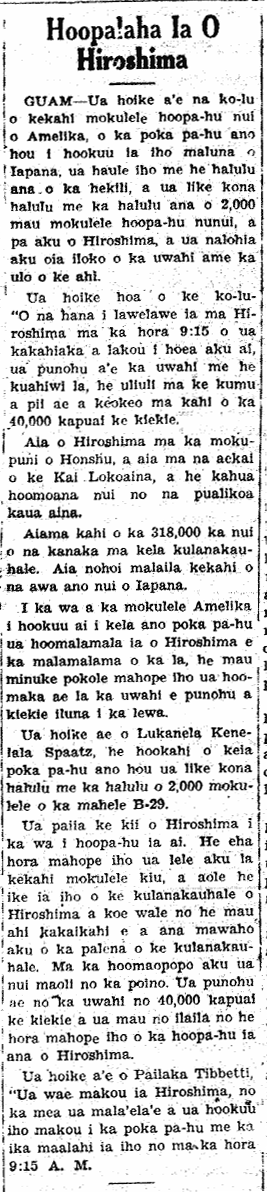
GUAM—The crew of a large American bomber reported of a new type of bomb released above Japan; it fell with the rumbling of thunder, and it was like the strength of 2,00 large bombers; and it hit Hiroshima which disappeared in smoke and the red of fire.

The crew also stated, “The action taken upon Hiroshima at 9:15 in the morning when they arrived, the smoke rose like a mountain, dark at the base and rose to white, reaching about 40,000 feet in height.

Hiroshima is on the island of Honshu, and is on the shore of the Inland Sea [Kai Lokoaina], and it is a large camp for the soldiers of the army.

The population of that city was 318,000. And also one of the major ports of Japan is located there.

When the American aircraft released the bomb, Hiroshima was lit up with the light of the sun, and a few minutes later, smoke began to billow high into the sky.

Lieutenant General Spaatz said the strength of one of those new bombs was equal to the strength of 2,000 B-29 planes.

A picture of Hiroshima was taken when it was bombed. Four hours later, a spy plane flew over, and the city of Hiroshima could not be seen except for a few fires burning outside of the city limits. The great destruction was clear. The smoke billowed up 40,000 feet high, and it remained for hours after the bombing of Hiroshima.

The Pilot Tibbett said, “Hiroshima was chosen because it was clear, and we released the bomb with clear vision at 9:15 A. M.

[70 years ago… Let’s learn from history.]

(Hoku o Hawaii, 8/15/1845, p. 1)

Hoopalaha Ia O Hiroshima

Ka Hoku o Hawaii, Volume XL, Number 16, Aoao 1. Augate 15, 1845.