Ghosts at Nohili, 1912.

BEWILDERING GHOSTS OF THE NIGHT ATOP OF THE RUMBLING SANDS OF NOHILI

O Mr. Editor of the Kuokoa Newspaper, Aloha amongst us:—Please extend your patience and your kindness in inserting these words above, so that the intimates and friends will see this astonishing news that is so bewildering.

On the 8th of this past month, my fellow travellers and I were riding aboard an automobile headed for the famous Rumbling Sands of Nohili [One Kani o Nohili], it was between 10 p. m. and 11 p. m. on Sunday night mentioned above.

We went that night to go fishing at the shores around that place at night.

But when we arrived there, my travelling companions headed to the top of the Rumbling Sands of Nohili; one was a German and one was a Japanese, their names being Louis Seghorn and Kamisato; and other than the two, there was myself and my son below the hill of the Sands of Nohili.

While we sat, my son urged for us to climb on the rumbling sands, and I agreed to his idea; we went up, and while we were climbing to the middle of the hill of rumbling sands, I heard a faint voice saying, “Don’t go up.”

I stopped in the middle of that sand hill, and due to the insistence of my son that we go up, we climbed up and met up with my companions who were lying on the sand.

While we sat, the German left us, and proceeded to head toward the other side of the rumbling sands to see the conditions.

The time that he went and we sat, it was pitch dark. While he was walking, we saw him walking until he fell down; he tried calling out, but couldn’t, and we did not hear him calling; when I got there, I started massaging him until we both were there; at which point I saw ghost [uhane] coming out of the sand, and I urged that we should return to where we were sitting.

When we sat there again, that German wanted to go and see again to make sure, so we all went together. When we went to where this German first walked, and he reached a flat area, it was as if there was a magnet pulling him right up to a huge specter, and there met up face to face; at which point, he started to shrink back but was unable to; when this was happening, I didn’t see that ghost [uhane lapu].

As he was being twisted about here and there, he fell down face upwards; he saw a ghost holding his throat and two young ghosts holding down his hands, one on the left hand and one on the right; while my Japanese friend and I were overwhelmed during this dire time, being that we could no longer see nor hear our friend then, and we were thinking of a way to revive him from this second fall; the Japanese tried to pull him by his hand, but to no avail, for his hands were held fast by those ghosts.

Afterwards, I had an idea from what I heard being said by the kamaaina of this land; urine is the cure should you meet up with a ghost of that sort in the night; I started to urinate on the body of our friend who was lying down, from head to foot, without any thought to whether or not it was working; but the problem was solved.

As the two of us saw our friend shaking until it stopped, while I was urinating, I saw so many ghosts coming out of one of the hills of sand; I could not fathom the number of ghosts. Here is the awful thing: while I was carrying out this action to help our travelling companion, right behind me was something scorching like fire; I turned to look back, and there was the hand of a ghost [kanaka uhane] grabbing me; it was a fat ghost, and I besmeared myself with my leftover urine and that is when this ghost left; I immediately urged my friends that we should return at once without waiting any longer; we then went back and got on the automobile, heading for town without going fishing.

I speak truthfully of the things my eyes have witnessed from my youth until now when I am an adult, and shall have grandchildren should I live; this is the first time I’ve seen this truly amazing thing.

I am a native of this area, and the sun-snatching island of Kauai is the land of my birth.

We sincerely are the two witnesses along with the writer who saw the ghosts of the night.

E. H. KANAHELE, JR.,
LOUIS SEGHORN,
J. P. KAAPUWAI.

Kekaha, Kauai, Sept. 16, 1912.

(Kuokoa, 9/27/1912, p. 3)

KA UHANE LAPU HOOKALAKUPUA O KA PO I KA PIKO O KE ONE KANI O NOHILI

Ka Nupepa Kuokoa, Buke XLVIII, Helu 39, Aoao 3. Sepatemaba 27, 1912.
More Westerners expecting their host nation to change instead of them assimilating to the host culture. 1863.

Pertaining to Japan

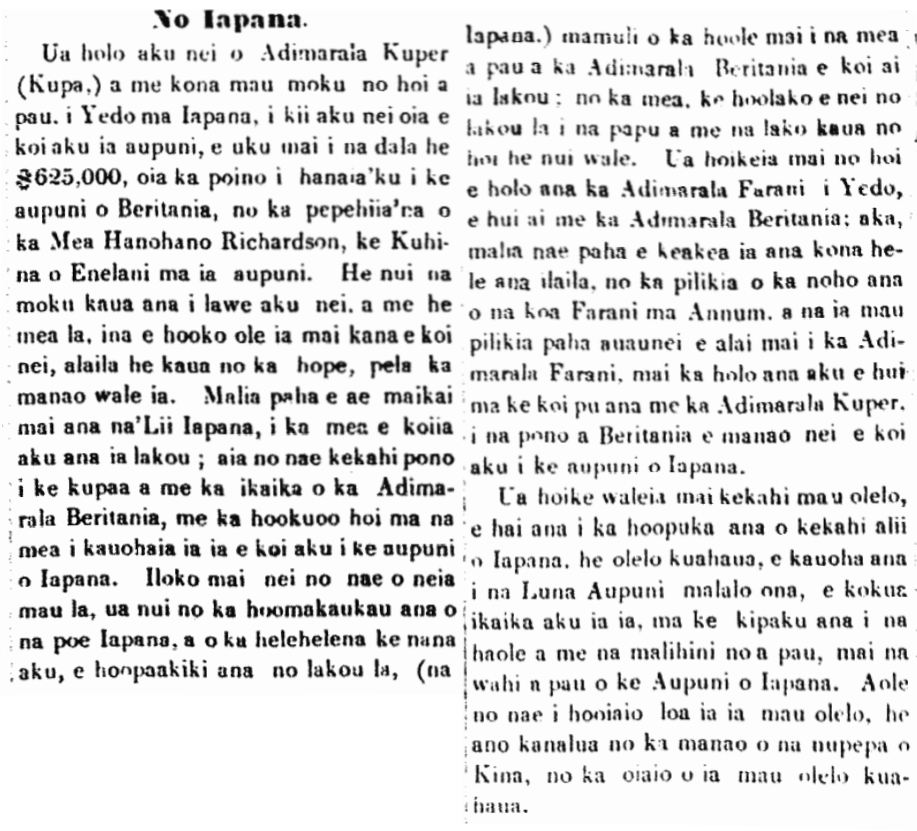
Admiral Kuper and all of his ships left for Yedo in Japan to demand from the government the payment of $625,000, which are the damages acted against the British nation in the killing of the Honorable Richardson, the English ambassador to Japan. He took with him many warships, and it seems  that should his demands not be met, there will be war; that is what is believed. Perhaps the alii of Japan will acquiesce graciously to what is being demanded of them; being that the British Admiral’s insistence and force is justified as he solemnly carries out the demands to Japan that he was ordered to do. There have been however during these past days much preparations made by the Japanese; and their countenances are hardening, in order to refuse all that the British Admiral will demand from them; for they are greatly supplying the forts and war provisions in preparation. It was announced that the French Admiral was headed for Yedo to meet with the British Admiral; his way there however may be impeded because of the trouble the French soldiers are having stationed in Annum [Annam?], and these difficulties may obstruct the French Admiral from going and joining Admiral Kuper in claiming the rights that Britain decided to demand from the nation of Japan.

Some words spoken by an alii of Japan were brought out into the open: a proclamation ordering all of the Government Officials under him to assist him with expelling the haole and all foreigners from all over the Nation of Japan. However those words were not verified, and the thoughts amongst the newspapers in China are unsure about the veracity of the words of that proclamation.

[It was just recently the 150th anniversary of the Namamugi Incident (Richardson Affair), where a British national was killed for not dismounting his horse when encountering the oncoming procession of a daimyo, Shimazu Hisamitsu, which was a sign of disrespect. The West was not amused.

Newspapers were the major means through which Hawaii learned not only national news, but international news as well.]

(Kuokoa, 7/4/1863, p. 2)

No Iapana.

Ka Nupepa Kuokoa, Buke II, Helu 27, Aoao 2. Iulai 4, 1863.

Description of Yedo, capital of Japan, 1860.

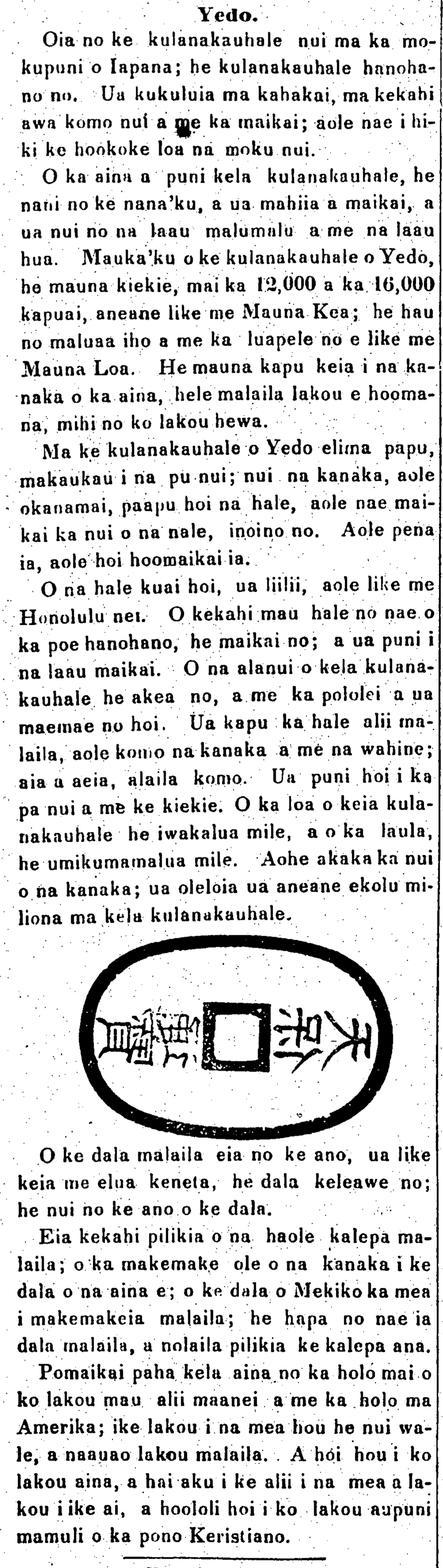
Yedo.

This is the capital of the nation of Japan; it is a grand city. It is built by the sea, by a great and fine harbor; but large ships cannot approach it.

The land surrounding that city is beautiful, and is well farmed, and there are many shade trees and fruit trees. Inland of the city of Yedo, there is a tall mountain from 12,000 to 16,000 feet, almost like Mauna Kea; it is topped by snow and a caldera like Mauna Loa. It is a sacred mountain for the people there, they go there to worship and to repent for their sins.

In the city of Yedo, there are five forts which are equipped with cannons; there are a great number o people, and houses are crowded together, but the houses are not nice, they are dilapidated. They are not painted, and not improved.

Shops are small, not like here in Honolulu. Some houses however, of the distinguished people, are nice, and they are surrounded by fine trees. The streets of the city are wide, and straight, and clean as well. The houses of the alii there are restricted, men and women cannot enter; only when given permission can they enter. They are surrounded by great and tall walls. The length of this city is twenty miles, and the width is twelve miles. The population is not clear; it is said that the number of people in that city is almost three million.

The currency there is like this; this is similar two cents, and it is a copper coin; there are a many variety of currency.

Here is a problem that the haole traders have there: the fact that people there don’t want foreign money; Mexican currency is what is wanted, and so trading is problematic.

Perhaps this land would benefit by their chiefs coming here and to America; they would see many new things and get educated. And they’d return to their land and tell the alii what they saw, and then reform their land following the tenants of Christianity.

[This is just a few years after Japan was forced to end its sakoku policy by the United States and Perry (1854).

The image of the coin is a mirror image.]

(Hae Hawaii, 3/21/1860, p. 202)

Yedo.

Ka Hae Hawaii, Buke 4, Helu 51, Aoao 202. Maraki 21, 1860.

Wahiawa Reservoir, 1912.

[Found under: “Bits of News”]

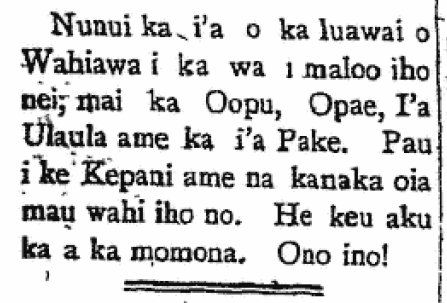
There were a lot of fish in the reservoir of Wahiawa when it recently went dry; from Oopu, to Shrimp [Opae], Red Fish [I’a Ulaula], and Chinese fish [i’a Pake]. They were all taken by the Japanese and those of the area. How sweet tasting. So delicious!

[I might not suggest doing this today…]

(Kuokoa Home Rula, 9/5/1912, p. 4)

Nunui ka i'a o ka luawai o Wahiawa...

Kuokoa Home Rula, Buke X, Helu 36, Aoao 4. Sepatemaba 5, 1912.

Alligator loose?? 1928.

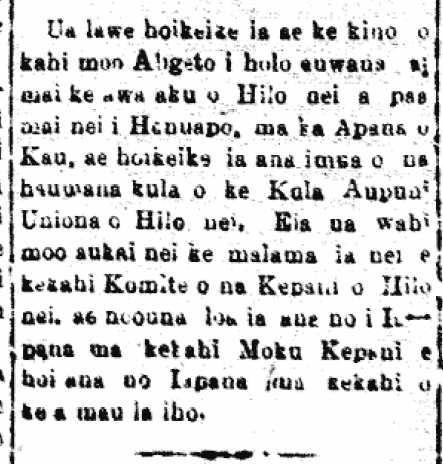
The body of an Alligator [moo Aligeto] that wandered from the port of Hilo and caught in Honuapo in Kau was taken to show before the school children of the Government School, Union, of Hilo nei. The sea navigating serpent is being cared for by a Japanese Committee of Hilo nei, and it will be sent all the way to Japan aboard a Japanese ship one of these upcoming days.

(Hoku o Hawaii, 1/10/1928, p. 2)

Ua lawe hoikeike ia ae ke kino o kahi moo Aligeto...

Ka Hoku o Hawaii, Buke XXI, Helu 32, Aoao 2. Ianuari 10, 1928.

Titanic survivor comes through Hawaii. 1912

[Found under: “Local News”]

One of the passengers who escaped from the steamship Titanic, Hosono, a Japanese, arrived here in Honolulu aboard the Shinyo Maru [Shun’yō Maru] and left for Japan.

[Monday (4/16/2012) marks the 100th year since the tragedy heard all over the world. Who knew the only Japanese aboard the Titanic, Masabumi Hosono, spent some time in Hawaii nei.]

(Kuokoa, 5/31/1912, p. 8)

O kekahi o na ohua...

Ka Nupepa Kuokoa, Buke XLVIII, Helu 22, Aoao 8. Mei 31, 1912.

More from David Keaweamahi on Japanese contract laborers, 1890.

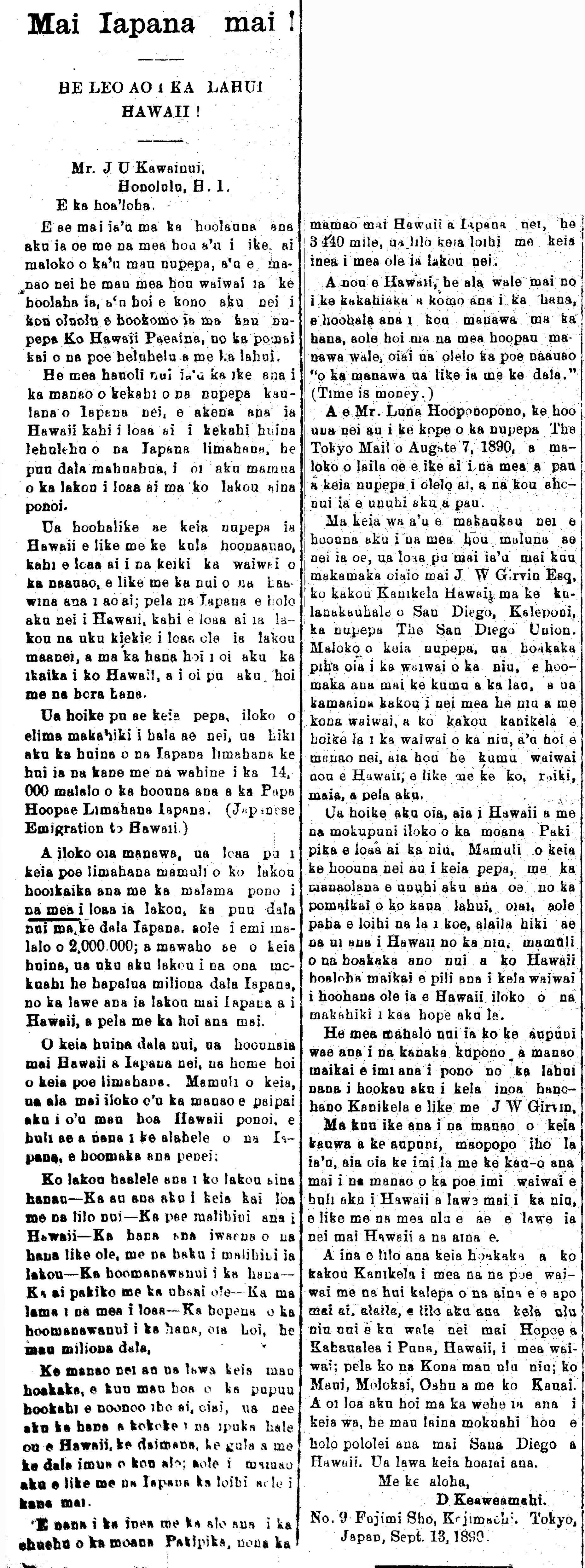
From Japan!

INFORMATION FOR THE HAWAIIAN PEOPLE!

Mr. J. U. Kawainui,

Honolulu, H. I.

O Friend,

Please allow me to introduce you to the new things I have seen in my newspaper which I believe are new information important to spread; which I invite you to kindly insert into your newspaper, Ko Hawaii Pae Aina, for the benefit of the readers and the nation.

I was pleased to see the thoughts of a famous newspaper of Japan, praising Hawaii as the place where a great number of Japanese laborers obtained a big sum of money, more than they’d receive in their homeland.

This newspaper likened Hawaii to a school of education, where a child receives the wealth of knowledge, equal to the amount of lessons he studies; so too with the Japanese who are going to Hawaii, where they get high salaries that they’d not get here, and for more intense work than in Hawaii, along with more hours.

This paper also stated that within the past five years, the total number of Japanese laborers including men and women has reached 14,000, sent by the Board for Emigration of Japanese Laborers.

And within this period, these laborers, as a result of their effort and their saving of what they earned, made a great amount in Japanese money, not less than 2,000,000 yen; and not included with this, they paid the ship owners half a million yen to take them from Japan to Hawaii and return.

This great sum of money was sent from Hawaii to here in Japan, the home of these laborers. As a result, there rose within me the desire to encourage my own Hawaiian friends to take a look at the path taken by the Japanese, starting like this:

Their departure from the land of their birth—Their travelling across the great ocean at great expense—The landing as strangers in Hawaii—Working all sorts of jobs for a boss who is a stranger—Enduring the work—Eating only a little without wasting—Caring for what they have—The results of their putting up with the work, that being millions of dollars.

I believe that this is ample explanation, O Friends of the same womb, for you to think about; for the work has come to your door O Hawaiians—diamonds, gold, and money, right before your eyes; it is not far away like for the Japanese for whom it is far, far away.

Look at the hardships and the facing of the spray of the Pacific Ocean whose distance from Hawaii to Japan is 3,440 miles; this distance and hardships became nothing to them.

And you, O Hawaiians, you wake up in the morning and take up your work, and put in your time working, and not with things that waste your time, as goes the saying of the educated people: “Time is like money.”

And O Mr. Editor, I am sending a copy of the newspaper, “The Tokyo Mail” of August 7th, 1890, and within it you will see all of what this paper has said, and it is for you to patiently translate it all.

As I am preparing to send to you the news above, I have also received from my true friend, J. W. Girvin, Esq., our Hawaiian Consul in the city of San Diego, California, the newspaper “The San Diego Union”. Within this paper, he explained fully the value of coconuts, starting from the trunk to the leaves; we are familiar with coconuts and its value; and with our consul explaining the value of the coconut, I am thinking that there are also other sources of wealth for you, O Hawaiians, like sugarcane, rice, bananas, and so forth.

He explains that coconuts can be found in Hawaii and the islands of the Pacific Ocean. Therefore, I am sending this paper with hopes that you will translate it for the good of our people, being that it should not be long before Hawaii starts receiving inquiries for coconuts because of this important description of Hawaii’s good friend dealing with the asset not put to use by Hawaiians in the past years.

It is a very admirable thing that the government selects good people with good ideas to search after the well being of the people that conferred upon him that honorable title, Consul, like J. W. Girvin.

When I look at the ideas of this servant of the nation, I know that he is searching while pulling along the minds of entrepreneurs to look to Hawaii to export coconuts, like the other produce exported from Hawaii to other lands.

And should this description of our Consul become something that the wealthy people and trade companies of foreign lands latch on to, then those great fields of coconut from Hopoe until Kahaualea in Puna, Hawaii will become a source of wealth; so too the stands of coconut in the Kona districts, along with those of Maui, Molokai, Oahu and Kauai. And even more so, with the opening these days of new steamship lines which go directly from San Diego to Hawaii. This clarification should be sufficient.

With aloha,

D. Keaweamahi.

No. 9 Fujimi Sho [Fujimi-cho], Kojimachi, Tokyo, Japan, Sept. 13, 1890.

[As we celebrate Merrie Monarch week, Japanese contract laborers is one of Kalakaua’s many legacies…]

(Ko Hawaii Pae Aina, 9/27/1890, p. 2)

Mai Iapana mai!

Ko Hawaii Pae Aina, Buke XIII, Helu 39, Aoao 2. Sepatemaba 27, 1890.

David Keaweamahi living in Japan, 1890.

[Found under: “News of Hawaii”]

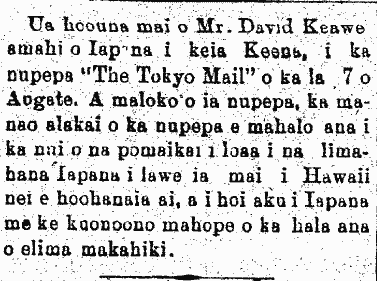
Mr. David Keaweamahi of Japan sent the newspaper, “The Tokyo Mail” of the 7th of August. Within that paper, an editorial expressed appreciation at the great benefits gained by the Japanese laborers brought to Hawaii nei to be put to work and then returned well off to Japan after five years.

(Ko Hawaii Pae Aina, 9/27/1890, p. 2)

Ua hoouna mai o Mr. David Keaweamahi...

Ko Hawaii Pae Aina, Buke XIII, Helu 39, Aoao 2. Sepatemaba 27, 1890.

Because February shouldn’t be the only Hawaiian Language month… 1948.

THE MOTHER TONGUE

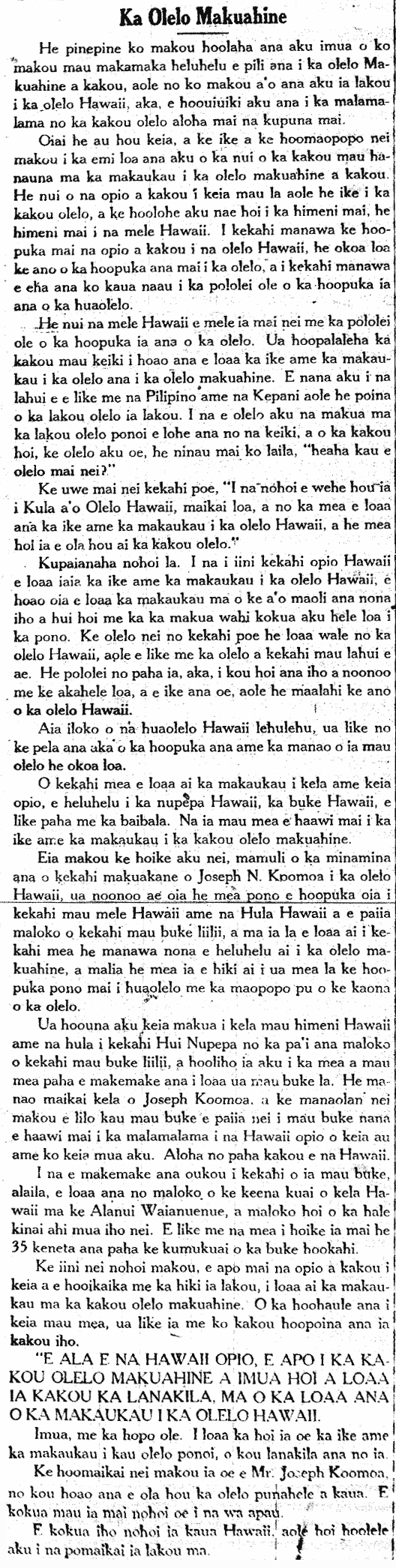
We frequently speak to our dear readers about our Mother tongue, not about our teaching them the Hawaiian language, but that the light of our beloved language from our forefathers is being extinguished.

Being that this is a new era, and we see and realize that there is a drastic reduction in the number of our generations capable in our mother tongue. There are many of our youths these days who have no knowledge of our language, but when you listen to them singing, they sing Hawaiian songs. Sometimes when our children speak Hawaiian, their production of the language is so strange, and sometimes our naau [gut, heart] aches at their mispronunciation of words.

There are many Hawaiian songs sung with incorrect pronunciation. Our children are neglecting trying to acquire knowledge and proficiency in speaking the mother tongue. Look at the other ethnicities like the Filipinos and the Japanese, they haven’t forgotten their language. If parents spoke in their own language then the children would hear; and when we talk to them, they’ll ask, “he aha kau e olelo mai nei? [what are you saying?]”

Some people bewail, “If only Hawaiian-Language Schools were reopened, that would be a good thing because we’d get knowledge and proficiency in the Hawaiian language and it would revive our language.”

That is astonishing. Should a young Hawaiian have the desire to acquire knowledge and competency in the Hawaiian language, he should try to get this competency by studying diligently by himself and to get together with an adult for help and there would be great progress. Some say that Hawaiian can be gotten just like that, not like the languages of other people. Perhaps it is true, but if you go back and think with great seriousness, you will see that the Hawaiian language is not easy.

Within the many Hawaiian words, spellings might be the same, but the pronunciation and meanings of those words are different.

One thing that will give every youth proficiency is the reading of Hawaiian newspapers and Hawaiian books like perhaps the bible. Those things will give knowledge and competence in our native language.

We point out that because of the great love of a certain father, Joseph N. [Nihiaumoe] Koomoa, for the Hawaiian language, he thought it would be important to publish some Hawaiian songs and Hawaiian Hula and print some booklets, and through that someone could make time to read the Hawaiian language and perhaps that way the person could pronounce the words while understanding the kaona [underlying meanings].

This man sent those Hawaiian songs and hula to a Newspaper company to be printed in booklets, and it will be sold to the person or persons who want those books. This is a good idea of Joseph Koomoa’s, and we hope that your books that are being printed will become books that give knowledge to the Hawaiian youths of this age and of the future. Aloha to us, O Hawaiians.

Should you want one of those books, they will be available at the shop of that Hawaiian on Waianuenue Avenue, and also the former fire station [?] According to what was announced, the books will probably cost 35 cents each.

We want our youngsters to get a hold of this and and improve themselves to the best of their ability so that they can get proficiency in our mother tongue. Letting these go would be like forgetting our own selves.

“RISE YOUNG HAWAIIANS, GRASP OUR MOTHER TONGUE AND GO FORTH AND LET US BE TRIUMPHANT BY BEING PROFICIENT IN THE HAWAIIAN LANGUAGE.

Forge forward with no fear. So that you can get knowledge and proficiency in your own language—that will be your triumph.

We give our congratulations to you, Mr. Joseph Koomoa, for you attempt to revive the prized language of ours. You will be helping for all times [E kokua mau ia mai nohoi oe i na wa apau. ?]

Help ourselves Hawaiians, and don’t let the benefits go to those others [E kokua iho nohoi ia kaua Hawaii, aole hoi hoolele aku i na pomaikai ia lakou ma. ?]

[Anyone know of any copies of these music booklets by Joseph N. Koomoa still in existence???]

(Hoku o Hawaii, 2/11/1948, p. 2)

Ka Olelo Makuahine.

Ka Hoku o Hawaii, Volume XLI, Number 19, Aoao 2. Pepeluali 11, 1948.

More on Orramel Gulick, 1874.

[Found under: “Local News”]

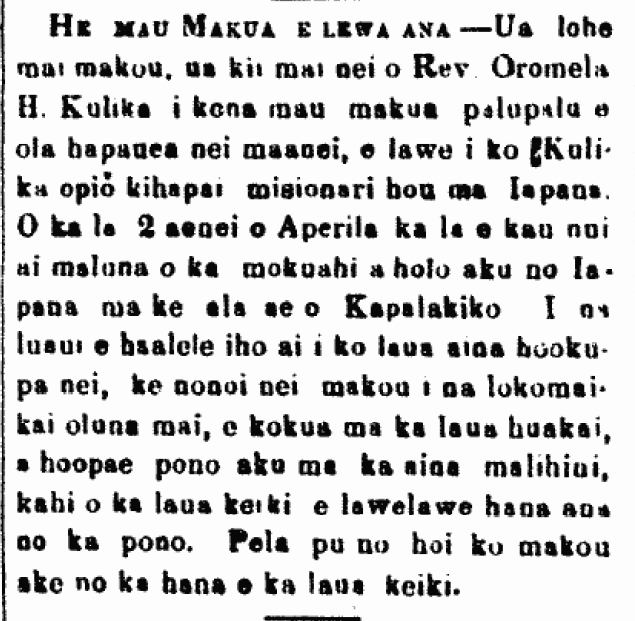
Parents will be voyaging—We hear that Rev. Orramel H. Gulick came to get his weak parents [Peter Johnson Gulick and Fanny Hinckley Thomas Gulick] living here in a feeble state to take them to the young Gulick’s [Luther Halsey Gulick] new missionary parish in Japan.It is on the coming 2nd of April that they will all board the steamship to make their journey to Japan by way of San Francisco. To his parents who are leaving this land which they grew accustomed, we hope for blessings from above, to help them on their journey, and to give them safe landing at this foreign land, where their child works for righteousness. So too is our hopes for the endeavors of their child.

[For more on Orramel Hinckley Gulick, see also: The Pilgrims of Hawaii, by Rev. and Mrs. Orramel Hinckley Gulick (1918).]

(Kuokoa, 3/14/1874, p. 2)

He mau Makua e lewa ana...

Ka Nupepa Kuokoa, Buke XIII, Helu 11, Aoao 2. Maraki 14, 1874.