A haole kamaaina’s advice on teaching English instead of Hawaiian, 1872.

Pertaining to the English Language.

O Kuokoa Newspaper: Aloha oe:—

In the year 1866, I asked a missionary, “What is the reason English isn’t being taught in the government schools,” and he replied, “That is what I think as well, but we are weak, there are not enough of us, and we teach Hawaiian, and from amongst our students we find teachers.”

The Hawaiians are often astounded at seeing how quickly the haole gains wealth, and one asked me, “How does the haole get rich?” I answered this way, “Why is the cow in the fields fatter than the cow that works, isn’t it because it isn’t tamed? or because it is independent? or because it refuses to have it’s neck put in a yoke? That’s it. So when shown the yoke of the haole, your necks are put within it and your noses are soon wired; some may say, ‘How are we to live if we don’t work under the haole; they have the work, to them belongs the land, because soon our land will all be taken by you.’ It is true, you cannot survive without working for the rich (haole), but you can think about your children, lest they fall into the abyss with you. This race was called a race of slaves in a newspaper in New York, and I say to you that this will soon be true. ‘Your noses will be put through with a wire.’ until the day when the English language spreads amongst you, then you’ll will be able to remove your yokes and associate with the haole.

If you all understand the language and the knowledge of the haole, then you’d be able to climb the path and meet up with them in law, medicine, &c.

What is the reason that the college of Lahainaluna is not changed, having only English taught there?

This college is currently a waste. And so too the other schools, the government schools. We must all think carefully about the good of our children. That is no reason for them to forever more work under yearly contracts, for we’ve worked under yearly contracts during out lifetimes.

If the schools were changed so that just English was taught, I predict that after fifteen years, and if the haole leave, then you’d become your own leaders in the government, and not only haole would be appointed.

Kamaaina haole.

Lahaina, Maui.

{This is a letter written by a haole, and it is for us to determine his competence.}

[The argument over what language should be taught in schools is a heated topic that can be seen throughout the life of the Hawaiian-Language Newspapers. At first the argument is whether or not to teach English, and in later years when more and more schools are taught in English, the argument for teaching Hawaiian in schools will become prominent. Most everyone it seems were concerned with the future of the children (whether they were for English or Hawaiian-language education).]

(Kuokoa, 10/26/1872, p. 2)
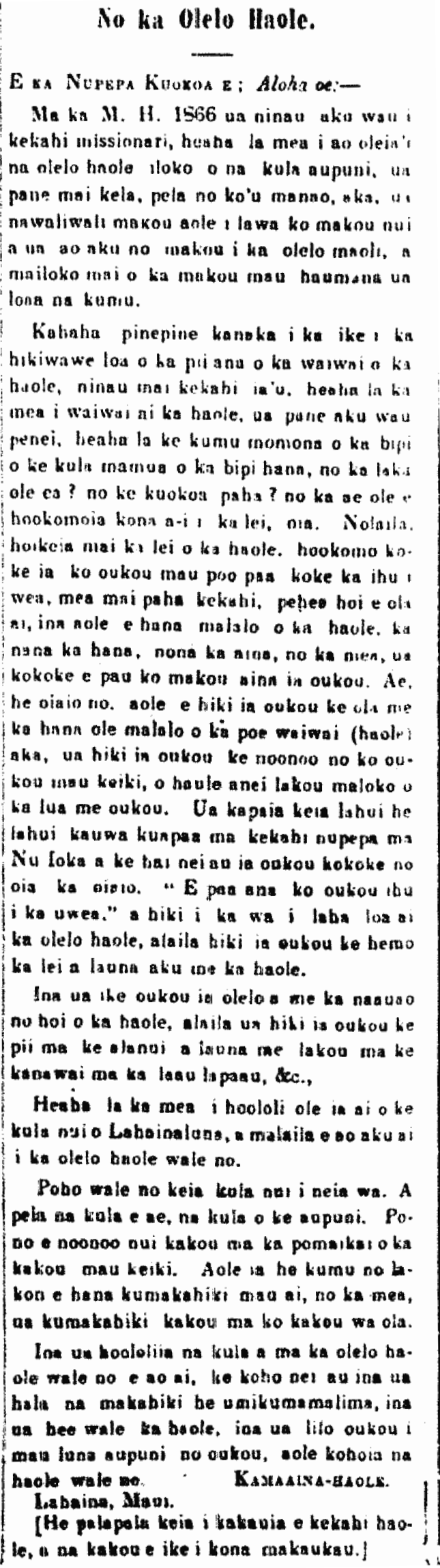
No ka Olelo Haole.

Ka Nupepa Kuokoa, Buke XI, Helu 43, Aoao 2. Okatoba 26,1872.
On the perpetuation of the Hawaiian Language, 1911.

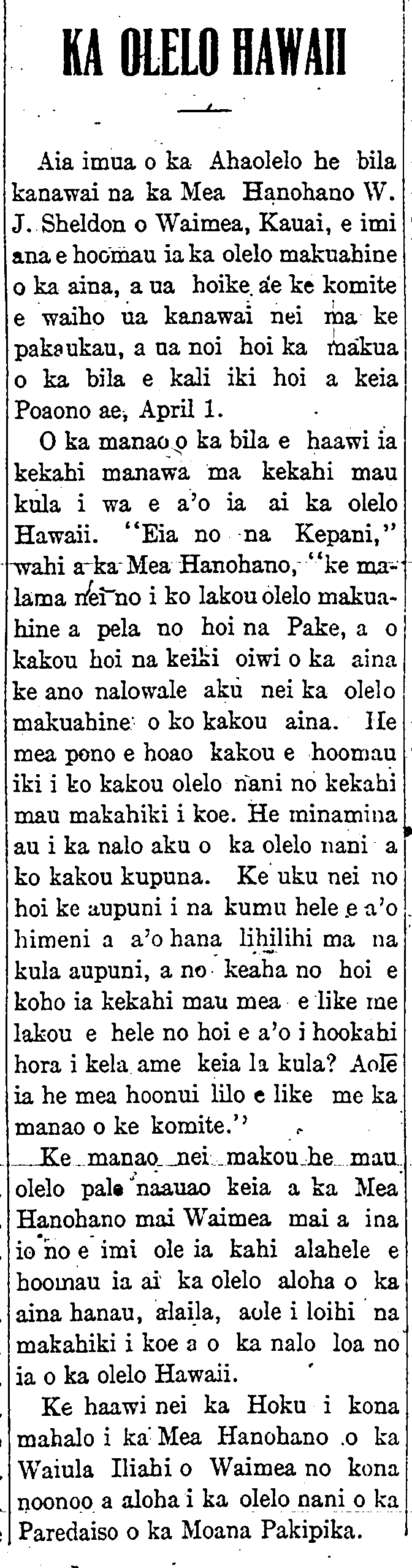
THE HAWAIIAN LANGUAGE

Before the Legislature is a bill put forth by the Honorable W. J. Sheldon of Waimea, Kauai, which seeks to perpetuate the mother tongue of this land; but the committee announced that the bill will be tabled; to which the father of the bill asked that they wait for a bit until the following Saturday, April 1.

The intent of the bill is to allow for time in some schools to teach the Hawaiian language. “Here are the Japanese,” said the Honorable One, “they are caring for their mother tongue, and so too of the Chinese; but we, the native children of this land, our native language is disappearing from our own land. It is imperative that we try to perpetuate our beautiful language even just a little longer. I feel remorse in letting the beautiful language of our ancestors go. The government pays for travelling instructors to teach singing and lace making [hana lihilihi ?] in public schools, so why not choose people like that to go and teach for one hour every school day? It will not be a great expense like what is imagined by the committee.”

We believe that these are very wise responses by the Honorable One of Waimea, and if indeed means are not sought to perpetuate the beloved language of our birth land, then it will not be long before the Hawaiian language will disappear completely.

The Hoku gives its mahalo to the Honorable One of the Waiula Iliahi¹ of Waimea for his consideration and aloha for the beautiful language of the Paradise of the Pacific Ocean.

¹Waiula Iliahi is one of the two branches of the Waimea River, and the other being Waikea, and they merge at Kikiaola.

(Hoku o Hawaii, 3/30/1911, p. 2)

KA OLELO HAWAII

Ka Hoku o Hawaii, Buke 5, Helu 47, Aoao 2. Maraki 30, 1911.

Response to claim that Lahainaluna was banning the use of Hawaiian, 1868.

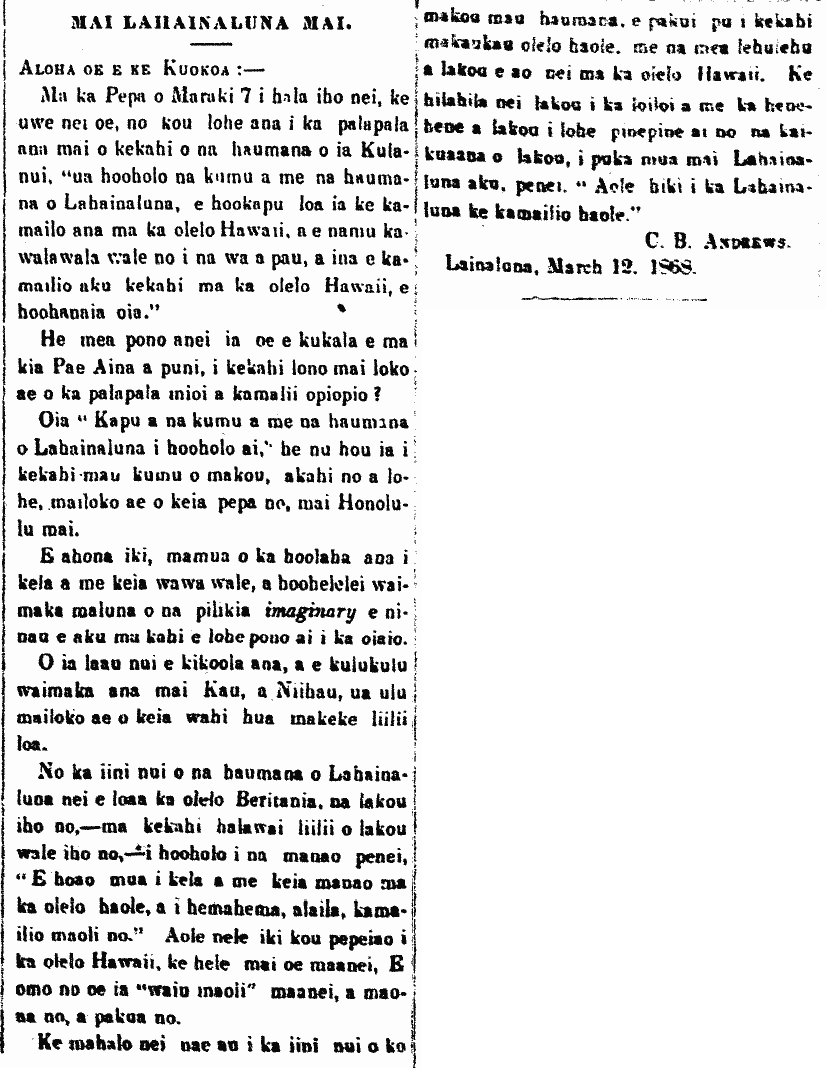
FROM LAHAINALUNA.

Aloha to you O Kuokoa:—

In the paper of this past March 7th, you wail over your hearing through a letter from one of students of that College, “the teachers and students of Lahainaluna have decided to ban speaking Hawaiian and to speak solely in English instead at all times, and someone speak in Hawaiian, he will be made to work.”

Is it right for you to spread all across this Archipelago something you hear in a pushy letter from a youngster?

That “Ban that the teachers and students of Lahainaluna passed,” is news to some of our teachers, first heard from this paper from Honolulu.

It would be somewhat better if before announcing publicly this or that rumor and shedding tears over an imaginary [“imaginary” in English] tragedy, that you inquire of someplace where you can hear the truth.

That great tree that grows haphazardly, for which tears are being shed from Kau to Niihau, it grew from a tiny mustard seed [hua makeke].¹

Because of the great desire of the students of Lahainaluna to speak English, it was they who—in a small meeting amongst only themselves—decided thusly: “To try first to speak their thoughts in English, and if it comes out  not clearly, then to speak in Hawaiian [kamailio maoli].” Your ears will not miss the Hawaiian language should you come here. You will drink “real milk” here, and have your fill, and it will be a regular thing.

I do however appreciate the great desire of our students to supplement the English language, along with all the many other things they are learning in Hawaiian. They are embarrassed at the judgement and the ridicule that their elder siblings receive, that graduated from Lahainaluna before them, in this manner: “The Lahainaluna students cannot speak English.”

C. B. Andrews.

Lahainaluna, March 12, 1868.

¹Hearkening back to the parable of the mustard seed and the kingdom of heaven in Matthew.

[This is one a response found to the article posted yesterday about the banning of Hawaiian language at Lahainaluna. It is always important to look for responses and followups in later papers and in other newspapers of the time, both in Hawaiian and English (and in other languages if available), to get a clearer picture of what is happening!]

(Kuokoa, 3/21/1868, p. 3)

MAI LAHAINALUNA MAI.

Ka Nupepa Kuokoa, Buke VII, Helu 12, Aoao 3. Maraki 21, 1868.

Hawaiian Language banned at Lahainaluna and Hawaii to become a state of the United States? 1868.

Hawaiian Banned at

LAHAINALUNA.

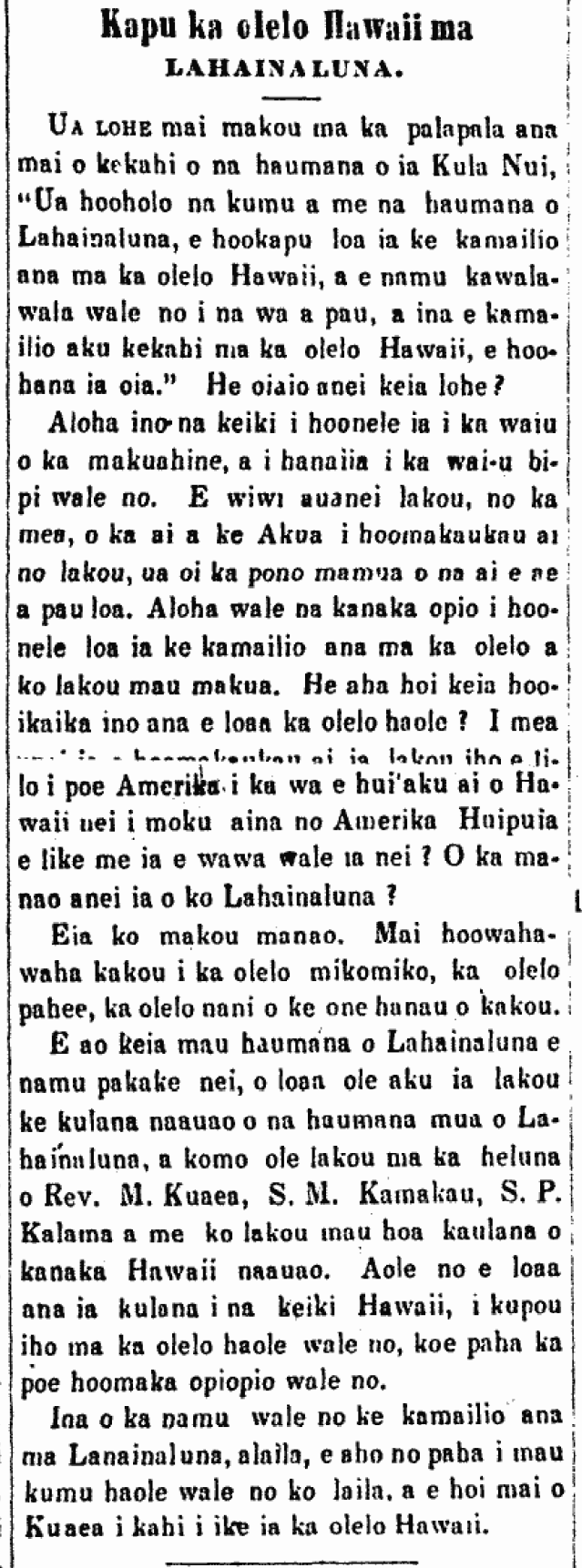
We have heard through a letter from one of the students at the College, “The teachers and students have decided to ban the speaking of Hawaiian, and instead to speak English [namu kawalawala] all the time; and should anyone speak in Hawaiian, he will be made to work.” Is what we hear correct?

How sad for children to be denied their mother’s milk, and fed only cow’s milk. They will end up malnourished, for the nourishment God prepared for them is better than all other foods. How tragic is it for the youth to be denied speaking the language of their parents. What is this big push to acquire the English language [olelo haole]? Is it to prepare them to become Americans when Hawaii joins as a state of the United States as is being rumored about? Is that the idea at Lahainaluna?

This is what we think. Let us not treat with contempt this eloquent language, this graceful language, this beautiful language of our homeland.

These students of Lahainaluna who speak English [namu pakake] will not attain the high education of the early students of Lahainaluna, and they will not join the ranks of Rev. M. Kuaea, S. M. Kamakau, S. P. Kalama, and their fellow famed educated Hawaiians. This level will not be reached by the Hawaiian youth who attempt to speak only English, except perhaps for those who start young.

If only English is spoken at Lahainaluna, then it would be better were there only haole teachers there, and Kuaea should be sent somewhere that Hawaiian Language is recognized.

[Does anyone know if this ban ever took place in the late 1860s?

And what does “S. P.” stand for in “S. P. Kalama”?]

(Kuokoa, 3/7/1868, p. 2)

Kapu ka olelo Hawaii ma LAHAINALUNA.

Ka Nupepa Kuokoa, Buke VII, Helu 10, Aoao 2. Maraki 7, 1868.

Congratulations to all ‘Ike Kū‘oko‘a Project volunteers, 2012.

I was looking in this morning’s newspaper, and there was an article by ‘Alohi Bikle, on page 2 of section B, “Volunteers end transcriptions of Hawaiian-language papers,” about the volunteer project that just ended their first phase yesterday, Hawaiian Restoration Day. The volunteers typed an amazing 15,500 pages of newspapers!

I am perhaps most excited to hear that the project is pledging to translate all of the completed 15,500 pages of newspaper and to put them up online! And it seems that these will not just be summaries like what i do here just for fun, but “quality translations.” Hopefully some day in the near future, i can put this blog aside, and do some gardening, because they also pledge to be thorough, making sure that “no ‘a,’ ‘e,’ ‘i,’ ‘o’ and ‘u’ will be overlooked.”!!

This is something the words and thoughts of the people of old deserve. After all, in the word is life, and in the word is death.

Kamehameha School for Girls new school year, 1898.

KAMEHAMEHA SCHOOL FOR GIRLS.

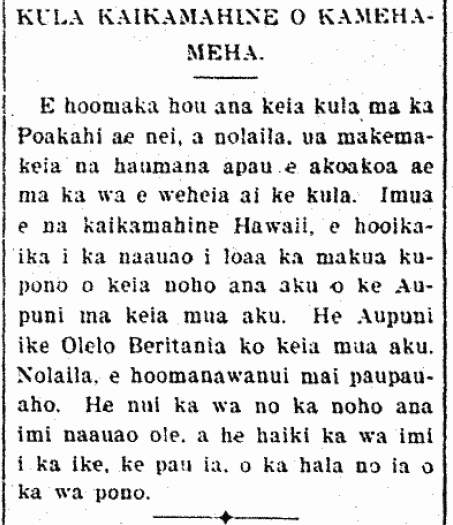
This school will be in session again starting next Monday, and so all students are requested to assemble when school opens. Imua, O Hawaiian girls, strive to be educated so that there will be good parents in the future of this Nation. Here forth this is a Nation of the English Language. Therefore, be patient and don’t give up. There is a lot of time not given to learning, and only a limited time allotted for learning; once this is over, it will be too late.

(Kuokoa, 9/2/1898, p. 3)

KULA KAIKAMAHINE O KAMEHAMEHA.

Ka Nupepa Kuokoa, Buke XXXVII, Helu 35, Aoao 3. Sepatemaba 2, 1898.

Hawaii’s Story by Hawaii’s Queen, in the Hawaiian Language, 1898.

WE WILL SATISFY.

Because we are constantly asked by our readers to print the story which our Queen wrote in Washington and that was just published in Boston, therefore, we are spreading the news to our readership that we will translate and print the story in the columns of the newspapers the daily and weekly Ke Aloha Aina, on the first week of this coming month for the benefit of our readers. Therefore, do take up Ke Aloha Aina so that you can see the one story written by Queen Liliuokalani and published in foreign lands, with statements full of sentiment and aloha dealing with Her overthrow. Aloha for Her.

(Aloha Aina, 3/19/1898, p. 5)

E HOOKO AKU ANA MAKOU.

Ke Aloha Aina, Buke IV, Helu 12, Aoao 5. Maraki 19, 1898.

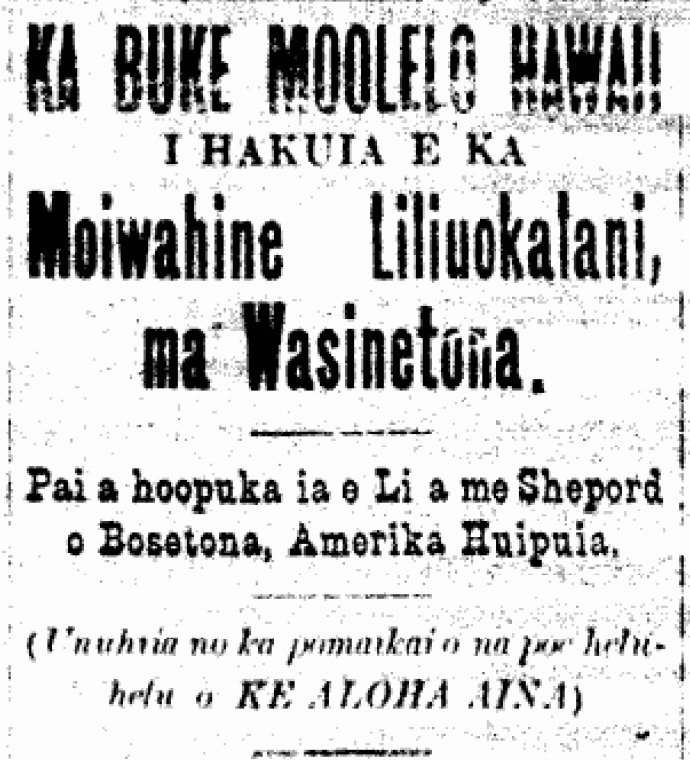
Here, by the way, is what the heading of that running column looked like:

HAWAIIAN HISTORY

WRITTEN BY

Queen Liliuokalani,

in Washington.

Published by Lee and Shepard

of Boston, United States of America.

(Translated for the benefit of the

readers of KE ALOHA AINA)

(Aloha Aina, 4/2/1898, p. 6)

KA BUKE MOOLELO HAWAII

Ke Aloha Aina, Buke IV, Helu 14, Aoao 6. Aperila 2, 1898.

On Liliuokalani’s composition of “Mele Lahui Hawaii,” 1898.

“In the early years of the reign of Kamehameha V, he brought to my notice the fact that the Hawaiian people had no national air. Each nation, he said, but ours had its expression of patriotism and love of country in its own music; but we were using for the purpose on state occasions the time-honored British anthem, “God save the Queen.” This he desired me to supplant by one of my own composition. In one week’s time I notified the king that I had completed my task. The Princess Victoria had been the leader of the choir of the Kawaiahao church; but upon her death, May 29, 1866, I assumed the leadership. It was in this building and by that choir that I first introduced the “Hawaiian National Anthem.” The king was present for the purpose of criticising my new composition of both words and music, and was liberal in his commendations to me on my success. He admired not only the beauty of the music, but spoke enthusiastically of the appropriate words, so well adapted to the air and to the purpose of which they were written.”

(from Hawaii’s Story by Hawaii’s Queen, pp. 31–32.)

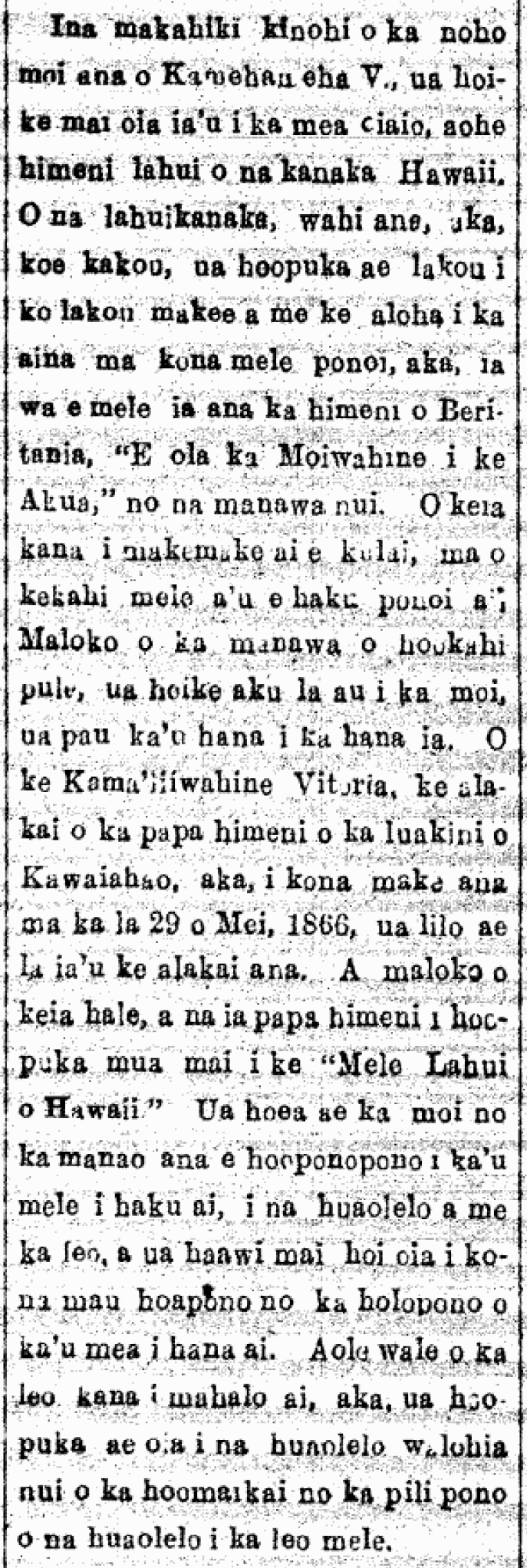
“Ina makahiki kinohi o ka noho moi ana o Kamehameha V., ua hoike mai oia ia’u i ka mea oiaio, aohe himeni lahui o na kanaka Hawaii. O na lahuikanaka, wahi ana, aka, koe kakou, ua hoopuka ae lakou i ko lakou makee a me ke aloha i ka aina ma kona mele ponoi, aka, ia wa e mele ia ana ka himeni o Beritania, “E ola ka Moiwahine i ke Akua,” no na manawa nui. O keia kana i makemake ai e kulai, ma o kekahi mele a’u e haku ponoi ai. Maloko o ka manawa o hookahi pule, ua hoike aku la au i ka moi, ua pau ka’u hana i ka hana ia. O ke Kama’liiwahine Vitoria, ke alakai o ka papa himeni o ka luakini o Kawaiahao, aka, i kona make ana ma ka la 29 o Mei, 1866, ua lilo ae la ia’u ke alakai ana. A maloko o keia hale, a na ia papa himeni i hoopuka mua mai i ke “Mele Lahui o Hawaii.” Ua hoea ae ka moi no ka manao ana e hooponopono i ka’u mele i haku ai, i na huaolelo a me ka leo, a ua haawi mai hoi oia i kona mau hoapono no ka holopono o ka’u mea i hana ai. Aole wale o ka leo kana i mahalo ai, aka, ua hoopuka ae oia i na huaolelo walohia nui o ka hoomaikai no ka pili pono o na huaolelo i ka leo mele.”

(Aloha Aina, 5/14/1898, p. 7)

KA BUKE MOOLELO HAWAII I HAKUIA E KA Moiwahine Liliuokalani...

Ke Aloha Aina, Buke IV, Helu 20, Aoao 7. Mei 14, 1898.