Mary Mahiai, the original story, in English, 1901.

ROMANTIC HISTORY OF MARY MAHIAI

PROBABLY the most interesting woman in all Hawaii is the white-haired old wahine of four-score and ten, or thereabouts, who answers to the name of Mary Mahiai.

Last week an intricate land case came up in Judge Gear’s court and Mary Mahiai was summoned to appear as a witness, her testimony being relied upon to establish the validity of certain patents to extensive and valuable lands, the ancient boundaries of which were in dispute.

The old lady scorned the services of the interpreter on the witness stand and proceeded with her own story in good English astonishing the court and silencing the lawyers as, with Hawaiian freedom of gesture and animated features, she related the details of a most remarkable career.

It developed that she was born on the Island of Kauai before the coming of the first missionary, the arrival of Rev. Hiram Bingham being distinctly within her memory; at the age of seven years, little Mahiai, whose name (meaning “Working in the taro”) had been given her by her mother, went out in a rowboat with her uncle and five other men, starting for Molokai, to “go look see.” A storm came up and the boat was driven out of sight of land, its occupants having no food or drink with them, and suffering terribly from the pangs of hunger and thirst: for ten days and nights they drifted, becoming crazed and unable to cry out, and at last, when all hopes had been abandoned, and it was certain that the frail boat would go to pieces before the end of another day, a sail appeared upon the horizon and the faint outcries and feeble signals of the seven unfortunates attracted the attention of a sailor on board the ship, which was a sailing vessel bound for China. The six men and the little girl were taken on board and treated kindly. When the little girl was able to be about she was given the task of taking care of the captain’s little daughter, and the men were put to work on the ship; the vessel put in at Ladrone Islands, and by their own desire, the five men who had set out with little Mahiai and her uncle, were put ashore. It was afterwards learned that they were eaten by cannibals. Continue reading

Chiefs’ Children’s School, 1841.

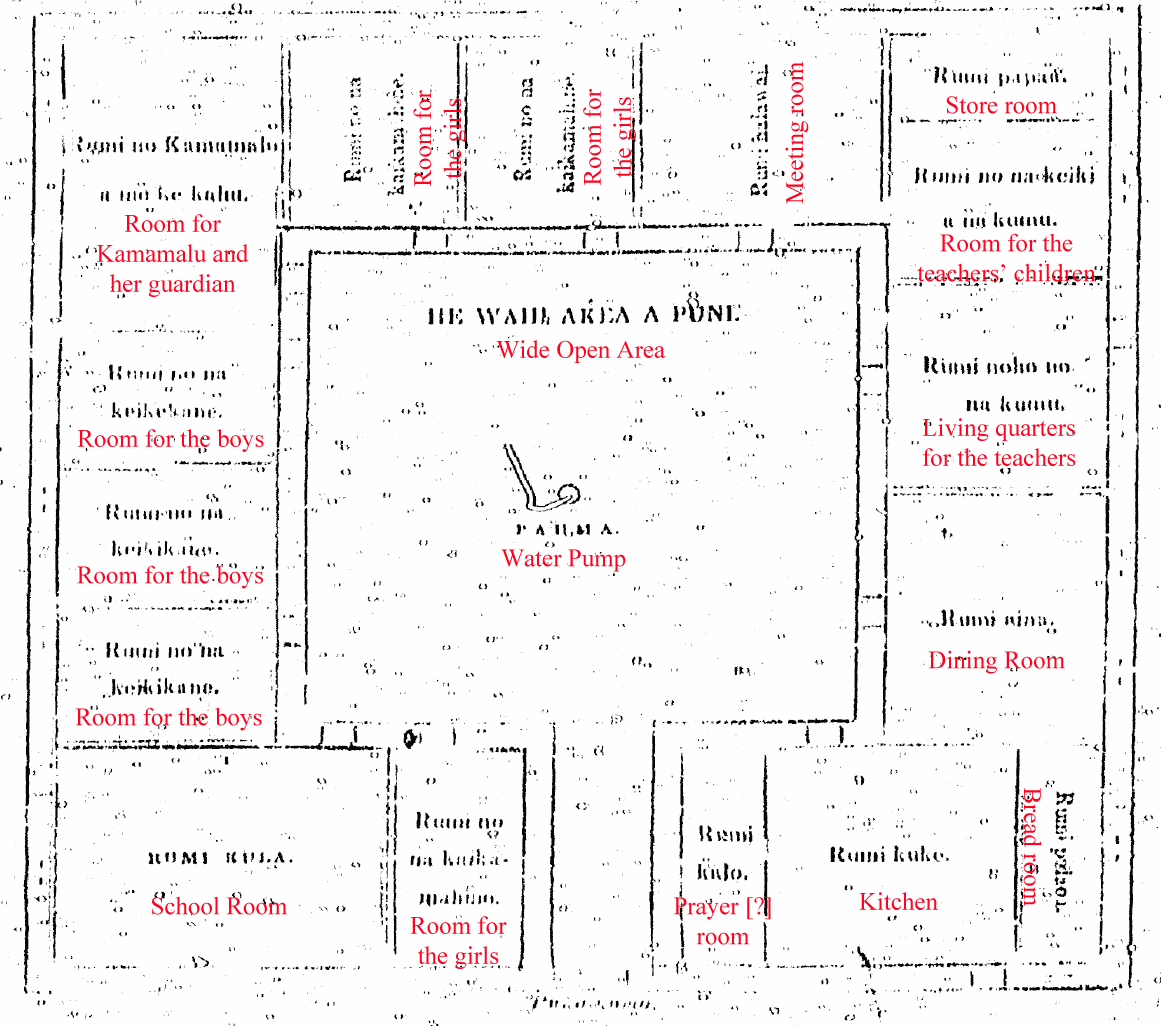
Chiefs' Children's School Diagram

Ka Nonanona, Buke 1, Pepa 2, Aoao 5. Iulai 20, 1841.

THE CHIEFS’ CHILDREN’S SCHOOL.

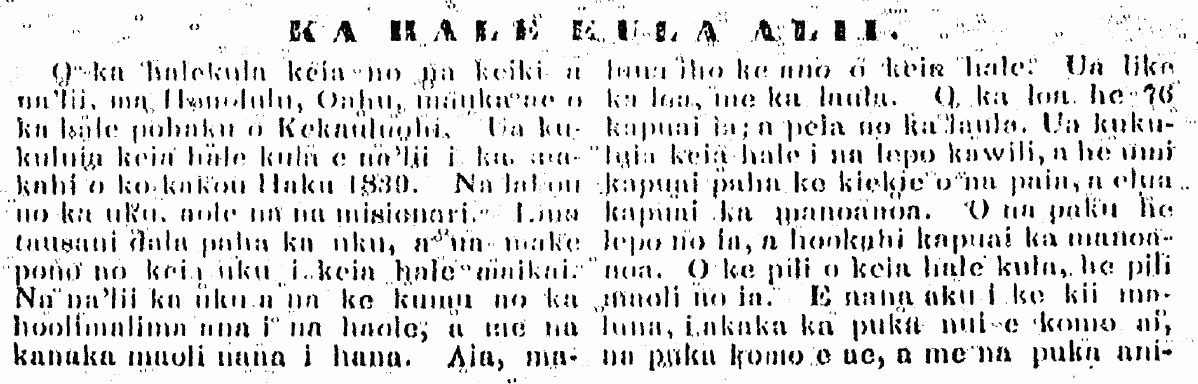
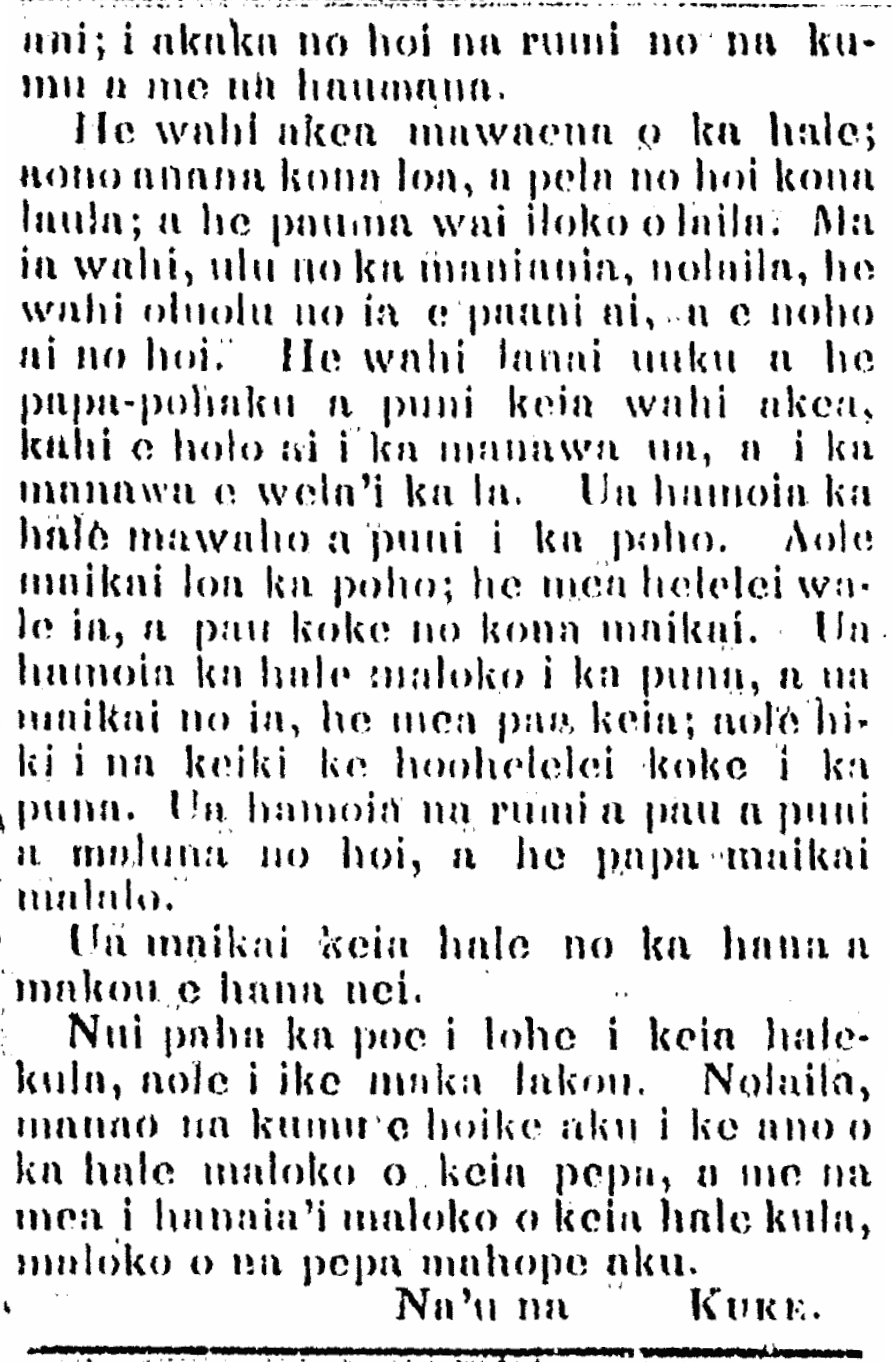
This is the schoolhouse for the children of the alii, in Honolulu, Oahu, upland of the stone house of Kekauluohi. This schoolhouse was built by the alii in the year of our Lord 1839. They are the ones who paid for the costs, not the missionaries. The costs were perhaps two thousand dollars, and the cost was well worth this fine building. The alii paid out the money and the missionaries hired the haole and Hawaiians who did the labor. Above, you will see what this building is like. The length is the same as the width. It is 76 feet long, and so is its width. It is made with adobe, and its walls are about ten feet tall, and its thickness is two feet. The partitions are made of adobe as well and are one foot thick. The thatching of this building is actual pili grass. Look at the illustration above, the entrance is made clear, as are the other doors, and the…

(Nonanona, 7/20/1841, p. 5)

KA HALE KULA ALII.

Ka Nonanona, Buke 1, Pepa 2, Aoao 5. Iulai 20, 1841.

…windows; clear also are the rooms for the teachers and the students.

There is an open space in the middle of the building; it is six feet wide and so too is the length; there is a water pump within it. Maniania [Manienie] grass grows there, so it is a nice place to play as well as to sit. There is a small lanai and a stone wall surrounding this wide area, which is a place to go when it is raining or when the sun is hot. The outside of the entire building is covered with mortar [poho]. Poho is not great; it will just fall off, and it soon loses its integrity. The inside of the building is covered with plaster [puna], and it is very good and sturdy; the children cannot make the plaster fall easily. The rooms are plastered all around and on top, and there is a fine floor below.

The building is appropriate for what we are using it for.

There are perhaps many who have heard of this schoolhouse but who have not seen it. Therefore, the instructors thought to put a description in this paper, as well as what is being done in this schoolhouse in later issues of the newspaper.

By me, Cooke.

[Maybe if the Hawaiian-Language Newspapers like this one are rescanned clearly, the image of the schoolhouse would indeed be clear and we could see the doors, windows, and rooms.

I was not sure if “Rumi kalo” could refer to a “Taro room”. And it seems that at the center on the bottom of the diagram is “Puka komo” for “Entrance”.]

(Nonanona, 7/20/1841, p. 6)

ani; i akaka no hoi...

Ka Nonanona, Buke 1, Pepa 2, Aoao 6. Iulai 20, 1841.

The Chiefs’ Children’s School and its beginnings. 1844.

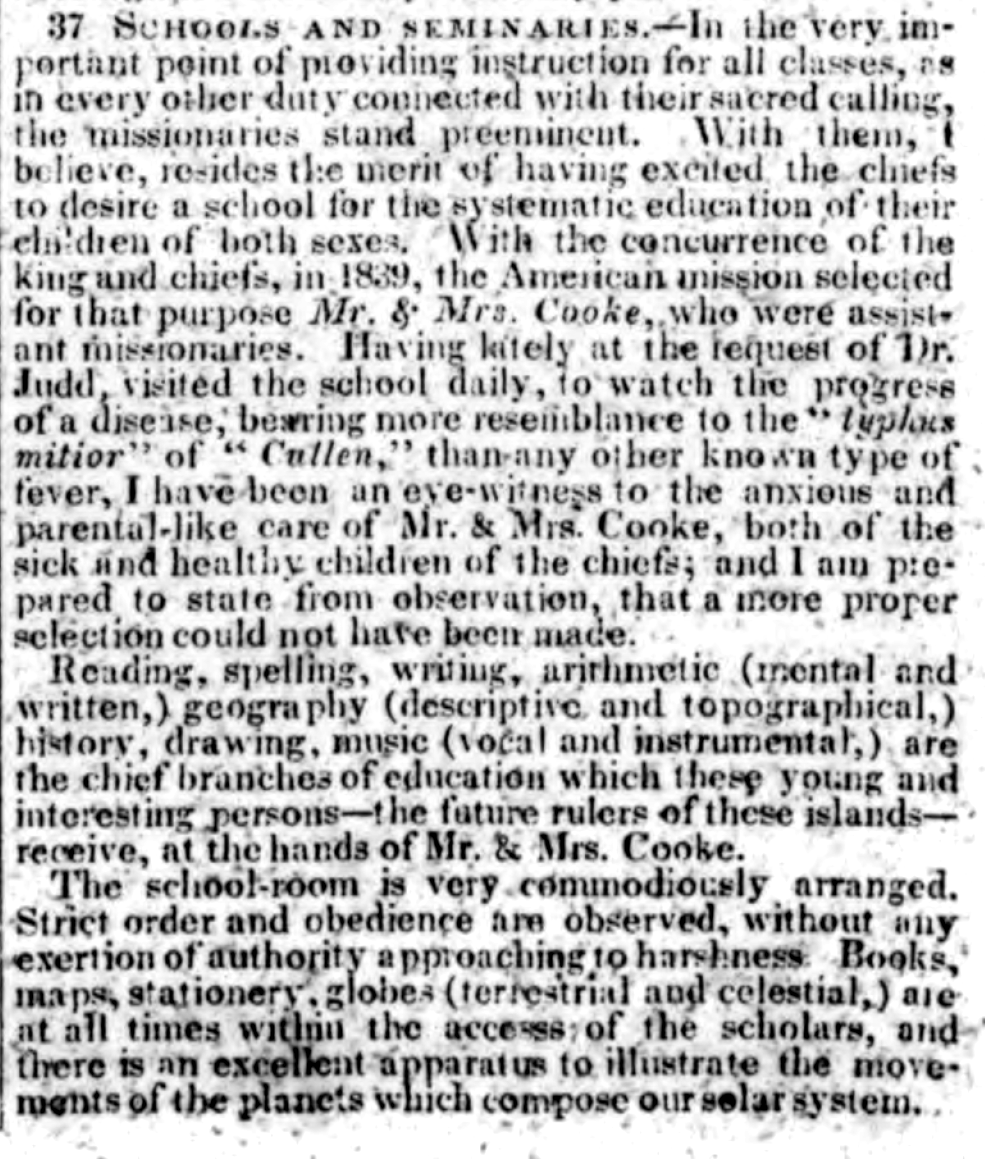
Schools and Seminaries.—In the very important point of providing instruction for all classes, as in every other duty connected with their sacred calling, the missionaries stand prominent. With them, I believe, resides the merit of having excited the chiefs to desire a school for the systematic education of their children of both sexes. With the concurrence of the king and chiefs, in 1839, the American mission selected for that purpose Mr. & Mrs. Cooke, who were assistant missionaries. Having lately at the request of Dr. Judd, visited the school daily, to watch the progress of a disease, bearing more resemblance to the “typhus mitior” of “Cullen,” than any other known types of fever, I have been an eye-witness to the anxious and parental-like care of Mr. & Mrs. Cooke, both of the sick and healthy children of the chiefs; and I am prepared to state from observation, that a more proper selection could not have been made.

The school-room is very commodiously arranged. Strict order and obedience are observed, without any exertion of authority approaching to harshness. Books, maps, stationery, gloves (terrestrial and celestial,) are at all times within the access of the scholars, and there is an excellent apparatus to illustrate the movements of the planets which compose our solar system.

(Friend, August 1, 1844, p. 35)
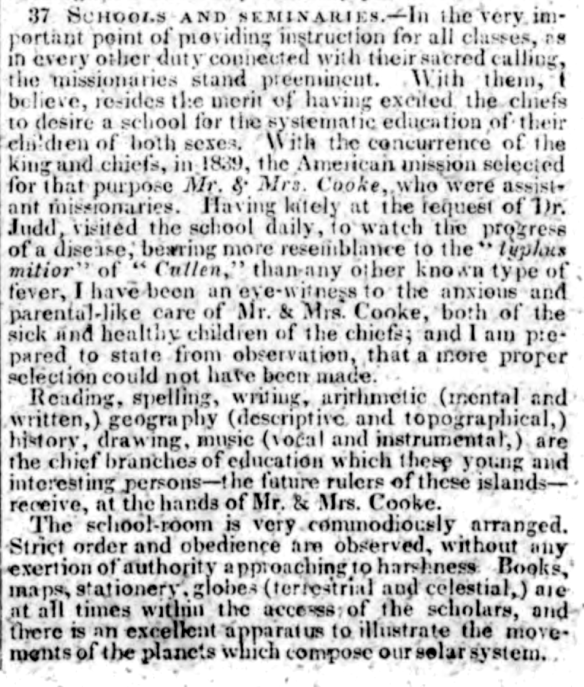
37. Schools and Seminaries.

The Friend, Volume II, Number VIII, Page 35. August 1, 1844.

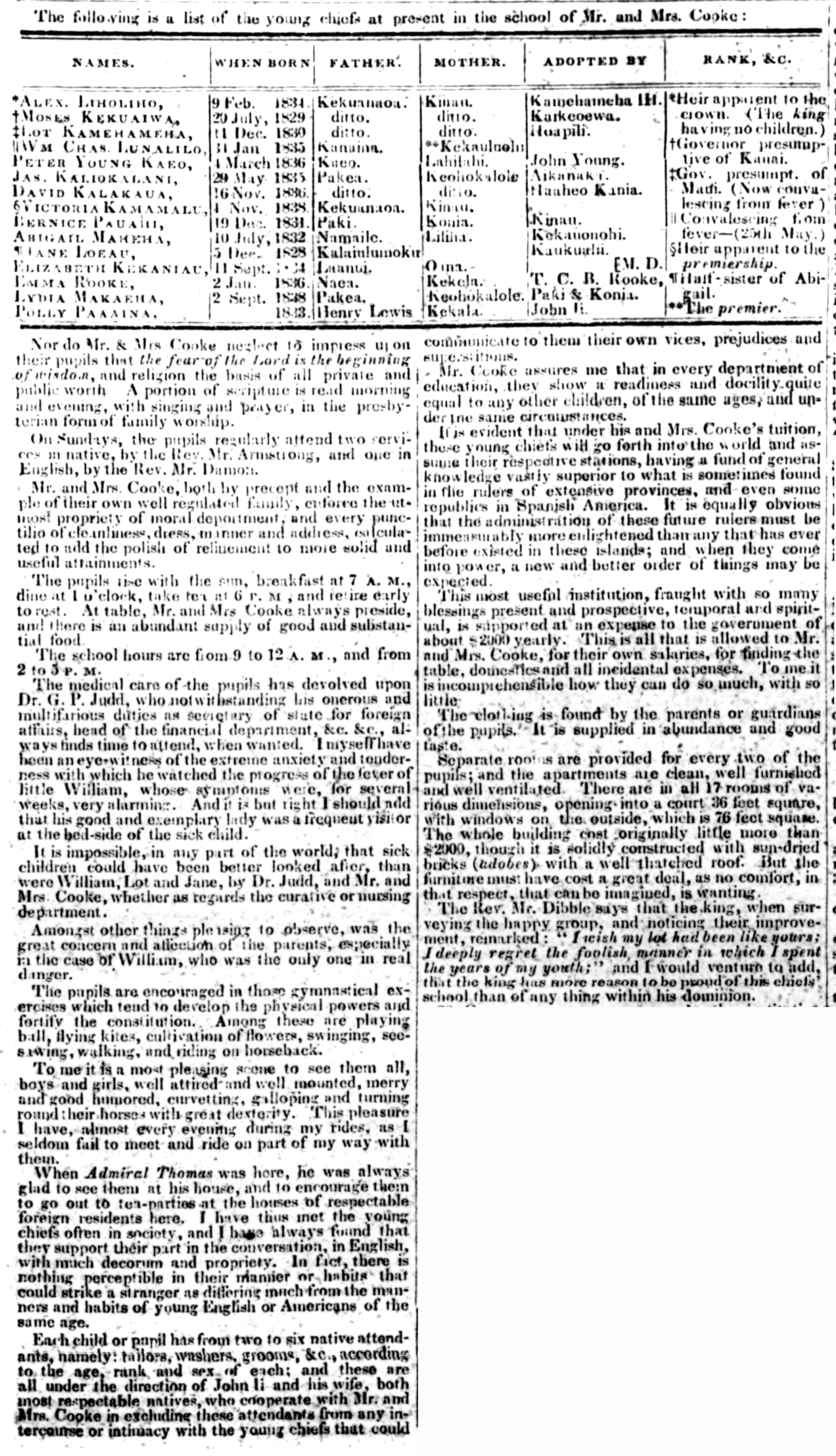
The following is a list of the young chiefs at present in the school of Mr. and Mrs. Cooke:

NAMES. WHEN BORN FATHER MOTHER ADOPTED BY
*Alexander Liholiho, 9 Feb. 1834. Kekuanaoa. Kinau. Kamehameha III.
†Moses Kekuaiwa, 20 July 1829. ditto. ditto. Kaieoewa [Kaikioewa].
‡Lot Kamehameha, 11 Dec. 1830. ditto. ditto. Hoapili.
‖William Charles Lunalilo, 31 Jan. 1835. Kanaina. **Kekauluohi.
Peter Young Kaeo, 4 March 1836. Kaeo. Lahilahi. John Young.
James Kaliokalani, 29 May 1835. Pakea [Kapaakea]. Keohokalole. Aikanaka.
David Kalakaua, 16 Nov. 1836. ditto. ditto. Haaheo Kania [Kaniu].
§Victoria Kamamalu, 4 Nov. 1838. Kekuanaoa. Kinau.
Bernice Pauahi, 19 Dec. 1831. Paki. Konia. Kinau.
Abigail [Lanihau] Maheha, 10 July 1832. Namaile. Liliha. Kekauonohi.
¶Jane Loeau, 5 Dec. 1828. Kalaiulumoku [Kalaniulumoku] [Liliha.] Kaukualii.
Elizabeth Kekaniau [Kekaaniau], 11  Sept. 1834. Laanui. Oana.
Emma Rooke, 2 Jan. 1836. Naea. Kekela. T. C. B. Rooke, M. D.
Lydia Makaeha [Kamakaeha], 2 Sept. 1838. Pakea [Kapaakea]. Keohokalole. Paki & Konia.
Polly Paaaina, 1833. Henry Lewis. Kekala [Kekela]. John Ii.

*Heir apparent to the crown. (The king having no children.)
†Governor presumptive of Kauai.
‡Gov. presumpt. of maui. (Now convalescing from fever.)
‖Convalescing from fever—(25th May.)
§Heir apparent to the premiership.
¶Half-sister of Abigail.
**The premier.

Nor do Mr. & Mrs. Cooke neglect to impress upon their pupils that the fear of the Lord is the beginning of wisdom, and religion the basis of all private and public worth. A portion of scripture is read morning and evening, with singing and prayer, in the presbyterian form of family worship.

On Sundays, the pupils regularly attend two services in native, by the Rev. Mr. Armstrong, and one in English, by the Rev. Mr. Damon.

Mr. and Mrs. Cooke, both by precept and the example of their own well regulated family, enforce the utmost propriety of moral deportment, and every punctilio of cleanliness, dress, manner and address, calculated to add the polish of refinement to more solid and useful attainments.

The pupils rise with the sun, breakfast at 7 A. M., dine at 1 o’clock, take tea at 6 P. M., and retire early to rest. At table, Mr. and Mrs. Cooke always preside, and there is an abundant supply of good and substantial food.¹

The school hours are from 9 to 12 A. M., and from 2 to 5 P. M.

The medical care of the pupils has devolved upon Dr. G. P. Judd, who not withstanding his onerous and multifarious duties as secretary of state for foreign affairs, head of the financial department, &c., &c., always finds time to attend, when wanted. i myself have been an eye-witness of the extreme anxiety and tenderness with which he watched the progress of the fever of little William, whose symptoms were, for several weeks, very alarming. And it is but right I should add that his good and exemplary lady was a frequent visitor at the bed-side of the sick child.

It is impossible, in any part of the world, that sick children could have been better looked after, than were William, Lot and Jane, by Dr. Judd, and Mr. and Mrs. Cooke, whether as regards the curative or nursing department.

Amongst other things pleasing to observe, was the great concern and affection of the parents, especially in the case of William, who was the only one in real danger.

The pupils are encouraged in the gymnastical exercises which tend to develop the physical powers and fortify the constitution. Among these are playing ball, flying kites, cultivation of flowers, swinging, see-sawing, walking, and riding on horseback.

To me it is a most pleasing scene to see them all, boys and girls, well attired and well mounted, merry and good humored, curvetting, galloping and turning round their horses with great dexterity. This pleasure I have, almost every evening during my rides, as I seldom fail to meet and ride on part of my way with them.

When Admiral Thomas was here, he was always glad to see them at his house, and to encourage them to go out to tea-parties at the houses of respectable foreign residents here. I have thus met the young chiefs often in society, and I have always found that they support their part in the conversation, in English, with much decorum and propriety. In fact, there is nothing perceptible in their manner or habits that could strike a stranger as differing much from the manners and habits of young English or Americans of the same age.

Each child or pupil has from two to six native attendants, namely: tailors, washers, grooms, &c., according to the age, rank and sex of each; and these are all under the direction of John Ii and his wife, both most respectable natives, who cooperate with Mr. and Mrs. Cooke in excluding these attendants from any intercourse of intimacy with the young chiefs that could communicate to them their own vices, prejudices and superstitions.

Mr. Cooke assures me that in every department of education, they show a readiness and docility quite equal to any other children, of the same ages, and under the same circumstances.

If is evident that under his and Mrs. Cooke’s tuition, these young chiefs will go forth into the world and assume their respective stations, having a fund of general knowledge vastly superior to what is sometimes found in the riders of extensive provinces, and even some republics in Spanish America. It is equally obvious that the administration of these future rulers must be immeasurably more enlightened than any that has ever before existed in these islands; and when they come into power, a new and better order of things may be expected.

This most useful institution, fraught with so many blessings present and prospective, temporal and spiritual, is supported at an expense to the government of about $2000 yearly. This is all that is allowed to Mr. and Mrs. Cooke, for their own salaries, for finding the table, domestics and all incidental expenses. To me it is incomprehensible how they can do so much, with so little.

The clothing is found by the parents or guardians of the pupils. It is supplied in abundance and good taste.

Separate rooms are provided for every two of the pupils; and the apartments are clean, well furnished and well ventilated. There are in all 17 rooms of various dimensions, opening into a court 36 feet square, with windows on the outside, which is 76 feet square. The whole building cost originally little more than $2000, though it is solidly constructed with sun-dried bricks (adobes) with a well thatched roof. But the furniture must have cost a great deal, as no comfort, in that respect, that can be imagined, is wanting.

The Rev. Mr. Dibble says that the king, when surveying the happy group, and noticing their improvement, remarked: “I wish my lot had been like yours; I deeply regret the foolish manner in which I spent the years of my youth;” and I would venture to add, that the king has more reason to be proud of this chiefs’ school than of any thing within his dominion.

(Friend, August 1, 1844, p. 36)
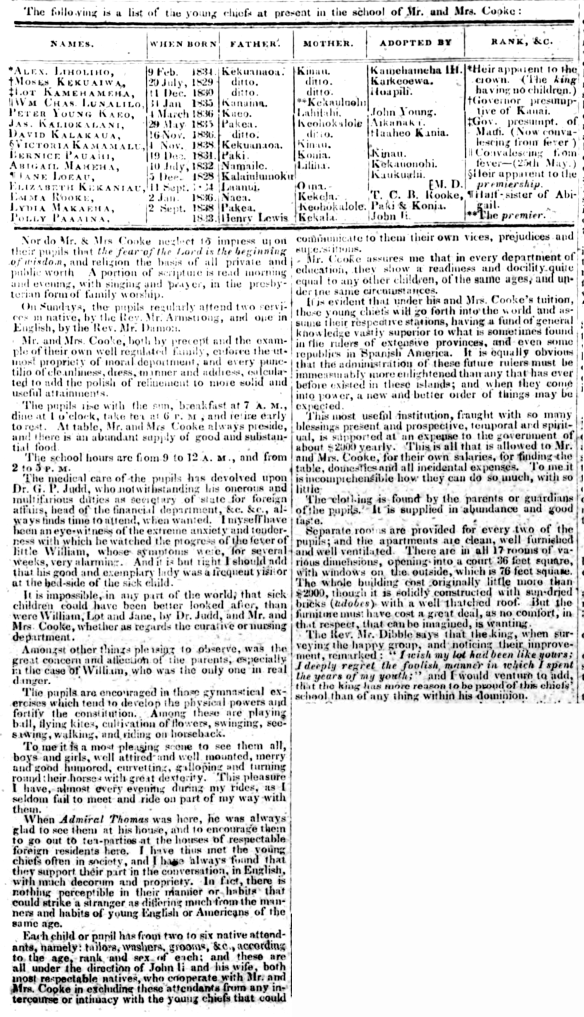
The following is a list...

The Friend, Volume II, Number VIII, Page 36. August 1, 1844.

¹This comment about the abundance of food reminded me of something Liliuokalani said in Hawaii’s Story by Hawaii’s Queen. “…our instructors were especially particular to teach us the proper use of the English language; but when I recall the instances in which we were sent hungry to bed, it seems to me that they failed to remember that we were growing children. A thick slice of bread covered with molasses was usually the sole article of our supper, and we were sometimes ingenious, if not over honest, in our search for food: if we could beg something of the cook it was the easier way; but if not, anything eatable left within our reach was surely confiscated. As a last resort, we were not above searching the gardens for any esculent root or leaf, which (having inherited the art of igniting a fire from the friction of sticks), we could cook and consume without the knowledge of our preceptors.”

Speaking of Hawaii’s Story by Hawaii’s Queen, i was expecting the new much-awaited edition to be available already, but hopefully it will be out in bookstores soon! I am thinking of putting up related articles like this one (mostly from the Hawaiian-Language Newspapers) to perhaps give a fuller picture of topics covered in the Queen’s book.

[This is written by Robert Crichton Wyllie, and is found in a very enlightening treatise describing many aspects of life in Honolulu in the 1840s. “NOTE On the Shipping, Trade, Agriculture, Climate, Diseases, Religious Institutions, Civil and Social Conditions, Mercantile and Financial Policy of the Sandwich or Hawaiian Islands, viewed in relation to other groups of islands, and to the natural and acquired advantages of the Sandwich or Hawaiian Islands.” Friend, June 1–September 24, 1844.]

New Hawaiian Language Textbook, 1939.

Hawaiian Language Book

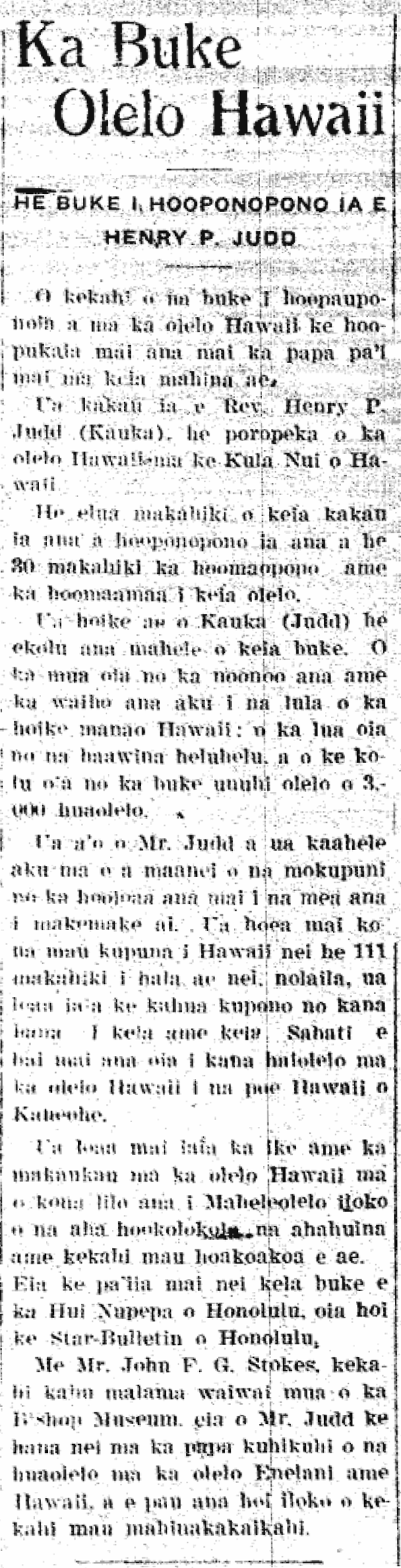
A BOOK EDITED BY HENRY P. JUDD

A book completed in the Hawaiian language is being published by the press next month.

It was written by Rev. Henry P. Judd (Kauka), a professor of the Hawaiian language at the University of Hawaii.

The writing and editing took two years, and it was 30 years of learning and practicing of the language.

Kauka (Judd) says there are three sections to this book. The first part is the studying and the giving of rules of Hawaiian expression; the second is reading lessons; and the third is the translation of 3,000 words.

Mr. Judd has taught and travelled here and there in the islands obtaining what he was after. His kupuna came to Hawaii nei 111 years ago, and therefore, he has the appropriate place for his work. Every Sunday, he gives his sermons in Hawaiian to Hawaiians in Kaneohe.

He gained his knowledge and proficiency in the Hawaiian language through his becoming a translator [Maheleolelo] in the courts, the [Evangelical] Conferences, and other gatherings.

This book is being published by the Newspaper Company of Honolulu, that is the Star-Bulletin of Honolulu.

With Mr. John F. G. Stokes, one of the first trustees of the Bishop Museum, Mr. Judd is now in the process of making a word list in English and Hawaiian, which will be completed in a few months.

[This is referring to the book: Judd, Henry P. The Hawaiian language. Honolulu: Honolulu Star-Bulletin, Ltd., 1939.]

(Hoku o Hawaii, 7/26/1939, p. 1)

Ka Buke Olelo Hawaii

Ka Hoku o Hawaii, Volume XXXIV, Number 13, Aoao 1. Iulai 26, 1939.

Maria Whitney Pogue passes, 1900.

THE FIRST HAOLE GIRL TO BE BORN IN HAWAII NEI.

Santa Clara, Apr. 20. This morning Mrs. Maria Whitney Pogue, the first haole girl to be born in the Hawaiian archipelago, died after a long illness. She was eighty years old. Her parents are Mr. and Mrs. Samuel Whitney, missionaries who arrived first with other missionaries for the islands. This girl was educated in Boseton, and she came here five years ago.

(Aloha Aina, 5/5/1900, p. 6)

KE KAIKAMAHINE HAOLE MUA LOA I HANAU MA HAWAII NEI.

Ke Aloha Aina, Buke VI, Helu 18, Aoao 6. Mei 5, 1900.

Another “Memoirs of Obookiah” translation, 1867.

Book of the Moolelo of Heneri Opukahaia.

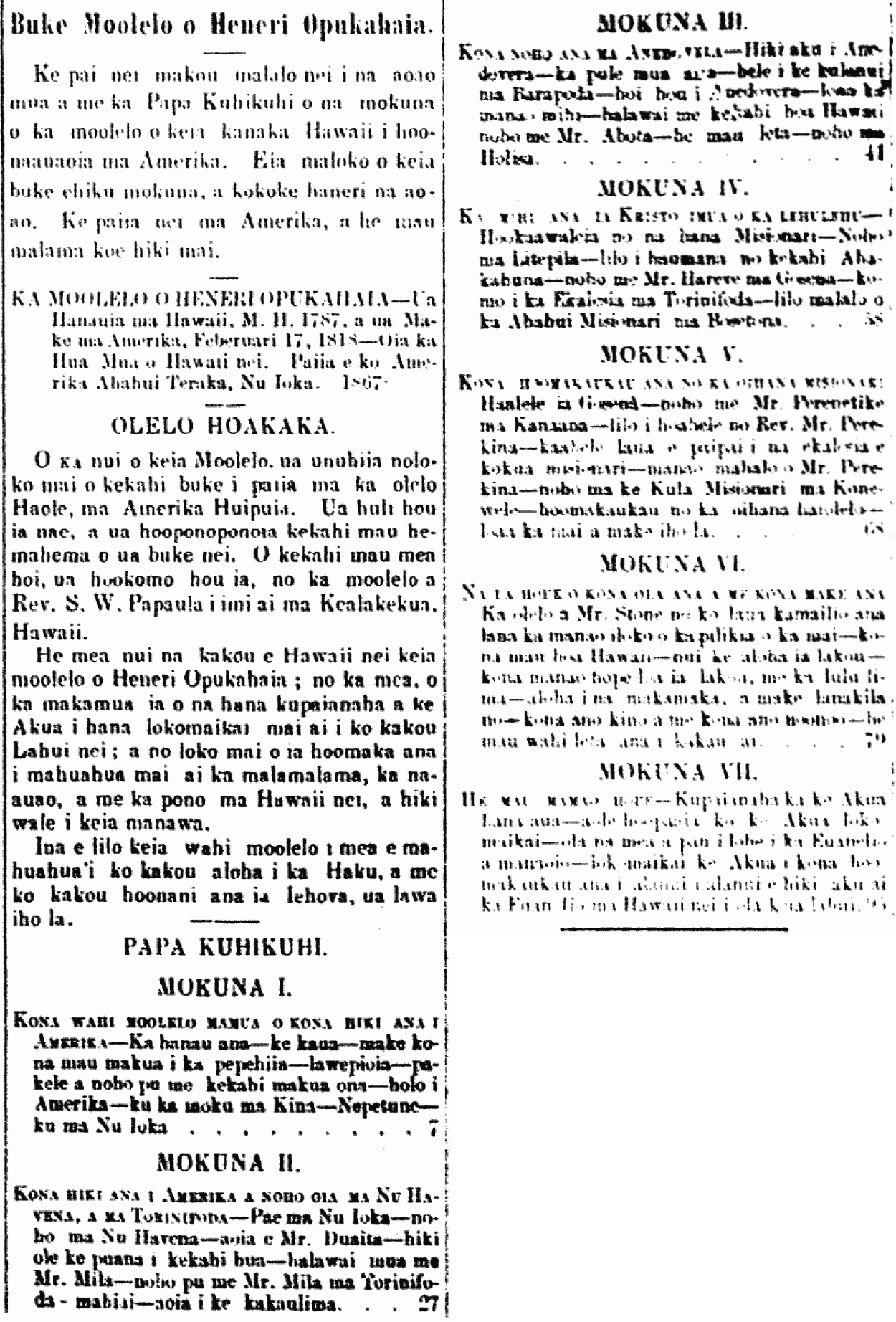
We are printing below the first pages of and the Table of Contents of the Chapters of the story of this Hawaiian that was educated in America. In this book is seven chapters, and it is almost a hundred pages. It is being printed in America and it will be here in a few more months.

THE STORY OF HENERI OPUKAHAIA—Born in Hawaii, A. D. 1787, and Died in America, February 17, 1818—The First Fruit of Hawaii nei. Printed by the American Tract Society [Amerika Ahahui Teraka], New York, 1867.

INTRODUCTION.

The majority of this Moolelo was translated from a book published in English in the United States of America. However, information was researched, and some of the errors of the book was corrected. Some things were added from the moolelo that Rev. S. W. Papalua investigated at Kealakeakua, Hawaii.

This story of Heneri Opukahaia is something important to us Hawaiians; for this is the first of the miracles that God performed benevolently upon our People; and through this start, the enlightenment, the knowledge, and the righteousness of Hawaii has increased until this day.

Should this moolelo become something which increases our love for God and our glorification of Jehovah, that will be enough…

[A couple of years later in 1867, the original translation was appended to and corrected with the information collected by that same S. W. Papaula of Napoopoo, and published in book form under the title: “KA MOOLELO O HENERI OPUKAHAIA, UA HANAUIA MA HAWAII, M. H. 1787, A UA MAKE MA AMERIKA, FEBERUARI 17, 1818. OIA KA HUA MUA O HAWAII NEI.”]

(Kuokoa, 5/18/1867, p. 3)

Buke Moolelo o Heneri Opukahaia.

Ka Nupepa Kuokoa, Buke VI, Helu 20, Aoao 3. Mei 18, 1867.

Speaking of Hewahewa, the great kahuna o Kamehameha…, 1837.

[Found under: “DEATHS.”]

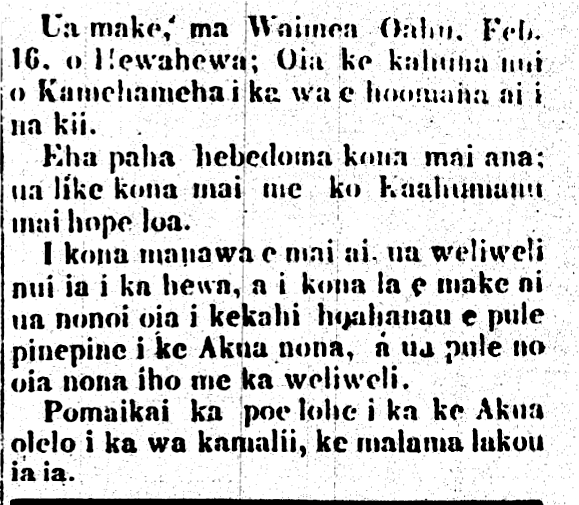
Hewahewa died at Waimea, Oahu, Feb. 16; he was the great kahuna of Kamehameha during the time when the idols were worshiped.

He was ill for perhaps four months; his illness was like that of Kaahumanu’s final illness.

While he was sick, he was terrified of sins, and on the day that he died, he asked one of the brethren to pray often to God for him, and he prayed for himself in fear.

Blessed are those who hear Godʻs teachings while they are young, should they heed them.

(Kumu Hawaii, 4/26/1837, p. 96)

Ua make ma Waimea, Oahu...

Ke Kumu Hawaii, Buke 2, Pepa 24, Aoao 96. Aperila 26, 1937.

More on Opukahaia, 1865.

The Story of Opukahaia.

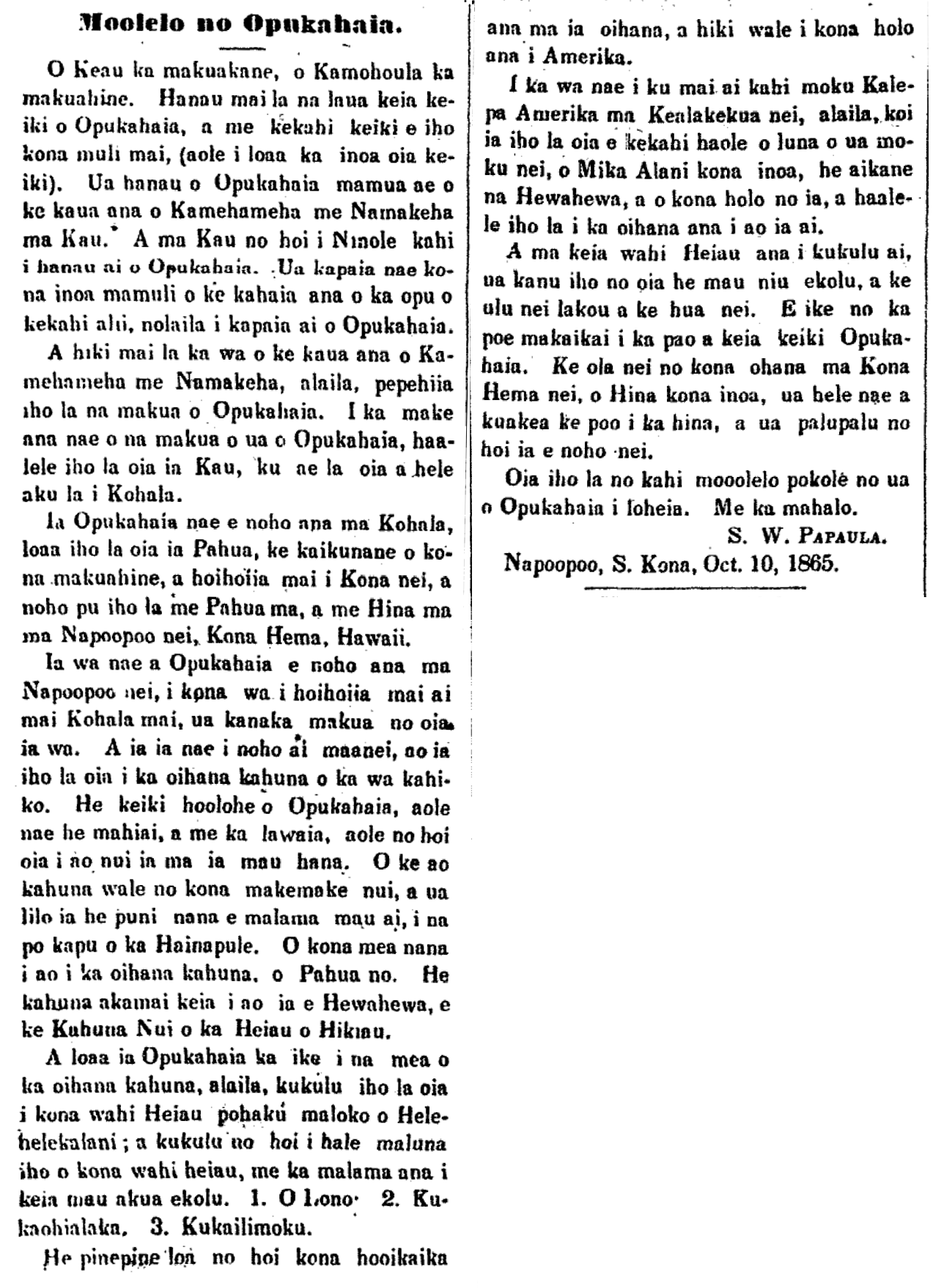
Keau was the father, Kamohoula was the mother. From the two was born this child, Opukahaia, along with another younger child (the name of that child is not known). Opukahaia was born soon before the battle between Kamehameha and Namakeha at Kau. And at Kau in Ninole, is where Opukahaia was born. He was named for the slitting of the stomach of a certain alii, and that is why he was called Opukahaia [“the cutting of the stomach”].

When the time of warfare between Kamehameha and Namakeha arrived, the parents of Opukahaia were killed. When his parents were killed, Opukahaia fled Kau, and went to Kohala.

While he lived in Kohala, Opukahaia was found by Pahua, the brother of his mother, and he was returned here to Kona, and lived with Puhua them and Hina them here in Napoopoo, South Kona, Hawaii.

The time when Opukahaia was living here in Napoopoo, when he was brought back from Kohala, he was an adult at the time. While he lived here, to him belonged the occupation of the kahuna of the olden days. Opukahaia was obedient; he was however not a farmer nor a fisherman, for he was not taught much about those things. He really just wanted to be taught kahuna things, and this was something that he was very interested in doing constantly, on sacred nights of Prayer [? Hainapule]. The one who taught him the ways of the kahuna was Pahua. He was a skilled kahuna taught by Hewahewa, the Great Kahuna of the Heiau of Hikiau.

After Opukahaia received the knowledge of the occupation of the kahuna, he constructed his stone Heiau within Helehelekalani, and he built a house atop his heiau, while he worshiped three gods. 1. Lono, 2. Kukaohiakala, 3. Kukailimoku.

He was constantly honing his skills, until he left for America.

When the American trading ship appeared here at Kealakekua, he was prodded by a haole aboard the ship, named Mika Alani, who was an aikane of Hewahewa; and so he went and left the work that he was trained in.

And at this Heiau which he built, he planted three coconuts, and they are growing and fruiting. The cave [? pao] of this boy, Opukahaia, can be seen by those who visit here. His relative still lives here in South Kona, her name is Hina; she is gray-haired and is frail now.

This is a short story of what is heard of Opukahaia. With mahalo.

S. W. Papaula.

Napoopoo, S. Kona, Oct. 10, 1865.

[This seems to be written in response to the translation being published in Kuokoa at the same period. Papaula is adding to the information given in the translation. This ability to quickly add to or correct information published in the newspapers was one of the many advantages newspapers had over books.]

(Kuokoa, 11/4/1865, p. 4)

Moolelo no Opukahaia.

Ka Nupepa Kuokoa, Buke IV, Helu 44, Aoao 4. Novemaba 4, 1865.

Translation of “Memoirs of Henry Obookiah: A Native of Owhyhee, and a Member of the Foreign Mission School…” 1865.

Ka Moolelo o Heneri Opukahaia.

HELU 1.
Kona wahi moolelo mamua o kona hiki ana i Amerika.

He kanaka o Heneri Opukahaia no Hawaii ka mokupuni kaulana a laukanaka hoi o ka Pae Aina Hawaii. Ua hanau ia i ka makahiki 1792. He mau makaainana kona mau makua; aka ua pili nae kona makuahine i ka ohana o na’lii. O kona inoa o Kumuola; a o ka inoa o kona makuakane aole i maopopo. I ka wa i hiki aku ai o ko Opukahaia mau makahiki i ka umi a umikumamalua paha, pepehiia kona mau makua mamua pono o kona mau maka. Elua wale no laua o kona ohana i ola, oia a me kona wahi muli loa nona na malama ekolu. Ua manao lana ia e hoola i kona wahi pokii mai ka popilikia mai i ili iho ai maluna o kona mau makua, nolaila, ua hopu akuu ia i kona wahi pokii a kau ae la ma kona kua, a holo aku la mai ka enemi aku; aka, ua loaa aku no ia i ka poe i alualu aku, a pepehi mainoino ia ua wahi pokii la ona. O ka moolelo o ia wahi ua kakau ia ma kekahi buke e aku mamuli o ka mea i hai waha ia aku e Opukahaia…

[This translation of Edwin Welles Dwight’s “Memoirs of Henry Obookiah, a Native of Owhyhee, and a Member of the Foreign Mission School; Who Died at Cornwall, Conn. Feb. 17, 1818, Aged 26 Years.” begins on 9/9/1865 and is completed on 3/24/1866.]

(Nupepa Kuokoa, 9/9/1865, p. 2)

Ka Moolelo o Heneri Opukahaia.

Ka Nupepa Kuokoa, Buke IV, Helu 36, Aoao 2. Sepatemaba 9, 1865.

Patriotic mele in English, 1893.

As Israel in ancient times sat weeping by the waters of Babylon listening to the plaintive songs which arose from their singers, so sits Hawaii in grief and mourning to-day and to Her our bard sings:

I had a dream, I saw a vision pass before me,
Long ages past arose in swift array,
Adown the stream of time my fleeting fancy bore me
From age to age unto the present day,
Far o’er the southern sea I saw brave ships a-sailing
From isle to isle, till at Hawaii’s shore
They touched, and soon with joy the natives came, them hailing
With pious awe, incarnate Gods of yore,
From all the land they flocked with speed to see the stranger,
Adoring gave their gifts both rich and rare,
But time brought fuller knowledge, knowledge brought its dangers
And Captain Cook’s life paid the forfeit there.
And down the stream still visions came a-floating;
Vancouver came unto this race so brave;
Restored the friendship Cook had lost; while noting
That Britain ne’er would hold them as her slave.
Still swept the vision on with flight so speedy;
One ship alone this time comes into view—
America’s gift unto these islands needy,
Peace, love, goodwill—and Christianity too.
Right lovingly was welcomed each new teacher,
The people flocked to hear good news so true,
That more and more it seemed to every preacher,
The harvest plenteous, but the laborers few.
And time flew by on wings. The isles grew fair, and fairer;
One Briton thought to seize them for his land,
But Britain’s Admiral, our independence bearer,
Restored the flag midst praise from every hand,
The years passed by. Through all the land there rose the steeple—
The preacher controlled all with kindly hand;
Give land and constitution to your people!
(O King! Give heed!) and God will bless your land.
Year followed year. Changed Kings and constitution.
The stranger increased: took mortgages on land:
Kept Hawaii’s daughters, sisters, wives in prostitution:
Spread poverty and vice around on ev’ry hand.
Still years rolled on. With sugar now grown wealthy,
The foreign Christians lifts his eye around,
And says: “For me no doubt the climate is most healthy,
“Tho’ poor and dying Hawaii’s native sons are found.
“Some seventy years ago we gave this land the Bible
“And tried to teach them then its use,
“(To say we’ve showed them poor examples is no libel)
“And fair exchange ‘t will be to cook their goose.
“Their cries for right and justice soon we’ll stifle:
“Take for ourselves this Paradise on earth.
“If they object, we’ll each one tap our rifle,
“And call for help upon our land of birth.
“Unfit to rule with all these years of training—
“(We’ll spread the lie around on every hand,)
“You’ll see they’ll let us do it, uncomplaining,
“For they have got our Bible, and so we’ll take their land.”
At this a noise awoke me, and in wonder
I saw the very instance of my dream.
Hawaii’s Queen and Natives were put under
To bolster up their money-getting scheme
And now forth from them goes across the waters
One last appeal for Justice and for Right.
Preserving peace, Hawaii’s gen’rous sons and daughters,
Before God’s throne on high, in prayer unite:
“Great God! the Judge of All! The records thou art keeping!
“Look down in mercy on our sad estate!
“Be kind unto us! Hear our voice of weeping!
“Till thou restore, grant us in peace to wait.
“And thou, great nation! home of truth and bravery!
“Freedom’s defender! we pray thee us O, hear!
“Restore our Queen and us; now, as in slavery,
“Held by usurper’s armed fear.
“Restore our rights and help us to maintain them!
“O let our prayer be crowned with success!
“Our conduct and your friendship will retain them,
“The God of nations will for ever bless.”

[This mele was probably composed by Kahikina Kelekona, J. G. M. Sheldon.

The image taken from the microfilm is hard to make out at the bottom. Hopefully there will be funding found to have the Hawaiian-Language Newspapers be unbound and rescanned clearly. How can you get to all the pearls stored in the newspapers if you can’t make out the words?]

(Hawaii Holomua, puka pule, 1/28/1893, p. 4)

As Israel in ancient times...

Hawaii Holomua (Puka Pule), Buke III, Helu 5, Aoao 4. Ianuari 28, 1893.