More on Liliuokalani and her support of education. 1895.

HYPOCRITICAL REMEMBRANCE.

The celebrating and remembering of the birthday of someone is not a bad thing, or something to criticize. And this applies when the person whose birthday that is being remembered has died, it is a good thing, should that person have done a famous deed or left an important legacy for her trustees to carry out, like the Alii, Pauahi-a-Paki.

We are not opposing the remembrance of her trustees and the heads of the Kamehameha Schools, like what was done this past Thursday, on the birthday of this Alii of this land, who showed her true aloha for her lahui by leaving her great estate for the good and welfare of the new generations of her own people, so that the their thoughts and actions are bettered. We do however oppose and criticize the attempt to deify, and it is almost to the point where the missionaries and teachers of those places of learning are making her, the deceased Alii, into a god [akua? ahua?] to be worshiped. In the presentations on that day mentioned, the girls performed before a huge audience of all sorts of people who attended, where they all knelt before an image of the Alii, and thereafter placed lei and flowers upon that picture. This is not a good lesson for the children.

Pauahi has died, she has gone, she is no more in body, but she still lives through her glorious deeds, perhaps the greatest amongst the Hawaiian Chiefs who left on the “Dark Path of Kane”. It is for her trustees and her representatives that were empowered in her will, which the Supreme Court will fill should there be a vacancy amongst those people, they are they ones carrying out these remembrances without her knowledge of what is being done, and that is why we call it—a hypocritical remembrance.

For here is the Queen, still living, and she is not honored by those missionaries for her good works that are exemplary for the benefit of her people, before and since her ascending the throne. She took up the Liliuokalani Educational Society, with its two divisions, and greatly assisted its funds from her own earnings and property. There were many girls who received an education because of this society, and the girls’ school of Kawaiahao, that grounds of learning of the missionaries, saw benefits, and this cannot be denied in the least.

She is sill living and has followed through on her good works which were established under her very own leadership, not by other like with the late Pauahi. And yet these haughty missionaries of her days don’t at all remember her great deeds which show her true aloha for her lahui while she is alive and not after her death. Aye, she is still living, and we see the fruits of her good labors, and perhaps she mistakenly put her faith in her weak fellow lahui for whom she felt much aloha, and she fell from her position on high; and now she sees clearly those who are steadfastly loyal to her and those who are traitorous, abusive, and speak badly about her.

The missionaries themselves are the true witnesses to her good deeds. They have no words for Pauahi, hers were seen before. They go to her [Liliuokalani] and ask for money from her, and they are not given just a trifle, but they are given great amounts. And yet, those people do not think a bit of her, or thank her, not at all; they instead abuse and fling and besmear her with filth, in return for the good that was done, and given to, and received by them. This is a time to tell tales, to rouse, ask for rudely, to beg, to abuse, to curse, to insult, and that list goes on and on, just filled with indolence.

[How sad that even today, her namesake, Queen Lydia Liliuokalani Elementary School has been shut down. Today there was a celebration of the 100th anniversary of the laying of the cornerstone of the school on the grounds of Liliuokalani Elementary School! Let us remember her always along with her great love for her people!]

(Makaainana, 12/23/1895, pp. 4 & 5.)
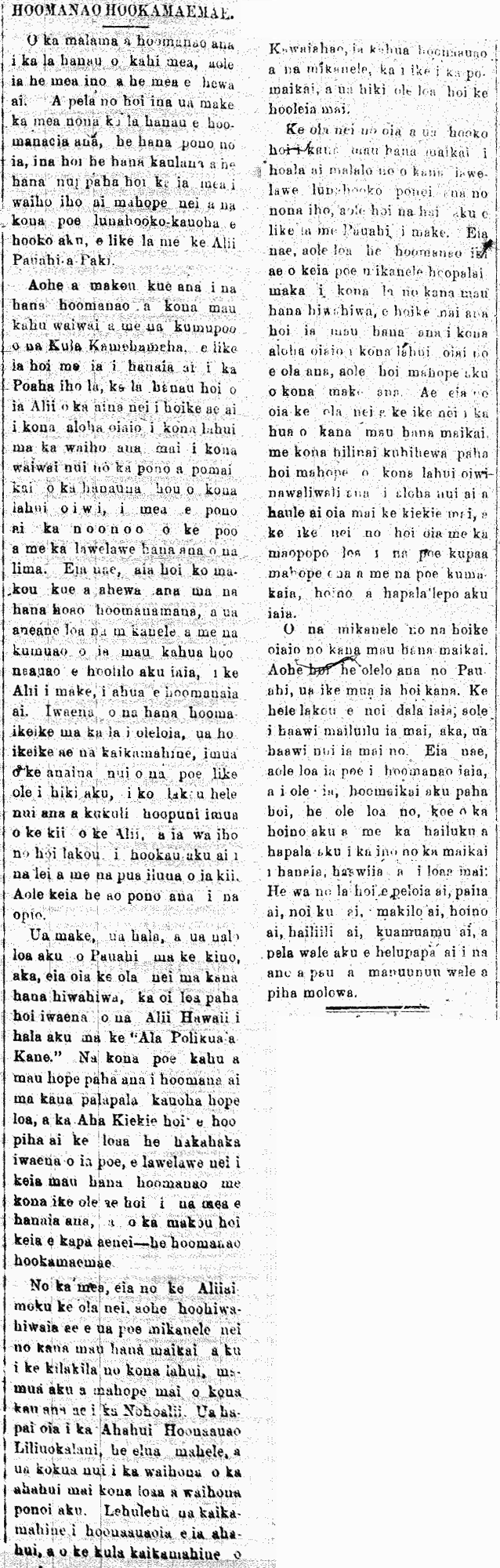
HOOMANAO HOOKAMAEMAE.

Ka Makaainana, Buke IV----Ano Hou., Helu 26, Aoao 4 & 5. Dekemaba 23, 1895.
Royal Hawaiian Band gets new instruments, 1912.

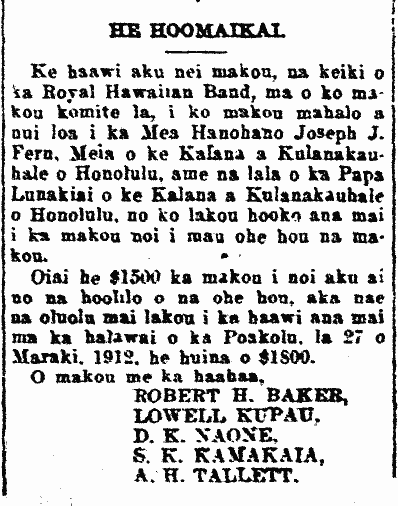
EXPRESSION OF APPRECIATION.

We, the boys of the Royal Hawaiian Band, by means of our committee, give our great appreciation to the Honorable, Joseph J. Fern, Mayor of the City and County of Honolulu, and the Board of Supervisors of the City and County of Honolulu, for their approving our request for new wind instruments.

Although we requested $1500 for the costs of the new instruments, they kindly granted us at the meeting of Wednesday, the 27th of March, 1912, the sum of $1800.

We, with sincerity,

Robert H. Baker,
Lowell Kupau,
D. K. Naone,
S. K. Kamakaia,
A. H. Tallett.

(Kuokoa, 4/5/1912, p. 6)

HE HOOMAIKAI.

Ka Nupepa Kuokoa, Buke XLVIII, Helu 14, Aoao 6. Aperila 5, 1912.

Words of condolences from the Liliuokalani Educational Society at the passing of Poomaikelani, 1895.

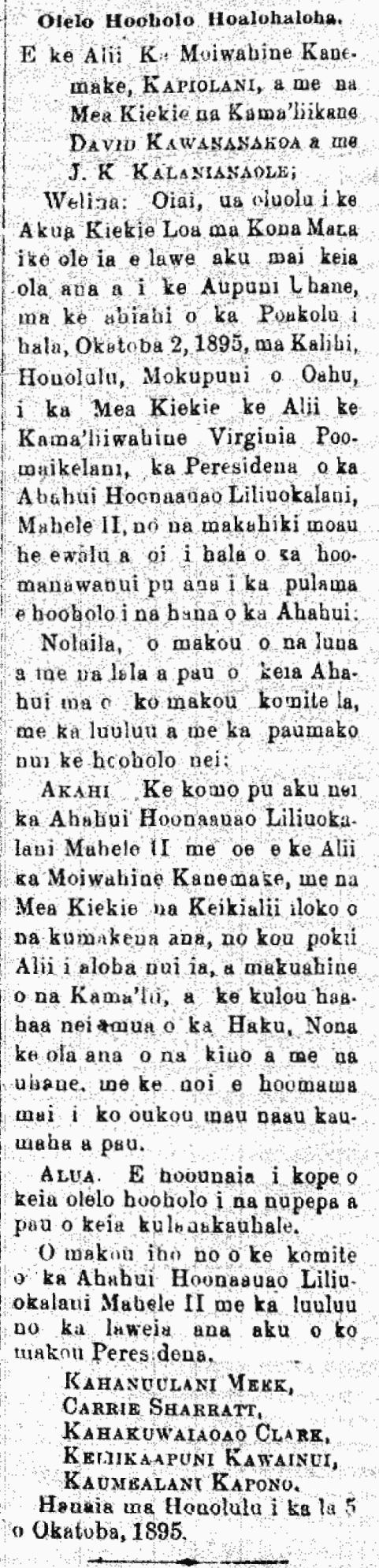
Resolution of Condolences.

To the Alii, the Dowager Queen Kapiolani; and Their Highnesses, Princes David Kawananakoa and J. K. Kalanianaole;

Greetings: Whereas the Almighty God has kindly in His unfathomable Power taken from this life to the Land of Souls, on the evening of this past Wednesday, October 2, 1895, at Kalihi, Honolulu, Island of Oahu, Her Highness, the Alii, Princess Virginia Poomaikelani, the President of the Liliuokalani Educational Society, Division II, for many years, eight or more, for which she patiently cared for along with us the advancement of the works of the Society.

Therefore, we, the officers and all of the members of the Society, through our committee, with sadness and grief, have resolved:

First. The Liliuokalani Educational Society, Division II, join with you, the Alii, the Queen Dowager and their Highnesses, the Princes, in your grief for your greatly beloved younger Royal sibling, the mother of the Royal Children, and we bow before the Lord, Whose is the life in the body and the soul, as we ask him to lighten your heavy hearts.

Second. A copy of this resolution shall be sent to all of the newspapers of this town.

We of the committee of the Liliuokalani Educational Society, Division II, with sorrow, at the taking of our President.

Kahanuulani Meek,

Carrie Sharratt,

Kahakuwaiaoao Clark,

Keliikaapuni Kawainui,

Kaumealani Kapono.

Done at Honolulu on the 5th of October, 1895.

(Makaainana, 10/14/1895, p. 2)

Olelo Hooholo Hoalohaloha.

Ka Makaainana, Buke IV----Ano Hou, Helu 16, Aoao 2. Okatoba 14, 1895.

A Dance to benefit the Liliuokalani Educational Society, 1888.

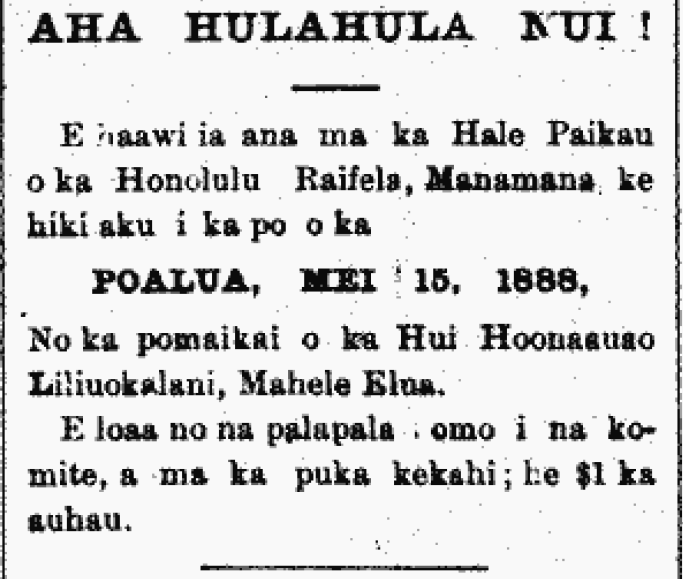
A BIG DANCE!

To be held at the Armory of the Honolulu Rifles, Manamana when reaching the night of

TUESDAY, MAY 15, 1888.

For the benefit of the Hui Hoonaauao Liliuokalani, Mahele Elua [The Liliuokalani Educational Society, Division Two].

Tickets of entry may be obtained from the committee, and also at the door; $1 is the cost.

(Makaainana, 5/3/1888, p. 3)

AHA HULAHULA NUI!

Ka Makaainana, Buke III, Helu 3, Aoao 3. Mei 3, 1888.

More on Liliuokalani Educational Society, 1892.

[Found under: “HAWAII NEWS”]

On the 15th of this month, it will be the [???] anniversary of the Hui Hoonaauao Liliuokalani, Mahele 2 [Liliuokalani Educational Society, Division 2] from its inception by the Queen of Hawaii at this time.

[This article in theory states the year that the Liliuokalani Educational Society, Division 2 begins, but that year is not visible. Here is another article which is cut off because of tight binding. It is a sad thing to have to randomly go back and flip through fragile newspaper pages just to find what a word or phrase is. And if a whole bunch of people need to find different things, the papers will deteriorate quickly, and soon, a good image will be impossible because the pages will be dust…]

(Kuokoa, 5/7/1892, p. 3)

Ke hiki ae i ka la 15...

Ka Nupepa Kuokoa, Buke XXXI, Helu 19, Aoao 3. Mei 7, 1892.

Liliuokalani Educational Society, 1890.

[Found under: “LOCAL & GENERAL NEWS”]

The First Division of the Liliuokalani Educational Society will meet at Washington Place, three [?] o’clock Monday afternoon.

[Granted, this is a single sentence, but there is not much known about the Liliuokalani Educational Society, and every little mention is important…

This newspaper is bilingual, Hawaiian and English, and is also called “The National Herald”. The images are not very clear, and the typescript as a result is riddled with “@”s, which indicate that the area is illegible. Hopefully they (and all of the other newspapers) can be re-shot so that there will be legible images—the information they hold is priceless!]

(Ahailono a ka Lahui, February 1, 1890, p. 5)

The First Division of the Liliuokalani Educational Society...

Ka Ahailono a ka Lahui, Volume 1, Number 20, Page 5. February 1, 1890.

Kuhio and the Hawaiian Civic Clubs. 1918.

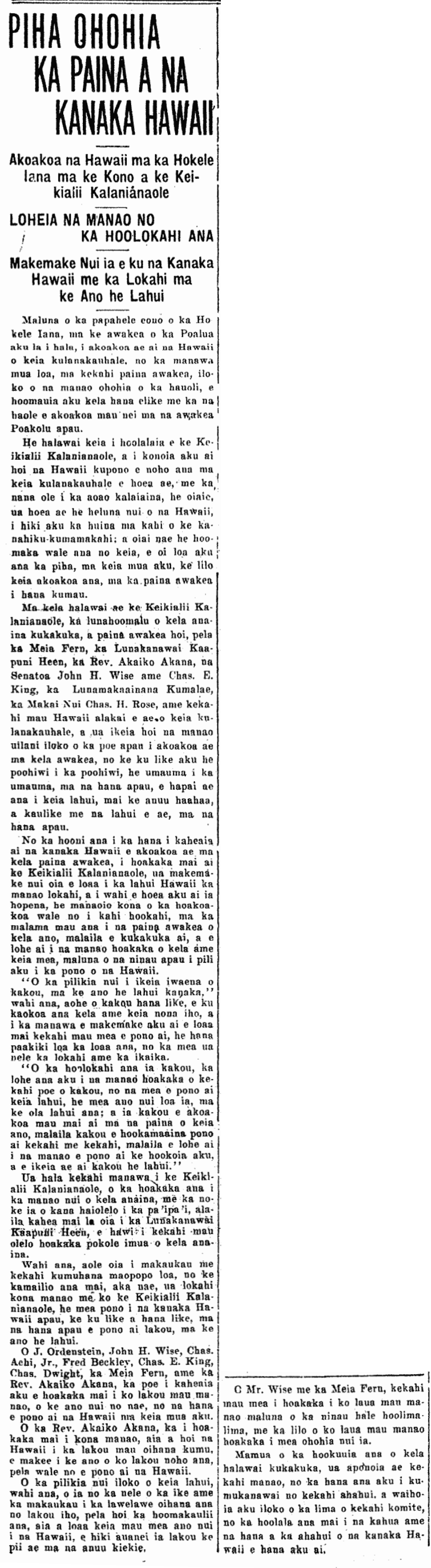
THE PARTY OF HAWAIIANS  WAS FILLED WITH ENTHUSIASM

Hawaiians Gathered at the Young Hotel at the Invitation of Prince Kalanianaole

HEARD WAS IDEAS FOR UNIFICATION

Desired that Hawaiians Stand Together as a People

On the sixth floor of the Young Hotel, at noon this past Tuesday, the Hawaiians of this town gathered for the first time, for a luncheon amid enthusiasm and joy, and this will be a regular thing, like the haole regularly meet at noon on Wednesdays.

This was a meeting organized by Prince Kalanianaole, and Hawaiians of good standing who live here in town were invited to attend, without attention being paid to political affiliation; it is true, many Hawaiians came, and the total number was about seventy-one; and being that this is just the beginning, it will be more full in the future, should this gathering at lunch become a regular thing.

At this meeting was Prince Kalanianaole, the chairman of this meeting and luncheon, and also Mayor Fern, Circuit Judge Heen, Rev. Akaiko Akana, Senators John H. Wise and Charles E. King, Representative Kumalae, Sheriff Charles H. Rose, and some other Hawaiian leaders of town; and everyone gathered there that afternoon seemed spirited to stand shoulder to shoulder, chest to chest, in all things; to lift this lahui from the low level to be equal with the other ethnicities in all aspects.

In order to move forward the agenda for which the Hawaiians gathered at that luncheon, Prince Kalanianaole explained that he greatly wished that the Hawaiian people would think as one, and as a means to that ends, he believes that meeting together in one place by holding regular luncheons of that sort, is where you’d discuss things and hear explanation from different people on all questions regarding the well-being of Hawaiians.

“The great problem seen amongst us, as a people,” according to him, is that we don’t cooperate; we all stand independently, and when we want good works to be done, it is very hard to accomplish for we lack unity and strength.

“Unifying ourselves, and listening to people talk about things that will benefit this lahui is very important for the perpetuation of the lahui; and as we gather regularly at meals of this sort, we will become familiar with each other, and we will hear ideas that should be carried out, and we will be seen as a lahui.”

Some time was spent by Prince Kalanianaole explaining the goals of that gathering while his speech was encouraged by applause, then he called up Circuit Judge Heen to give a few words of clarification before the crowd.

According to him, he was not prepared with a clear topic to talk about, however, he was in agreement with Prince Kalanianaole; all Hawaiians must stand together and work as one in all endeavors that will better themselves as a lahui.

J. Ordenstein, John H. Wise, Charles Achi, Jr., Fred Beckley, Charles E. King, Charles Dwight, Mayor Fern, and Rev. Akaiko Akana were called to explain their overall thoughts as to what is to be done to benefit Hawaiians from here forth.

Rev. Akaiko Akana shared his thoughts; when Hawaiians go back to their traditional occupations [?] and cherish their way of life, that is the only way Hawaiians will be blessed.

The big problem with this lahui, according to him, is the lack of knowledge and readiness to go into business for themselves and so too with being economical; when these important things are acquired by Hawaiians, they will be able to climb to a high level.

Mr. Wise and Mayor Fern were some who spoke of their ideas on the question of leasing a building [?], and their ideas were heard with much enthusiasm.

Before the meeting was adjourned, one idea was approved, to draft a constitution for a club, and to place it in the hands of a committee to lay out the foundation and mission that this association of Hawaiians would carry out.

(Kuokoa, 11/29/1918, p. 1)

PIHA OHOHIA KA PAINA A NA KANAKA HAWAII

Ka Nupepa Kuokoa, Buke LVI, Helu 48, Aoao 1. Novemaba 29, 1918.

May Day Queen, 1941.

Became Queen

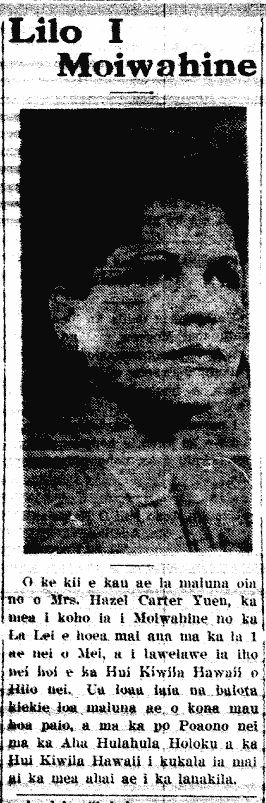
The picture above is of Mrs. Hazel Carter Yuen, the one chosen as Queen for the upcoming Lei Day, the 1st of May, held by the Hawaiian Civic Association [Hui Kiwila Hawaii] of Hilo. She received the most ballots from amongst her running mates, and on the night of this past Saturday at the Holoku Ball of the Hawaiian Civic Association the one who took the win was announced.

(Hoku o Hawaii, 4/9/1941, p. 1)

Lilo i Moiwahine

Ka Hoku o Hawaii, Buke XXXV, Helu 50, Aoao 1. Aperila 9, 1941.

More donations for the anti-annexation petitions committee, 1898.

LIST OF DONORS

Honolulu, Feb. 26, 1898.

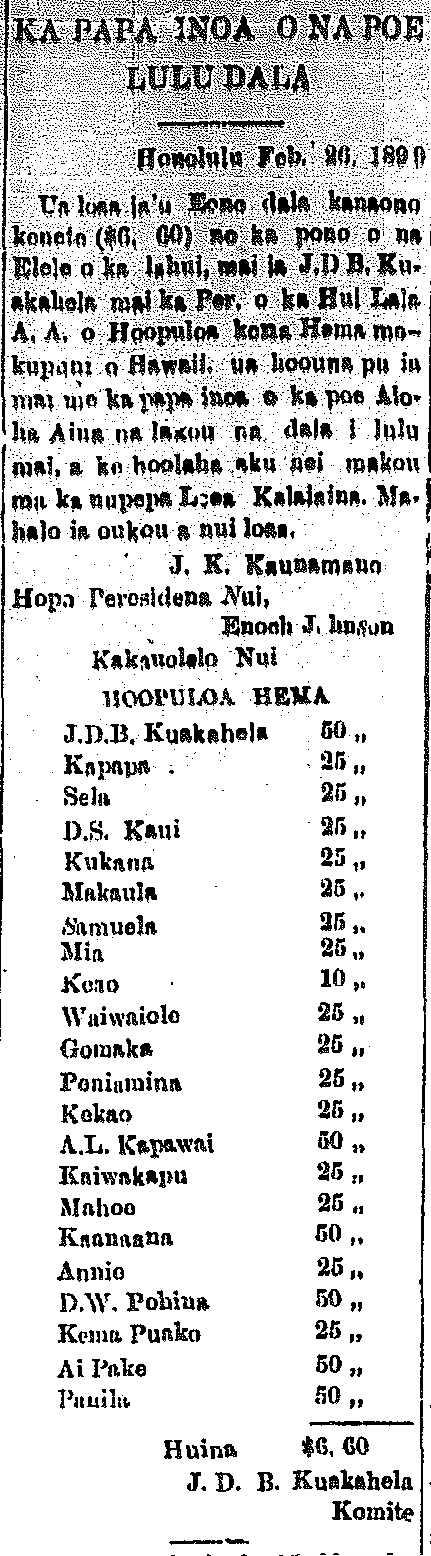
I have Six dollars and sixty cents ($6.60) for the well-being of the Representatives of the nation, from J. D. B. Kuakahela from the Pres. of the Members of the Patriotic League of Hoopuloa, South Kona, Island of Hawaii; it was sent along with a list of names of the Patriots who donated the money, and we are publishing it in the newspaper Loea Kalaiaina. Thank you very much to you all.

J. K. Kaunamano

Vice President,

Enoch Johnson

Head Secretary.

SOUTH HOOPULOA

J. D. B. Kuakahela, 50 ”

Kapapa, 25 ”

Sela, 25 ”

D. S. Kaui, 25 ”

Kukana, 25 ”

Makaula, 25 ”

Samuela, 25 ”

Mia, 25 ”

Keao, 10 ”

Waiwaiole, 25 ”

Gomaka, 25 ”

Peniamina, 25 ”

Kekao, 25 ”

A. L. Kapawai, 50 ”

Kaiwakapu, 25 ”

Mahoe, 25 ”

Kaanaana, 50 ”

Annie, 25 ”

D. W. Pohina, 50 ”

Kema Puako, 25 ”

Ai Pake, 50 ”

Pauila, 50 ”

Total, $6.60

J. D. B. Kuakahela

Committee.

(Loea Kalaiaina, 3/21/1898, p. 3)

KA PAPA INOA O NA POE LULU DALA

Ka Loea Kalaiaina, Buke II, Helu 12, Aoao 3. Maraki 21, 1898.

More Ernest Kaai—meeting a Hawaiian living in Australia, 1925.

That Hawaiian Wants to Come Back Here

Ernest Kaai Finds L. G. Kaainoa in Australia, and He Tells of His Desire to See Once Again His Land

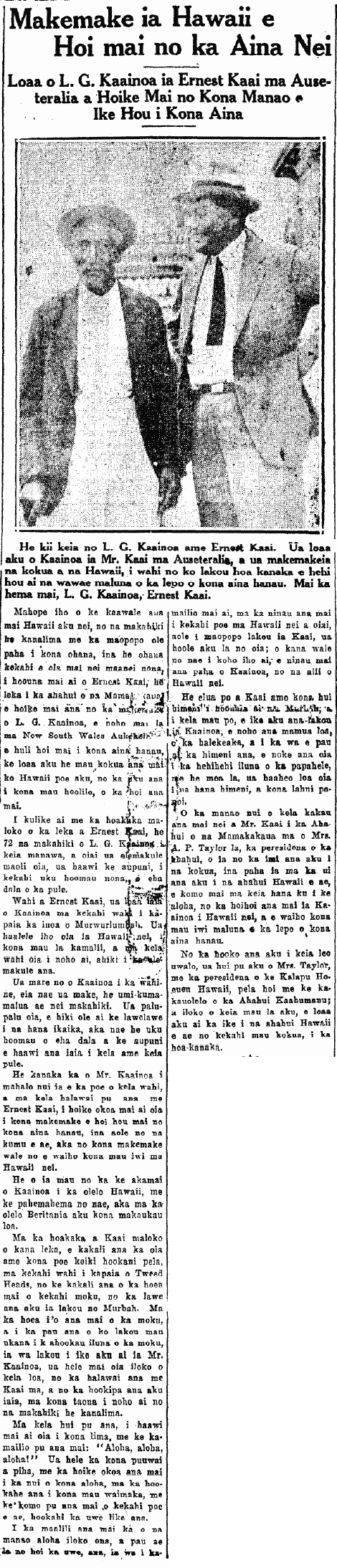
This is a picture of L. G. Kaainoa and Ernest Kaai. Mr. Kaai found Kaainoa in Australia, and he wants the help from Hawaiians to provide him a means for him to once again tread upon the land of his birth. From the left, L. G. Kaainoa, Ernest Kaai.

L. G. Kaainoa has been away from Hawaii for 50 years now without his family’s knowledge, or knowing even if he has ohana left alive here; Ernest Kaai sent a letter to the Ahahui Mamakakaua [Sons and Daughters of Hawaiian Warriors] telling them of the desire of Kaainoa (who now lives in New South Wales, Australia), to return to his homeland were he to receive assistance from Hawaii’s people to pay his expenses for the return.

According to the explanation in the letter of Ernest Kaai, L. G. Kaainoa is now 72 years old, and being that he is very old, the government provides him a pension of 4 dollars a week.

Ernest Kaai says he found Kaainoa at a place called Murwillumbah. He left Hawaii nei in his youth and it is there that he lived until his old age.

He married a woman, but she died 12 years earlier. He is infirm and cannot do hard labor. But he is given benefits by the government of 4 dollars every week.

Kaainoa is well liked by the people there, and when he met with Ernest Kaai, he made clear his hope to return to his homeland, if not for any other reason, but for his desire to leave his bones in Hawaii nei.

He is still very good at Hawaiian, yet is somewhat clumsy, but he is most fluent in English.

According to Kaai in his letter, he was staying along with his fellow musicians at a place called Tweed Heads, where they were waiting for the arrival of a ship to take them to Murbah. When the ship arrived, and after they loaded their belongings aboard, it was then they saw Mr. Kaainoa. He came all the way to meet with Kaai folk, and to welcome him to his town where he has lived for 50 years.

At their meeting, Kaainoa gave his hand, saying, “Aloha, aloha, aloha!” His heart was full while he expressed his great aloha as his tears flowed, while some others joined in with him.

After those feelings of aloha calmed within him, and his crying stopped, it was then that he began to speak, asking about some people in Hawaii nei. And as Kaai did not know them, he told him so. All he could think of that Kaainoa could ask of was the alii of Hawaii nei.

Kaai and his musical group spent two nights at Murbah, and on those two nights, they saw Kaainoa sitting way up front of the theater house. And when the singing was over, he continued to stomp on the floor as if he was so proud of this singing of his very own people.

The main reason Mr. Kaai wrote to the Ahahui Mamakakaua by way of Mrs. A. P. Taylor, the president of the Association, was to look for assistance; if she could ask the other Hawaiian associations to join in on this charitable endeavor to bring Kaainoa back to Hawaii nei for him to leave his bones in the soil of his homeland.

To follow through on this plea, Mrs. Taylor met with the president of the Hawaiian Civic Club [Kalapu Hoeueu Hawaii], and the secretary of the Kaahumanu Society; and in the upcoming days, the other Hawaiian organizations will learn about this assistance of their fellow Hawaiian.

(Kuokoa 3/5/1925, p. 1)

Makemake ia Hawaii e Hoi mai no ka Aina Nei

Ka Nupepa Kuokoa, Buke LXIV, Helu 10, Aoao 1. Maraki 5, 1925.