“He make no ka ka haole, a he ola no hoi; pela no na Kahuna Hawaii.” 1872.

ANNOUNCEMENT.

LET ALL MEN know the thoughts of the Hawaiian Medical Practitioners [Kahuna Lapaau Hawaii], they who number one hundred and fifty. O Ke Au Okoa, speak their thoughts. About how we will bear this immense right of ours impeccably, without deceit. Let them be instructed to put behind these evil thing: evil sorcery [anaana], imitative magic [hoopiopio], sending spirits [hoounauna], and the deification of all evil things; Continue reading

Pressured by their teachers, 1893.

THE SCHOOLS OF SAINT LOUIS AND KAMEHAMEHA.

We were told that the students of Saint Louis School [ke Kula o Sana Lui] were prohibited from placing the ribbon of the annexationists upon their chests. And we were also informed that the students of Kamehameha

Continue reading

Be vigilant. Just because someone claims to represent you, does that necessarily mean it is so? 1893 / timeless.

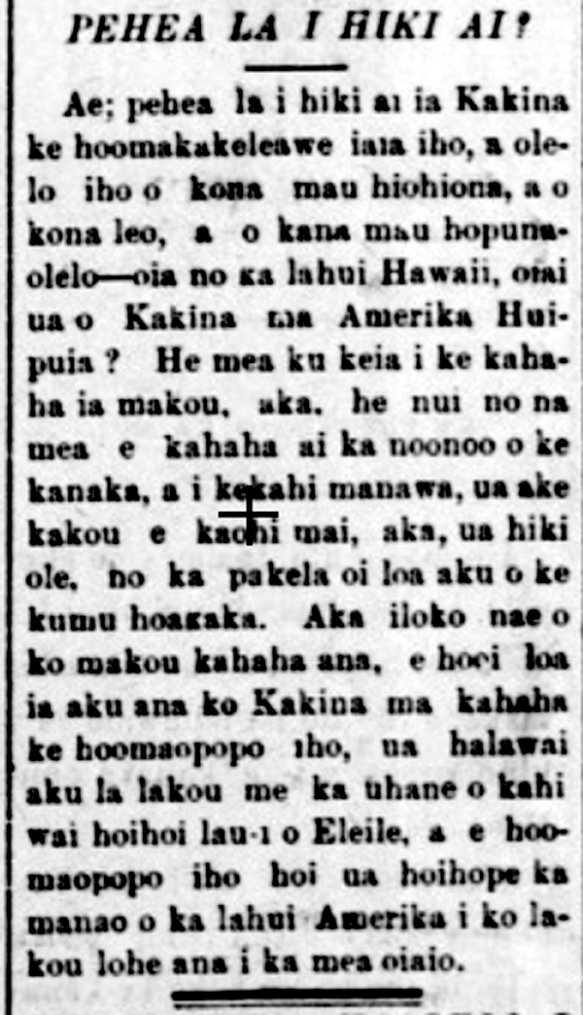
HOW IS IT POSSIBLE?

Yes, how can Stevens [John L. Stevens] make himself so brazen and say that his appearance, his voice, and his words—that they represent the Hawaiian people, all the while that that Stevens is in the United States? This is something that is appalling to us, but there are many things that will shock someone, and at times we just want to suppress that feeling, but we cannot, because of how blatant the examples. However, while we may be in shock, the shock of Thurston and his group will greatly surpass this, when they realize that they  met up with the spirit of the waters of Eleile that turn back ti leaves,* and they will realize that the sentiment of the Americans will turn back as well when they hear the truth.

[Many times people don’t pay attention to what is happening outside their own community because they have a job to do, or they have children to care for, or this, or that. Let us be vigilant during these upcoming years. The future generations deserve our attention.]

* See Mary Kawena Pukui’s ʻŌlelo Noʻeau: Hawaiian Proverbs & Poetical Saying, #1649 about the current in the pool of Eleile which turns back stalks of ti leaves thrown into it by visitors.

(Hawaii Holomua, 2/15/1893, p. 2)

HawaiiHolomua_2_15_1893_2.png

Hawaii Holomua, Buke III, Helu 160, Aoao 2. Feberuari 15, 1893.

Some advice from the past to composers of today, 1893.

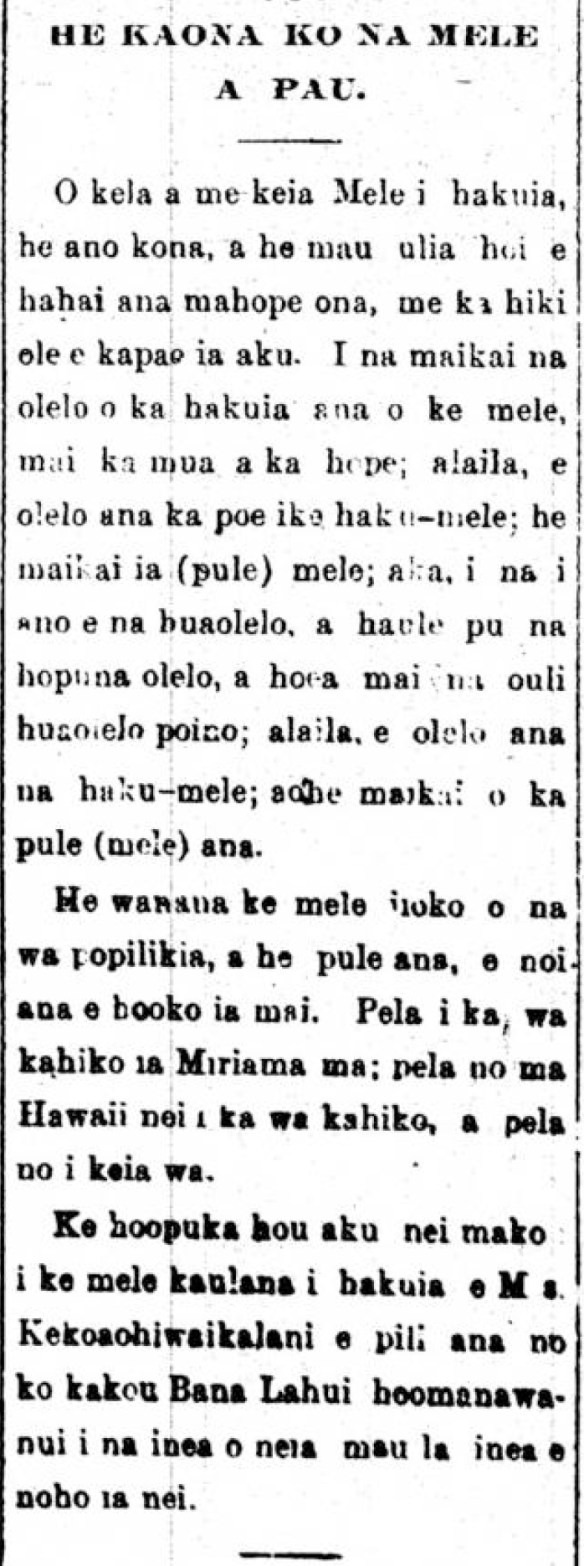
ALL MELE HAVE KAONA.

Each Mele that is composed has its own nature, and there are results that follow that cannot be avoided. Should the words of the composition be good from beginning to end, then those who understand mele composition [haku mele] will say that the mele (prayer) is a good one; however, should the words be off, and syllables are dropped, and words of unfortunate nature result, those knowledgeable in haku mele will say that the pule (mele) is not good.

A mele is a prophesy in times of trouble, and it is a prayer that asks to be fulfilled. So it was in the ancient times of Miriam folks; and so it was in ancient times in Hawaii nei, and so it is today.

We publish once again the famous mele composed by Mrs. Kekoaohiwaikalani pertaining to our Hawaiian Band [Bana Lahui] who are enduring the hardships of these trying times we are living in.

[Doesn’t this sound like a call from the past to those of today?]

(Leo o ka Lahui, 9/8/1893, p. 2)

LOKL_9_8_1893_2.png

Ka Leo o ka Lahui, Buke II, Helu 765, Aoao 2. Sepatemaba 8, 1893.

Mele for the Claudine, the vessel that carried the commission of annexationists to Washington DC, 1893.

KELAUDINA SONG.

Kaulana mai nei Kelaudina
Ahailono o ka poe pakaha
Nau i lawe aku na komisina
O ke aupuni kuloko o Hawaii
Hopuhopualulu e ka hele’na
A na elele o ua aupuni nei
E ake ana e hookoia
Ka iini pakaha aina
Halawai aku nei lakou
Me kahi paele a Kalivilana Continue reading

On patriotism, 1894.

THE ARRANT COWARDS.

It is refreshing to hear the supporters of the revolutionary Americans accuse the loyal citizens of Hawaii of cowardice. The attitude on the 17th of January of the men, who boast of their patriotism and heroism, was not a proof of the qualities now claimed by them. The p. gs. remind us of the small boy standing behind his big and armed brother—and two policemen as guards—yelling to the lonely boy on the other side with no arms and no police: “Come on, come on you coward and I will fix you.”

The abject cowardice of the government was further illustrated today. A well-known contractor, a man of many years residence, and of unblemished standing in this community desired some cartridges for his revolver. He as many other civilized citizens enjoy during their stay at the Waikiki beach all manly sports, and he fishes, rows, jumps, boxes, and shoots to the target. As a law-abiding citizen he made a formal request to the fir of E. O. Hall & Son, for 100 cartridges and his requisition was returned crossed in red ink “refused by the Marshal.” Continue reading

Hawaiian language not economical, 1939.

Unfair to Hawaiians

Territorial Secretary Charles M. Hite wants to have a bill put through the legislature eliminating the publication of the session laws in the Hawaiian language, claiming this is an “economy” measure.

Mr. Hite seems to be starting his so-called economy program in the wrong place. He probably doesn’t realize that there are still thousands of old time Hawaiians in the territory who cannot read English and who depend on the reports from the legislature through their own Hawaiian language newspaper, otherwise they won’t know what has been done by our law makers. Continue reading

Lorenzo Lyons preached, “Never be a double-faced traitor,” 1894.

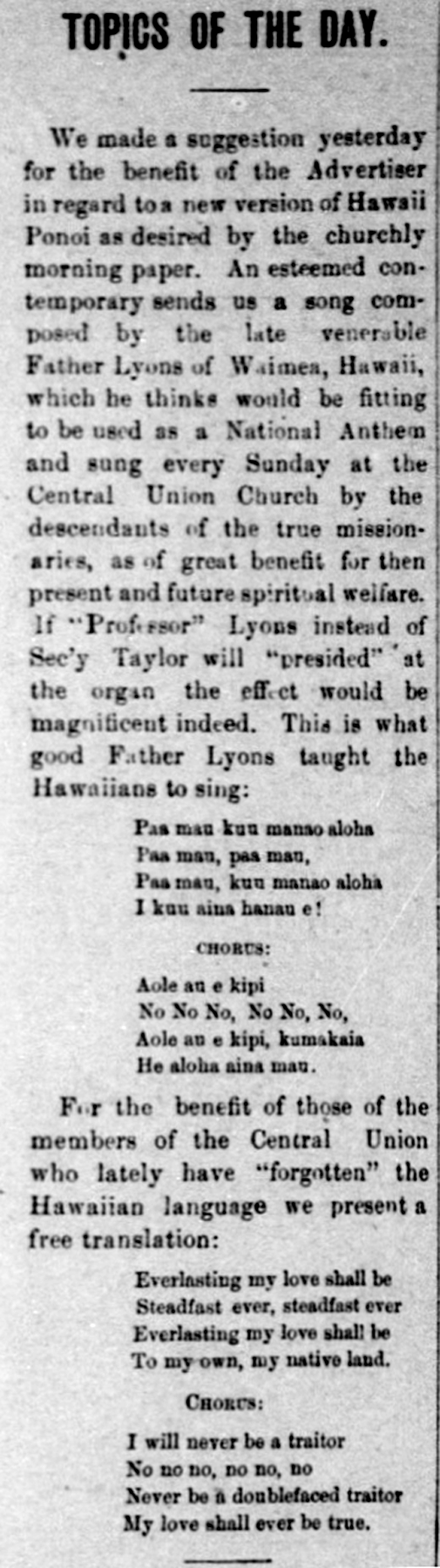
TOPICS OF THE DAY.

We made a suggestion yesterday for the benefit of the Advertiser in regard to a new version of Hawaii Ponoi as desired by the churchly morning paper. An esteemed contemporary sends us a song composed by the late venerable Father Lyons of Waimea, Hawaii, which he thinks would be fitting to be used as a National Anthem and sung every Sunday at the Central Union Church by the descendants of the true missionaries, as of great benefit for then present and future spiritual welfare. If “Professor” Lyons instead of Sec’y Taylor will “presided” at the organ the effect would be magnificent indeed. This is what good Father Lyons taught the Hawaiians to sing:

Paa mau kuu manao aloha
Paa mau, paa mau,
Paa mau, kuu manao aloha
I kuu aina hanau e!

CHORUS:

Aole au e kipi
No No No, No No, No,
Aole au e kipi, kumakaia
He aloha aina mau.

For the benefit of those of the members of the Central Union who lately have “forgotten” the Hawaiian language we present a free translation:

Everlasting my love shall be
Steadfast ever, steadfast ever
Everlasting my love shall be
To my own, my native land.

CHORUS:

I will never be a traitor
No no no, no no, no
Never be a doublefaced traitor
My love shall ever be true.

(Hawaii Holomua, 1/10/1894, p. 2)

HawaiiHolomua_1_10_1894_2.png

Hawaii Holomua, Volume II, Number 8, Page 2. January 10, 1894.

A new scathing “Hawaii Ponoi,” 1894.

TOPICS OF THE DAY.

The Advertiser with its usual ingenuity has finally found the cause for all the opposition among the Hawaiians to the P. G., and to the annexation cause. It is all on account of Hawaii Ponoi, our national anthem, and the morning organette demands, and immediate change in the words of that time-honored song. The new version given by the Advertiser will hardly be adopted, and we therefore take the liberty to substitute some words which we submit to the kind consideration of all loyal Hawaiians who are to be forbidden to sing the anthem of their native land. How is this brother Castle?

HAWAII PONOI HOU.

Pakaha Hawaii,
Kipi i ka lahui,
Na welo mikanele,
Na Pi Gi.

Ino ka ia e,
Ia Kolekaaka,
Pale i ka nani,
Me ka uahoa.

[NEW HAWAII PONOI

They plunder Hawaii
Conspire against the people,
Those missionary descendants,
The P. G.

How vile he is,
That Kole Kaaka,*
Pushing aside beauty,
With his cruelty.]

*”Kole Kaaka” can be found in the dictionary. Look it up. This term with a negative connotation is used often during this period. Might it also be a play on the name Dole? “Wretched Dole”?

(Hawaii Holomua, 1/9/1894, p. 2)

HawaiiHolomua_1_9_1894_2.png

Hawaii Holomua, Volume II, Number 7, Page 2. January 9, 1894.

Denial of “Hawaii Ponoi,” 1894.

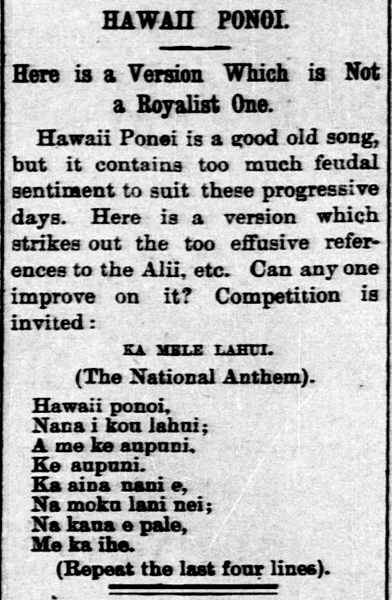
HAWAII PONOI.

Here is a Version Which is Not a Royalist One.

Hawaii Ponoi is a good old song, but it contains too much feudal sentiment to suit these progressive days. Here is a version which strikes out the too effusive references to the Alii, etc. Can any one improve on it? Competition is invited:

KA MELE LAHUI.

(The National Anthem).

Hawaii ponoi,
Nana i kou lahui;
A me ke aupuni,
Ke aupuni.
Ka aina nani e,
Na moku lani nei;
Na kaua e pale,
Me ka ihe.

(Repeat the last four lines).

(Pacific Commercial Advertiser, 1/8/1894, p. 4)

PCA_1_8_1894_4.png

The Pacific Commercial Advertiser, Volume XIX, Number 3580, Page 4. January 8, 1894.