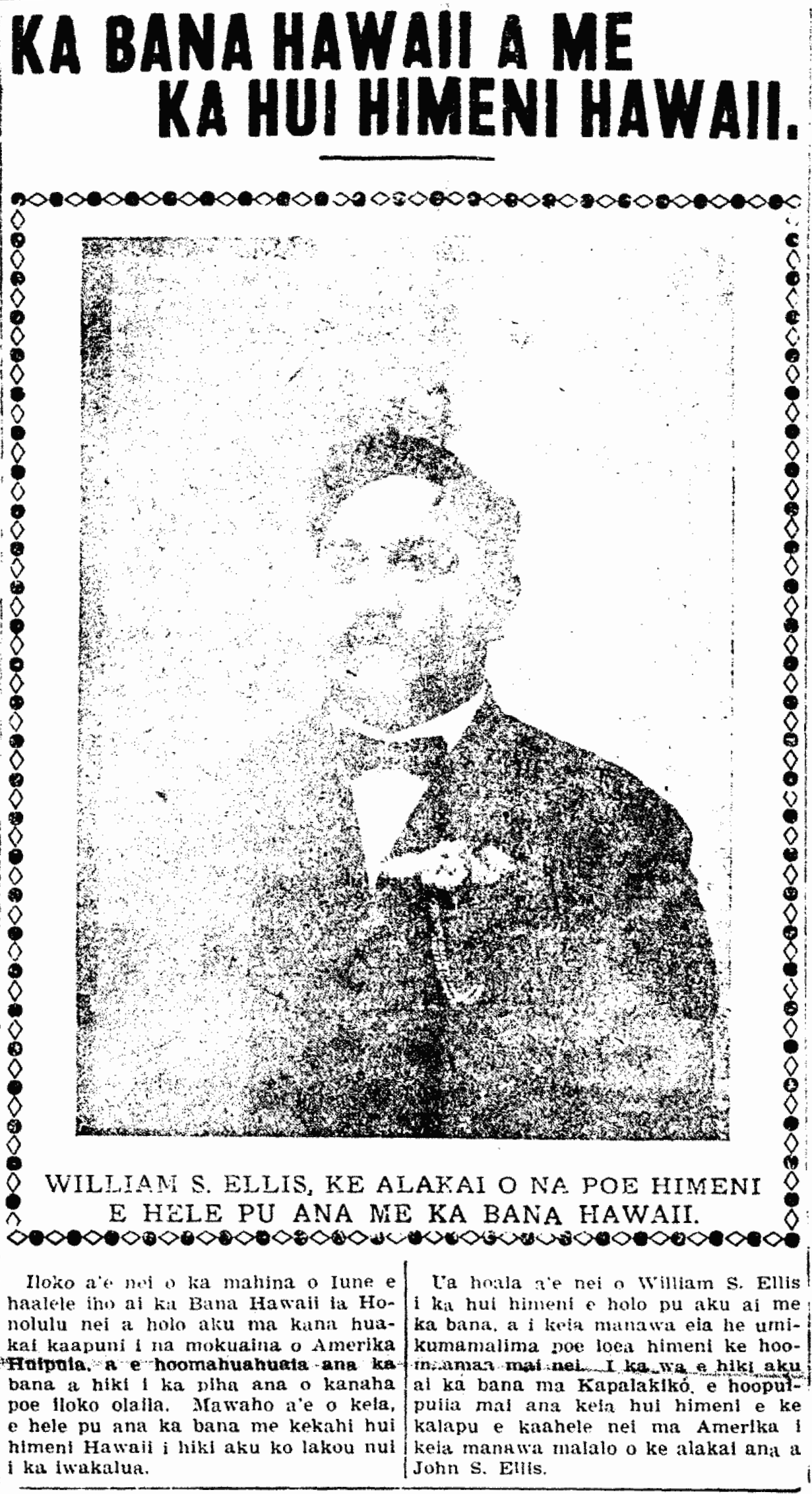
William S. Ellis, leader of the glee club accompanying the Royal Hawaiian Band on tour, 1906.

THE ROYAL HAWAIIAN BAND AND THE HAWAIIAN GLEE CLUB.

WILLIAM S. ELLIS, THE LEADER OF THE SINGERS THAT ARE TRAVELLING WITH THE ROYAL HAWAIIAN BAND.

In the month of June, the Royal Hawaiian Band is leaving Honolulu and going on their tour of the states of the United States of America, and their number will increase until it includes forty people. Other than that, the band will go with a Hawaiian glee club that is made up of twenty people.

William S. Ellis formed the glee club going along with the band, and currently there are fifteen skilled singers who are practicing. When the band arrives in San Francisco, this glee club will be increased by the club that is touring America under the leadership of John S. Ellis.

(Kuokoa, 3/9/1906, p. 1)

KA BANA HAWAII A ME KA HUI HIMENI HAWAII.

Ka Nupepa Kuokoa, Buke XLIV, Helu 10, Aoao 1. Maraki 9, 1906.

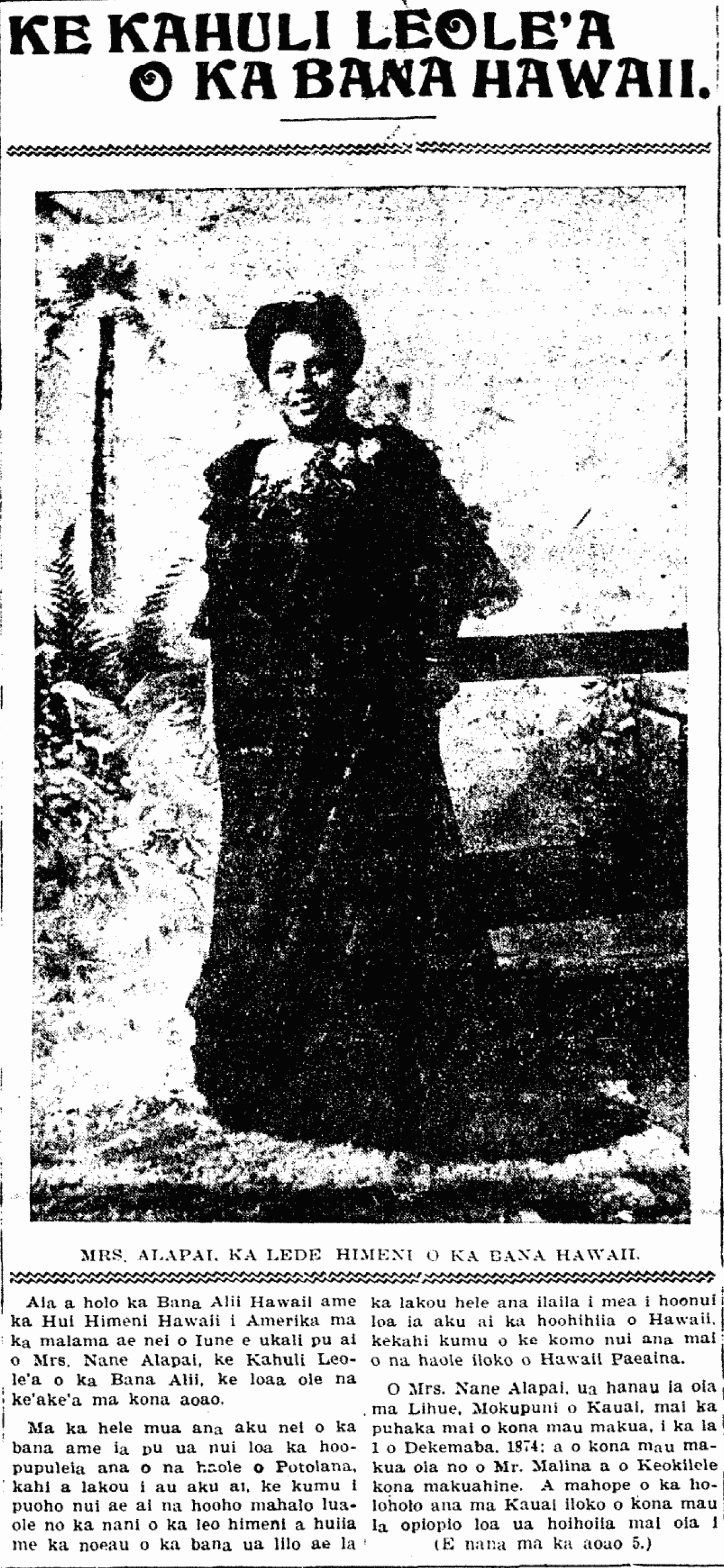
Nane Alapai, 1906.

THE HAPPY-VOICED KAHULI OF THE HAWAIIAN BAND

When the Royal Hawaiian Band and the Hawaiian Glee Club leaves for America in the next month of June, Mrs. Nane Alapai [Nani Alapai], the Beautiful-Voiced Kahuli of the Hawaiian Band will accompany them, should there be no obstructions in her way.

When the band first went with her along, the haole of Portland, where they travelled to, were driven crazy, and that is the reason that there was unequaled exclaim for the beauty of of the singing along with the skill of the band; and their travelling there caused a great interest in Hawaii, which is why there is a great influx in the number of haole coming to the Hawaiian Islands.

Mrs. Nane Alapai [Nani Alapai], was born in Lihue, on the island of Kauai, from the loins of her parents, on the 1st of December, 1874; her parents are Mr. Malina and Keokilele is her mother. And after going around Kauai during her youth, she was taken…

(Kuokoa, 3/16/1906, p. 1)

KE KAHULI LEOLE'A O KA BANA HAWAII.

Ka Nupepa Kuokoa, Buke XLIV, Helu 11, Aoao 1. Maraki 16, 1906.

to Honolulu, where she was educated at the Catholic Boarding School for Girls. She married her husband, Mr. W. J. Alapai almost eleven years ago. She has some siblings other than her; five brothers and eight sisters.

When she joined the Royal Hawaiian Band until today, she spent nine years singing before an audience, and during that whole time, her singing has brought much delight in Hawaii’s people and more so in the malihini who come to Hawaii and then go to America; they are so much more delighted; and this is very valuable to Hawaii and to her herself, and this advertises Hawaii’s beauty; the beauty of her ridges, the beauty of her mountains, and the beauty of the songs of her people; it seems there will be a lot of Hawaiian singer born as a result.

(Kuokoa, 3/16/1906, p. 5)

KE KAHULI LEOLE'A O KA BANA HAWAII.

Ka Nupepa Kuokoa, Buke XLIV, Helu 11, Aoao 5. Maraki 16, 1906.

More on the California Midwinter International Expo, 1894.

More Exhibits.

The Hawaiian Exposition Company will send another large shipment of exhibits to the Midwinter Fair by the Australia next Saturday. Among the things to be sent are native mats and tapa, poi boards and pounders, surf-boards, etc. Apu, the expert surf-rider from Niihau, will be among the twenty-five natives who will go up on the Australia. Mr. and Mrs. J. Ailau will take with them ten native women, who will make leis, fans and hats at the Fair.

(Hawaiian Gazette, 1/5/1894, p. 6)

More Exhibits.

Hawaiian Gazette, Volume XXIX, Number 2, Page 6. January 5, 1894.

Mild hula ku’i and California Midwinter International Exposition, 1894.

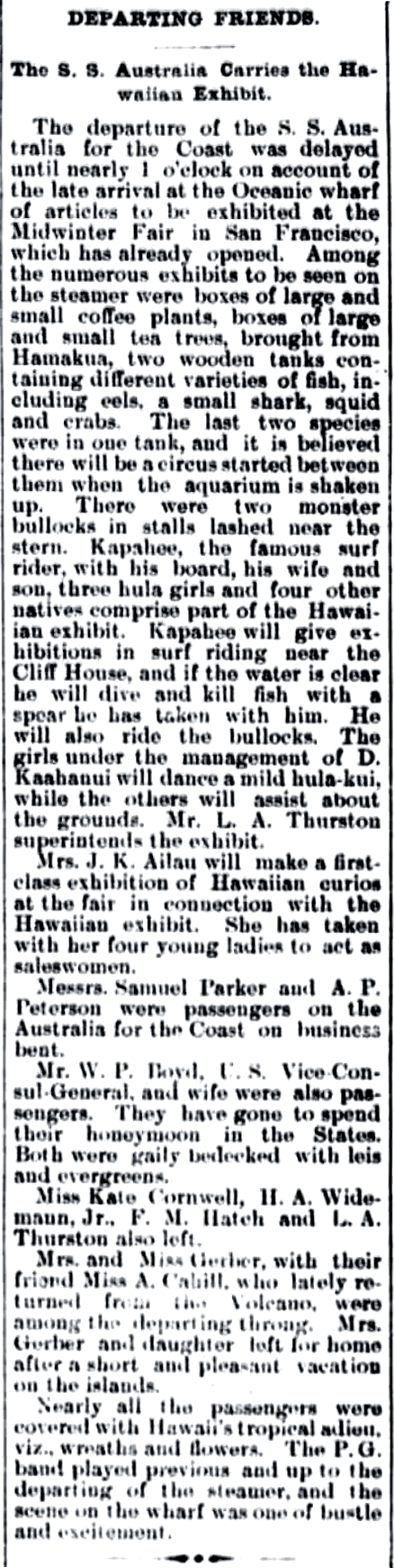
DEPARTING FRIENDS.

The S. S. Australia Carries the Hawaiian Exhibit.

The departure of the S. S. Australia for the Coast was delayed until nearly 1 o’clock on account of the late arrival at the Oceanic wharf of articles to be exhibited at the Midwinter Fair in San Francisco, which has already opened. Among the numerous exhibits to be seen on the steamer were boxes of large and small coffee plants, boxes of large and small tea trees, brought from Hamakua, two wooden tanks containing different varieties of fish, including eels, a small shark, squid and crabs. The last two species were in one tank, and it is believed there will be a circus started between them when the aquarium is shaken up. There were two monster bullocks in stalls lashed near the stern. Kapahee, the famous surf rider, with his board, his wife and son, three hula girls and four other natives comprise part of the Hawaiian exhibit. Kapahee will give exhibitions in surf riding near the Cliff House, and if the water is clear he will dive and kill fish with a spear he has taken with him. He will also ride the bullocks. The girls under the management of D. Kaahanui will dance a mild hula-kui, while the others will assist about the grounds. Mr. L. A. Thurston superintends the exhibit.

Mrs. J. K. Ailau will make a first-class exhibition of Hawaiian curios at the fair in connection with the Hawaiian exhibit. She has taken with her four young ladies to act as saleswomen.

Messrs. Samuel Parker and A. P. Peterson were passengers on the Australia for the Coast on business bent.

Mr. W. P. Boyd, U. S. Vice-Consul-General, and wife were also passengers. They have gone to spend their honeymoon in the States. Both were gaily bedecked with leis and evergreens.

Miss Kate Cornwell, H. A. Widemann, Jr., F. M. Hatch and L. A. Thurston also left.

Mrs. and Miss Gerber, with their friend Miss A. Cahill, who lately returned from the Volcano, were among the departing throng. Mrs. Gerber and daughter left for home after a short and pleasant vacation on the islands.

Nearly all the passengers were covered with Hawaii’s tropical adieu, viz., wreaths and flowers. The P. G. band played previous and up to the departing of the steamer, and the scene on the wharf was one of bustle and excitement.

(Daily Bulletin, 1/6/1894, p. 2)

DEPARTING FRIENDS.

The Daily Bulletin, Volume VII, Number 924, Page 2. January 6, 1894.

More on the missionaries and hula ku’i …and Sweet Emalia, 1894.

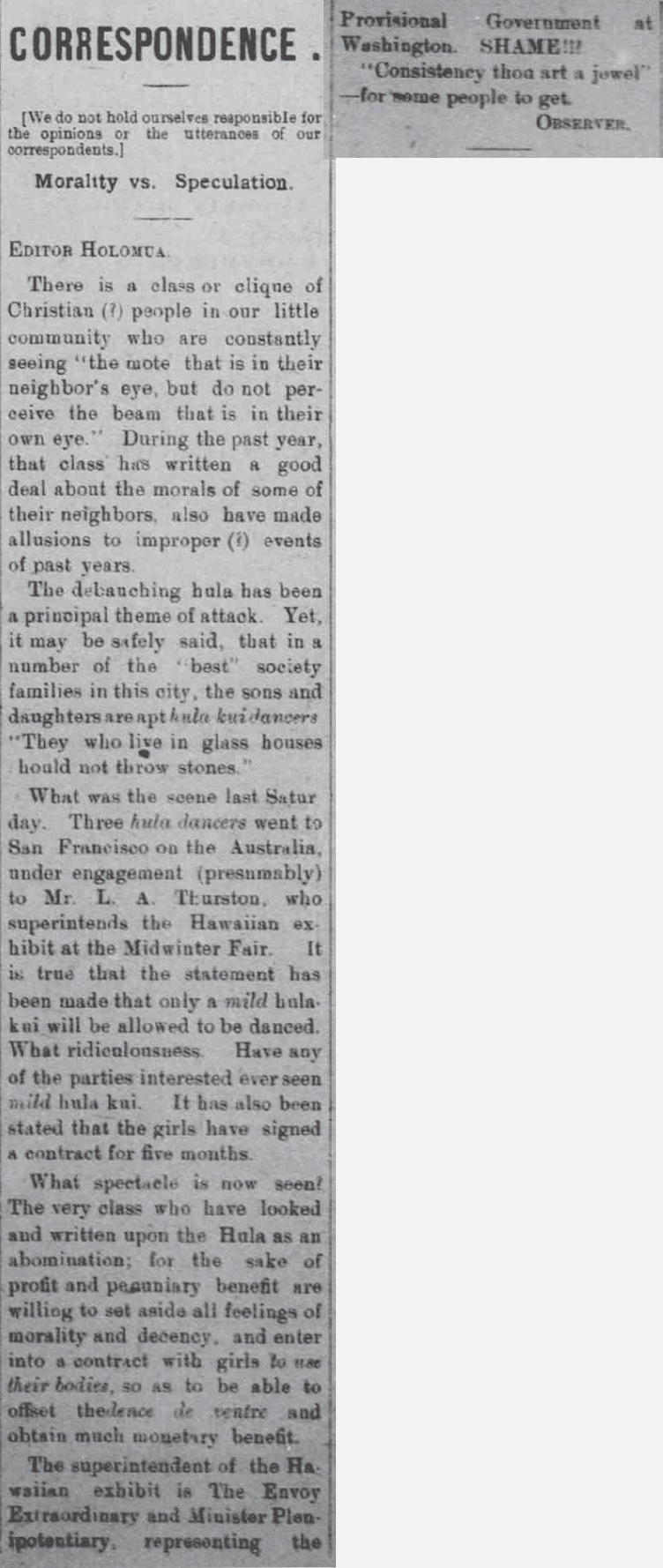
CORRESPONDENCE.

[We do not hold ourselves responsible for the opinions or the utterances of our correspondents.]

Morality vs. Speculation.

Editor Holomua.

There is a class or clique of Christian (?) people in our little community who are constantly seeing “the mote that is in their neighbor’s eye, but do not perceive the beam that is in their own eye.” During the past year, that class has written a good deal about the morals of some of their neighbors also have made allusions to improper (?) events of past years.

The debauching hula has been a principal theme of attack. Yet, it may be safely said, that in a number of the “best” society families in this city, the sons and daughters are apt hula kui dancers. “They who live in glass houses should not throw stones.”

What was the scene last Saturday. Three hula dancers¹ went to San Francisco on the Australia, under engagement (presumably) to Mr. L. A. Thurston, who superintends the Hawaiian exhibit at the Midwinter Fair. It is true that the statement has been made that only a mild hula kui will be allowed to be danced. What ridiculousness. Have any of the parties interested ever seen mild hula kui. It has also been stated that the girls have signed a contract for five months.

What spectacle is now seen? The very class who have looked and written upon the Hula as an abomination; for the sake of profit and pecuniary benefit are willing to set aside all feelings of morality and decency, and enter into a contract with girls to use their bodies, so as to be able to offset the dence de ventre and obtain much monetary benefit.

The superintendent of the Hawaiian exhibit is the Envoy Extraordinary and Minister Plenipotentiary, representing the Provisional Government at Washington. SHAME!!!

“Consistency thou art a jewel”—for some people to get.

¹One of these was of course, Emalia Kaihumua.

(Hawaii Holomua, 1/8/1894, p. 3.)

CORRESPONDENCE.

Hawaii Holomua, Volume II, Number 6, Page 3. January 8, 1894.

Tourists… 1906.

[Found under: “TOWN TALK”]

One of my Southern California friends here with the party of editors had a very amusing experience with a native waiter in a restaurant into which she had dropped for lunch. She saw the brown son of the islands coming and she nerved herself for the ordeal. She consulted her souvenir program and running over the list of translated words she finally found and said “Pa-Hay-Oe.”

“Maikai no” replied the man with a smile.

The young lady then attempted to find the native words for “Ham and Eggs” or something to that effect—but alas they were not there. She hesitates, looked frantically around in search of some haole, and finally she though of sign language and commenced to make all sorts of passes in the air. The native stood near her her and kept shaking his head, all the time with a questioning look in his eye.

Finally the young lady said in despair, “Oh, you block head, why don’t you talk English?”

“I was about to say madam,” came the reply, “that if you would say in English what you are endeavoring to convey by means of the sign language, I would be most delighted to fill even your humblest desire.”

Then the young lady was angry. She stamped out of the restaurant and all one needs to do to court sudden death is to make a few passes like “Ham and Eggs” in the air in her presence.

(Hawaiian Star, 9/22/1906, p. 7)

One of my Southern California friends...

The Hawaiian Star, Volume XIV, Number 4524, Page 7. September 22, 1906.

Early movies of Hawaii, 1913.

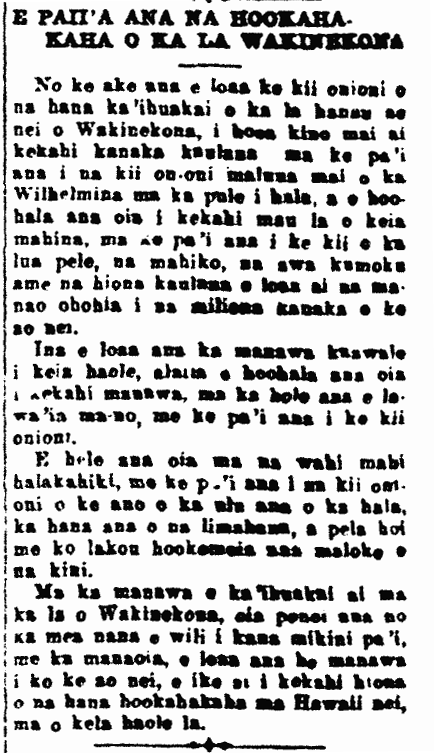
THE PARADE ON WASHINGTON’S [BIRTH]DAY WILL BE FILMED

Because there is a desire to have a movie of the parade on this upcoming birthday of Washington, a man famous for filming movies arrived aboard the Wilhelmina last week, and he is spending some days of this month filming the volcano, the sugar plantation, the harbors, and famous sights to delight the millions of people of the world.

If this haole has spare time, he will spend some time going shark fishing, and filming it.

He will go to the pineapple plantations, and film the growth of the pineapple, the activities of the laborers, as well as the canning.

During the parade on Washington’s birthday, he will be the one rolling his film; and it is believed that there will come a time when the world will see scenes of the parade in Hawaii because of this haole.

[Anyone know who this is, and where these reels might be today?]

(Kuokoa, 1/31/1913, p. 7)

E PAII'A ANA NA HOOKAHAKAHA O KA LA WAKINEKONA

Ka Nupepa Kuokoa, Buke XLIX, Helu 5, Aoao 7. Ianuari 31, 1913.

King Kalakaua gifts some 200 kii¹ to the National Academy of Sciences. 1887.

A Gift from the King.

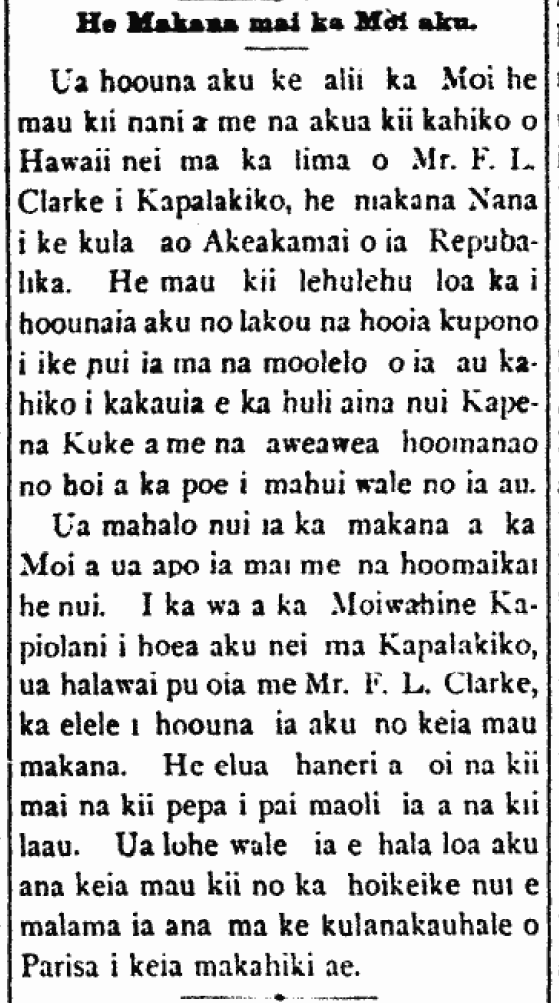
The alii, the King, sent a number of beautiful pictures [kii] and old godly images [akua kii] of Hawaii to the hands of Mr. F. L. Clarke² in San Francisco, a gift from Him to the National Academy of Sciences [? ke kula ao Akeakamai o ia Repubalika]. There were a great many images sent which are well attested to as seen in the old accounts written by the great explorer Captain Cook and the faint recollections of those who have slight knowledge of that era.

The gift of the King was greatly appreciated and it was accepted with much thanks. When Queen Kapiolani arrived in San Francisco, she met with Mr. F. L. Clarke, the representative sent for this gift. There were two hundred or more images, from images that were printed on paper, to wooden idols. It’s been heard that they will go all the way to the city of Paris for the great exposition to be held next year.³

¹”Kii” refers to any image or representation of something, whether it be printed on paper, painted on canvas, carved out of wood, or cast in metal.

²See Clarke’s short history of Hawaii, “Hawaii’s Real Story,” which appeared in The Forum, July 1900, pp. 555–565.

³Exposition Universelle, 1889. See “Catalogue of the Hawaiian Exhibits at the Exposition Universelle, Paris, 1889.” by John A. Hassinger, Department of the Interior.

[Does anyone know of what happens to all of this?]

(Kuokoa, 5/14/1887, p. 2)

He Makana mai ka Moi aku.

Ka Nupepa Kuokoa, Buke XXVI, Helu 20, Aoao 2. Mei 14, 1887.

Musicians travel to Japan and China, 1912.

Those Hawaiian Singers Leave for the East.

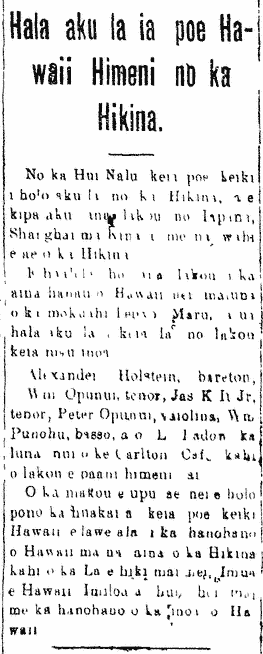
These youths are from the Hui Nalu [Singing Club] who left for the East; and they will visit Japan and Shanghai in China and other locations in the East.

They will leave the land of their birth aboard the steamship Tenyo Maru [?], and they left this day, their names being:

Alexander Holstein, baritone,

William Opunui, tenor, James K. Ii, Jr., tenor, Peter Opunui, violin, William Punohu, bass, and L. Ladon [Louis Ladow] the head of the Carlton Cafe, where they are to perform.

Our hope is that the journey of these Hawaii boys carrying with them the pride of Hawaii to East, to the land of the rising Sun, goes well. Go forward, go forward O Great-Travelling Hawaiians and return with glory in the name of Hawaii.

(Kuokoa Home Rula, 12/19/1912, p. 1)

Hala aku la ia poe Hawaii Himeni no ka Hikina

Kuokoa Home Rula, Buke X, Helu 51, Aoao 1. Dekemaba 19, 1912.

More on “Prince,” 1924.

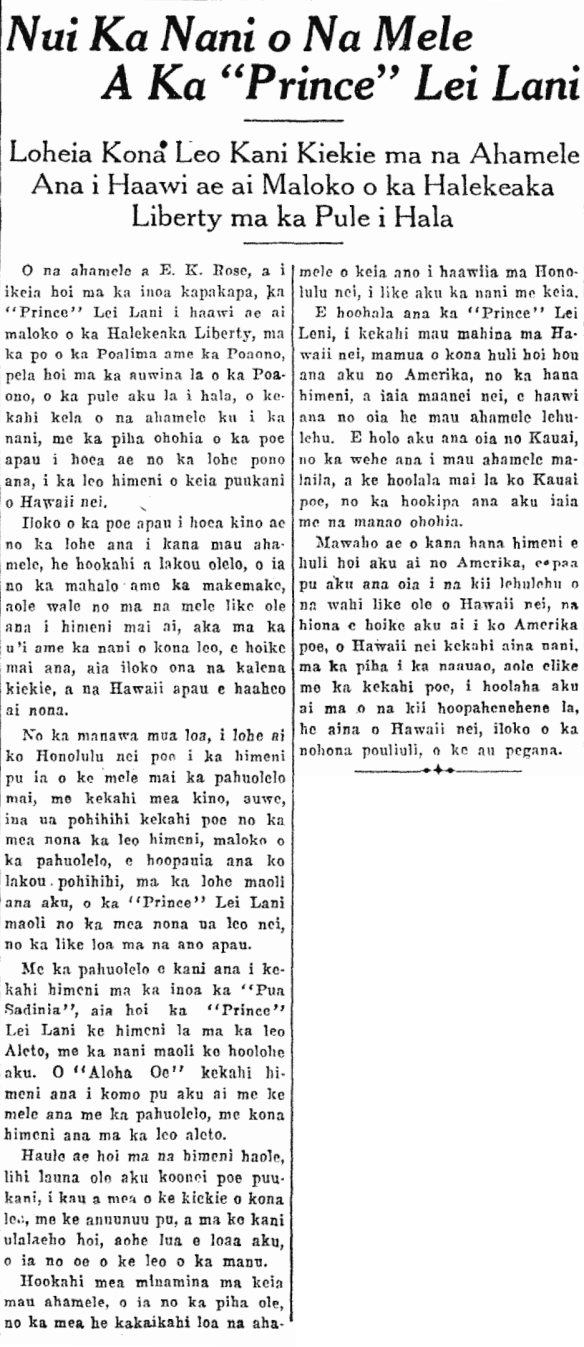
The Songs of “Prince” Lei Lani Were Just Beautiful

His Falsetto Voice Was Heard at the Concerts He Gave in the Liberty Theater Last Week.

The concerts given by E. K. Rose, known by the stage name “Prince” Lei Lani [Leilani], in the Liberty Theater on the nights of Friday and Saturday, and the afternoon of Saturday of this past week, those were some of the most beautiful concerts, filling all those who attended with delight at hearing in person, the singing voice of this musician of Hawaii nei.

Amongst all of the people who attended to hear his concerts, they said but one thing; that being of their appreciation and desire, not just for all of the different mele sung, but for the loveliness and beauty of his voice, showing that within him are the high talents for which all Hawaiians have pride in him.

For the first time, Honolulu’s people heard singing live along with a phonograph [pahuolelo], auwe, if people weren’t clear about who the singer was on the phonograph, this lack of clarity was put to an end by them hearing the real “Prince” Lei Lani’s voice, being that they were the same in every way.

While the phonograph was playing a song called “Pua Sadinia,” “Prince” Lei Lani sang it in Alto, and it sounded beautiful. “Aloha Oe” was another number played on the phonograph while he sang in alto.

The local singers pale in haole songs, and cannot match the high range of his voice along with the modulation, and yodeling; there is no match, like the voice of a bird.

There was one unfortunate thing in the concert, that was that it was not filled, for there are not many concerts of this sort put on here in Honolulu that are as beautiful.

“Prince” Lei Lani will spend a number of months here in Hawaii nei before turning back to return to America to sing, and while he is here, he will be giving many concerts. He’ll be going to Kauai to perform concerts there, and Kauai’s people are planning a reception for him with excitement.

Other than to sing, he is returning to America, taking with him many photographs of all sorts of places here in Hawaii nei, scenes showing the people of America that Hawaii is a lovely place full of intelligence; not as was shown by some people using ridiculing pictures, saying that Hawaii is in the dark of pagan times.

[I wonder where the pictures ridiculing Hawaii were printed, and who it was that did it.

The internet is pretty amazing. Some ninety years later, we can hear Prince Lei Lani singing “Pua Sadinia” and “Aloha Oe”! Mahalo to cdbpdx for putting it up on youtube!!]

(Kuokoa, 4/10/1924, p. 1)
Nui Ka Nani o Na Mele A Ka "Prince" Lei Lani

Ka Nupepa Kuokoa, Buke LXIII, Helu 15, Aoao 1. Aperila 10, 1924.