Kona Inn ad in Hawaiian, 1947

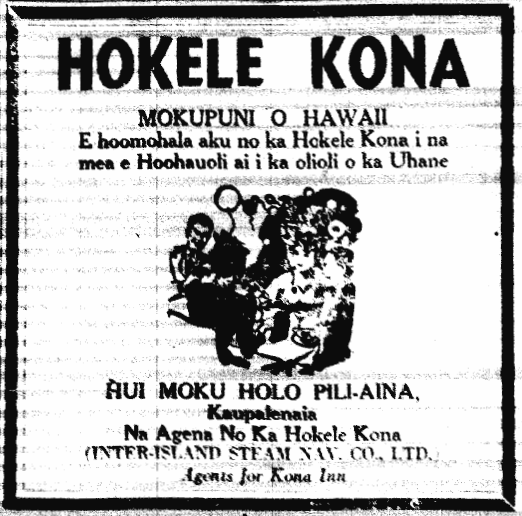
HOKELE KONA

MOKUPUNI O HAWAII

E hoomohala aku no ka Hokele Kona i na mea e Hoohauoli ai i ka olioli o ka Uhane

HUI MOKU HOLO PILI-AINA,

Kaupalenaia

Na Agena No Ka Hokele Kona

(INTER-ISLAND STEAM NAV. CO., LTD.

Agents for Kona Inn

(Hoku o Hawaii, 8/6/1947, p. 1)

HOKELE KONA

Ka Hoku o Hawaii, Volume XLI, Number 11, Aoao 1. Augate 6, 1947.

More from the Deshas, 1944.

Our Day

THE CALM SEAS OF KONA

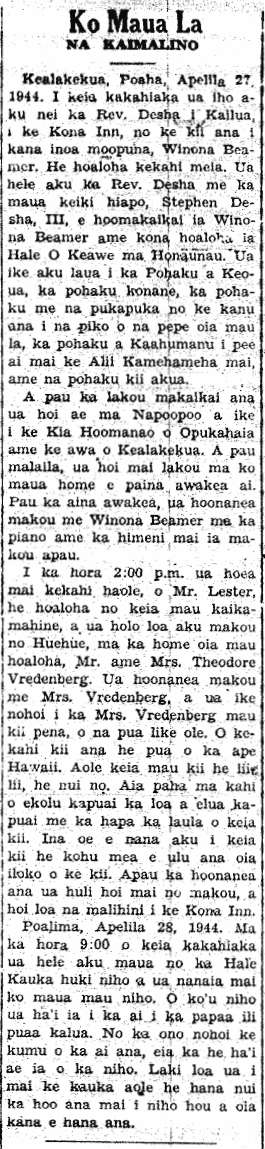
Kealakekua, Thursday, April 27, 1944. This morning the Rev. Desha went down to Kailua, to the Kona Inn, to fetch his namesake grandchild, Winona Beamer. She had a friend with her. The Rev. Desha went with our first child, Stephen Desha III, to take Winona Beamer and her friend to Hale o Keawe at Honaunau. They saw the Stone of Keoua [Pohaku a Keoua], the stone konane board, the stone with holes to bury the umbilical cord of babies of those days, the stone that Kaahumanu used to hide from Kamehameha with, and the stone god figures.

After their tour was over they returned to Napoopoo and saw the Monument to Opukahaia and the bay of Kealakekua. And after that was done, they came back to our home to eat lunch. After lunch, we had an enjoyable time with Winona Beamer with the piano and all of us singing.

At 2:00 p. m., a haole arrived, Mr. Lester, a friend of these girls, and we all went to Huehue, to the home of those friends, Mr. and Mrs. Theodore Vredenberg [Vredenburg]. We spent a pleasant time with Mrs. Vredenberg and saw her drawings of all sorts of flowers. One of her pictures was of the flower of the Hawaiian ape. These drawings were not small, they were big indeed. The length of this drawing is around three feet while the width is about two feet and a half. If you look at this drawing, it looks as if it is growing in the picture. After enjoying our time, we turned back and the visitors returned to the Kona Inn.

Friday, April 28, 1944. At 9:00 this morning, the two of us went to the Dentist [Hale Kauka huki niho] and had a checkup. My tooth was chipped from eating the charred skin from a kalua pig. I ate it because it was tasty, and alas my tooth became chipped. I was so lucky, the doctor said it was not a big thing to insert a new tooth, and that is what he will do.

[This was a fun account, perhaps mostly because I know the awesome daughter of Theodore and Beatrice Vredenburg!]

(Hoku o Hawaii, 5/10/1944, p. 1)

Ko Maua La

Ka Hoku o Hawaii, Volume XXXIX, Number 3, Aoao 1. Mei 10, 1944.

More from Kona and the Deshas, 1943.

Our Day

The Calm Seas of Kona

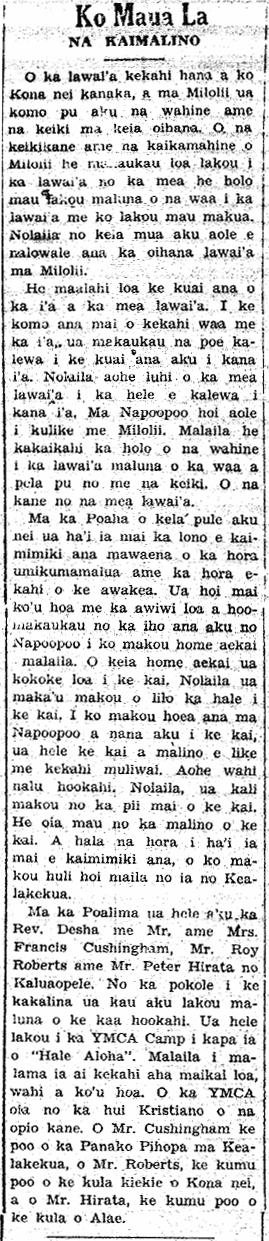
Fishing is an occupation carried out by Kona men, and in Milolii the women and children take part in this endeavor. The boys and girls of Milolii are totally capable at fishing because they always go out on the canoes to go fishing with their parents. Therefore, in the future, fishing will not disappear from Milolii.

It is a truly simple thing to sell the fish of the fishermen. When a canoe comes in with fish, the peddlers are ready to buy the fish. So the fisherman doesn’t have to bother with selling his fish. In Napoopoo, it is not like Milolii. There, there are a few women who go fishing on canoes and so too of the children. Men are the ones who go fishing.

On last week Thursday, the news was told that there would be a tsunami [kai mimiki] between eleven o’clock and one o’clock in the afternoon. My companion rushed home and made ready to go down to Napoopoo, to our home by the sea there. This beach home was very near the ocean. So we were afraid the house would be lost to the sea. When we arrived at Napoopoo and looked at the ocean, the water was calm like an estuary. There was not a single wave. Therefore, we waited for the water to rise. The water remained calm. And the time it was said that there would be a tsunami passed, and we turned back for Kealakekua.

On Friday, the Rev. Desha along with Mr. and Mrs. Francis Cushingham, Mr. Roy Roberts, and Mr. Peter Hirata went to the Crater. Because of the gasoline shortage, they all went on one car. They went to the YMCA Camp called “Hale Aloha.” There a fine meeting was held, according to my companion. The YMCA is the Christian association of young men. Mr. Cushingham is the head of the Bishop Bank [Panako Pihopa] at Kealakekua; Mr. Roberts is the principal of the high school of Kona, and Mr. Hirata is the principal of Alae School.

(Hoku o Hawaii, 11/17/1943, p. 1)

Ko Maua La

Ka Hoku o Hawaii, Volume XXXVIII, Number 30, Aoao 1. Novemaba 17, 1943.

Journal of Evelyn Desha and Stephen Desha Jr., 1943.

Our Day

THE CALM SEAS OF KONA

The person who helps me in all sorts of chores at home is Nellie Kakutani. She is a pleasant girl and lively at work.

And these days what we are doing is cooking guava jelly [puhi kele kuawa]. The guava here in Kona is very ripe. There are two types of jelly we are making. One jelly is dark red, and the other is yellowish. The difference comes with the heat at which you cook it. If you want dark red, you cook with on medium heat. So you cook it for a long time. And should you want yellowish jelly, then you cook it on high heat. And you cook it for a short time.

There is a butter shortage, so this is advice to the women of the home; if you haven’t cooked your jelly, you should start these days, right.

On Thursday, the ninth of November, there was a meeting of the members of the Board of Supervisors [Papa Lunakiai] and some other members of the County of Hawaii and some citizens of Kona nei, at the meeting house of Central Kona Union Church that is under the care of Rev. Stephen Desha of Kealakekua. They discussed the Appropriations [Bila Haawina] of the County of Hawaii pertaining to matters here in Kona. They decided to set aside funds for schools, hospitals, and roads. This was one of the few times where the members of the Board of Supervisors met with the citizens of Kona to talk about the well-being of this district. Praise goes to the members of the Board of Supervisors and the other members of Hawaii County.

—–

There are many visitors here in Kona these days. Here with us these days are Mr. and Mrs. Paul Mahi, the daughter-in-law of our elder sister, Mrs. May Haae. This is the first time that Mrs. Mahi has come to Hawaii and to here in Kona. With them came their baby son, Mosely. We took them around sight seeing.

The other day we took the two of them to Kailua and Keauhou. Yesterday we took them to Napoopoo, to our home by the sea. Mr. Mahi is adept at spearfishing, and he caught some fish. My companion caught the sweet-eyed kole. The fish were fried and eaten for lunch. We went to seethe monument to Opukahaia at the cove of Kealakekua.

Today they went to see some of their friends here in Kona.

The women of Kona held a prayer meeting called “The Church Wide Day of Prayer.” This assembly was held at the Episcopal Church, Christ Church, of Kealakekua. The Japanese, Chinese, Hawaiians and Haole participated. After the meeting, a celebration was held, and everyone joined in at the U. S. O. Hall.

[This is a series that seems to continue after another called “Ko’u La” written by Evelyn Desha. I believe that “Ko Maua La: Na Kaimalino” is also written by her about her daily life with Stephen Langhern Desha, Jr.]

(Hoku o Hawaii, 12/4/1943, p. 1)

Ko Maua La

Ka Hoku o Hawaii, Volume XXXVIII, Number 32, Aoao 1. Dekemaba 4, 1943.

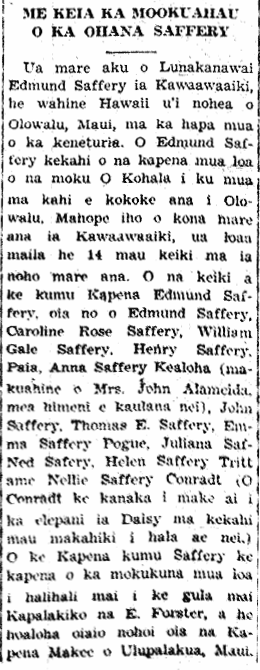
Saffery family genealogy, 1943.

THIS IS THE GENEALOGY OF THE SAFFERY FAMILY

Judge Edmund Saffery married Kawaawaaiki, a beautiful Hawaiian woman from Olowalu, Maui, in the first half of the century. Edmund Saffery was one of the first captains of the Kohala districts who landed near Olowalu. After he got married to Kawaawaaiki, they had 14 children in that marriage. The children of the original Captain Edmund Saffery are Edmund Saffery, Caroline Rose Saffery, William Gale Saffery, Henry Saffery, Paia, Anna Saffery Kealoha (mother of Mrs. John Alameida, the famous singer), John Saffery, Thomas E. Saffery, Emma Saffery Pogue, Juliana Saf- Ned Saffery, Helen Saffery Tritt and Nellie Saffery Conradt (O Conradt was the man who died by the elephant Daisy some years ago). Captain Saffery was the captain of the first schooner that transported bold from San Francisco for E. Forster, and he was a true friend of Captain Makee of Ulupalakua, Maui.

(Hoku o Hawaii, 5/26/1943, p. 1)

MA KEIA KA MOOKUAUHAU O KA OHANA SAFFERY

Ka Hoku o Hawaii, Volume XXXVIII, Number 5, Aoao 1. Mei 26, 1943.

Fish market prices, 1943.

Prices Set

The Office of Price Administration [Mahele Kau Kumukuai] set the top price of fishes for the island of Hawaii, and it is seen here below:

Some fish prices rose a little, and some decreased.

Mahimahi, Ono and Ulua rose from 55 to 60 cents. (This is per pound.)

Kalekale went from 55 to 65 cents.

Opihi went from 30 to 40 cents.

Awa, fillet, from 45 to 50 cents.

Ulua over 20 pounds, from 55 to 45 cents.

Aku fillet, ocean anae, papiopio, whole ulua under 20 pounds, 55 cents per pound.

Ahi fillet, and moi from 55 to 50 cents.

A’u fillet, kalekale, moano, opakapaka, u-u, from 55 to 45 cents.

Aholehole, from 50 to 45 cents.

Whole aku, kupipi from 40 to 35 cents.

Opelu from 45 to 35 cents.

Humuhumu from 35 to 25 cents.

Pond anae, from 60 to 55 cents.

Kole from 40 to 18 cents. Palani, Pualu, from 35 cents to 18 cents. Akule from 50 cents to 35 cents.

We see that the price of some fish are indeed low while some are higher. We have no criticisms about some, and over some we will just keep our mouths shut, for that is under their control.

Know you fishermen the prices shown above, so that you know the prices of all the different fishes, lest you go beyond it and end up without profit.

(Hoku o Hawaii, 9/22/1943, p. 1)

Kau Ia Maila Ke Kumukuai

Ka Hoku o Hawaii, Volume XXXVIII, Number 22, Aoao 1. Sepatemaba 22, 1943.

Mele hooipoipo, 1913.

“LEI HULU MAMO.”

Auhea wale oe Lei Hulu Mamo,
O ka lei kohu a o kuu papale,
Hookohu ka opua me ka naulu,
Kau mai la i ka lae a o Mololani,
Aniani he kilohi mau oe no’u,
A ke kehau a i hali mai nei,
O ke ko mai hoi a ke kehau,
I mehana iho au a i ko poli.
O oe a owau ka i ike iho,
I ka eha lima ole a ke aloha.
Ia aloha ia no a o Haiku,
E walea ae nei me Kilohana,
O ka hana paha ia a ke aloha,
Kohu wai mapuna ka puapua’i;
Kaomi iho au he ole ka paa,
Pakela ke koii hana nowelo,
Hoona ae ana i ko aloha,
A i kahi Lei Rose a kaua,
Ua lei no oe lei no au,
Me ka opua hiki o ke ahiahi,
Mahope hoi au ou hookahi,
A lei i ka lei o ka lanakila.
Kilohi ae au ia Hiilaniwai,
Ia wai kaulana o ka aina.
Haina ia mai ana ka puana,
Kuu Lei Hulu Mamo ua hiki mai.

(Kuokoa, 4/4/1913, p. 8)

"LEI HULU MAMO."

Ka Nupepa Kuokoa, Buke LI, Helu 13, Aoao 8. Aperila 4, 1913.

Hawaiian birds and the law, 1865.

ANNOUNCEMENT.

KNOW YOU ALL BY THIS Announcement; prohibited totally is the catching and the killing of Oo and Mamo birds living on the personal lands of King Kamehameha V, and from this day forward, no Oo is to be injured or killed on the lands of the Monarch; not by using lime [ke kapili kepau ana], not by snaring [ka ahele puka kaula], not by shooting [ke ki pu ana]; it is totally kapu. The person or persons who go against the words above, they each can be prosecuted.

R. KEELIKOLANI,

Governor of Hawaii.

Hilo, Hawaii, August 1, 1865.

[Might any of you law people know if there were any Kingdom laws on the books that outlawed the catching or killing of native birds? I have seen laws prohibiting the killing of non-native birds, but not native birds.]

(Au Okoa, 9/4/1865, p. 4)

OLELO HOOLAHA.

Ke Au Okoa, Buke I, Helu 20, Aoao 4. Sepatemaba 4, 1865.

Translation of Edward Lilikalani’s response to the haole Memorial, 1876.

[Translated from the Kuokoa, of Mar. 18.]

The Memorial.

Mr. Editor:—In the Commercial of the last Saturday I observe a matter of importance emanating from foreigners of Honolulu. It is a memorial to the King in respect to repopulation, and mainly advocating the bringing hither of people from India whereby this nation shall be reinvigorated.

 Therein also the King is recommended to seek for information abroad from persons skilled in such matters. This is not, I think, good advice; the real meaning however is a contempt for the Ministers because they have done nothing.

The astonishing thing about this memorial is that the Hawaiian people are entirely left out in so important a matter as a proposition to bring people from a foreign land to increase this nation.

The idea of increasing the nation by bringing people of another country here, is a good one, but it is proper that the Hawaiians themselves should be as well consulted in the matter. But we are altogether thrown on one side; and if the foreigners wish to bring East Indians here to increase without our concurrence or knowledge, it will be altogether wrong. If this is really their intention, thus to treat us like dumb animals, then we had better arise and seriously consider this startling scheme that is being projected among the foreigners.

Know O Hawaiian People! The King’s increase of the nation is the Reciprocity Treaty. When we have got that secured and in operation, then we will consider in regard to getting people from India, Japan, China or Malaysia; provide first something for people to do when they arrive; but if you get laborers now, and East India population, where is the work for them to do or the land to give them.

The impudence and haste of these people is surprising; they appear like a lot of children, fuming and showing their teeth at the Ministers, accusing them and accusing the King of having done nothing. Indeed! and how about the Treaty?

Another surprising thing is that four members of the House of Nobles signed their names to that paper, Messrs. Rhodes, Cleghorn, Smith and Castle. Which of these labored so hard to put the King on the throne, as stated in the memorial? I am of the opinion that the names of some of these persons are those of annexationists, who were strong for the treaty when Lunalilo was King. It is certain that they did not vote for the present King, for they were not then in the Legislature, having only recently been appointed as Nobles. I am of the opinion that they having thus dragged the King’s Ministers into the memorial, it would be well for the King to withdraw their appointments, or better still that they return their patents as Nobles to His Majesty—if it was not for the fact that it would be unconstitutional.

Perhaps they want to become Ministers themselves? Yes, that is so; but if their judgments are thus perverted, they are unfit for the Ministerial office, for they would by and bye be doing something without consulting the people, and disaster might follow. Let their desires be disappointed, and let the King appoint none but native Hawaiians.

This is a matter for the Legislature to attend to; but as we have not been consulted by the memorialists, it is proper that we should stand and consider what is to be the end of this business.

Respectfully,  Edward Lilikalani.

[Here is a translation of Edward Kamakau Lilikalani’s response to the repopulation memorial that was printed in the Kuokoa on 3/18/1876.]

(Pacific Commercial Advertiser, 3/25/1876, p. 3)

The Memorial.

The Pacific Commercial Advertiser, Volume XX, Number 39, Page 3. March 25, 1876.

Edward Lilikalani responds to the Memorial by the haole, 1867.

Ka palapala Memoriala.

E ka Nupepa Kuokoa e; Aloha oe:—

Ua ike iho wau ma ka nupepa Kalepa o kela Poaono i hala ae nei, i kahi mau mea nui i hanaia e na haole o ke kulanakauhale nei o Honolulu, oia hoi he Palapala Memoriala maloko o laila, he mau kumu hoopii i ka Moi, e hooulu i ka lahui, a o ke ano nui o ka hooulu i oleloia ma ua palapala nei, oia no ke kii ana i ka Lahui Inia, a e hoopae mai i kumu e hoowelo hou aku ai i keia lahui kanaka.

A maloko no hoi oia palapala, he noi ana kekahi i ka Moi, e hele ae mawaho e kuka ai me kekahi poe akamai e ae. Ma keia ke manao nei au ua alakai hewa ka Memoriala i ka Moi; o ke ano maoli nae o keia o ka hoowahawaha i na Kuhina no ko lakou hana ole.

Eia ka mea kupaianaha o keia palapala Memoriala, o ke kapae loa ia ana o na kanaka Hawaii ma keia noi ano nui, e hoopae mai i ka lahui kanaka o ko na aina e ma ko kakou aina nei, e hooulu i keia lahui.

He manao maikai ka hooulu ana i ka lahui, mai ko na aina e mai, aka, e pono o kakou o na kanaka Hawaii kekahi e kuka pu no keia mea. Aka, ua kiloi loa ia kakou ma kahi e; ina paha ua makemake na haole e hoopae mai i keia lahui o Inia me ke kuka ole me kakou, ka poe a ua Inia nei e hele mai ana e hooulu, alaila, he mea hewa loa ko kakou ike e ole. A ina ua kiola loaia kakou a hooliloia me he mau holoholona’la, ka i ae no o ua poe haole nei e hoopae mai i ka Inia, na lakou no e onou okoa mai, me ko kakou ae ole; alaila, e pono no e ku kakou, a noonoo nui no keia hana i ulu kamahao ae iwaena o na haole.

E ike e ka Lahui Hawaii! O ka Hooulu Lahui a ka Moi ma ke kalaunu, oia no ke Kuikahi Panailike. A loaa mai ia a noho pu, a paa i ko kakou lima, alaila, noonoo ae, no ke kii ana’ku i na Inia, Iapana, Kina, a Malaea paha, i loaa mua na kumu hana a keia poe e hana ai, ke hiki mai, aka, ina e kii wale ia no na paahana, a me na Inia hooulu lahui, auhea ka hana, a me ka aina e haawi ai ia lakou.

He kupanaha ka mahaoi, a me ka lele e o lakou nei; ua hoolilo lakou ia lakou iho me he mau kamalii liilii’la, e hakaka ana, e hookeke wale ana no i na niho i na Kuhina o ka Moi, me ka olelo iho aole ka a lakou hana, aole ka a ka Moi hana. He kupaianaha, pehea ka ke Kuikahi?

Eia kekahi mea kupaianaha, he eha mau alii o ka Hale Ahaolelo alii i kakau i ko lakou mau inoa ma ia palapala. Oia o Kapena Loke, o Ake, Kamika, a me Kakela; owai o keia poe i hooikaika e hoonoho i ka Moi ma ka noho alii, e like me ka olelo o ua palapala la? Ke manao nei au o kekahi mau inoa o keia poe he mau hoohui aupuni lakou, i ikaika loa no ke kuikahi ia Lunalilo ka Moi, o ka mea i maopopo lea o ka Ahaolelo no, aole lakou nei ia wa, eia wale mai no mahope nei ko lakou lilo ana i mau alii no ka Hale Ahaolelo. A ke manao nei au, o ko lakou pakui ana aku i na Kuhina o ka Moi ma keia palapala noi, me ke kumu ole, e  pono e hoihoi mai ka Moi i ko lakou mau palapala hookohu, o ka pono loa no ko lakou hoihoi okoa aku i ko lakou mau hookohu alii i ka Moi, ina aole he paku nui nana e alai nei oia no ke kumukanawai.

E makemake ana paha e lilo lakou i mau kuhina ea. Ae! oia maoli no, aka, ina pela iho la ke kau kapakahi o ko lakou mau manao, alaila, aole lakou e pono e lilo i mau kuhina, mamuli hana lakou i na hana me ka ui ole mai ia kakou, a poino kakou. E pono no e hoohokaia ko lakou manao, a e koho ka Moi i poe kanaka Hawaii wale no.

He hana keia na ke kau Ahaolelo e hana ai, aka, no ko lakou ui ole ia mai e pono no e ku kakou a noonoo i ka hopena o keia hana. Me ka mahalo.

Edward Lilikalani.

[Find a translation of this rebuke by Edward Kamakau Lilikalani in the Advertiser of 3/25/1876.]

(Kuokoa, 3/18/1876, p. 4)

Ka palapala Memoriala.

Ka Nupepa Kuokoa, Buke XV, Helu 12, Aoao 4. Maraki 18, 1876.