International Hawaii, 1844.

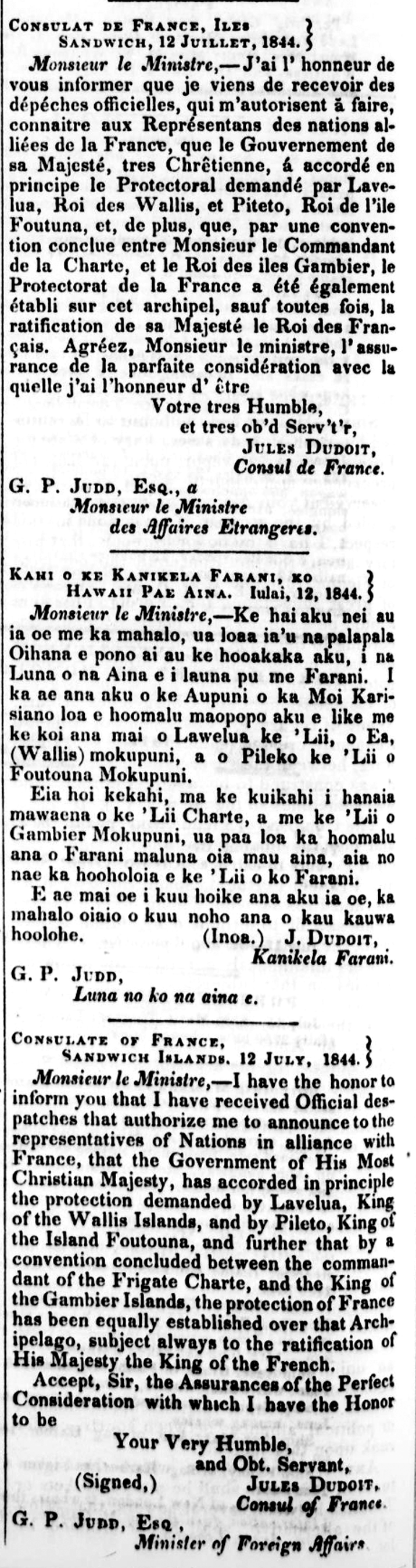
Consulat de France, Iles
Sandwich, 12 Juillet, 1844.

Monsieur le Ministre,—J’ai l’ honneur de vous informer que je viens de recevoir des dépéches officielles, qui m’autorisent ă faire, connaitre aux Représentans des nations alliées de la France, que le Gouvernement de sa Majesté, tres Chrêtienne, á accordé en principe le Protectoral demandé par Lavelua, Roi des Wallis, et Piteto, Roi de l’ile Foutuna, et, de plus, que, par une convention conclue entre Monsieur le Commandant de la Charte, et le Roi des iles Gambier, le Protectorat de la France a été également établi sur cet archipel, sauf toutes fois, la ratification de sa Majesté le Roi des Français. Agréez, Monsieur le ministre l’ assurance de la parfaite considération avec la quelle j’ai l’ honneur d’ être

Votre tres Humble,
et tres ob’d Serv’t’r,
Jules Dudoit,
Consul de France.

G. P. Judd, Esq., a
Monsieur le Minstre
des Affaires Etrangeres.

—————

Kahi o ke Kanikela Farani, Ko
Hawaii Pae Aina. Iulai, 12, 1844.

Monsieur le Ministre,—Ke hai aku nei au ia oe me ka mahalo, ua loaa ia’u na palapala Oihana e pono ai au ke hooakaka aku, i na Luna o na Aina e i launa pu me Farani. I ka ae ana aku o ke Aupuni o ka Moi Karisiano loa e hoomalu maopopo aku e like me ke koi ana mai o Lawelua ke ‘Lii, o Ea, (Wallis) mokupuni, a o Pileko ke ‘Lii o Foutouna Mokupuni.

Eia hoi kekahi, ma ke kuikahi i hanaia mawaena o ke ‘Lii Charte, a me ke ‘Lii o Gambier Mokupuni, ua paa loa ka hoomalu ana o Farani maluna o ia mau aina, aia no nae ka hooholoia e ke ‘Lii o ko Farani.

E ae mai oe i kuu hoike ana ia oe, ka mahalo oiaio o kuu noho ana o kau kauwa hoolohe.

(Inoa.)  J. Dudoit,
Kanikela Farani.

G. P. Judd,
Luna no ko na aina e.

—————

Consulate of France,
Sandwich Islands, 12 July, 1844.

Monsieur le Ministre,—I have the honor to inform you that i have received Official despatches that authorize me to announce to the representatives of Nations in alliance with France, that the Government of His Most Christian Majesty, has accorded in principle the protection demanded by Lavelua, King of the Wallis Islands, and by Pileto, King of the Island Foutouna, and further that by a convention concluded between the commandant of the Frigate Charte, and the King of the Gambier Islands, the protection of France has been equally established over that Archipelago, subject always to the ratification of His Majesty the King of the French.

Accept, Sir, the Assurances of the Perfect Consideration with which I have the Honor to be

Your Very Humble,
and Obt. Servant,
(Signed,) Jules Dudoit,
Consul of France.

G. P. Judd, Esq.
Minister of Foreign Affairs.

(Polynesian, 7/20/1844, p. 2)

Consulat de France, Iles

The Polynesian, New Series, Volume 1, Number 9, Page 2. July 20, 1844.

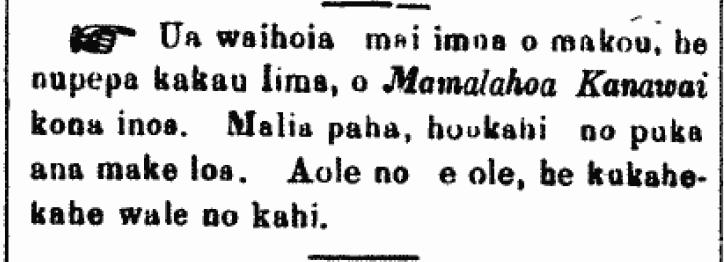
Handwritten newspaper, “Mamalahoa Kanawai,” 1873.

[Found under: “Nu Hou Kuloko.”]

Put before us was a handwritten newspaper called “Mamalahoa Kanawai.” Perhaps it will only come out with one issue and it will perish. Or perhaps also it will flourish.

[Anyone know of this newspaper?]

(Kuokoa, 7/5/1873, p. 2)

Ua waihoia mai imua o makou...

Ka Nupepa Kuokoa, Buke XII, Helu 27, Aoao 2. Iulai 5, 1873.

More on mele, 1860.

Pertaining to Mele

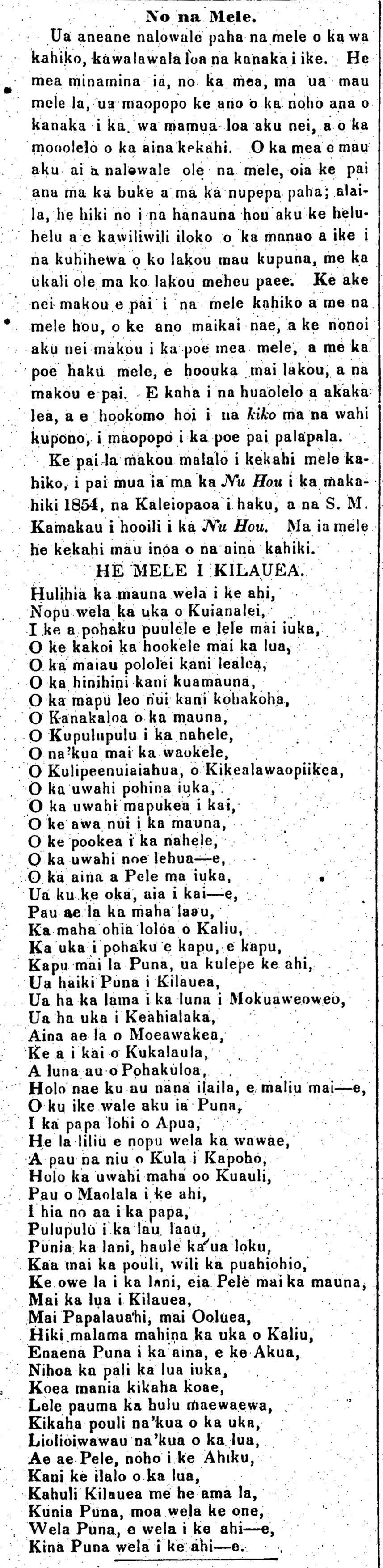
Perhaps the mele of old are almost all lost; those who know them are but few. This is something to be regretful of for in those mele, one can understand the way of life of the people of very long ago, and the stories of the land as well. The means for these mele to continue and not to be lost is by printing them in books and newspapers perhaps; in that way, the new generations can read them and contemplate over it and see the misconceptions of their kupuna and to not follow in their misguided ways. We wish to print the old mele and new mele, as long as they are good, and we ask of those who have mele and the composers of mele to send them to us and we will print them. Write the letters very clearly, and insert punctuation where they should be so that the printers understand.

We are printing below an old mele previously printed in Nu Hou in 1854, composed by Kaleiopaoa and submitted to the Nu Hou by S. M. Kamakau. In the mele there are foreign place names.

HE MELE I KILAUEA.

Hulihia ka mauna wela i ke ahi,
Nopu wela ka uka o Kuianalei,
I ke a pohaku puulele e lele mai iuka,
O ke kakoi ka hookele mai ka lua,
O ka maiau pololei kani lealea,
O ka hinihini kani kuamauna,
O ka mapu leo nui kani kohakoha,
O Kanakaloa o ka mauna,
O Kupulupulu i ka nahale,
O na’kua mai ka waokele,
O Kulipeenuiaiahua, o Kikealawaopiikea,
O ka uwahi pohina iuka,
O ka uwahi mapukea i kai,
O ke awa nui i ka mauna,
O ke pookea i ka nahele,
O ka uwahi noe lehua—e,
O ka aina a Pele ma iuka,
Ua ku ke oka, aia i kai—e,
Pau ae la ka maha laau,
Ka maha ohia loloa o Kaliu,
Ka uka i pohaku e kapu, e kapu,
Kapu mai la Puna, ua kulepe ke ahi,
Ua haiki Puna i Kilauea,
Ua ha ka lama i ka luna i Mokuaweoweo,
Ua ha uka i Keahialaka,
Aina ae la o Moeawakea,
Ke a i kai o Kukalaula,
A luna au o Pohakuloa,
Holo nae ku au nana ilaila, e maliu mai—e,
O ku ike wale aku ia Puna,
I ka papa lohi o Apua,
He la liliu e nopu wela ka wawae,
A pau na niu o Kula i Kapoho,
Holo ka uwahi maha oo Kuauli,
Pau o Maolala i ke ahi,
I hia no aa i ka papa,
Pulupulu i ka lau laau,
Punia ka lani, haule ka ua loku,
Kaa mai ka pouli, wili ka puahiohio,
Ke owe la i ka lani, eia Pele mai ka mauna,
Mai ka lua i Kilauea,
Mai Papalauahi, mai Ooluea,
Hiki malama mahina ka uka o Kaliu,
Enaena Puna i ka aina, e ke Akua,
Nihoa ka pali ka lua iuka,
Koea mania kikaha koae,
Lele pauma ka hulu maewaewa,
Kikaha pouli na’kua o ka uka,
Liolioiwawau na’kua o ka lua,
Ae ae Pele, noho i ke Ahiku,
Kani ke ilalo o ka lua,
Kahuli Kilauea me he ama la,
Kunia puna, moa wela ke one,
Wela Puna, e wela i ke ahi—e,
Kina Puna wela i ke ahi—e.

(Hae Hawaii, 3/21/1860, p. 204)

No na Mele.

Ka Hae Hawaii, Buke 4, Ano Hou.—Helu 51, Aoao 204. Maraki 21, 1860.

The importance of mele, 1860.

Pertaining to Mele!

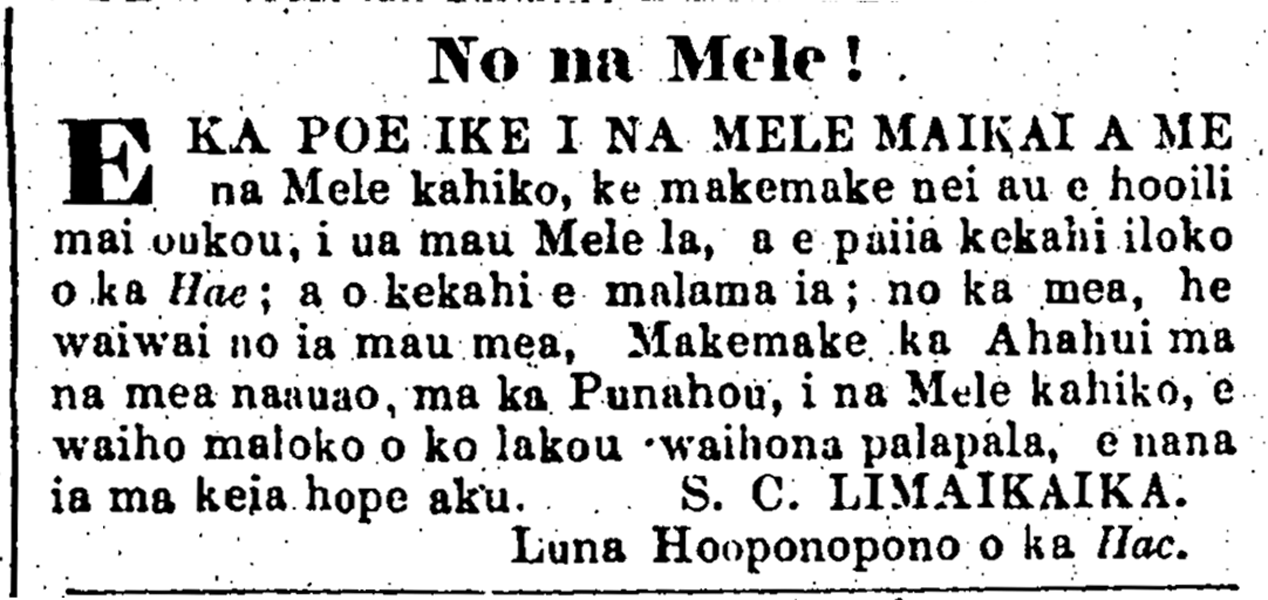
O PEOPLE THAT KNOW FINE MELE AND the old Mele, I want you all to send those Mele in, and some will be published in the Hae [Ka Hae Hawaii]; and some will be kept; for those things are valuable. The Philomathian Society [?? Ahahui ma na mea naauao]  at Punahou is wanting old Mele to put into their archives to be looked at at a later date. S. C. Armstrong [S. C. Limaikaika].

Editor of the Hae.

(Hae Hawaii, 3/21/1860, p. 203)

No na Mele

Ka Hae Hawaii, Buke 4, Ano Hou.—Helu 51, Aoao 203. Maraki 21, 1860.

Crown Room of Iolani Palace, 1936.

THE CROWN ROOM OF IOLANI PALACE TO BE REDONE

ACTING GOVERNOR HITE REVEALED HIS THOUGHTS

This past Thursday, June 25, acting Governor [kokua Kiaaina] Charles M. Hite revealed his thoughts to redo the crown room of Iolani Palace in the upcoming days to bring back once again the commemoration of the alii of Hawaii who passed on; the pulo’ulo’u, the paintings hanging upon the walls, the throne, and also the other chairs which decorated the crown room. Continue reading

Hanaiakamalama rules, 1916.

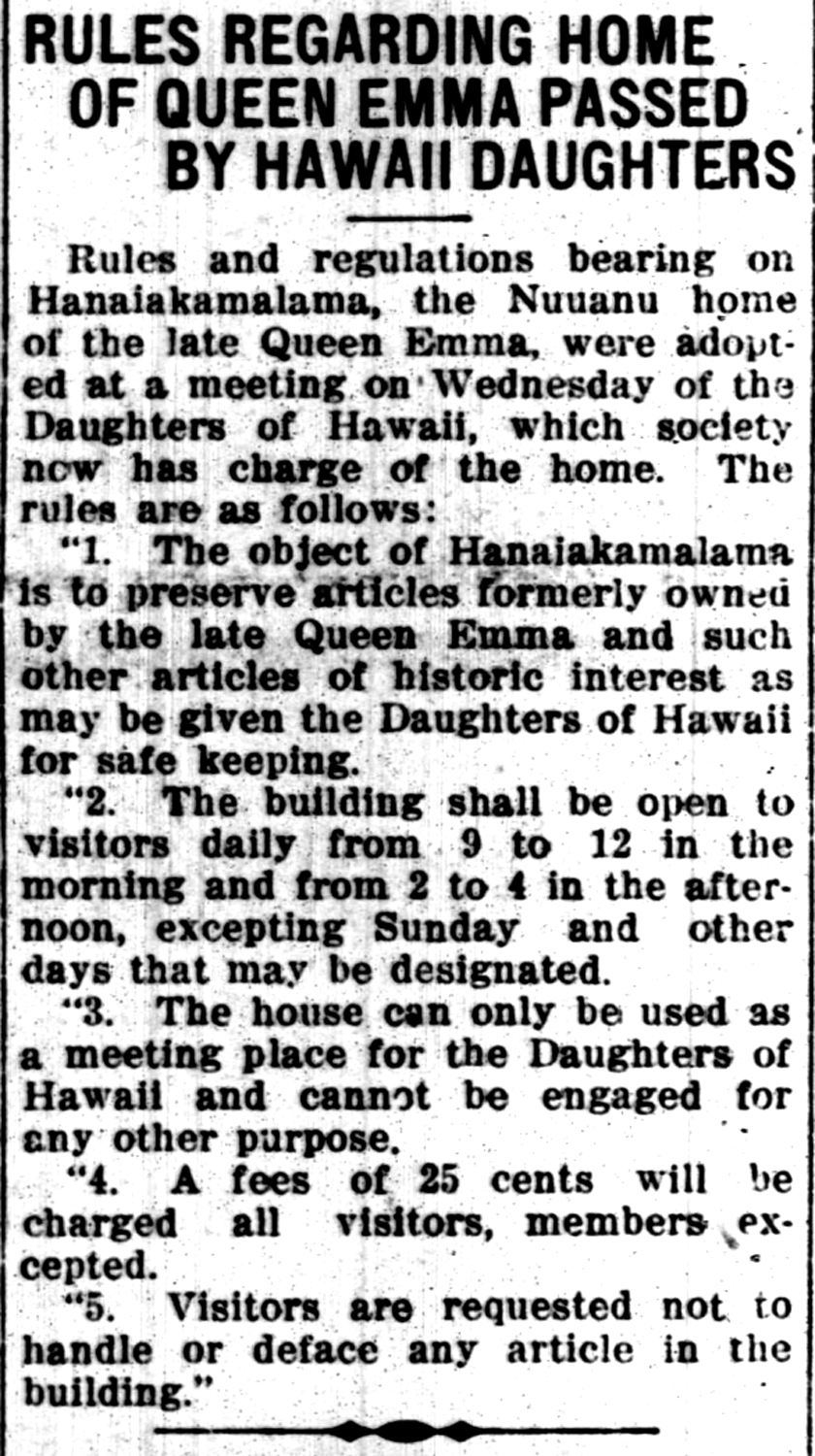
RULES REGARDING HOME OF QUEEN EMMA PASSED BY HAWAII DAUGHTERS

Rules and regulations bearing on Hanaiakamalama, the Nuuanu home of the late Queen Emma, were adopted at a meeting on Wednesday of the Daughters of Hawaii, which society now has charge of the home. The rules are as follows:

“1. The object of Hanaiakamalama is to preserve articles formerly owned by the late Queen Emma and such other articles of historic interest as may be give the Daughters of Hawaii for safe keeping.

“2. The building shall be open to visitors daily from 9 to 12 in the morning and from 2 to 4 in the afternoon, excepting Sunday and other days that may be designated.

“3. The house can only be used as a meeting place for the Daughters of Hawaii and cannot be engaged for any other purpose.

“4. A fee of 25 cents will be charged all visitors, members excepted.

“5. Visitors are requested not to handle or deface any article in the building.”

(Star-Bulletin, 10/19/1916, p. 3)

RULES REGARDING HOME OF QUEEN EMMA PASSED BY HAWAII DAUGHTERS

Honolulu Star-Bulletin, Volume XXIV, Number 7651, Page 3. October 19, 1916.

Samuel K. Kekoowai on the Daughters of Hawaii and Hanaiakamalama, 1923.

HANAIAKAMALAMA

This is a building near the end of the route of the electric car, and it stands on a hill.

As a result of the graciousness of one of the members of the Daughters of Hawaii [Ahahui o na Kaikamahine o Hawaii], this writer [Samuel K. Kekoowai] was introduced to Mrs. J. Swanzy, the leader of this association, and by her kindness I was welcomed to see the walls of that house which is filled with beautiful decorations of the monarchy, and their images hanging from the walls, set up almost like the museum of Kamehameha [Bernice Pauahi Bishop Museum].

This group, the Daughters of Hawaii, upholds the name of Queen Emma Kaleleonalani, and her birthday is cherished by them, and the writer observed the commemoration held by the association which holds dear the name placed upon them, the Daughters of Hawaii.

In the story told to me within the house, Kaleleonalani was raised by her hanai guardian [kahu hanai], Dr. Rooke [Kauka Luka], until she married Liholiho Kamehameha 4, however, there is another version that I have been told by another.

On that 20th day of this June, I saw the back room totally filled with those who came, from the members to visitors, and most were whites and there were a few Hawaiians [??? a o-a na Hawaii].

The story of the circuit of Queen Emma Kaleleonalani around Oahu nei was told, beginning at Waimanalo at the place of John Cummins [Keoni Kamaki], and to Kaneohe at the place of Wainui Pii, and then on to Waikane at the place of Kameaaloha; at Kahana there was a Chinese named Apakana, on to Punaluu there was Naili, to Laie at the place of Kupau, to Kahuku at the place of Kaluhi, to Waialua at the place of Kaiaikawaha. Continue reading

Traditional place names and the Daughters of Hawaii, 1918.

OLD HAWAIIAN NAMES TO BE PRESERVED.

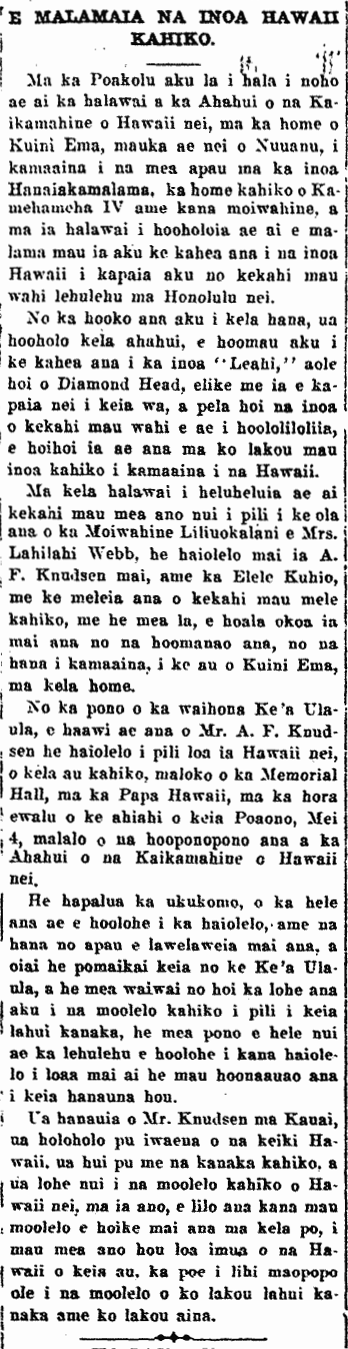
This past Wednesday the Daughters of Hawaii [Ahahui o na Kaikamahine] held a meeting at the home of Queen Emma in the uplands of Nuuanu, known by all by the name Hanaiakamalama, the old home of Kamehameha IV and his queen; and at that meeting it was decided that the calling of many places in Honolulu nei by their Hawaiian names will be preserved forever.

To carry out this endeavor, the organization decided to continue calling the name “Leahi,” and not Diamond Head, as it is being called now, and so too with other names that have been changed; they will be returned to their old names that Hawaiians are familiar with.

At that meeting several things were read pertaining to the life of Queen Liliuokalani  by Mrs. Lahilahi Web, a speech by A. F. Knudsen, and Representative Kuhio, along with the singing of some old mele, just as if they were recreating memories of familiar deeds from the time of Queen Emma in that home.

For the treasury of the Red Cross, Mr. A. F. Knudsen will give a speech specifically pertaining to Hawaii nei of the olden days, at Memorial Hall of the Hawaiian Evangelical Association [Papa Hawaii], at eight o’clock on the evening of this Saturday, May 4, under the direction of the Daughters of Hawaii nei.

The entrance will be half price to go and listen to the speech and for all activities that will be put on, and being that it is a benefit for the Red Cross, and that it is beneficial to listen to this history pertaining to the Hawaiian lahui, all the people should go to hear his speech so that the new generations can get some education.

Mr. Knudsen was born on Kauai and went around amongst the Hawaiian children, and met the old people, and listened to the old stories of Hawaii nei; and because of this, the stories he tells that night will be something totally new for Hawaiians of today, the people who know hardly any of the stories of their lahui and their land.

(Kuokoa, 5/3/1918, p. 4)

E MALAMAIA NA INOA HAWAII KAHIKO.

Ka Nupepa Kuokoa, Buke LVI, Helu 18, Aoao 4. Mei 3, 1918.

Petition from Koloa, Kauai, supporting King Kalakaua, 1880.

His Most Highness King D. Kalakaua, the Moi of the Hawaiian Archipelago.

O Father, Give us heed.

We are Your own citizens, named below, from the District of Koloa, Island of Kauai.

We humbly ask before Your Most Highness, while approving of all which You have done for the rights and the benefits of Your Nation. Just as the Royal rights that You have.

And we truthfully state that we do not join with the white skins [ili keokeo] who oppose You and Your Ministers that You rightly selected, as per your power as King and Father of Your Lahui. And we thank the Heavens.

“Long Live the King in God!
Long Live your Kingdom!”

Koloa, Kauai, Sept. 17, 1880.

Poikauahi,  H. Kanakaole,
Kaili,  Pohihi,
Iapeka,  Kaapanui,
W. Brown,  A. Kawai,
J. W. Puni,  Hili,
Kanakaole,  Palakamaia,
Kamakee,  Pakaua,
Kaili,  Noa,
Uilama,  Kamale,
Kamaka,  Kauapo,
Kehau,  Hanaole,
Kaluna,  Kuike,
Paahao,  Kapo,
J. W. Keliinui,  Kuai,
Makamaka,  Apelahama,
Jimo Alapai,  Daniela,
Kahoolewa,  Nao,
Makole,  Molokoa,
Kahiko,  Opeka,
Kale Molohu,  K. L. Pilipo,
Makia,  Michael Luhau,
P. Kamaka,  Mookini,
Makaole,  P. Kaluna,
Hoopii,  T. Naapuelua,
Hapaumi,  Kalawaia,
Keliinui,  D. Kaioike,
Haumea,  Keonipahia,
Kainokane,  Kane,
Kanaana,  Kalonui,
Kolona,  J. K. Luka,
Eke,  Naholoaa,
Ohule,  T. Kalaluhi,
Kaukuna,  J. B. Kaheleloa,
Moke,  W. H. Kekahimoku,
Mahina,  Kawahineaea,
Keo,  Lihilihi 2,
Kimo,  Hanaole,
Hoolaumakani,  J. K. Pelekai,
Minamina,  Moke,
Kimokeo,  H. Mokuhiwa,
Kuihonua,  H. Nakapaahu,
Kuakini,  A. K. Nahoa,
Lihilihi.

[This newspaper is not available online as of yet. Hopefully a clear copy will be put up soon. Some of the names in this image are difficult to decipher.]

(Elele Poakolu, 9/29/1880, p. 3)

Mea Kiekie Loa King D. Kalakaua, ka Moi o ko Hawaii Pae Aina.

Ka Elele Poakolu, Buke I, Helu 4, Aoao 3. Sepatemaba 29, 1880.

“Laksamana” in English by Walter Murray Gibson, 1882.

LAKSAMANA;

THE GREAT HERO of the MALAYS.

A ROMANCE.

By WALTER MURRAY GIBSON.

Introduction.

In the year 1873, whilst publishing a small bilingual sheet, the Nuhou, in the English and Hawaiian languages, I was urged by Hawaiian friends to write a story about my experience in Malaysia, and illustrative of Malay manners and customs. I published some incidents of travel in the Island of Sumatra, and as I introduced some fragments of the legendary stories of the Malays, especially in relation to the renowned hero Laksamana, of Malay romance, I was pressed and tempted to expand this subject, drawing on my imagination, as well as on the traditions of the Malays and Javanese to which I had listened, and the result was that the story of “Laksamana” was continued in the Nuhou in the Hawaiian language, in a succession of weekly issues for a space of six months, and yet when the Nuhou had terminated its career, the story like those of Scheheserade [Scheherazade of One Thousand and One Nights], was left unfinished.

When the editor of the Nuhou, and author of Laksamana, commenced the publication of the Elele Poakolu in 1880, the Hawaiians very generally expressed a wish that the story of Laksamana should be continued; for the memory of the interest that it had awakened in 1873 had not abated in Hawaiian minds, and the author resumed the story in the Elele, publishing a revised edition of the Nuhou series of Laksamana legends.

This is a story based upon legends, designed for the entertainment of young and unsophisticated minds. It is a romance of the mythic age of Malaysia and originating in the poetic invention of Asia. Laksamana, the brother of the demi-god Rama, is a hero of the great Hindoo [Hindu] poem the “Ramayana,” and in a later age appears in the Javanese epic, the “Bratayuda.” The mythic Prince of the Indian epopee gas given the name that is so prominent in Malay story, but there was, according to widespread tradition, an actual Malay hero to whom was given the name of Laksamana, as a title, as certain potentates of Europe are styled Cæsars—deriving their title from the name of the great Roman who founded imperialism. Laksamana has long been a naval title in Malaysia, being the titular designation of an admiral, or commander of a fleet of war prahus.

Laksamana the hero is frequently mentioned in Malay song and story at this day, and he appears sometimes a mythic hero working wonders and sometimes a historic personage and the hero of Malay achievements. There is no written history, or series of stories, recording in any collective form, the myths or the achievements, and the author of this story, designed for the instruction and entertainment of native Hawaiians has had no assistance in the preparation of the romance but the memory of fragmentary legends narrated to him whilst he languished in the Prison of Weltevreden, on the island of Java, and which he arranged into this Hawaiian kaao, or romantic tale, during days of peaceful toil on the island of Lanai.

This story is now presented to the English reading public, through the columns of the Advertiser, not on account of any presumed literary merit, but because it has been thought by many friends of the author that it would be interesting to those desiring the welfare of the Hawaiian People, to know what kind of literature captivated their attention, and at the same time it was thought that the romance of Laksamana, would at least interest the juvenile, if not the more matured readers of the Advertiser.

Walter Murray Gibson.

Haleaniani, April 29, 1882.

[The actual tale starts here…

It was introduced in the Nuhou, on 10/14/1873, pp. 4–5; the translation of the tale is printed from 11/4/1873 to 4/28/1874. In the Nuhou, it actually states that the story was translated from the Malay language.]

(Pacific Commercial Advertiser, 4/29/1882, p. 5)

LAKSAMANA;

The Pacific Commercial Advertiser, Volume XXVI, Number 44, Page 5. April 29, 1882.