A visit to the Mormon settlement, Iosepa, Utah, 1912.

Travelling to Find Hawaiians in Iosepa, Utah.

Following the Presidential Nominating Convention in Chicago, I boarded the evening train, along with my travelling companions, on the sabbath, June 23, to return to San Francisco. We arrived at Salt Lake City at 5 p. m. on Tuesday evening, and I jumped off alone in that foreign land while my companions continued all the way.

The next day, I went to grounds of the Mormon temple and asked for the way to get to where the Hawaiians lived in Iosepa. I was told by the locals that Tempie was where the train stopped to go to Iosepa, and eight more miles and you’d reach Iosepa. I was restrained to wait for one of the Mormon teachers who lived here in Hawaii, for they knew the way to Iosepa, but I did not wait, I toured about the city until the time the train departed, and I boarded for Tempie.

I arrived there at 4:30 and saw a barren land with but two buildings, no trees, no crops, and they were just houses for the men who worked on the railroad. I was shocked, because there was no one home; I looked at the road lying to the south, to the east of the valley and I decided to walk until the houses of the locals of Iosepa, and so I went as a malihini on that lonely deserted road; I looked as far as my eyes could see, and there were no homes in sight, but I continued walking forward for eight miles and reached a hillock from which I could see four more miles, but I couldn’t see any houses, while I recalled what was told to me, that it was eight miles from Tempie to Iosepa; I was confused, thinking that maybe this wasn’t the correct road, so I turned back once again for Tempie. The sun went down, but the moon came out, so the trip on this deserted foreign land was not forlorn.

I arrived back in Tempie at eleven that night, knocked on the door, and the kamaaina, who was a Greek, awoke, and I slept there that night. He asked me about my travels, and I told him that I was headed for Iosepa, and I asked him the right way to get there, and he told me that that was indeed the road but he estimated that it was fourteen miles before reaching Iosepa.

Early the next morning, we were done with breakfast, and my kamaaina went off to work; he locked up the house, and I sat out on the lanai, waiting for for the mail truck, since the locals told me that the letter truck to Iosepa arrived at two that afternoon; I thought to walk once again, but because of swelling of my legs, I couldn’t do it.

In the afternoon, a delivery truck driven by a Hawaiian youth born there arrived first. After him arrived the mail truck driven by John Broad, the son of Charles Broad, along with three passengers headed for Salt Lake. I spent time with them until their train arrived and they left; and I waited for the train from Salt Lake; its arrival ran late, and it came at about six; we got the mail bag, and I went along with Jno. Broad to Iosepa which he said was sixteen miles from Iosepa to Tempie. We arrived at Iosepa at dusk, at eight in the evening and visited the home of Charles Broad and his queen [wife]. There I ate poi once again, that being poi palaoa [poi made of flour], and this was much tastier and better than the expensive haole food that I had in the American hotels.

I spent time with the Hawaiians living there, and asked about how their lives were;  they said their way of life in Iosepa was pleasant. Charles Broad and George Hubbel told me that when they were home in the land of their birth, they were subject to frequent bouts of rheumatism but in Iosepa they were fine and this ailment giving them sore bones disappeared. I was asked to stay back by the kamaaina to spend [seems to be a dropped line here: “hoohala i mau lakou”] so that they can properly welcome me, like by roasting a pig, joining together in celebration, and allowing time for the two singing groups to  come and entertain me with their music and Hawaiian songs that they cherish in that foreign land. But because of my very short time left before the Wilhelmina, my ship upon which I was returning, was leaving, therefore, I could not accept their invitation.

The town of Iosepa is east of Skull Valley [Awawa Pookanaka], and it is land dedicated as a home for kanaka people. Hawaiians are the majority living there, and there are some kauna [forty] samoans and the head haole and his family. There are 176 people in Iosepa. There is a school house, store, post office, church, dance hall, and a lanai for parties on special occasions.

The work people do there is farming, planting oats, wheat, potatoes, barley, and so forth. The land is flat and stretches out, and there is much space, enough for a thousand people, and there is a lot of spring water in that valley, but the land is like a salt bed, and it is by irrigation that the crops grow. Should you want a homestead, you can get 320 acres, being that there is abundant land yet few people.

Water is brought in for the town of Iosepa from the deep, grooved ravines of the mountains for many miles in canals which are lined with cement and runs out to a reservoir, and from there the water runs into great pipes reaching the roads of Iosepa and entering the house lots of the people.  The Church spent $76,000 to lay the waterway.

It is thought that it was an ultimate feat of Maui County, which spent $100,000 to lay the water system to bring the water from Puohokamoa Stream as water for the thousands of people of Makawao and Kula and the thousands of cattle of Kahikinui, however, people have to pay to get the water; as for the water in Iosepa, the Mormon Church paid $76,000 to get the water to make the life of the Hawaiians there easy, and they give it for free.

After finishing breakfast, the Head Boss, William Wadup [Waddoups], invited me to  tour the work place of the people, and so I went with him aboard his vehicle [Not sure what a “kaa bake” is, but it appeared in an earlier article i put up]. We arrived at the place of work, and I saw two men cutting grass. They sat atop the machine, guided the horses straight, and the machine was what cut the grass. And at another location, the dried grass (hay) was piled onto a large truck and taken to where it was heaped up, and the pile was as tall as a two-story building.

George Hubbel told me that pitching hay with long-handled three-pronged pitch forks was the most important job there, and the pay for that job was two dollars and a half a day for a single man, and three dollars for a married man; for other jobs, the pay was a dollar quarter and  a dollar half a day.

As I made ready to depart Iosepa that afternoon, people were let off work, they told me because it was windy that they could not pitch hay, and they all came down to see me and to give their aloha to the families in the land of their birth. There was much asking for me to visit them again should I come back to America, and from what I saw, they were very happy at the arrival of one of their own who saw and visited with them in this foreign land upon which they live.

They told me that in the twenty or more years which they lived in Iosepa, there were a great many Hawaiians who visited Salt Lake City, but I was a Hawaiian who actually went to Iosepa to see them before returning here to the sands of our birth.

Here are some people I saw there: Makaweli, the last born of the wife of Nailima of Hilo, who has many children and grandchildren in Iosepa. It was this kind Hawaiian lady who took care of Emilia Kalua (f), the grandchild of Keanini of Waikapu, Maui, because both of her parents died; the family of her father wanted to bring back this young girl to live with them. The Circuit Court of Maui appointed me as executor for her portion of the estate of her grandfather, and these are they things which made me visit Iosepa, Utah, and to see firsthand how this Hawaiian girl was living without parents in this foreign land. From what I saw and heard about her there, she was being properly taken care of, and she did not want to come to Hawaii nei.

Also, there is Naihe, a child of D. B. Mahoe of Hana; he is family there; he has eight children living. George Hubbel formerly of Honolulu, his wife, and their children, and so many more other Hawaiians gave their aloha to their family here in the land of their birth. According to some of them, it is their homeland, the treatment of the church elders is good, and the thought to return to the land of their birth is very far away, except for the fact that their aloha for Hawaii is not gone, as for their kin at home with their never-ending thoughts of them.

KALE WILIKOKI [Charles Wilcox]

(Kuokoa Home Rula, 7/12/1912, p. 4)
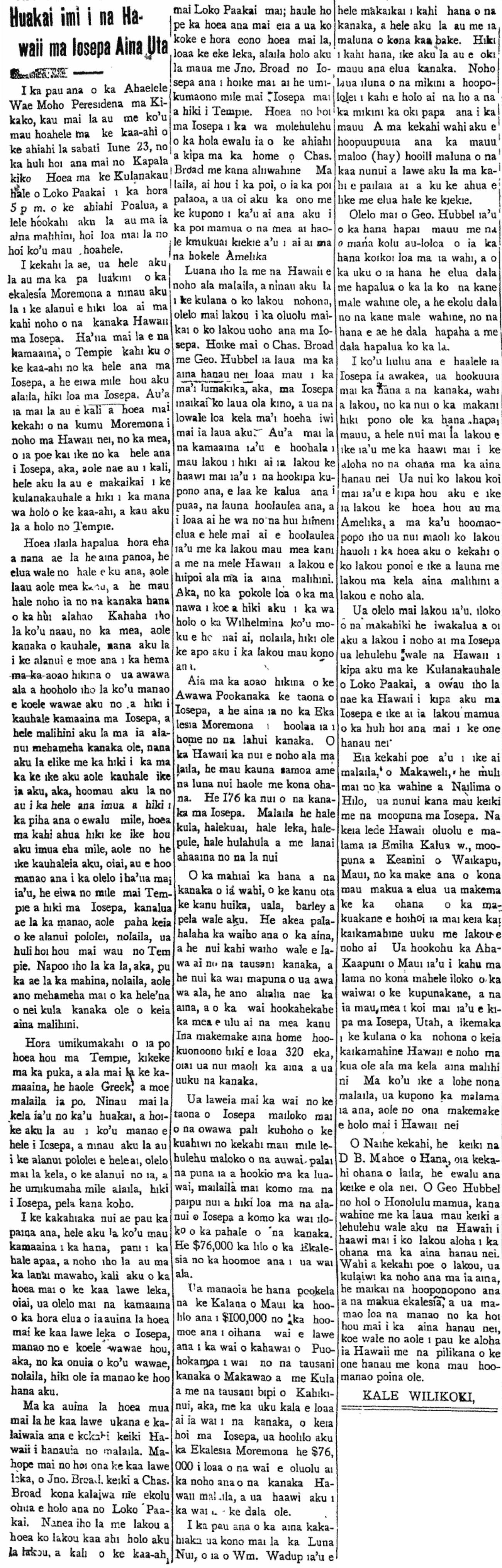
Huakai imi i na Hawaii ma Iosepa Aina Uta

Kuokoa Home Rula, Buke X, Helu 28, Aoao 4. Iulai 12, 1912.
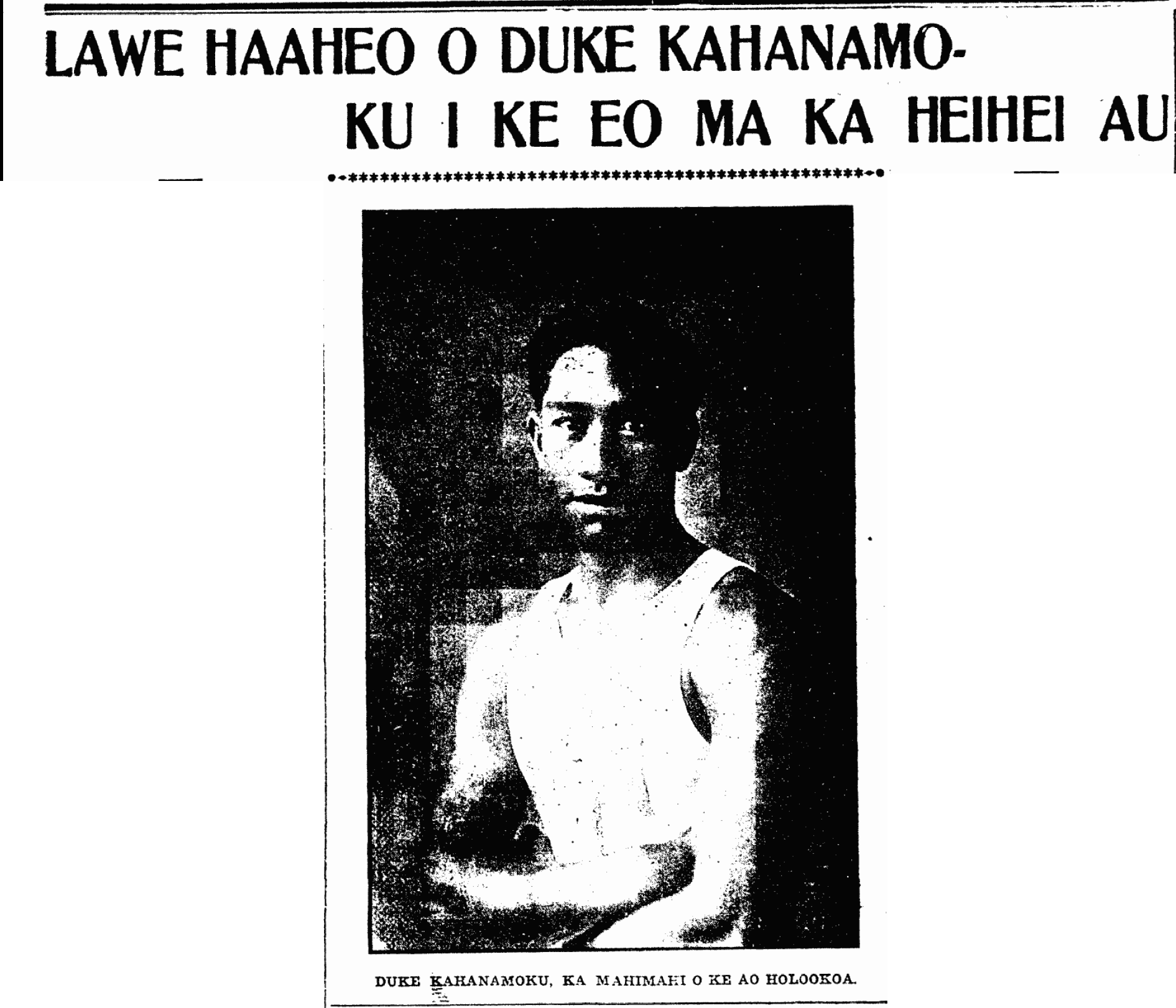
Duke victorious, 1912

DUKE KAHANAMOKU PROUDLY TAKES THE WIN IN THE SWIMMING COMPETITION.

DUKE KAHANAMOKU, THE MAHIMAHI¹ OF THE ENTIRE WHOLE.

¹The mahimahi is a fish known for its prowess and speed.

(Kuokoa, 7/12/1912, p. 1)

LAWE HAAHEO O DUKE KAHANAMOKU I KE EO MA KA HEIHEI AU

Ka Nupepa Kuokoa, Buke XLVIII, Helu 28, Aoao 1. Iulai 12, 1912.

Marriage announcement outside of the Vital Statistics Column, 1912.

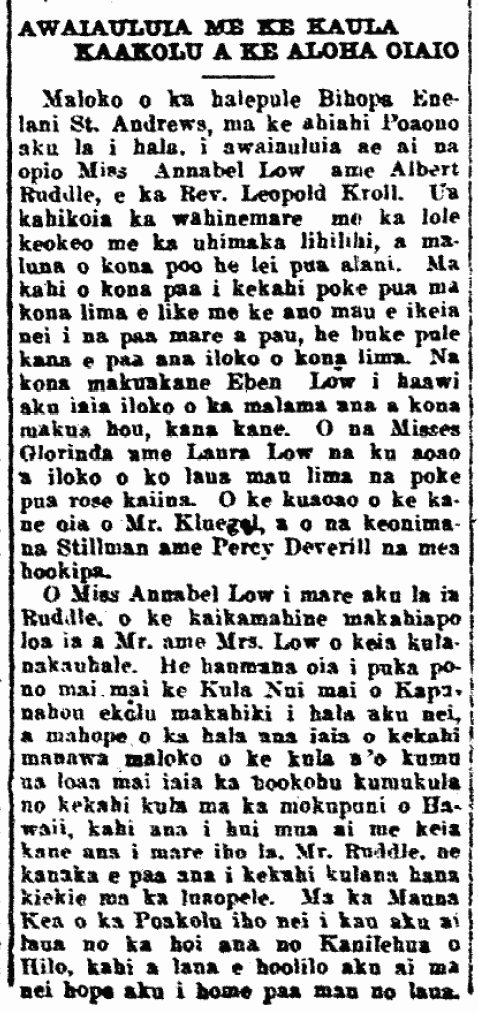
BOUND WITH THE THREE-STRAND CORD OF TRUE LOVE

Within the Anglican Church of St. Andrew’s, on this past Saturday evening, the youths, Miss Annabel Low and Albert Ruddle were joined together by the Rev. Leopold Kroll. The bride was donned with a white dress and a sheer veil, and atop her head was a lei of orange blossoms. She held a bouquet of flowers in her hand as seen in all marriage ceremonies, and she held a book of prayers in her hand. It was her father, Eben Low, who gave her into the care of her new parent, her husband. Misses Glorinda and Laura Low were the bride’s maids, and they held in their hands, bouquets of lavender roses. The best man was Mr. Kinegal, and the gentlemen in charge of hospitality were Stillman and Percy Deverill.

Miss Annabel Low who married Ruddle is the eldest daughter of Mr. and Mrs. Low of this town. She was a student who graduated from the College of Kapunahou [Punahou] three years ago, and after some time in the teachers’ school, she was appointed as a teacher at a school on Hawaii Island, where she first met this man whom she wed, Mr. Ruddle, who is employed in a high position at the volcano. They will be returning to the Kanilehua of Hilo on Wednesday’s Mauna Kea where they will make their permanent home from here forth.

(Kuokoa, 7/12/1912, p. 6)

AWAIAULUIA ME KE KAULA KAAKOLU A KE ALOHA OIAIO

Ka Nupepa Kuokoa, Buke XLVIII, Helu 28, Aoao 6. Iulai 12, 1912.

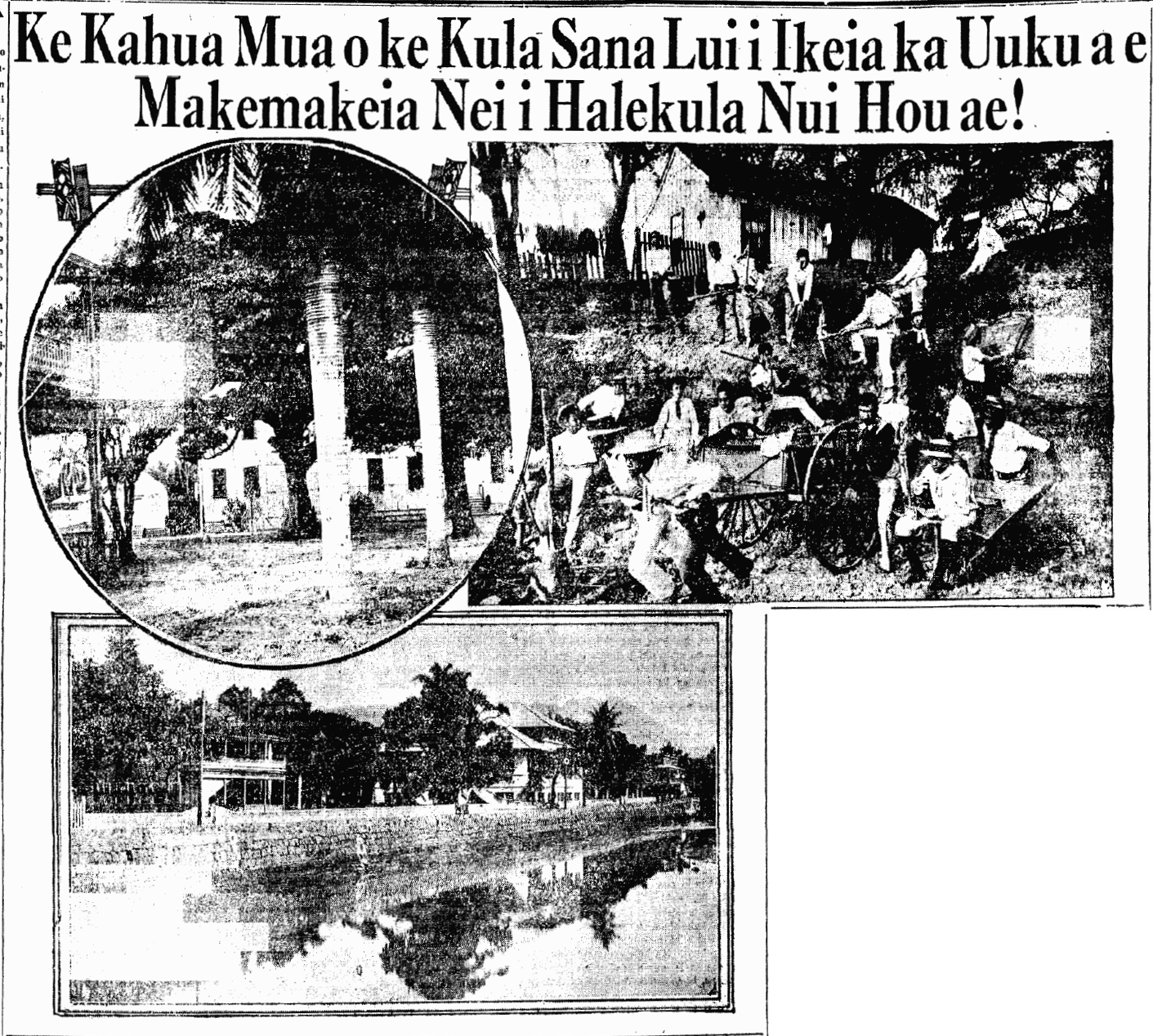
The new and improved St. Louis College, 1881.

THE COLLEGE
OF SAINT LOUIS
—and the—
COMMERCIAL AND BUSINESS ACADEMY
HONOLULU, OAHU, H. I.

This institution being remote from city allurements, is an acknowledged safeguard for morals—for salubrity of climate, is unrivalled. The buildings are large and commodious, while the grounds afford the pupils opportunities for healthful exercises.

Unremitting attention will be given to the intellectual and moral culture of the pupils. Non-Catholic pupils will be free to attend the religious exercises or not, according as their parents or guardians may desire.

Pupils are received at any time during the year. No reduction will be made from regular charges, except for absence caused by protracted illness.

No leave of absence during the scholastic year, except at the College vacations or by special permission.

Each pupil must on entering obtain one suit of uniform, which with all other necessary clothing, &c., &c., will be furnished at moderate cost by the College; but none of these will be provided by the College unless by special arrangement.

Payments are to be made quarterly, and invariably in advance.

The course of study is Classical, Scientific and Commercial; Latin, Greek, French, Spanish, German and Italian are taught.

Particular attention will be paid to the English Language in all its branches. Literature, Pure and Mixed Mathematics, History, Geography, Chemistry and Natural Philosophy, &c.

TERMS:

For Board, Lodging, Tuition and Washing, per Scholastic Year…$200.00

Entrance fee…10.00

Vacation at College…40.00

Music, vocal and instrumental, Drawing and Modern Languages—extras.

DAY PUPILS—Senior Class…$60.00

Junior Class…40.00

The Scholastic Year consists of two Sessions, each comprising a period of five months. The first session commences on the 20th of August; the second on the 20th of January.

For all further particulars, apply to

REV. W. J. LARKIN, President.

No. 73 Beretania St.

Evening School Department of St. Louis College.

The President has decided to include this branch in the curriculum of the College.

Its object is to afford all classes of the community the means of acquiring a theoretical and practical knowledge of all commercial and business transactions in daily use; and also to give an insight into the workings and applications of the different Trades, which it is so essential to do in these Islands.

The Theoretical Branch will be under the supervision of the President and Professors of the College. The Practical and most important Branch will be specially attended to by volunteers from the various master artizans among us, who have kindly and generously promised their services to this useful and valuable enterprise.

They will, alternately, devote half and hour each evening to the task of imparting knowledge to the students. All the implements necessary to each trade, and to Agriculture, will be furnished by the College.

Each master-artizan, while connected with the College, will be entitled to name one Free-Life-Scholarship to the privileges of this Evening School Department.

TERMS—Each student per week, 50 cts. The Evening School will open at 7 o’clock p. m.

(Elele Poakolu, 2/2/1881, p. 5)

KE KULA NUI O SANA LUI

Ka Elele Poakolu, Buke I, Helu 22, Aoao 5. Feberuari 2, 1881.

[This is an advertisement for the recently moved Saint Louis College, back in 1881. The English is taken from the English advertisement appearing on page 5 of the Hawaiian Gazette, 2/9/1881.

This Hawaiian ad appears in the newspaper Ka Elele Poakolu, which for some reason is not available online as of yet, even if it has been available on microfilm for years…]

Replanting of native plants, 1901!

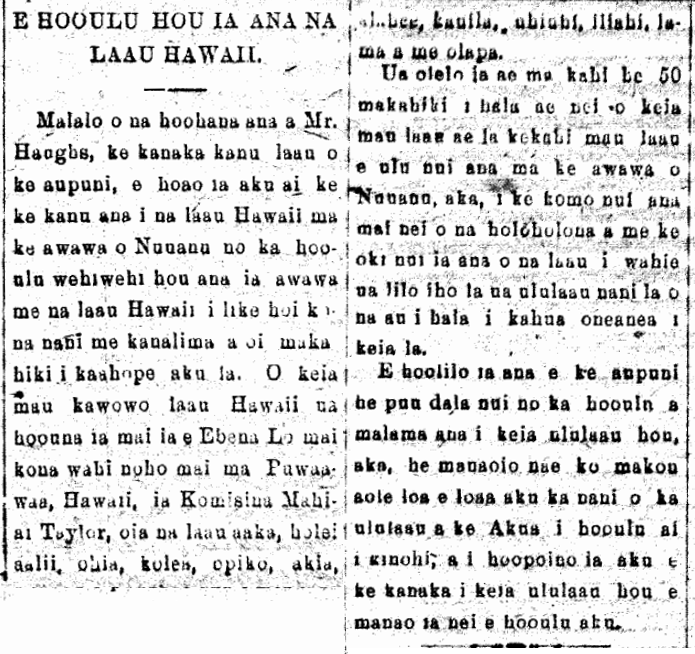
HAWAIIAN PLANTS WILL BE GROWN AGAIN.

Under the direction of Mr. Haughs, the nurseryman of the government, the planting of Hawaiian plants in the valley of Nuuanu will be attempted, to make that valley verdant once again with native plants, so that it will be just as beautiful as it was fifty or more years ago. These seedlings were sent by Ebena Lo [Eben Low] from his residence at Puuwaawaa, Hawaii, to Commissioner Taylor, those being aaka, holei, aalii, ohia, kolea, opiko, akia, alahee, kauila, uhiuhi, iliahi, lama, and olapa.

It is said that it has been about 50 years that these plants were growing in abundance in Nuuanu Valley, for with the influx of animals and the mass cutting of trees for firewood, the beautiful forest of times gone by became a barren field.

The government will spend a sum of money to grow and foster this new forest, however, we believe that there is no way that the beauty of the forest which God grew originally and which was damaged by man will be attained by this new forest which is intended to be grown.

(Aloha Aina, 12/7/1901, p. 4)

E HOOULU HOU IA ANA NA LAAU HAWAII.

Ke Aloha Aina, Buke VII, Helu 49, Aoao 4. Dekemaba 7, 1901.

Harper’s New Monthly Magazine and Kekuanaoa, 1871.

Here is the short piece described in the last post:

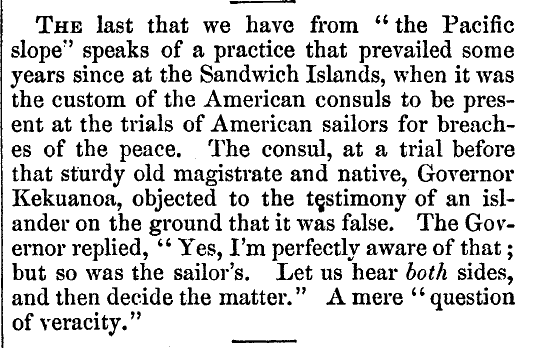
The last that we have from “the Pacific slope” speaks of a practice that prevailed some years since at the Sandwich Islands, when it was the custom of the American consuls to be present at the trials of American sailors for breaches of the peace. The consul, at a trial before the sturdy old magistrate and native Governor Kekuanoa [Kekuanaoa], objected to the testimony of an islander on the grounds that it was false. The Governor replied, “Yes, I’m perfectly aware of that; but so was the sailor’s. Let us hear both sides, and then decide the matter.” A mere “question of veracity.”

(Harper’s New Monthly, 4/1871, p. 797)

The last that we have from...

Harper’s New Monthly Magazine, Volume 42, Issue 251, Page 797. April 1871.

In praise of Mataio Kekuanaoa, 1871.

The different Father of Chiefs.

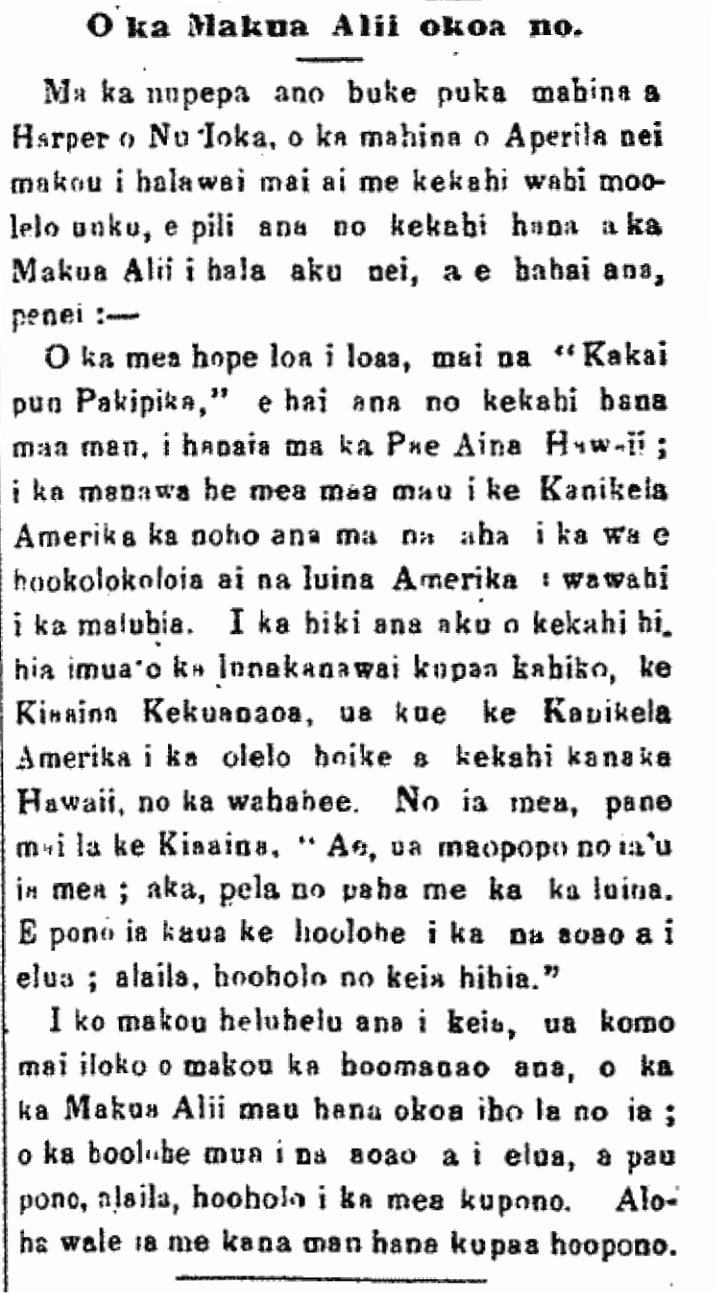
In the monthly magazine, Harper’s of New York, we came across in the April edition, a short story about something done by the Alii Father [Makua Alii] who has passed, and it reports:—

The latest received from the “Pacific String of Hills” speaks of a regular practice carried out in the Hawaiian Islands; during the times when it was a regular thing for the American Consul to sit at court when an American sailor was on trial for disturbing the peace. When a case came before the traditional judge, the Governor Kekuanaoa, the American Consul objected to the testimony of a Hawaiian on the grounds of perjury. At which the Governor replied, “Yes, I am aware of this; but the same may be true of the sailor. The two of us must hear both sides and then rule on this matter.”

When we read this, we recalled that is the different way the Father of Chiefs did things; he listened to both sides first, and when that was finished, he would decide what was proper. Aloha to him and his deeds of steadfast righteousness.

(Au Okoa, 4/13/1871, p. 1)

O ka Makua Alii okoa no.

Ke Au Okoa, Buke VI, Helu 52, Aoao 1. Aperila 13, 1871.