More on Liliu’s marriage, 1862.

I was engaged to Mr. Dominis for about two years and it was our intention to be married on the second day of September, 1862. But by reason of the fact that the court was in affliction and mourning, our wedding was delayed at the request of the king, Kamehameha IV., to the sixteenth of that month; Rev. Dr. Damon, father of Mr. S. M. Damon, at present the leading banker of the Islands, being the officiating clergyman. It was celebrated at the residence of Mr. and Mrs. Bishop, in the house which had been erected by my father, Paki, and which, known as the Arlington Hotel [Haleakala], is still one of the most beautiful and central of the mansions in Honolulu. To it came all the high chiefs then living there, also the foreign residents; in fact, all the best society of the city.

[This is what Queen Liliuokalani had to say about her marriage in Hawaii’s Story by Hawaii’s Queen, first published in 1898. Mahalo to Heather Wilkinson Rojo for her response on the previous post, saying she posted an image of their marriage certificate on her blog. This is one of the many priceless treasures cared for by the Bernice Pauahi Bishop Museum!]

(Hawaii’s Story by Hawaii’s Queen, 1988. p. 22.)
Marriage of Liliuokalani and John Owen Dominis, 1862.

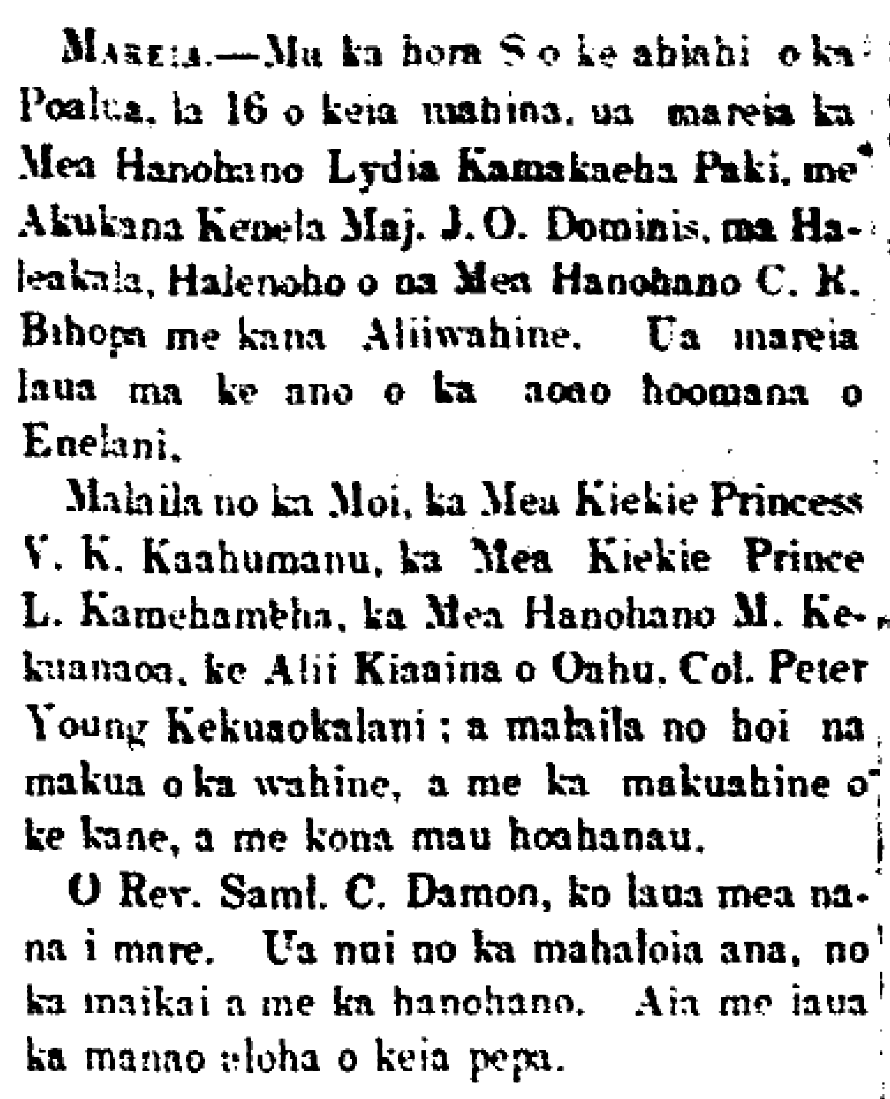
Marriage.—At 8 in the evening of Tuesday, the 16th of this month, the Honorable Lydia Kamakaeha Paki and Adjutant General Major J. O. Dominis were wed at the Residence of the Honorable C. R. Bishop and his Queen. The two were married in the Anglican faith.

Present were the King; her Highness Princess V. K. Kaahumanu; his Highness Prince L. Kamehameha; the Honorable M. Kekuanaoa, the Royal Governor of Oahu; Colonel Peter Young Kekuaokalani; also there were the parents of the bride, and the mother of the groom, and his cousins.

Rev. Samuel C. Damon was who performed the ceremony. It was appreciated for its righteousness and honor. With the two of them are the thoughts of aloha of this paper.

(Kuokoa, 9/20/1862, p. 3)

Mareia.

Ka Nupepa Kuokoa, Buke I, Helu 43, Aoao 3. Sepatemaba 20, 1862.

Beginning of line-by-line commentary of “Aia i Honolulu kuu pohaku,” 1929.

EXPLANATION OF THE FIRST LINE.

1. Aia i Honolulu kuu pohaku

Kapanookalani’s thoughts:—This land Honolulu, it is close to Nanawale, Puna, by the sea. It is a ku, a small land in between large lands.

The stone [pohaku] is Lord [Haku] of the chiefess and in this word, the important idea is chiefess [‘lii wahine].

Kahapula’s thoughts:—Honolulu is on Oahu, where King Kamehameha V dwelt and those who opposed him is the Honolulu in this first line of the mele. It was here his enemies schemed and carried out all their defiant acts against him. While they knew the wish of the King to marry the chiefess Pauahi, her teacher, Amos Cooke secretly agreed to  Bishop for him to meet with Pauahi without the knowledge of her parents. That is how Pauahi became Bishop’s, and this is how Bishop and his relative Lee [? William Little Lee] became dignitaries of the land.

Kupihea’s thoughts:—Honolulu is a fish stone called a Kuula, and was brought here to this Honolulu [on Oahu] from the Honolulu of Puna [on Hawaii]. This Kuula was placed in the tiny land of Honolulu where an Alii called Honolulu lived, who was related to the chiefess Peleula, whose younger sister was the beautiful Waikiki. This place is mauka of the old Rawlin’s Estate. There is a bank of coral where Honolulu is; the fishing altar [Kuula] for the fish ponds [loko i’a] is on the Waikiki side of Liliha Street and between Vineyard and King Streets.

The stone is related to chiefs from times immemorial [mai ka po mai]. It is a manifestation made by God.

Iokepa’s thoughts:—Honolulu is a small land and a canoe landing makai of Nanawale, Puna, between two sand dunes, one on the Hilo side and one on the Puna side, called Puu Waawaa. From this Honolulu is called the Honolulu here [on Oahu] which used to be called Kou before, and after it was called Honolulu until this day.

This is the meaning for the word Honolulu:—The wind is very calm [lulu] an the sea is serene; it is very fine and peaceful. Bay [? Hono] of calm sea; Hono that is peaceful.

Kuluwaimaka’s thoughts:—The stone is related to Kamehameha V. Honolulu in Puna is a lowland next to the sea. Its width is perhaps half a mile long between Na Puu o Pele and Waiakahiula on the Hilo side. Honolulu is a place where you pick opihi [ku’i opihi] and pick limu [hana limu]. There is a fine spring [punawai] there and there is a foot path there.

[And to think that this is but the very beginning of Kelsey’s detailed account of the explanation of the six loea of the mele “Aia i Honolulu kuu pohaku.” This is just the first line! It continues in the following issues!!

One more (huge) reason that Hawaiian-Language Newspapers are priceless!!!]

(Alakai o Hawaii, 12/5/1929, p. 2)

NA MANAO WEHEWEHE MALUNA O KA LAINA EKAHI.

Ke Alakai o Hawaii, Buke 1, Helu 32, Aoao 2. Dekemapa 5, 1929.

Keolaokalani Paki Bishop, 1863.

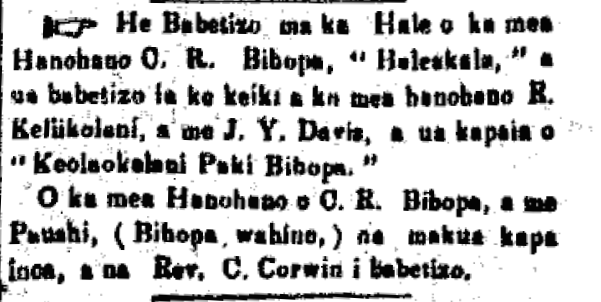
There was a Baptism at the Residence of the Honorable C. R. Bishop, “Haleakala;” baptized was the child of the honorable R. Keelikolani and J. Y. Davis, and he was called, “Keolaokalani Paki Bihopa.”

The Honorable C. R. Bishop and Pauahi (the wife of Bishop) were those who bestowed the name, and Rev. C. Corwin is the one who performed the baptism.

(Hoku o ka Pakipika, 2/12/1863, p. 2)

"He Babetizo ma ka Hale..."

Ka Hoku o ka Pakipika, Buke 2, Helu 18, Aoao 2. Feberuari 12, 1863.

Honorable Lydia Kamakaeha Paki weds Adjutant General Major J. O. Dominis, 1862.

MARRIED—At the hour of 8 in the evening of Tuesday, the 16th of this month, the Honorable Lydia Kamakaeha Paki married Adjutant General Major J. O. Dominis, at Haleakala, the Residence of the Honorable C. R. Bishop and his Chiefess. The two were married in the Anglican faith.

Present were the King; Her Highness Princess V. K. Kaahumanu; His Highness Prince L. Kamehameha; the Honorable M. Kekuanaoa, the Chiefly Governor of Oahu; Colonel Peter Young Kekuaokalani; there also were the parents of the woman, and the mother of the man, and his cousins.

Rev. Samuel C. Damon was who married them. There was much appreciation for how fine and honorable it was. With the two of them is the aloha of this paper.

[It seems Queen Emma was not present at this wedding. Ka Haku o Hawaii had only passed away a few weeks earlier…]

(Kuokoa, 9/20/1862, p. 3)

MAREIA...

Ka Nupepa Kuokoa, Buke I, Helu 43, Aoao 3. Sepatemaba 20, 1862.

Beginnings of the Anglican Church in Hawaii, 1862.

Pertaining to the 28th of November¹

This day known to everyone, the day of the return of independence to the Islands and the day chosen by the Monarchs as a day for the two of them to join the new faith which has recently arrived.

On the morning of that day, at the hour of 10½, the Alii arrived at the Church and the National troops [koa o ke Aupuni], the Honolulu Rifles [koa Rifles?], the Hawaii Kiai [?], and the Cavalry [Puali Kaua Lio] were all lined up.

When the Alii arrived and passed through the entrance, the Bishop came and layed his hand and blessed them. They then entered within and sat down; following them was a procession, and they entered while chanting one of the psalms. After this was done, the laying on of hands began, and they were confirmed as brethren of the new church.

The beauty that is imbued in all creatures of the earth is what left all of their subjects who went there awe-stricken. Some wept, some fled [hoonaholoholopoo?], some were downcast, and some shuddered in awe, appearing as if the spirit from the heavens was accepted in the Monarchs joining into the circle of eternal life.

Present was Her Highness Princess V. K. Kaahumanu, the Honorable M. Kekuanaoa, the Honorable R. C. Wyllie, the Honorable Chief Justice E. H. Allen, the Honorable C. R. Bishop and his wife, the Honorable C. Kapaakea, the Honorable Colonel D. Kalakaua, Colonel McKibbin Jr., Colonel W. C. Lunalilo, Major Hasslocher, Kekaaniau, the Dowager Queen K. Hakaleleponi, Mrs. Haalelea, the wives of the Supreme Court Judges, and the Honorable Ii. There also was W. W. F. Synge and his wife, along with the Consuls of Foreign Nations.

The building was filled with those wanting to witness the joining of the Monarchs as brethren, and everyone felt much appreciation for the beauty of the Royals, the Alii, and the ceremony performed. God save the King.

¹La Kuokoa [Hawaiian Independence Day]

(Hoku o ka Pakipika, 12/4/1862, p. 2)

No ka la 28 o Novemaba.

Ka Hoku o ka Pakipika, Buke 2, Helu 8, Aoao 2. Dekemaba 4, 1862.