John L. Stevens represents Hawaii in America, 1893.

STEVENS AND HAWAII.

The Ex-Minister Points Out the Advantage of Annexation.

AMERICAN INTEREST LEAD

An Address Before San Francisco Chamber of Commerce, Which Passes Resolution Favoring Annexation.

San Francisco, June 1.—Hon. John L. Stevens, ex-United States minister at Hawaii, addressed the Chamber of Commerce of this city to-day on the subject of “Hawaiian Affairs and Their Relation to the Interest of the United States.” A large number of businessmen were present and gave the speaker an appreciative reception. At the close of the address a resolution was adopted favoring the speedy annexation of the islands. Mr. Stevens, in relating his first impressions upon the islands, said he had not been long in Honolulu before he perceived how thoroughly an American city it was and how predominating were all American interests on the islands. Continuing he said:

He had found an intelligent body of citizens of American and European origin supporting a semi-barbaric monarchy, dead in everything but its vices; coarsely luxuriant in its tastes and wishes and spreading social and political demoralization througout the island.

The speaker then related several incidents in the career of the deposed queen, and charges her not only with personal immorality, but also with having by unconstitutional and arbitrary methods, secured the adoption of certain measures, such as the opium and lottery bills, and recited her attempt to promulgate a new constitution, which finally aroused the respectable element of the community to action. Mr. Stevens then reviewed in detail the circumstances of the revolution and overthrow of the queen last January, and the subsequent establishment of the provisional government. He spoke of the danger of riot and incendiarism at the time of the revolution, the fact that there was no adequate police power in Honolulu, and that an appeal was accordingly made for the landing of men from the United States ship Boston. In this connection, Mr. Stevens said in part:

Under the diplomatic and naval rules, the United States minister and naval commander would have shamefully ignored their duty had they not landed men from the Boston for the security of American life and property and the maintenance of public order, even had the committee of public safety not requested the United States to do so. The Boston’s men stepped not an inch from the line of duty; they never lifted a finger in aid of the fallen monarchy on the rising of the provisional government and all assertions to the contrary, by whomsoever uttered, are audacious falsehoods.

Continue reading

King Kalakaua’s 50th birthday celebration, with detailed tour of Iolani Palace, 1886.

THE KING’S BIRTHDAY.

The Palace Decorated for the Festivities.

Changes in the Pictures and Decorations Which Bring Out the Ancient History of the People.

In view of the festivities which commence this morning in honor of the fiftieth anniversary of the natal day of His Majesty the King, Iolani Palace has undergone extensive preparations, the arrangements for the reception and entertainment of the guests being very complete. The balconies are bedecked in bunting embodying in bold and striking designs the colors of the Royal Standard. The principal entrance hall has been richly caparisoned at the hands of the upholsterer. Its walls have been newly hung with the valuable oil paintings, representing in life size the line of Hawaiian Sovereigns, with their consorts, from the time of Kamehameha I, downwards. The first position on the right is occupied by the portrait of the Conqueror, whose reign marked so momentous and epoch in the history of the Kingdom, and whose genius has so largely influenced its destiny. Side by side with this is the portrait of Kekauluohi, mother of King Lunalilo. Next are those of Kmehameha II and Queen Kaumaulii [Kamamalu ?]; Kamehameha III and Queen Kalama. On the left are arranged the portraits of Kamehameha IV and Queen Emma; Kamehameha V and King Lunalilo. The niches in the intervening spaces are each filled with some choice fern or other horticultural specimen. The general effect is extremely pleasing to the eye.

The throne room, in which the receptions will take place, has been newly furnished with a rich crimson carpet. On either side of the dais are suspended the Royal Orders of Kamehameha, Kalakaua, Kapiolani and the Crown of Hawaii, whilst the walls on every side are adorned with the numerous foreign decorations with which His Majesty has from time to time been invested. Each one is enclosed in a gilt oval frame, surmounted with the Royal Arms of the particular nation or empire to which the Order belongs. Leaving the throne room and crossing the central hall, one passes into the Blue room . The first object that meets the eye is a striking portrait of His Majesty in the uniform of the King’s Guard, with decorations. Facing this, to the right of the doorway, is one of Her Majesty the Queen, whilst on the left is a full length life size representation of Louis XIV of France, a work of rare value. The two former are from the brush of Charles Hasselmann. Among the many ornaments and curios is a set of vases in Benares brass ware, from India. To the rear of this apartment is the spacious dining hall, in which are displayed the massive silver table ware, each article bearing the Royal Arms in colored enamel. The furniture is early English in style, whilst some choice works of art adorns the walls. The latter include a portrait of Kamehameha IV, taken during the monarch’s boyhood, a companion pair of Napoleon I and IV, taken during that monarch’s boyhood, a companion pair of Napoleon I and Blucher; Admiral Thomas, who restored the country; the Czar Alexander II of Russia, and a graphic delineation of the crater of Kilauea by night, painted by Furneaux.

Ascending the grand staircase the upper hall is next entered, wherein the King’s Privy Council of State is usually held. The central figure is a bust in bronze of His Majesty the King; oil paintings and tasteful cabinets, containing articles of vertu,are disposed on either side, while the hall, which runs the entire width of the building, commands a magnificent vista of Pauoa Valley, the mountains, tier behind tier, with the different hues forming an effective background. The front window overlooks the Aliiolani Hale, and affords a distant view of the sea.

The private apartments of His Majesty lead off from the upper hall, and are located on the left, or Ewa, side of the Palace. In the front is the music room, in which the heavy style of furniture is discarded for a lighter and more appropriate one, the appointments being in excellent taste. In the room are a set of half a dozed water color drawings of special historic interest. They are illustrative of island scenes at a period prior to the advent of civilization, among which are representations of the large double canoes carrying the ancient idols; the heiaus or temples, both open and closed; grass houses, etc. These pictures are enlargements by R. C. Barnfield, after the originals taken on the spot by Captain Kotzbue, the Russian author of “Voyages in the Pacific.”

At the further end, facing the entrance, is a speaking likeness of Her Majesty the Queen, life size, in oil, by Furneaux. The room also contains a very fine painting of the crater of Kilauea, by Tavernier; a Belgian Princess, a daughter of the present King, together with cabinet photographs of Sir John and Lady Franklin. Less obtrusive, but of considerable interest, is a study in music, framed in a peculiarly chaste and unique manner.

Continue reading

Leprosy patients wanting to be reexamined, 1909.

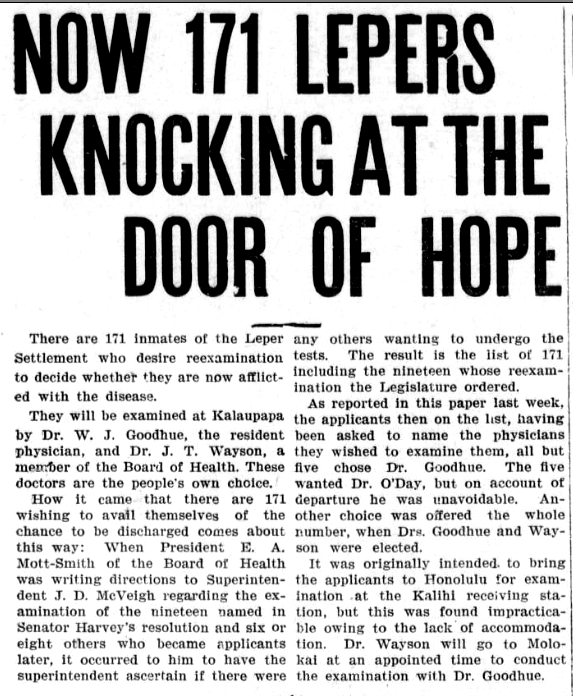
NOW 171 LEPERS KNOCKING AT THE DOOR OF HOPE

There are 171 inmates of the Leper Settlement who desire reexamination to decide whether they are now afflicted with the disease.

They will be examined at Kalaupapa by Dr. W. J. Goodhue, the resident physician, and Dr. J. T. Wayson, a member of the Board of Health. These doctors are the people’s own choice.

How it came that there are 171 wishing to avail themselves of the chance to be discharged comes about this way: When President E. A. Mott-Smith of the Board of Health was writing directions to Superintendent J. D. McVeigh regarding the examination of the nineteen named in Senator Harvey’s resolution and six or eight others who became applicants later, it occurred to him to have the superintendent ascertain if there were any other wanting to undergo the tests. The result is the list of 171 including the nineteen whose reexamination the Legislature ordered.

As reported in this paper last week, the applicants then on the list, having been asked to name the physicians they wished to examine them, all but five chose Dr. Goodhue. The five wanted Dr. O’Day, but on account of departure he was unavoidable. Another choice was offered the whole number, when Drs. Goodhue and Wayson were elected.

It was originally intended to bring the applicants to Honolulu for examination at the Kalihi receiving station, but this was found impracticable owing to the lack of accommodation. Dr. Wayson will go to Molokai at an appointed time to conduct the examination with Dr. Goodhue.

(Hawaiian Star, 8/24/1909, p. 1)

HawaiianStar_8_24_1909_1.png

The Hawaiian Star, Volume XVII, Number 5426, Page 1. August 24, 1909.

More on prolific Charles Furneaux, 1881.

Mr. Furneaux’s Paintings.

A very interesting series of oil paintings by Mr. Furneaux is to be seen in the tower room of the Government Building [Aliiolani Hale]. These are chiefly sketches of the volcanic phenomena which have been displayed on Hawaii since November last. Having been on the spot from the beginning of the eruption, and taking a great interest in it, Mr. Furneaux has been able to secure illustrations of all its phases during the progress of the flow, from its source to the immediate proximity of the sea. The first of the series is a view taken from Kawaihae, in November last, after the flow had divided into two or more streams; one the Kau stream, which, after threatening the Kapapala Plantation, has long since ceased to flow; another the flow towards the plateau between Maunaloa and Maunakea, which, after many windings and doublings, is now threatening the town and harbor of Hilo. The next view was taken from Hilo Bay, and shows the three streams which were so conspicuous on the face of the mountain in November last. Immediately after his arrival Mr. Furneaux paid a visit to the crater of eruption, which is situated at an elevation of about 12,000 feet, or about 2,000 feet below the summit of the mountain. Three of the paintings depict this crater, one being from a point which gives a view of its interior. Another picture gives a near view of the blow-hole, or secondary crater, from which a discharge of lava was noticed on December 3rd. The next group of paintings gives us vivid illustrations of the conditions of things near Hilo in April and May last. In the former month Mr. Furneaux obtained a fine view of the main flow, as it appeared in the woods about eight miles from Hilo, at the time when its whole width of two to two and a half miles was in a molten and very active state, just at a point where the Puna, Waiakea and Hilo flows were being separately developed from it. In this picture we have a fine illustration of the “volcano cloud” with its deep red tinge looking more fiery than the very lava whose glow it reflects. The next of the series shows the curious phenomena of a waterspout on the lava flow, a sight frequently witnessed when the front face of the stream was lingering in the woods. Another picture also taken in April at the same distance from Hilo, shows the black and broken surface of the flow of 1856 and this new and greater flow creeping up to and over it. The next series of sketches were of the Waiakea flow taken two months before the sudden outburst by which it has threatened the sugar mill. One is of the artist’s camp in a dense growth of ohias, tree-ferns and wild bananas close to the edge of the flow. Another sketch from the tent door pictures some bananas, ferns and creepers with the red glare from the lava as a background. A third is a daylight view of the flow showing the havoc made in the lovely forest thus cruelly invaded. This sketch was taken when one tall ohia remained still erect with lava all round it. John Hall, whose place has since been destroyed, was Mr. Furneaux’s guide, and the latter made a sketch of his house before its fate was anticipated. This view was taken in May; a companion picture shows everything overwhelmed except a tree and part of the fence, with an extraordinary pit in the foreground, revealing the liquid lava flowing beneath the cooled crust. Later in May Mr. Furneaux paid a visit to what is known as the Hilo flow. Among the group of sketches then taken is one of the advanced part of the flow, with a group of Hawaiians getting specimens in the foreground; a sketch of Hale Laumaia, with the volcanic cloud hanging over the wooded scenery of the background; a sketch of the flow at the moment of one of the gas explosions, which are common when the lava is passing over the surface of previous flows, and penetrating into the caverns which about in the dead lava. Then comes a sketch in which we have a cascade of lava falling over a ledge of bare rock, and by way of contrast to its lurid fire, the flame of burning timber and undergrowth on the right hand of the picture. Following this series is a picture of the Waiakea flow as seen from a distance before its sudden advance; also a sketch of H. H. Ruth Keelikolani’s place, where that flow will probably reach the sea. The last group are from sketches taken late in July, after the Waiakea flow had pushed forward with so much violence. One of John Hall’s property has already been alluded to; another shows the lava flowing over a precipice about 60 feet wide, and 14 or 15 feet high, into a great pool of water—a scene already familiar to us through Mr. Dickson’s photographs; and a third shows the Waiakea mill, and the position of the flow on 25th July, with the intervening land. One interesting picture shows the way in which the lava at times pushes its way forward, throwing out snake-like tongues of fire from the black front of the stream.

Besides these paintings, there are some pictures of Halemaumau, and some views of forest and mountain scenery. Mr. Furneaux has also a number of other pictures, which he has not at present opened out for the public view, as he intends to return at once to Hilo to increase his store of sketches, and to catch, if possible, the lava stream in the very act of precipitating itself into the sea.

(Pacific Commercial Advertiser, 8/13/1881, p. 3)

PCA_8_13_1881_3.png

The Pacific Commercial Advertiser, Volume XXVI, Number 7, Page 3. August 13, 1881.

Mauna Loa eruption and Furneaux, 1881.

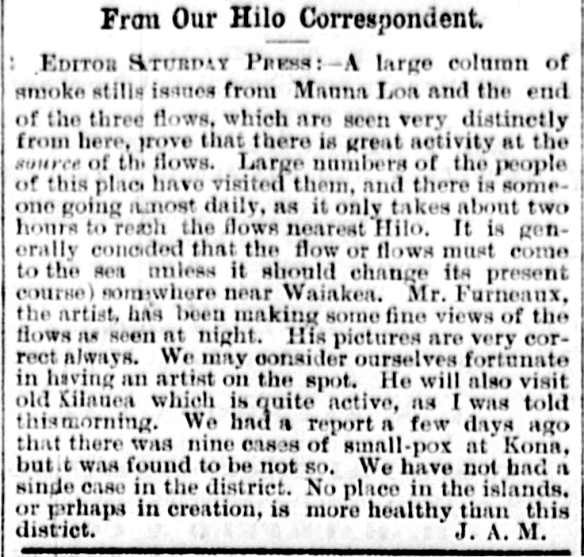
From Our Hilo Correspondent.

Editor Saturday Press:—A large column of smoke stills issues from Mauna Loa and the end of the three flows, which are seen very distinctly from here, prove that there is great activity at the source of the flows. Large numbers of the people of this place have visited them, and there is someone going almost daily, as it only takes about two hours to reach the flows nearest Hilo. It is generally conceded that the flow or flows must come to the sea unless it should change its present course) somewhere near Waiakea. Mr. Furneaux, the artist, has been making some fine views of the flows as seen at night. His pictures are very correct always. We may consider ourselves fortunate in having an artist on the spot. He will also visit old Kilauea which is quite active, as I was told this morning. We had a report a few days ago that there was nine cases of small-pox at Kona, but it was found to be not so. We have not had a single case in the district. No place in the islands, or perhaps in creation, is more healthy than this district.  J. A. M.

(Saturday Press, 5/21/1881, p. 2)

SaturdayPress_5_21_1881_2.png

Saturday Press, Volume I, Number 38, Page 2. May 21, 1881.

English coverage of Kamehameha Schools graduation, 1908.

CLOSING EXERCISES AT KAMEHAMEHA SCHOOLS

The Kamehameha Manual Schools will have their closing exercises this evening and the graduating class have invited their many friends to be present to enjoy the following program which has been arranged:

Prelude—Offertoire in D Minor ..Batiste
Miss S. L. Byington.

Invocation—
Rev. Bradford Leavitt, D. D.

Response—”He Aloha no ka Haku”..Liliuokalani
Choir Boys.

Essay—”Ancient Hawaii as Told by a Retainer”
Julia Lazaro.

Mele—”He Inoa no Pauahi”..Prince Leleiohoku

Essay—”Modern Hawaii”
Henry Waiau.

Essay—”Industries of Ancient Hawaii”
Elizabeth Macy.

Chorus—Hawaiian Hymn ..E. A. P. Newcomb
Boys’ Glee Club.

Essay—”Industries of Modern Hawaii”
John Pahia.

Essay—”Influence of Kamehameha in the Future of Hawaii”
Joseph Ordenstein.

Chorus of Vintages ..Henry Smart
School for Girls.

Essay—”Woman in Ancient and Modern Hawaii”
Lillian Broad.

Essay—”Hawaii of Tomorrow”
James Mahikoa.

Chorus—Recessional ..De Koven
Boys’ Glee Club.

Presentation of Certificates.

“Hawaii Ponoi”

Benediction—
Rev. John L. Hopwood.

“Kamehameha School for Girls’ Call”
Senior Class.

Postlude in E Flat..Lefebure Wely

The graduating class of 1908 consists of the following pupils of the school: Continue reading

Things that make you go, “Hmmmm.” 1883.

[Found under: “ISLAND LOCALS: ABOUT TOWN.”]

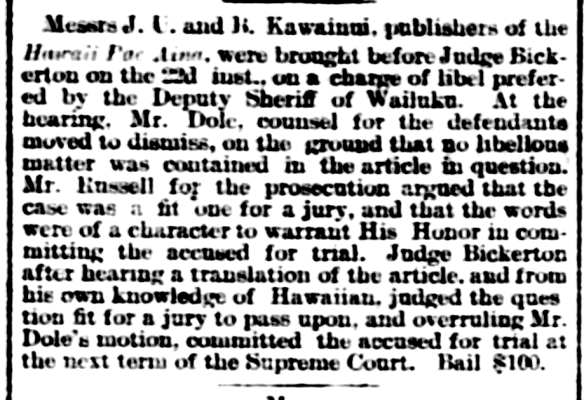
Messrs J. U. and B. Kawainui, publishers of the Hawaii Pae Aina, were brought before Judge Bickerton on the 22d inst., on a charge of libel prefered by the Deputy Sheriff of Wailuku. At the hearing, Mr. Dole, counsel for the defendants moved to dismiss, on the ground that no libellous matter was contained in the article in question. Mr. Russell for the prosecution argued that the case was a fit one for jury, and that the words were of a character to warrant His Honor in committing the accused for trial. Judge Bickerton after hearing a translation of the article, and from his own knowledge of Hawaiian, judged the question fit for a jury to pass upon, and overruling Mr. Dole’s motion, committed the accused for trial at the next term of the Supreme Court. Bail $100.

(Hawaiian Gazette, 4/25/1883, p. 3)

HawaiianGazette_4_25_1883_3.png

Hawaiian Gazette, Volume XVIII, Number 17, Page 3. April 25, 1883.

Makawao Union Church comes to an end, 1916.

Memories Awakened By Passing Of Old Church

June 25th was a memorable day at the Makawao Union Church of Paia because it was the last Sunday during which religious services were to be held previous to the dismantling of the building.

The exercises were especially marked by a beautiful solo by Mrs. Jones, and an interesting sermon of a semi-historical nature, entitled—”The Passing of the Old Church”, by Rev. A. C. Bowdish.

The first building of the church was a small wooden structure at Makawao on the site now occupied by the cemetery. The change of location was made to the present situation for two reasons, first because of the shifting of the center of the district’s population and second because of the present position marks the place where the late Mr. H. P. Baldwin nearly lost his life. Continue reading

Adam Pali dies, 1903.

[From: “LAHAINA LINES.”]

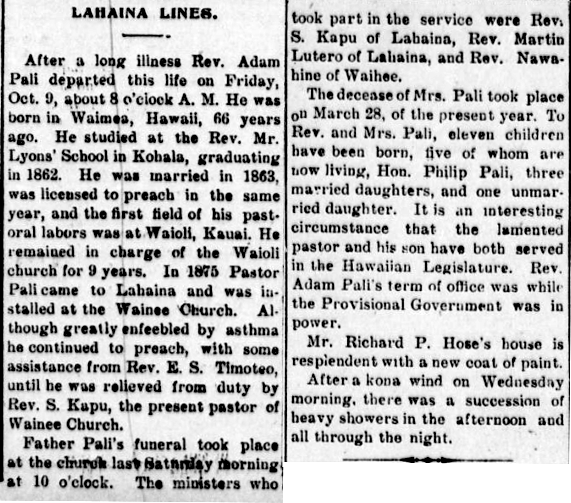
After a long illness Rev. Adam Pali departed this life on Friday, Oct. 9, about 8 o’clock A. M. He was born in Waimea, Hawaii, 66 years ago. He studied at the Rev. Mr. Lyons’ School in Kohala, graduating in 1862. He was married in 1863, was licensed to preach in the same year, and the first field of his pastoral labors was a Waioli, Kauai. He remained in charge of the Waioli church for 9 years. In 1875 Pastor Pali came to Lahaina and was installed at the Wainee Church. Although greatly enfeebled by asthma he continued to preach, with some assistance from Rev. E. S. Timoteo, until he was relieved from duty by Rev. S. Kapu, the present pastor of Wainee Church.

Father Pali’s funeral took place at the church last Saturday morning at 10 o’clock. the minister who took part in the service were Rev. S. Kapu of Lahaina, Rev. Martin Lutero of Lahaina, and Rev. Nawahine of Waihee.

The decease of Mrs. Pali took palce on March 28, of the present year. To Rev. and Mrs. Pali, eleven children have been born, five of whom are now living, Hon. Pilip Pali, three married daughters, and one unmarried daughter. It is an interesting circumstance that the lamented pastor and his son havve both served in the Hawaiian Legislature. Rev. Adam Pali’s term of office was while the Provisional Government was in power.

(Maui News, 10/17/1903, p. 3)

MauiNews_10_17_1903_3

Maui News, Volume VIII, Number 8, Page 3. October 17, 1903.

Pāʻū riding a hundred ten years ago and more, 1906.

PA-U PARADE ON MONDAY

The Riders Expect to Have a Very Big Turnout.

The Association of Pa-u Riders, otherwise known as the Hui Holopa-u Maile Alii, is making great preparations for its parade of Pa-u riders on Monday, June 11. This society formed by Mrs. Kaimana [Kainana] Puahi and others interested in the preservation of the old Hawaiian manner of horseback riding with the picturesque pa-u immediately following the floral parade of Washington’s birthday, of which parade the pa-u riders formed one of the most attractive features. The ladies have since devoted much time to practice, and to the making of appropriate dresses, and have been helped by the members of the Promotion Committee, by Manager Charles Crane of the Hawaiian Gazette Co. and by many others, to all of whom the members of the Hui Holopa-u Maile Alii wish to return their most sincere thanks.

OBSERVATIONS OF THE DAY.

The program for the day is most complete. At 6:30 in the morning, the members of the hui will meet at the Waikiki residence of Mrs. Puahi, at which time all will don the pa-u. At eight o’clock the line will begin to form, Sheriff A. M. Brown being the marshal of the parade. At 8:30 the procession will move to the Kapahulu road, thence to Beretania street, thence to Washington place. Continue reading