Invasion, 1893.

The American Troops Landed.

Without knowledge of the Government, and with agreement from the American Minister [Stevens] not to land the troops from the warship while the Government is prepared to keep peace; the American Minister nonetheless ordered the troops of the Boston to be  put in service. This would appear as if it is an attack, and should the government [provisional government] listen to the truth of these actions by its official, this will be something that it will condemn.

(Leo o ka Lahui, 1/17/1893, p. 2)

LeookaLahui_1_17_1893_2

Ka Leo o ka Lahui, Buke II, Helu 624, Aoao 2. Ianuari 17, 1893.

The U. S. S. Boston, John L. Stevens, and the Hawaiian flag, 1893.

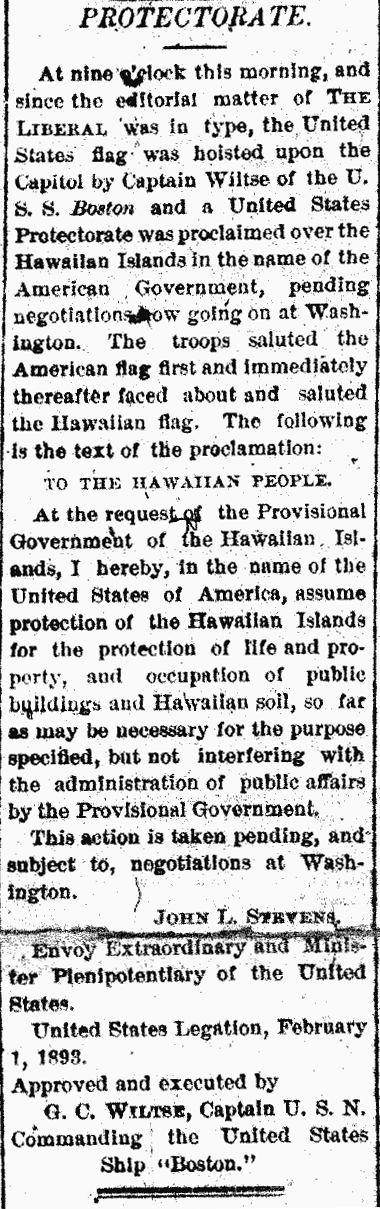
PROTECTORATE.

At nine o’clock this morning, and since the editorial matter of The Liberal was in type, the United States flag was hoisted upon the Capitol by Captain Wiltse of the U. S. S. Boston and a United States Protectorate was proclaimed over the Hawaiian Islands in the name of the American Government, pending negotiations now going on at Washington. The troops saluted the American flag first and immediately thereafter faced about and saluted the Hawaiian flag. The following is the text of the proclamation:

TO THE HAWAIIAN PEOPLE.

At the request of the Provisional Government of the Hawaiian Islands, I hereby, in the name of the United States of America, assume the protection of the Hawaiian Islands for the protection of life and property, and occupation of the public buildings and Hawaiian soil, so far as may be necessary for the purpose of specified, but not interfering with the administration of public affairs by the Provisional Government.

This action is taken pending, and subject to, negotiations at Washington.

John L. Stevens,

Envoy Extraordinary and Minister Plenipotentiary of the United States.

United States Legation, February 1, 1893.

Approved and executed by

G. C. Wiltse, Captain U. S. N.

Commanding the United States Ship “Boston.”

(Liberal, 2/1/1893, p. 2)

PROTECTORATE.

The Liberal, Volume I, Number 41, Page 2. February 1, 1893.

Senator John T. Morgan replies, 1897.

MORGAN’S REPLY.

The Senator From Alabama Answers J. K. Kaulia’s Open Letter.

He Defends the Position of Himself and the Annexationists.

Honolulu, Oct. 12, 1897.

Mr. James K. Kaulia,

Dear Sir,—A pressure of engagements has necessarily delayed an answer to your open letter.

Having no disposition to interfere in Hawaiian affairs or to attempt to influence the opinions of the Hawaiians on the subject of annexation to the United States, or to any country, I do not wish to enter upon a discussion, which you invite, as to any views I have heretofore expressed on that subject.

A preference is quite a different matter from an alternative, when the latter is forced upon us by circumstances beyond our control. As my government has not submitted to a vote of our people, the question of our willingness to accept the annexation of Hawaii, and has not a proceeding so unusual and so idle, I have not thought it necessary, or fair, that this question should be submitted to a popular vote in Hawaii, Your Constitution provides for annexation without such a vote. But I would regret to have you feel that I am indifferent to the wishes of your people on this subject; I wish them to feel that our motives are honorable; that our sentiments are only those of sincere regard for their happiness, and that our course towards them will be wise and just.

I have said in the Senate that if I was a Hawaiian citizen I would not prefer annexation to any country. If I were a Cuban I would have the same preference for a separate and independent Republic, won by Cuban blood. This is in the sense of national pride, which must always yield to national safety.

But the present condition of Cuba and of Hawaii does not admit of such a preference.

Cuba has found that she must be a republic in order to escape the terrors of foreign monarchial rule, and Hawaii must also remain a republic to avoid sinking into a like condition.

If Hawaii relapses into monarchy she will be cut off from any reliance on the protection of the United States. In that event we could not accept her into our Union, nor could we, in any event, accept Hawaii as a dependency, or colony. We have no such powers under our Constitution.

When the alternative is presented as it is, whether I would prefer annexation to the United States rather than have Hawaii sink into a petty monarchy, to be ruled by some foreign country, I would prefer to save the liberties of the people, through annexation, to a tawdry show of royalty by a few persons set in authority over them, who would be compelled to do the bidding of some monarch. In the American Union Hawaii would be really independent, and would be forever safe against any foreign interference. She would not be smothered with Asiatic immigrants, nor would she ever become a sugar colony of a monarch, as Cuba is, to be robbed and oppressed by non-resident nabobs, and then flayed alive on the first utterance of a plea or protest in the name of humanity. Finding that it is necessary to act in order to meet the clandestine movements of some citizens and others who are subjects of foreign monarchies, for the destruction of republican government in Hawaii, I would prefer annexation to the United States, rather than risk the danger of having to fight for the life of the country, as Cuba is forced to do.

When Japau wished to annex Formosa to her Empire, she did not consult the Chinese there, to ascertain their wishes. When by a process of emigration Japan has filled these islands with her people, who still owe allegiance to the Emperor, she will ask no questions of the Hawaiians whether they wish to become Japanese subjects; nor will your people be able to resist this quiet process of absorption, you will sink, as the rains sink into the thirsty soil.

If your people were all united in their preference for republican government, I would, if I were a citizen of Hawaii, now prefer her separate independence, as a matter of pride, yet I remember how costly, to Ireland, a like feeling has been, and how it has lost to her people all hope of separate national independence, but the Hawaiian Islands are not independent of fate, however much their native people may desire a separate government. If I belonged to that race I would sacrifice any preference, either of pride or convenience, rather than be suffocated with people who have nothing in common with them in religion, or in their ideas of government. I would unite with the American people in their support of free, constitutional government rather than see any republic relapse into a monarchy, in this Western Hemisphere.

Very respectfully,

John T. Morgan.

(Independent, 10/16/1897, p. 3)

MORGAN'S REPLY.

The Independent, Volume V, Number 716, Page 3. October 16, 1897.

James Keauiluna Kaulia speaks to America, 1897 / 2014.

AN OPEN LETTER.

From J. K. Kaulia to Senator Morgan.

Let the United States Undo the Great Wrong Perpetrated Upon the Hawaiian People by Minister Stevens, and then Consult Them as to Annexation.

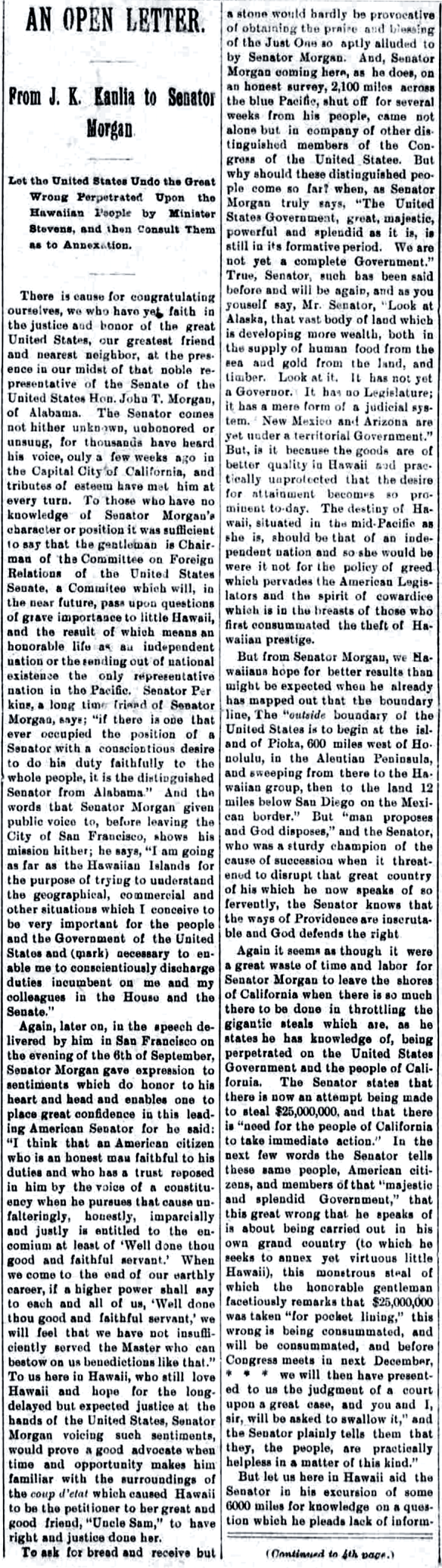
There is cause for congratulating ourselves, we who have yet faith in the justice and honor of the great United States, our greatest friend and nearest neighbor, at the presence in our midst of that noble representative of the Senate of the United States Hon. John T. Morgan, of Alabama. Tho Senator comes not hither unknown, unhonored or unsung, for thousands have heard his voice, only a few weeks ago in the Capital City of California, and tributes of esteem have met him at every turn. To those who have no knowledge of Senator Morgan’s character or position it was sufficient to say that the gentleman is Chairman of the Committee on Foreign Relations of the United States Senate, a Committee which will, in the near future, pass upon questions of grave importance to little Hawaii, and the result of which means an honorable life as an independent nation or the sending out of national existence the only representative nation in the Pacific. Senator Perkins, a long time friend of Senator Morgan, says: “if there is one that ever occupied the position of a Senator with a conscientious desire to do his duty faithfully to the whole people, it is the distinguished Senator from Alabama.” And the words that Senator Morgan given public voice to, before leaving the City of San Francisco, shows his mission hither; he says, “I am going as far as the Hawaiian Islands for the purpose of trying to understand the geographical, commercial and other situations which I conceive to be very important for the people and the Government of the United States and (mark) necessary to enable me to conscientiously discharge duties incumbent on me and my colleagues in the House and the Senate.”

Again, later on, in the speech delivered by him in San Francisco on the evening of tho 6th of September, Senator Morgan gave expression to sentiments which do honor to his heart and head and enables one to place great confidence in this leading American Senator for he said: “I think that an American citizen who is an honest man faithful to his duties and who has a trust reposed in him by the voice of a constituency when he pursues that cause unfalteringly, honestly, imparcially and justly is entitled to the encomium at least of ‘Well done thou good and faithful servant.’ When we come to the end of our earthly career, if a higher power shall say to each and all of us, ‘Well done thou good and faithful servant,’ we will feel that we have not insufficiently served the Master who can bestow on us benedictions like that.” To us here in Hawaii, who still love Hawaii and hope for the long-delayed but expected justice at the hands of the United States, Senator Morgan voicing such sentiments, would prove a good advocate when time and opportunity makes him familiar with the surroundings of the coup d’etat which caused Hawaii to be the petitioner to her great and good friend, “Uncle Sam,” to have right and justice done her.

To ask for bread and receive but a stone would hardly be provocative of obtaining the praise and blessing of the Just One so aptly alluded to by Senator Morgan. And, Senator Morgan coming here, as he does, on an honest survey, 2,100 miles across the blue Pacific, shut off for several weeks from his people, came not alone but in company of other distinguished members of the Congress of the United States. But why should those distinguished people come so far? when, as Senator Morgan truly says, “The United States Government, great, majestic, powerful and splendid as it is, is still in its formative period. We are not yet a complete Government.” True, Senator, such has been said before and will be again, and as you yourself say, Mr. Senator, “Look at Alaska, that vast body of land which is developing more wealth, both in the supply of human food from the sea and gold from the land, and timber. Look at it. It has not yet a Governor. It has no Legislature; it has a mere form of a judicial system. New Mexico and Arizona are yet under a territorial Government.” But, is it because the goods are of better quality in Hawaii and practically unprotected that the desire for attainment becomes so prominent to-day. The destiny of Hawaii, situated in the Mid-Pacific as she is, should be that of an independent nation and so she would be were it not for the policy of greed which pervades the American Legislators and the spirit of cowardice which is in the breasts of those who first consummated the theft of Hawaiian prestige.

But from Senator Morgan, we hope for bettor results than might be expected when he already has mapped out that the boundary line, The “outside boundary of the United States is to begin at the island of Pioka, 600 miles west of Honolulu, in the Aleutian Peninsula, and swooping from there to the Hawaiian group, then to the land 12 miles below San Diego on the Mexican border.” But “man proposes and God disposes,” and the Senator, who was a sturdy champion of the cause of succession when it threatened to disrupt that great country of his which he now speaks of so fervently, the Senator knows that the ways of Providence are inscrutable and God defends the right.

Again it seems as though it were a great waste of time and labor for Senator Morgan to leave the shores of California when there is so much there to be done in throttling the gigantic steals which are, as he states he has knowledge of, being perpetrated on the United States Government and the people of California. The Senator states that there is now an attempt being made to steal $25,000,000, and that there is “need for the people of California to take immediate action.” In the next few words the Senator tells those same people, American citizens, and members of that “majestic and splendid Government,” that this great wrong that he speaks of is about being carried out in his own grand country (to which he seeks to annex yet virtuous little Hawaii), this monstrous steal of which the honorable gentleman facetiously remarks that 25,000,000 was taken “for pocket lining,” this wrong is being consummated, and will be consummated, and before Congress meets in next December, * * * we will then have presented to us the judgment of a court upon a great case, and you and I, sir, will be asked to swallow it,” and the Senator plainly tells them that they, the people, are practically helpless in a matter of this kind.”

But let us here in  Hawaii aid the Senator in his excursion of some 6000 miles for knowledge on a question which he pleads lack of inform-

(Independent, 10/11/1897, p. 1)
An Open Letter.

The Independent, Volume V, Number 711, Page 1. October 11, 1897.

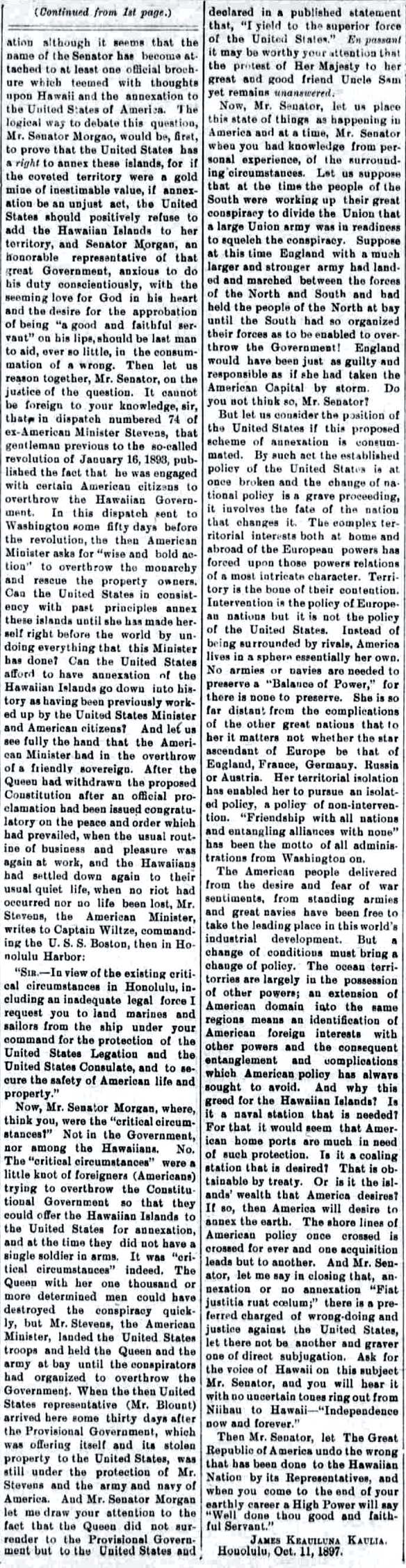
ation although it seems that the name of the Senator has become attached to at least one official brochure which loomed with thoughts upon Hawaii and the annexation to the United States of America. The logical way to debate this question, Mr. Senator Morgan, would be, first, to prove that the United States has a right to annex these islands, for if the coveted territory were a gold mine of inestimable value, if annexation be an unjust act, the United States should positively refuse to add the Hawaiian Islands to her territory, and Senator Morgan, an honorable representative of that great Government, anxious to do his duty conscientiously, with the seeming love for God in his heart and the desire for the approbation of being “a good and faithful servant” on his lips, should be last man to aid, over so little, in the consummation of a wrong. Then let us reason together, Mr. Senator, on the justice of the question. It cannot be foreign to your knowledge, sir, that, in dispatch numbered 74 of ex-American Minister Stevens, that gentleman previous to the so-called revolution of January 16, 1893, published the fact that he was engaged with certain American citizens to overthrow the Hawaiian Government. In this dispatch sent to Washington some fifty days before the revolution, the then American Minister asks for “wise and bold action” to overthrow the monarchy and rescue the property owners. Can the United States in consistency with past principles annex these islands until she has made herself right before the world by undoing everything that this Minister has done? Can the United States afford to have annexation of the Hawaiian Islands go down into history as having been previously worked up by the United States Minister and American citizens? And let us see fully the hand that the American Minister had in the overthrow of a friendly sovereign. After the Queen had withdrawn the proposed Constitution after an official proclamation had been issued congratulatory on the peace and order which had prevailed, when the usual routine of business and pleasure was again at work, and the Hawaiians had settled down again to their usual quiet life, when no riot had occurred nor no life been lost, Mr. Stevens, the American Minister, writes to Captain Wiltze, commanding the U. S. S. Boston, then in Honolulu Harbor:

“Sir.—In view of the existing critical circumstances in Honolulu, including an inadequate legal force I request you to land marines and sailors from the ship under your command for the protection of the United States Legation and the United States Consulate, and to secure the safety of American life and property.”

Now, Mr. Senator Morgan, where, think you, were the “critical circumstances?” Not in the Government, nor among the Hawaiians. No. The “critical circumstances” were a little knot of foreigners (Americans) trying to overthrow the Constitutional Government so that they could offer the Hawaiian Islands to the United States for annexation, and at the time they did not have a single soldier in arms. It was “critical circumstances” indeed. The Queen with her one thousand or more determined men could have destroyed the conspiracy quickly, but Mr, Stevens, the American Minister, landed the United States troops and held the Queen and the army at bay until the conspirators had organized to overthrow the Government. When the then United States representative (Mr. Blount) arrived here some thirty days after the Provisional Government, which was offering itself and its stolen property to the United States, was still under the protection of Mr. Stevens and the army and navy of America. And Mr. Senator Morgan let me draw your attention to the fact that the Queen did not surrender to the Provisional Government but to the United States and declared in a published statement that, “I yield to the superior force of the United States.” En passant it may be worthy your attention that the protest of Her Majesty to her great and good friend Uncle Sam yet remains unanswered.

Now, Mr. Senator, let us place this state of things as happening in America and at a time, Mr. Senator when you had knowledge from personal experience, of the surrounding circumstances. Let us suppose that at the time the people of the South were working up their great conspiracy to divide the Union that a large Union army was in readiness to squelch the conspiracy. Suppose at this time England with a much larger and stronger army had landed and marched between the forces of the North and South and had held the people of the North at bay until the South had so organized their forces as to be enabled to overthrow the Government! England would have been just as guilty and responsible as if she had taken the American Capital by storm. Do you not think so, Mr. Senator?

But let us consider the position of the United States if this proposed scheme of annexation is consummated. By such act the established policy of the United States is at once broken and the change of national policy is a grave proceeding, it involves the fate of the nation that changes it. The complex territorial interests both at home and abroad of the European powers has forced upon those powers relations of a most intricate character. Territory is the bone of their contention. Intervention is the policy of European nations but it is not the policy of the United States. Instead of being surrounded by rivals, America lives in a sphere essentially her own. No armies or navies are needed to preserve a “Balance of Power,” for there is none to preserve. She is so far distant from the complications of the other great nations that to her it matters not whether the star ascendant of Europe be that of England, France, Germany, Russia or Austria. Her territorial isolation has enabled her to pursue an isolated policy, a policy of “Friendship with all nations and entangling alliances with none” has been the motto of all administrations from Washington on.

The American people delivered from the desire and fear of war sentiments, from standing armies and great navies have been free to take the leading place in this world’s industrial development. But a change of conditions must bring a change of policy. The ocean territories are largely in the possession of other powers; an extension of American domain into the same regions means an identification of American foreign interests with other powers and the consequent entanglement and complications which American policy has always sought to avoid. And why this greed for the Hawaiian Islands? Is it a naval station that is needed? For that it would seem that American home ports are much in need of such protection. Is it a coaling station that is desired? That is obtainable by treaty. Or is it the islands’ wealth that America desires? If so, then America will desire to annex the earth. The shore lines of American policy once crossed is crossed for ever and one acquisition leads but to another. And Mr. Senator, let me say in closing that, annexation or no annexation “Fiat justitia ruat cœlum;” there is a preferred charged of wrong-doing and justice against the United States, let there not be another and graver one of direct subjugation. Ask for the voice of Hawaii on this subject Mr. Senator, and you will hear it with no uncertain tones ring out from Niihau to Hawaii—”Independence now and forever.”

Then Mr. Senator, let The Great Republic of America undo the wrong that has been done to the Hawaiian Nation by its Representatives, and when you come to the end of your earthly career a High Power will say “Well done thou good and faithful Servant.”

James Keauiluna Kaulia.

Honolulu, Oct. 11, 1897.

(Independent, 10/11/1897, p. 4)
ation although...

The Independent, Volume V, Number 711, Page 4. October 11, 1897.

The great protest of July 2, 1894.

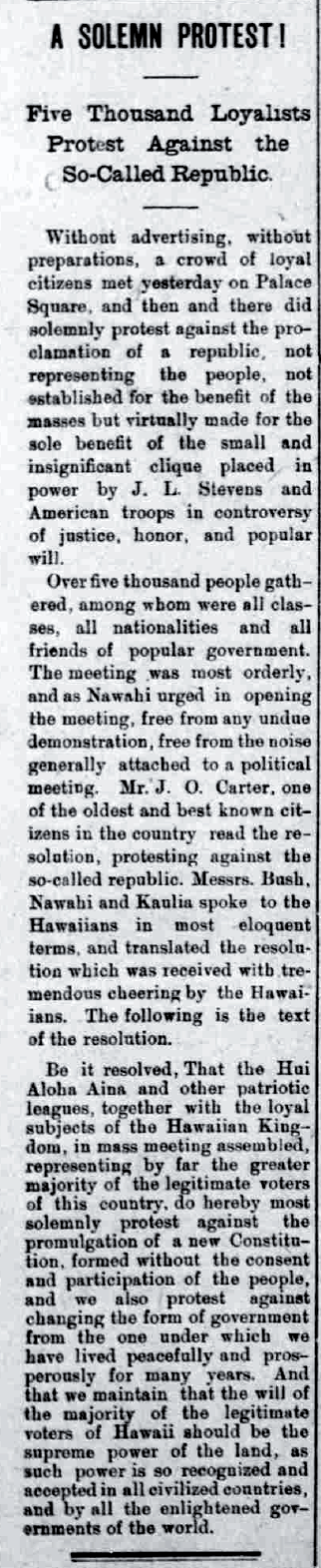
A SOLEMN PROTEST!

Five Thousand Loyalist Protest Against the So-Called Republic.

Without advertising, without preparations, a crowd of loyal citizens met yesterday on Palace Square, and then there did solemnly protest against the proclamation of a republic, not representing the people, not established for the benefit of the masses but virtually made for the sole benefit of the small and insignificant clique placed in power by J. L. Stevens and American troops in controversy of justice, honor, and popular will.

Over five thousand people gathered, among whom were all classes, all nationalities and all friends of popular government. The meeting was most orderly, and as Nawahi urged in opening the meeting, free from any undue demonstration, free from noise generally attached to a political meeting. Mr. J. O. Carter, one of the oldest and best known citizens in the country read the resolution, protesting against the so-called republic. Messrs. Bush, Nawahi and Kaulia spoke to the Hawaiians in most eloquent terns, and translated the resolution which was received with tremendous cheering by the Hawaiians. The following is the text of the resolution.

Be it resolved. That the Hui Aloha Aina and other patriotic leagues, together with the loyal subjects of the Hawaiian Kingdom, in mass meeting assembled, representing by far the greater majority of the legitimate voters of this country, do hereby most solemnly protest against the promulgation of a new Constitution, formed without the consent and participation of the people, and we also protest against changing the form of government from the one under which we have lived peacefully and prosperously for many years. And that we maintain that the will of the majority of the legitimate voters of Hawaii should be the supreme power of the land, as such power is so recognized and accepted in all civilized countries, and by all the enlightened governments of the world.

(Hawaii Holomua, 7/3/1894, p. 2)

A SOLEMN PROTEST!

Hawaii Holomua, Volume III, Number 154, Page 2. July 3, 1894.

The call to protest in English, 1894.

A SOLEMN PROTEST.

The People of Hawaii protest against the New Constitution and Mr. Dole’s Republic.

This afternoon at five o’clock the loyal citizens of Hawaii will meet on Palace Square, and enter a solemn and earnest protest against the infamous outrage, which it is proposed to perpetuate on Wednesday—the proclaiming of a republic of filibusters, the proclamation of a constitution framed by aliens and for the sole benefit of certain classes.

The temporary power invested in the provisional government was obtained through a most contemptible conspiracy, and through underhanded tricks. The revolt of January 1893 was not the outcome of a spontaneous outburst of the popular will. It was the most contemptible act on record in history. The hired brigand John L. Stevens used his brief authority to further this scheme. The country which he represented disavowed his actions and thought that the honor of the United States was saved by dismissing him, and in six lines in a message to congress rebuking him.

The world thinks differently, and there are no reasons to believe hat President Cleveland will allow himself, and his administration to be covered with infamy by leaving an admitted wrong unrepaired.

In this, the fin de siecle, the bloody ravage of war and revolution is out of fashion and arbitration has taken the place of force. But, it is necessary to show to the world that the Hawaiian People are not participating in the revolutionary movement of the oath-breaking ex-Judge, who now maskerades as a president of a republic. The People of Hawaii believe in self-government and, by the Heavens they will have it. The people shall rule. The will of the people shall be the force which makes the government.

When, this afternoon, Hawaiians and foreigners be the Anglo-Saxons, Portuguese or Chinese, stand sholder to shoulder and listen to J. O. Carter, Hawaii’s best citizen, reading the protest of Hawaii against the usurpers the loyal men they can rest assured that their protest will be heard and echoed all over the civilized world, and that the unrelenting and solid opposition to the junta, now calling themselves a republic, will be supported and admired by every power that knows the existence of these fair isles. Let therefore every man, woman and child of every race, nationality and birth be present on Palace Square, and by their presence testify to the true desire of the people of Hawaii, and quietly, orderly and peacefully prove to the world that the new government is unpopular, detested, and created against the will of the Hawaiian nation.

(Hawaii Holomua, 7/2/1894, p. 2)

A SOLEMN PROTEST.

Hawaii Holomua, Volume III, Number 153, Page 2. July 2, 1894.

Updated Elepaio Story, 1894.

DON’T WORRY.

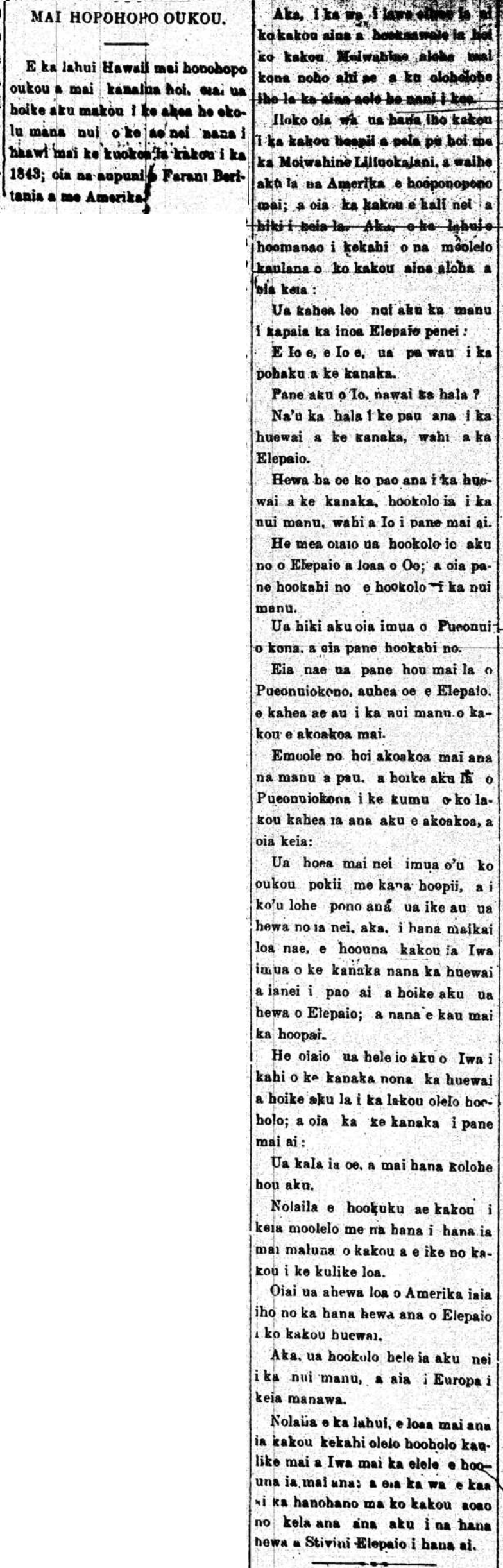
O Hawaiian people, don’t worry and don’t be uncertain. for we have publicly shown that there are three great powers of the world who have granted independence to us in 1843, that being France, Britain, and America.

But when our land was stolen and our beloved Queen was taken from her throne and our land stood bare without any beauty remaining,

During that time, we composed our protest, along with Queen Liliuokalani, and left if for America to make right; and it for this that we wait until today. But O Nation, do recall one of the famous stories of our beloved land, this being:

The bird called Elepaio called out loudly:

“O Io, O Io, I was hit by the rock of the man.”

Io answered, “Who was at fault?”

“I was wrong for pecking at the huewai of the man,” answered Elepaio.

“You are indeed at fault for puncturing the huewai of the man; let it be judged by the many birds,” was Io’s answer.

It was so, Elepaio was judged; he came upon Oo, and his answer was the same, that it be judged by the many birds.

Elepaio arrived before Pueonuiokona, and his answer was the same.

But Pueonuiokona went on to say, “Say Elepaio, I will call our many fellow birds to come together.”

In no time, all the birds came together, and Pueonuiokona revealed the reason for them being called to assemble, like this:

“Before me appeared your younger sibling with his protest, and when I heard correctly, I knew he was wrong, however, the best thing to do would be for us to send Iwa before the man to whom belonged the huewai that Elepaio pecked, and to tell him that Elepaio was guilty, and it is for him to set the punishment.”

And it was so, Iwa went to the place of the man to whom belonged the huewai, and told him of their decision; this is what the man said:

“You are forgiven, and don’t do anymore harmful acts.”

So we compare this story with the actions carried out upon us, and we see that they are exactly the same.

For America totally blames itself for the wrong done by Elepaio to our huewai.

But it is going around being judged by the many birds, and is currently in Europe.

So therefore, O Nation, we will receive a fair judgement from Iwa, the messenger that is being sent; and that will be when the dignity shall be awarded to our side through the judgement of the crimes carried out by Stevens Elepaio.

(Leo o ka Lahui, 10/11/1894, p. 2)

MAI HOPOHOPO OUKOU.

Ka Leo o ka Lahui, Buke II, Helu 1047, Aoao 2. Okatoba 11, 1894.

More on the Boston, in English, 1893.

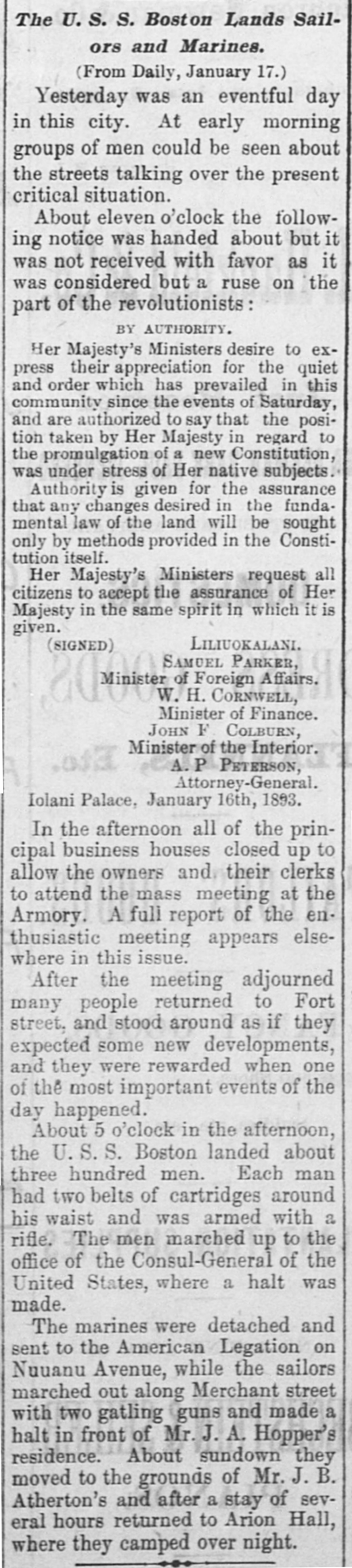
The U. S. S. Boston Lands Sailors and Marines.

(From Daily, January 17.)

Yesterday was an eventful day in this city. At early morning groups of men could be seen about the streets talking over the present critical situation.

About eleven o’clock the following notice was handed about but it was not received with favor as it was considered but a ruse on the part of the revolutionists:

BY AUTHORITY.

Her Majesty’s Ministers desire to express their appreciation for the quiet and order which has prevailed in this community since the events of Saturday, and are authorized to say that the position taken by Her Majesty in regard to the promulgation of a new Constitution, was under stress of Her native subjects.

Authority is given for the assurance that any changes desired in the fundamental law of the land will be sought only by methods provided in the Constitution itself.

Her Majesty’s Ministers request all citizens to accept the assurances of Her Majesty in the same spirit in which it is given.

(SIGNED) Liliuokalani.

Samuel Parker,
Minister of Foreign Affairs.

W. H. Cornwell,
Minister of Finance.

John F. Colburn,
Minister of the Interior.

A. P. Peterson,
Attorney-General.

Iolani Palace, January 16, 1893.

In the afternoon all of the principal business houses closed up to allow the owners and their clerks to attend the mass meeting at the Armory. A full report of the enthusiastic meeting appears elsewhere in this issue.

After the meeting adjourned many people returned to Fort street, and stood around as if they expected some new developments, and they were rewarded when one of the most important events of the day happened.

About 5 o’clock in the afternoon, the U. S. S. Boston landed about three hundred men. Each man had two belts of cartridges around his waist and was armed with a rifle. The men marched up to the office of the Consul-General of the United States, where a halt was made.

The marines were detached and sent to the American Legation on Nuuanu Avenue, while the sailors marched out along Merchant street with two gatling guns and made a halt in front of Mr. J. A. Hopper’s residence. About sundown they moved to the grounds of Mr. J. B. Atherton’s and after a stay of several hours returned to Arion Hall, where they camped over night.

[The “Daily” here mention at the top refers to the Daily Pacific Commercial Advertiser.]

(Hawaiian Gazette, 1/24/1893, p. 6)

The U. S. S. Boston Lands Sailors and Marines.

Hawaiian Gazette, Volume XXVIII, Number 4, Page 6. January 24, 1893.

More on the landing of the Boston, 1893.

OPPOSED.

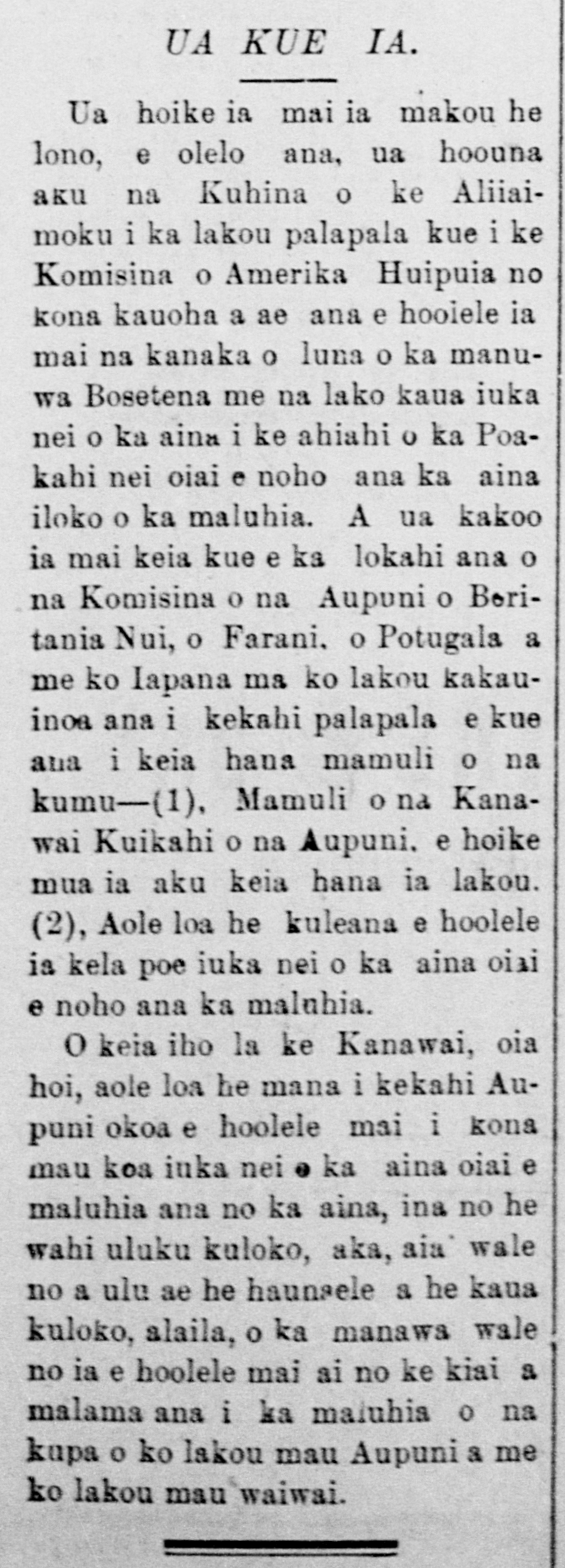
We have received news that the Ministers of the Queen sent their written protest to the Minister of the United States for his ordering the landing of the armed men from the man-of-war Boston on the evening of this Monday notwithstanding that there was peace on land. And this objection was jointly supported by the Commissioners of the Nations of Great Britain, France, Portugal, and Japan, by them signing a document opposing this action over these reasons—(1), Because of the agreement under law between the Nations to give prior notice. (2),  There was no cause to land the troops being that there was peace.

This is the Law, that being there is no other Nation that has any right to land its troops while there is peace; were there internal problems, but only if there was an uprising or a civil war, only then could there be troops landed to watch over and protect the safety of their citizens as well as their property.

(Hawaii Holomua, 1/18/1893, p. 3)

UA KUE IA.

Hawaii Holomua, Buke III, Helu 141, Aoao 3. Ianuari 18, 1893.

More on the Boston, 1893.

[Excerpt from the article: “OVERTHROW IN HAWAII NEI: The Queen Attempts to Push a New Constitution”]

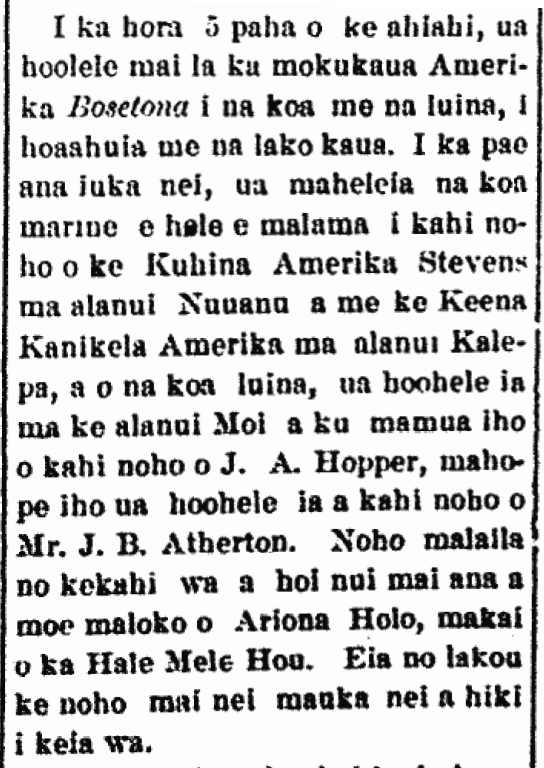
At perhaps 5 oʻclock in the afternoon, the American warship Boston [Bosetona] landed its officers and sailors who were armed. When they came ashore, the marines were split up to go and guard the residence of the American Minister Stevens on Nuuanu Avenue, and the American Consulate on Merchant Street, and the sailors were sent to King Street and stood before the residence of J. A. Hopper, and later they were sent to the residence of Mr. J. B. Atherton. They stayed there for some time, and then all came back and slept in Arion Hall [Ariona Holo] makai of the Opera House. They are still on shore to the present.

(Kuokoa, 1/21/1893, p. 2)

I ka hora 5 paha o ke ahiahi...

Ka Nupepa Kuokoa, Buke XXXII, Helu 3, Aoao 2. Ianuari 21, 1893.