The Chiefs’ Children’s School and its beginnings. 1844.

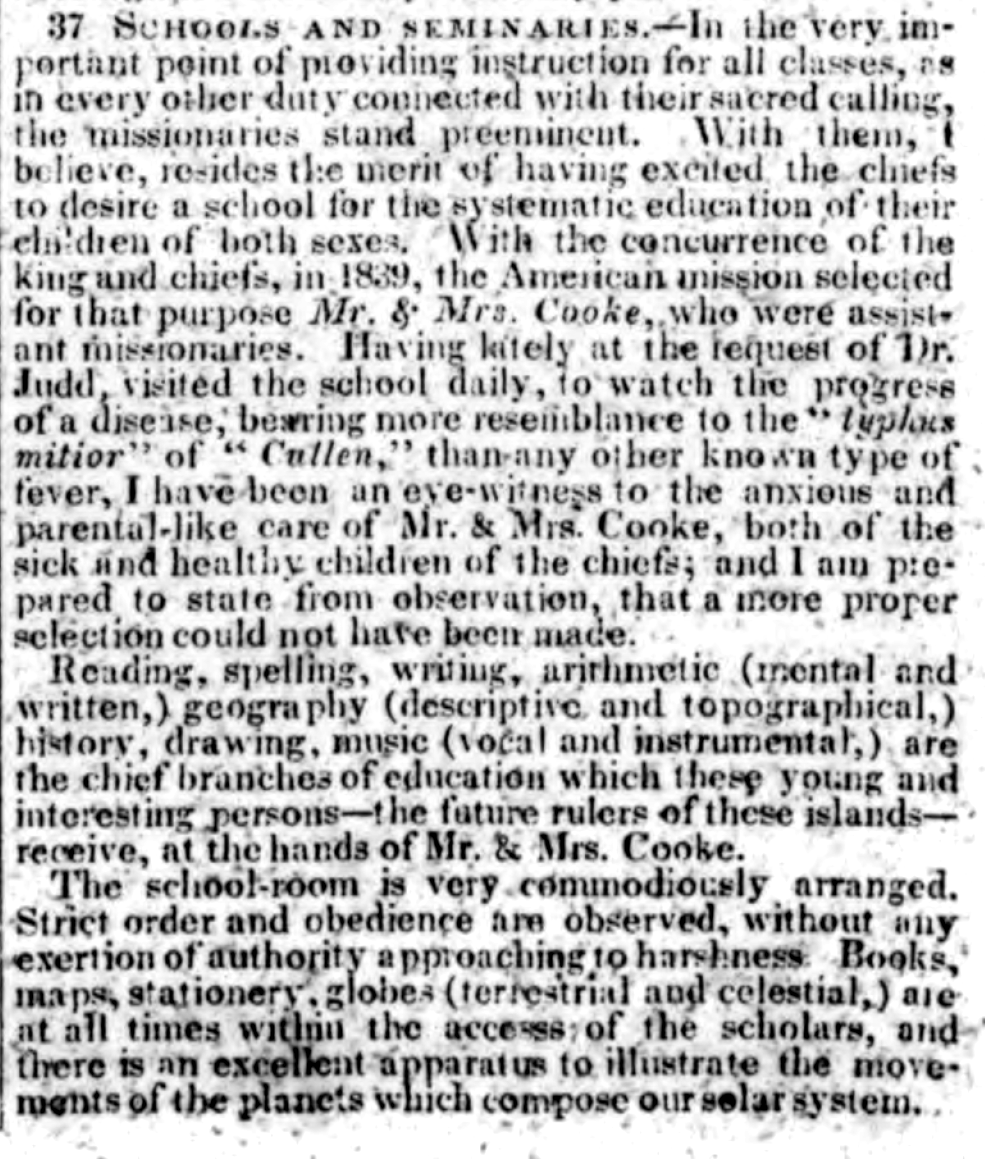
Schools and Seminaries.—In the very important point of providing instruction for all classes, as in every other duty connected with their sacred calling, the missionaries stand prominent. With them, I believe, resides the merit of having excited the chiefs to desire a school for the systematic education of their children of both sexes. With the concurrence of the king and chiefs, in 1839, the American mission selected for that purpose Mr. & Mrs. Cooke, who were assistant missionaries. Having lately at the request of Dr. Judd, visited the school daily, to watch the progress of a disease, bearing more resemblance to the “typhus mitior” of “Cullen,” than any other known types of fever, I have been an eye-witness to the anxious and parental-like care of Mr. & Mrs. Cooke, both of the sick and healthy children of the chiefs; and I am prepared to state from observation, that a more proper selection could not have been made.

The school-room is very commodiously arranged. Strict order and obedience are observed, without any exertion of authority approaching to harshness. Books, maps, stationery, gloves (terrestrial and celestial,) are at all times within the access of the scholars, and there is an excellent apparatus to illustrate the movements of the planets which compose our solar system.

(Friend, August 1, 1844, p. 35)
37. Schools and Seminaries.

The Friend, Volume II, Number VIII, Page 35. August 1, 1844.

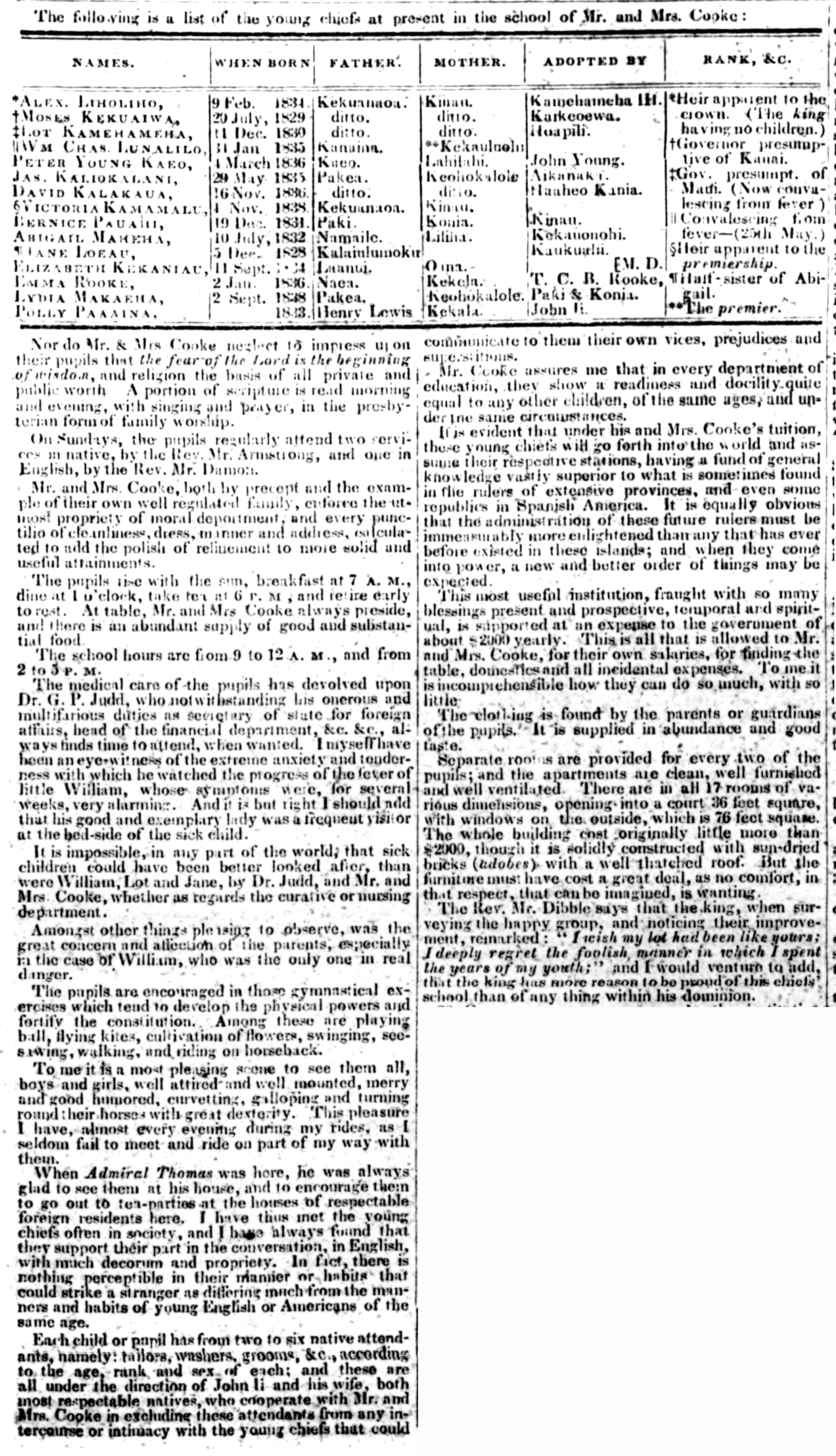
The following is a list of the young chiefs at present in the school of Mr. and Mrs. Cooke:

NAMES. WHEN BORN FATHER MOTHER ADOPTED BY
*Alexander Liholiho, 9 Feb. 1834. Kekuanaoa. Kinau. Kamehameha III.
†Moses Kekuaiwa, 20 July 1829. ditto. ditto. Kaieoewa [Kaikioewa].
‡Lot Kamehameha, 11 Dec. 1830. ditto. ditto. Hoapili.
‖William Charles Lunalilo, 31 Jan. 1835. Kanaina. **Kekauluohi.
Peter Young Kaeo, 4 March 1836. Kaeo. Lahilahi. John Young.
James Kaliokalani, 29 May 1835. Pakea [Kapaakea]. Keohokalole. Aikanaka.
David Kalakaua, 16 Nov. 1836. ditto. ditto. Haaheo Kania [Kaniu].
§Victoria Kamamalu, 4 Nov. 1838. Kekuanaoa. Kinau.
Bernice Pauahi, 19 Dec. 1831. Paki. Konia. Kinau.
Abigail [Lanihau] Maheha, 10 July 1832. Namaile. Liliha. Kekauonohi.
¶Jane Loeau, 5 Dec. 1828. Kalaiulumoku [Kalaniulumoku] [Liliha.] Kaukualii.
Elizabeth Kekaniau [Kekaaniau], 11  Sept. 1834. Laanui. Oana.
Emma Rooke, 2 Jan. 1836. Naea. Kekela. T. C. B. Rooke, M. D.
Lydia Makaeha [Kamakaeha], 2 Sept. 1838. Pakea [Kapaakea]. Keohokalole. Paki & Konia.
Polly Paaaina, 1833. Henry Lewis. Kekala [Kekela]. John Ii.

*Heir apparent to the crown. (The king having no children.)
†Governor presumptive of Kauai.
‡Gov. presumpt. of maui. (Now convalescing from fever.)
‖Convalescing from fever—(25th May.)
§Heir apparent to the premiership.
¶Half-sister of Abigail.
**The premier.

Nor do Mr. & Mrs. Cooke neglect to impress upon their pupils that the fear of the Lord is the beginning of wisdom, and religion the basis of all private and public worth. A portion of scripture is read morning and evening, with singing and prayer, in the presbyterian form of family worship.

On Sundays, the pupils regularly attend two services in native, by the Rev. Mr. Armstrong, and one in English, by the Rev. Mr. Damon.

Mr. and Mrs. Cooke, both by precept and the example of their own well regulated family, enforce the utmost propriety of moral deportment, and every punctilio of cleanliness, dress, manner and address, calculated to add the polish of refinement to more solid and useful attainments.

The pupils rise with the sun, breakfast at 7 A. M., dine at 1 o’clock, take tea at 6 P. M., and retire early to rest. At table, Mr. and Mrs. Cooke always preside, and there is an abundant supply of good and substantial food.¹

The school hours are from 9 to 12 A. M., and from 2 to 5 P. M.

The medical care of the pupils has devolved upon Dr. G. P. Judd, who not withstanding his onerous and multifarious duties as secretary of state for foreign affairs, head of the financial department, &c., &c., always finds time to attend, when wanted. i myself have been an eye-witness of the extreme anxiety and tenderness with which he watched the progress of the fever of little William, whose symptoms were, for several weeks, very alarming. And it is but right I should add that his good and exemplary lady was a frequent visitor at the bed-side of the sick child.

It is impossible, in any part of the world, that sick children could have been better looked after, than were William, Lot and Jane, by Dr. Judd, and Mr. and Mrs. Cooke, whether as regards the curative or nursing department.

Amongst other things pleasing to observe, was the great concern and affection of the parents, especially in the case of William, who was the only one in real danger.

The pupils are encouraged in the gymnastical exercises which tend to develop the physical powers and fortify the constitution. Among these are playing ball, flying kites, cultivation of flowers, swinging, see-sawing, walking, and riding on horseback.

To me it is a most pleasing scene to see them all, boys and girls, well attired and well mounted, merry and good humored, curvetting, galloping and turning round their horses with great dexterity. This pleasure I have, almost every evening during my rides, as I seldom fail to meet and ride on part of my way with them.

When Admiral Thomas was here, he was always glad to see them at his house, and to encourage them to go out to tea-parties at the houses of respectable foreign residents here. I have thus met the young chiefs often in society, and I have always found that they support their part in the conversation, in English, with much decorum and propriety. In fact, there is nothing perceptible in their manner or habits that could strike a stranger as differing much from the manners and habits of young English or Americans of the same age.

Each child or pupil has from two to six native attendants, namely: tailors, washers, grooms, &c., according to the age, rank and sex of each; and these are all under the direction of John Ii and his wife, both most respectable natives, who cooperate with Mr. and Mrs. Cooke in excluding these attendants from any intercourse of intimacy with the young chiefs that could communicate to them their own vices, prejudices and superstitions.

Mr. Cooke assures me that in every department of education, they show a readiness and docility quite equal to any other children, of the same ages, and under the same circumstances.

If is evident that under his and Mrs. Cooke’s tuition, these young chiefs will go forth into the world and assume their respective stations, having a fund of general knowledge vastly superior to what is sometimes found in the riders of extensive provinces, and even some republics in Spanish America. It is equally obvious that the administration of these future rulers must be immeasurably more enlightened than any that has ever before existed in these islands; and when they come into power, a new and better order of things may be expected.

This most useful institution, fraught with so many blessings present and prospective, temporal and spiritual, is supported at an expense to the government of about $2000 yearly. This is all that is allowed to Mr. and Mrs. Cooke, for their own salaries, for finding the table, domestics and all incidental expenses. To me it is incomprehensible how they can do so much, with so little.

The clothing is found by the parents or guardians of the pupils. It is supplied in abundance and good taste.

Separate rooms are provided for every two of the pupils; and the apartments are clean, well furnished and well ventilated. There are in all 17 rooms of various dimensions, opening into a court 36 feet square, with windows on the outside, which is 76 feet square. The whole building cost originally little more than $2000, though it is solidly constructed with sun-dried bricks (adobes) with a well thatched roof. But the furniture must have cost a great deal, as no comfort, in that respect, that can be imagined, is wanting.

The Rev. Mr. Dibble says that the king, when surveying the happy group, and noticing their improvement, remarked: “I wish my lot had been like yours; I deeply regret the foolish manner in which I spent the years of my youth;” and I would venture to add, that the king has more reason to be proud of this chiefs’ school than of any thing within his dominion.

(Friend, August 1, 1844, p. 36)
The following is a list...

The Friend, Volume II, Number VIII, Page 36. August 1, 1844.

¹This comment about the abundance of food reminded me of something Liliuokalani said in Hawaii’s Story by Hawaii’s Queen. “…our instructors were especially particular to teach us the proper use of the English language; but when I recall the instances in which we were sent hungry to bed, it seems to me that they failed to remember that we were growing children. A thick slice of bread covered with molasses was usually the sole article of our supper, and we were sometimes ingenious, if not over honest, in our search for food: if we could beg something of the cook it was the easier way; but if not, anything eatable left within our reach was surely confiscated. As a last resort, we were not above searching the gardens for any esculent root or leaf, which (having inherited the art of igniting a fire from the friction of sticks), we could cook and consume without the knowledge of our preceptors.”

Speaking of Hawaii’s Story by Hawaii’s Queen, i was expecting the new much-awaited edition to be available already, but hopefully it will be out in bookstores soon! I am thinking of putting up related articles like this one (mostly from the Hawaiian-Language Newspapers) to perhaps give a fuller picture of topics covered in the Queen’s book.

[This is written by Robert Crichton Wyllie, and is found in a very enlightening treatise describing many aspects of life in Honolulu in the 1840s. “NOTE On the Shipping, Trade, Agriculture, Climate, Diseases, Religious Institutions, Civil and Social Conditions, Mercantile and Financial Policy of the Sandwich or Hawaiian Islands, viewed in relation to other groups of islands, and to the natural and acquired advantages of the Sandwich or Hawaiian Islands.” Friend, June 1–September 24, 1844.]
Restoration celebration at Kaniakapupu, 1847.

Fourth Anniversary of the Restoration.

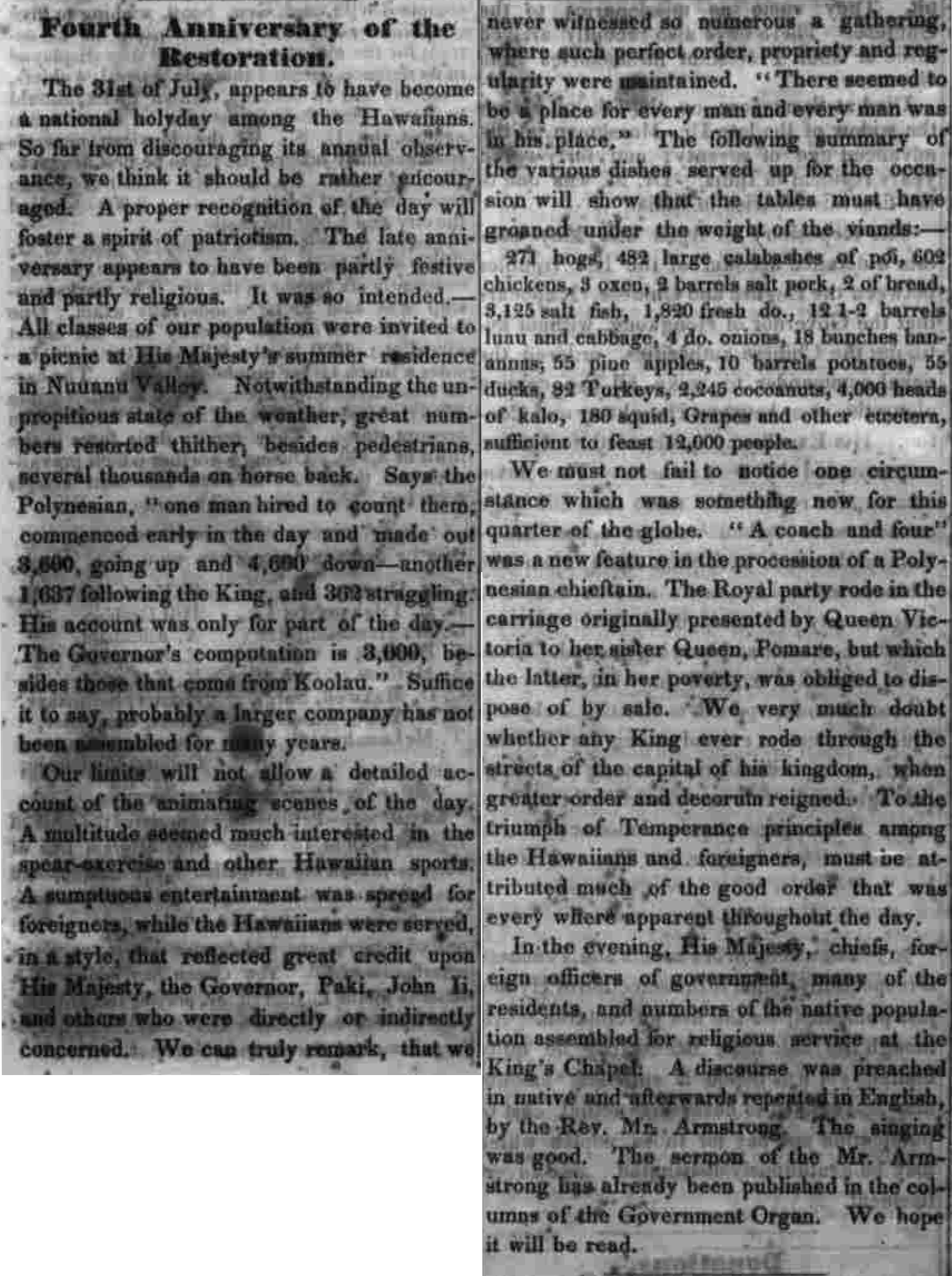
The 31st of July, appears to have become a national holyday among the Hawaiians. So far from discouraging its annual observance, we think it should be rather encouraged. A proper recognition of the day will foster a spirit of patriotism. The late anniversary appears to have been partly festive and partly religious. It was so intended.—All classes of our population were invited to a picnic at His Majesty’s summer residence in Nuuanu Valley. Notwithstanding the unpropitious state of the weather, great numbers resorted thither; besides pedestrians, several thousands on horse back. Says the Polynesian, “one man hired to count them, commenced early in the day and made out 3,600, going up and 4,600 down—another 1,637 following the King, and 362 straggling. His account was only for part of the day.—The Governor’s computation is 3,000, besides those that come from Koolau.” Suffice it to say, probably a larger company has not been assembled for many years.

Our limits will not allow a detailed account of the animating scenes of the day. A multitude seemed much interested in the spear-exercise and other Hawaiian sports. A sumptuous entertainment was spread for foreigners, while the Hawaiians were served, in a style, that reflected great credit upon His Majesty, the Governor, Paki, John Ii, and others who were directly or indirectly concerned. We can truly remark, that we never witnessed so numerous a gathering, where such perfect order, propriety and regularity were maintained. “There seemed to be a place for every man and every man was in his place.” The following summary of the various dishes served up for the occasion will show that the tables must have groaned under the weight of the viands:—

271 hogs, 482 large calabashes of poi, 602 chickens, 3 oxen, 2 barrels salt pork, 2 of bread, 3,125 salt fish, 1,820 fresh do., 12 1-2 barrels luau and cabbage, 4 do. onions, 18 bunches bananas, 55 pine apples, 10 barrels potatoes, 55 ducks, 82 Turkeys, 2,245 cocoanuts, 4,000 heads of kalo, 180 squid, Grapes and other etcetera, sufficient to feast 12,000 people.

We must not fail to notice one circumstance which was something new for this quarter of the globe. “A coach and four” was a new feature in the procession of a Polynesian chieftain. The Royal party rose in the carriage originally presented by Queen Victoria to her sister Queen, Pomare, but which the latter, in her poverty, was obliged to dispose of by sale. We very much doubt whether any King ever rode through the streets of the capital of his kingdom, when greater order and decorum reigned. To the triumph of Temperance principles among the Hawaiians and foreigners, must be attributed much of the good order that was every where apparent throughout the day.

In the evening, His Majesty, chiefs, foreign officers of government, many of the residents, and numbers of the native population assembled for religious service at the King’s Chapel. A discourse was preached in native and afterwards repeated in English, by the Rev. Mr. Armstrong. The singing was good. The sermon of the Mr. Armstrong has already been published in the columns of the Government Organ. We hops it will be read.

[This and the rest of The Friend can be found here at the click of a mouse on the Mission Children Society page!

This celebration is also described in Thrum’s Annual for 1930!]

(Friend, 8/12/1847, p. 117.)

Fourth Anniversary of the Restoration.

The Friend, Volume V, Number XV, Page 117. August 12, 1847.

Cotton grown in Hawaii, 1863.

[Found under: “NEWS OF HAWAII NEI.”]

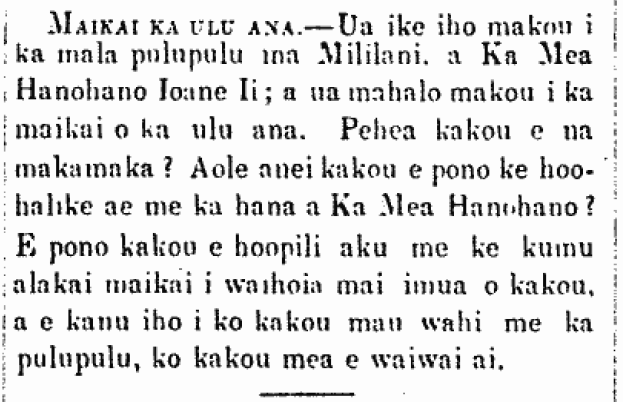
Growing well.—We have seen the cotton plantation at Mililani, of the Honorable John Ii [Ioane Ii]; and we are in admiration at how well it is growing. What about us, O Friends? Shouldn’t we emulate the efforts of the Honorable One? We must follow the good example put before us and plant our land with cotton, that thing which will make us rich.

(Kuokoa, 8/22/1863, p. 2)

Maikai ka ulu ana.

Ka Nupepa Kuokoa, Buke II, Helu 34, Aoao 2. Augate 22, 1863.

More on Kaheleiki trial: “Something not to be forgotten.” 1863.

Voyage of the Hawaiian Chiefs to San Francisco.

This past Wednesday morning [4/15/1863], the Honorable C. Gordon Hopkins [Hapakini], John Ii [Ioane Ii], Kaisara Kapaakea [Caesar Kapaakea], and J. Koii Unauna, along with the one who is involved in the dispute for whom they went to testify for, namely Harry Kaheleiki, came to shore riding aboard the ship, Yankee; and we are pleased to report the public that they are in good health.

During the trial of Harry Kaheleiki in San Francisco, there were many witnesses strongly against him; however, with the arrival of the alii mentioned above, there was true testimony in favor of the accused, and the error of those who testified against him was clear. The newspapers of San Francisco were filled with thoughts of appreciation for this Nation sending witnesses at much expense to have one of its citizens wrongly charged in a foreign land set free; according to one of the papers, this is a benevolent act not done by the enlightened Nations of the world, and so the Hawaiian Nation has taken the lead in this fine action. This is truly an act of aloha, and it is something not to be forgotten for all times.

The reason it was heard that a Hawaiian was being imprisoned in San Francisco was because of Doctor Gulick [Gulika], the one who was previously living in the islands of Micronesia, and due to weakening health, arrived in California. While he was in San Francisco several months ago, he heard that there was a Hawaiian man being held in one of the Jails there on the charge of murder; he therefore went quickly to meet with the man, and when he got there, he spoke with the aforementioned Kaheleiki, and though this conversation, it was clear in Doctor Gulick’s mind that the accused was innocent. And because Kaheleiki asked him if they could wait until witnesses were sent for from Hawaii for him, there would be many who would testify that he was innocent of the charges against him. So Doctor Gulick immediately went to the office of the Hawaiian Consul, Mr. Hitchcock [Kanikela Hawaii o Mr. Hikikoki], and told him about the circumstances of Kaheleiki and how he was certain that Kaheleiki was innocent of the charges. When the Hawaiian Consul heard of this, he went at once to meet with the accused, and upon seeing his demeanor and what he had to say, he knew for himself that Kaheleiki was innocent. He then went quickly to see the Judge to ask that the trial of Kaheleiki be postponed until he heard from here; for he had witnesses here for him. And that is how time was given to send his witnesses, and that is how he was freed. And when he sent for witnesses here, along with a letter from Doctor Gulick, and when His Highness L. Kamehameha heard of this, he along with Sheriff W. C. Parke put great effort into finding appropriate witnesses to testify for Kaheleiki, the one who was falsely charged. We are filled with appreciation for the Royal One, His Highness, and the Sheriff.

We must thank Doctor Gulick, and we are truly thankful for him in the name of all who desire that the innocent who are persecuted be freed, and in the name of all who strive to find ways to free the innocent from the hands of those who oppose them, while they live in foreign lands. God shall free the righteous.

[There are countless stories like this in the Hawaiian-Language Newspapers that should be relearned and retold and retold again, so they are not forgotten!]

(Kuokoa, 4/18/1863, p. 3)

Ka Huakai a na 'Lii Hawaii i Kapalakiko.

Ka Nupepa Kuokoa, Buke II, Helu 16, Aoao 3. Aperila 18, 1863.

More on the Kaheleiki trial, 1863.

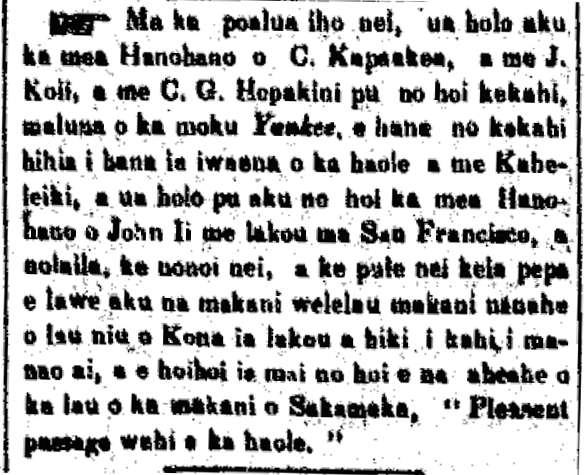
This past Tuesday [2/17/1863], the Honorable C. Kapaakea, and  J. Koii, and C. G. Hopkins also went aboard the ship Yankee, to appear in a case raised between the haole and Kaheleiki; the Honorable John Ii also accompanied them to San Francisco, and this paper hopes and prays that the fringes of the winds; the gentle winds of the coconut fronds of Kona take them to their destination, and that they are brought back by the soft puffs of the wind of Sakameka [? Sacramento]; “Pleasant passage,” according to the haole.

(Hoku o ka Pakipika, 2/19/1863, p. 2)

Ma ka poalua iho nei...

Ka Hoku o ka Pakipika, Buke 2, Helu 19, Aoao 2. Feberuari 19, 1863.

Mahalo to MAB for pointing to this article on the Kaheleiki trial, 1863.

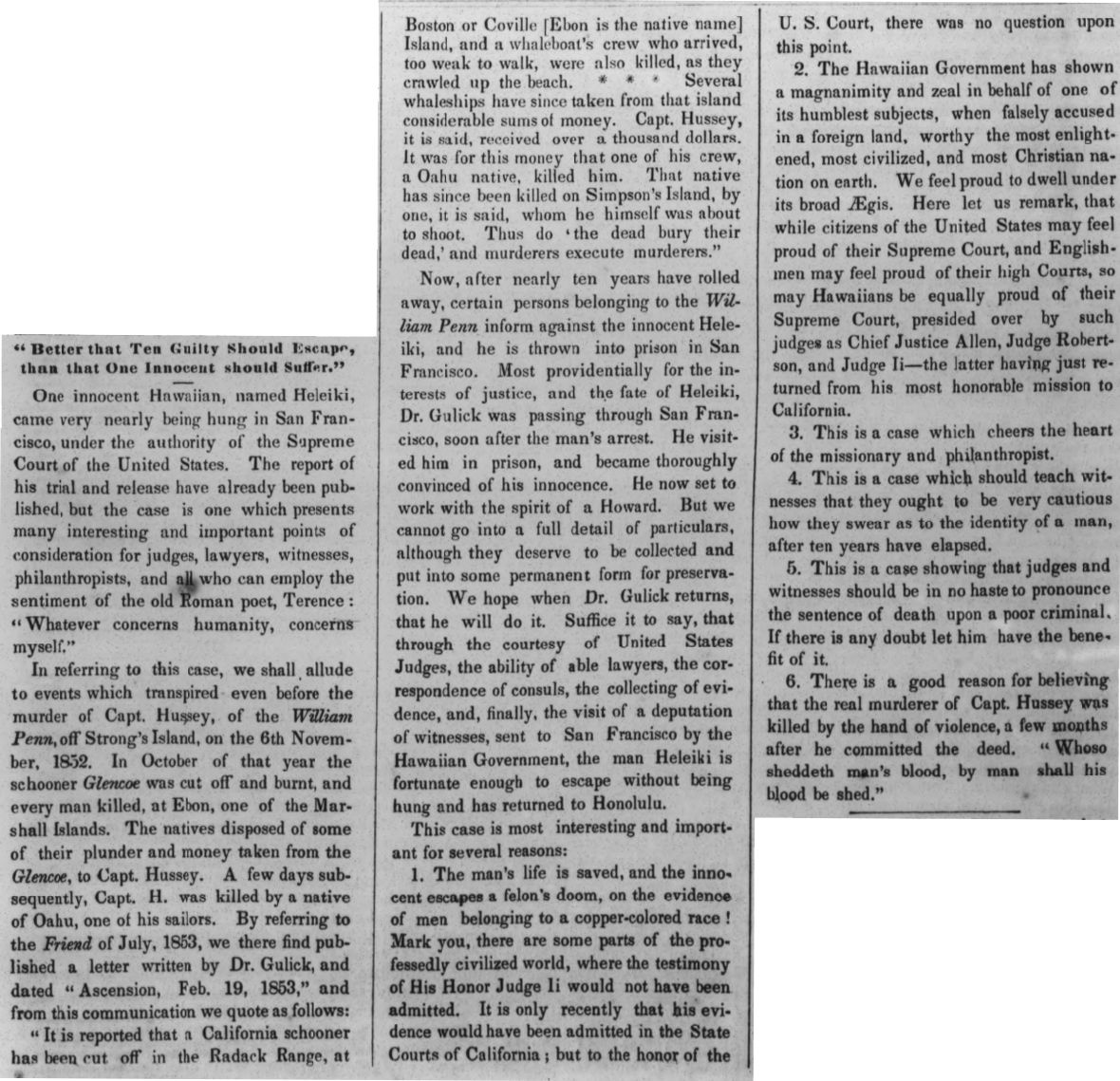
“Better that Ten Guilty Should Escape, than that One Innocent should Suffer.”

One innocent Hawaiian, named Heleiki, came very nearly being hung in San Francisco, under the authority of the Supreme Court of the United States. The report of his trial and release have already been published, but the case is one which presents many interesting and important points of consideration for judges, lawyers, witnesses, philanthropists, and all who can employ the sentiment of the old Roman poet, Terence: “Whatever concerns humanity, concerns myself.”

In referring to this case, we shall allude to events which transpired even before the murder of Capt. Hussey, of the William Penn, off Strong’s Island, on the 6th of November, 1852. In October of that year the schooner Glencoe was cut off and burnt, and every man killed, at Ebon, one of the Marshall Islands. The natives disposed of some of their plunder and money taken from the Glencoe, to Capt. Hussey. A few days subsequently, Capt. H. was killed by a native of Oahu, one of his sailors. By referring to the Friend of July, 1853, we there find published a letter written by Dr. Gulick, and dated “Ascension, Feb. 19, 1853,” and from this communication we quote as follows:

“It is reported that a California schooner has been cut off in the Radack Range, at Boston or Coville (Ebon is the native name) Island, and a whaleboat’s crew who arrived, too weak to walk, were also killed, as they crawled up the beach. * * * Several whaleships have since taken from that island considerable sums of money. Capt. Hussey, it is said, received over a thousand dollars. It was for this money that one of his crew, a Oahu native, killed him. That native has since been killed on Simpson’s Island, by one, it is said, whom he himself was about to shoot. Thus do ‘the dead bury their dead,’ and murderers execute murderers.”

Now, after nearly ten years have rolled away, certain persons belonging to the William Penn inform against the innocent Heleiki, and he is thrown into prison in San Francisco. Most providentially for the interests of justice, and the fate of Heleiki, Dr. Gulick was passing through San Francisco, soon after the man’s arrest. He visited him in prison, and became throughly convinced of his innocence. He now set to work with the spirit of a Howard. But we cannot go into a full detail of particulars, although they deserve to be collected and put into some permanent form for preservation. We hope when Dr. Gulick returns, that he will do it. Suffice it to say, that through the courtesy of United States Judges, the ability of able lawyers, the correspondence of consuls, the collecting of evidence, and, finally, the visit of a deputation of witnesses, sent to San Francisco by the Hawaiian Government, the man Heleiki is fortunate enough to escape without being hung and has returned to Honolulu.

This case is most interesting and important for several reasons:

1. The man’s life is saved, and the innocent escapes a felon’s doom, on the evidence of men belonging to a copper-colored race! Mark you, there are some parts of the professedly civilized world, where the testimony of His Honor Judge Ii would not have been admitted. It is only recently that his evidence would have been admitted in the State Courts of California; but to the honor of the U. S. Court, there was no question upon this point.

2. The Hawaiian Government has shown a magnanimity and zeal in behalf of one of its humblest subjects, when falsely accused in a foreign land, worthy the most enlightened, most civilized, and most Christian nation on earth. We feel proud to dwell under its broad Ægis. Here let us remark, that while citizens of the United States may feel proud of their Supreme Court, and Englishmen may feel proud of their high Courts, so may Hawaiians be equally proud of their Supreme Court, presided over by such judges as Chief Justice Allen, Judge Roberson, and Judge Ii—the latter having just returned from his most honorable mission to California.

3. This is a case which cheers the heart of the missionary and philanthropist.

4. This is a case which should teach witnesses that they ought to be very cautious how they swear as to the identity of a man, after ten years have elapsed.

[See earlier article: Government officials to go to California to defend a Hawaiian citizen. 1863.]

(Friend, 5/1/1863, p. 33)

"Better that Ten Guilty Should Escape, than that One Innocent should Suffer."

The Friend, New Series, Volume 12, Number 5, Page 33. May 1, 1863.

Mele Inoa for Kauikeaouli, Kamehameha III. 1862.

HE INOA NO KAUIKEAOULI.

Auhea wale ana oe, kapua hau o Maleka,
Ke au nei ka manao, Pehea o Niagala,
Kela wai kamahao, wai halulu o ka moano,
Nene i na moku, lohe aku nei Lukini,
Ua ana ia Kuleke, aohe i hopo Ladana,
I ka nui o Asia, hue a ke kaona nui,
Laki ka moana Iniana, ehuehu Enelani,
Ke kowa o Sekotia, aita oe e palau,
No’u o Ainahau, a ka wai o Nolewai,
Pau mai ko’u palena, ilaila a’u la oki,
Lawe u’a linohau, a ai ka manu iluna,
I kilohi iho kuu hana, he nani o Hudesona,
Kaikuono Papine, mea ua ae ia,
Me oe a ke aloha iwini o ke aumoa,
Auhea wale ana oe, e ka uneune puuwai,
E ke kaukini ma-lo, nana i ue laholio,
Hoomaloe i kuu kino, hooueue i ka moe,
Lana koi kahi manao, halanalana i ka leo,
O ua mea ino nei, he hoouluulu ia,
Keehi pono i ko haka, i luhi lai ko kahu,
A ao luau ai, pau ko aumakua pi kai a kaua,
I ka lihi kai o lalo, eia la he manao,
Kai hiki mai ia nei, e kali iki iho oe,
A hala ae Welehu, ka malama ino ke kau,
Hiki ae la ia Nana, pe oi kahi manao,
Olu ka noho na o ka lani me oe a ke aloha,
Iwini o ke aumoe, i mai nei o Piuta,
Ua hala kou palena, aohe koina oonei,
O kou la luu loli, a lae hao au lohe,
Ilaila ka wahine Ia, nana i nai ka moana,
He ukali aina ahi, i ka lae o Kepohoni,
Aia iho o Palema, ke noho la i ka hema,
Nana e kuhikuhi mai, ka lonitu akau,
Ike ia na degere, na kuea o ka honua,
Alo mai Kapena Kuke, ka noe i Nouaiki,
Ikiiki wale hoi au, i ka lohe pepeiao,
E ake ko’u manao, ka ike ia Panama,
I pau kuu kuhihewa, i ke kai o Inia,
Nopia o Iapana, ke hui me Ualana,
Me oe a ke aloha, iwini o ke aumoe.

Ii.

Honolulu, Aperila 14, 1862.

[This is a mele known as a mele inoa for Kamamalu, but here it is submitted by Ioane Ii as a mele inoa for Kauikeaouli.]

(Hoku o ka Pakipika, 5/8/1862, p. 4)

HE INOA NO KAUIKEAOULI.

Ka Hoku o ka Pakipika, Buke I, Helu 33, Aoao 4. Mei 8, 1862.

People from Nuuhiva, 1867.

[Found under: “LOCAL NEWS: OAHU”]

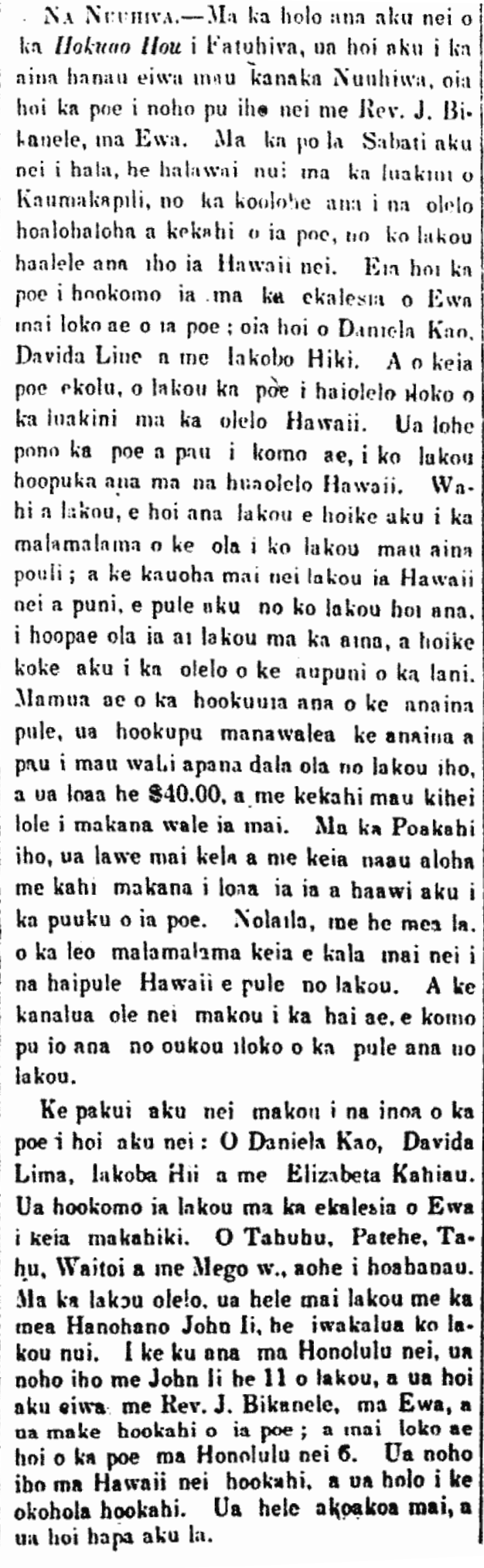
The Nuuhivans.—Upon the sail of the New Hokuao to Fatuhiva, eight Nuuhivans returned to the land of their birth, those were the people who lived with Rev. J. Bicknell [Bikanele] in Ewa. On this past Sunday night, there was a great gathering at Kaumakapili Church, to hear the words of gratitude by some of these people as they leave Hawaii nei. Here are those who were placed in the church of Ewa from amongst these people: Daniela Kao, Davida Line, and Iakobo Hiki. And these three were the ones who gave speeches at the church in Hawaiian. All who entered listened carefully to their speaking of Hawaiian. According to them, they are returning to teach about the light of life in their unenlightened lands; and they bid all of Hawaii to pray on their return, that they may be put on land safely, and soon teach the words of the kingdom of heaven. Before being released, the entire congregation donated money for their daily needs, and $40.00 was collected, along with capes that were gifted. Last Monday, the benevolent brought gifts and gave it to the treasurer of those people. Therefore, it is as if this is the enlightening voice announcing to the devout Hawaiians to pray for them. And we can say without doubt that you will all join in in praying for them.

We are appending the names of the people who returned: Daniela Kao, Davida Lima, Iakoba Hii, and Elizabeth Kahiau. They joined the church of Ewa this year. Tahuhu, Patehe, Tahu, Waitoi, and Mego (female), did not become brethren. According to them, they came along with the Honorable John Ii; there were twenty of them. When they landed in Honolulu, 11 of them lived with John Ii, and nine went with Rev. J. Bicknell to Ewa, and one of those died; those in Honolulu from amongst them are 6. One stayed in Hawaii, and one went on a whaling ship. They came all together, and a portion returned home.

(Kuokoa, 3/30/1867, p. 2)

Na Nuuhiva.

Ka Nupepa Kuokoa, Buke VI, Helu 13, Aoao 2. Maraki 30, 1867.

Alii of Fatu Hiva, 1867.

[Found under: “LOCAL NEWS: OAHU”]

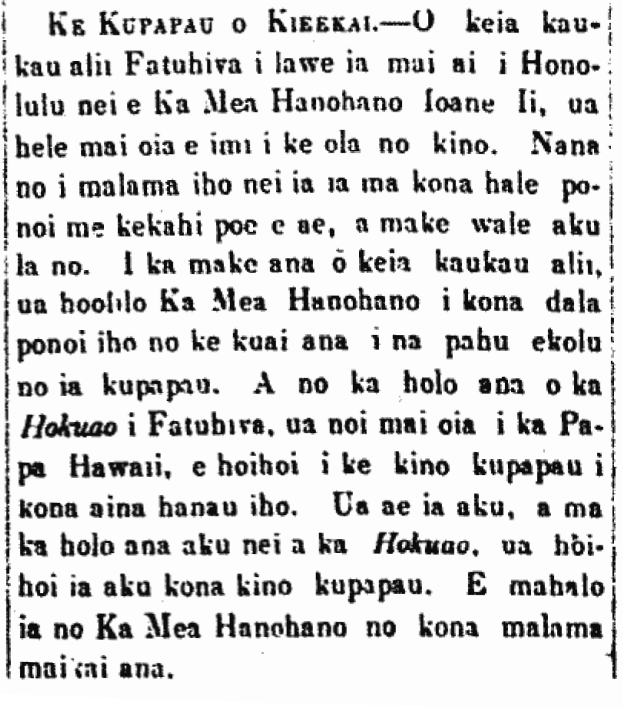
The Body of Kieekai.—This kaukau alii from Fatu Hiva [Fatuhiva] to Honolulu by the Honorable John Papa Ii [Ioane Ii], and he came here in search of health. It was Ii who cared for him at his own home along with some others, and Kieekai died. At the death of this kaukau alii, The Honorable One spent his own money to purchase the three caskets for the body. Being that the Hokuao is on its way to Fatu Hiva, he asked the Hawaiian Board of Missions [Papa Hawaii] to return the body to the land of his birth. It was agreed to, and when the Hokuao left, the body was taken. The Honorable One is appreciated for his fine care.

(Kuokoa, 3/30/1867, p. 2)

Ke Kupapau o Kieekai.

Ka Nupepa Kuokoa, Buke VI, Helu 13, Aoao 2. Maraki 30, 1867.

Beginnings of the Anglican Church in Hawaii, 1862.

Pertaining to the 28th of November¹

This day known to everyone, the day of the return of independence to the Islands and the day chosen by the Monarchs as a day for the two of them to join the new faith which has recently arrived.

On the morning of that day, at the hour of 10½, the Alii arrived at the Church and the National troops [koa o ke Aupuni], the Honolulu Rifles [koa Rifles?], the Hawaii Kiai [?], and the Cavalry [Puali Kaua Lio] were all lined up.

When the Alii arrived and passed through the entrance, the Bishop came and layed his hand and blessed them. They then entered within and sat down; following them was a procession, and they entered while chanting one of the psalms. After this was done, the laying on of hands began, and they were confirmed as brethren of the new church.

The beauty that is imbued in all creatures of the earth is what left all of their subjects who went there awe-stricken. Some wept, some fled [hoonaholoholopoo?], some were downcast, and some shuddered in awe, appearing as if the spirit from the heavens was accepted in the Monarchs joining into the circle of eternal life.

Present was Her Highness Princess V. K. Kaahumanu, the Honorable M. Kekuanaoa, the Honorable R. C. Wyllie, the Honorable Chief Justice E. H. Allen, the Honorable C. R. Bishop and his wife, the Honorable C. Kapaakea, the Honorable Colonel D. Kalakaua, Colonel McKibbin Jr., Colonel W. C. Lunalilo, Major Hasslocher, Kekaaniau, the Dowager Queen K. Hakaleleponi, Mrs. Haalelea, the wives of the Supreme Court Judges, and the Honorable Ii. There also was W. W. F. Synge and his wife, along with the Consuls of Foreign Nations.

The building was filled with those wanting to witness the joining of the Monarchs as brethren, and everyone felt much appreciation for the beauty of the Royals, the Alii, and the ceremony performed. God save the King.

¹La Kuokoa [Hawaiian Independence Day]

(Hoku o ka Pakipika, 12/4/1862, p. 2)

No ka la 28 o Novemaba.

Ka Hoku o ka Pakipika, Buke 2, Helu 8, Aoao 2. Dekemaba 4, 1862.