Royal Order of Kamehameha: the early days, 1903.

The Secret Society of the True Natives.

On the 11th of this month, on the day of Ka Na’i Aupuni [Kamehameha Day], a number of native youths established a secret society called “Kamehameha Order”. There are many respected Hawaiians who joined this association, and Prince Kalanianaole is the head of this group.

It is stated that this association will be spread across this Archipelago, and native Hawaiians will be allowed to join, should they be fitting.

One of their major functions will be trying to search out and to care for things from times of old, and the designating of the storied places [wahi pana] all over these islands.

Currently, there is a Historical Society [Ahahui Moolelo o ke Au Kahiko]¹, and they have a lot, but the oiwi Hawaii themselves must do something so that the famed ones of times past will live on, and also to foster things that will let the name of Hawaii live on in perpetuity.

¹The roster of active members of the Hawaiian Historical Society of 1903 read:

“Ables, L. C.; Achi, W. C.; Alexander, S. T.; Alexander, W. D.; Allen, S. C.; Allen, W. F.; Baldwin, H. P.; Banning, B. R.; Beckwith, Rev. E. G.; Beckwith, Miss Martha; Bertram, Bro. G.; Bishop, Rev. S. E.; Bolte, C.; Bowen, W. A.; Boyd, J. H.; Brown, Cecil; Brown, C. A.; Bryan, Wm. A.; Carter, A. W.; Carter, G. R.; Carter, Mrs. H. A. P.; Carter, J. O.; Cartwright, Bruce; Castle, G. P.; Castle, J. B.; Castle, W. R.; Catton, R.; Cooke, A. F.; Cooke, C. M.; Cooke, Jos. P.; Cunha, E. S.; Damon, F. W.; Damon, S. M.; Day, Dr. F. R.; Dayton, D.; Desha, G. L.; Dickey, C. H.; Dickey, L. A.; Dillingham, B. F.; *Dimond, W. W.; Dole, E. P.; Dole, Hon. S. B.; Dowsett, J. M.; Emerson, J. S.; Emerson, Mrs. J. S.; Emerson, Dr. N. B.; Emerson, Rev. O. P.; Emmeluth, J.; Fisher, J. H.; Frear, Hon. W. F.; Giffard, W. M.; Goodale, W. W.; Graham, W. M.; Haalelea, Mrs. A. A.; Hackfeld, J. F.; Hall, W. W.; Hartwell, A. S.; Hatch, F. M.; Henriques, E.; Herrick, C. F.; Hobron, T. W.; Ho Fon; Humphreys, A. S.; Hustace, C.; Irwin, W. G.; Jones, P. C.; Judd, Albert F.; Lewers, Robert; Logan, D.; Lowrey, F. J.; Lucas, George; Lyle, James; Lyons, C. J.; Mclanahan, E. B.; McGonagle, Chas.; McIntyre, H. E.; Mackintosh, Rev. A.; Magoon, J. A.; May, Thos.; Mott-Smith, E. A.; Nakuina, M. K.; Nolte, H. J.; Parke, W. C.; Peacock, W. C.; Pearson, Arthur W.; Pond, Percy M.; Potter, Geo. C.; Rhodes, C. L.; Robinson, M. P.; Rodgers, Dr. C. T.; *Ropert, Rev. F. G., Bishop of Panopolis; Rowell, W. E.; Schaefer, F. A.; Schmidt, H. W.; Searle, J. C.; Sedgwick, T. F.; Smith, G. W.; Smith, Henry; Smith, Walter G.; Smith, W. O.; Stokes, John; Swanzy, F. M.; Timmons, L. D.; Towse, Ed.; Thrum, T. G.; Thurston, L. A.; von Holt, H.; Walker, T. R.; Wall, W. E.; Waterhouse, H.; Weaver, P. L.; Westervelt, Rev. W. D.; Whiting, W. A.; Whitney, Dr. J. M.; Wichman, H. F.; Wilcox, A. S.; Wilcox, C.; Wilcox, G. N.; Williams, H. H.; Wilson, W. F.; Wodehouse, E. H.; Wood, Dr. C. B.; Wood, Edgar; Wundenberg, F.
*Deceased.

(Kuokoa, 6/26/1903, p. 1)

Ka Hui Malu o na Oiwi Ponoi.

Ka Nupepa Kuokoa, Buke XLI, Helu 26, Aoao 1. Iune 26, 1903.
Use of tradition for propaganda, 1896.

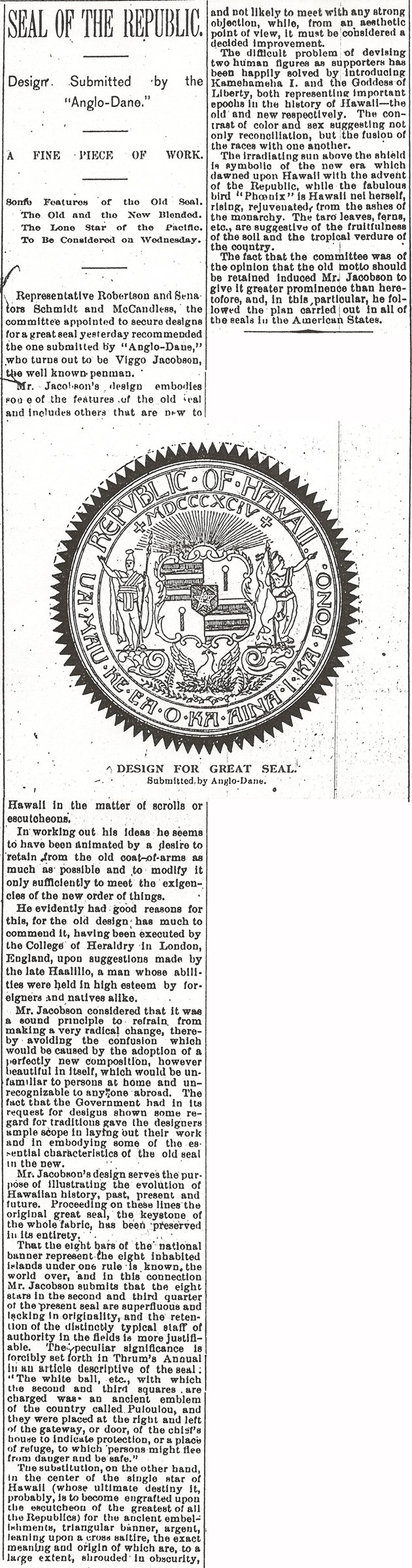
SEAL OF THE REPUBLIC.

Design Submitted by the “Anglo-Dane.”

A FINE PIECE OF WORK.

Some Features of the Old Seal. The Old and the New Blended. The Lone Star of the Pacific. To be Considered on Wednesday.

Representative Robertson and Senators Schmidt and McCandless, the committee appointed to secure designs for a great seal yesterday recommended the one submitted by “Anglo-Dane,” who turns out to be Viggo Jacobson, the well known penman.

Mr. Jacobson’s design embodies some of the features of the old seal and includes others that are new to Hawaii in the matter of scrolls or escutcheons.

In working out his ideas he seems to have been animated by a desire to retain from the old coat-of-arms as much as possible and to modify it only sufficiently to meet the exigencies of the new order of things.

He evidently had good reasons for this, for the old design has much to commend it, having been executed by the College of Heraldry in London, England, upon suggestions made by the late Haalilio, a man whose abilities were held in high esteem by foreigners and natives alike.

Mr. Jacobson considered that it was a sound principle to refrain from making a very radical change, thereby avoiding the confusion which would be caused by the adoption of a perfectly new composition, however beautiful in itself, which would be unfamiliar to persons at home and unrecognizable to anyone abroad. The fact that the Government had in its request for designs shown some regard for traditions gave the designers ample scope in laying out their work and in embodying some of the essential characteristics of the old seal in the new.

Mr. Jacobson’s design serves the purpose of illustrating the evolution of Hawaiian history, past, present and future. Proceeding on these lines the original great seal, the keystone of the whole fabric, has been preserved in its entirety.

That the eight bars of the national banner represent the eight inhabited islands under one rule is known, the world over, and in this connection Mr. Jacobson submits that the eight stars in the second and third quarter of the present seal are superfluous and lacking in originality, and the retention of the distinctly typical staff of authority in the fields is more justifiable. The peculiar significance is forcibly set forth in Thrum’s Annual in an article descriptive of the seal: “The white ball, etc., with which the second and third squares are charged was an ancient emblem of the country called Puloulou, and they were placed at the right and left of the gateway, or door, of the chief’s house to indicate protection, or a place of refuge, to which persons might flee from danger and be safe.”

The substitution, on the other hand, in the center of the single star of Hawaii (whose ultimate destiny it, probably, is to become engrafted upon the escutcheon of the greatest of all the Republics) for the ancient embellishments, triangular banner, argent, leaning upon a cross saltire, the exact meaning and origin of which are, to a large extent, shrouded in obscurity, and not likely to meet with any strong objection, while, from an aesthetic point of view, it must be considered a decided improvement.

The difficult problem of devising two human figures as supporters has been happily solved by introducing Kamehameha I. and the Goddess of Liberty, both representing important epochs in the history of Hawaii—the old and new respectively. The contrast of color and sex suggesting not only reconciliation, but the fusion of the races with one another.

The irradiating sun above the shield is symbolic of the new era which dawned upon Hawaii with the advent of the Republic, while the fabulous bird “Phœnix” is Hawaii nei herself, rising, rejuvenated, from the ashes of the monarchy. The taro leaves, ferns, etc., are suggestive of the fruitfulness of the soil and the tropical verdure of the country.

The fact that the committee was of the opinion that the old motto should be retained induced Mr. Jacobson to give it greater prominence than theretofore, and, in this particular, he followed the plan carried out in all of the seals in the American States.

(Pacific Commercial Advertiser, 2/25/1896, p. 1)

SEAL OF THE REPUBLIC.

The Pacific Commercial Advertiser, Volume XXIII, Number 4234, Page 1. February 25, 1896.

Decorating the Kamehameha Statue, 1912.

[Found under: “Local News”]

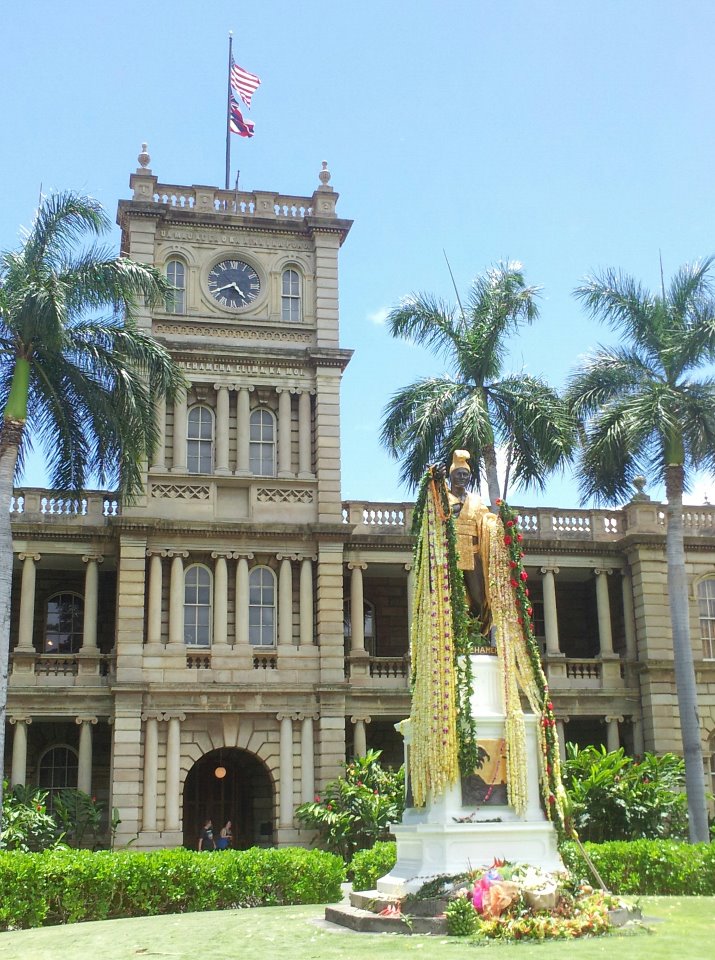
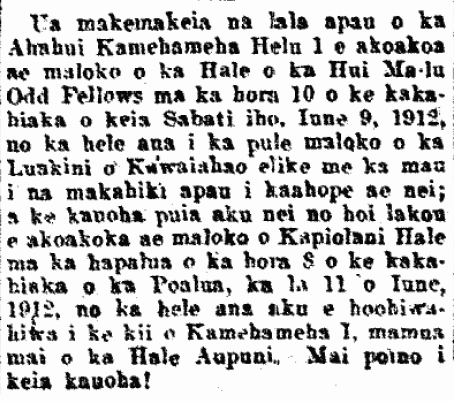
All members of the Ahahui Kamehameha Division 1 are requested to assemble in the Building of the Secret Society, Odd Fellows, at 10 in the morning of this coming Sunday, June 9, 1912, to go on to pray in Kawaiahao Church, as is done in all past years; and they are also ordered to assemble within Kapiolani Hale at half past 8 on the morning of Tuesday, the 11th of June, 1912, to go and decorate the statue of Kamehameha I in front of the Government Building. Do not forget this order!

(Kuokoa, 6/7/1912, p. 8)

Ua makemakeia na lala apau...

Ka Nupepa Kuokoa, Buke XLVIII, Helu 23, Aoao 8. Iune 7, 1912.

Aberahama Kaikioewa Palekaluhi and the malo of Kaumualii,

See this story about A. K. Palekaluhi’s description of a malo of Kaumualii’s, the king of Kauai, found in Additional Notes on Hawaiian Feather Work: a second supplement by William T. Brigham, in Memoirs of the Bernice Pauahi Bishop Museum of Polynesian Ethnology and Natural History, Vol VII.—No. 1, 1918. pp. 30–39.

I am not sure if this is what is described here at the Bishop Museum.

Kamehameha Statue, 1882.

[Found under: “LOCAL NEWS”]

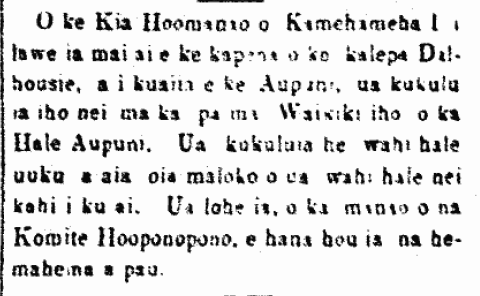
The Kamehameha I Statue brought by the captain of the clipper ship Dalhousie [Earl of Dalhousie], and purchased by the Government, was set up on the Waikiki side of the grounds of the Government Building. A small structure was built and the statue stands within it. It is heard that the plan of the Managing Committee is that all the flaws be redone.

(Kuokoa, 5/6/1882, p. 3)

O ke Kia Hoomanao o Kamehameha I...

Ka Nupepa Kuokoa, Buke XXI, Helu 13, Aoao 3. Mei 6, 1882.

The Hawaiian Flag and James Auld and Capt. Alexander Adams…

It is interesting to note that newspaperman, James Auld, who was responsible for the Kuokoa 1/1/1862 color image of the Hawaiian Flag was the son of Andrew Auld, who arrived from Scotland in 1816. And that this Andrew Auld was apparently dear friends with none other than fellow Scot, Capt. Alexander Adams, who captained the Kaahumanu (formerly named Forrester) for Kamehameha I. Adams is traditionally credited for designing the the Hawaiian Flag.

[Andrew Auld and Alexander Adams lay side by side at Oahu Cemetery, their single gravestone reads: “Twa croanies frae the land of heather / Are sleepin’ here in death th’gether.”Two close friends from the land of heather (Scotland) are sleeping here in death together.

And James’ brother, William, who we spoke of earlier as the engraver of James’ wife’s (Uwinihepa’s) tombstone, was perhaps more importantly one of the four men sent to take the Anti-Annexation Petitions to Washington D. C. Oh! and William marries one of the daughters of Capt. Alexander Adams, Mary (9/21/1859). Both James and William seem to also go by the last name Andrew/Andrews.]

Kapihe and his prophecy. 1862.

The Story of Kapihe.

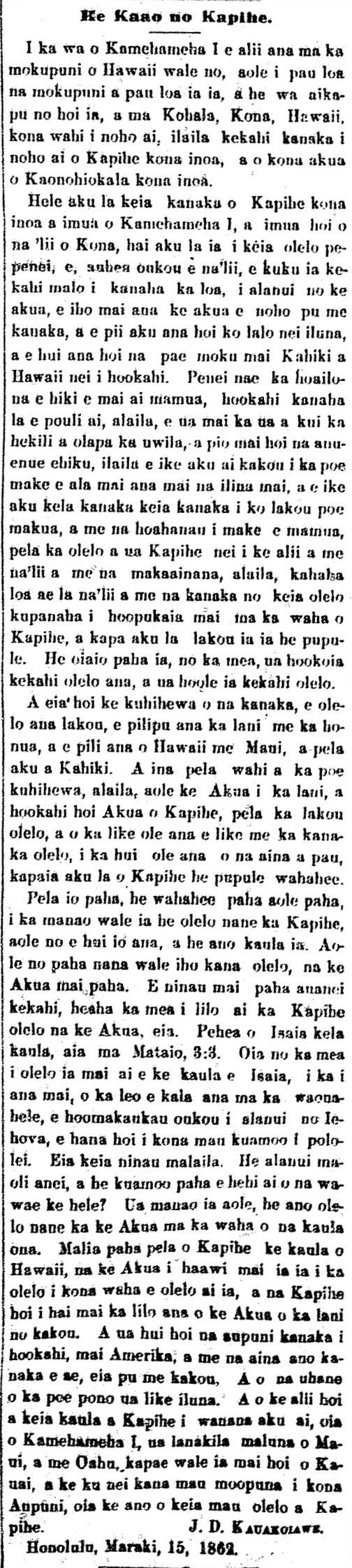
When Kamehameha I was ruler over only Hawaii Island, and not all of the islands were his, and while the eating kapu was still enforced, and while he was living in Kohala, Kona, Hawaii, it was there that a certain man lived named Kapihe, and his god was called Kaonohiokala.

This man named Kapihe went before Kamehameha I and before the alii of Kona, and he said these words, “Listen, O Chiefs, a malo will stand, forty in length, as a path for the god; the god will come down and live with man, and what is down here will rise up above, and the archipelago from Kahiki* all the way to Hawaii will be joined as one. This is the sign that will come before this: there will be forty days of darkness and then rain will fall and thunder will crash and lightning will flash and seven rainbows will arch; there we will see the dead rise from the graves and all people will see their parents and hoa hanau [siblings, cousins] who died earlier.” And that is what Kapihe said to the King, alii, and makaainana. The chiefs and commoners were astounded at these shocking words spoken by Kapihe, and they called him crazy. This perhaps is the truth, for some of his predictions came true and others were denied.

This is how people are mistaken, they say, the heavens and earth will come together, and Hawaii and Maui will join together, and so too with Kahiki. And if that is the case, according to the mistaken ones, then God is not in heaven, and there is but one God, and that is Kapihe; that is what they said, and because all of the lands did not merge together as the they were saying, Kapihe was called a lying, crazed person.

Perhaps that is so, perhaps he was a liar, and perhaps not; it might be thought that Kapihe’s was a riddle and the land would not literally join together, and that he was a prophet. Perhaps his words were not his alone, but from God. Someone might ask, how did Kapihe’s words come from God, and here is the answer. What of Isaiah, that prophet, in Matthew 3:3? For this is what was spoken by the prophet Isaiah, ‘The voice of the one crying in the wilderness: ‘Prepare ye the way of Jehovah, make his paths straight.'” Here is the question there. Is it a real road, and is it a path that will be tread on by feet? It is believed not, but that it was a riddle from God through the mouth of his prophet. Maybe so too it was of Kapihe, the prophet of Hawaii; God gave the words for his mouth to speak, and Kapihe spoke what God of the heavens gave to us. And the nations of man joined as one, from America, and the other inhabited lands, they are here together with us. And the souls of the righteous are the same up above. The alii of whom Kapihe predicted was Kamehameha I, who was victorious over Maui and Oahu, and Kauai was left, and his grandchildren now rule over his Kingdom. This is the nature of Kapihe’s words. J. D. Kauakoiawe

Honolulu, March 15, 1862.

*Kahiki usually refers to foreign lands.

(Hoku o ka Pakipika, 3/20/1862, p. 1)

Ke Kaao no Kapihe.

Ka Hoku o ka Pakipika, Buke I, Helu 26, Aoao 1. Maraki 20, 1862.

Mahalo to Kamaoli Kuwada for kindly allowing us to repost this! 1905/2012.

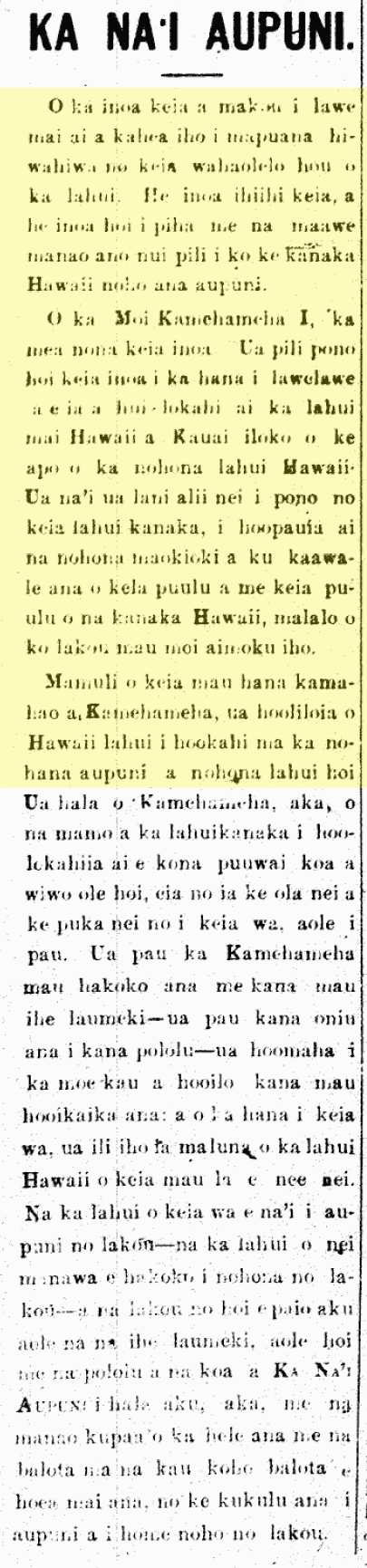
KA NA’I AUPUNI.

[Today is not only a day to mourn the events of 1893, but also to celebrate the courage, tenacity, and deep aloha of the lāhui Hawai’i for persisting and growing these past 119 years.

As the editors of the newspaper Ka Nai Aupuni said in an editorial published alongside Ka Moolelo o Kamehameha I:]

. . .

Kamehameha has passed on, but as for the descendants of the race of people united by his brave and fearless heart, they still live on and emerge in this time; they are not gone. Kamehameha’s fighting with his ihe, his barbed spears, is finished; the whirling of his pololū, his long spears, is ended; his struggles have retired to the sleep of ages; and the work of this time has been inherited by the Hawaiian nation of this progressive era. It is the people of this era who shall conquer a nation for themselves; it is the people of this era who will wrestle for a lifestyle of their own; it is they who will fight, not with barbed ihe, not with the long spears of the warriors of the Conqueror who has passed on, but with the firm conviction to go with ballots to the coming elections in order to build a government and a home for themselves.

(Na’i Aupuni, 11/27/1905, p. 2)

KA NA'I AUPUNI

Ka Na'i Aupuni, Buke I, Helu 1, Aoao 2. Novemaba 27, 1905.

Maunumu dies at 116 years of age, 1918.

Died at 116 Years Old; Saw Kamehameha I.

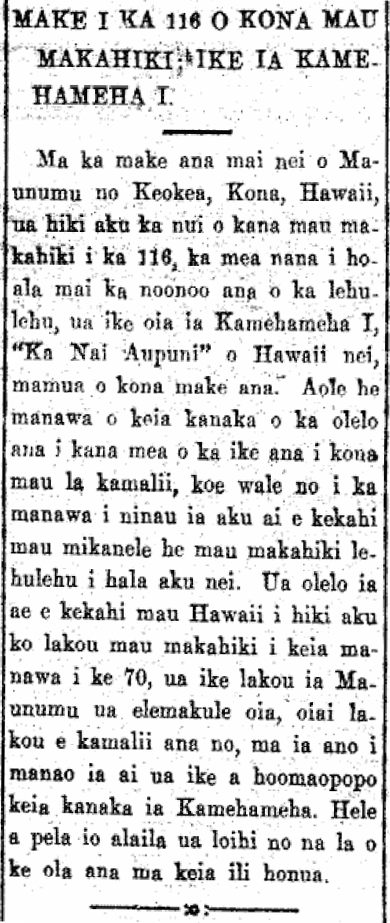
When Maunumu of Keokea, Kona, Hawaii died, his age reached 116 years, the one who made people consider that he saw Kamehameha I, “Ka Nai Aupuni” of Hawaii nei, before his death. There was no time when this man spoke of what he saw in his childhood, except for the time when he was asked by a missionary many years ago. It is said by some Hawaiians who are now 70, that they know Maunumu and he is old; when they were young it was believed that this man saw and knew Kamehameha. Should that indeed be so, then his days upon this earth were truly long.

(Aloha Aina, 8/16/1918, p. 2)

MAKE I KA 116 O KONA MAU MAKAHIKI; IKE IA KAMEHAMEHA I

Aloha Aina, Buke XXIII, Helu 33, Aoao 2. Aukake 16, 1918.