Aloha Aina, 2015.

Expressing aloha ʻāina on the anniversary of the overthrow

“And so it happened that on the 16th day of January, 1893, between four and five o’clock in the afternoon, a detachment of marines from the United States Steamer Boston, with two pieces of artillery, landed at Honolulu. The men, upwards of 160 in all, were supplied with double cartridge belts filled with ammunition and with haversacks and canteens, and were accompanied by a hospital corps with stretchers and medical supplies. This military demonstration upon the soil of Honolulu was of itself an act of war. . .”

By nightfall of the next day, the Kingdom of Hawaiʻi had been illegally overthrown.

Hawaiʻi’s people today live in the resulting repercussions of that infamous day. For some, reflection on those historical events still conjures up the ʻeha (pain, hurt) of being wronged.

There may never be an adequate outlet to express the ʻeha, nevertheless, this story commemorates the 122nd anniversary of the illegal overthrow and honors some of the great expressions of aloha ʻāina (patriotism) coming from Hawaiʻi’s aliʻi (monarchs) and lāhui (people).→Continue reading.

Queen Liliʻuokalani, Hawaiʻi’s last reigning monarch, was imprisoned after her kingdom was illegally overthrown on January 17, 1893.
Kamehameha School for Girls, 50th Anniversary, 1944.

50th ANNIVERSARY STORY¹

By Betty Yim

Featuring the education of the Hawaiian people from early times up to the present day, an historical pageant of authenticly staged scenes with more than 100 characters climaxed the celebration of the founding of the Kamehameha Schools for Girls.

Three performances were given, on Wednesday, December 6, for students; the others on Friday, December 8, for parents and guests and Saturday, December 9, for alumnae and alumni. Continue reading

David K. White, Jr., passes away, 1910.

MY DEAR DAVID K. WHITE HAS GONE.

DAVID K. WHITE, JR.

To the editor of the Nupepa Kuokoa, The Pride of the Hawaiian Nation, Aloha oe:—Please give me some open space in your greatly cherished newspaper to insert some lines of reminiscences for my beloved lei that has gone on the road on which the whole world travels, so that his many classmates and big ohana from Hawaii of Keawe to Kauai of Manokalani will know.

My dear David was born in the coconut grove of Kaohai, Waikele, Ewa, Oahu on the 1st of March, 1889, and went to sleep the eternal sleep at 10:30 p. m. on the 4th of this July at Lahaina, Maui; therefore, he was 21 years old and some in this life.

My dear David was educated at the Kamehameha primary school when he was 8 years old, and he continued on in that same school, graduating as a well trusted student by his classmates and his teachers, and he was the president of the class of 1908. Continue reading

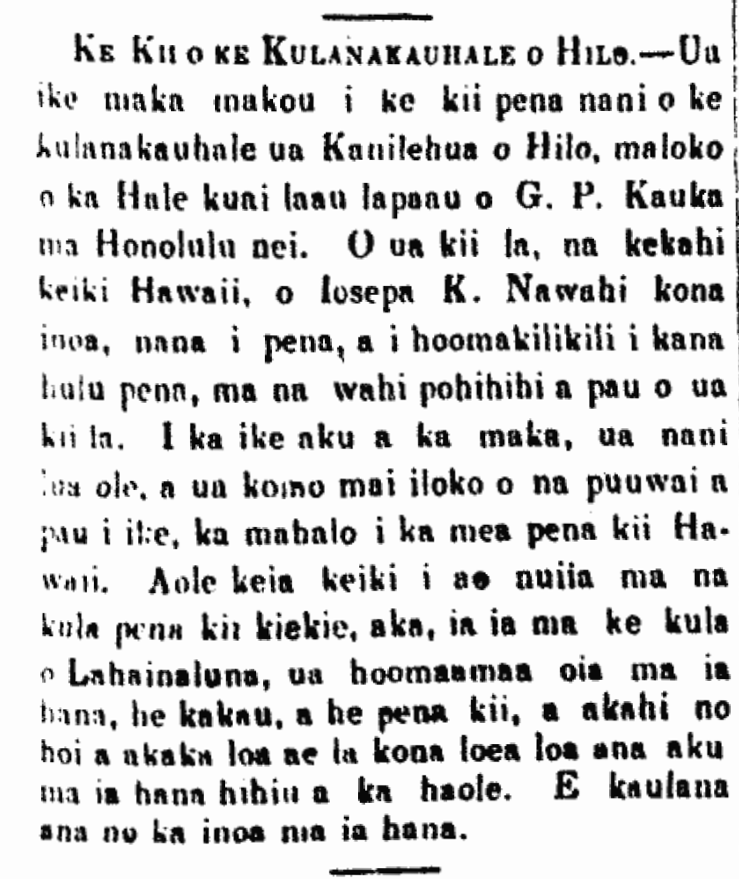
Nawahi paints Hilo Town, 1868.

[Found under: “NU HOU KULOKO.”—”Oahu.”]

Painting of the Hilo Town.—We saw the beautiful painting of the town of Hilo of the Kanilehua rain, in the drug store of G. P. Judd [G. P. Kauka] here in Honolulu. The painting was painted by a Hawaiian boy, named Joseph K. Nawahi [Iosepa K. Nawahi], and he used his brush with detail in all the intricacies the painting. When you see it, it is so beautiful, and admiration for that Hawaiian painter wells in the hearts of all who sees it. This youth was not intensely educated in great art schools, but while he attended Lahainaluna Seminary, he was trained in that skill, drawing and painting, and his expertise in that exceptional discipline of the haole is clear for the first time. His name will become famous through his paintings.

[We all have heard about the awesome story of the 1888 painting by Nawahi of Hilo Town which was featured on Antique Roadshow, now displayed up on the campus of Kamehameha Schools, but the painting described here seems to be the one in the care of the Mission Houses Museum!

Check out this story about two more Nawahi paintings. The whereabouts of these two painting are not known (at least publicly) today… I really want to see the one with the Hiiaka sisters!]

(Kuokoa, 10/31/1868, p. 3)

Ke Kii o ke Kulanakauhale o Hilo.

Ka Nupepa Kuokoa, Buke VII, Helu 44, Aoao 3. Okatoba 31, 1868.

Kamehameha graduating class, 1926.

The Students of Kamehameha Schools Who Graduated This Year 1926.

1. Juliette Blake, 2. Alice Leialoha, 3. Edwin Stone, 4. Harry Chang, 5. Arthur Ahulii, 6. Samuel Vida, 7. Charles Buchanan, 8. Daniel Lansing, 9. Daniel McGregor, 10. Florence Smith, 11. Thurza Drake (class president Girls’ school), 12. George Groves, 13. Charles Travis, 14. George Naumu, 15. Evelyn Cooper, 16. Piilani Yates, 17. Helen Lani, 18. Evelyn Clark, 19. Dinah Dunn, 20. Paul Keaka, 21. Charles Aiden, 22. Henry Reinhardt, 23. Emma Woodward, 24. Elizabeth Leal, 25. Henry Kaahea, 26. Henry Young (class president Boys’ school), 27. Rogers Whitmarsh, 28. Edward Chang, 29. William Poka, 30. Walter Ahulii, 31. George Cummings, 32. Daisy Pa, 33. Bertha Mahikoa.

(Kuokoa, 6/17/1926, p. 2)

Na Haumana o na Kula Kamehameha i Puka i Keia Makahiki 1926

Ka Nupepa Kuokoa, Buke LXV, Helu 24, Aoao 2. Iune 17, 1926.

Kamehameha Schools new year, 1947.

Students at Kamehameha

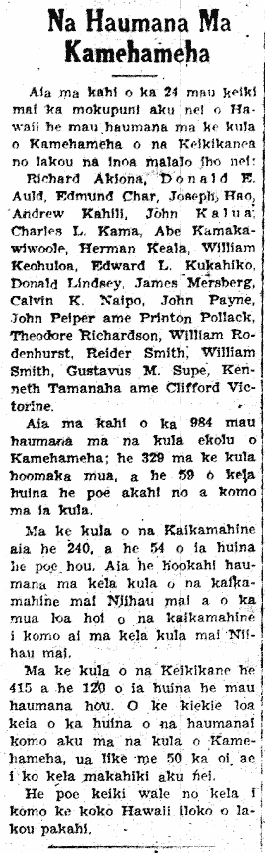
There are 24 children from Hawaii Island who are students at the Boys School, and their names are below:

Richard Akiona, Donald E. Auld, Edmund Char, Joseph Hao, Andrew Kahili, John Kalua, Charles L. Kama, Abe Kamakawiwoole, Herman Keala, William Keohuloa, Edward L. Kukahiko, Donald Lindsey, James Mersberg, Calvin K. Naipo, John Payne, John Peiper and Printon Pollack, Theodore Richardson, William Rondenhurst, Reider Smith, William Smith, Gustavus M. Supe, Kenneth Tamanaha and Clifford Victorine.

There are about 984 students in the three schools of Kamehameha; 329 at the primary school, and 59 of them have entered that school for the first time.

In the Girls’ School, there are 240, and 54 of them are new students. There is one student at the girls’ school from Niihau, and she is the first of the girls to enter that school from Niihau.

In the Boys’ School, there are 415 and 120 are new students. This is the greatest number of students in the schools of Kamehameha; it is 50 more students than the year past.

These are only children who are each of Hawaiian blood.

(Hoku o Hawaii, 10/1/1947, p. 1)

Na Haumana Ma Kamehameha

Ka Hoku o Hawaii, Volume XLI, Number 12, Aoao 1. Okatoba 1, 1947.


Kamehameha graduating class, 1911.

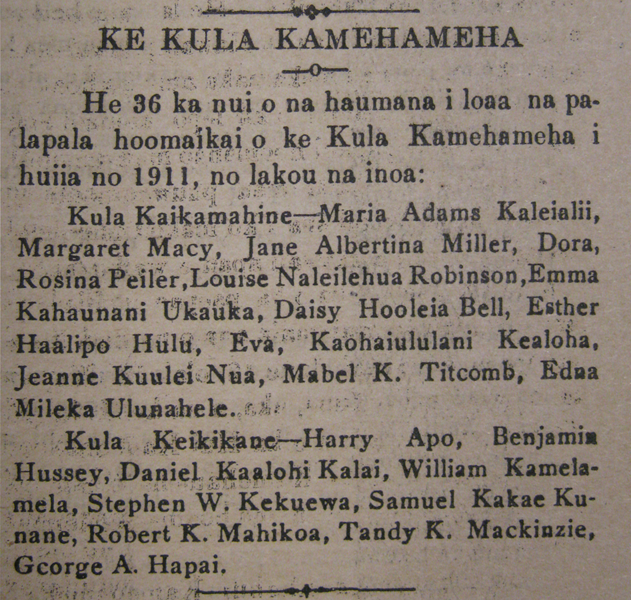
KAMEHAMEHA SCHOOL

36 students received their diplomas from the joint Kamehameha Schools for 1911, and their names are:

Girls School—Maria Adams Kaleialii, Margaret Macy, Jane Albertina Miller, Dora Rosina Peiler, Louise Naleilehua Robinson, Emma Kahaunani Ukauka, Daisy Hooleia Bell, Esther Haalipo Hulu, Eva Kaohaiululani Kealoha, Jeanne Kuulei Nua, Mabel K. Titcomb, Edna Mileka Ulunahele.

Boys School—Harry Apo, Benjamin Hussey, Daniel Kaalohi Kalai, William Kamelamela, Stephen W. Kekuewa, Samuel Kakae Kunane, Robert K. Mahikoa, Tandy K. Mackinzie, George A. Hapai.

(Au Hou, 6/7/1911, p. 23.)

KE KULA KAMEHAMEHA

Ke Au Hou, Buke 2, Helu 23, Aoao 23. Iune 7, 1911.

Kamehameha School graduation, 1893.

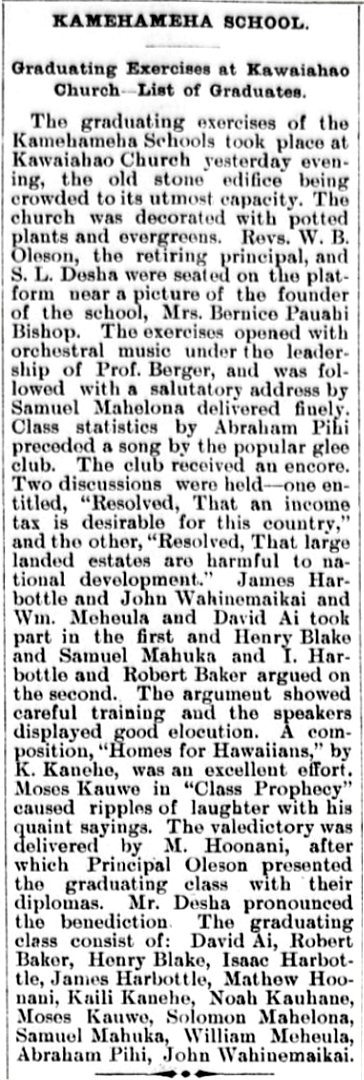
KAMEHAMEHA SCHOOL.

Graduating Exercises at Kawaiahao Church—List of Graduates.

The graduating exercises of the Kamehameha Schools took place at Kawaiahao Church yesterday evening, the old stone edifice being crowded to its utmost capacity. The church was decorated with potted plants and evergreens. Revs. W. B. Oleson, the retiring principal, and S. L. Desha were seated on the platform near a picture of the founder of the school, Mrs. Bernice Pauahi Bishop. The exercises opened with orchestral music under the leadership of Prof. Berger, and was followed with a salutatory address by Samuel Mahelona delivered finely. Class statistics by Abraham Pihi preceded a song by the popular glee club. The club received an encore. Two discussions were held—one entitled, “Resolved, That an income tax is desirable for this country.” and the other, “Resolved, That large landed estates are harmful to national development.” James Harbottle and John Wahinemaikai and William Meheula and David Ai took part in the first and Henry Blake and Samuel Mahuka and I. Harbottle and Robert Baker argued on the second. The argument showed careful training and the speakers displayed good elocution. A composition, “Homes for Hawaiians,” by K. Kanehe, was an excellent effort. Moses Kauwe in “Class Prophecy” caused ripples of laughter with his quaint sayings. The valedictory was delivered by M. Hoonani, after which Principal Oleson presented the graduating class with their diplomas. Mr. Desha pronounced the benediction. The graduating class consist of: David Ai, Robert Baker, Henry Blake, Isaac Harbottle, James Harbottle, Matthew Hoonani, Kaili Kanehe, Noah Kauhane, Mose Kauwe, Solomon Mahelona, Samuel Mahuka, William Meheula, Abraham Pihi, John Wahinemaikai.

[Here is a picture of the class of 1893 found on the Kamehameha Schools Archives page. Some names given on the Archives page are not the same as found here.

Here is perhaps a more detailed article on the graduation appearing in the Hawaiian Gazette.

Yet another article in the Pacific Commercial Advertiser.

And this as well.

Also, see this touching follow up post on one of the graduates, Abraham Pihi!]

(Daily Bulletin, 6/16/1893, p. 3)

KAMEHAMEHA SCHOOL.

The Daily Bulletin, Volume V, Number 754, Page 3. June 16, 1893.

Charles Auld, Hula, and Hawaiian Civic Club of Hilo, 1941.

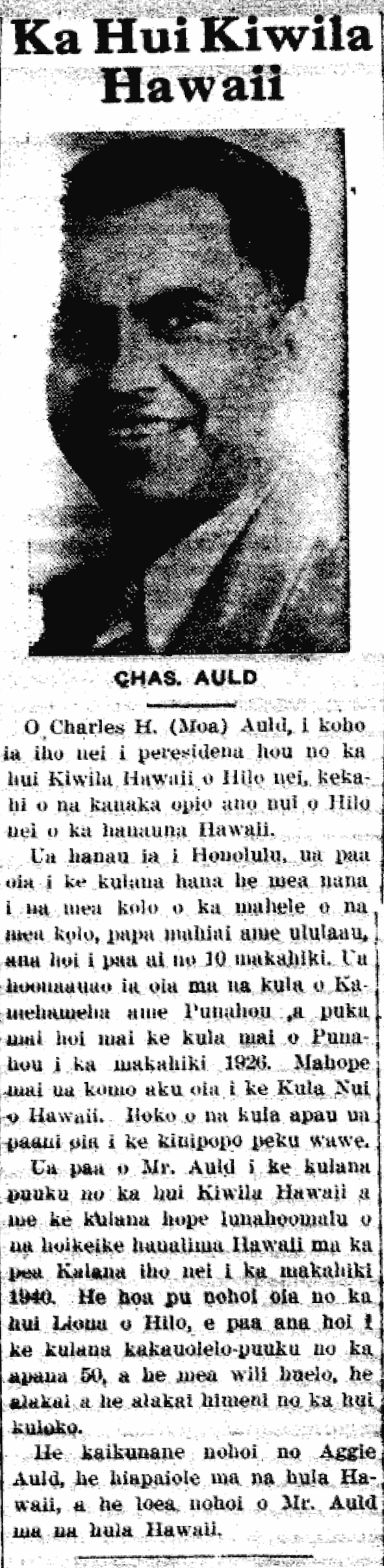
Hawaiian Civic Club

CHAS. AULD

Charles H. (Moa) Auld has been chosen as the new president of the Hawaiian Civic Club [hui Kiwila Hawaii] of Hilo nei, one of the important youths here in Hilo of Hawaiian ancestry.

He was born in Honolulu, and was employed as an inspector of insects in the insects division of the department of agriculture and forestry [papa mahiai ame ululaau], in which he was employed for 10 years. He was educated at the Kamehameha Schools and at Punahou, and he graduated from Punahou in 1926. Thereafter he attended the University of Hawaii. In each of these schools he played football [kinipopo peku wawae].

He is a brother also of Aggie Auld, and expert in Hawaiian hula, and Mr. Auld himself is adept at it as well.

(Hoku o Hawaii, 3/19/1941, p. 1)

Ka Hui Kiwila Hawaii

Ka Hoku o Hawaii, Volume XXXV, Number 47, Aoao 1. Malaki 19, 1941.

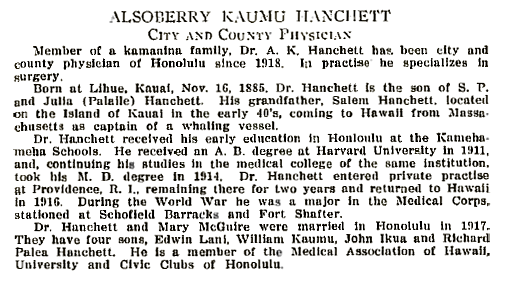
Alsoberry Kaumu Hanchett from “The Story of Hawaii and Its Builders,” 1925.

ALSOBERRY KAUMU HANCHETT

City and County Physician

Member of a kamaaina family, Dr. A. K. Hanchett has been city and county physician of Honolulu since 1918. In practice he specializes in surgery.

Born in Lihue, Kauai, Nov. 16, 1885, Dr. Hanchett is the son of S. P. and Julia (Palaile) Hanchett. His grandfather, Salem Hanchett, located on the Island of Kauai in the early 40’s, coming to Hawaii from Massachusetts as captain of a whaling vessel.

Dr. Hanchett received his early education in Honolulu at the Kamehameha Schools. He received and A. B. degree at Harvard University in 1911, and, continuing his studies in the medical college of the same institution, took his M. D. degree in 1914. Dr. Hanchett entered private practise at Providence, R. I., remaining there for two years and returned to Hawaii in 1916. During the World War he was a major in the Medical Corps, stationed at Schofield Barracks and Fort Shafter.

Dr. Hanchett and Mary McGuire were married in Honolulu in 1917. They have four sons, Edwin Lani, William Kaumu, John Ikua and Richard Palea Hanchett. He is a member of the Medical Association of Hawaii, University and Civic Clubs of Honolulu.

[This comes from another awesome resource: The Story of Hawaii and Its Builders, with which is incorporated volume III Men of Hawaii; an historical outline of Hawaii with biographical sketches of its men of note and substantial achievement, past and present, who have contributed to the progress of the Territory, edited by George F. Nellist. Honolulu: Honolulu Star-Bulletin, Ltd., 1925. It is available in text form (minus the many picture portraits) here at the Hawaii USGenWeb Archives.]

(Story of Hawaii and Its Builders, 1925.)

Alsoberry Kaumu Hanchett

The Story of Hawaii and Its Builders, p. 487