Hōkūleʻa, 1980 / 2015.

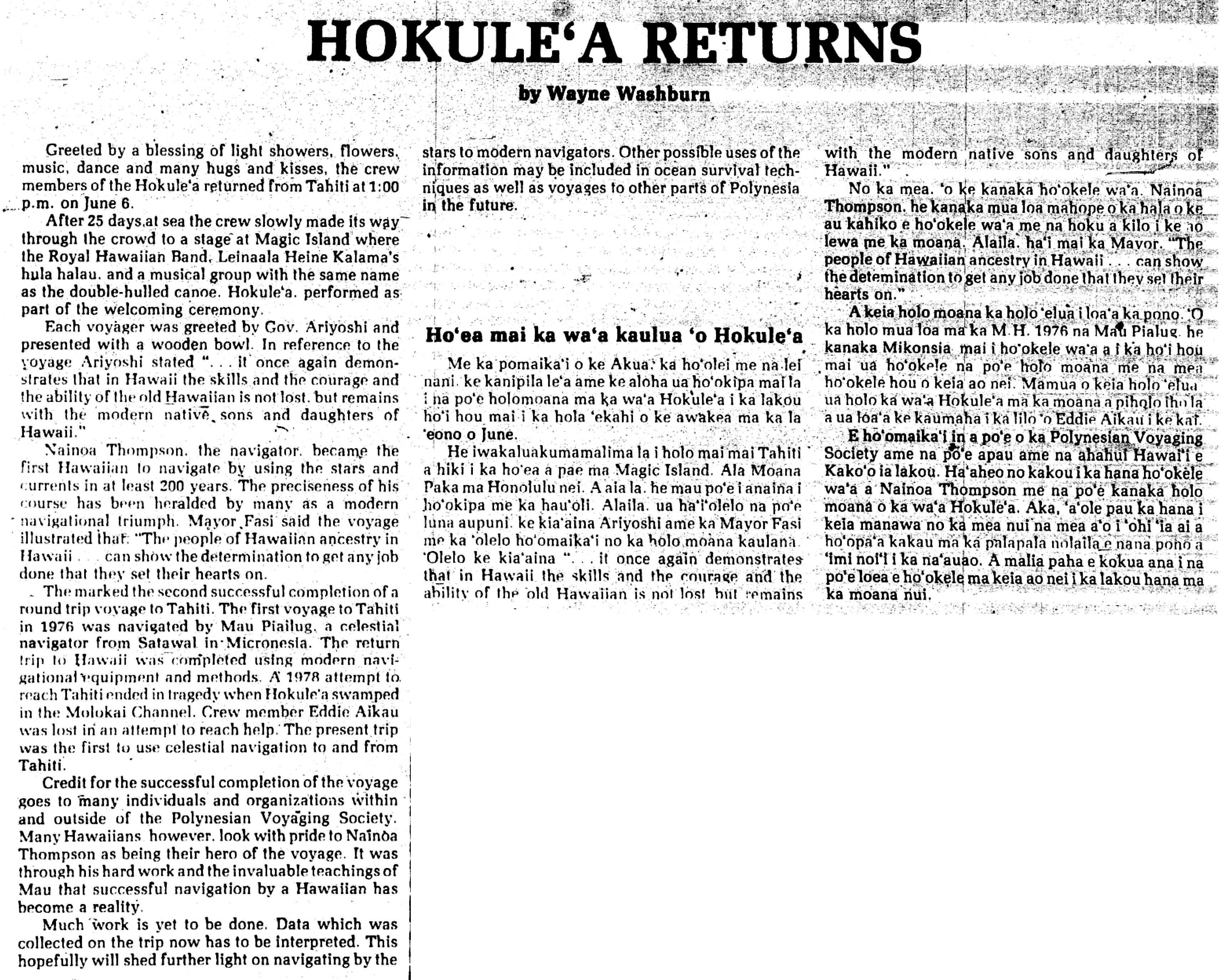
HOKULEʻA RETURNS

by Wayne Washburn

Greeted by a blessing of light showers, flowers, music, dance and many hugs and kisses, the crew members of the Hokuleʻa returned from Tahiti at 1:00 p.m. on June 6.

After 25 days at sea the crew slowly made its way through the crowd to a stage at Magic Island where the Royal Hawaiian Band, Leinaala Heine Kalama’s hula halau, and a musical group with the same name as the double-hulled canoe. Hokuleʻa, performed as part of the welcoming ceremony.

Each voyager was greeted by Gov. Ariyoshi and presented with a wooden bowl. In reference to the voyage Ariyoshi stated “…It once again demonstrates that in Hawaii the skills and the courage and the ability of the old Hawaiian is not lost, but remains with the modern native sons and daughters of Hawaii.”

Nainoa Thompson, the navigator, became the first Hawaiian to navigate by using the stars and currents in at least 200 years. The preciseness of his course has been heralded by many as a modern navigational triumph. Mayor Fasi said the voyage illustrated that: “The people of Hawaiian ancestry in Hawaii…can show the determination to get any job done that they set their hearts on.

This marked the second successful completion of a round trip voyage to Tahiti. The first voyage to Tahiti in 1976 was navigated by Mau Piailug, a celestial navigator from Satawal in Micronesia. The return trip to Hawaii was completed using modern navigational equipment and methods. A 1978 attempt to reach Tahiti ended in tragedy when Hokuleʻa swamped in the Molokai Channel. Crew member Eddie Aikau was lost in an attempt to reach help. The present trip was the first to use celestial navigation to and from Tahiti.

Credit for the successful completion of the voyage goes to many individuals and organizations within and outside of the Polynesian Voyaging Society. Many Hawaiians however, look with pride to Nainoa Thompson as being their hero through his hard work and the invaluable teachings of Mau that successful navigation by a Hawaiian has become a reality.

Much work is yet to be done. Data which was collected on the trip now has to be interpreted. This hopefully will shed further light on navigating by the stars to modern navigators. Other possible uses of the information may be included in ocean survival techniques as well as voyages to other parts of Polynesia in the future.

Hōʻea mai ka waʻa kaulua ʻo Hōkūleʻa

Me ka pōmaikaʻi o ke Akua ka hoʻolei me nā lei nani ke kanipila leʻa a me ke aloha ua hoʻokipa maila i na poʻe holomoana ma ka waʻa Hōkūleʻa i kā lākou hoʻi hou mai i ka hola ʻekahi o ke awakea ma ka lā ʻeono o June.

He ʻiwakāluakūmālima lā i holo mai ma Tahiti a hiki i ka hōʻea a pae ma Magic Island. Ala Moana Pāka ma Honolulu nei. A aia lā, he mau poʻe i anaina i hoʻokipa me ka hauʻoli. A laila, ua haʻiʻōlelo nā poʻe luna aupuni, ke kiaʻāina Ariyoshi a me ka Mayor Fasi me ka ʻōlelo hoʻomaikaʻi no ka holo moana kaulana. ʻŌlelo ke kiaʻāina, “…it once again demonstrates that in Hawaii the skills and the courage and the ability of the old Hawaiian is not lost but remains with the modern native sons and daughters of Hawaii.”

No ka mea, ʻo ke kanaka hoʻokele waʻa, Nāinoa Thompson, he kanaka mua loa ma hope o ka hala o ke au kahiko e hoʻokele waʻa me nā hōkū a kilo i ke ao lewa me ka moana. A laila, haʻi mai ka Mayor, “The people of Hawaiian ancestry in Hawaii…can show the determination to get any job done that they set their hearts on.”

A kēia holo moana ka holo ʻelua i loaʻa ka pono. ʻO ka holo mua loa ma ka M. H. 1976 na Mau Pialug, he kanaka Maikonia mai i hoike mai i hoʻokele waʻa a i ka hoʻi hou mai ua hoʻokele nā poʻe holo moana me nā mea hoʻokele hou o kēia ao nei. Ma mua o kēia holo ʻelua ua holo ka waʻa Hōkūleʻa ma ka moana a piholo ihola a ua loaʻa ke kaumaha i ka lilo ʻo Eddie Aikau i ke kai.

E hoʻomaikaʻi i nā poʻe o ka Polynesian Voyaging Society a me nā poʻe a pau a me na ʻahahui Hawaiʻi e kākoʻo iā lākou. Haʻaheo nō kākou i ka hana hoʻokele waʻa a Nāinoa Thompson me nā poʻe kānaka holo moana o ka waʻa Hōkūleʻa. Akā, ʻaʻole pau ka hana i kēia manawa no ka mea nui nā mea aʻo i ʻohi ʻia ai a hoʻopaʻa kākau ma ka palapala no laila e nānā pono a ʻimi noiʻi i ka naʻauao. A malia paha e kokua ana i nā poʻe loea e hoʻokele ma kēia ao nei i kā lākou hana ma ka moana nui.

[Now on their worldwide voyage, Mālama Honua!]

(Alahou, 5/1/1980, p. 7)
HOKULEʻA RETURNS

Ke Alahou, Helu 6 & 7, Aoao 7. May-June 1980.
Restoration Day celebration by true patriots, 1894.

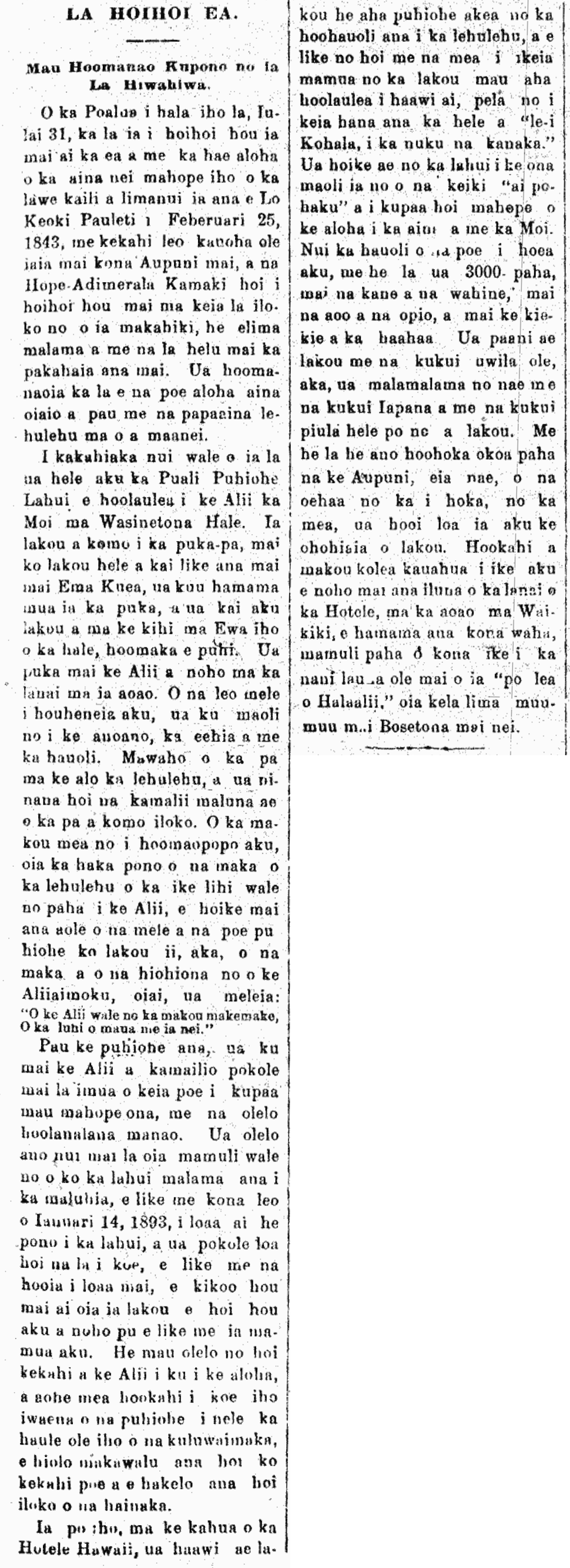
LA HOIHOI EA.

Fitting Remembrances for that Great Day.

This past Tuesday, July 31, was the day that the independence and the beloved flag of this land was restored after being seized and forcefully taken by Lord George Paulet [Lo Keoki Pauleti] on February 25, 1843, without orders from his Nation, and Rear-Admiral Thomas [Hope-Adimerala Kamaki] was the one who restored it on this day in that very year, five months and some days after it was stolen. This day is celebrated by all true patriots with many feasts all over the place.

In the early morning, the Royal Hawaiian Band [Puali Puhiohe Lahui] went to entertain the Alii, the Monarch, at Washington Place. When they entered the yard after marching from Emma Square [Ema Kuea], the door was swung open and they marched to the Ewa corner of the house and began to play. The Alii came out and sat on the lanai on that side. The songs that were played were full of reverence, awe, and joy. Outside before the front yard were the masses, and children climbed the fence and went inside. From what we saw, the crowd was looking intensely to try and maybe get a glimpse of the Alii, showing that the songs by the band wasn’t what they desired, but it was the sight of the face and the appearance of the Ruler that they were after, as it is sung: “Our desire is but for our Alii, The one we care for.” [“O ke Alii wale no ka makou makemake, O ka luhi o maua me ia nei.”]

After the music was over, the Alii stood and spoke briefly before these people who stood steadfast behind her, with words of encouragement. She stressed that the lahui keep the peace, like her statement of January 14, 1893, for the welfare of her people, and that it would be but a few more days before, according to assurances she received, that she will once again have them [? e kikoo hou mai ai oia ia lakou] go back to their lives just as before. The Alii had as well some words filled with aloha, and there was not one from amongst the members of the band who did not shed tears; some shed great many tears while blowing their noses into handkerchiefs.

That night, on the grounds of the Hawaiian Hotel [Hotele Hawaii], they gave an open concert to entertain the public, and just as was seen at the performance they put on earlier, so too was this one, and it was very well attended. Those who attended were very happy, there being perhaps 3000, from men to women, from the old to they young, and from those of high stature to low. They played without electric lights, but were illuminated by Japanese lanterns and their pewter lanterns. It would appear as if they were totally thwarted by the Government [P. G.], but in fact it was the deceitful ones who were disappointed, because they were all the more delighted. There was a single wealth-seeking haole [kolea kauahua] that we saw sitting on the lanai of the Hotel, on the Waikiki side, with his mouth wide open, maybe because he witnessed the unmatched beauty of that great night of entertainment, that person was the one with a maimed hand from Boston.

[Let the story never be forgotten. Ua mau ke ea o ka aina i ka pono!]

(Makaainana, 8/6/1894, p. 1)

LA HOIHOI EA.

Ka Makaainana, Buke II—-Ano Hou, Helu 6, Aoao 1. Augate 6, 1894.

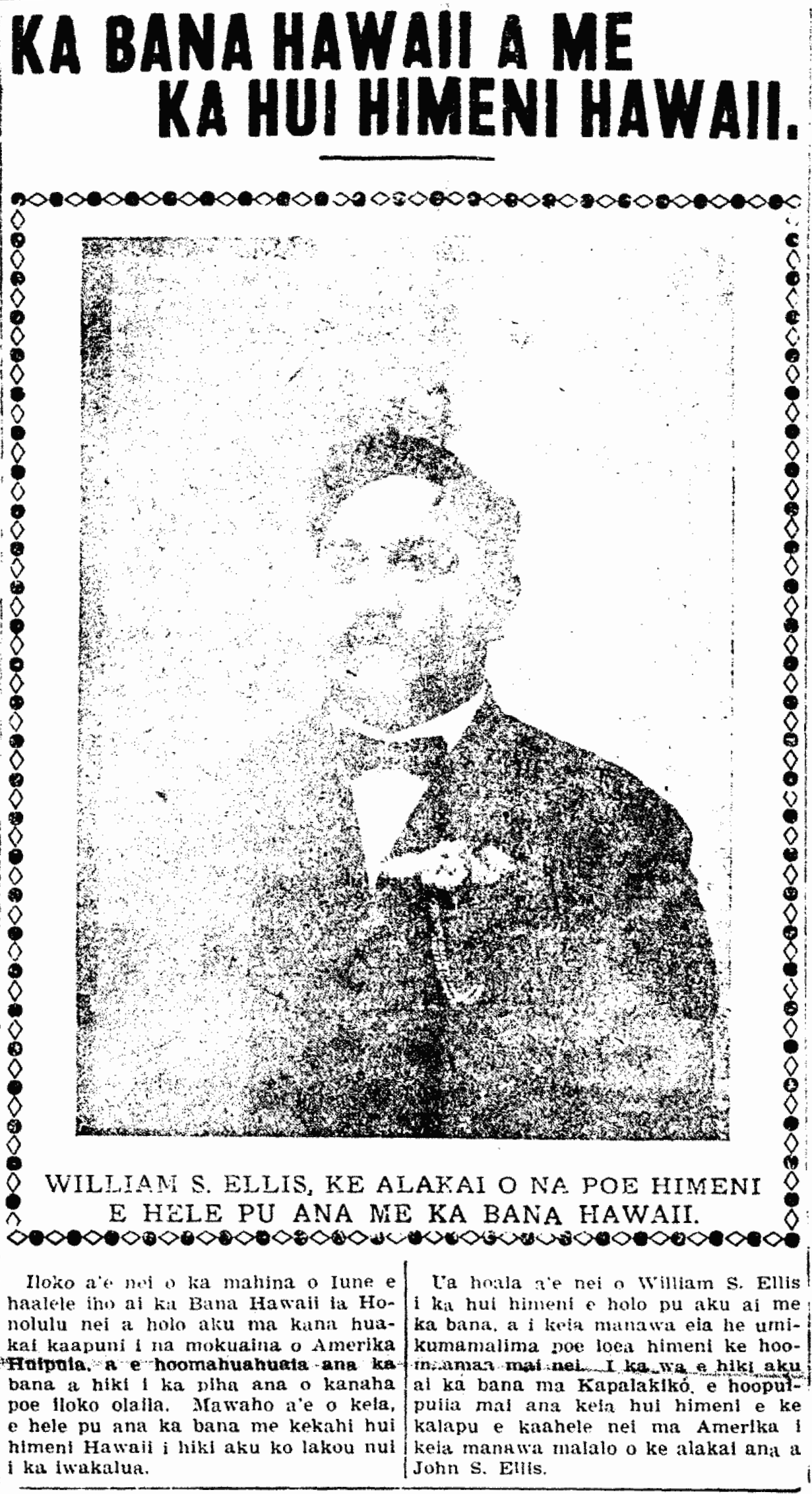
William S. Ellis, leader of the glee club accompanying the Royal Hawaiian Band on tour, 1906.

THE ROYAL HAWAIIAN BAND AND THE HAWAIIAN GLEE CLUB.

WILLIAM S. ELLIS, THE LEADER OF THE SINGERS THAT ARE TRAVELLING WITH THE ROYAL HAWAIIAN BAND.

In the month of June, the Royal Hawaiian Band is leaving Honolulu and going on their tour of the states of the United States of America, and their number will increase until it includes forty people. Other than that, the band will go with a Hawaiian glee club that is made up of twenty people.

William S. Ellis formed the glee club going along with the band, and currently there are fifteen skilled singers who are practicing. When the band arrives in San Francisco, this glee club will be increased by the club that is touring America under the leadership of John S. Ellis.

(Kuokoa, 3/9/1906, p. 1)

KA BANA HAWAII A ME KA HUI HIMENI HAWAII.

Ka Nupepa Kuokoa, Buke XLIV, Helu 10, Aoao 1. Maraki 9, 1906.

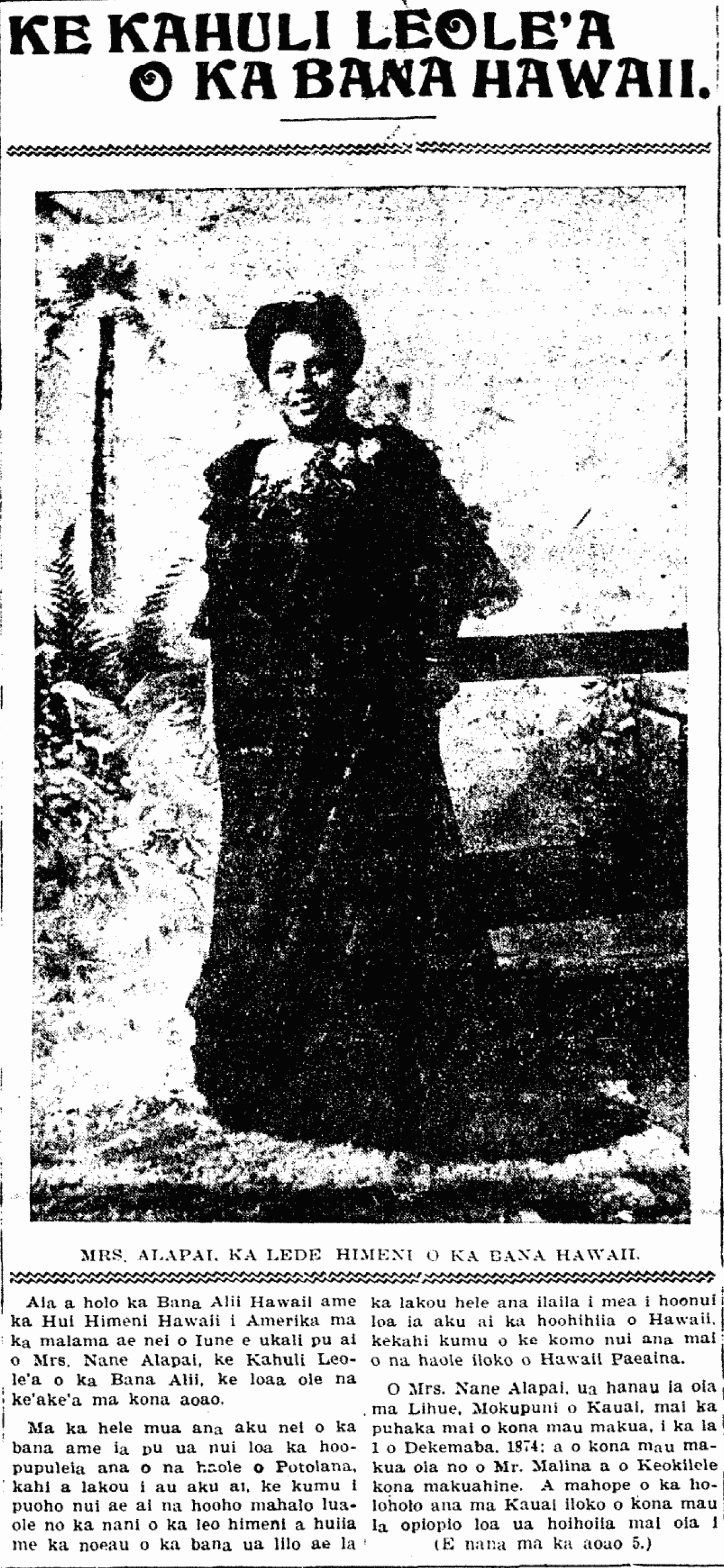
Nane Alapai, 1906.

THE HAPPY-VOICED KAHULI OF THE HAWAIIAN BAND

When the Royal Hawaiian Band and the Hawaiian Glee Club leaves for America in the next month of June, Mrs. Nane Alapai [Nani Alapai], the Beautiful-Voiced Kahuli of the Hawaiian Band will accompany them, should there be no obstructions in her way.

When the band first went with her along, the haole of Portland, where they travelled to, were driven crazy, and that is the reason that there was unequaled exclaim for the beauty of of the singing along with the skill of the band; and their travelling there caused a great interest in Hawaii, which is why there is a great influx in the number of haole coming to the Hawaiian Islands.

Mrs. Nane Alapai [Nani Alapai], was born in Lihue, on the island of Kauai, from the loins of her parents, on the 1st of December, 1874; her parents are Mr. Malina and Keokilele is her mother. And after going around Kauai during her youth, she was taken…

(Kuokoa, 3/16/1906, p. 1)

KE KAHULI LEOLE'A O KA BANA HAWAII.

Ka Nupepa Kuokoa, Buke XLIV, Helu 11, Aoao 1. Maraki 16, 1906.

to Honolulu, where she was educated at the Catholic Boarding School for Girls. She married her husband, Mr. W. J. Alapai almost eleven years ago. She has some siblings other than her; five brothers and eight sisters.

When she joined the Royal Hawaiian Band until today, she spent nine years singing before an audience, and during that whole time, her singing has brought much delight in Hawaii’s people and more so in the malihini who come to Hawaii and then go to America; they are so much more delighted; and this is very valuable to Hawaii and to her herself, and this advertises Hawaii’s beauty; the beauty of her ridges, the beauty of her mountains, and the beauty of the songs of her people; it seems there will be a lot of Hawaiian singer born as a result.

(Kuokoa, 3/16/1906, p. 5)

KE KAHULI LEOLE'A O KA BANA HAWAII.

Ka Nupepa Kuokoa, Buke XLIV, Helu 11, Aoao 5. Maraki 16, 1906.

Royal Hawaiian Band on major tour, 1906.

THE HAWAIIAN BAND HAS LEFT

Miss Annie Leilehua Brown is the Kahuli¹ that has Left.

Madame Nane [Nani] Alapai Pulled Out Over Some Issues—The Places They Will Visit.

MISS ANNIE LEILEHUA BROWN, THE KAHULI OF THE HAWAIIAN BAND WHO HAS LEFT.

On the evening of this past Wednesday, the Royal Hawaiian Band gave their aloha to the communities of their beloved land, and travelled across the wide ocean to the Golden Gate [Ipuka Gula] of San Francisco, and from there they will travel the major cities of the Father Land. They made the deck of the Steamer Korea adorned with them.

There were sixty people on there of the band and glee club, and the majority are Hawaiian, with a few Portuguese; and some people are waiting in San Francisco to join up with the band there. All of them are under the management of Mr. J. C. Cohen, the haole who took the band earlier to Portland [Pokolana].

There is one sad thing, and that is the dropping of the sweet-voiced singer of the band, Madame Nane [Nani] Alapai. Due to a differences between her and J. C. Cohen about her husband, Mrs. Alapai has left the band, and returned to the bosom of her beloved husband; this is a noble example of the power of aloha that is triply bound betwixt a man and his wife; and she will abandon the prestige and power of money.

Hawaii however does not lack in all sorts of singers, so that band is not missing a singer being that they were accompanied by Miss Annie Leilehua Brown, the bird that enlivens the nights of Niolopa. Upon this Hawaiian girl lies the hopes of J. C. Cohen that Hawaii will be lauded with much praise, and that before the band returns home, this girl will become something big.

There are men in that band with beautiful voices, and they will be made to sing solos. There is Jack Ellis, one of Hawaii’s fine tenors; Beni Jones, the bull of the Kawaihau Glee Club; William Ellis and Solomon Hiram, the baritones. When they are all singing together, it is just so beautiful!

These below are all of the people in this tour of the band:

Executive Staff—J. C. Cohen, general manager [lunanui]; A. A. Lotto, business representative [lunahana]; W. Prestidge, master of properties [malama waiwai]; W. Schwartz, assistant master of properties [hope malama waiwai] and librarian [malama pepa].

THE BAND.

Captain H. Berger, Director.

Clarinets—D. K. Naone, C. Palikapu, F. Santanna, L. Salamanco, P. K. Kakalia, S. Opeka, J. M. Gomes, A. H. Elona, P. Kanoho, A. Baker, G. K. Gilman, D. Nape, S. Santanna.

Saxophones—W. S. Ellis, L. Nunes.

Oboes—K. Peters, D. Kaiwi.

Drums—J. Naone, J. C. Freitas, J. Colburn.

The Brass Section.

Cornets—J. Amasiu, Charles Krueter, L. Waiamau, R. W. Aylett, W. Anahu, M. Moniz, W. Sea.

Baritone Horn—M. Mendoza.

Tubas—R. H. Baker, J. Kanoho, J. Kaaua, J. McCabe.

Alto Horns—M. Garcia, R. S. Kapua, G. Wela, H. Keawe.

Trombones—H. Heanu, J. Punua, J. Pa, S. Hiram.

GLEE CLUB.

Directors—Sonny Cunha and W. S. Ellis.

Double bass—R. H. Baker; Violinists—J. Colburn, C. Palikapu; flutists, D. Kaiwi, D. Nape; Piano, Sonny Cunha.

Singers—John S. Ellis, tenor, soloist; Ben Jones, bass, soloist; W. S. Ellis, baritone, soloist; Solomon Hiram, J. Harrison, P. H. Kakalia, W. Sea, H. Heanu, H. K. Clark, K. Peters, J. Kamakani, L. Waiamau, J. Edwards, R. W. Aylett, Joe Pa, J. Akana, H. Keawe, J. K. Kaaa, R. S. Kapua, J. Punua.

Female singer—Miss Lei Lehua [Leilehua]

THE PLACES THEY WILL TRAVEL.

May 28 to June 4, 1906, Oakland, California.
June 5, Stockton, Yosemite Theater.
June 6, Sacramento, Clumie Theater.
June 7, on the road.
June 8, 9, Portland, Oregon, Hellig Theater.
June 10, 11, 12, Seattle, Washington, Grand Music House.
June 13, Victoria, British Columbia, Victoria Theater.
June 14, Vancouver, B. C., Vancouver Music House.
June 15, Watcom, Washington, Beck Theater.
June 16, Everett, Washington, Everett Theater.
June 17, Tacoma, Washington, Music House.
June 18, Aberdeen, Washington, Music House.
June 19, Yakima, Washington, Yakima Theater.
June 20, 21, Spokane, Washington, Spokane Theater.
June 22, Missoula, Montana, Music House.
June 23, Helena, Montana, Helena Theater.
June 24, Great Falls, Montana, Music House.

¹Kahuli are the famous singing land shells which are often used to describe sweet-voiced singers.

(Kuokoa, 5/25/1906, p. 1)

UA HOLO AKU LA KA BANA HAWAII

Ka Nupepa Kuokoa, Buke XLIV, Helu 21, Aoao 1. Mei 25, 1906.

June 25, Anaconda, Montana, Margaret Theater.
June 26, Butte, Montana, Broadway Theater.
June 28, Pocatello, Idaho, Auditorium.
June 29, Logan, Utah, Thatcher Music House.
June 30, July 1, Ogden, Utah, Music House.
July 2, 3, 4, Salt Lake City, Salt Lake Theater.
July 5, Salida, Colorado, Music House.
July 6, Pueblo, Colorado, Music House.
July 7, Colorado Springs, Music House.
July 8, 9, 10, 11, 12, 13, 14, Denver, Colorado, Tabor Grand Theater.

(Kuokoa, 5/25/1906, p. 8)

HOLO AKU KA BANA HAWAII.

Ka Nupepa Kuokoa, Buke XLIV, Helu 21, Aoao 8. Mei 25, 1906.

Nora Rickard of Honokaa turns 90, 1938.

Mother Rickard Celebrates her birthday

MRS. RICKARD

On Sunday, March 6, “Mother” Nora Rickard of Honokaa celebrated her 90th birthday, after living until local on the Island of Keawe for 71 years. She was born in Devonshire, England, and left there when she was 19 years old and went to America on a sailboat travelling under Cape Horn [Kaipo Hone], a trip that took five months.

“Mother” Rickard is the first white woman who lived in Honokaa. She is still strong and spry, even if she is very old. Pertaining to her trip from England, she says: Continue reading

Royal Hawaiian Band headed to America, 1906.

THE ROYAL HAWAIIAN BAND OF THE COUNTY OF OAHU.

The picture below is of the Royal Hawaiian Band [Bana Alii Hawaii], famous here in the Hawaiian Archipelago, but there will be a small change, that being, this band will head to America in the month of June, and will stay there during the months of July and August, and will have two lady singers, which will be the entire band as is desired. Continue reading

Iolani Palace open to the public, 1938.

The Crown Room of Iolani Palace Opened

This is the only Crown Room in the United States of America, and it is a reminder of the days when it was under the rule of the kings and queens of Hawaii nei. The appearance of the crown room these days is like that of the times of the monarchs.

This past week, the crown room of the Iolani Palace was opened once again, and it was opened to the public; Governor Poindexter and Secretary Hite [of the Citizens’ Council] opened the doors of that crown room. There were many who arrived there for the opening.

Amongst the chants [na olioli ame na kanaenae] of the ancient Hawaiians, there were eyes misted with tears with memories of the days of the monarchy, and there was also the sweet sound of the Royal Hawaiian Band [Bana Hawaii]; there were hundreds of people lined up in the only crown room in all the United States. This tour was led by Mrs. Eugenia Reis, moi of the Daughters and Sons of Hawaiian Warriors, and in attendance were the members of her association and seven other Hawaiian associations. Continue reading

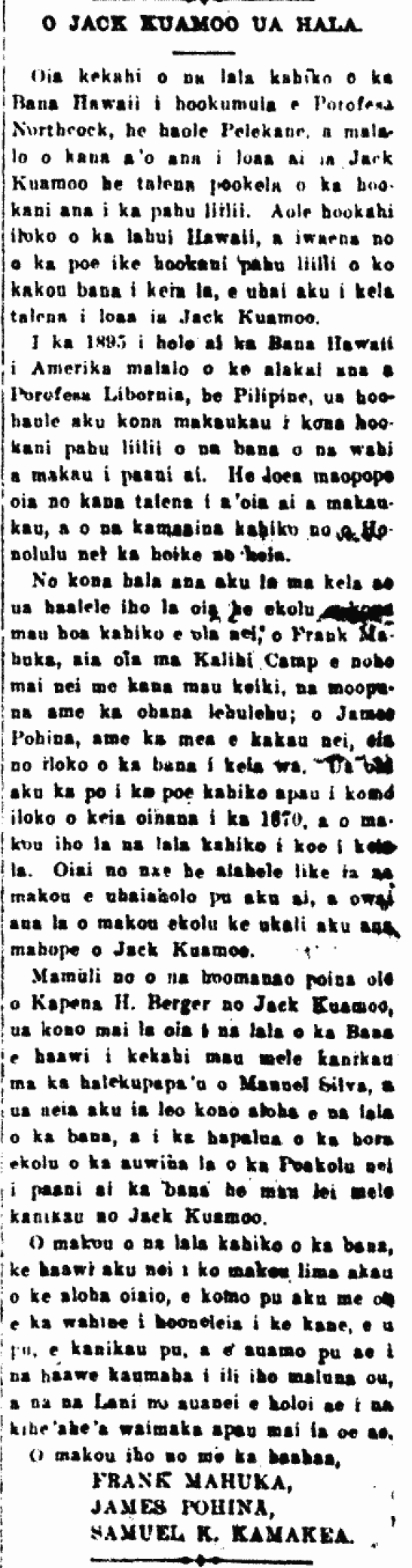
The passing of Jack Kuamoo, 1913.

JACK KUAMOO HAS PASSED AWAY.

He is one of the members of the Royal Hawaiian Band [Bana Hawaii] established by Professor Northcock, a British man, and under his instruction, Jack Kuamoo acquired a superior talent in playing the smaller drums. There is no one amongst the Hawaiian people and amongst those who play the smaller drums of our band these days that can follow after the talent that Jack Kuamoo had.

In 1895, the Royal Hawaiian Band went to America under the leadership of Professor Libornio, a Filipino, and his abilities in drumming smaller drums diminished in the places where we in the band played. He was a known expert in his talent taught to him until proficient, and it is the old kamaaina of Honolulu nei who are the witness to this.

With his death, he left behind three of his old friends still living: Frank Mahuka, living with his children, grandchildren and many of his family in Kalihi Camp; James Pohina, and the one writing this [Samuel K. Kamakea], still with the band today. All of the old ones of this profession in 1870 have died, and we are the old members left alive today. But we are to follow too on the same path, so who amongst us three will be the one to go after Jack Kuamoo.

Because of the unforgettable remembrances of Captain H. Berger for Jack Kuamoo, he was invited by the members of the Band to offer some dirges at the crypt of Manuel Silva, and the loving invitation by the band was accepted, and at half past three in the afternoon of this Wednesday, the band played some mele kanikau for Jack Kuamoo.

We, the old members of the band, are giving our right hand of true aloha, and join with you O Wife who is left without a husband, and grieve with you, and mourn with you, and carry with you the sadness borne upon you; and may the Heavens wash away all of the streaks of tears from you.

We with sincerity,

FRANK MAHUKA,

JAMES POHINA,

SAMUEL K. KAMAKEA.

[Does anyone know who the Professor Northcock mentioned refers to?]

(Kuokoa, 9/26/1913, p. 3)

O JACK KUAMOO UA HALA.

Ka Nupepa Kuokoa, Buke LI, Helu 38, Aoao 3. Sepatemaba 26, 1913.

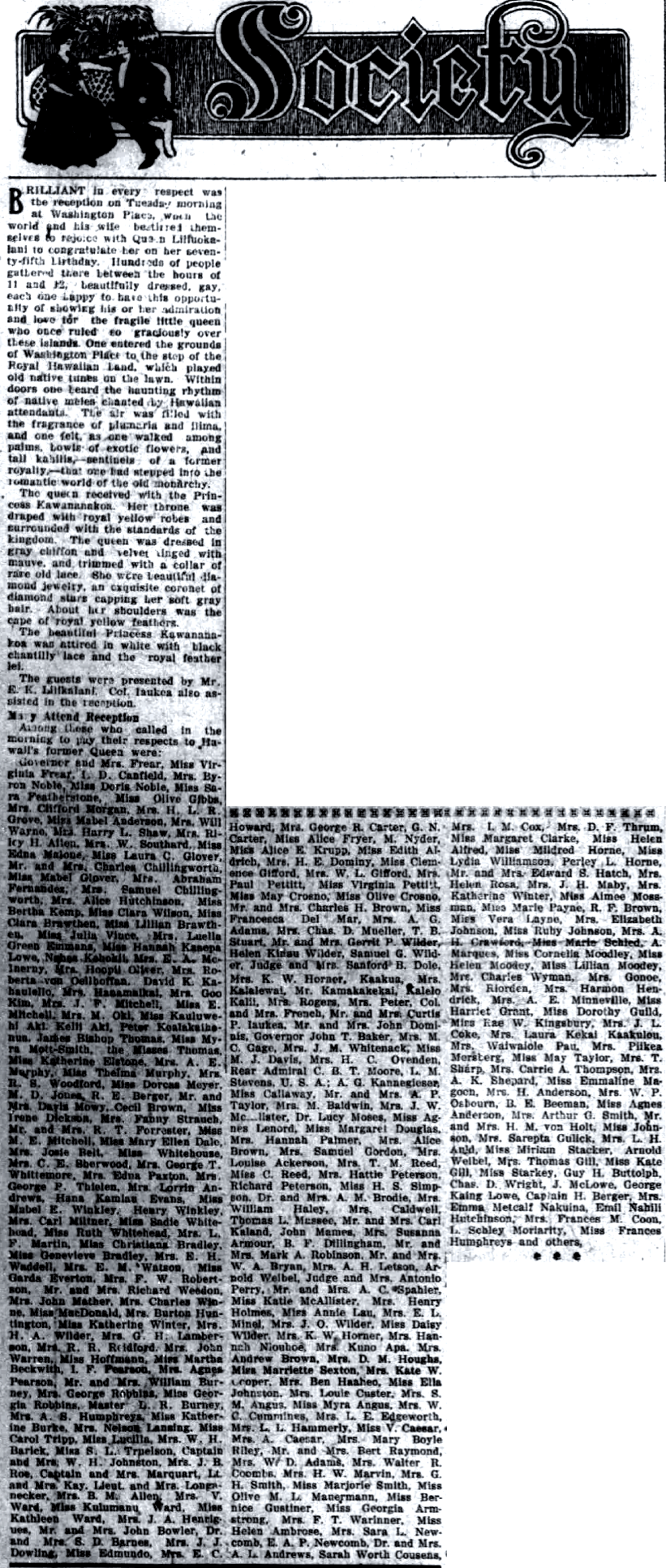
More on Liliuokalani’s 75th birthday celebration, 1913.

Society

BRILLIANT in every respect was the reception on Tuesday morning at Washington Place, when the world and his wife bestirred themselves to rejoice with Queen Liliuokalani to congratulate her on her seventy-fifth birthday. Hundreds of people gathered there between the hours of 11 and 12, beautifully dressed, gay, each one happy to have this opportunity of showing his or her admiration and love for the fragile little queen who once ruled so graciously over these islands. One entered the grounds of Washington Place to the step of the Royal Hawaiian Band, which played old native tunes on the lawn. Within doors one heard the haunting rhythm of native meles chanted by Hawaiian attendants. The air was filled with the fragrance of plumeria and ilima, and one felt, as one walked among palms, bowls of exotic flowers, and tall kahilis,—sentinels of a former royalty,—that one had stepped into the romantic world of the old monarchy.

The queen received with the Princess Kawananakoa. Her throne was draped with royal yellow robes and surrounded with the standards of the kingdom. The queen was dressed in gray chiffon and velvet tinged with mauve, and trimmed with a collar of rare old lace. She wore beautiful diamond jewelry, and exquisite coronet of diamond stars capping her soft gray hair. About her shoulders was the cape of royal yellow feathers.

The beautiful Princess Kawananakoa was attired in white with black chantilly lace and the royal feather lei.

The guests were presented by Mr. E. K. Lilikalani, Col. Iaukea also assisted in the reception.

Many Attended Reception

Among those who called in the morning to pay their respects to Hawaii’s former Queen were:

Governor and Mrs. Frear, Miss Virginia Frear, I. D. Canfield, Mrs. Byron Noble, Miss Doria Noble, Miss Sara Featherstone, Miss Olive Gibbs, Mrs. Clifford Morgan, Mrs. H. L. R. Grove, Miss Mabel Anderson, Mrs. Will Wayne, Mrs. Harry L. Shaw, Mrs. Riley H. Allen, Mrs. W. Southard, Miss Edna Malone, Miss Laura C. Glover, Mr. and Mrs. Charles Chillingworth, Miss Mabel Glover, Mrs. Abraham Fernandez, Mrs. Samuel Chillingworth, Mrs. Alice Hutchinson, Miss Bertha Kemp, Miss Clara Wilson, Miss Clara Brawthen, Miss Lillian Brawthen, Miss Julia Vince, Mrs. Luella Green Emmans, Miss Hannah Kaaepa Lowe, Nahea Kehokii, Mrs. E. A. McInerny, Mrs. Hoopii Oliver, Mrs. Roberta von Oellhoffan, David K. Kahaulelio, Mrs. Hanamaikai, Mrs. Goo Kim, Mrs. J. F. Mitchell, Miss E. Mitchell, Mrs. M. Oki, Miss Kauluwehi Aki, Kelii Aki, Peter Kealakaihonua, James Bishop Thomas, Miss Myra Mott-Smith, the Misses Thomas, Miss Katherine Elstone, Mrs. A. E. Murphy, Miss Thelma Murphy, Mrs. R. S. Woodford, Miss Dorcas Meyer, M. D. Jones, R. E. Berger, Mr. and Mrs. Davis Mowy, Cecil Brown, Miss Irene Dickson, Mrs. Fanny Strauch, Mr. and Mrs. R. T. Forrester, Miss M. E. Mitchell, Miss Mary Ellen Dale, Mrs. Josie Belt, Miss Whitehouse, Mrs. C. E. Sherwood, Mrs. George T. Whittemore, Mrs. Edna Paxton, Mrs. George P. Thielen, Mrs. Lorrin Andrews, Hana Kamiau Evans, Miss Mabel E. Winkley, Henry Winkley, Mrs. Carl Miltner, Miss Sadie Whitehead, Miss Ruth Whitehead, Mrs. L. F. Martin, Miss Christiana Bradley, Miss Genevieve Bradley, Mrs. E. H. Waddell, Mrs. E. M. Watson, Miss Garda Everton, Mrs. F. W. Robertson, Mr. and Mrs. Richard Weedon, Mrs. John Mather, Mrs. Charles Winne, Miss MacDonald, Mrs. Burton Huntington, Miss Katherine Winter, Mrs. H. A. Wilder, Mrs. G. H. Lamberson, Mrs. R. R. Reidford, Mrs. John Warren, Miss Hoffmann, Miss Martha Beckwith, I. F. Pearson, Mrs. Agnes Pearson, Mr. and Mrs. William Burney, Mrs. George Robbins, Miss Georgia Robbins, Master L. R. Burney, Mrs. A. S. Humphreys, Miss Katherine Burke, Mrs. Nelson Lansing, Miss Carol Tripp, Miss Lucilla, Mrs. W. H. Barick, Miss S. L. Truelson, Captain and Mrs. W. H. Johnston, Mrs. J. B. Roe, Captain and Mrs. Marquart, Lt. and Mrs. Kay, Lieut. and Mrs. Longanecker, Mrs. B. M. Allen, Mrs. V. Ward, Miss Kulumanu Ward, Miss Kathleen Ward, Mrs. J. A. Henriques, Mr. and Mrs. John Bowler, Dr. and Mrs. S. D. Barnes, Mrs. J. J. Dowling, Miss Edmundo, Mrs. E. C. Howard, Mrs. George R. Carter, G. N. Carter, Miss Alice Fryer, M. Nyder, Miss Alice E. Krupp, Miss Edith Aldrich, Mrs. H. E. Dominy, Miss Clemence Gifford, Mrs. W. L. Gifford, Mrs. Paul Pettitt, Miss Virginia Pettitt, Miss May Crosno, Miss olive Crosno, Mr. and Mrs. Charles H. Brown, Miss Francesca Del Mar, Mrs. A. G. Adams, Mrs. Charles D. Mueller, T. B. Stuart, Mr. and Mrs. Gerrit P. Wilder, Helen Kinau Wilder, Samuel G. Wilder, Judge and Mrs. Sanford B. Dole, Mrs. K. W. Horner, Kaakua, Mrs. Kalalewai, Mr. Kamakakekai, Kalelo Kalii, Mrs. Rogers, Mrs. Peter, Col. and Mrs. French, Mr. and Mrs. Curtis P. Iaukea, Mr. and Mrs. John Dominis, Governor John T. Baker, Mrs. M. C. Gage, Mrs. J. M. Whitenack, Miss M. J. Davis, Mrs. H. C. Ovenden, Rear Admiral C. B. T. Moore, L. M. Stevens, U. S. A.; A. G. Kannegieser, Miss Callaway, Mr. and Mrs. A. P. Taylor, Mrs. M. Baldwin, Mrs. J. W. McAllister, Dr. Lucy Moses, Miss Agnes Lenord, Miss Margaret Douglas, Mrs. Hannah Palmer, Mrs. Alice Brown, Mrs. Samuel Gordon, Mrs. Louise Ackerson, Mrs. T. M. Reed, Miss C. Reed, Mrs. Hattie Peterson, Richard Peterson, Miss H. S. Simpson, Dr. and Mrs. A. M. Brodie, Mrs. William Haley, Mrs. Caldwell, Thomas l. Massee, Mr. and Mrs. Caldwell, Thomas l. Massee, Mr. and Mrs. Carl Kaland, John Mames, Mrs. Susanna Armour, B. F. Dillingham, Mr. and Mrs. Mark A. Robinson, Mr. and Mrs. W. A. Bryan, Mrs. A. H. Letson, Arnold Weibel, Judge and Mrs. Antonio Perry, Mr. and Mrs. A. C. Spahler, Miss Katie McAllister, Mrs. Henry Holmes, Miss Annie Lau, Mrs. E. L. Minel, Mrs. J. O. Wilder, Miss Daisy Wilder, Mrs. K. W. Horner, Mrs. Hannah Niauhoe, Mrs. Kuno Apa, Mrs. Andrew Brown, Mrs. D. M. Houghs, Miss Marriette Sexton, Mrs. Kate W. Cooper, Mrs. Ben Haaheo, Miss Ella Johnston, Mrs. Louie Custer, Mrs. S. M. Angus, Miss Myra Angus, Mrs. W. C. Cummings, Mrs. L. E. Edgeworth, Mrs. L. L. Hammerly, Miss V. Caesar, Mrs. A. Caesar, Mrs. Mary Boyle Riley, Mr. and Mrs. Bert Raymond, Mrs. W. D. Adams, Mrs. Walter R. Coombs, Mrs. H. W. Marvin, Mrs. G. H. Smith, Miss Marjorie Smith, Miss Olive M. L. Manermann, Miss Bernice Gustiner, Miss Georgia Armstrong, Mrs. F. T. Warinner, Miss Helen Ambrose, Mrs. Sara L. Newcomb, E. A. P. Newcomb, Dr. and Mrs. A. L. Andrews, Sarah Worth Cousens, Mrs. L. M. Cox, Mrs. D. F. Thrum, Miss Margaret Clarke, Miss Helen Alfred, Miss Mildred Horne, Miss Lydia Williamson, Perley L. Horne, Mr. and Mrs. Edward S. Hatch, Mrs. Helen Rosa, Mrs. J. H. Maby, Mrs. Katherine Winter, Miss Aimee Mossman, Miss Marie Payne, R. F. Brown, Miss Vera Layne, Mrs. Elizabeth Johnson, Miss Ruby Johnson, Mrs. A. H. Crawford, Miss Marie Schied, A. Marques, Miss Cornelia Moodley, Miss Helen Moodey, Miss Lillian Moodey, Mrs. Charles Wyman, Mrs. Gonoe, Mrs. Riorden, Mrs. Harmon Hendrick, Mrs. A. E. Minneville, Miss Harriet Grant, Miss Dorothy Guild, Miss Rae W. Kingsbury, Mrs. J. L. Coke, Mrs. Laura Kekai Kaakulou, Mrs. Waiwaiole Pau, Mrs. Piikea Mersberg, Miss May Taylor, Mrs. T. Sharp, Mrs. Carrie A. Thompson, Mrs. A. K. Shepard, Miss Emmaline Magoch, Mrs. H. Anderson, Mrs. W. P. Osbourn, B. E. Beeman, Miss Agnes Anderson, Mrs. Arthur G. Smith, Mr. and Mrs. H. M. von Holt, Miss Johnson, Mrs. Sarepta Gullick, Mrs. L. H. Auld, Miss Miriam Stacker, Arnold Weibel, Mrs. Thomas Gill, Miss kate Gill, Miss Starkey, Guy H. Buttolph, Charles D. Wright, J. McLowe, George Kaing Lowe, Captain H. Berger, Mrs. Emma Metcalf Nakuina, Emil Nahili Hutchinson, Mrs. Frances M. Coon, L. Schley Moriarity, Miss Frances Humphreys and others.

(Honolulu Star-Bulletin, 9/6/1913, p. 13)

Society

Honolulu Star-Bulletin, Volume XXI, Number 6683, Page 13. September 6, 1913.