More about snow on Molokai, 1912.

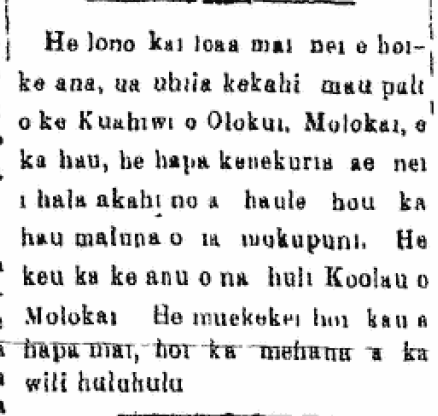
We received word saying that some precipices of the Olokui Mountain, Molokai is covered with snow; it was half a century ago when snow first fell on that island. The Koolau side of Molokai is tremendously cold. [He muekekei hoi a kau hapa mai, hoi ka mehana a ka wili huluhulu. ??]

[Although the previous article says Emma Nakuina thought there never was snow on Molokai before, this here seems to say that snow was recorded on Molokai some time before this!

And does anyone have clarity on the last sentence of the article?]

(Kuokoa Home Rula, 3/15/1912, p. 1)

He lono kai loaa mai nei...

Kuokoa Home Rula, Buke X, Helu 11, Aoao 1. Maraki 15, 1912.

Vital Statistics. 1912.

MARRIAGES.

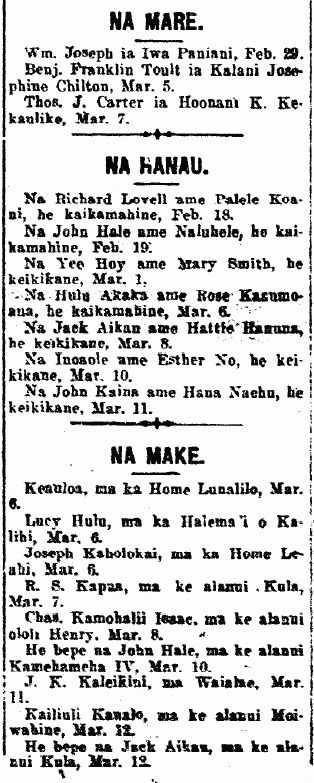
William Joseph to Iwa Paniani, Feb. 29.
Benjamin Franklin Toult to Kalani Josephine Chilton, Mar. 5.
Thomas J. Carter to Hoonani K. Kekaulike, Mar. 7.

BIRTHS.

To Richard Lovell and Palele Koani, a daughter, Feb. 18.
To John Hale and Naluhele, a daughter, Feb. 19.
To Yee Hoy and Mary Smith, a son, Mar. 1
To Hulu Akaka and Rose Kaaumoana, a daughter, Mar. 6.
To Jack Aikau and Hattie Hanuna, a son, Mar. 8.
To Nameless and Esther No, a son, Mar. 10.
To John Kaina and Hana Naehu, a son, Mar. 11.

DEATHS.

Keauloa, at Lunalilo Home, Mar. 6.
Lucy Hulu, at the Kalihi Hospital, Mar. 6.
Joseph Kaholokai, at Leahi Home, Mar. 6.
R. S. Kapua, on School Street, Mar. 7.
Charles Kamohalii Isaac, on Henry Lane, Mar. 8.
A baby of John Hale, on Kamehameha IV Road, Mar. 10.
J. K. Kaleikini, in Waialae, Mar. 11.
Kailiuli Kanalo, on Queen Street, Mar. 12.
A baby of Jack Aikau, on School Street, Mar. 12.

(Kuokoa, 3/15/1912, p. 8)

NA MARE. / NA HANAU. / NA MAKE.

Ka Nupepa Kuokoa, Buke XLVIII, Helu 11, Aoao 8. Maraki 15, 1912.

If you think we’ve been having strange weather lately… Snow on Molokai? 1912.

SNOW FELL ON MOLOKAI.

THE FIRST TIME THIS REMARKABLE THING WAS WITNESSED.

On her way home from Molokai, Mrs. Emma Nakuina brought proof of snow [hau sano] falling on Molokai, and you can clearly see the whitening of the mountain tops behind Pukoo with snow. In the history of the inhabitation of Molokai, there has never been seen this amazing thing on that island from the beginning, and this is the first time that snow has been seen falling on Molokai. According to Mrs. Nakuina.

H. D. Bowen stated that snow fell in great quantities on the mountain behind Pukoo, so that you could see clearly the patches of snow in many places on the ridges as well as down in the valleys.

You can see the snow all the way from the harbor of Pukoo and the shore, according to Mr. Bowen. He has some land next to [illegible because of fold] and while he was there, he saw the snow.

I believe this is the first time that man remembers that snow fell on Molokai, said Mrs. Nakuina.

So it is perhaps because of the cold we’ve had these past days that snow fell on Molokai. According to the scientists, the time is coming where the tropic zone will become arctic, and will be covered in snow. Could this be the beginning of this?

[See the article from which this was translated [?] and more in The Hawaiian Star, 3/11/1912, pp. 1 & 5.]

(Aloha Aina, 3/16/1912, p. 1)

HAULE KA HAU SANO MA MOLOKAI.

Ke Aloha Aina, Buke XI, Helu 11, Aoao 1. Maraki 16, 1912.

You never know who you will find… 1923.

APPRECIATION

MY BELOVED HUSBAND HAS LEFT ME

To you, Mr. Editor of the Hoku o Hawaii.

Much aloha between us:

Please be so kind as to insert this bundle of sadness shown above in an open space of our newspaper, Ka Hoku o Hawaii, and it will be you who flashes all over the land so that the family and friends of my beloved husband who has left me will see.

That being on the 23rd of Oct., this past month, while I was relaxing at our home, a car arrived from Waiohinu revealing to me this:

“The two of us have come; the train of Punalulu [Punaluu] has gone off the tracks.” That is my husband was on the train, as he works as the stoker. At that moment, I thought that it might be my husband, and I left immediately to the ocean-side of the mill to ask the people of the mill who got injured, but  I first got to where Mrs. Kawaha was doing the wash, and I asked her if she heard the news, and she said she did not.

I told her that I heard the train toppled, and at that moment I saw the sheriff, Moses Kawaha and the doctor.

I called to the sheriff, asking who from the train got injured, but he didn’t respond, then I asked the doctor who was hurt, and his answer to me was Willie, the man from house number 2. Right then my hopes were gone; I returned to our home and everyone else had heard and the house was full of friends. His body was returned here, and I thought maybe he was still breathing, but it was not so, his body was cold and he had gone earlier; he had many injuries.

The reason for the accident is not known; how horrifying to think about.

Puna of the fragrant bowers of pandanus [Puna paia aala i ka hala] is where he was born. He is a true grandchild of Maunakea and Lilia; he grandmother is Puna.

I was joined with my loving husband, William K. Kumukahi in the pure covenant of marriage in the month of March 16, 922 in Kona, Kealia, by reverend John Keala. I think about the places were were together, alas; my husband who has gone afar. We were brought here by the parents [?], Ben Kamoku, to come and be the assistant blacksmith for the mill, and he ended up doing various work. He was kind to me and to all others; my children were important to him.

Alas, I am without my provider [makua], beloved are all the places we were together; he just left this morning to go to work but he has gone forever. His own mother came from Opihikaa [Opihikao?], Puna, but she did not see how he looked; his Kuku [grandparent] and Cousins and Aunty, they saw what he looked like. And his funeral procession went on to the cemetery at Kauahao [Kauahaao?], Waiohinu.

It is there that he lies alone. With the friends and family go my great thanks, those who stayed up with me that night till day, and also the lei, the bouquets of flowers from the friends, and to the family is my endless appreciation.

All of us in sadness:

Mrs. Mary Kumukahi

Miss Alice Kumukahi

Samuel Kumukahi

Mrs. Kawaa Lohiau

Mr. L. K. Lohiau

[I found this article by chance. Genealogy and family stories abound in the Hawaiian-Language Newspapers. Hopefully the names and important information will be inputted faithfully so that if you look up your kupuna, you will find them every time they appear!]

(Hoku o Hawaii, 11/15/1923, p. 3)

HOALOHALOHA

Ka Hoku o Hawaii, Buke XVII, Helu 25, Aoao 3. Novemaba 15, 1923.

True Hawaiian? 1893.

True Hawaiian.

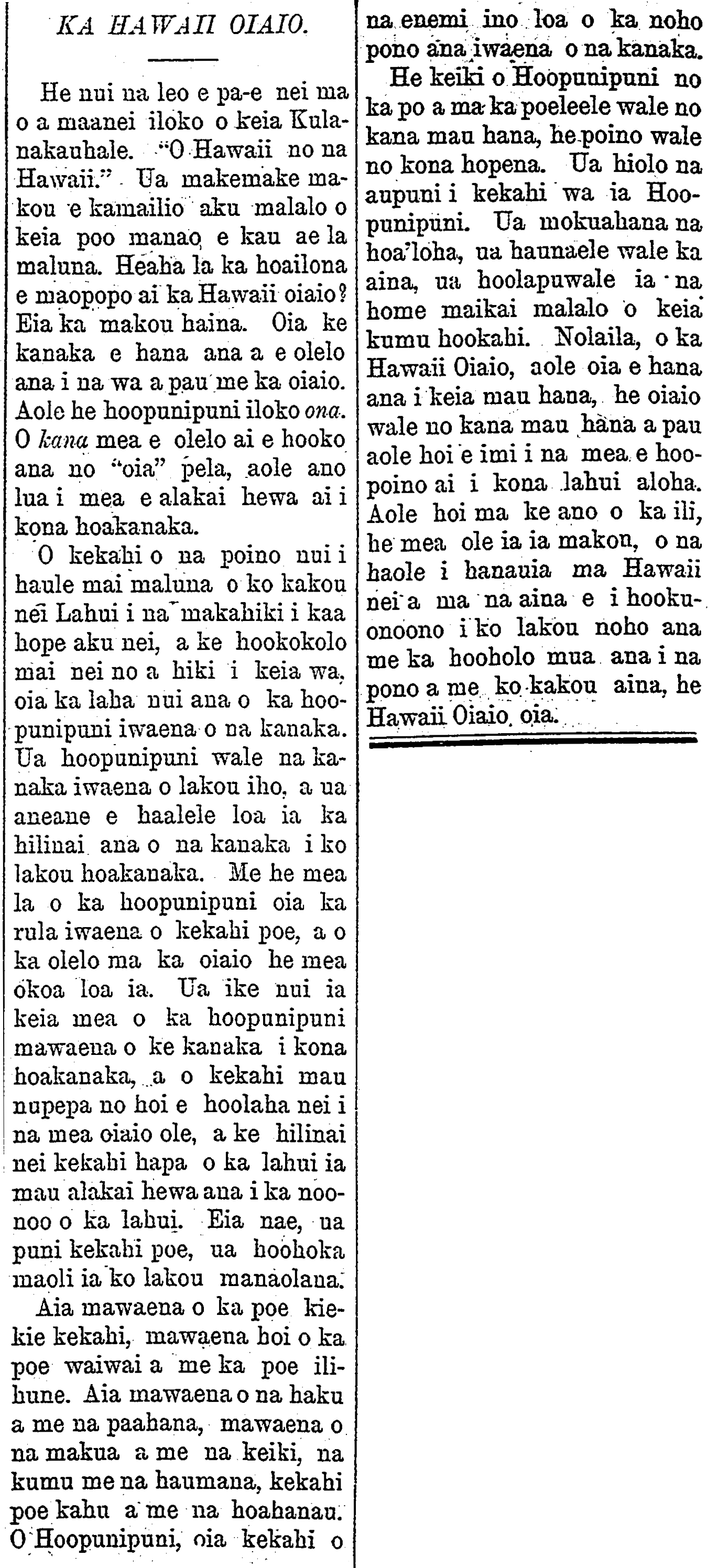
There are many voices ringing out here and there in this Town. “Hawaii for Hawaiians.” We wish to discuss the topic above. What in the world are the signs that distinguish a true Hawaiian? This is our answer. It is a person who acts and speaks at all times in truth. He has no falsehood within him. What he says, he follows through on, and does not speak to mislead his fellow man.

One of the great misfortune which fell upon our Lahui these past years, and creeps on to the present, is the rampant promulgation of lies amongst the people. People tell falsehoods amongst themselves, and it is almost to the point where people have lost faith their fellow man. It is as if lying is the norm with some people, and telling the truth is something terribly odd. This telling of falsehoods is often seen among people to his fellow man, and some newspapers are spreading things that are not true; and a part of the lahui believes this misleading of the minds of the lahui. And still some people were taken by it, and their hopes dashed.

Amongst the prominent people, amongst the rich and the poor. Amongst the bosses and the laborers, amongst the parents and the children, the instructors and students, some pastors and church members. Falsehood is the most vile enemy of righteous living amongst people.

Falsehood is the spawn of night, and it only works in darkness, and misfortune is its outcome. During some ages, nations have fallen to Falsehood. Friends have been torn apart, the land grew tumultuous, and good homes became retched, all because of this one reason. Therefore, the True Hawaiian does not act in such a manner, he only acts truthfully, and he does not seek to cause harm his own beloved lahui. It is not skin color, that means nothing to us; those haole born in Hawaii nei  and elsewhere who prosper while moving well-being and our land forward, he is a True Hawaiian.

[Notice that this editorial came out soon after the overthrow, and was in response to the many articles anticipating the return of the crown.

There were many types of Hawaiian-Language Newspaper owners and editors as well, and it is important to understand the slant of a paper when reading its articles. It is important also to remember that a newspaper might not always have the same goals and objectives throughout its existence, especially if its leadership changes. J. U. Kawainui was editor and J. K. Iosepa was assistant editor of the Daily Kuokoa when this article appeared.

This is one of those papers that are not available online yet (images or text). Also, they are not available at the usual places on microfilm. Hopefully they will be made available soon!]

(Nupepa Puka La Kuokoa me Ko Hawaii Paeaina i Huiia, 3/9/1893, p. 2)

KA HAWAII OIAIO.

Nupepa Puka La Kuokoa me Ko Hawaii Paeaina i Huiia, Buke I, Helu 28, Aoao 2. Maraki 9, 1893.

More from Kalaupapa, 1912.

A REMEMBRANCE OF THE ONE WHO HAS GONE.

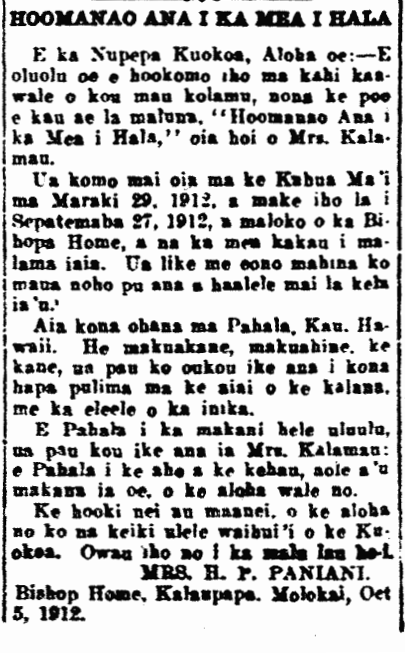
O Nupepa Kuokoa, Aloha oe:—Please be so kind as to include in an empty space of your columns the article with the title above, “A Remembrance of the One Who Has Gone,” that being Mrs. Kalamau.

She came to the leprosy settlement on March 29, 1912, and died on September 27, 1912 in Bishop Home, and it was your writer who took care of her. We lived together for about six months when she left me.

Her family is in Pahala, Kau, Hawaii. Her father, mother, and husband, you will no longer see her hand on white stationery with the black of ink.

O Pahala in the blustery winds, you shall no longer see Mrs. Kalamau; O Pahala in the soft blowing Kehau, i have no gift for you, only aloha.

I end here; my aloha to the type setting boys of the Kuokoa. Me, in the shade of the hoi [ho’i?] leaves.

Mrs. H. P. Paniani.

Bishop Home, Kalaupapa, Molokai, Oct. 5, 1912.

(Kuokoa, 10/18/1912, p. 7)

HOOMANAO ANA I KA MEA I HALA

Ka Nupepa Kuokoa, Buke XLVIII, Helu 42, Aoao 7. Okatoba 18, 1912.

Description of native flora, 1857.

Hard Wood.

O Hae Hawaii:

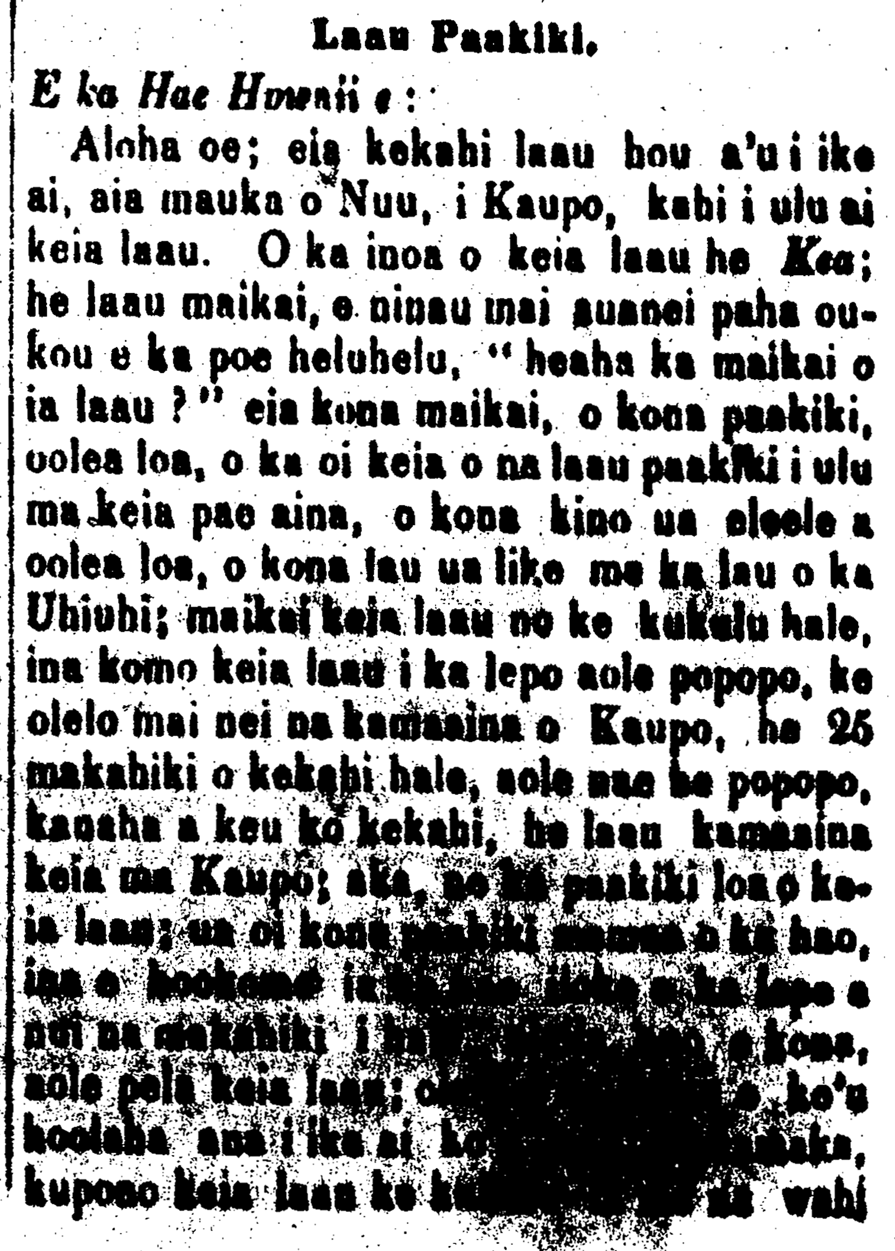
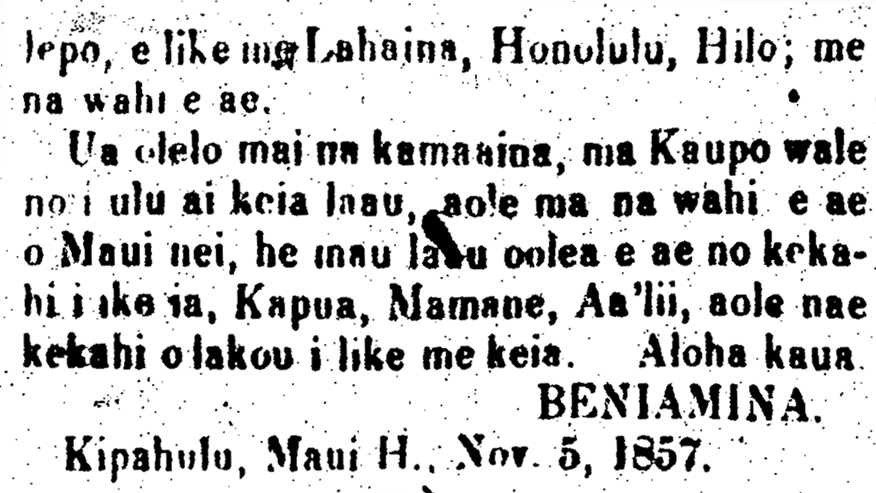
Aloha oe: this is a new tree I have seen, this tree grows in the uplands of Nuu, in Kaupo. The name of this tree is Kea, and it is a useful tree. You, the reader may ask, “What is good about this tree?” And this is why it is good, because of its solidness; it is very strong, it is the strongest tree growing in this archipelago; its body is black and it very strong, its leaves are like that of the Uhiuhi. This tree is good for house building; if the wood is put into dirt, it doesn’t rot. The natives of Kaupo say that some houses are over 25 years old and there is no rot, and some are over forty years old. It is a familiar tree in Kaupo. But because it is so solid, it is stronger than metal, in that if you put metal into the earth and many years go by, it deteriorates; not so of this wood. This is the reason I am getting the word out, so that my friends will know that this is a good wood for building in dirt, like in Lahaina, Honolulu, Hilo, and other places.

The locals say that it is only in Kaupo that this tree grows, and not any other place on Maui; there are other known strong-wooded trees like Kapua [Pua?], Mamani, and Aalii, but none are like this. Aloha amongst us.

Beniamina.

Kipahulu, Maui, Hawaii, Nov. 5, 1857.

(Hae Hawaii, 11/18/1857, p. 133 & 34)

Laau Paakiki.

Ka Hae Hawaii, Buke 2, Ano Hou----Helu 34, Aoao 133. Novemaba 18, 1857.

Laau Paakiki (hoomau ia).

Ka Hae Hawaii, Buke 2, Ano Hou----Helu 34, Aoao 134. Novemaba 18, 1857.

Laying of the cornerstone of Liliuokalani School, 1912.

The Cornerstone of the New Great School is Laid.

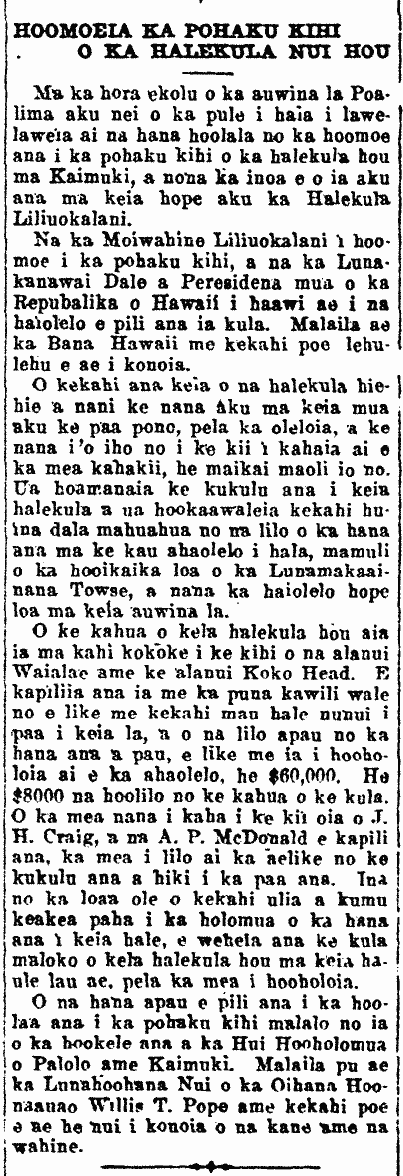
At three o’clock on the afternoon of last Friday (4/12/1912), a ceremony was conducted to lay the cornerstone of the new school house in Kaimuki, that will be called hereafter, Liliuokalani School.

Queen Liliuokalani laid the cornerstone, and Legislator Dole, and former President of the Republic of Hawaii gave a speech about the school. The Hawaiian Band was there along with many invited guests.

When it is completed, this will be one of the most distinguished and beautiful schools, according to what is being said. And when you look at the artist’s rendering, it is indeed splendid. Authorization for building and funds were set aside in the previous session of the Legislature, through the efforts of Legislator Towse, and it was he that gave the final speech that afternoon.

The grounds of this school is near the corner of Waialae and Koko Head. It is being constructed of cement, like many of the great buildings being built these days. And the entire costs will be, as decided by the legislature, $60,000. $8000 was spent to purchase the land. The artist who drew the rendering was J. H. Craig. A. P. McDonald is the one doing the constructing; he received the contract to build the school to completion. Should there be no accidents or hinderances to the progress, the school will be unveiled this coming fall, as per what was decided.

Everything concerning the dedication of the cornerstone fell under the Improvement Club of Palolo and Kaimuki. Present also the head of the DOE, Willis T. Pope, as well as many men and women invited to attend.

[Although sadly this school has been closed, I hear there will be a 100th year celebration of the laying of the cornerstone to be held on the Queen Liliuokalani School grounds, on the 12th of April, with gates opening at 3:00 p. m.

See also from Chronicling America these related articles in English:

Evening Bulletin, 4/13/1912, p. 11,

Hawaiian Gazette, 4/16/1912, p. 7.

And about the actual opening of the school:

Hawaiian Gazette, 10/15/1912, p. 7.]

(Kuokoa, 4/19/1912, p. 6)

HOOMOEIA KA POHAKU KIHI O KA HALEKULA NUI HOU.

Ka Nupepa Kuokoa, Buke XLVIII, Helu 16, Aoao 6. Aperila 19, 1912.

Ad from the first issue of Kuokoa, 1861.

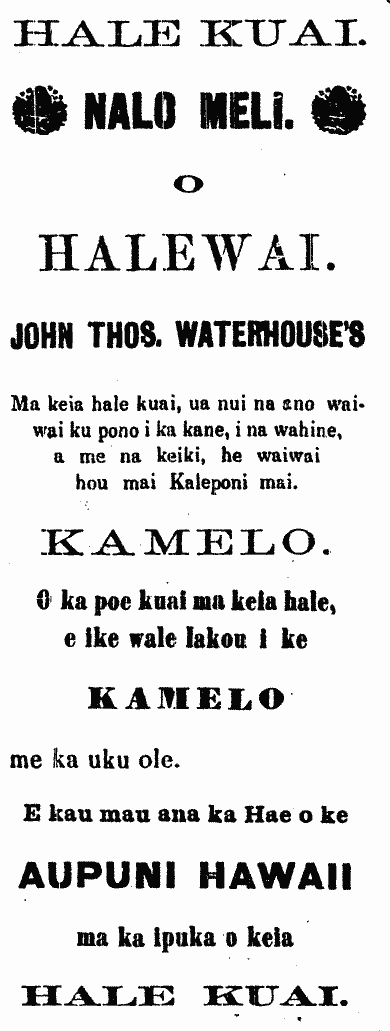
NALO MELI [Bee]

SHOP

of

HALEWAI.

JOHN THOMAS WATERHOUSE’S

At this store, there are many items for men, women, and children; new goods from California.

CAMEL

Those who make purchases from this store will see the

CAMEL

at no cost.

Always flying is the Flag of the

HAWAIIAN NATION

at the entrace of this

STORE.

[Notice how “Halewai” [lit., water house] is what they called John Thomas Waterhouse. Later for Waterhouse you will also see Walakahausi and Walakahauki.

The images to the left and right of “Nalo Meli” are of a bee hive with bees flying above it.

OH, and yes, it seems there was a camel…]

(Kuokoa, 10/1861, p. 3)

HALE KUAI.

Ka Nupepa Kuokoa, Buke I, Helu 1, Aoao 3. Okatoba, 1861.

Criticism of treatment at Baldwin Home, 1896.

Improper Acts.

Editor:

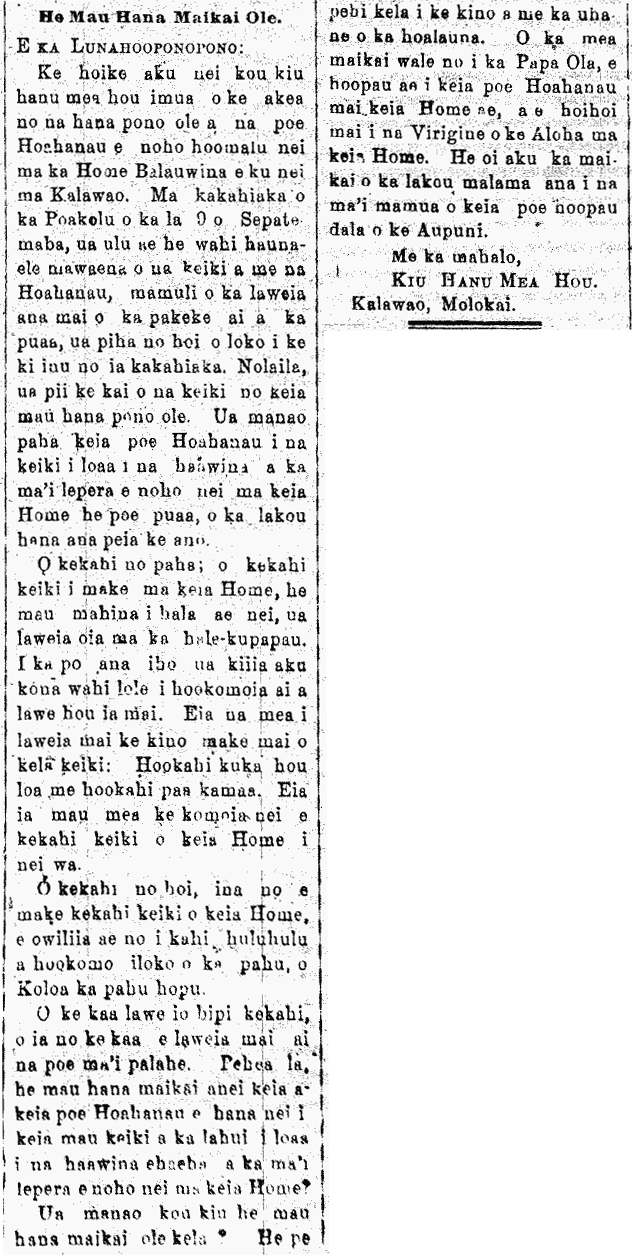
Your news-sniffing detective reports before all, the improper actions of the Brothers [Hoahanau] overseeing the Baldwin Home [Home Balauwina] in Kalawao. On Wednesday morning, the 9th of September, there was a uprising between the boys and the Brothers because the pig feed bucket was brought filled with tea to drink that morning. So the boys were incensed at that mistreatment. These Brothers must have thought that those boys inflicted with leprosy at that Home were pigs, and that is why they did that kind of thing.

Here is another thing: one of the boys who died at the Home some months ago was taken to the mortuary. That night, his clothes he was wearing were fetched. Here are the items taken from the body of the dead boy: One brand new suit, and a pair of shoes. These things are being worn now by another boy of the Home.

One more thing, if a boy of the Home dies, he is wrapped up in a blanket and put in a box and taken to Koloa [?].

The cart used to transport beef is another thing; that is the cart used to transport the patients with rotting sores. Is this something proper that the Brothers are doing to these boys of the lahui who are afflicted with this suffering from leprosy living in the Home?

Your detective believes that it is not right. It is killing the body and the soul of their neighbor. The Board of Health [Papa Ola] should remove these Brothers from the Home and return the Sisters [Viregine] of Aloha to this Home. Their care of the patients was much better than that of these people who waste the Government’s money.

With appreciation,

News-Sniffing Detective

Kalawao, Molokai.

(Makaainana, 11/9/1896, p. 3)

He Mau Hana Maikai Ole.

Ka Makaainana, Buke VI----Ano Hou, Helu 19, Aoao 3. Novemaba 9, 1896.